REVIEW 4 major objections 5 minor 1 cited by
Trainable Joint Time-Vertex Fractional Fourier Transform
T0 review · 4 major / 5 minor · reviewed 2026-08-06 · deepseek-v4-flash
Pith's one-line read This paper makes the joint time-vertex fractional Fourier transform learnable: it embeds the transform order pair (alpha, beta) and Wiener filter coefficients as trainable parameters of a neural network, optimizes them by gradient…
desk verdict The trainable JFRFT construction is sound and the differentiability math checks out, but the denoising experiments are not on equal footing: the proposed method trains and evaluates on the same signal and reports best-of-20, while GNN baselines use an 8:2 split, so the claimed superiority is unsupported. read the letter →
The pith
A machine-rendered reading of the paper's core claim, the machinery that carries it, and where it could break.
The reading
What carries the argument
The key object is the hyper-differential JFRFT operator $F_J^{\alpha,\beta} = F^\beta \otimes F_G^\alpha$, built from the hyper-differential GFRFT $F^\alpha_G = \exp(-j\alpha\pi/2 \cdot (\pi(D_G^2 + F_GD_G^2F_G^{-1}) - \tfrac12 I))$ and the discrete FRFT matrix $F^\beta$. Its role is to define a two-parameter spectral domain in which the transform orders act as continuous, differentiable controls, so that the gradient of the loss with respect to $\alpha$ and $\beta$ can be computed and the orders, together with the Wiener filter coefficients, can be optimized by backpropagation.
What would settle it
Repeat the SST, PM-2.5 or COVID experiment on a graph whose shift operator is deliberately made nearly defective, e.g. by adding a small Jordan block perturbation, and compare the learned $\alpha$, $\beta$ and output SNR against a well-conditioned graph of the same size: the paper's own limitation implies the SNR should collapse and the learned orders should become unstable.
Extended reading notes
Core claim
The central claim is that the hyper-differential form of the JFRFT, defined as the Kronecker product $F_J^{\alpha,\beta} = F^\beta \otimes F_G^\alpha$, is differentiable in both fractional orders, so $\alpha$ and $\beta$ can be learned parameters inside a neural network rather than grid-searched values. The authors prove the required derivatives $\dot{F}^\beta$ and $\dot{F}_G^\alpha$ as matrix exponentials, embed the order pair plus the diagonal Wiener filter $H$ into a model-driven network, and train all of them by backpropagation with the MSE loss. They further show that the learned orders obey index additivity across layers, and that the adaptive scheme matches or beats the grid-searched JFRFT Wiener filter while cutting complexity from $O(N^3 + N^4T^4)$ to $O(N^3 + N^2T^2)$ per epoch.
Load-bearing premise
The whole construction assumes an exact and numerically stable Jordan decomposition of the graph shift operator, which is required to define the hyper-differential GFRFT in Eq. (4); when the shift operator is nearly defective or the graph is large, that decomposition becomes ill-conditioned and the learned orders and filter output become unreliable.
Editorial extensions
If this is right
- A pipeline for denoising time-varying graph signals no longer needs a grid search over transform order pairs; the optimal pair is found by gradient descent on the data.
- The learned orders can be interpreted as data-adapted spectral coordinates: for real-world datasets the method consistently selects $\beta \approx -1$, effectively a time-reversal flip, rather than the default $\beta = 1$.
- The same trainable layer can be stacked, and the learned orders add across layers, so network depth can be traded against individual order magnitudes.
- The claimed complexity reduction from $O(N^3+N^4T^4)$ to $O(N^3+N^2T^2)$ makes the method feasible on graphs where the grid-search JFRFT is prohibitively slow.
Reading between the lines
- If the method is right, the same backpropagation scheme should transfer to other tasks where a transform order controls a trade-off between domains, such as time-vertex sampling, reconstruction, or compression, with the order pair learned from a task loss instead of a denoising loss.
- The consistent $\beta \approx -1$ outcome suggests the temporal fractional order may often be redundant or reducible to a sign flip for real data; one could test whether fixing $\beta = -1$ and learning only $\alpha$ retains most of the SNR gain.
- A natural stress test is to apply the method to graphs that are deliberately nearly defective, where the Jordan decomposition in Eq. (4) becomes ill-conditioned; the paper's own limitation list predicts the learned orders and filters would degrade there.
Signed reviews
Editorial analysis
A structured set of objections, weighed in public.
Referee Report
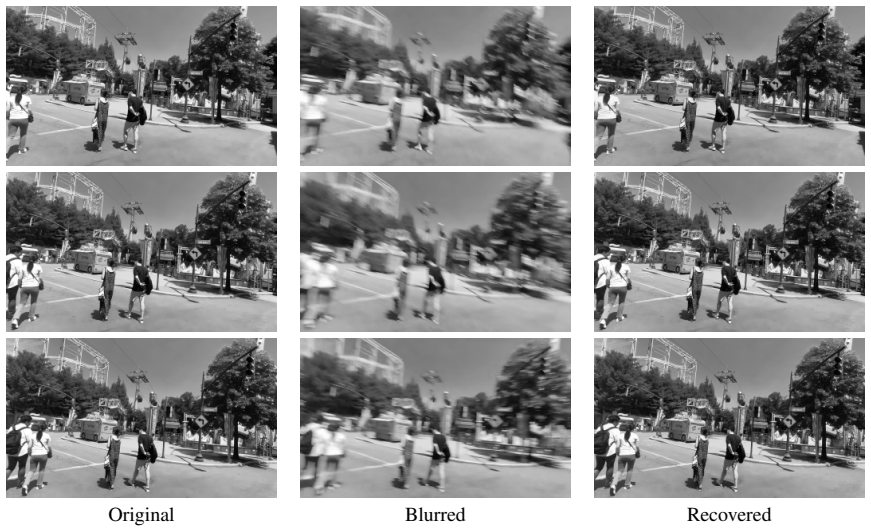
Summary. The paper defines a learnable joint time-vertex fractional Fourier transform F_J^{α,β} = F^β ⊗ F^α_G using hyper-differential GFRFT and DFRFT, proves basic algebraic properties (reduction, index additivity, commutativity, reversibility, separability), derives gradients with respect to α and β, and embeds transform order pair and diagonal filter coefficients as trainable parameters in a Wiener-filtering network. Experiments cover a transform-order learning sanity check, synthetic and real-world denoising comparisons on SST, PM-2.5 and COVID data, a REDS image enhancement illustration, and a runtime comparison with grid search. The main claimed contributions are adaptive selection of the order pair and filter coefficients without grid search, and improved denoising of time-varying graph signals.
Significance. If the empirical claims were properly supported, the contribution would be a useful model-driven alternative to grid-search JFRFT: gradient-based tuning of the order pair and Wiener coefficients is a natural and computationally attractive extension of earlier trainable GFRFT work. The differentiability calculation in Eqs. (16)-(17) is correct but elementary, and the property proofs are straightforward. The paper also provides a transparency-strengthening artifact: a public code repository link and an explicit limitation list. However, as reported, the denoising experiments do not support the paper's superiority claim because of the training/evaluation protocol mismatch. The theoretical contribution is sound and incremental; the empirical claim is the load-bearing part that needs rework.
major comments (4)
- [Algorithm 3; Tables 3-5] The comparison is not on equal footing. In Algorithm 3, for each of 20 runs the network is trained on the full noisy signal Y and the SNR is computed on the output for that same signal, then the maximum over runs is stored (SNRmax, lines 7-29). In contrast, the GNN baselines are explicitly trained on an 8:2 temporal split with a held-out test set of 60 time points ('the test set contains data from 60 time points that need to be denoised'). Thus the reported JFRFT-learn numbers are best-of-20 training-set SNR values, while the GNN numbers are held-out test SNR values. Since the central claim is that the proposed method 'consistently outperforms' other methods, this protocol cannot support that claim. A fair evaluation should use a held-out temporal or vertex split for the proposed method and report mean and standard deviation over initializations rather than the maximum.
- [Section 4.2.2; Table 2] The synthetic overlap=0 results, with SNR around 130 dB and MSE near 10^-14 for Hfixed and 10^-9 for Hlearn, are self-recovery checks rather than denoising results: the clean signal is generated by the same transform family at (0.55,0.45), and the 'high-frequency' noise is generated in the same JFRFT domain. This demonstrates that the optimizer can invert the transform when the model class contains the true signal, which is a useful sanity check, but it does not show that the method denoises unseen noise. The paragraph describing Table 2 should be reworded to separate this identifiability check from the denoising claim.
- [Eq. (4); Section 5, limitation 1] The construction relies on an exact and numerically stable Jordan decomposition of the graph shift operator to form log(F_G) and the matrix exponentials in Eqs. (16)-(17). The paper acknowledges in its limitation list that 'for large-scale graphs or when the shift operator is nearly defective, numerical instability during decomposition may adversely affect the filtering performance.' This is not merely a caveat: it limits the applicability of the core model, and the experiments in Tables 3-5 use small k-NN graphs whose shift operators are well-behaved. The robustness claims should be scoped accordingly, and a small experiment on a defective or nearly defective shift operator would make the limitation concrete.
- [Section 4.2.2; Table 8] The computational-efficiency claim is plausible asymptotically, but the reported wall-clock numbers are not internally consistent. In Section 4.2.2 the text states that the learnable JFRFT training 'takes less than a minute,' while Table 8 reports 990 s for JFRFT-learn at N=10, T=10. The reader cannot tell whether the 990 s includes 20 repeated runs, 10,000 epochs each, or whether the minute is for a single run at a different scale. The runtime column should state the exact protocol used for the timing measurement.
minor comments (5)
- [Table 1; Section 4.1] The text states that the original transform order pair is (0.55,0.45) and (1.55,1.45), but Table 1's row header reads (0.45,0.55) and the first block learns (0.4500,0.5500); the notation should be made consistent.
- [Eq. (15)] The separability property as written, F_J^{α,β} = F_G^α F^β, mixes operators acting on different dimensions without specifying the action on a matrix signal; writing the identity with the Kronecker structure or with an explicit matrix action would avoid ambiguity.
- [Algorithm 2] Lines 21-30 update α, β and H inside the epoch loop, but line 32 says to 'compute new Y0' and update the same parameters again; the pseudo-code should distinguish forward evaluation from parameter updates to avoid redundant or contradictory steps.
- [Section 2.1; Section 4.2.1] Equation (23) uses G_G for the graph transform, which clashes with the graph notation G = (V,A); using distinct symbols for the graph and the transform matrix would improve readability.
- [Section 3.1] The proof of index additivity in Eq. (12) uses the commutativity of the temporal DFRFT matrices F^{β1} and F^{β2}; this commutativity holds for the eigen-decomposition definition and should be stated explicitly.
Circularity Check
The JFRFT construction and differentiability derivation are self-contained; the claimed denoising superiority, however, compares an in-sample best-of-20 training SNR with held-out GNN test SNRs, making the performance claim a fitted value rather than a prediction.
-
fitted input called prediction
[Section 4.2.2, Algorithm 3 (steps 25-29) and the GNN-baseline paragraph before Tables 3-5]
"We select 10 vertices and 60 time points in the dataset ... The network is then trained for 10,000 epochs ... repeated over 20 independent runs to obtain the optimal result ... We select data ... 10 vertices and 300 time points, and split it into training and test sets in an 8:2 ratio, where the test set contains data from 60 time points ... Compute SNR from the output of the current experiment ... Store maximum SNR from 20 experiments: SNRmax = max(SNR1, SNR2,..., SNR20)."
Algorithm 3 trains alpha, beta and the diagonal filter H on the full noisy input Y, then computes SNR on the same filtered output Y0 and keeps only the maximum over 20 restarts; with N=10, T=60, Hlearn has NT=600 free coefficients, so the reported SNR is a best-case training MSE expressed in dB. The GNN baselines are trained on 240 time points and evaluated on a separate 60-time-point test set. Tables 3-5 therefore compare a best-of-20 in-sample fit, with a heavily overparameterized diagonal filter, against out-of-sample predictions. The conclusion that the proposed method 'consistently outperforms' is forced by the evaluation protocol: the reported JFRFT-learn numbers are fitted values, not denoising predictions on unseen data.
full rationale
The mathematical derivation is not circular. Section 3 defines the learnable JFRFT as a Kronecker product F^{alpha,beta}_J = F^beta (x) F^alpha_G, proves the group-like properties from the factors, and obtains the order derivatives in Eqs. (16)-(17) by direct differentiation of matrix exponentials. These steps do not presuppose any experimental result. The single self-citation [8] (D. Wei and Z. Yan) appears only in a background enumeration of GFRFT developments and is not load-bearing. The transform-learning and synthetic denoising experiments are self-referential sanity checks, since targets and noise are generated in the same JFRFT family at known orders, but they do not enter the derivation chain and I do not count them as circular. The circularity is confined to the empirical superiority claim: Algorithm 3 reports the training objective as the denoising SNR, best of 20, while GNN baselines are held out, so the 'consistently outperforms' conclusion reduces to comparing a fit with a prediction. This is partial circularity of the performance claim, not of the theory.
Assumptions & free parameters
free parameters (3)
- alpha =
learned via backpropagation (e.g., 0.45, 1.45 in transform learning)
- beta =
learned via backpropagation (e.g., 0.55, 1.55 in transform learning)
- diagonal filter coefficients h_i =
initialized to 1, learned to minimize MSE loss
assumptions (4)
- domain assumption The graph shift operator Z admits a Jordan decomposition Z = V J V^{-1} and the GFT matrix F_G = V^{-1} is well-defined.
- standard math The hyper-differential and fractional-power definitions of the GFRFT are equivalent.
- standard math The DFRFT matrix F^beta defined via hyper-differential operators is differentiable with respect to beta.
- domain assumption Time-varying graph signals are K-L bandlimited in the (alpha, beta) domain.
Cite this review
Pith. "Pith review of Trainable Joint Time-Vertex Fractional Fourier Transform." pith.science (2026). https://pith.science/paper/LK546IKH
@misc{pith2026250721527,
  author       = {Pith},
  title        = {Pith review of: Trainable Joint Time-Vertex Fractional Fourier Transform},
  year         = {2026},
  howpublished = {\url{https://pith.science/paper/LK546IKH}},
  note         = {Machine review of arXiv:2507.21527}
}
read the original abstract
To address limitations of the graph fractional Fourier transform (GFRFT) Wiener filtering and the traditional joint time-vertex fractional Fourier transform (JFRFT) Wiener filtering, this study proposes a filtering method based on the hyper-differential form of the JFRFT. The gradient backpropagation mechanism is employed to enable the adaptive selection of transform order pair and filter coefficients. First, leveraging the hyper-differential form of the GFRFT and the fractional Fourier transform, the hyper-differential form of the JFRFT is constructed and its properties are analyzed. Second, time-varying graph signals are divided into dynamic graph sequences of equal span along the temporal dimension. A spatiotemporal joint representation is then established through vectorized reorganization, followed by the joint time-vertex Wiener filtering. Furthermore, by rigorously proving the differentiability of the transform orders, both the transform orders and filter coefficients are embedded as learnable parameters within a neural network architecture. Through gradient backpropagation, their synchronized iterative optimization is achieved, constructing a parameters-adaptive learning filtering framework. This method leverages a model-driven approach to learn the optimal transform order pair and filter coefficients. Experimental results indicate that the proposed framework improves the time-varying graph signals denoising performance, while reducing the computational burden of the traditional grid search strategy.
Figures


Figures from the paper (2 more)

Forward citations
Cited by 1 Pith paper
-
JFRFFNet: A Data-Model Co-Driven Graph Signal Denoising Model with Partial Prior Information
JFRFFNet learns the transform orders and filter weights of a joint time-vertex fractional Fourier transform from clean/noisy training pairs, reporting higher output SNR than ten graph baselines on eight datasets.
Reference graph
Works this paper leans on
-
[1]
D. I Shuman, S. Narang, P. Frossard, A. Ortega, P. Vandergheynst, The emerging field of signal processing on graphs: Extending high dimensional data analysis to networks and other irregular domains, IEEE Signal Processing Magazine 30 (2013) 83–98
work page 2013
-
[2]
A. Sandryhaila, J. M. Moura, Big data analysis with signal processing on graphs: Representation and pro- cessing of massive data sets with irregular structure, IEEE Signal Processing Magazine 31 (2014) 80–90
work page 2014
- [3]
-
[4]
L. Stankovic, D. Mandic, M. Dakovic, M. Brajovic, B. Scalzo, T. Constantinides, Graph signal processing – Part I: Graphs, graph spectra, and spectral clustering (2019). arXiv:1907.03467
arXiv 2019
-
[5]
F. Yan, B. Li, Windowed fractional Fourier transform on graphs: Properties and fast algorithm, Digital Signal Processing 118 (2021) 103210
work page 2021
-
[6]
F. Yan, W. Gao, B. Li, Windowed fractional Fourier transform on graphs: Fractional translation operator and hausdorff-young inequality, 2020 Asia-Pacific Signal and Information Processing Association Annual Summit and Conference (APSIPA ASC) (2020) 255–259
work page 2020
-
[7]
F. Yan, B. Li, Spectral graph fractional Fourier transform for directed graphs and its application, Signal Processing 210 (2023) 109099
work page 2023
-
[8]
D. Wei, Z. Yan, Generalized sampling of graph signals with the prior information based on graph fractional Fourier transform, Signal Processing 214 (2024) 109263
work page 2024
Show all 43 references
-
[9]
D. Wei, S. Yuan, Hermitian random walk graph Fourier transform for directed graphs and its applications, Digital Signal Processing 155 (2024) 104751
2024
-
[10]
Y . Wang, B. Li, Q. Cheng, The fractional Fourier transform on graphs, 2017 Asia-Pacific Signal and Infor- mation Processing Association Annual Summit and Conference (APSIPA ASC) (2017) 105–110. 33
2017
-
[11]
Alikas ¸ifo˘glu, B
T. Alikas ¸ifo˘glu, B. Kartal, A. Koc ¸, Graph fractional Fourier transform: A unified theory, IEEE Transactions on Signal Processing 72 (2024) 3834–3850
2024
-
[12]
Loukas, D
A. Loukas, D. Foucard, Frequency analysis of time-varying graph signals, 2016 IEEE Global Conference on Signal and Information Processing (GlobalSIP) (2016) 346–350
2016
-
[13]
Stankovi ´c, D
L. Stankovi ´c, D. Mandic, M. Dakovi ´c, B. Scalzo, M. Brajovi ´c, E. Sejdi ´c, A. G. Constantinides, Vertex- frequency graph signal processing: A comprehensive review, Digital Signal Processing 107 (2020) 102802
2020
-
[14]
K. Qiu, X. Mao, X. Shen, X. Wang, T. Li, Y . Gu, Time-varying graph signal reconstruction, IEEE Journal of Selected Topics in Signal Processing 11 (2017) 870–883
2017
-
[15]
X. Mao, Y . Gu, Time-varying graph signals reconstruction, Springer International Publishing (2018) 293– 316
2018
-
[16]
J. H. Giraldo, T. Bouwmans, On the minimization of sobolev norms of time-varying graph signals: Estimation of new coronavirus disease 2019 cases, 2020 IEEE 30th International Workshop on Machine Learning for Signal Processing (MLSP) (2020) 1–6
2020
-
[17]
Perraudin, A
N. Perraudin, A. Loukas, F. Grassi, P. Vandergheynst, Towards stationary time-vertex signal processing, 2017 IEEE International Conference on Acoustics, Speech and Signal Processing (ICASSP) (2017) 3914–3918
2017
-
[18]
Loukas, N
A. Loukas, N. Perraudin, Stationary time-vertex signal processing (2019). arXiv:1611.00255
2019 arXiv
-
[19]
Alikas ¸ifo˘glu, B
T. Alikas ¸ifo˘glu, B. Kartal, E. ¨Ozg¨unay, A. Koc ¸, Joint time-vertex fractional Fourier transform, Signal Pro- cessing 233 (2025) 109944
2025
-
[20]
Sandryhaila, J
A. Sandryhaila, J. M. F. Moura, Discrete signal processing on graphs: Graph filters, 2013 IEEE International Conference on Acoustics, Speech and Signal Processing (2013) 6163–6166
2013
-
[21]
Gavili, X
A. Gavili, X. Zhang, On the shift operator, graph frequency, and optimal filtering in graph signal processing, IEEE Transactions on Signal Processing 65 (2017) 6303–6318
2017
-
[22]
Ozturk, H
C. Ozturk, H. M. Ozaktas, S. Gezici, A. Koc ¸, Optimal fractional Fourier filtering for graph signals, IEEE Transactions on Signal Processing 69 (2021) 2902–2912
2021
-
[23]
Alikas ¸ifo˘glu, B
T. Alikas ¸ifo˘glu, B. Kartal, A. Koc ¸, Wiener filtering in joint time-vertex fractional Fourier domains, IEEE Signal Processing Letters 31 (2024) 1319–1323
2024
-
[24]
Sandryhaila, J
A. Sandryhaila, J. Moura, Discrete signal processing on graphs, IEEE Transactions on Signal Processing 61 (2013) 1644–1656
2013
-
[25]
Y . Wang, B. Li, The fractional Fourier transform on graphs: Sampling and recovery, 2018 14th IEEE Inter- national Conference on Signal Processing (ICSP) (2018) 1103–1108
2018
-
[26]
Zhang, B
Y . Zhang, B. Li, Discrete linear canonical transform on graphs, Digital Signal Processing 135 (2023) 103934
2023
-
[27]
J. Y . Chen, Y . Zhang, B. Z. Li, Graph linear canonical transform: Definition, vertex-frequency analysis and filter design, IEEE Transactions on Signal Processing 72 (2024) 5691–5707
2024
-
[28]
J. Ma, Y . Yang, R. Tao, G. Li, C. Gao, Spectrum analysis for nonuniform sampling of bandlimited and multiband signals in the fractional Fourier domain, Signal Processing 222 (2024) 109539
2024
-
[29]
Candan, M
C. Candan, M. Kutay, H. Ozaktas, The discrete fractional Fourier transform, IEEE Transactions on Signal 34 Processing 48 (2000) 1329–1337
2000
-
[30]
Koc ¸, H
A. Koc ¸, H. M. Ozaktas, Operator theory-based computation of linear canonical transforms, Signal Processing 189 (2021) 108291
2021
-
[31]
Koc ¸, B
A. Koc ¸, B. Bartan, H. M. Ozaktas, Discrete linear canonical transform based on hyperdifferential operators, IEEE Transactions on Signal Processing 67 (2019) 2237–2248
2019
-
[32]
R. Tao, B. Deng, W. Zhang, Y . Wang, Sampling and sampling rate conversion of band limited signals in the fractional Fourier transform domain, IEEE Transactions on Signal Processing 56 (2008) 158–171
2008
-
[33]
Sharma, S
K. Sharma, S. Joshi, Fractional Fourier transform of bandlimited periodic signals and its sampling theorems, Optics Communications 256 (2005) 272–278
2005
-
[34]
Sheng, H
H. Sheng, H. Feng, J. Yu, F. Ji, B. Hu, Sampling theory of jointly bandlimited time-vertex graph signals, Signal Processing 222 (2024) 109522
2024
-
[35]
A. G. Marques, S. Segarra, G. Leus, A. Ribeiro, Sampling of graph signals with successive local aggregations, IEEE Transactions on Signal Processing 64 (2016) 1832–1843
2016
-
[36]
S. Chen, R. Varma, A. Sandryhaila, J. Kova ˇcevi´c, Discrete signal processing on graphs: Sampling theory, IEEE Transactions on Signal Processing 63 (2015) 6510–6523
2015
-
[37]
J. Shi, J. M. F. Moura, Graph signal processing: Dualizing GSP sampling in the vertex and spectral domains, IEEE Transactions on Signal Processing 70 (2022) 2883–2898
2022
-
[38]
Koc ¸, T
E. Koc ¸, T. Alikas ¸ifo˘glu, A. C. Aras, A. Koc ¸, Trainable fractional Fourier transform, IEEE Signal Processing Letters 31 (2024) 751–755
2024
-
[39]
Isufi, A
E. Isufi, A. Loukas, A. Simonetto, G. Leus, Autoregressive moving average graph filtering, IEEE Transac- tions on Signal Processing 65 (2017) 274–288
2017
-
[40]
D. B. Tay, J. Jiang, Time-varying graph signal denoising via median filters, IEEE Transactions on Circuits and Systems II: Express Briefs 68 (2021) 1053–1057
2021
-
[41]
T. N. Kipf, M. Welling, Semi-supervised classification with graph convolutional networks (2017). arXiv:1609.02907
2017 arXiv
-
[42]
Veli ˇckovi´c, G
P. Veli ˇckovi´c, G. Cucurull, A. Casanova, A. Romero, P. Li `o, Y . Bengio, Graph attention networks (2018). arXiv:1710.10903
2018 arXiv
-
[43]
De fferrard, X
M. De fferrard, X. Bresson, P. Vandergheynst, Convolutional neural networks on graphs with fast localized spectral filtering, in: Proc. the 30th International Conference on Neural Information Processing Systems (NeurIPS), no. 9, 2016, p. 3844–3852. 35
2016
Reviewed August 6, 2026 · model on record in the stance chip above.
Discussion (0). Continue with ORCID to comment.