REVIEW 2 major objections 5 minor 9 references
Solid bricks that every $b$-invariant edge is solitary
T0 review · 2 major / 5 minor · reviewed 2026-08-06 · deepseek-v4-flash
Pith's one-line read Theorem: for a solid brick G other than K4, every b-invariant edge of G is solitary exactly when G is a wheel W_n.
desk verdict Clean characterization of solid bricks with all b-invariant edges solitary, but the cubic case rests on an unverified external classification. read the letter →
The pith
A machine-rendered reading of the paper's core claim, the machinery that carries it, and where it could break.
The reading
What carries the argument
The carrying object is the alternating path P obtained as the symmetric difference G[M1 ∆ M2] of the two unique perfect matchings M1 and M2 that belong to two solitary edges uu1 and uu2 at a vertex u of degree at least four. Since each Mi is the unique perfect matching of G - {u, ui}, any M1- or M2-alternating cycle in the relevant graph would contradict uniqueness. The solidity of G then acts as a global constraint: it forbids pairs of vertex-disjoint odd cycles that leave a perfect matching behind, which is exactly what rules out alternative routes from the path into the rest of the graph. Repeatedly applying this constraint forces all vertices outside the path to attach to u and to each other only along the path, yielding the rim of a wheel.
What would settle it
Enumerate all solid bricks on 6 to 12 vertices, compute for each graph the set of b-invariant edges and the number of perfect matchings containing each; the theorem predicts that the only graphs whose b-invariant edges each lie in exactly one perfect matching are the wheels W_6, W_8, W_10 and W_12. Any other solid brick found with this property would refute the theorem.
Extended reading notes
Core claim
The paper proves Theorem 1.3: for a solid brick G of order n distinct from K4, every b-invariant edge of G is solitary if and only if G is a wheel W_n. The necessity argument assumes the solitary-edge property, first rules out cubic bricks by appealing to an external classification theorem that says the only cubic bricks with the property are nonsolid, and then treats a vertex u of degree at least four. Two solitary edges incident to u supply two unique perfect matchings; their symmetric difference forms an alternating path. The bulk of the proof uses the solidity of G to forbid alternating cycles and paths that would violate the uniqueness of these matchings, gradually forcing every remaining vertex to lie on a single cycle C whose vertices are all adjacent to u. With no vertices left outside C ∪ {u}, G is a wheel.
Load-bearing premise
The proof that cubic solid bricks cannot satisfy the property is not proved here; it rests entirely on a classification theorem from another paper, so the main theorem inherits the correctness of that external result.
Editorial extensions
If this is right
- A solid brick other than K4 is a wheel exactly when all its b-invariant edges are solitary, so the two properties coincide inside the solid class.
- Outside wheels, every solid brick has at least one b-invariant edge that belongs to two or more perfect matchings.
- The nonsolid graphs that satisfy the solitary condition, such as those appearing in the cubic classification, are essential: none of them can be solid.
- The proof's alternating-path decomposition provides a reusable local-to-global argument for classifying solid bricks by matching uniqueness.
Reading between the lines
- The same technique may characterize solid bricks in which all but a bounded number of b-invariant edges are solitary; the proof only needs two solitary incident edges at a high-degree vertex to get started.
- If the external cubic classification were extended to cubic braces or near-bricks, the main theorem's necessity proof would become self-contained for the cubic case.
- A computational check over solid bricks up to moderate order would test the theorem's edge cases, since the structural lemmas suggest the wheel is the unique extremal shape.
Editorial analysis
A structured set of objections, weighed in public.
Referee Report
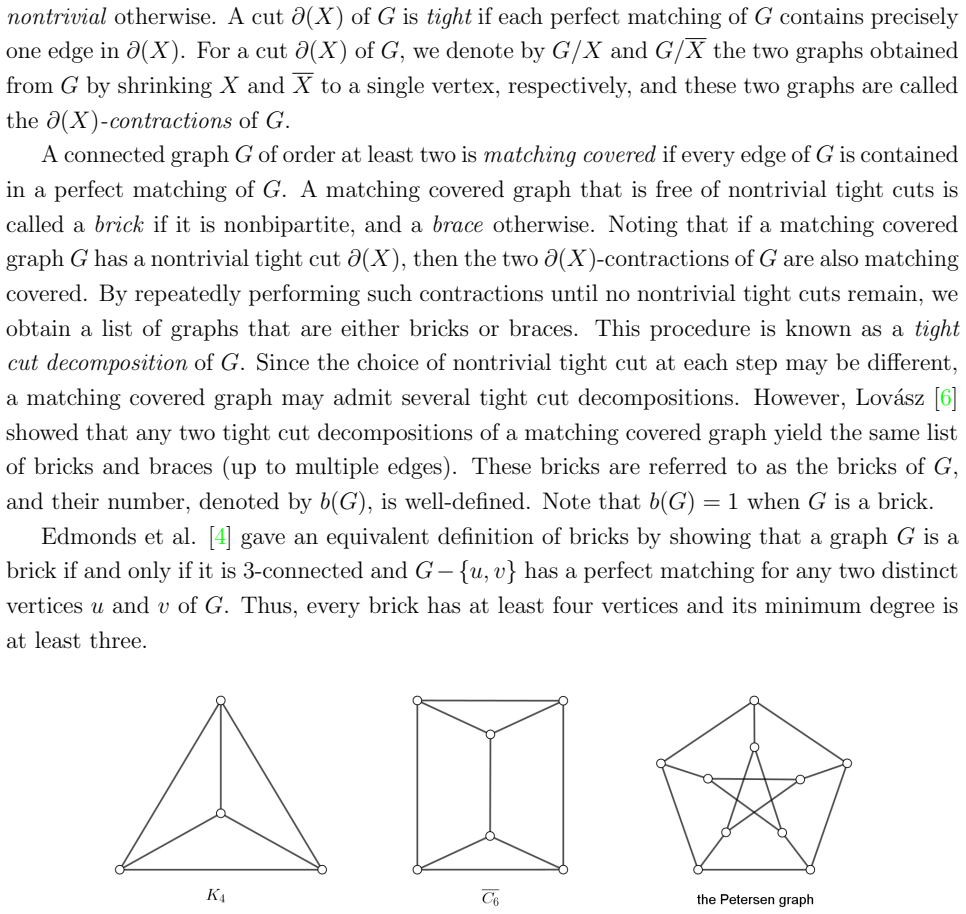
Summary. The paper studies the Lucchesi-Murty problem of characterizing bricks, other than K4, \overline{C6}, and the Petersen graph, in which every b-invariant edge is solitary. The main result, Theorem 1.3, states that for a solid brick G of even order n other than K4, every b-invariant edge of G is solitary if and only if G is a wheel W_n. The sufficiency is proved in Lemma 2.4. The necessity proof splits into a cubic and a non-cubic case. In the non-cubic case the paper selects a vertex u of degree at least 4, uses the uniqueness of the two perfect matchings of G-{u,u1} and G-{u,u2}, analyzes their symmetric difference as an alternating path P, and then uses a sequence of lemmas (3.1-3.7) to force every vertex of a certain cycle C to have degree 3 and to be adjacent to u, yielding the wheel structure. In the cubic case the proof invokes Theorem 1.2 from reference [9], an external classification of cubic bricks with the same solitary-edge property.
Significance. If the proof is completed, the paper gives a clean structural characterization inside the class of solid bricks: the property that all b-invariant edges are solitary is a complete fingerprint for even wheels. The main contribution is the self-contained alternating-path analysis of the non-cubic case, which appears plausible and uses standard matching-theoretic tools. The paper makes progress on a problem from Lucchesi and Murty's book and identifies exactly where the cubic case needs external input. The main caveats are that the cubic case depends entirely on an unreviewed arXiv preprint by overlapping authors, and that several solidity contradictions are asserted rather than demonstrated. These are load-bearing issues, but they do not appear to require changing the overall strategy.
major comments (2)
- [§3, first paragraph (necessity)] The entire cubic branch of the necessity proof is outsourced to Theorem 1.2 of [9]. The proof argues that if G has no vertex of degree at least 4, then G is a cubic brick, and Theorem 1.2 is invoked to conclude G belongs to the family G; the additional assertion that every graph in G is nonsolid (only stated in the Introduction as 'easily seen') then yields the contradiction. No proof of Theorem 1.2 is included, and [9] is an arXiv preprint by overlapping authors. Since Theorem 1.3 covers all solid bricks, this external classification is load-bearing: if [9] contains a gap, the theorem is unproved for every cubic solid brick. The authors should either provide a self-contained proof of the cubic case, include a complete proof of Theorem 1.2 as an appendix, or restrict the statement of Theorem 1.3 to non-cubic solid bricks.
- [§3, Lemma 3.4 (Claims 1 and 2) and Lemmas 3.5–3.7] The solidity contradictions in the proof of Lemma 3.4 are asserted rather than demonstrated. For example, in Claim 1 the proof says 'one can obtain that C1 and C2 are two vertex disjoint odd cycles of G such that G − (V(C1) ∪ V(C2)) has a perfect matching,' and similar statements appear in Claim 2 for C1,C3 and later for C1,C5. Since the whole point is to violate solidity, the perfect matching in the complement of two explicitly constructed odd cycles must be exhibited or its existence argued step by step. This is not a cosmetic omission: these claims are the only places where the hypothesis that G is solid is used to force the alternating-path structure. Please supply the matchings, or at least a uniform argument showing that one of M1 or M2 (or a fixed alternating-path matching) avoids both cycles.
minor comments (5)
- [Abstract] The abstract writes 'C6' where the text elsewhere uses '\overline{C6}'; the overline is missing. Also 'everyb-invariant edge' is missing a space.
- [§2, notation] The definition of N(X) reads 'the set of all the vertices in X that have one neighbour in X', which is garbled; presumably it should say the vertices outside X that have a neighbour in X, or something equivalent. Please correct.
- [§3, Lemma 3.4] The three subgraphs F1, F2, F3 are defined almost entirely through Figure 3; the verbal description is too terse. A reader cannot check the case analysis without reconstructing the figure from the text. Please list the edge sets of F1, F2, F3 explicitly.
- [Introduction] The assertion that every graph in the family G is nonsolid is stated as 'easily seen' but no verification is provided. Since this fact is used in the cubic case, either add a short proof or give an explicit reference to where it is established.
- [Theorem 1.3 and Lemma 2.4] The theorem states 'G is a wheel W_n' without specifying parity; since W_n is a brick only for even n (and W_4 = K_4 is excluded), the statement should clarify that n is even. Lemma 2.4 already assumes n even.
Circularity Check
No circular reduction; the cubic branch relies on an external classification, which is a verification risk rather than a circularity.
full rationale
The claimed derivation chain is not circular. The main theorem splits into two cases. In the non-cubic case, the proof is self-contained: starting from a vertex u of degree at least four, the paper uses the uniqueness of the two perfect matchings and constructs the alternating path P, then a sequence of lemmas (3.2-3.7) forces every vertex of the cycle C to be adjacent only to u, yielding the wheel. The input hypotheses (solid brick, every b-invariant edge solitary, Lemmas 2.1-2.3 from published independent sources) are not equivalent to the conclusion. In the cubic case, the paper invokes Theorem 1.2 of [9], an arXiv preprint by overlapping authors, to conclude that a cubic brick with the property belongs to the family G, and then uses the observation that each graph in G is nonsolid. This is a real external dependency: the entire cubic branch rests on Theorem 1.2, whose proof is not reproduced. However, this is not circular: Theorem 1.2 is a separate classification of all cubic bricks (not only solid ones) with the same b-invariant-solitary property; it is a proper specialization, not a restatement or a by-construction equivalent of Theorem 1.3. It is also externally checkable. The missing re-proof is a verification/correctness risk, not a circularity. No fitted parameters, no definition smuggling, and no renaming occur; the statement is not assumed.
Assumptions & free parameters
assumptions (4)
- standard math Tight cut decomposition theorem of Lovász: any two tight cut decompositions of a matching covered graph yield the same multiset of bricks and braces.
- standard math Lemma 2.1: in a solid brick, every removable edge is b-invariant (Carvalho, Lucchesi, Murty).
- standard math Lemma 2.2: if G is a solid brick with at least six vertices, every vertex is incident with at most two nonremovable edges (Carvalho, Lucchesi, Murty).
- domain assumption Theorem 1.2: characterization of cubic bricks, other than K4, complement of C6, and the Petersen graph, in which every b-invariant edge is solitary (Zhang, Lu, Zhang).
Cite this review
Pith. "Pith review of Solid bricks that every $b$-invariant edge is solitary." pith.science (2026). https://pith.science/paper/OSLOFVQC
@misc{pith2026250721565,
  author       = {Pith},
  title        = {Pith review of: Solid bricks that every $b$-invariant edge is solitary},
  year         = {2026},
  howpublished = {\url{https://pith.science/paper/OSLOFVQC}},
  note         = {Machine review of arXiv:2507.21565}
}
abstract
A graph $G$ is a brick if it is 3-connected and $G-\{u,v\}$ has a perfect matching for any two distinct vertices $u$ and $v$ of $G$. A brick $G$ is solid if for any two vertex disjoint odd cycles $C_1$ and $C_2$ of $G$, $G-(V(C_1)\cup V(C_2))$ has no perfect matching. Lucchesi and Murty proposed a problem concerning the characterization of bricks, distinct from $K_4$, $\overline{C_6}$ and the Petersen graph, in which every $b$-invariant edge is solitary. In this paper, we show that for a solid brick $G$ of order $n$ that is distinct from $K_4$, every $b$-invariant edge of $G$ is solitary if and only if $G$ is a wheel $W_n$.
Figures


Reference graph
Works this paper leans on
-
[9]
Y.X Zhang, F.L Lu and H.P Zhang, Cubic bricks that every b-invariant edge is forcing, arXiv:2411.17295. 12
-
[1]
Bondy, U.S.R
J.A. Bondy, U.S.R. Murty, Graph Theory, Springer-Verlag, Berlin, 2008
2008
-
[2]
M.H. Carvalho, C.L. Lucchesi, U.S.R. Murty, On a conjecture of Lov´ asz concerning bricks. I. The characteristic of a matching covered graph, J. Combin. Theory Ser. B 85 (2002) 94-136
work page 2002
-
[3]
M.H. Carvalho, C.L. Lucchesi, U.S.R. Murty, A generalization of Little’s Theorem on Pfaffian orientations, J. Combin. Theory Ser. B 102 (2012) 1241-1266
work page 2012
-
[4]
J. Edmonds, L. Lov´ asz, W.R. Pulleyblank, Brick decompositions and the matching rank of graphs, Combinatorica 2 (1982) 247-274. 11
work page 1982
-
[5]
N. Kothari, M.H. Carvalho, C.L. Lucchesi, C.H.C. Little, On essentially 4-edge-connected cubic bricks, Electron. J. Combin. 27 (2020) #P1.22
work page 2020
-
[6]
Lov´ asz, Matching structure and the matching lattice, J
L. Lov´ asz, Matching structure and the matching lattice, J. Combin. Theory Ser. B 43 (1987) 187-222
work page 1987
-
[7]
F.L. Lu, X. Feng, Y. Wang, b-invariant edges in essentially 4-edge-connected near-bipartite cubic bricks, Electron. J. Combin. 27 (2020) #P1.55
work page 2020
Show all 9 references
-
[8]
Lucchesi, U.S.R
C.L. Lucchesi, U.S.R. Murty, Perfect Matchings. Springer, 2024
2024
Reviewed August 6, 2026 · model on record in the stance chip above.
Discussion (0). Continue with ORCID to comment.