REVIEW 4 major objections 5 minor 1 cited by
Does magnetic field promote or suppress fragmentation in AGN disks? Results from local shearing box simulations with simple cooling
T0 review · 4 major / 5 minor · reviewed 2026-08-06 · deepseek-v4-flash
Pith's one-line read Magnetic fields suppress fragmentation in AGN disks: once magnetically dominated (plasma beta below $10^3$), bound clumps and gravitational stress drop as magnetic elevation raises the Toomre parameter, overwhelming the CRMG instability.
desk verdict A careful local simulation study that gives a plausible answer—magnetic fields suppress fragmentation in these idealized AGN disks—but the zonal-flow caveat keeps the lowest-β0 points on shaky ground. read the letter →
The pith
A machine-rendered reading of the paper's core claim, the machinery that carries it, and where it could break.
The reading
What carries the argument
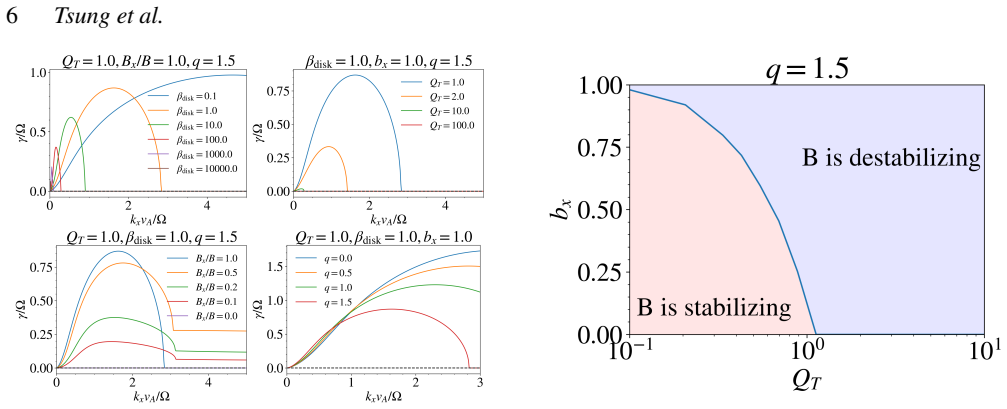
The argument is carried by two named mechanisms and a numerical procedure. First, the Coriolis-Restricted-Magneto-Gravitational (CRMG) instability: an axisymmetric WKB mode of a rotating, shearing, self-gravitating disk with an in-plane magnetic field, governed by a quartic dispersion relation (eqs. C20–C21). Its physical content is that magnetic tension acting through a radial field component $b_x$ restricts the Coriolis-driven expansion of an overdense region, so collapse can proceed even when the standard Toomre parameter exceeds unity; the growth rate rises for stronger fields and for more radial field orientation, and destabilization requires $b_x$ above a threshold set by $Q_T$ (Fig. 4). Second, magnetic elevation: the vertical pressure of the MRI-saturated toroidal field supports the disk column and evacuates the mid-plane, and the paper quantifies the effect through the mid-plane density, plasma beta, scale height, and Toomre parameter before evaluating the CRMG growth rate from the measured states. Third, the clump census: an extension of the GRID-core algorithm that identifies Gravitational Binding Regions (GBR) and Total Binding Regions (TBR), yielding the bound mass fraction used as the fragmentation diagnostic.
What would settle it
A decisive check is to rerun the strong-field cases ($\beta_0 = 10$ and $10^2$, same cooling) in a domain wide enough for the zonal-flow channels to form at their natural spacing, or in a global disk geometry with net vertical flux, and measure the bound mass fraction: if clumps reappear at the level of the weakly magnetized runs (bound fraction $\gtrsim 10^{-2}$), the elevation-only suppression story is over-stated. A complementary observational probe is to search for in-situ-formed star clusters or compact-object binaries in AGN disk regions whose accretion state implies a mid-plane plasma $\beta$ below unity.
Extended reading notes
Core claim
The paper's answer to its title question is that magnetic field suppresses fragmentation in AGN disks, once the saturated field makes the disk magnetically dominated. The key evidence is the bound mass fraction — the share of gas locked in self-gravitating clumps, found by a clump-finding algorithm — which drops by roughly a factor of 10 between $\beta_0 = 10^4$ and $10^3$ and reaches zero (no identified clumps) at $\beta_0 = 10$ and $10^2$, while volume-averaged gravitational stress falls from $\langle\alpha_G\rangle_t \sim 0.13$ to $\sim 0.001$. The mechanism is magnetic elevation: the MRI-dynamo sustains a strong toroidal field whose pressure thickens the disk (the measured scale height grows roughly 16-fold between $\beta_0 = 10^5$ and $10$, while the thermal scale height grows only 2.8-fold), evacuates the mid-plane, and raises the proxy Toomre parameter from $\langle Q\rangle_t \sim 0.6$ to $\sim 7.7$. Feeding the time-averaged mid-plane states into the CRMG dispersion relation, the authors find that the most unstable growth rate drops by close to an order of magnitude as $\beta_0$ decreases from $10^5$ to $10$, reaching $\gamma \sim 0.1$–$0.2\,\Omega$ — e-folding times of $30$–$60\,\Omega^{-1}$, too long for turbulent density seeds to grow into bound clumps. The destabilizing radial-field channel is present and time-steady in these disks, but magnetic elevation wins.
Load-bearing premise
The conclusion rests on treating the diagonal magnetic flux channels (zonal flows) that appear in the narrower simulation box as numerical artifacts rather than real features of AGN disks: if those channels are physical, they can raise the mid-plane density and restore fragmentation in the strongest-field cases, so the suppression found here would be weaker than claimed.
Editorial extensions
If this is right
- In the magnetically elevated regime, self-gravitational fragmentation in AGN disks is quenched, so the accretion flow can remain gravitationally stable to smaller radii than hydrodynamic cooling-time criteria alone would suggest, shifting the radius where GI takes over transport.
- In-situ formation of disk-embedded stars — the progenitors of single and binary compact objects that could be LISA or LIGO gravitational-wave sources — is suppressed wherever the MRI-saturated field makes the disk magnetically dominated.
- The destabilizing CRMG channel is real but subdominant: a disk's fragmentation fate is set by the net mid-plane state (density, temperature, field, Toomre parameter), not by the mere existence of a magnetic-tension instability.
- The contrast with global protoplanetary disk simulations in which magnetic fields promote small, long-lived clumps is explained by shear and field origin: where the MRI is inefficient (low shear $q$), the field stays weak and fragmentation is strong, whereas MRI-driven strong fields at Keplerian shear suppress fragmentation.
Reading between the lines
- If zonal-flow flux channels are astrophysically real rather than box artifacts — the paper leaves their global relevance open — the suppression measured at $\beta_0 = 10$ and $10^2$ is an upper bound, since in the narrower box these channels acted as pressure walls that thickened the mid-plane and boosted the bound mass fraction.
- The mechanism implies a spatial anti-correlation that future global simulations could test: clumps and in-situ stars should appear preferentially where the local plasma beta is high or the shear is weak, and should be absent where the mid-plane plasma beta is below unity.
- A sweep in cooling time at fixed magnetization (e.g., $\beta_0 = 10^3$) would show whether the boundary is better described by a critical Toomre parameter or a critical field strength; the paper's mechanism predicts that slower cooling, which raises $Q_T$ on its own, suppresses fragmentation even without strong fields.
- Because the cooling law shapes the vertical entropy profile and suppresses the magnetic butterfly cycle, realistic radiative cooling may change the field structure that drives elevation; the paper's thresholds ($\beta_0 \lesssim 10^3$) are therefore a basis for radiation-hydrodynamic checks rather than a universal number.
Editorial analysis
A structured set of objections, weighed in public.
Referee Report
Summary. The paper presents local shearing-box ideal MHD simulations of AGN disks with net vertical flux, using Athena++, a beta-cooling prescription with tau_cool=1, fixed initial Q=1, and initial mid-plane plasma beta values beta0=10, 1e2, 1e3, 1e4, and 1e5. It identifies a transition to magnetically dominated disks for beta0<1e3, accompanied by a sharp drop in the bound mass fraction and in gravitational stress. The authors argue that although radial magnetic fields can destabilize gravitational modes through the Coriolis-Restricted-Magneto-Gravitational (CRMG) instability, magnetic elevation lowers the mid-plane density and raises the Toomre parameter, thereby suppressing fragmentation. The interpretation is supported by a WKB dispersion analysis, a 2D numerical verification of the CRMG growth rate, and lower-resolution comparison runs.
Significance. If correct, the result is important: it implies that strong net vertical flux may suppress in situ star formation in inner AGN disks, with consequences for the radial extent of the accretion flow and for the population of disk-embedded stellar progenitors of compact-object mergers. The paper's strengths include direct 3D clump identification via gravitational and total binding regions, explicit quantification of magnetic elevation (the measured scale height increases by roughly a factor of 16 from beta0=1e5 to beta0=10, Table 2), transparent discussion of the idealized cooling and mass-injection prescriptions, and a clean 2D verification of the CRMG growth rate (Appendix F). However, because the central low-beta0 data points were obtained after deliberately suppressing zonal flows, and because the study uses a single cooling time and a single initial Toomre parameter, the astrophysical conclusion is not yet established at the level claimed in the abstract.
major comments (4)
- [Appendix B, Figs. B1-B2] The two data points that carry the headline result—zero or near-zero bound mass fraction at beta0=10 and 100 in Fig. 13—were obtained after widening the azimuthal box from 20H to 40H specifically to suppress a magnetic-wind-driven zonal flow. In the 20H box the beta0=100 run fragments strongly (Fig. B2), and the manuscript states that the width, regularity, and global relevance of these flux channels are poorly understood. If these channels are physical rather than a box-size artifact, suppressing them removes a fragmentation-promoting mechanism (the pressure-wall density enhancement described in Appendix B), and the central conclusion would be reversed for those runs. The paper therefore rests on an untested assumption; the authors should either demonstrate numerically that the zonal flows are not physical (e.g., by convergence with box width, vertical extent, outflow boundary treatment, or mass-injection profile) or explicitly restrict the conclusion to simulations in which such flows are absent.
- [Appendix G, Table G1, Figs. G3-G4] The resolution study does not establish convergence at the fragmentation boundary. For beta0=1e4 the lower-resolution run has a markedly different magnetic field structure and an exceptionally low bound mass fraction (Figs. G3-G4), and Q_z<10 for beta0>=1e4 at LR (Table G1), so MRI may be under-resolved in those runs. Since the transition between fragmentation and no fragmentation in Fig. 13 falls between beta0=1e3 and 1e4, the location of this transition is not converged with the available resolution pair. The authors should add at least one higher-resolution run near the transition, or explain why the anomalous LR behavior at beta0=1e4 does not affect the qualitative conclusion.
- [Section 2, Eq. (11), Fig. 13] The study varies beta0 but fixes tau_cool=1 and initial Q=1. Fragmentation in non-magnetized disks is controlled by the ratio of cooling time to dynamical time (Gammie 2001), and the balance between MRI heating, cooling, and magnetic elevation can shift with tau_cool. With a single cooling time and a single Q, the claim that magnetic fields suppress fragmentation in AGN disks is a statement about one thermodynamic regime, not a general result. At a minimum, the manuscript should show a second cooling time (e.g., tau_cool=3 at beta0=1e3 and 1e4) or should temper the abstract and conclusions accordingly.
- [Section 2, mass-injection paragraph] The setup adds mass to every grid cell with a Gaussian profile exp(-z^2/H^2) at each time step to keep the box mass constant, mimicking accretion supply. This is a strong, uncalibrated source term in the continuity equation; it can, in principle, replenish mid-plane material that magnetic elevation would otherwise remove, affect the fragmentation rate, and interact with the zonal-flow instability. No test of the sensitivity to injection rate or profile is presented. The authors should either quantify the effect (e.g., by varying the injection profile or comparing with simulations without mass injection over shorter times) or state more explicitly that the results apply to mass-loaded disks.
minor comments (5)
- [Appendix G, Fig. G3 caption] The caption contains the typo 'Comarison' for 'Comparison'.
- [Abstract] The abstract contains missing spaces in 'magneticallydominated' and 'magneticallyelevated'; the typesetting should be corrected.
- [Table 2 and Section 5.4.1] The superscript notation for the smoothed quantities (e.g., ⟨β^{smooth}_mid⟩_t) is awkward and slightly confusing; a cleaner notation or an explicit definition at first use would improve readability.
- [Section 5.3, Fig. 10] In the right column of Fig. 10, the two window lengths are distinguished only in the caption; adding an inline legend to the panels would make the comparison easier to follow.
- [Eq. (16)] The definitions of Q_T and Q_T,B would benefit from an explicit statement that κ = Ω for the Keplerian shear used throughout; the current parenthetical remark is easy to miss.
Circularity Check
No significant circularity: the fragmentation suppression is measured directly in the simulations, and the WKB analysis is an interpretive postdiction using measured mid-plane quantities.
full rationale
The paper's central claim — that strong net-vertical-flux magnetic fields suppress fragmentation via magnetic elevation — is established by direct simulation diagnostics, not by a fitted parameter or a self-citation chain. The bound-mass-fraction trend (Fig. 13; no clumps for β0 = 10, 10^2) is an output of the clump-finding algorithm applied to the simulated density and gravitational potential fields. Magnetic elevation is quantified from the same runs: the mid-plane density drops by over an order of magnitude and the e-folding scale height rises by about 16× (Table 2 and §5.4.1), while the thermal sound speed increases only 2.8×, so the elevation is measured rather than assumed. The WKB/CRMG growth rates (Fig. 16) are computed from the measured mid-plane β, Q_T, b_x, and sound speed using the standard dispersion relation (eq. C21); they are not fitted to the fragmentation outcome and are used only to interpret the direct result. The conceptual label "magnetically elevated" cites coauthored papers (Salvesen et al. 2016; Begelman & Silk 2017), but the elevation is independently demonstrated in this paper's own data, so the citation is not load-bearing. The identified sensitivity — zonal flows suppressed by widening the azimuthal box (Appendix B) — is a physical-robustness caveat, not a circular reduction; the paper explicitly flags that the global relevance of these channels is poorly understood. No equation in the paper reduces the conclusion to its inputs by construction, and no fitted parameter is renamed as a prediction. Resolution tests in Appendix G further support that the main simulated trends are not numerical artifacts.
Assumptions & free parameters
free parameters (3)
- initial mid-plane plasma beta β0 =
10, 10^2, 10^3, 10^4, 10^5
- cooling time τcool =
1 (in units of Ω^-1)
- proxy Toomre parameter Q =
1
assumptions (5)
- domain assumption Ideal MHD (no resistivity) applies in the self-gravitating region of AGN disks.
- domain assumption The local shearing box approximation captures the relevant fragmentation physics.
- ad hoc to paper The beta cooling prescription (eq. 11) with τcool = 1 adequately represents the thermodynamics for fragmentation.
- ad hoc to paper Mass is injected everywhere to keep the total box mass constant, mimicking accretion supply.
- standard math The WKB dispersion relation (eq. 25 / C20) for a razor-thin or uniform background describes the stability of the turbulent disk in an averaged sense.
invented entities (1)
-
Coriolis-Restricted-Magneto-Gravitational (CRMG) instability
independent evidence
Cite this review
Pith. "Pith review of Does magnetic field promote or suppress fragmentation in AGN disks? Results from local shearing box simulations with simple cooling." pith.science (2026). https://pith.science/paper/7ZBXAHRG
@misc{pith2026250721991,
  author       = {Pith},
  title        = {Pith review of: Does magnetic field promote or suppress fragmentation in AGN disks? Results from local shearing box simulations with simple cooling},
  year         = {2026},
  howpublished = {\url{https://pith.science/paper/7ZBXAHRG}},
  note         = {Machine review of arXiv:2507.21991}
}
abstract
Accretion disks in Active Galactic Nuclei (AGN) are predicted to become gravitationally unstable substantially interior to the black hole's sphere of influence, at radii where the disk is simultaneously unstable to the magnetorotational instability (MRI). Using local shearing box simulations with net vertical flux and a simple cooling prescription, we investigate the effect of magnetic fields on fragmentation in the limit of ideal magnetohydrodyamics. Different levels of in-disk magnetic field from the magnetorotational instability are generated by varying the initial vertical-field plasma beta $\beta_0$. We find that the disk becomes magnetically dominated when $\beta_0 < 10^3$, and that this transition is accompanied by a drastic drop in fragmentation (as measured by the bound mass fraction) and gravitational stress. The destabilizing influence of radial magnetic fields, which are present locally and which may promote fragmentation via magnetic tension effects, is overwhelmed by magnetic elevation, which significantly reduces the mid-plane density. The magnetic suppression of fragmentation in magnetically elevated disks has implications for the radial extent of the accretion flow in AGN disks, and for the efficiency of in situ formation of disk-embedded stars that are progenitors for single and binary compact objects.
Figures


Figures from the paper (12 more)


Forward citations
Cited by 1 Pith paper
-
Magnetic Pressure Dominance Stabilizes AGN Disks Against Gravitational Instability
Strongly magnetized isothermal shearing-box disks (β=10^2.5) stabilize against gravitational instability via MRI-driven magnetic pressure dominance, whereas weakly magnetized disks (β=10^4) fragment.
Reference graph
Works this paper leans on
-
[1]
Bai X.-N., Stone J. M., 2013, @doi [ ] 10.1088/0004-637X/767/1/30 , https://ui.adsabs.harvard.edu/abs/2013ApJ...767...30B 767, 30
-
[2]
Balbus S. A., Hawley J. F., 1998, @doi [Reviews of Modern Physics] 10.1103/RevModPhys.70.1 , https://ui.adsabs.harvard.edu/abs/1998RvMP...70....1B 70, 1
-
[3]
Begelman M. C., Silk J., 2017, @doi [MNRAS] 10.1093/mnras/stw2533 , https://ui.adsabs.harvard.edu/abs/2017MNRAS.464.2311B 464, 2311
-
[4]
B \'e thune W., Latter H., 2022, @doi [A&A] 10.1051/0004-6361/202243219 , https://ui.adsabs.harvard.edu/abs/2022A&A...663A.138B 663, A138
-
[5]
Chen Y.-X., Jiang Y.-F., Goodman J., Ostriker E. C., 2023, @doi [ ] 10.3847/1538-4357/acc023 , https://ui.adsabs.harvard.edu/abs/2023ApJ...948..120C 948, 120
-
[6]
Davis S. W., Stone J. M., Pessah M. E., 2010, @doi [ ] 10.1088/0004-637X/713/1/52 , https://ui.adsabs.harvard.edu/abs/2010ApJ...713...52D 713, 52
-
[7]
Deng H., Mayer L., Latter H., 2020, @doi [ApJ] 10.3847/1538-4357/ab77b2 , https://ui.adsabs.harvard.edu/abs/2020ApJ...891..154D 891, 154
-
[8]
Deng H., Mayer L., Helled R., 2021, @doi [Nature Astronomy] 10.1038/s41550-020-01297-6 , https://ui.adsabs.harvard.edu/abs/2021NatAs...5..440D 5, 440
Show all 52 references
-
[9]
G., 1987, @doi [ ] 10.1086/164907 , https://ui.adsabs.harvard.edu/abs/1987ApJ...312..626E 312, 626
Elmegreen B. G., 1987, @doi [ ] 10.1086/164907 , https://ui.adsabs.harvard.edu/abs/1987ApJ...312..626E 312, 626
1987 doi
-
[10]
Fromang S., 2005, @doi [ ] 10.1051/0004-6361:20053080 , https://ui.adsabs.harvard.edu/abs/2005A&A...441....1F 441, 1
2005 doi
-
[11]
A., Terquem C., De Villiers J.-P., 2004, @doi [ ] 10.1086/424829 , https://ui.adsabs.harvard.edu/abs/2004ApJ...616..364F 616, 364
Fromang S., Balbus S. A., Terquem C., De Villiers J.-P., 2004, @doi [ ] 10.1086/424829 , https://ui.adsabs.harvard.edu/abs/2004ApJ...616..364F 616, 364
2004 doi
-
[12]
F., 1996, @doi [ ] 10.1086/177185 , https://ui.adsabs.harvard.edu/abs/1996ApJ...462..725G 462, 725
Gammie C. F., 1996, @doi [ ] 10.1086/177185 , https://ui.adsabs.harvard.edu/abs/1996ApJ...462..725G 462, 725
1996 doi
-
[13]
F., 2001, @doi [ ] 10.1086/320631 , https://ui.adsabs.harvard.edu/abs/2001ApJ...553..174G 553, 174
Gammie C. F., 2001, @doi [ ] 10.1086/320631 , https://ui.adsabs.harvard.edu/abs/2001ApJ...553..174G 553, 174
2001 doi
-
[14]
Goldreich P., Lynden-Bell D., 1965, @doi [ ] 10.1093/mnras/130.2.125 , https://ui.adsabs.harvard.edu/abs/1965MNRAS.130..125G 130, 125
1965 doi
-
[15]
C., 2011, @doi [ ] 10.1088/0004-637X/729/2/120 , https://ui.adsabs.harvard.edu/abs/2011ApJ...729..120G 729, 120
Gong H., Ostriker E. C., 2011, @doi [ ] 10.1088/0004-637X/729/2/120 , https://ui.adsabs.harvard.edu/abs/2011ApJ...729..120G 729, 120
2011 doi
-
[16]
Goodman J., 2003, @doi [ ] 10.1046/j.1365-8711.2003.06241.x , https://ui.adsabs.harvard.edu/abs/2003MNRAS.339..937G 339, 937
2003
- [17]
-
[18]
F., Guan X., Krolik J
Hawley J. F., Guan X., Krolik J. H., 2011, @doi [ ] 10.1088/0004-637X/738/1/84 , https://ui.adsabs.harvard.edu/abs/2011ApJ...738...84H 738, 84
2011 doi
-
[19]
F., 2015, @doi [MNRAS] 10.1093/mnras/stv195 , https://ui.adsabs.harvard.edu/abs/2015MNRAS.450...53H 450, 53
Hopkins P. F., 2015, @doi [MNRAS] 10.1093/mnras/stv195 , https://ui.adsabs.harvard.edu/abs/2015MNRAS.450...53H 450, 53
2015 doi
-
[20]
F., et al., 2024, @doi [The Open Journal of Astrophysics] 10.21105/astro.2310.04507 , https://ui.adsabs.harvard.edu/abs/2024OJAp....7E..20H 7, 20
Hopkins P. F., et al., 2024, @doi [The Open Journal of Astrophysics] 10.21105/astro.2310.04507 , https://ui.adsabs.harvard.edu/abs/2024OJAp....7E..20H 7, 20
2024
-
[21]
Jiang Y.-F., Goodman J., 2011, @doi [ ] 10.1088/0004-637X/730/1/45 , https://ui.adsabs.harvard.edu/abs/2011ApJ...730...45J 730, 45
2011 doi
-
[22]
H., Toomre A., 1966, @doi [ ] 10.1086/148957 , https://ui.adsabs.harvard.edu/abs/1966ApJ...146..810J 146, 810
Julian W. H., Toomre A., 1966, @doi [ ] 10.1086/148957 , https://ui.adsabs.harvard.edu/abs/1966ApJ...146..810J 146, 810
1966 doi
-
[23]
C., 2001, @doi [ ] 10.1086/322330 , https://ui.adsabs.harvard.edu/abs/2001ApJ...559...70K 559, 70
Kim W.-T., Ostriker E. C., 2001, @doi [ ] 10.1086/322330 , https://ui.adsabs.harvard.edu/abs/2001ApJ...559...70K 559, 70
2001 doi
-
[24]
Kim J., Ryu D., 2001, @doi [ ] 10.1086/324422 , https://ui.adsabs.harvard.edu/abs/2001ApJ...561L.135K 561, L135
2001 doi
-
[25]
C., Stone J
Kim W.-T., Ostriker E. C., Stone J. M., 2003, @doi [ ] 10.1086/379367 , https://ui.adsabs.harvard.edu/abs/2003ApJ...599.1157K 599, 1157
2003 doi
-
[26]
C., 2011, @doi [ ] 10.1088/0004-637X/743/1/25 , https://ui.adsabs.harvard.edu/abs/2011ApJ...743...25K 743, 25
Kim C.-G., Kim W.-T., Ostriker E. C., 2011, @doi [ ] 10.1088/0004-637X/743/1/25 , https://ui.adsabs.harvard.edu/abs/2011ApJ...743...25K 743, 25
2011 doi
-
[27]
C., 2009, @doi [ ] 10.1088/0004-637X/693/2/1316 , https://ui.adsabs.harvard.edu/abs/2009ApJ...693.1316K 693, 1316
Koyama H., Ostriker E. C., 2009, @doi [ ] 10.1088/0004-637X/693/2/1316 , https://ui.adsabs.harvard.edu/abs/2009ApJ...693.1316K 693, 1316
2009 doi
-
[28]
Kratter K., Lodato G., 2016, @doi [ ] 10.1146/annurev-astro-081915-023307 , https://ui.adsabs.harvard.edu/abs/2016ARA&A..54..271K 54, 271
2016 doi
-
[29]
M., Matzner C
Kratter K. M., Matzner C. D., Krumholz M. R., Klein R. I., 2010, @doi [ ] 10.1088/0004-637X/708/2/1585 , https://ui.adsabs.harvard.edu/abs/2010ApJ...708.1585K 708, 1585
2010 doi
-
[30]
Kubli N., Mayer L., Deng H., 2023, @doi [MNRAS] 10.1093/mnras/stad2478 , https://ui.adsabs.harvard.edu/abs/2023MNRAS.525.2731K 525, 2731
2023 doi
-
[31]
Levin Y., 2007, @doi [ ] 10.1111/j.1365-2966.2006.11155.x , https://ui.adsabs.harvard.edu/abs/2007MNRAS.374..515L 374, 515
2007
-
[32]
G., 2023, @doi [A&A] 10.1051/0004-6361/202244608 , https://ui.adsabs.harvard.edu/abs/2023A&A...677A.173L 677, A173
L \"o hnert L., Peeters A. G., 2023, @doi [A&A] 10.1051/0004-6361/202244608 , https://ui.adsabs.harvard.edu/abs/2023A&A...677A.173L 677, A173
2023 doi
-
[33]
Lynden-Bell D., 1966, The Observatory, https://ui.adsabs.harvard.edu/abs/1966Obs....86...57L 86, 57
1966
-
[34]
A., Ostriker E
Mao S. A., Ostriker E. C., Kim C.-G., 2020, @doi [ ] 10.3847/1538-4357/ab989c , https://ui.adsabs.harvard.edu/abs/2020ApJ...898...52M 898, 52
2020 doi
-
[35]
McKernan B., et al., 2018, @doi [ ] 10.3847/1538-4357/aadae5 , https://ui.adsabs.harvard.edu/abs/2018ApJ...866...66M 866, 66
2018 doi
-
[36]
Menou K., Quataert E., 2001, @doi [ ] 10.1086/320466 , https://ui.adsabs.harvard.edu/abs/2001ApJ...552..204M 552, 204
2001 doi
-
[37]
R., 2010, @doi [ ] 10.1111/j.1365-2966.2010.16867.x , https://ui.adsabs.harvard.edu/abs/2010MNRAS.406.2279M 406, 2279
Meru F., Bate M. R., 2010, @doi [ ] 10.1111/j.1365-2966.2010.16867.x , https://ui.adsabs.harvard.edu/abs/2010MNRAS.406.2279M 406, 2279
2010
-
[38]
A., 1961, @doi [Physics of Fluids] 10.1063/1.1706342 , https://ui.adsabs.harvard.edu/abs/1961PhFl....4..391N 4, 391
Newcomb W. A., 1961, @doi [Physics of Fluids] 10.1063/1.1706342 , https://ui.adsabs.harvard.edu/abs/1961PhFl....4..391N 4, 391
1961 doi
-
[39]
N., 1966, @doi [ ] 10.1086/148828 , https://ui.adsabs.harvard.edu/abs/1966ApJ...145..811P 145, 811
Parker E. N., 1966, @doi [ ] 10.1086/148828 , https://ui.adsabs.harvard.edu/abs/1966ApJ...145..811P 145, 811
1966 doi
-
[40]
Rice W. K. M., Lodato G., Armitage P. J., 2005, @doi [ ] 10.1111/j.1745-3933.2005.00105.x , https://ui.adsabs.harvard.edu/abs/2005MNRAS.364L..56R 364, L56
2005
-
[41]
Riols A., Latter H., 2018, @doi [ ] 10.1093/mnras/stx2455 , https://ui.adsabs.harvard.edu/abs/2018MNRAS.474.2212R 474, 2212
2018 doi
-
[42]
Riols A., Latter H., 2019, @doi [ ] 10.1093/mnras/sty2804 , https://ui.adsabs.harvard.edu/abs/2019MNRAS.482.3989R 482, 3989
2019 doi
-
[43]
Riols A., Lesur G., 2019, @doi [ ] 10.1051/0004-6361/201834813 , https://ui.adsabs.harvard.edu/abs/2019A&A...625A.108R 625, A108
2019 doi
-
[44]
W., Latter H., 2021, @doi [MNRAS] 10.1093/mnras/stab1637 , https://ui.adsabs.harvard.edu/abs/2021MNRAS.506.1407R 506, 1407
Riols A., Xu W., Lesur G., Kunz M. W., Latter H., 2021, @doi [MNRAS] 10.1093/mnras/stab1637 , https://ui.adsabs.harvard.edu/abs/2021MNRAS.506.1407R 506, 1407
2021 doi
-
[45]
B., Armitage P
Salvesen G., Simon J. B., Armitage P. J., Begelman M. C., 2016, @doi [ ] 10.1093/mnras/stw029 , https://ui.adsabs.harvard.edu/abs/2016MNRAS.457..857S 457, 857
2016 doi
-
[46]
C., Frank J., 1990, @doi [ ] 10.1038/345679a0 , https://ui.adsabs.harvard.edu/abs/1990Natur.345..679S 345, 679
Shlosman I., Begelman M. C., Frank J., 1990, @doi [ ] 10.1038/345679a0 , https://ui.adsabs.harvard.edu/abs/1990Natur.345..679S 345, 679
1990 doi
-
[47]
F., 2025, @doi [The Open Journal of Astrophysics] 10.33232/001c.136467 , https://ui.adsabs.harvard.edu/abs/2025OJAp....8E..39S 8, 39
Squire J., Quataert E., Hopkins P. F., 2025, @doi [The Open Journal of Astrophysics] 10.33232/001c.136467 , https://ui.adsabs.harvard.edu/abs/2025OJAp....8E..39S 8, 39
2025 doi
-
[48]
M., Tomida K., White C
Stone J. M., Tomida K., White C. J., Felker K. G., 2020, @doi [ ] 10.3847/1538-4365/ab929b , https://ui.adsabs.harvard.edu/abs/2020ApJS..249....4S 249, 4
2020 doi
-
[49]
C., 2011, @doi [ ] 10.1111/j.1745-3933.2011.01147.x , https://ui.adsabs.harvard.edu/abs/2011MNRAS.418L..79T 418, L79
Tchekhovskoy A., Narayan R., McKinney J. C., 2011, @doi [ ] 10.1111/j.1745-3933.2011.01147.x , https://ui.adsabs.harvard.edu/abs/2011MNRAS.418L..79T 418, L79
2011
-
[50]
Toomre A., 1964, @doi [ ] 10.1086/147861 , https://ui.adsabs.harvard.edu/abs/1964ApJ...139.1217T 139, 1217
1964 doi
- [51]
-
[52]
write newline
" write newline "" before.all 'output.state := FUNCTION fin.entry write newline FUNCTION new.block output.state before.all = 'skip after.block 'output.state := if FUNCTION new.sentence output.state after.block = 'skip output.state before.all = 'skip after.sentence 'output.stat...
Reviewed August 6, 2026 · model on record in the stance chip above.
Discussion (0). Continue with ORCID to comment.