REVIEW 4 major objections 5 minor 28 references
Toward Trusted Onboard AI: Advancing Small Satellite Operations using Reinforcement Learning
T0 review · 4 major / 5 minor · reviewed 2026-08-06 · deepseek-v4-flash
Pith's one-line read The paper claims that a reinforcement-learning policy trained on a CubeSat digital twin can demonstrate its validity on orbit by being copied into an isolated container that receives live telemetry but never gets command authority.
desk verdict The RL result is not there yet—the agent openly fails to learn—but the paper is an honest, useful integration case study with real on-orbit engineering lessons, and the abstract overclaims. read the letter →
The pith
A machine-rendered reading of the paper's core claim, the machinery that carries it, and where it could break.
The reading
What carries the argument
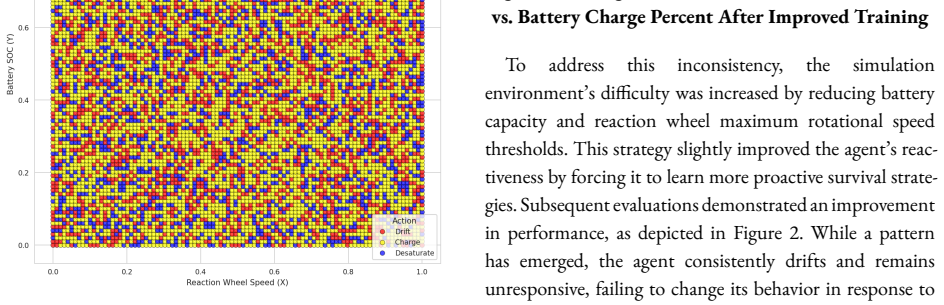
The load-bearing object is Macro Control Action Reinforcement Learning (CARL): the policy's observation is a small compiled vector of spacecraft state—attitude represented by a direction cosine matrix and modified Rodrigues parameters, body-frame angular velocity, inertial position and velocity, battery charge fraction, and wheel-speed fraction—and its output is one of three high-level actions, Drift, Charge, or Desaturate, which map to operator-style command sequences. Training happens in a digital twin of the spacecraft built in BSK-RL, a Gymnasium-wrapped Basilisk simulation, using the PPO algorithm; the macro action abstraction shrinks the search space and keeps the same input format in simulation and on the flight computer. The safety mechanism that carries the trust argument is the containerized inference engine: the trained policy is copied into an isolated Docker container that receives real telemetry but has no command authority, so every recommendation can be logged and compared against actual satellite behavior. The final mechanism is the input-space sampling method, which sweeps health metrics such as battery fraction and wheel saturation across a grid and color-codes the policy's chosen action, letting operators reverse-engineer the black box and detect when the policy fails to react to obvious stress states.
What would settle it
A replay of LIME's archived telemetry through the deployed container, scoring whether the policy recommends Charge whenever battery fraction is critically low and sun-pointing is available, would settle whether the on-orbit validity claim holds; if agreement with the known safe action is at chance in those states, the agent is not behaving sensibly.
Extended reading notes
Core claim
The paper's central claim is that a deep reinforcement-learning policy issuing macro control actions can be validated for onboard small-satellite use without ever being given command authority. The agent is trained with PPO in a digital twin of the LIME CubeSat built with the BSK-RL package, where its observations are compiled telemetry-derived quantities (attitude, angular velocity, position, velocity, battery fraction, wheel-speed fraction) and its actions are high-level commands that decode into operator-equivalent instructions. The trained policy is then wrapped in a Docker container on the flight computer, fed live telemetry through open ports, and run in isolation so its predictions can be compared against real satellite behavior; the authors call this a demonstration of the RL algorithm's validity on orbit. In the paper's own results section, the agent's decisions remained inconsistent until the simulation's battery capacity and wheel-speed thresholds were tightened, and even then the agent 'consistently drifts and remains unresponsive' and 'is not learning to adapt its actions'; the authors present this as evidence of the iterative nature of the trust-building process and direct it to future reward redesign.
Load-bearing premise
The load-bearing assumption is that the digital twin is faithful enough to LIME for behavior learned in simulation to transfer, an assumption the paper itself weakens by noting that the magnetorquers, which are the satellite's actual desaturation hardware, were never integrated into the simulation.
Editorial extensions
If this is right
- An onboard RL agent can be evaluated against real satellite behavior for long stretches with zero risk to the vehicle, because the deployed container only produces recommendations.
- Operators can cede control gradually, promoting individual action types from human-approved to pre-approved, instead of switching from full manual to full autonomous operation at once.
- The macro-action abstraction lets the same policy interface serve simulation and flight, since telemetry is compiled into the same feature vector the agent was trained on.
- Containerized inference with reloadable configuration files allows the satellite to accept updated policy files and changed container behavior after launch without uploading an entire new image.
- If the agent's recommendations hold up in comparison with actual behavior, the same framework could shorten reaction times and reduce reliance on ground control for future missions.
Reading between the lines
- Because the reported agent 'consistently drifts and remains unresponsive,' the isolated-container deployment is, at this stage, stronger evidence that the telemetry-to-inference pipeline works than that the RL policy itself is valid; the paper's on-orbit validity claim becomes testable only after the reward redesign produces a policy that reacts to inputs.
- A natural certification extension would convert the paper's input-space sampling into pass/fail rules, such as requiring Charge to be recommended whenever battery fraction is critically low and sun-pointing is available, and forbidding Desaturate in low-battery states.
- Adding a torque-rod model for the satellite's magnetorquers to the digital twin would make Desaturate testable: one could then compare the simulated momentum-unloading response against LIME's actual magnetorquer behavior, directly probing the digital twin's fidelity.
- The zero-authority container pattern could generalize to other machine-learning controllers on orbit, since it separates 'does the model produce sensible outputs' from 'can we let it act,' provided the telemetry interface and unit consistency checks are validated first.
Signed reviews
Editorial analysis
A structured set of objections, weighed in public.
Referee Report
Summary. The paper proposes a phased trust-building framework for deploying a reinforcement learning (RL) agent as an onboard command automation system for a 3U CubeSat called LIME. A PPO agent is trained in a BSK-RL digital twin to issue three macro actions (Drift, Charge, Desaturate) from compiled telemetry observations, and the trained policy is containerized and deployed in an isolated onboard environment for inference. The abstract claims that feeding compiled satellite telemetry to this isolated policy 'demonstrat[es] the RL algorithm's validity on orbit.' The body reports development and integration activities only, with deployment phases 5 and 6 explicitly deferred to future work. The Results section, however, states that after improved training the agent 'consistently drifts and remains unresponsive' and 'is not learning to adapt its actions,' and no quantitative evaluation or on-orbit inference output analysis is presented.
Significance. The paper's engineering contributions are real and useful: the phased trust-building structure, multi-stage Docker builds for onboard deployment, cross-compilation via QEMU, keyword-based telemetry alignment, unit-consistency refactoring, and bandwidth-conscious downlink design are practical lessons for small-satellite onboard ML experiments. The reverse-engineering approach of sampling the policy's input space is a sensible sanity-check methodology. However, the central scientific claim—that on-orbit inference demonstrates the RL algorithm's validity—is not supported by the reported results. The authors' own Development section states that the agent is unresponsive and not learning to adapt, and no quantitative metrics, baselines, or error bars are provided. The paper is best read as a lessons-learned report on integration challenges rather than a demonstration of a valid onboard RL policy.
major comments (4)
- [Abstract and Results/Development] The abstract's claim that copying the trained policy to an isolated environment and feeding it compiled telemetry 'demonstrat[es] the RL algorithm's validity on orbit' is directly contradicted by the Results section. The Development subsection states that after improved training 'the agent consistently drifts and remains unresponsive, failing to change its behavior in response to different inputs' and 'is not learning to adapt its actions.' These statements describe the same policy used for the inference demonstration, and no quantitative metrics, baselines, reward curves, or error bars are given to override the authors' qualitative admission. The validity claim is therefore unsupported.
- [Results/Integration] No on-orbit inference results are reported. The Integration subsection describes containerization, network ports, cross-compilation, data downlink constraints, column misalignment, and unit inconsistencies, but it never reports the policy's actual outputs when fed LIME telemetry, nor does it compare those outputs with actual satellite behavior or operator decisions. Without such a comparison, the abstract's assertion of a 'safe comparison of the algorithm's predictions against actual satellite behavior' is not evidenced anywhere in the manuscript.
- [Development and Table 2] The Desaturate macro action is unvalidated for the flight hardware. Table 2 lists 'unload reaction wheel momentum using thrust system' as the final step, while the Development section states that LIME has no thrusters and uses magnetorquers, and that the team 'proceeded without full magnetorquer integration' after repeated integration errors. Consequently, a policy action central to avoiding reaction wheel saturation is modeled in simulation with an actuator that does not exist on the real satellite, and the transferability of the trained policy to LIME is not established.
- [Development] The training and evaluation procedure lacks the quantitative detail needed to assess the reported outcome. No training curves, episode returns, action distributions, hyperparameters, random seeds, number of episodes, or numerical reward values are provided, so the statement that 'the policy achieving the highest average reward was selected' cannot be verified. The only evaluation evidence is the qualitative description of Figures 1 and 2, whose axes and color encodings are not described in enough detail to reproduce the analysis.
minor comments (5)
- [Figures 1 and 2] The captions for Figures 1 and 2 should include axis labels, units, and a color legend explaining how actions are encoded; the current text leaves the reader unable to interpret the plots.
- [Table 2] The Desaturate row should be revised to reflect magnetorquer-based momentum unloading or explicitly labeled as nominal pseudocode independent of hardware, to avoid contradicting the Development section.
- [Abstract and Deployment] The Deployment section states that phases 5 and 6 'were not implemented herein,' but the abstract implies that the on-orbit inference step already demonstrated validity. The abstract should be aligned with the actual scope, which is development and integration only.
- [Development] The reported tuning of battery capacity and reaction wheel maximum speed thresholds is a set of free parameters adjusted to elicit proactive behavior; please report the final values and discuss the risk of overfitting to the specific sanity-check scenarios.
- [References] References [23] and [26] are URLs without access dates; please add access dates and, where available, DOIs or version identifiers.
Circularity Check
No significant circularity: the training/evaluation loop is standard RL validation; the on-orbit 'validity' claim is contradicted by the paper's own Results but is not derived from its inputs.
full rationale
No circularity found in the paper's derivation chain. The RL agent is trained in a BSK-RL digital twin with a survival reward proportional to time operational, terminal states for battery depletion and reaction-wheel saturation, and the evaluation then samples the input space and visualizes the trained policy's action choices. This is a standard train-and-evaluate loop: the reward is a designer-chosen training objective, not a parameter fitted to the evaluation data, and the evaluation does not derive a prediction from a fit. The integration and deployment work concerns software engineering (Docker containerization, telemetry abstraction, keyword-based data alignment, unit consistency) and is not presented as a mathematical derivation from the trained policy. The paper's own Results section states that 'the agent consistently drifts and remains unresponsive, failing to change its behavior in response to different inputs' and 'is not learning to adapt its actions,' which does undercut the Abstract's assertion that on-orbit inference 'demonstrat[es] the RL algorithm's validity,' but this is an internal-evidence or correctness problem, not circularity: the unsupported claim does not reduce to its inputs by construction. There are no load-bearing self-citations: the cited BSK-RL documentation is external to the authors, and no uniqueness theorem is imported. The paper is self-contained with respect to its claimed training and evaluation methodology, so the circularity score is 0.
Assumptions & free parameters
free parameters (3)
- Battery capacity in simulation =
Reduced from nominal (amount not specified)
- Reaction wheel maximum speed threshold in simulation =
Reduced from nominal (amount not specified)
- Reward coefficients =
Survival reward near 1.0; terminal penalty less than -1.0
assumptions (4)
- standard math PPO converges to a policy that maximizes cumulative reward in the BSK-RL environment.
- domain assumption Basilisk/BSK-RL faithfully simulates LIME's attitude dynamics, power, and orbital environment.
- ad hoc to paper The three macro actions (Drift, Charge, Desaturate) are sufficient to avoid terminal states.
- domain assumption The representative background features used in input-space sampling are representative of actual on-orbit distributions.
Cite this review
Pith. "Pith review of Toward Trusted Onboard AI: Advancing Small Satellite Operations using Reinforcement Learning." pith.science (2026). https://pith.science/paper/MIP4R32N
@misc{pith2026250722198,
  author       = {Pith},
  title        = {Pith review of: Toward Trusted Onboard AI: Advancing Small Satellite Operations using Reinforcement Learning},
  year         = {2026},
  howpublished = {\url{https://pith.science/paper/MIP4R32N}},
  note         = {Machine review of arXiv:2507.22198}
}
read the original abstract
A RL (Reinforcement Learning) algorithm was developed for command automation onboard a 3U CubeSat. This effort focused on the implementation of macro control action RL, a technique in which an onboard agent is provided with compiled information based on live telemetry as its observation. The agent uses this information to produce high-level actions, such as adjusting attitude to solar pointing, which are then translated into control algorithms and executed through lower-level instructions. Once trust in the onboard agent is established, real-time environmental information can be leveraged for faster response times and reduced reliance on ground control. The approach not only focuses on developing an RL algorithm for a specific satellite but also sets a precedent for integrating trusted AI into onboard systems. This research builds on previous work in three areas: (1) RL algorithms for issuing high-level commands that are translated into low-level executable instructions; (2) the deployment of AI inference models interfaced with live operational systems, particularly onboard spacecraft; and (3) strategies for building trust in AI systems, especially for remote and autonomous applications. Existing RL research for satellite control is largely limited to simulation-based experiments; in this work, these techniques are tailored by constructing a digital twin of a specific spacecraft and training the RL agent to issue macro actions in this simulated environment. The policy of the trained agent is copied to an isolated environment, where it is fed compiled information about the satellite to make inference predictions, thereby demonstrating the RL algorithm's validity on orbit without granting it command authority. This process enables safe comparison of the algorithm's predictions against actual satellite behavior and ensures operation within expected parameters.
Figures

Reference graph
Works this paper leans on
-
[1]
Small Satellites: Revolutionizing Space Exploration and Earth Observation,
I. Siddique, “Small Satellites: Revolutionizing Space Exploration and Earth Observation,” no. 4908526. Rochester, NY, Mar. 31, 2024. [Online]. Available: https://papers.ssrn.com/abstract=4908526
work page 2024
-
[2]
Digital T win of Space Environment: Development, Challenges, Applications, and Future Outlook,
W . Liu, M. Wu, G. W an, and M. Xu, “Digital T win of Space Environment: Development, Challenges, Applications, and Future Outlook,” Remote Sensing, vol. 16, no. 16, p. 3023, Jan. 2024, doi: 10.3390/ rs16163023
work page 2024
-
[3]
Large Satellite Constellations: Challenges and Im- pact,
F. Baccelli, S. Candel, G. Perrin, and J.-L. Puget, “Large Satellite Constellations: Challenges and Im- pact,” Mar. 2024. doi: 10.62686/3
work page doi:10.62686/3 2024
-
[4]
M. Jipp, “Reaction Times to Consecutive Au- tomation Failures: A Function of W orking Mem- ory and Sustained Attention,” Human Factors , vol. 58, no. 8, pp. 1248–1261, Dec. 2016, doi: 10.1177/0018720816662374
-
[5]
M. K. Ben-Larbi et al., “T owards the Automated Op- erations of Large Distributed Satellite Systems. Part 1: Review and Paradigm Shifts,” Advances in Space Research, vol. 67, no. 11, pp. 3598–3619, Jun. 2021, doi: 10.1016/j.asr.2020.08.009
-
[6]
Starling Formation-Flying Optical Experiment: Initial Operations and Flight Results
J. Kruger, S. S. Hwang, and S. D'Amico, “Starling For- mation-Flying Optical Experiment: Initial Operations and Flight Results.” Jun. 10, 2024. doi: 10.48550/ arXiv.2406.06748. Whitney 9 39th Annual Small Satellite Conference Approved for public release; distribution is unlimited. Public Affairs release approval #AFRL-2025-2983
work page Pith review arXiv doi:10.48550/arxiv.2406.06748 2024
-
[7]
Autonomous Management and Control of Multi-Spacecraft Operations Leveraging Atmospheric Forces,
A. T. Harris, “ Autonomous Management and Control of Multi-Spacecraft Operations Leveraging Atmospheric Forces,” 2021. [On- line]. Available: https://hanspeterschaub.info/ Papers/grads/ AndrewHarris.pdf
work page 2021
-
[8]
D. A. Zeleke and H.-D. Kim, “ A New Strategy of Satellite Autonomy with Machine Learning for Effi- cient Resource Utilization of a Standard Performance CubeSat,” Aerospace, vol. 10, no. 1, p. 78, Jan. 2023, doi: 10.3390/aerospace10010078
Show all 28 references
-
[9]
T rustworthy Reinforce- ment Learning for Decentralized Control of Satel- lites,
V . Bajenaru, A. Herrmann, H. Schaub, J. Ramirez, and S. Phillips, “T rustworthy Reinforce- ment Learning for Decentralized Control of Satel- lites,” Feb. 2023, [Online]. Available: https:// www.researchgate.net/publication/367453124_ T rustworthy_Reinforcement_Learning_for_ D...
2023
-
[10]
T owards Fully Au- tonomous Orbit Management for Low-Earth Orbit Satellites Based on Neuro-Evolutionary Algorithms and Deep Reinforcement Learning,
A. Kyuroson, A. Banerjee, N. A. T afanidis, S. Satpute, and G. Nikolakopoulos, “T owards Fully Au- tonomous Orbit Management for Low-Earth Orbit Satellites Based on Neuro-Evolutionary Algorithms and Deep Reinforcement Learning,” European Jour nal of Control , vol. 80, p. 10105...
2024
-
[11]
Deep Reinforce- ment Learning for Autonomous Satellite Responsive- ness to Observed Events,
K. Naik, O. Chang, and C. Kotulak, “Deep Reinforce- ment Learning for Autonomous Satellite Responsive- ness to Observed Events,” in 2024 IEEE Aerospace Conference, Mar. 2024, pp. 1–10. doi: 10.1109/ AERO58975.2024.10521008
2024
-
[12]
Deep Reinforcement Learning for Multi-Agent Autonomous Satellite Inspection,
H. H. Lei, M. Shubert, N. Damron, K. Lang, and S. Phillips, “Deep Reinforcement Learning for Multi-Agent Autonomous Satellite Inspection,” in Proceedings of the 44th Annual American Astro nautical Society Guidance, Navigation, and Control Conference, 2022 , 2024, pp. 1391–1412...
2022 doi
-
[13]
A Survey of Methods for Explaining Black Box Models,
R. Guidotti, A. Monreale, S. Ruggieri, F. Turini, F. Giannotti, and D. Pedreschi, “ A Survey of Methods for Explaining Black Box Models,” ACM Comput. Surv., vol. 51, no. 5, pp. 1–42, Aug. 2018, doi: 10.1145/3236009
2018 doi
-
[14]
DORRE: Autonomous Event Response Using an 8-Space- craft Constellation,
M. Swartwout and K. J. Bennett, “ DORRE: Autonomous Event Response Using an 8-Space- craft Constellation,” presented at the 38th An- nual Small Satellite Conference, 2024. [Online]. Available: https://digitalcommons.usu.edu/smallsat/ 2024/all2024/33/
2024
- [15]
-
[16]
Proximal Policy Optimization Through a Deep Reinforcement Learn- ing Framework for Multiple Autonomous V ehicles at a Non-Signalized Intersection,
D. Quang T ran and S.-H. Bae, “Proximal Policy Optimization Through a Deep Reinforcement Learn- ing Framework for Multiple Autonomous V ehicles at a Non-Signalized Intersection,” Applied Sciences , vol. 10, no. 16, p. 5722, Jan. 2020, doi: 10.3390/ app10165722
2020
-
[17]
A Comparative Analysis of Reinforcement Learning Algorithms for Earth-Observing Satellite Scheduling,
A. Herrmann and H. Schaub, “ A Comparative Analysis of Reinforcement Learning Algorithms for Earth-Observing Satellite Scheduling,” Frontiers in Space Technologies, vol. 4, Nov. 2023, doi: 10.3389/ frspt.2023.1263489
2023
- [18]
-
[19]
BSK- RL: Mod- ular, High-Fidelity Reinforcement Learning Environ- ments for Spacecraft T asking,
M. A. Stephenson and H. Schaub, “BSK- RL: Mod- ular, High-Fidelity Reinforcement Learning Environ- ments for Spacecraft T asking,” in 75th International Astronautical Congress, Milan, Italy, IAF , 2024, pp. 1186–1197. doi: 10.52202/078372-0120
2024 doi
-
[20]
Basilisk: A Flexible, Scalable and Modular Astrodynamics Simulation Framework,
P. W . Kenneally, S. Piggott, and H. Schaub, “Basilisk: A Flexible, Scalable and Modular Astrodynamics Simulation Framework,” Journal of Aerospace Infor mation Systems, vol. 17, no. 9, pp. 496–507, 2020, doi: 10.2514/1.I010762
2020 doi
-
[21]
Ray: A Distributed Framework for Emerging AI Applications,
P. Moritz et al., “Ray: A Distributed Framework for Emerging AI Applications,” presented at the 13th USENIX Symposium on Operating Systems Design and Implementation (OSDI 18), 2018, pp. 561–
2018
-
[22]
Rayproject/Ray - Docker Image | Docker Hub
“Rayproject/Ray - Docker Image | Docker Hub.” https://hub.docker.com/r/rayproject/ray
-
[23]
Dynamics Sims — BSK- RL v1.1.16 Documentation
M. Stephenson, “Dynamics Sims — BSK- RL v1.1.16 Documentation.” https://avslab.github.io/ bsk_rl/api_reference/sim/dyn.html#properties
-
[24]
Attitude Dynamics Fundamen- tals,
H. Schaub, “ Attitude Dynamics Fundamen- tals,” Encyclopedia of Aerospace Engineering . Wi- ley, pp. 3181–3198, Dec. 15, 2010. doi: 10.1002/9780470686652.eae295
2010 doi
-
[25]
Schaub and J
H. Schaub and J. L. Junkins, Analytical Mechanics of Space Systems, 2nd ed. Reston, V a: American Insti- Whitney 10 39th Annual Small Satellite Conference Approved for public release; distribution is unlimited. Public Affairs release approval #AFRL-2025-2983 tute of Aeronautic...
2025 doi
-
[26]
FSW Sims — BSK- RL v1.1.16 1.1.16 Documentation
M. Stephenson, “ FSW Sims — BSK- RL v1.1.16 1.1.16 Documentation.” https://avslab.github.io/ bsk_rl/api_reference/sim/fsw.html#actions
-
[27]
Unyt: Handle, Manipulate, and Convert Data with Units in Python,
N. J. Goldbaum, J. A. ZuHone, M. J. Turk, K. Kowa- lik, and A. L. Rosen, “Unyt: Handle, Manipulate, and Convert Data with Units in Python,” Journal of Open Source Software, vol. 3, no. 28, p. 809, 2018, doi: 10.21105/joss.00809. Whitney 11 39th Annual Small Satellite Conferenc...
2018 doi
-
[577]
Available: https://www.usenix.org/ conference/osdi18/presentation/moritz
[Online]. Available: https://www.usenix.org/ conference/osdi18/presentation/moritz
Reviewed August 6, 2026 · model on record in the stance chip above.
Discussion (0). Continue with ORCID to comment.