REVIEW 3 major objections 4 minor 40 references
The orbital period changes for novae
T0 review · 3 major / 4 minor · reviewed 2026-08-06 · deepseek-v4-flash
Pith's one-line read The paper argues that the positive and negative orbital period changes observed in cataclysmic variables over 30 years are short-term effects of nova eruptions, and that a model where part of the ejecta is lost through the outer Lagrange…
desk verdict Useful MESA study of binary-driven mass loss in novae, but the Pdot claim rests on comparing cycle averages to 30-year snapshots and does not yet establish the headline. read the letter →
The pith
A machine-rendered reading of the paper's core claim, the machinery that carries it, and where it could break.
The reading
What carries the argument
The central mechanism is binary-driven mass loss (BDML): a fraction f_ML,L2 of the nova ejecta, adopted from hydrodynamical simulations of nova outflows, leaves the system through the outer Lagrange point L2, carrying specific angular momentum $a_L2^{2}$ ω rather than the low specific angular momentum of a fast isotropic wind. The orbital response is computed from the relation Δa/a = 2ΔJ/J + (1 + 2q)/(1+q) × M_ejecta/M_WD, where the L2 mass loss makes ΔJ negative enough to flip the sign of Δa. This instantaneous angular-momentum loss is what allows both positive and negative ΔP and Ṃ within one model, and it also produces the discontinuous mass transfer and detached phases seen in the computed tracks.
What would settle it
For a normal CV with independently known white dwarf mass, donor mass, and nova ejecta mass, the FW+BDML model predicts a definite range of ΔP (and of Ṃ via ΔP/τ_rec); a single observed ΔP falling clearly outside that range, or a measured ejecta asymmetry that pushes the orbital response in the opposite direction to the prediction, would refute the central claim.
Extended reading notes
Core claim
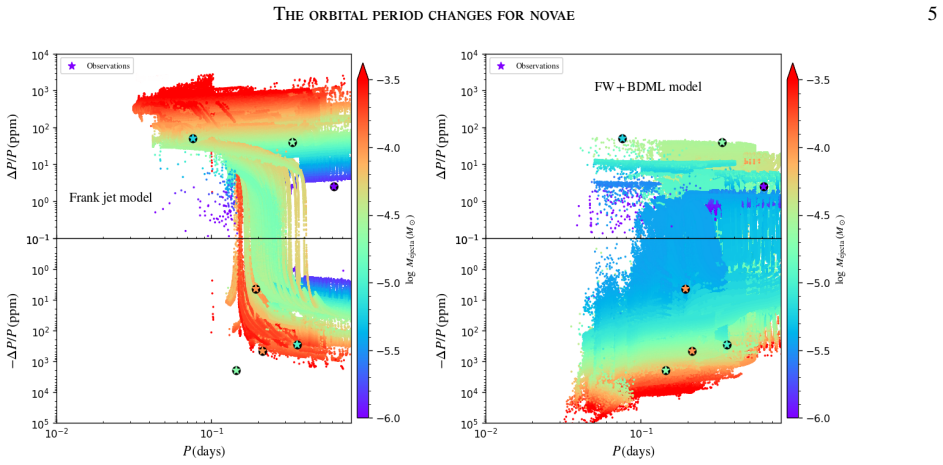
The paper's central claim is that the observed ΔP and Ṃ in cataclysmic variables, which take both positive and negative values, can be explained by the short-term dynamical effect of nova eruptions if a fraction of the ejecta is lost through the outer Lagrange point (L2) rather than as a fast isotropic wind. Building on hydrodynamical simulations of nova outflow, the authors treat mass loss through L2 as carrying additional orbital angular momentum, so a single eruption can either shrink or expand the orbit depending on the ejecta mass, the white dwarf mass, and the mass ratio. When this binary-driven mass loss is combined with fast wind in detailed binary evolution calculations, the resulting ΔP and Ṃ cover nearly all the observed data for normal CVs; the pure fast-wind model cannot explain the negative values, and the Frank jet model fails for the most negative ΔP sources and short-period systems.
Load-bearing premise
The model's explanatory power rests on mapping the fraction of nova ejecta that escapes through the outer Lagrange point, f_ML,L2, from hydrodynamical simulations onto every system in the binary evolution grid, and on the assumption that the observed ΔP and Ṃ are dominated by short-term nova effects rather than secular magnetic braking or gravitational radiation.
Editorial extensions
If this is right
- Observed positive and negative ΔP and Ṃ do not require abandoning standard magnetic braking theory; they can be reconciled as short-term nova effects.
- The sign of a measured period change in a normal CV cannot be taken as direct evidence against angular momentum loss prescriptions, because the binary-driven mass loss model produces both signs.
- The Frank jet mechanism, with its adjustable asymmetry parameter, may be needed in addition to BDML for recurrent novae like U Sco and T CrB, whose period changes vary drastically between eruptions despite apparently similar ejecta masses.
- The BDML-induced orbital expansion shifts the computed CV period gap to longer periods, but the paper argues this discrepancy can be removed by adjusting magnetic braking physics, such as the conditions under which magnetic braking operates or its strength.
- Within the model, a specific CV's ΔP and Ṃ between eruptions are controlled mainly by its varying ejecta mass, so repeated eruptions of the same system provide a direct test of the mechanism.
Reading between the lines
- The mapping that assigns an L2 mass-loss fraction to every nova in the model grid is extrapolated from a limited set of hydrodynamical simulations; a direct test would be to measure ejecta asymmetry (for example through polarization or resolved outflows) in a few well-observed novae and check whether the inferred L2 fraction matches the predicted sign and size of ΔP.
- The model implies that a long baseline of many eruptions from a single CV should show ΔP variations tied only to changing ejecta mass, whereas the Frank jet would allow larger, random sign flips; distinguishing these patterns would separate the two mechanisms observationally.
- If some of the observed period derivative is actually secular rather than short-term, the binary-driven mass loss model would overpredict the spread of Ṃ; a century-long timing baseline on a few bright CVs would begin to separate the short-term eruption contribution from the secular contribution.
- The same L2 mass-loss treatment, if correct, should also reshape population-level CV properties such as the period minimum and the bounce period, which could be checked against large photometric surveys.
Editorial analysis
A structured set of objections, weighed in public.
Referee Report
Summary. The paper investigates whether the observed orbital period changes (\Delta P and \dot P) of cataclysmic variables (CVs) can be explained as short-term effects of nova eruptions rather than as contradictions of standard magnetic braking theory. Using MESA binary evolution calculations with instantaneous nova mass ejection, the authors compare three mass-loss prescriptions: pure fast wind (FW), fast wind plus binary-driven mass loss through the outer Lagrange point (FW+BDML), and fast wind plus an asymmetric Frank jet. They compare their evolutionary tracks with observed \Delta P from Schaefer (2023) and \dot P from Schaefer (2024). The central claim is that FW+BDML can cover nearly all observed \Delta P and \dot P for normal CVs, while FW alone cannot and the Frank jet is needed only for some long-period systems with evolved companions.
Significance. If established, the result would be an important resolution of the apparent conflict between observed period changes in CVs and standard angular momentum loss theory, and it would strengthen the case that binary-driven mass loss is a key ingredient in nova-driven CV evolution. The paper is valuable for implementing three distinct mass-loss mechanisms in a detailed stellar evolution code and for confronting them with the full Schaefer data set rather than with selected systems. The use of independently determined ingredients (Shen & Quataert's hydrodynamic f_{ML,L2}, Chomiuk et al.'s recurrence times, and external observed period changes) avoids fitting the model to the target data. However, the central claim currently rests on visual coverage in the \Delta P and \dot P planes, and the \dot P comparison uses a cycle-averaged quantity that may not correspond to the observed 30-year baseline for long-recurrence systems, so the conclusion is not yet quantitatively established.
major comments (3)
- [Section 3.3, Eq. (10) and Fig. 3] The comparison in Section 3.3 uses the cycle-averaged \langle \dot P\rangle = (P_i - P_{i-1})/\Delta t, which includes the full effect of the sudden period change \Delta P/\tau_{\rm rec}. The observed \dot P values from Schaefer (2024), however, are measured over baselines of roughly 30 years, and for classical novae with recurrence times well above 10^4 yr no eruption occurs within the observing window. In such systems the observed quantity should be the quiescent local derivative \dot P_{\rm MT}+\dot P_{\rm GR}+\dot P_{\rm MB} from Eq. (9), not the recurrence-averaged value. This distinction is not a detail: the paper's own Fig. 1 shows that in the FW+BDML model the post-eruption mass-transfer rate is strongly enhanced and can even lead to detachment, so the local derivative immediately after an eruption differs greatly from the cycle average. As written, the claimed agreement between the FW+BDML model and the observed \dot P could be spurious, because long-recurrence systems have tiny \Delta P/\tau_{\rm rec} and their cycle averages are close to the secular MB+GR values, while the observations show both signs and large magnitudes. The authors should recompute the comparison using local quiescent derivatives over a simulated baseline comparable to the observational one, and show explicitly which systems in Fig. 3 are actually matched under that procedure.
- [Section 2, FW+BDML model paragraph] The FW+BDML model hinges on the fraction f_{ML,L2} of nova ejecta lost through the outer Lagrange point, taken from Fig. 8 of Shen & Quataert (2022) and applied to every MESA track. The paper does not propagate uncertainties in this mapping, does not test alternative prescriptions, and does not discuss whether the hydrodynamic regime of Shen & Quataert (2022) is directly applicable to the instantaneous-ejection treatment adopted here. Because the sign and magnitude of \Delta a across an eruption change with f_{ML,L2}, and because the ability of the model to cover both positive and negative observed values depends on that sign, this is a load-bearing assumption. A sensitivity test varying f_{ML,L2} by plausible factors, or at least a discussion of the extrapolation uncertainty, is needed to support the claim that FW+BDML covers nearly all observations.
- [Section 3.2, Fig. 2 and Section 3.3, Fig. 3] The central conclusion that the FW+BDML model 'explains' or 'covers' nearly all observed data is supported only by visual inspection of scatter plots. Since the model produces hundreds of evolutionary tracks with a wide range of ejecta masses and periods, some degree of overlap with any finite set of observed points is expected; 'coverage' is not a goodness-of-fit statistic. The authors should define a quantitative criterion (for example, the fraction of observed sources lying within a specified tolerance in \Delta P/P and \dot P, accounting for the reported observational errors and the theoretical spread) and report it for each model. Without such a metric, the comparative claims about FW, Frank-jet, and FW+BDML are not falsifiable in their present form.
minor comments (4)
- [Abstract and Section 1] The abstract and introduction contain several typos and grammatical errors, for example 'Cataclysmic variable (CVs)' should be 'Cataclysmic variables (CVs)', and 'aslo' should be 'also'; these should be corrected before submission.
- [Footnote 6, Section 3.3] The criterion that a track is 'available' if the donor loses at least 50% of its initial mass is described as arbitrary, and the statement that it does not affect the conclusions is not demonstrated. The paper should present a robustness check using a different mass-loss threshold, or at least quantify how many tracks are excluded by the 50% criterion.
- [Section 2, Frank-jet model] The statement that \xi is chosen randomly as \pm 1 introduces stochasticity into the results without specifying a random seed or demonstrating that the conclusions are stable across realizations; the authors should either fix \xi or show that the distribution of outcomes is insensitive to the random choice.
- [Section 4, Conclusion] The discussion of U Sco and T CrB correctly notes that variable \xi could produce variable \Delta P and \dot P, but the paper does not show whether the Frank-jet model with \xi = \pm 1 actually reproduces the magnitudes and signs of the observed period changes for those two systems; a direct comparison would strengthen the claim.
Circularity Check
No significant circularity: the BDML prediction is benchmarked against external data, with only a minor methodological self-citation to Tang et al. (2024).
full rationale
The derivation is self-contained in the sense required for circularity analysis. The central comparison uses observed Delta P/P from Schaefer (2023) and observed Pdot from Schaefer (2024) as external benchmarks. The model's input functions are not fitted to those data: fML,L2 is taken from the independent hydrodynamical simulations of Shen & Quataert (2022, their Figure 8), tau_rec is taken from Chomiuk et al. (2021), and the accretion-efficiency prescriptions come from Wang et al. (2010), Ma et al. (2013), and Wu et al. (2017). Equation (10) defines the model's cycle-averaged <Pdot> from the MESA tracks, not from the observed Pdot; Equation (9) is a decomposition, not a fit. The paper's reliance on Tang et al. (2024) for the MESA implementation of BDML is a genuine self-citation, but it is methodological and does not by itself force the conclusion: the sign and magnitude of Delta a are governed by Equation (4) with the external fML,L2 mapping, and the observed values are not used to select that mapping. A possible concern that observed 30-yr Pdot snapshots should be compared with the quiescent derivative rather than the recurrence-averaged <Pdot> is a question of physical validity of the comparison, not a circular reduction; no equation in the paper defines the observed quantity in terms of the model output or vice versa. Overall the central claim has independent content and is not forced by definition or by self-citation.
Assumptions & free parameters
free parameters (4)
- fdt (timestep resolution coefficient) =
0.5 for MWD,i >= 1.0 solar masses; 0.03, 0.1, or 0.5 for lower-mass WDs, choosing the smallest convergent value
- xi (Frank jet asymmetry parameter) =
Randomly set to +1 or -1 in the Frank-jet model; can in principle vary continuously between -1 and 1, with |xi|=2…
- Vejecta (nova ejecta velocity) =
1000 km/s
- fML,L2 (fraction of ejecta lost through L2) =
Function of MWD and Mejecta from Figure 8 of Shen and Quataert (2022); in practice about 20-30 percent BDML, with…
assumptions (8)
- standard math Orbital angular momentum conservation and Kepler's third law (Eqs. 3-4, Eq. 8)
- domain assumption Observed Delta P and Pdot over roughly 30 years are dominated by short-term effects of nova eruptions rather than secular magnetic braking or gravitational radiation
- domain assumption Nova mass ejection is instantaneous and no ejecta is recaptured by the companion
- domain assumption The recurrence time tau_rec(Mdot2, MWD) from Chomiuk et al. (2021) Figure 2, with Mejecta = |Mdot2| * tau_rec
- domain assumption The L2 mass-loss fraction fML,L2 from Figure 8 of Shen and Quataert (2022) applies to all nova eruptions and remains valid in the MESA instantaneous-ejection implementation
- domain assumption Standard gravitational radiation and magnetic braking prescriptions with gamma=3, with MB activation as implemented in MESA version 11701
- domain assumption In the nova region the white dwarf has no net mass growth; all transferred mass is ejected each eruption
- ad hoc to paper A MESA track is counted as available if the donor loses at least 50 percent of its initial mass
Cite this review
Pith. "Pith review of The orbital period changes for novae." pith.science (2026). https://pith.science/paper/NWJNVXB3
@misc{pith2026250722331,
  author       = {Pith},
  title        = {Pith review of: The orbital period changes for novae},
  year         = {2026},
  howpublished = {\url{https://pith.science/paper/NWJNVXB3}},
  note         = {Machine review of arXiv:2507.22331}
}
abstract
Cataclysmic variable (CVs) are close interacting binaries in which a white dwarf accretes materials from a low mass main sequence companion. CVs can experience nova eruptions due to low mass transfer rates. In the standard theory of CV evolution, the ejected materials during nova eruptions are assumed to leave the system in the form of fast, isotropic, optically thick winds, which predicts that novae only result in positive variation (expansion) of orbital period (i.e. positive $\Delta P$). In addition, the angular momentum losses (magnetic braking and gravitational radiation) only predicts a steady long-term decay in the orbital period of CVs, i.e. $\dot P$ is negative. Interestingly, an observation lasting over 30 years reveals positive and negative values for both $\Delta P$ and $\dot P$ in CVs, strongly conflicting with the standard evolutionary patterns. However, it cannot be excluded that these observations originate from short-term phenomena caused by nova eruptions because of a short timescale of observations. In this paper, we model the effect of instantaneous nova eruptions on the evolution of CVs, considering three mechanisms associated with mass loss in nova eruptions, including fast wind, Frank jet and binary-driven mass loss. By assuming that the observed $\Delta P$ and $\dot P$ are dominated by short-term phenomena, our results show that the binary-driven mass loss can explain almost all of the observations of normal CVs. However, the Frank jet may be needed for some of long-period CVs with evolved companions.
Figures


Reference graph
Works this paper leans on
-
[1]
, " * write output.state after.block = add.period write newline
ENTRY address archivePrefix author booktitle chapter doi edition editor eprint howpublished institution journal key month number organization pages publisher school series title misctitle type volume year version url label extra.label sort.label short.list INTEGERS output.state before.all mid.sentence after.sentence after.block FUNCTION init.state.consts ...
-
[2]
write newline
" write newline "" before.all 'output.state := FUNCTION format.url url empty "" new.block "" url * "" * if FUNCTION format.eprint eprint empty "" archivePrefix empty "" archivePrefix "arXiv" = new.block " " eprint * " " * new.block " " eprint * " " * if if if FUNCTION format.doi doi empty "" " " doi * " " * if FUNCTION format.pid doi empty eprint empty ur...
-
[3]
I @cs+- ; 7;*, v 7?? < , |dy c]vC aҤIK_RNt/Bw ^ w1o 7r_*'x
thebibliography [1] 20pt to REFERENCES 6pt =0pt 10pt plus 3pt =0pt =0pt =1pt plus 1pt =0pt =0pt -12pt =13pt plus 1pt =20pt =13pt plus 1pt \@M =10000 =-1.0em =0pt =0pt 0pt =0pt =1.0em @enumiv\@empty 10000 10000 `\.\@m \@noitemerr \@latex@warning Empty `thebibliography' environment \@ifnextchar \@reference \@latexerr Missing key on reference command Each re...
arXiv 2019
-
[4]
Aydi, E., Chomiuk, L., Izzo, L., et al.\ 2020, , 905, 62. doi:10.3847/1538-4357/abc3bb
-
[5]
Aydi, E., Page, K. L., Kuin, N. P. M., et al.\ 2018, , 474, 2679. doi:10.1093/mnras/stx2678
-
[6]
Chomiuk, L., Metzger, B. D., & Shen, K. J.\ 2021, , 59, 391. doi:10.1146/annurev-astro-112420-114502
-
[7]
D., Yang, J., et al.\ 2014, , 514, 339
Chomiuk, L., Linford, J. D., Yang, J., et al.\ 2014, , 514, 339. doi:10.1038/nature13773
-
[8]
Friedjung, M.\ 1966, , 132, 317. doi:10.1093/mnras/132.2.317
Show all 40 references
-
[9]
& Hachisu, I.\ 1994, , 437, 802
Kato, M. & Hachisu, I.\ 1994, , 437, 802. doi:10.1086/175041
1994 doi
- [10]
-
[11]
doi:10.1088/0067-0049/194/2/28
Knigge, C., Baraffe, I., & Patterson, J.\ 2011, , 194, 28. doi:10.1088/0067-0049/194/2/28
2011 doi
-
[12]
doi:10.1086/324074
Kolb, U., Rappaport, S., Schenker, K., et al.\ 2001, , 563, 958. doi:10.1086/324074
2001 doi
-
[13]
Landau, L. D. & Lifshitz, E. M.\ 1959, Course of theoretical physics, Oxford: Pergamon Press, 1959
1959
-
[14]
G., Livio, M., & Schaefer, B
Martin, R. G., Livio, M., & Schaefer, B. E.\ 2011, , 415, 1907. doi:10.1111/j.1365-2966.2011.18835.x
2011
-
[15]
liang ., et al.\ 2013, , 778, L32
Ma, X., Chen, X., Chen, H.-. liang ., et al.\ 2013, , 778, L32. doi:10.1088/2041-8205/778/2/L32
2013 doi
-
[16]
F., G \"a nsicke, B
Pala, A. F., G \"a nsicke, B. T., Townsley, D., et al.\ 2017, , Effective temperatures of cataclysmic-variable white dwarfs as a probe of their evolution, 466, 3, 2855. doi:10.1093/mnras/stw3293
2017 doi
-
[17]
F., G \"a nsicke, B
Pala, A. F., G \"a nsicke, B. T., Belloni, D., et al.\ 2022, , 510, 6110. doi:10.1093/mnras/stab3449
2022 doi
-
[18]
doi:10.3847/1538-4365/ab2241
Paxton, B., Smolec, R., Schwab, J., et al.\ 2019, , 243, 10. doi:10.3847/1538-4365/ab2241
2019 doi
-
[19]
B., et al.\ 2018, , 234, 34
Paxton, B., Schwab, J., Bauer, E. B., et al.\ 2018, , 234, 34. doi:10.3847/1538-4365/aaa5a8
2018 doi
-
[20]
doi:10.1088/0067-0049/220/1/15
Paxton, B., Marchant, P., Schwab, J., et al.\ 2015, , 220, 15. doi:10.1088/0067-0049/220/1/15
2015 doi
-
[21]
doi:10.1088/0067-0049/208/1/4
Paxton, B., Cantiello, M., Arras, P., et al.\ 2013, , 208, 4. doi:10.1088/0067-0049/208/1/4
2013 doi
-
[22]
doi:10.1088/0067-0049/192/1/3
Paxton, B., Bildsten, L., Dotter, A., et al.\ 2011, , 192, 3. doi:10.1088/0067-0049/192/1/3
2011 doi
-
[23]
C.\ 1983, , 275, 713
Rappaport, S., Verbunt, F., & Joss, P. C.\ 1983, , 275, 713. doi:10.1086/161569
1983 doi
-
[24]
B., et al.\ 2023, , 525, L50
Scaringi, S., Breivik, K., Littenberg, T. B., et al.\ 2023, , 525, L50. doi:10.1093/mnrasl/slad093
2023 doi
- [25]
- [26]
- [27]
-
[28]
J., Shore, S
Schwarz, G. J., Shore, S. N., Starrfield, S., et al.\ 2001, , 320, 103. doi:10.1046/j.1365-8711.2001.03960.x
2001
-
[29]
M., Livio, M., Moffat, A
Shara, M. M., Livio, M., Moffat, A. F. J., et al.\ 1986, , 311, 163. doi:10.1086/164762
1986 doi
-
[30]
Shen, K. J. & Quataert, E.\ 2022, , 938, 31. doi:10.3847/1538-4357/ac9136
2022 doi
- [31]
-
[32]
M., & Truran, J
Starrfield, S., Sparks, W. M., & Truran, J. W.\ 1985, , 291, 136. doi:10.1086/163048
1985 doi
-
[33]
doi:10.3847/1538-4357/ad8880
Tang, W.-S., Li, X.-D., & Cui, Z.\ 2024, , 977, 34. doi:10.3847/1538-4357/ad8880
2024 doi
-
[34]
doi:10.1111/j.1365-2966.2009.15857.x
Wang, B., Li, X.-D., & Han, Z.-W.\ 2010, , 401, 4, 2729. doi:10.1111/j.1365-2966.2009.15857.x
2010
-
[35]
Wang, B., 2018, RAA (Res. Astron. Astrophys.), 18, 049
2018
-
[36]
& Han, Z.\ 2012, , 56, 122
Wang, B. & Han, Z.\ 2012, , 56, 122. doi:10.1016/j.newar.2012.04.001
2012 doi
-
[37]
Wang, B., Li, Y., Ma, X., et al.\ 2015, , 584, A37
2015
-
[38]
Astrophys
Warner, B.\ 1995, Camb. Astrophys. Ser., Vol. 28,
1995
-
[39]
M., Bildsten, L., Brooks, J., et al.\ 2013, , 777, 136
Wolf, W. M., Bildsten, L., Brooks, J., et al.\ 2013, , 777, 136. doi:10.1088/0004-637X/777/2/136
2013 doi
-
[40]
doi:10.1051/0004-6361/201630099
Wu, C., Wang, B., Liu, D., et al.\ 2017, , 604, A31. doi:10.1051/0004-6361/201630099
2017 doi
Reviewed August 6, 2026 · model on record in the stance chip above.
Discussion (0). Continue with ORCID to comment.