REVIEW 3 major objections 4 minor 66 references
Key Physical Parameters Influencing Fragmentation and Multiplicity in Dense Cores of Orion A
T0 review · 3 major / 4 minor · reviewed 2026-08-06 · deepseek-v4-flash
Pith's one-line read The paper claims that in Orion A, dense cores hosting binary or multiple protostars are significantly denser and more supersonically turbulent than cores hosting single protostars, while turbulence-to-gravity and magnetic-field-to-gravity…
desk verdict Worth a serious referee: new magnetic-field null in Orion A core multiplicity, but the density/Mach result partly replicates Luo et al. and has unresolved beam issues. read the letter →
The pith
A machine-rendered reading of the paper's core claim, the machinery that carries it, and where it could break.
The reading
What carries the argument
The argument rests on a catalogue of 53 dense cores extracted from the JCMT 850 micron map with astrodendro, classified as single or binary/multiple using the VANDAM ALMA survey's protostar positions at 0.1 arcsecond resolution. Core-averaged density comes from 850 micron flux with Herschel dust temperatures, Mach number and non-thermal velocity dispersion from hyperfine fits to Nobeyama N2H+ spectra, and magnetic field strength from POL-2 polarization using the Davis-Chandrasekhar-Fermi method with unsharp-masked angular dispersions. The statistical engine is a bootstrap-resampled cumulative distribution comparison, with Kolmogorov-Smirnov tests applied to each physical parameter to decide which properties separate the two groups.
What would settle it
Re-measure the density and Mach number of the same 53 cores after convolving all data to a common beam that fully resolves the smallest cores, or observe the sample with a matched high-resolution line survey; if the density and Mach number differences between single and multiple cores disappear, the central claim fails.
Extended reading notes
Core claim
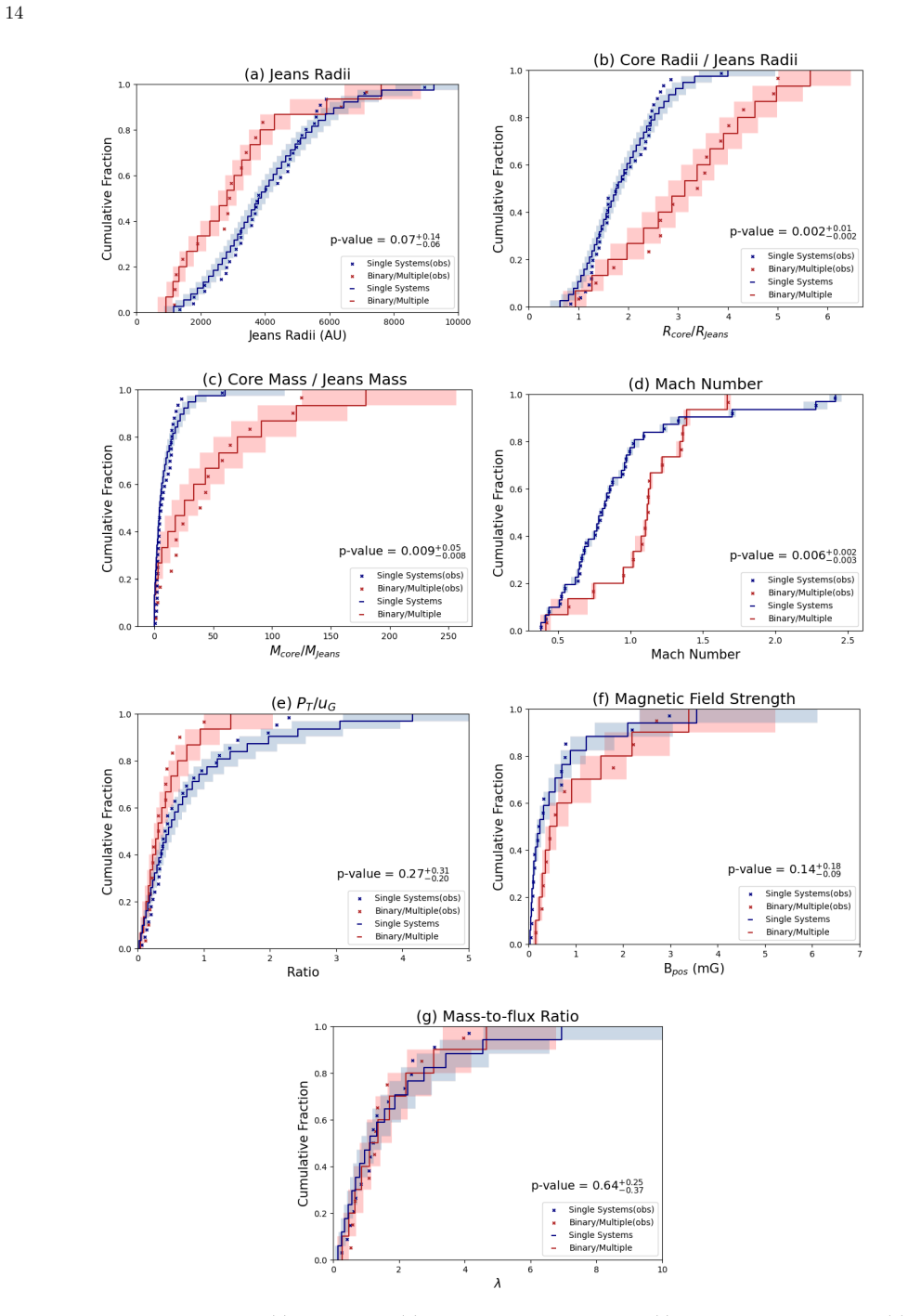
The paper's central discovery, stated in Sections 5.1 and 6, is that dense cores forming binary or multiple systems in Orion A are statistically denser and more supersonically turbulent than cores forming a single protostar. Kolmogorov-Smirnov tests give p-values of 0.005 for core mass, 0.04 for density, 0.006 for Mach number, and 0.002 and 0.009 for the ratios of core radius to Jeans radius and core mass to Jeans mass, all favoring the binary/multiple group. In contrast, the p-values for core radius (0.21), aspect ratio (0.50), turbulent-to-gravitational energy ratio (0.27), magnetic field strength (0.14), and mass-to-flux ratio (0.64) show no significant difference. The number of protostars per core also correlates with density, Mach number, and the Jeans-based ratios. The authors interpret these results as evidence that high density and supersonic turbulence promote local collapse and fragmentation, while the magnetic field has limited influence on whether a core fragments in Orion A.
Load-bearing premise
The inferred core-averaged density and Mach number faithfully represent the pre-fragmentation physical conditions, even though the JCMT, Nobeyama, and Herschel beams are comparable to or larger than the smallest cores in the sample.
Editorial extensions
If this is right
- If high density and supersonic turbulence drive fragmentation, surveys of core multiplicity can use density and Mach number as predictors of which cores will split into binary or multiple systems.
- The absence of a mass-to-flux ratio trend suggests that magnetic support is not the dominant regulator of multiplicity in Orion A, so models of low-mass star formation should treat turbulence and gravity, not magnetic fields, as the main fragmentation switches in such cores.
- The correlation between protostar number and Mach number supports turbulent core fragmentation scenarios in which supersonic fluctuations create multiple density peaks that exceed the local Jeans mass.
- The null result on the turbulent-to-gravitational energy ratio indicates that turbulence acts as a fragmentation promoter rather than as a stabilizing support, because gravity dominates in most of these cores.
- Combined with the earlier sample of Luo et al. (2022), the two studies claim that 91 cores across the Orion complex point to the same drivers of fragmentation: gas density and Mach number.
Reading between the lines
- A direct test this paper leaves implicit is a matched-resolution reanalysis: convolving all data to a common beam that covers the smallest cores and re-measuring density and Mach number would show whether the single-versus-multiple differences are robust or partly a resolution artifact.
- If the trend holds generally, multiplicity fraction should increase toward the densest, most turbulent parts of any star-forming cloud, offering a cloud-scale diagnostic for predicting where wide binaries and higher-order multiples are born.
- The authors argue that outflow or infall energy is unlikely to inflate the line widths in multiple cores; an independent check using outflow tracers such as CO or SiO would verify whether any of the Mach number excess is feedback-related rather than intrinsic turbulence.
- Extending the same comparison to other clouds with measured mass-to-flux ratios would test whether Orion A's null magnetic-field result generalizes or is peculiar to its magnetic environment.
Editorial analysis
A structured set of objections, weighed in public.
Referee Report
Summary. This paper compares the physical properties of 38 dense cores hosting single protostars and 15 dense cores hosting binary or multiple systems in Orion A, using JCMT 850 micron continuum and polarimetry, Herschel dust temperatures, Nobeyama N2H+ line data, and VANDAM multiplicity measurements. The authors derive core mass, density, Jeans length and mass, Mach number, turbulent pressure, DCF magnetic field strength, and mass-to-flux ratio, and then compare the two groups with cumulative distributions and KS tests. The central claim is that fragmented cores have significantly higher density and Mach number, and larger ratios of core radius/mass to Jeans radius/mass, while the energy ratios of turbulence and magnetic field to gravity show no significant difference. The paper interprets this as evidence that density and supersonic turbulence drive core fragmentation in Orion A and that magnetic support is not a dominant factor.
Significance. If the central result holds, the paper provides a valuable observational constraint on the fragmentation of low-mass cores: it supports the turbulent core fragmentation scenario and challenges a strong role for magnetic fields at the ~0.1 pc scale in Orion A. The study extends the work of Luo et al. (2022) by adding magnetic field measurements and by using the high-resolution VANDAM multiplicity catalog. Strengths include a clearly described sample selection, full tables of core properties, Monte Carlo treatment of CDF uncertainties, and a transparent statistical comparison. The main novel contribution is the comparison of the mass-to-flux ratio and turbulent-to-gravitational energy ratio between fragmented and unfragmented cores. However, the headline conclusions depend on resolution-related assumptions and on the treatment of multiple statistical tests, both of which need to be demonstrated before the result can be considered robust.
major comments (3)
- [§3.1–3.2, Eq. (1)] The paper states that unresolved cores smaller than the JCMT beam are excluded, yet Table 1 lists many cores with radii well below the 14.6 arcsec FWHM beam (~5800 au at 400 pc), e.g., indices 45 (3200 au), 52 (3400 au), 53 (4400 au). It is not stated whether the reported radii are beam-deconvolved. If they are not, the fitted 2D Gaussian sizes should be at least the beam's own 2-sigma width (~4900 au), so either the radii are deconvolved by an unspecified procedure or the claimed exclusion was not applied. Since the core density in Section 3.2 is computed as M/(4/3 pi R^3), a biased R for the smallest cores could directly produce the apparent density difference between the single and multiple groups. In addition, the N2H+ beam (23.4 arcsec) and Herschel temperature beam (37 arcsec) average over regions 3-5 times the radius of the smallest cores, so the core-averaged Mach number and dust temperature may be contaminated by surrounding gas. The statement in Section 3 that the resolution impact is 'minimal' is asserted rather than demonstrated. Please provide a resolution-matched subsample analysis, a synthetic beam-convolution test, or a clear description of any deconvolution procedure.
- [§4, Table 3] The KS tests in Table 3 involve 11 parameters, and no correction for multiple comparisons is applied. The density p-value is 0.04 with an upper uncertainty of 0.15, and the Mach number p-value is 0.006; with a Bonferroni threshold of 0.0045 neither would be individually significant. The abstract and §5.1 highlight these parameters as the key evidence, so the paper should either apply a multiple-testing correction or reframe the conclusion around the more robust Jeans-ratio test (p=0.002) and the mass test (p=0.005), noting that the density and Mach number results are suggestive trends. The Spearman correlations in §4.5 and Figure 7 also involve multiple tests and are reported without adjustment.
- [§3.6 and §4.4, Table 2] Magnetic field strengths and mass-to-flux ratios are measured for only 27 of the 53 cores, with different detection fractions for the two groups: 17 of 38 single systems (45%) and 10 of 15 multiple systems (67%). Because polarization detection requires sufficiently bright and polarized emission, the magnetic subsample may be biased toward the same dense, massive cores that drive the main result, so the null KS results for B_pos (p=0.14) and lambda (p=0.64) could be a selection artifact rather than a physical absence of magnetic effects. The authors should test whether restricting the density and Mach number comparisons to the 27 cores with magnetic detections reproduces their headline differences, and should discuss the impact of the unequal detection fractions, possibly by using upper limits for the nondetections.
minor comments (4)
- [§3.1] The sentence 'we note that dense core with sizes smaller than the JCMT beam size may not be fully resolved' contains a typo ('core' should be 'cores'), and the exclusion criterion should be stated precisely, e.g., whether 'smaller than the beam' refers to the FWHM or to the 2-sigma width of the fitted Gaussian.
- [§3.4] When two velocity components are fitted, the paper selects the component with higher optical depth; the potential bias introduced by this choice should be briefly justified or tested, since the higher-optical-depth component may preferentially trace the densest gas and thus affect the derived velocity dispersion and Mach number.
- [§3.6] The angular dispersion is measured after subtracting a smoothed field with a 3x3 pixel (36 arcsec) kernel that is said to correspond to the median core size; the sensitivity of the derived B_pos and mass-to-flux ratio to the kernel choice is not discussed and could be checked, especially for the smallest cores.
- [§5.3] The discussion of mass-to-flux ratios in the context of other surveys would benefit from stating explicitly that the DCF-derived B_pos is a plane-of-sky lower limit, so the conclusion that magnetic fields are relatively weak is partly projection-dependent; the text makes this point earlier but the summary and abstract do not.
Circularity Check
No circularity: the paper compares measured core properties across independently classified single and multiple protostar groups, with no fitted parameter renamed as a prediction and no load-bearing self-citation.
full rationale
The paper's central claim is a statistical comparison between two groups defined by the independent VANDAM protostar catalog, using physical parameters measured from separate archival data sets (JCMT 850 um continuum, Herschel dust temperature, Nobeyama N2H+ line data, and JCMT POL-2 polarization). Core density is computed from mass and radius; Mach number is computed from non-thermal line width and sound speed; turbulent and magnetic energy ratios are computed from these measured quantities. No parameter is fitted to the fragmentation outcome, and no quantity is defined in terms of the target result. The reported correlations in Sections 4 and 5 are direct comparisons of measured distributions, not predictions from a model whose inputs were calibrated to the same data. The derived ratios R/λ_Jeans and M/M_Jeans are algebraically related to density and sound speed, but the paper presents them as consequences of the density difference rather than as independent evidence, which is not circularity. The concern that the JCMT, Nobeyama, and Herschel beams are larger than some of the smallest cores is a measurement-validity issue, not a circularity issue: it does not make any claimed result equal to its input by construction or by self-citation. There are no load-bearing self-citations; the cited works are external surveys, simulations, and methods. The paper is self-contained in its derivation of the compared quantities, so the circularity score is 0.
Assumptions & free parameters
free parameters (4)
- DCF correction factor Q =
0.5
- Dust opacity kappa_850 =
0.0125 cm2/g
- Unsharp masking kernel size =
3x3 pixels (36 arcsec)
- Distance D =
383-392 pc
assumptions (5)
- domain assumption Gas temperature equals dust temperature
- domain assumption Dense cores are spherical for density and gravitational energy estimates
- domain assumption DCF method and Q=0.5 yield valid Bpos
- domain assumption N2H+ line width traces core turbulence, not outflows or infall
- domain assumption 850 um dust emission is optically thin
Cite this review
Pith. "Pith review of Key Physical Parameters Influencing Fragmentation and Multiplicity in Dense Cores of Orion A." pith.science (2026). https://pith.science/paper/LYPRDYOR
@misc{pith2026250722470,
  author       = {Pith},
  title        = {Pith review of: Key Physical Parameters Influencing Fragmentation and Multiplicity in Dense Cores of Orion A},
  year         = {2026},
  howpublished = {\url{https://pith.science/paper/LYPRDYOR}},
  note         = {Machine review of arXiv:2507.22470}
}
abstract
When dense cores in molecular clouds or filamentary structures collapse and form protostars, they may undergo fragmentation and form binary or multiple systems. In this paper, we investigated the key mechanisms influencing fragmentation by comparing the physical conditions of fragmented and unfragmented dense cores (~0.1 pc) in Orion A. Utilizing archival submillimeter continuum data from the James Clerk Maxwell Telescope (JCMT) and the Atacama Large Millimeter/Submillimeter Array survey of Class 0 and I protostars at a 0.''1 resolution, we identified 38 dense cores hosting single protostars and 15 cores hosting binary or multiple systems. We measured the dense cores properties with the Herschel dust temperature, Nobeyama 45m N$_2$H$^+$ J=1-0, and JCMT polarization data. Our results reveal that the dense cores hosting binary/multiple systems exhibit significantly higher density and Mach number compared to those hosting single protostars, while there are no correlations between the occurrence of fragmentation and the energy ratios of turbulence and magnetic field to gravity. Our results suggest that the higher density and supersonic turbulence of the dense cores can lead to local collapse and fragmentation to form binary/multiple systems, while the magnetic field has limited influence on fragmentation in the dense cores in Orion A.
Figures


Figures from the paper (8 more)





Reference graph
Works this paper leans on
-
[1]
, " * write output.state after.block = add.period write newline
ENTRY address archivePrefix author booktitle chapter doi edition editor eprint howpublished institution journal key month number organization pages publisher school series title misctitle type volume year version url label extra.label sort.label short.list INTEGERS output.state before.all mid.sentence after.sentence after.block FUNCTION init.state.consts ...
-
[2]
write newline
" write newline "" before.all 'output.state := FUNCTION format.url url empty "" new.block "" url * "" * if FUNCTION format.eprint eprint empty "" archivePrefix empty "" archivePrefix "arXiv" = new.block " " eprint * " " * new.block " " eprint * " " * if if if FUNCTION format.doi doi empty "" " " doi * " " * if FUNCTION format.pid doi empty eprint empty ur...
-
[3]
0 Ded)Iʐ ߹ <ߍ^a 9 ?d۬ Ү8 1gS /\8r8Zhk-\)(_;Cju)Ob I Oc 0P
thebibliography [1] 20pt to REFERENCES 6pt =0pt -12pt 10pt plus 3pt =0pt =0pt =1pt plus 1pt =0pt =0pt -12pt =13pt plus 1pt =20pt =13pt plus 1pt \@M =10000 =-1.0em =0pt =0pt 0pt =0pt =1.0em @enumiv\@empty 10000 10000 `\.\@m \@noitemerr \@latex@warning Empty `thebibliography' environment \@ifnextchar \@reference \@latexerr Missing key on reference command E...
2021
-
[4]
A \ n ez-L \'o pez , N., Busquet , G., Koch , P. M., et al. 2020, , 644, A52, 10.1051/0004-6361/202039152
-
[5]
2010, , 518, L102, 10.1051/0004-6361/201014666
Andr \'e , P., Men'shchikov , A., Bontemps , S., et al. 2010, , 518, L102, 10.1051/0004-6361/201014666
-
[6]
Ballesteros-Paredes , J., Klessen , R. S., Mac Low , M. M., & Vazquez-Semadeni , E. 2007, in Protostars and Planets V, ed. B. Reipurth , D. Jewitt , & K. Keil , 63, 10.48550/arXiv.astro-ph/0603357
- [7]
- [8]
Show all 66 references
-
[9]
D., et al
Beuther , H., Gieser , C., Soler , J. D., et al. 2024, , 682, A81, 10.1051/0004-6361/202348117
2024 doi
-
[10]
Boss , A. P. 2000, , 545, L61, 10.1086/317332
2000 doi
-
[11]
P., Fisher , R
Boss , A. P., Fisher , R. T., Klein , R. I., & McKee , C. F. 2000, , 528, 325, 10.1086/308160
2000 doi
-
[12]
2016, , 819, 139, 10.3847/0004-637X/819/2/139
Busquet , G., Estalella , R., Palau , A., et al. 2016, , 819, 139, 10.3847/0004-637X/819/2/139
2016 doi
-
[13]
1953, , 118, 113, 10.1086/145731
Chandrasekhar , S., & Fermi , E. 1953, , 118, 113, 10.1086/145731
1953 doi
-
[15]
2010, , 510, L3, 10.1051/0004-6361/200913597
Commer c on , B., Hennebelle , P., Audit , E., Chabrier , G., & Teyssier , R. 2010, , 510, L3, 10.1051/0004-6361/200913597
2010 doi
-
[16]
S., Reipurth , B., & Tokunaga , A
Connelley , M. S., Reipurth , B., & Tokunaga , A. T. 2008, , 135, 2526, 10.1088/0004-6256/135/6/2526
2008 doi
-
[17]
Crutcher , R. M. 2012, , 50, 29, 10.1146/annurev-astro-081811-125514
2012 doi
-
[18]
J., Berry , D
Currie , M. J., Berry , D. S., Jenness , T., et al. 2014, in Astronomical Society of the Pacific Conference Series, Vol. 485, Astronomical Data Analysis Software and Systems XXIII, ed. N. Manset & P. Forshay , 391
2014
-
[19]
1951, Physical Review, 81, 890, 10.1103/PhysRev.81.890.2
Davis , L. 1951, Physical Review, 81, 890, 10.1103/PhysRev.81.890.2
1951 doi
-
[21]
1982, , 114, 151
Dorfi , E. 1982, , 114, 151
1982
-
[22]
2007, , 476, 229, 10.1051/0004-6361:20077270
Duch \^e ne , G., Bontemps , S., Bouvier , J., et al. 2007, , 476, 229, 10.1051/0004-6361:20077270
2007 doi
-
[23]
2013, , 51, 269, 10.1146/annurev-astro-081710-102602
Duch \^e ne , G., & Kraus , A. 2013, , 51, 269, 10.1146/annurev-astro-081710-102602
2013 doi
-
[24]
2020, , 251, 20, 10.3847/1538-4365/abba26
Dutta , S., Lee , C.-F., Liu , T., et al. 2020, , 251, 20, 10.3847/1538-4365/abba26
2020 doi
-
[25]
2018, , 615, A94, 10.1051/0004-6361/201832672
Fontani , F., Commer c on , B., Giannetti , A., et al. 2018, , 615, A94, 10.1051/0004-6361/201832672
2018 doi
-
[26]
F., Lin , Y.-T., Stone , J
Gammie , C. F., Lin , Y.-T., Stone , J. M., & Ostriker , E. C. 2003, , 592, 203, 10.1086/375635
2003 doi
-
[27]
2018, , 480, 3511, 10.1093/mnras/sty2016
Girichidis , P., Seifried , D., Naab , T., et al. 2018, , 480, 3511, 10.1093/mnras/sty2016
2018 doi
- [28]
-
[29]
P., Whitworth , A
Goodwin , S. P., Whitworth , A. P., & Ward-Thompson , D. 2004 a , , 414, 633, 10.1051/0004-6361:20031594
2004 doi
-
[30]
2004 b , , 423, 169, 10.1051/0004-6361:20040285
---. 2004 b , , 423, 169, 10.1051/0004-6361:20040285
2004 doi
-
[31]
2012, , 20, 55, 10.1007/s00159-012-0055-y
Hennebelle , P., & Falgarone , E. 2012, , 20, 55, 10.1007/s00159-012-0055-y
2012 doi
-
[32]
2019, Frontiers in Astronomy and Space Sciences, 6, 5, 10.3389/fspas.2019.00005
Hennebelle , P., & Inutsuka , S.-i. 2019, Frontiers in Astronomy and Space Sciences, 6, 5, 10.3389/fspas.2019.00005
2019
-
[33]
Hildebrand , R. H. 1983, , 24, 267
1983
-
[34]
G., & Whitworth , A
Hosking , J. G., & Whitworth , A. P. 2004, , 347, 1001, 10.1111/j.1365-2966.2004.07274.x
2004
-
[35]
2017, , 836, 132, 10.3847/1538-4357/aa5b95
Johnstone , D., Ciccone , S., Kirk , H., et al. 2017, , 836, 132, 10.3847/1538-4357/aa5b95
2017 doi
-
[36]
2016, , 817, 167, 10.3847/0004-637X/817/2/167
Kirk , H., Di Francesco , J., Johnstone , D., et al. 2016, , 817, 167, 10.3847/0004-637X/817/2/167
2016 doi
-
[37]
T., Poteet , C
Kounkel , M., Megeath , S. T., Poteet , C. A., Fischer , W. J., & Hartmann , L. 2016, , 821, 52, 10.3847/0004-637X/821/1/52
2016 doi
-
[38]
Lee , Y.-N., Offner , S. S. R., Hennebelle , P., et al. 2020, , 216, 70, 10.1007/s11214-020-00699-2
2020 doi
-
[39]
S., Norman , M
Li , P. S., Norman , M. L., Mac Low , M.-M., & Heitsch , F. 2004, , 605, 800, 10.1086/382652
2004 doi
-
[40]
2022, , 931, 158, 10.3847/1538-4357/ac66d9
Luo , Q.-y., Liu , T., Tatematsu , K., et al. 2022, , 931, 158, 10.3847/1538-4357/ac66d9
2022 doi
-
[41]
N., Tomisaka , K., Matsumoto , T., & Inutsuka , S.-i
Machida , M. N., Tomisaka , K., Matsumoto , T., & Inutsuka , S.-i. 2008, , 677, 327, 10.1086/529133
2008 doi
-
[42]
Maury , A., Hennebelle , P., & Girart , J. M. 2022, Frontiers in Astronomy and Space Sciences, 9, 949223, 10.3389/fspas.2022.949223
2022
-
[43]
F., & Ostriker , E
McKee , C. F., & Ostriker , E. C. 2007, , 45, 565, 10.1146/annurev.astro.45.051806.110602
2007 arXiv
-
[44]
T., McKee , C
Myers , A. T., McKee , C. F., Cunningham , A. J., Klein , R. I., & Krumholz , M. R. 2013, , 766, 97, 10.1088/0004-637X/766/2/97
2013 doi
-
[45]
Offner , S. S. R., Kratter , K. M., Matzner , C. D., Krumholz , M. R., & Klein , R. I. 2010, , 725, 1485, 10.1088/0004-637X/725/2/1485
2010 doi
- [46]
-
[47]
C., Stone , J
Ostriker , E. C., Stone , J. M., & Gammie , C. F. 2001, , 546, 980, 10.1086/318290
2001 doi
-
[48]
2015, , 453, 3785, 10.1093/mnras/stv1834
Palau , A., Ballesteros-Paredes , J., V \'a zquez-Semadeni , E., et al. 2015, , 453, 3785, 10.1093/mnras/stv1834
2015 doi
-
[49]
M., et al
Palau , A., Zhang , Q., Girart , J. M., et al. 2021, , 912, 159, 10.3847/1538-4357/abee1e
2021 doi
-
[50]
2023, in Astronomical Society of the Pacific Conference Series, Vol
Pattle , K., Fissel , L., Tahani , M., Liu , T., & Ntormousi , E. 2023, in Astronomical Society of the Pacific Conference Series, Vol. 534, Protostars and Planets VII, ed. S. Inutsuka , Y. Aikawa , T. Muto , K. Tomida , & M. Tamura , 193, 10.48550/arXiv.2203.11179
-
[51]
2017, , 846, 122, 10.3847/1538-4357/aa80e5
Pattle , K., Ward-Thompson , D., Berry , D., et al. 2017, , 846, 122, 10.3847/1538-4357/aa80e5
2017 doi
-
[52]
S., & Mac Low , M.-M
Peters , T., Banerjee , R., Klessen , R. S., & Mac Low , M.-M. 2011, , 729, 72, 10.1088/0004-637X/729/1/72
2011 doi
-
[53]
2013, , 777, L33, 10.1088/2041-8205/777/2/L33
Polychroni , D., Schisano , E., Elia , D., et al. 2013, , 777, L33, 10.1088/2041-8205/777/2/L33
2013 doi
-
[54]
J., & Bate , M
Price , D. J., & Bate , M. R. 2007, , 377, 77, 10.1111/j.1365-2966.2007.11621.x
2007
-
[55]
R., Eswaraiah , C., et al
Rawat , V., Samal , M. R., Eswaraiah , C., et al. 2024, , 528, 1460, 10.1093/mnras/stae053
2024 doi
-
[56]
2020, , 644, A29, 10.1051/0004-6361/202039303
Redaelli , E., Bizzocchi , L., & Caselli , P. 2020, , 644, A29, 10.1051/0004-6361/202039303
2020 doi
-
[57]
2006, , 118, 590, 10.1086/502982
Rosolowsky , E., & Leroy , A. 2006, , 118, 590, 10.1086/502982
2006 doi
-
[58]
G., Polychroni , D., et al
Roy , A., Martin , P. G., Polychroni , D., et al. 2013, , 763, 55, 10.1088/0004-637X/763/1/55
2013 doi
-
[59]
M., Zhang , Q., et al
Sanhueza , P., Jackson , J. M., Zhang , Q., et al. 2017, , 841, 97, 10.3847/1538-4357/aa6ff8
2017 doi
-
[60]
M., Peretto , N., et al
Tang , Y.-W., Koch , P. M., Peretto , N., et al. 2019, , 878, 10, 10.3847/1538-4357/ab1484
2019 doi
-
[61]
2008, , 60, 407, 10.1093/pasj/60.3.407
Tatematsu , K., Kandori , R., Umemoto , T., & Sekimoto , Y. 2008, , 60, 407, 10.1093/pasj/60.3.407
2008 doi
-
[62]
J., Looney , L
Tobin , J. J., Looney , L. W., Li , Z.-Y., et al. 2016, , 818, 73, 10.3847/0004-637X/818/1/73
2016 doi
-
[63]
J., Sheehan , P
Tobin , J. J., Sheehan , P. D., Megeath , S. T., et al. 2020, , 890, 130, 10.3847/1538-4357/ab6f64
2020 doi
-
[64]
J., Offner , S
Tobin , J. J., Offner , S. S. R., Kratter , K. M., et al. 2022, , 925, 39, 10.3847/1538-4357/ac36d2
2022 doi
-
[65]
2014, , 439, 3275, 10.1093/mnras/stu127
Wang , K., Zhang , Q., Testi , L., et al. 2014, , 439, 3275, 10.1093/mnras/stu127
2014 doi
-
[66]
2007, , 119, 855, 10.1086/521277
Ward-Thompson , D., Di Francesco , J., Hatchell , J., et al. 2007, , 119, 855, 10.1086/521277
2007 doi
-
[67]
M., & Wyckoff , S
Womack , M., Ziurys , L. M., & Wyckoff , S. 1992, , 387, 417, 10.1086/171094
1992 doi
-
[68]
2024, , 270, 9, 10.3847/1538-4365/acfee5
Xu , F., Wang , K., Liu , T., et al. 2024, , 270, 9, 10.3847/1538-4365/acfee5
2024 doi
Reviewed August 6, 2026 · model on record in the stance chip above.
Discussion (0). Continue with ORCID to comment.