REVIEW 2 major objections 7 minor 27 references
Domino tilings beyond 2D
T0 review · 2 major / 7 minor · reviewed 2026-08-06 · deepseek-v4-flash
Pith's one-line read Flux and twist decide when 3D tilings can be rearranged.
desk verdict A useful survey of higher-dimensional domino tilings with a fixable but real definitional flaw in its central flux invariant. read the letter →
The pith
A machine-rendered reading of the paper's core claim, the machinery that carries it, and where it could break.
The reading
What carries the argument
The argument runs on three local moves and two invariants attached to them. The flip exchanges two parallel dominoes inside a 2×2×1 block, the trit replaces three mutually perpendicular dominoes inside a 2×2×2 box, and a refinement subdivides every cube into 5×5×5 smaller cubes to create room for moves. The flux and twist are defined by fixing a base tiling: Flux(t)=[t−t⊕]∈H1(R;Z), and Twist(t)=ϕ(t;t−t⊕), where ϕ sums signed contributions of how tiles of t lie above or below a discrete Seifert surface for the difference. Lemma 4.7, that equal flux guarantees such a Seifert surface after sufficiently many refinements, is the load-bearing link that turns the geometric question of connectivity into an algebraic comparison. A parallel structure, the domino complex and its fundamental group the domino group, carries the cylinder results and the higher-dimensional theory.
What would settle it
Enumerate all tilings of a small box such as [0,4]^3, compute flux and twist for every pair, and test for k=1,2,... whether pairs with equal invariants become connected after k refinements; finding a pair with equal flux and twist that remains flip-disconnected at every refinement level, or a pair with equal flux that is never connected by flips and trits, would refute Theorem 2.
Extended reading notes
Core claim
The central discovery, stated as Theorem 2, is that for any tileable three-dimensional region the flip-connected components of the space of tilings are classified by two invariants once refinements are allowed. Two tilings of a region have refinements connected by flips and trits if and only if their flux is equal, and refinements connected by flips alone if and only if their flux and twist are both equal. Flux is the homology class in H1(R;Z) of the difference cycle formed by the two tilings, while twist is computed from how the tiling intersects a discrete Seifert surface spanning that difference. In dimensions four and above the same theory simplifies: twist takes values in Z/2, and for cylinders over boxes any two tilings with the same twist are flip-connected after adding vertical space, with two twin giant components in the flip graph.
Load-bearing premise
The entire 'if and only if' claim rests on the borrowed Lemma 4.7, that two tilings with equal flux can always be spanned by a discrete Seifert surface once the region is refined sufficiently, and if that lemma fails for some region, equal flux would no longer guarantee connectivity.
Editorial extensions
If this is right
- For any 3D region, two tilings can be connected by flips and trits after refinement exactly when their flux matches, and by flips alone exactly when their twist also matches.
- The twist is a complete invariant for flip connectivity after refinement, so no additional hidden invariant is needed to separate flip components.
- In dimensions 4 and above, twist is binary and the flip graph of a box has two twin giant components, meaning almost all tilings of a tall cylinder lie in the flip component of their twist class.
- For cylinders over a fixed 2D disk, twist is asymptotically normally distributed, so counts of tilings by twist value are statistically regular even though exact enumeration is #P-complete.
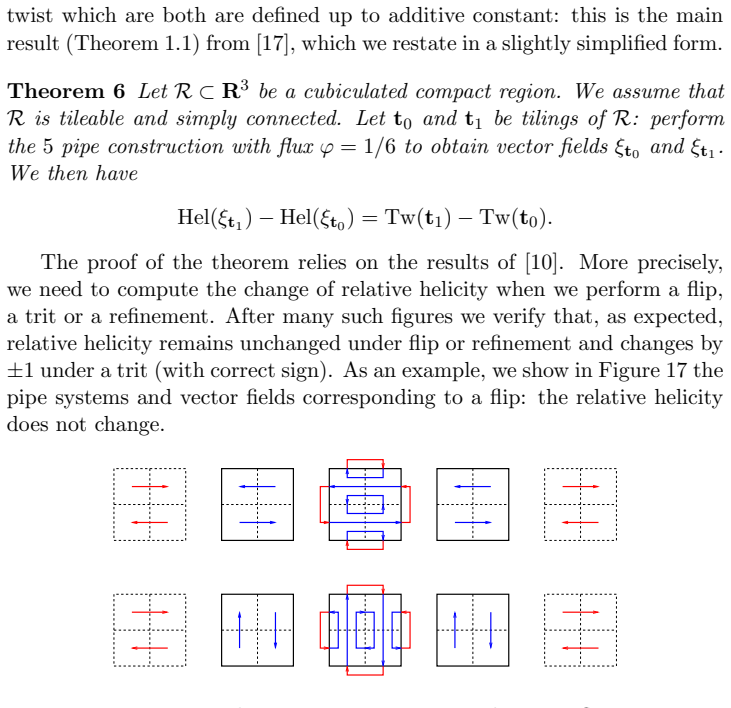
- The identity between twist and the relative helicity of the five-pipe construction gives a fluid-dynamics counterpart to the combinatorial obstruction to local rearrangement.
Reading between the lines
- If the unknown refinement bound in Lemma 4.7 could be made explicit, connectivity for boxes would become a finite search problem: refine, then search for flip and trit sequences between two given tilings.
- The flux–twist classification suggests a natural map from flip components to H1(R;Z) × (Z or Z/m), and one could test computationally whether every pair of invariants is realized for specific regions such as small boxes.
- For boxes in which more than one side tends to infinity, the cylinder result suggests that twist should remain asymptotically normal; computing twist distributions for 4×N×N boxes as N grows would provide a direct numerical test.
- The five-pipe construction may permit physical experiments: a network of pipes with flux φ=1/6 built from a tiling would have measurable helicity equal to its twist, allowing fluid experiments to probe tiling connectivity classes.
Editorial analysis
A structured set of objections, weighed in public.
Referee Report
Summary. The manuscript is a survey of domino tilings in dimensions three and higher. It reviews classical two-dimensional results (enumeration via Pfaffians, the Arctic circle theorem, flip connectivity), then introduces three-dimensional tilings, flip and trit moves, the flux and twist invariants, and the main structural result (Theorem 2) that after sufficiently many refinements, flux equality characterizes flip-and-trit connectivity and flux-plus-twist equality characterizes flip connectivity. It also surveys the domino complex and domino group for cylinders, a commutative algebra approach via tiling and flip ideals, random tilings, a helicity interpretation of twist, enumeration data for small boxes, slab tilings with the triple twist, and results in dimensions four and above. The paper is written as a chapter-level overview and explicitly states many open problems.
Significance. If the presentation is corrected, the survey would be a useful entry point to a young and technically demanding area. It collects results from several recent papers, states the main theorems with references, and includes numerical data for small boxes that match values known in the literature (e.g., 229 tilings of the 3x3x2 box and 5,051,532,105 tilings of the 4x4x4 box). The authors are transparent about their reliance on their own work and about the open problem of bounding the number of refinements. However, the survey has an internal inconsistency in the definition of flux on which Theorem 2 rests, and it presents new computational data without any reproducibility information; these issues must be fixed before the survey can be relied upon as a self-contained reference.
major comments (2)
- [Section 4.2, Definition 4.5] Definition 4.5 defines Flux(t) := [t - t⊕] in H1(R*;Z), but R* was introduced in Section 3 only as the dual graph G(R*). In the homology of that graph, the difference between two tilings related by a flip is a 4-cycle, which is generally nonzero in H1(G(R*);Z). Therefore flux, as literally defined, is not invariant under flips, contradicting the paragraph immediately before Theorem 2 and making Theorem 2 ill-posed. The intended object must be the full dual cell complex (or, equivalently, H1(R;Z), as stated two paragraphs earlier in Section 4.2), in which a flip's 4-cycle bounds a face and is null-homologous. The definition should be repaired explicitly by defining the dual cell complex or by stating that flux takes values in H1(R;Z).
- [Section 8, Figure 18] The paper reports the number of tilings of the 4x4x8 box and the full twist distribution for the 4x4x60 box, and uses the latter to refute the conjecture that almost all tilings have twist 0. No algorithm, code, data file, or citation to a source for these computations is provided. Because these numbers do not appear in the cited literature and are load-bearing for the statement 'we know that this is not the case,' the authors should either give reproducibility details (algorithm, implementation, data) or clearly label the data as experimental and point to a source where the computation is described.
minor comments (7)
- [Section 4.2] The displayed 't0 ; trit ; t1' is garbled: a sequence of flips and trits, not a single trit, is meant, and the arrow notation should be cleaned up.
- [Section 6] The text says 'Figure 6 shows the graph of connected components under the flip move' but the graph is actually Figure 15; Figure 6 is the tiling of the 8x8x4 box with no flips.
- [References] Reference [4] is incomplete: the authors should be listed as Chandgotia, Sheffield, and Wolfram, and the arXiv identifier should be complete; reference [13] should read Jockusch, Propp, and Shor.
- [Section 4.4] The name 'Yazmon' should be 'Yamzon' both in the text and in the reference list entry for Gross and Yamzon.
- [Section 4.3] The statement 'The amount M of extra vertical space required is a function of D only' should clarify whether M depends on the two tilings being connected or only on the disk D; as written, this could be misread as a uniform bound depending only on D.
- [Lemma 4.7] Since Lemma 4.7 is the key technical step behind Theorem 2, a sentence explaining why refinements make the existence of a discrete Seifert surface plausible would help readers who do not have access to [10].
- [Table in Section 3] The component-size data for the 4x4x4 box are presented without a source; a citation to [10] or a note that the data are reproduced from the literature would be appropriate.
Circularity Check
No significant circularity: the survey's main theorems are imported from independent published sources, and the self-citations are disclosed, not constructed.
full rationale
This is a survey whose main structural results—Theorem 2 and Lemma 4.7 from [10], Theorem 6 from [17], and Theorems 3, 9, and 10 from [18, 23, 9]—are quoted from prior published papers, several co-authored by the present authors. Quoting one's own refereed theorems is not circular: these are parameter-free mathematical results with explicit hypotheses and published proofs, and the survey does not fit any parameter to data and then rename that fit a prediction. The introduction explicitly discloses the self-citation bias. The only substantive internal issue is Definition 4.5, where flux is assigned to H1(R*;Z) even though only the dual graph G(R*) was introduced; under a literal graph-homology reading a flip would change the class, so Theorem 2 is stated over an under-specified object. This is an expositional or definitional flaw and a correctness risk, but it is not a circular reduction: the theorem's content is not obtained by inserting a definition, nor is connectivity defined in terms of flux. Lemma 4.7 is also explicitly attributed to [10] and not proved in the survey, but that is a missing-proof and attribution matter, not a circular one. There is no fitted input called a prediction, no uniqueness result imported to forbid alternatives, and no ansatz smuggled in by citation. The paper is a transparent survey of independent published results, so the circularity score is 0.
Assumptions & free parameters
free parameters (2)
- Refinement factor k =
5 (hand-chosen; theory only requires 'sufficiently large')
- Pipe flux phi =
1/6
assumptions (3)
- domain assumption Regions are assumed to be balanced (equal numbers of black and white cubes) and topological manifolds
- standard math Standard algebraic topology machinery (homology H1(R;Z), fundamental groups, Seifert surface existence) applies to cubical complexes and the dual graph G(R*)
- ad hoc to paper The 5-pipe construction with flux 1/6 per pipe yields a divergence-free vector field whose relative helicity equals the twist
invented entities (3)
-
Twist invariant (Twist(t))
independent evidence
-
Flux invariant (Flux(t))
independent evidence
-
Triple twist (for slab tilings)
independent evidence
Cite this review
Pith. "Pith review of Domino tilings beyond 2D." pith.science (2026). https://pith.science/paper/DMI4D7OY
@misc{pith2026250722625,
  author       = {Pith},
  title        = {Pith review of: Domino tilings beyond 2D},
  year         = {2026},
  howpublished = {\url{https://pith.science/paper/DMI4D7OY}},
  note         = {Machine review of arXiv:2507.22625}
}
read the original abstract
There is a rich history of domino tilings in two dimensions. Through a variety of techniques we can answer questions such as: how many tilings are there of a given region or what does the space of all tilings look like? These questions and their answers become significantly more difficult in dimension three and above. Despite this curse of dimensionality, there have been exciting recent advances in the theory. Here we briefly review foundational results of two-dimensional domino tilings and highlight where challenges arise when generalizing to higher dimensions. We then survey results in higher dimensional domino tilings, focusing on the question of connectivity of the space of tilings, and the open problems that still remain.
Figures


Figures from the paper (19 more)




Reference graph
Works this paper leans on
-
[1]
Vieira Arthur M. M. Alencar George L. D., Saldanha Nicolau C. Slab tilings, flips and the triple twist. Discrete & Computational Geometry , 2025
work page 2025
-
[2]
V. I. Arnold. The asymptotic Hopf invariant and its applications. vol- ume 5, pages 327–345. 1986. Selected translations
work page 1986
-
[3]
Vladimir I. Arnold and Boris A. Khesin. Topological methods in hy- drodynamics, volume 125 of Applied Mathematical Sciences . Springer, Cham, second edition, [2021] ©2021
work page 2021
-
[4]
Large deviations for the 3d dimer model
Sheffield Chandgotia and Wolfram. Large deviations for the 3d dimer model. Arxiv Preprint arXiv:math/230408468
-
[5]
A computational commutative algebra approach to tilings
Tracy Chin. A computational commutative algebra approach to tilings. Bachelor’s thesis, Brown University, 2019
work page 2019
-
[6]
An improved upper bound for the 3-dimensional dimer problem
Mihai Ciucu. An improved upper bound for the 3-dimensional dimer problem. Duke Math. J. , 94(1):1–11, 1998
work page 1998
-
[7]
Local statistics for ran- dom domino tilings of the Aztec diamond
Henry Cohn, Noam Elkies, and James Propp. Local statistics for ran- dom domino tilings of the Aztec diamond. Duke Math. J. , 85(1):117– 166, 1996
work page 1996
-
[8]
A variational principle for domino tilings
Henry Cohn, Richard Kenyon, and James Propp. A variational principle for domino tilings. J. Amer. Math. Soc. , 14(2):297–346, 2001
work page 2001
Show all 27 references
-
[9]
Domino tilings of 3-dimensional cylinders
Raphael de Marreiros. Domino tilings of 3-dimensional cylinders. Phd thesis, Pontificia Universidade Catolica do Rio de Janeiro, 2025
2025
-
[10]
Klivans, Pedro H
Juliana Freire, Caroline J. Klivans, Pedro H. Milet, and Nicolau C. Saldanha. On the connectivity of spaces of three-dimensional domino tilings. Trans. Amer. Math. Soc. , 375(3):1579–1605, 2022
2022
-
[11]
Binomial ideals of domino tilings
Elizabeth Gross and Nicole Yamzon. Binomial ideals of domino tilings. Discrete Math., 344(11):Paper No. 112530, 14, 2021
2021
-
[12]
J. M. Hammersley. An improved lower bound for the multidimensional dimer problem. Proc. Cambridge Philos. Soc. , 64:455–463, 1968
1968
-
[13]
Random domino tilings and the arctic circle theorem
Propp Jockusch and Shor. Random domino tilings and the arctic circle theorem. Arxiv Preprint arXiv:math/9801068 . 26
-
[14]
Kasteleyn
P.W. Kasteleyn. The statistics of dimers on a lattice: I. the number of dimer arrangements on a quadratic lattice. Physica, 27(12):1209–1225, 1961
1961
-
[15]
R. Kenyon. An introduction to the dimer model. 17:p. 267–304, Mar 2004
2004
-
[16]
Dimers and amoebae
Richard Kenyon, Andrei Okounkov, and Scott Sheffield. Dimers and amoebae. Ann. of Math. (2) , 163(3):1019–1056, 2006
2006
-
[17]
Khesin and N
B. Khesin and N. Saldanha. Relative helicity and tiling twist. Trans- actions of the American Mathematical Society , 2025
2025
-
[18]
Klivans and Nicolau C
Caroline J. Klivans and Nicolau C. Saldanha. Domino tilings and flips in dimensions 4 and higher. Algebr. Comb., 5(1):163–185, 2022
2022
-
[19]
Domino tilings of three-dimensional regions
Pedro Milet. Domino tilings of three-dimensional regions. Phd thesis, Pontificia Universidade Catolica do Rio de Janeiro, 2015
2015
-
[20]
An asymptotic solution of the multidimensional dimer problem
Henryk Minc. An asymptotic solution of the multidimensional dimer problem. Linear and Multilinear Algebra , 8(3):235–239, 1979/80
1979
-
[21]
The complexity of generalized domino tilings
Igor Pak and Jed Yang. The complexity of generalized domino tilings. Electron. J. Combin. , 20(4):Paper 12, 23, 2013
2013
-
[22]
Saldanha
Nicolau C. Saldanha. Domino tilings of cylinders: connected compo- nents under flips and normal distribution of the twist. Electron. J. Combin., 28(1):Paper No. 1.28, 23, 2021
2021
-
[23]
Saldanha
Nicolau C. Saldanha. Domino tilings of cylinders: the domino group and connected components under flips. Indiana Univ. Math. J. , 71(3):965– 1002, 2022
2022
-
[24]
Saldanha and Carlos Tomei
Nicolau C. Saldanha and Carlos Tomei. An overview of domino and lozenge tilings. volume 2, pages 239–252. 1995. Combinatorics Week (Portuguese) (S˜ ao Paulo, 1994)
1995
-
[25]
H. N. V. Temperley and Michael E. Fisher. Dimer problem in statistical mechanics—an exact result. Philos. Mag. (8) , 6:1061–1063, 1961
1961
-
[26]
Thurston
William P. Thurston. Conway’s tiling groups. Amer. Math. Monthly , 97(8):757–773, 1990. 27
1990
-
[27]
L. G. Valiant. Completeness classes in algebra. In Conference Record of the Eleventh Annual ACM Symposium on Theory of Computing (At- lanta, Ga., 1979) , pages 249–261. ACM, New York, 1979. Caroline J. Klivans Brown University Box F Providence, RI 02906 USA klivans@brown.edu N...
1979
Reviewed August 6, 2026 · model on record in the stance chip above.
Discussion (0). Continue with ORCID to comment.