REVIEW 3 major objections 7 minor 95 references
Foundations for Energy-Aware Zero-Energy Devices: From Energy Sensing to Adaptive Protocols
T0 review · 3 major / 7 minor · reviewed 2026-08-06 · deepseek-v4-flash
Pith's one-line read Energy-aware protocols for zero-energy devices only work if their models include the cost of measuring energy itself, task-level energy variability, and the physics of energy storage.
desk verdict A genuinely useful taxonomy paper, not a new result; the motivating claim about modeling inaccuracy is plausible but unproven, exactly as the paper's own open-challenges table admits. read the letter →
The pith
A machine-rendered reading of the paper's core claim, the machinery that carries it, and where it could break.
The reading
What carries the argument
The load-bearing machinery is the energy state evolution equation, $E(t) = E(t_0) + \eta_1 E_H(t_0,t) - (1/\eta_2) E_L(t_0,t) - E_{\mathrm{leak}}(t_0,t)$, with capacity bounds $0 \le E(t) \le E_M$, which ties every protocol decision to physical energy accounting, together with the taxonomies that feed it: the three EI measurement points and four acquisition methods, the three harvest-use interaction modes (sequential harvest-then-consume, concurrent harvest-and-consume, and hybrid two-buffer harvest-consume), and the four energy-usage granularities (per-cycle, per-task, per-phase, per-instruction). The measurement cost models, for example $P_c = g(L) I_{sb} V_{dd}$ for comparator banks, $E_c = P_{\mathrm{an}} t_m + C_s V_{dd}^2$ for ADC sampling with capacitance scaling as $2^N$, and $E_c = (t-t_0) P_{\mathrm{id}} + \lfloor E_H/\Delta E \rfloor E_v$ for energy-integrated accumulation, are what let the paper quantify the overhead that idealized models omit. The granularity-axis-plus-atomicity rule, that each task class must be matched to the granularity at which energy enforcement happens, with atomic tasks designed idempotent and energy-bounded, is the design principle that translates the models into protocol guidance.
What would settle it
Instrument a capacitor-based ZED with a real ambient source, run a scheduler that assumes free and perfect energy knowledge plus fixed task costs, and compare its measured task-completion rate and brownout count against a scheduler that budgets the actual energy-information cost. If the idealized scheduler sustains its promised performance, the claim that small modeling inaccuracies make protocols unworkable collapses; if it fails as predicted, the claim is supported, and the measured completion-rate curve versus sampling period should show the concave peak that the paper's Example 3 predicts.
Extended reading notes
Core claim
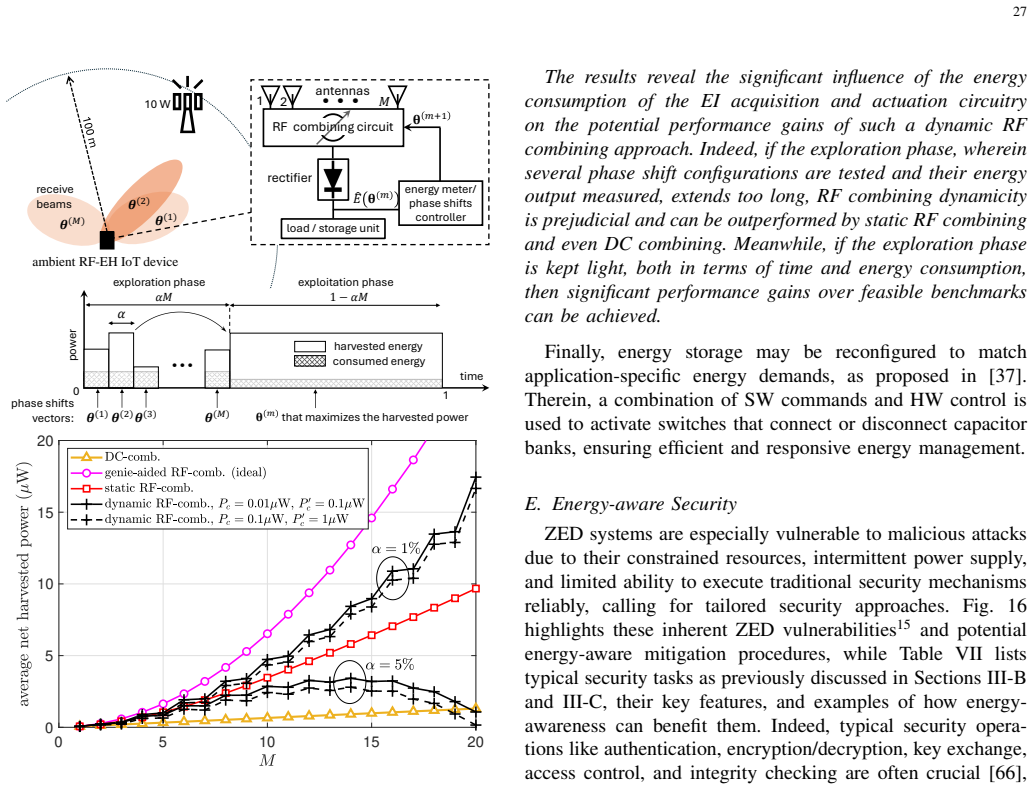
The central claim is that the realism of the underlying energy model, not the cleverness of the scheduling policy, is what decides whether an energy-aware ZED protocol works in practice. Concretely, the paper maintains that three aspects routinely oversimplified in the literature must be modeled explicitly: the energy and time cost of acquiring energy information (EI), the heterogeneity of task-level energy behavior, and the nonlinear dynamics and imperfections of energy storage. To make this operational, it dissects EI acquisition into three measurement points, the energy transducer output, the storage element, and the load consumption points, and four acquisition methods, comparator-based monitoring, information sampling, energy-integrated accumulation, and indirect sensing or time-to-event monitoring, each with its own overhead and error model. It then characterizes tasks by energy profile, execution granularity, and timeliness, and formalizes energy evolution through a state equation balancing harvested, consumed, and leaked energy with storage efficiency factors and capacity bounds. The paper's own examples, such as an age-of-information MAC where a threshold-only partially-aware policy can beat a fully-aware one once measurement cost is counted, and a dynamic RF-combining scheme whose gains evaporate if the exploration phase is too costly, are offered as evidence that including these factors changes protocol conclusions.
Load-bearing premise
The load-bearing premise is that the paper's taxonomies, three energy-information measurement points, four acquisition methods, three harvest-use modes, and four energy-usage granularities, genuinely span the practically important ZED design space, so that a device or protocol whose central constraint falls outside these categories would not be guided toward workable design by the paper's insights.
Editorial extensions
If this is right
- Protocol designers must treat EI acquisition as a budgeted operation: every voltage reading, comparator event, or forecast step costs energy and time, and a scheduler that ignores this cost can waste the very energy it is trying to protect.
- Task classification by energy profile and granularity becomes a prerequisite for scheduling: computational tasks can be chunked and checkpointed across power cycles, while actuation and security-critical bursts must run as atomic, idempotent units that succeed in one uninterrupted shot.
- Storage physics, leakage rate, charge and discharge efficiencies, capacity, and harvest-use mode, should enter protocol logic directly, since the sequential, concurrent, and hybrid architectures support different task sizes, latencies, and leakage penalties.
- Coarser EI can outperform richer EI once overhead is counted: a single comparator threshold can beat continuous energy sampling in some regimes, so the choice of EI fidelity is itself a design parameter to optimize.
- The field's theoretical and hybrid studies should converge on models that parametrize acquisition overhead, storage dynamics, and task variability rather than assuming them away, which the paper frames as its main open research direction.
Reading between the lines
- A natural extension the paper leaves implicit: because measured EI fidelity has a cost, each operating regime has an optimal measurement period and resolution, so the protocol design problem can be framed as a joint stopping-time problem, when to stop sensing energy and commit to an action, rather than as scheduling given free information.
- The concave task-completion curves in the paper's Example 3 suggest a testable law: for any ZED there is an optimal EI-sampling frequency balancing measurement cost against decision staleness, and this optimum shifts with the ratio of measurement energy to task energy, a prediction a testbed could verify quantitatively.
- The hybrid two-buffer architecture points toward a design exercise the paper does not solve: co-optimizing the split of storage capacity between the low-latency buffer and the bulk buffer against the task mix, treating the split as a protocol parameter rather than a fixed hardware choice.
- If the paper's central claim is right, benchmark comparisons of ZED protocols are only meaningful when they state the EI overhead model, the storage model, and the task energy profiles used; otherwise two 'energy-aware' protocols are comparing different physical systems under the same name.
Editorial analysis
A structured set of objections, weighed in public.
Referee Report
Summary. The paper is a survey/tutorial on energy-aware protocol design for zero-energy devices (ZEDs). It structures the design space into three main pillars: energy-information (EI) acquisition (measurement points, methods, overhead, forecasting), operation tasks (sensing, computation, communication, actuation), and energy-usage/storage models (source/load abstractions, harvest-use interaction modes, granularity, storage constraints). It then reviews representative energy-aware protocols and closes with a research agenda. The central thesis is that realistic protocol design must explicitly model EI acquisition overhead, task-level energy variability, and storage dynamics, because even small modeling inaccuracies can make ZED protocols unworkable.
Significance. If the central thesis holds, this is a valuable synthesis: it provides a useful taxonomy of EI acquisition points and methods, concrete overhead models (Eqs. (1), (2), (6)), a systematic task-energy characterization (Tables III and IV), a formal energy-evolution framework (Eq. (12) and Fig. 7), and several in-house examples grounded in prototypes. The paper also explicitly names open challenges, including sensitivity analysis and comparative evaluation. However, the significance is conditional: the paper is primarily a taxonomy and agenda, and its prescriptive conclusion—that the field 'must' shift to overhead-aware, storage-aware models—is not yet supported by quantitative evidence that small modeling errors actually cause feasibility collapse rather than mere performance degradation.
major comments (3)
- [Sections I-B, VI; Remarks 1 and 8] The load-bearing claim that 'even small modeling inaccuracies may result in unworkable protocols' is asserted rather than demonstrated. The supporting examples show performance degradation or parameter-dependent trade-offs, not a feasibility threshold: Example 3 (Fig. 11) shows a concave completion-rate curve, Example 5 (Fig. 14) shows average-AoI differences, and Example 6 (Fig. 15) shows that dynamic RF combining is 'prejudicial' only when the exploration phase is long. None of these establishes that small modeling errors push a realistic ZED from workable to unworkable. Moreover, Table VIII itself lists 'sensitivity of modeling assumptions' as an open challenge, conceding that the impact of these factors has not been quantified. I recommend either adding a quantitative sensitivity analysis (e.g., sweeping model-parameter errors and showing feasibility-region collapse for representative ZED parameter regimes) or softening the necessity claim to conditional guidance, so that the paper's research agenda does not rest on an unproven premise.
- [Examples 3 and 5 (Figs. 11 and 14)] The illustrative simulations that support the central narrative are not reproducible from the manuscript: no code, data, or full parameter tables are provided, and the figures lack error bars or confidence intervals. For a paper whose main claim is that modeling accuracy is critical, the absence of reproducible evidence for the illustrative performance comparisons weakens the argument. Please provide the simulation code/data or, at minimum, a complete parameter listing and a sensitivity check over the key parameters (E_c, Q, F, B, E_M, p, p', δ).
- [Section I-A1 (Table I)] The statement that purely theoretical studies 'often overestimate performance, or worse, incorrectly claim protocol feasibility' is a strong empirical claim, but Table I is a representative selection rather than a systematic comparison. No quantitative evidence is given that existing idealized models actually overestimate performance in realistic ZED scenarios, nor is there a meta-analysis showing how often such overestimation occurs. This claim is used to justify the paper's central necessity argument, so it should either be backed by a systematic comparison of model predictions against prototype measurements or be reframed as a plausible hypothesis.
minor comments (7)
- [Section II-B1] There is a typo: 'indicatie' should be 'indicate'.
- [Section II-B] The phrase 'acqusision' should be 'acquisition'.
- [Section V-D, paragraph on actuation intensity] 'PWW dimming' appears to be a typo for 'PWM dimming'.
- [Example 6, Fig. 15] The text '10 W . . .' in the figure is unclear; please specify whether 10 W is the EIRP of the RF source or the conducted power, and state the number of Monte Carlo runs used for the average net harvested power curves.
- [Table IV] The energy formula for the LED example is typeset without a multiplication symbol between I_F and t, which may confuse readers; please add the missing operator.
- [Section IV-A3] The phrase 'V oltage behavior' contains an unintended space; please fix the capitalization and spacing.
- [Section IV-C, paragraph on per-instruction granularity] The description of per-instruction-level energy tracking would benefit from a citation to a specific intermittent-computing checkpointing system, since the current text refers only to 'some intermittent computing platforms'.
Circularity Check
No significant circularity; the survey's taxonomies and worked examples are self-contained and do not reduce to their own inputs.
full rationale
The paper is a survey/tutorial whose central claims are qualitative, and its design insights are illustrated through examples rather than derived from a fitted parameter. The energy evolution equation (12) is a conservation-law definition, and the worked examples (Examples 2 through 6) apply it to specific hardware/parameter settings; the TinyML selection in Example 2, for instance, evaluates post-inference capacitor voltage via (15) and then chooses the most accurate feasible model, which is a direct application of the stated physical model rather than a prediction equivalent to a fit. The claim in Section I-B and the conclusions that 'even small modeling inaccuracies may result in unworkable protocols' is an assertion supported by qualitative examples and by the cited literature, not by a circular reduction; Table VIII explicitly lists the 'sensitivity of modeling assumptions' as an open challenge, which is a stated limitation rather than a hidden dependence on the target conclusion. Self-citations to the authors' prototypes [36], [39], [83], [85] appear as illustrative examples and as entries in the protocol review tables, but the taxonomy and the energy-usage classifications (SHC, CHC, HHC; per-cycle to per-instruction granularity) are presented as organizing frameworks, not as results forced by those citations. No fitted input is renamed as a prediction, no uniqueness theorem is imported from the authors' prior work, and no ansatz is smuggled in via citation. Therefore, the derivation chain is self-contained for the paper's stated purpose, and no circular step is identifiable.
Assumptions & free parameters
assumptions (4)
- standard math Capacitor energy-voltage relation E = (1/2) C V^2 with I(t) = C dV/dt
- domain assumption Energy state evolution E(t) = E(t0) + eta1 E_H - (1/eta2) E_L - E_leak with 0 <= E(t) <= E_M
- domain assumption CMOS dynamic power model P = gamma C_s V_dd^2 f, with E_task approximately proportional to f^2 N_cyc under DVFS
- domain assumption Measurement error decomposition epsilon = epsilon_t + epsilon_q + epsilon_0 with sigma_t^2 = A/t_m and uniform quantization error
Cite this review
Pith. "Pith review of Foundations for Energy-Aware Zero-Energy Devices: From Energy Sensing to Adaptive Protocols." pith.science (2026). https://pith.science/paper/R4QXV5P7
@misc{pith2026250722740,
  author       = {Pith},
  title        = {Pith review of: Foundations for Energy-Aware Zero-Energy Devices: From Energy Sensing to Adaptive Protocols},
  year         = {2026},
  howpublished = {\url{https://pith.science/paper/R4QXV5P7}},
  note         = {Machine review of arXiv:2507.22740}
}
read the original abstract
Zero-energy devices (ZEDs) are key enablers of sustainable Internet of Things networks by operating solely on harvested ambient energy. Their limited and dynamic energy budget calls for protocols that are energy-aware and intelligently adaptive. However, designing effective energy-aware protocols for ZEDs requires theoretical models that realistically reflect device constraints. Indeed, existing approaches often oversimplify key aspects such as energy information (EI) acquisition, task-level variability, and energy storage dynamics, limiting their practical relevance and transferability. This article addresses this gap by offering a structured overview of the key modeling components, trade-offs, and limitations involved in energy-aware ZED protocol design. For this, we dissect EI acquisition methods and costs, characterize core operational tasks, analyze energy usage models and storage constraints, and review representative protocol strategies. Moreover, we offer design insights and guidelines on how ZED operation protocols can leverage EI, often illustrated through selected in-house examples. Finally, we outline key research directions to inspire more efficient and scalable protocol solutions for future ZEDs.
Figures


Figures from the paper (13 more)



Reference graph
Works this paper leans on
-
[1]
Energy-sustainable IoT connec- tivity: Vision, technological enablers, challenges, and future directions,
O. L. A. L ´opez, O. M. Rosabal, D. E. Ruiz-Guirola, P. Raghuwanshi, K. Mikhaylov, L. Lov ´en, and S. Iyer, “Energy-sustainable IoT connec- tivity: Vision, technological enablers, challenges, and future directions,” IEEE Open Journal of the Communications Society, vol. 4, pp. 2609– 2666, 2023
2023
-
[2]
Next-generation IoT devices: Sustainable eco-friendly manufacturing, energy harvesting, and wireless connectivity,
H. Rahmani, D. Shetty, M. Wagih, Y . Ghasempour, V . Palazzi, N. B. Carvalho, R. Correia, A. Costanzo, D. Vital, F. Alimenti, J. Kettle, D. Masotti, P. Mezzanotte, L. Roselli, and J. Grosinger, “Next-generation IoT devices: Sustainable eco-friendly manufacturing, energy harvesting, and wireless connectivity,”IEEE Journal of Microwaves, vol. 3, no. 1, pp. ...
2023
-
[3]
White paper on critical and massive machine type communication towards 6G [white paper],
N. Mahmood, O. L ´opez, O. Park, I. Moerman, K. Mikhaylov, E. Mercier, A. Munari, F. Clazzer, S. B ¨ocker, and H. Bartz(Eds.), “White paper on critical and massive machine type communication towards 6G [white paper],”6G Research Visions, vol. 11, 2020
2020
-
[4]
Energy harvesting in self-sustainable IoT devices and applications based on cross-layer architecture design: A survey,
A. Banotra, S. Ghose, D. Mishra, and S. Modem, “Energy harvesting in self-sustainable IoT devices and applications based on cross-layer architecture design: A survey,”Computer Networks, vol. 236, p. 110011, 2023
2023
-
[5]
Massive wireless energy transfer: En- abling sustainable IoT toward 6G era,
O. L. A. L ´opez, H. Alves, R. D. Souza, S. Montejo-S ´anchez, E. M. G. Fern´andez, and M. Latva-Aho, “Massive wireless energy transfer: En- abling sustainable IoT toward 6G era,”IEEE Internet of Things Journal, vol. 8, no. 11, pp. 8816–8835, 2021
2021
-
[6]
Low power energy harvesting systems: State of the art and future challenges,
K. Calautit, D. S. Nasir, and B. R. Hughes, “Low power energy harvesting systems: State of the art and future challenges,”Renewable and Sustainable Energy Reviews, vol. 147, p. 111230, 2021
2021
-
[7]
Alves and O
H. Alves and O. A. Lopez,Wireless RF Energy Transfer in the Massive IoT Era: Towards Sustainable Zero-energy Networks. John Wiley & Sons, 2021
2021
-
[8]
Hexa-X-II - Deliverable D5.2: characteristics and classification of 6G device classes,
B. Balakrishnan (ed.), M. Aernouts, P. Alexias, A. AlNahari, B. Balakrishnan, M. Basnayaka, P. Demestichas, C. Desset, J. Famaey, R. J ¨antti, A. Karakoc, E. Katranaras, H. Khan, K. Koskinen, C. Lavaud, O. L ´opez, H. Master, L. Mayer, N. Mazloum, B. Mendes, O. Rosabal, M. Schiefer, M. Shehata, H. S. ao, B. Singh, R. Singh, P. Tinnakornsrisuphap, J. Velas...
2023
Show all 95 references
-
[9]
Zero-energy devices for 6G: Technical enablers at a glance,
O. L ´opez, R. K. Singh, D.-T. Phan-Huy, E. Katranaras, N. Mazloum, K. Ruttik, R. J ¨antti, H. Khan, O. Rosabal, P. Alexias, P. Raghuwanshi, D. Ruiz-Guirola, B. Singh, A. H ¨oglund, D. P. Van, A. Azarbahram, and J. Famaey, “Zero-energy devices for 6G: Technical enablers at a g...
2025
-
[10]
Energy harvesting technologies for IoT edge devices,
F. ¨Unl¨u, L. Wawrla, and A. Diaz, “Energy harvesting technologies for IoT edge devices,”Energy Efficient End-use Equipment International Energy Agency, vol. 36, 2018
2018
-
[11]
Internet of hybrid energy harvesting things,
O. B. Akan, O. Cetinkaya, C. Koca, and M. Ozger, “Internet of hybrid energy harvesting things,”IEEE Internet of Things Journal, vol. 5, no. 2, pp. 736–746, 2018
2018
-
[12]
Energy harvesting for the Internet-of-Things: Measurements and proba- bility models,
G. Smart, J. Atkinson, J. Mitchell, M. Rodrigues, and Y . Andreopoulos, “Energy harvesting for the Internet-of-Things: Measurements and proba- bility models,” in23rd International Conference on Telecommunications (ICT), 2016, pp. 1–6
2016
-
[13]
Energy harvesting techniques for Internet of Things (IoT),
T. Sanislav, G. D. Mois, S. Zeadally, and S. C. Folea, “Energy harvesting techniques for Internet of Things (IoT),”IEEE Access, vol. 9, pp. 39 530–39 549, 2021
2021
-
[14]
Energy harvesting for wireless IoT use cases: A generic feasibility model and tradeoff study,
D. Van Leemput, A. Sabovic, K. Hammoud, J. Famaey, S. Pollin, and E. De Poorter, “Energy harvesting for wireless IoT use cases: A generic feasibility model and tradeoff study,”IEEE Internet of Things Journal, vol. 10, no. 17, pp. 15 025–15 043, 2023
2023
-
[15]
Design architectures for energy harvesting in the Internet of Things,
S. Zeadally, F. K. Shaikh, A. Talpur, and Q. Z. Sheng, “Design architectures for energy harvesting in the Internet of Things,”Renewable and Sustainable Energy Reviews, vol. 128, p. 109901, 2020. 30
2020
-
[16]
Sensing, computing, and communications for energy harvesting IoTs: A survey,
D. Ma, G. Lan, M. Hassan, W. Hu, and S. K. Das, “Sensing, computing, and communications for energy harvesting IoTs: A survey,”IEEE Communications Surveys & Tutorials, vol. 22, no. 2, pp. 1222–1250, 2020
2020
-
[17]
A survey of techniques for intermittent computing,
S. Umesh and S. Mittal, “A survey of techniques for intermittent computing,”Journal of Systems Architecture, vol. 112, p. 101859, 2021
2021
-
[18]
Scheduling computational and energy harvest- ing tasks in deadline-aware intermittent systems,
B. Islam and S. Nirjon, “Scheduling computational and energy harvest- ing tasks in deadline-aware intermittent systems,” in2020 IEEE Real- Time and Embedded Technology and Applications Symposium (RTAS), 2020, pp. 95–109
2020
-
[19]
Transient computing for energy harvesting systems: A survey,
M. Jia, E. H.-M. Sha, Q. Zhuge, and S. Gu, “Transient computing for energy harvesting systems: A survey,”Journal of Systems Architecture, vol. 132, p. 102743, 2022
2022
-
[20]
Task schedul- ing for energy-harvesting-based IoT: A survey and critical analysis,
M. M. Sandhu, S. Khalifa, R. Jurdak, and M. Portmann, “Task schedul- ing for energy-harvesting-based IoT: A survey and critical analysis,” IEEE Internet of Things Journal, vol. 8, no. 18, pp. 13 825–13 848, 2021
2021
-
[21]
CARTOS: a charging-aware real-time operating system for intermittent batteryless devices,
M. Karimi, Y . Wang, Y . Kim, Y . Lim, and H. Kim, “CARTOS: a charging-aware real-time operating system for intermittent batteryless devices,”arXiv preprint arXiv:2311.07227, 2023
2023
-
[22]
A modular 1 mm 3 die-stacked sensing platform with low power I 2C inter-die communication and multi-modal energy harvesting,
Y . Lee, S. Bang, I. Lee, Y . Kim, G. Kim, M. H. Ghaed, P. Pannuto, P. Dutta, D. Sylvester, and D. Blaauw, “A modular 1 mm 3 die-stacked sensing platform with low power I 2C inter-die communication and multi-modal energy harvesting,”IEEE Journal of Solid-State Circuits, vol. 4...
2013
-
[23]
Simulating the power consumption of large-scale sensor network applications,
V . Shnayder, M. Hempstead, B. Chen, G. W. Allen, and M. Welsh, “Simulating the power consumption of large-scale sensor network applications,” inProceedings of the 2nd international conference on Embedded networked sensor systems, 2004, pp. 188–200
2004
-
[24]
Timely execution on intermittently powered batteryless sensors,
J. Hester, K. Storer, and J. Sorber, “Timely execution on intermittently powered batteryless sensors,” inProceedings of the 15th ACM Confer- ence on Embedded Network Sensor Systems, 2017, pp. 1–13
2017
-
[25]
Supporting peripherals in intermittent sys- tems with just-in-time checkpoints,
K. Maeng and B. Lucia, “Supporting peripherals in intermittent sys- tems with just-in-time checkpoints,” inProceedings of the 40th ACM SIGPLAN Conference on Programming Language Design and Imple- mentation, 2019, pp. 1101–1116
2019
-
[26]
Adaptive low-overhead scheduling for periodic and reactive intermittent execution,
——, “Adaptive low-overhead scheduling for periodic and reactive intermittent execution,” inProceedings of the 41st ACM SIGPLAN Conference on Programming Language Design and Implementation, 2020, pp. 1005–1021
2020
-
[27]
Energy-aware sensing on battery-less LoRaW AN devices with energy harvesting,
A. Sabovic, C. Delgado, D. Subotic, B. Jooris, E. De Poorter, and J. Famaey, “Energy-aware sensing on battery-less LoRaW AN devices with energy harvesting,”Electronics, vol. 9, no. 6, p. 904, 2020
2020
-
[28]
Energy-adaptive real-time sensing for batteryless devices,
M. Karimi, Y . Wang, and H. Kim, “Energy-adaptive real-time sensing for batteryless devices,” inIEEE 28th International Conference on Em- bedded and Real-Time Computing Systems and Applications (RTCSA), 2022, pp. 205–211
2022
-
[29]
Optimal energy-aware task scheduling for batteryless IoT devices,
C. Delgado and J. Famaey, “Optimal energy-aware task scheduling for batteryless IoT devices,”IEEE Transactions on Emerging Topics in Computing, vol. 10, no. 3, pp. 1374–1387, 2022
2022
-
[30]
Towards energy-aware tinyML on battery-less IoT devices,
A. Sabovic, M. Aernouts, D. Subotic, J. Fontaine, E. De Poorter, and J. Famaey, “Towards energy-aware tinyML on battery-less IoT devices,” Internet of Things, vol. 22, p. 100736, 2023
2023
-
[31]
Energy-aware federated learning with distributed user sampling and multichannel ALOHA,
R. Valente da Silva, O. L. A. L ´opez, and R. D. Souza, “Energy-aware federated learning with distributed user sampling and multichannel ALOHA,”IEEE Communications Letters, vol. 27, no. 10, pp. 2867– 2871, 2023
2023
-
[32]
En- ergy and age-aware MAC for low-power massive IoT,
O. Giannini, G. M. de Jesus, R. Verdone, and O. A. L ´opez, “En- ergy and age-aware MAC for low-power massive IoT,”arXiv preprint arXiv:2502.08344, 2025
2025 arXiv
-
[33]
EnergyBudgets: Inte- grating physical energy measurement devices into systems software,
L. Gerhorst, S. Reif, B. Herzog, and T. H ¨onig, “EnergyBudgets: Inte- grating physical energy measurement devices into systems software,” in X Brazilian Symposium on Computing Systems Engineering (SBESC), 2020, pp. 1–8
2020
-
[34]
An efficient medium access control protocol for RF energy harvesting based IoT devices,
S. Khan, A. N. Alvi, M. A. Javed, Y . D. Al-Otaibi, and A. K. Bashir, “An efficient medium access control protocol for RF energy harvesting based IoT devices,”Computer Communications, vol. 171, pp. 28–38, 2021
2021
-
[35]
Machine learning prediction based adaptive duty cycle MAC protocol for solar energy harvesting wireless sensor networks,
S. Sarang, G. M. Stojanovi ´c, M. Drieberg, S. Stankovski, K. Bingi, and V . Jeoti, “Machine learning prediction based adaptive duty cycle MAC protocol for solar energy harvesting wireless sensor networks,”IEEE Access, vol. 11, pp. 17 536–17 554, 2023
2023
-
[36]
Dynamic RF combining for multi-antenna ambient energy harvesting,
O. L. A. L ´opez, B. Clerckx, and M. Latva-Aho, “Dynamic RF combining for multi-antenna ambient energy harvesting,”IEEE Wireless Commu- nications Letters, vol. 11, no. 3, pp. 493–497, 2022
2022
-
[37]
A reconfigurable energy storage architecture for energy-harvesting devices,
A. Colin, E. Ruppel, and B. Lucia, “A reconfigurable energy storage architecture for energy-harvesting devices,”SIGPLAN Not., vol. 53, no. 2, p. 767–781, Mar. 2018
2018
-
[38]
A self-adaptive and self- sufficient energy harvesting system,
M. M ¨osch, G. Fischerauer, and D. Hoffmann, “A self-adaptive and self- sufficient energy harvesting system,”Sensors, vol. 20, no. 9, p. 2519, 2020
2020
-
[39]
An energy management unit for predictive solar energy harvesting IoT,
A. J. Rajappa, A. Sabovic, B. Celikkol, M. Aernouts, P. Reiter, S. Mer- celis, P. Hellinckx, and J. Famaey, “An energy management unit for predictive solar energy harvesting IoT,” in8th International Conference on Internet of Things, Big Data and Security (IoTBDS), APR 21-23, ...
2023
-
[40]
AsTAR: Sustainable battery free energy harvesting for heterogeneous platforms and dynamic en- vironments,
F. Yang, A. S. Thangarajan, G. S. Ramachandran, B. Krishnamachari, W. Joosen, C. Huygens, and D. Hughes, “AsTAR: Sustainable battery free energy harvesting for heterogeneous platforms and dynamic en- vironments,” inProceedings of the 2019 International Conference on Embedded W...
2019
-
[41]
InK: Reactive kernel for tiny batteryless sensors,
K. S. Yıldırım, A. Y . Majid, D. Patoukas, K. Schaper, P. Pawelczak, and J. Hester, “InK: Reactive kernel for tiny batteryless sensors,” in Proceedings of the 16th ACM Conference on Embedded Networked Sensor Systems, ser. SenSys ’18. New York, NY , USA: Association for Computi...
2018
-
[42]
Learning to communicate effec- tively between battery-free devices,
K. Geissdoerfer and M. Zimmerling, “Learning to communicate effec- tively between battery-free devices,” in19th USENIX Symposium on Networked Systems Design and Implementation (NSDI 22), 2022, pp. 419–435
2022
-
[43]
RACEME: Embedded intelligence for correlation-driven predictive energy-harvesting management in LoRa networks,
S. Jewsakul and E. C. H. Ngai, “RACEME: Embedded intelligence for correlation-driven predictive energy-harvesting management in LoRa networks,”ACM Trans. Sen. Netw., vol. 21, no. 2, Mar. 2025
2025
-
[44]
An electromagnetic vibration energy harvester with a tunable mass moment of inertia,
P. Ibrahim, M. Arafa, and Y . Anis, “An electromagnetic vibration energy harvester with a tunable mass moment of inertia,”Sensors, vol. 21, no. 16, 2021
2021
-
[45]
Measurement and validation of energy harvesting IoT devices,
L. Sigrist, A. Gomez, R. Lim, S. Lippuner, M. Leubin, and L. Thiele, “Measurement and validation of energy harvesting IoT devices,” in Design, Automation & Test in Europe Conference & Exhibition (DATE), 2017, 2017, pp. 1159–1164
2017
-
[46]
Sense your power: The ECO approach to energy awareness for IoT devices,
M. Rottleuthner, T. C. Schmidt, and M. W ¨ahlisch, “Sense your power: The ECO approach to energy awareness for IoT devices,”ACM Trans- actions on Embedded Computing Systems (TECS), vol. 20, no. 3, pp. 1–25, 2021
2021
-
[47]
A nano-power wake-up circuit for energy- driven IoT applications,
L. Teng, J. Liang, and S. Du, “A nano-power wake-up circuit for energy- driven IoT applications,” inIEEE International Symposium on Circuits and Systems (ISCAS), 2022, pp. 2383–2387
2022
-
[48]
Scalable and interoperable low-power internet of things networks,
J. Eriksson, “Scalable and interoperable low-power internet of things networks,” Ph.D. dissertation, Acta Universitatis Upsaliensis, 2023
2023
-
[49]
Powering the IoT: Storage-less and converter- less energy harvesting,
H. G. Lee and N. Chang, “Powering the IoT: Storage-less and converter- less energy harvesting,” inThe 20th Asia and South Pacific Design Automation Conference, 2015, pp. 124–129
2015
-
[50]
µmonitor: In-situ energy monitoring with microwatt power consumption,
S. Naderiparizi, A. N. Parks, F. S. Parizi, and J. R. Smith, “µmonitor: In-situ energy monitoring with microwatt power consumption,” inIEEE International Conference on RFID (RFID), 2016, pp. 1–8
2016
-
[51]
Analysis of energy consumption for SPI and I2C communications in ultra-low power embedded systems,
J. Zidar, I. Aleksi, and T. Mati ´c, “Analysis of energy consumption for SPI and I2C communications in ultra-low power embedded systems,” in46th MIPRO ICT and Electronics Convention (MIPRO), 2023, pp. 213–217
2023
-
[52]
Analysis of power consumption and linearity in capacitive digital-to-analog convert- ers used in successive approximation ADCs,
M. Saberi, R. Lotfi, K. Mafinezhad, and W. A. Serdijn, “Analysis of power consumption and linearity in capacitive digital-to-analog convert- ers used in successive approximation ADCs,”IEEE Transactions on Circuits and Systems I: Regular Papers, vol. 58, no. 8, pp. 1736–1748, 2011
2011
-
[53]
Set- up for observation thermal voltage noise and determination of absolute temperature and boltzmann constant,
T. M. Mishonov, N. S. Serafimov, E. G. Petkov, and A. M. Varonov, “Set- up for observation thermal voltage noise and determination of absolute temperature and boltzmann constant,”European Journal of Physics, vol. 43, no. 3, p. 035103, apr 2022
2022
-
[54]
TinyML: Tools, applications, challenges, and future research direc- tions,
R. Kallimani, K. Pai, P. Raghuwanshi, S. Iyer, and O. L. L ´opez, “TinyML: Tools, applications, challenges, and future research direc- tions,”Multimedia Tools and Applications, vol. 83, no. 10, pp. 29 015– 29 045, 2024
2024
-
[55]
A comprehensive review on energy harvesting integration in IoT systems from MAC layer perspective: Challenges and opportunities,
G. Famitafreshi, M. S. Afaqui, and J. Meli `a-Segu´ı, “A comprehensive review on energy harvesting integration in IoT systems from MAC layer perspective: Challenges and opportunities,”Sensors, vol. 21, no. 9, p. 3097, 2021
2021
-
[56]
A testbed and an experimental public dataset for energy- harvested IoT solutions,
M. Kuzman, X. d. Toro Garc ´ıa, S. Escolar, A. Caruso, S. Chessa, and J. C. L ´opez, “A testbed and an experimental public dataset for energy- harvested IoT solutions,” inIEEE 17th International Conference on Industrial Informatics (INDIN), vol. 1, 2019, pp. 869–876. 31
2019
-
[57]
Dataset: Tracing indoor solar harvesting,
L. Sigrist, A. Gomez, and L. Thiele, “Dataset: Tracing indoor solar harvesting,” inProceedings of the 2nd Workshop on Data Acquisition To Analysis, ser. DATA’19. New York, NY , USA: Association for Computing Machinery, 2019, p. 47–50
2019
-
[58]
Machine learning for QoS prediction in vehicular communication: Challenges and solution approaches,
A. Palaios, C. L. Vielhaus, D. F. K ¨ulzer, C. Watermann, R. Her- nang´omez, S. Partani, P. Geuer, A. Krause, R. Sattiraju, M. Kasparick, G. P. Fettweis, F. H. P. Fitzek, H. D. Schotten, and S. Sta´nczak, “Machine learning for QoS prediction in vehicular communication: Challen...
2023
-
[59]
A comprehensive review of energy harvesting and routing strategies for IoT sensors sustainability and communication technology,
H. N. S. Aldin, M. R. Ghods, F. Nayebipour, and M. N. Torshiz, “A comprehensive review of energy harvesting and routing strategies for IoT sensors sustainability and communication technology,”Sensors International, vol. 5, p. 100258, 2024
2024
-
[60]
Recent advances in energy-saving chemiresistive gas sensors: A review,
S. M. Majhi, A. Mirzaei, H. W. Kim, S. S. Kim, and T. W. Kim, “Recent advances in energy-saving chemiresistive gas sensors: A review,”Nano Energy, vol. 79, p. 105369, 2021
2021
-
[61]
Spectral physical un- clonable functions: downscaling randomness with multi-resonant hybrid particles,
M. Sandomirskii, E. Petrova, P. Kustov, L. Chizhov, A. Larin, S. Bruy`ere, V . Yaroshenko, E. Ageev, P. Belov, and D. Zuev, “Spectral physical un- clonable functions: downscaling randomness with multi-resonant hybrid particles,”Nature Communications, vol. 16, no. 1, p. 5097, 2025
2025
-
[62]
Analog architecture complexity theory empowering ultra-low power configurable analog and mixed mode SoC systems,
J. Hasler, “Analog architecture complexity theory empowering ultra-low power configurable analog and mixed mode SoC systems,”Journal of Low Power Electronics and Applications, vol. 9, no. 1, p. 4, 2019
2019
-
[63]
Opportunistic routing with in-network aggregation for duty-cycled WSNs with delay requirements,
J. So and H. Byun, “Opportunistic routing with in-network aggregation for duty-cycled WSNs with delay requirements,”EURASIP Journal on Wireless Communications and Networking, vol. 2014, pp. 1–16, 2014
2014
-
[64]
Ultra-low power keyword spotting at the edge,
M. G. Ulkar and O. E. Okman, “Ultra-low power keyword spotting at the edge,”arXiv preprint arXiv:2111.04988, 2021
2021 arXiv
-
[65]
Goal-oriented communications based on recursive early exit neural networks,
J. Pomponi, M. Merluzzi, A. Devoto, M. P. Mota, P. Di Lorenzo, and S. Scardapane, “Goal-oriented communications based on recursive early exit neural networks,” in2024 58th Asilomar Conference on Signals, Systems, and Computers, 2024, pp. 378–382
2024
-
[66]
The energy cost of crypto- graphic key establishment in wireless sensor networks,
J. Großsch ¨adl, A. Szekely, and S. Tillich, “The energy cost of crypto- graphic key establishment in wireless sensor networks,” inProceedings of the 2nd ACM symposium on Information, computer and communica- tions security, 2007, pp. 380–382
2007
-
[67]
A performance study of crypto-hardware in the low-end IoT,
P. Kietzmann, L. Boeckmann, L. Lanzieri, T. C. Schmidt, and M. W ¨ahlisch, “A performance study of crypto-hardware in the low-end IoT,”Cryptology ePrint Archive, 2021
2021
-
[68]
An empirical evaluation of various digital signature scheme in wireless sensor network,
P. Kumar and S. K. Sharma, “An empirical evaluation of various digital signature scheme in wireless sensor network,”IETE Technical Review, vol. 39, no. 4, pp. 974–984, 2022
2022
-
[69]
J. M. Rabaey, A. Chandrakasan, and B. Nikolic,Digital integrated circuits. Prentice hall Englewood Cliffs, 2002, vol. 2
2002
-
[70]
Power- efficient time-sensitive mapping in heterogeneous systems,
C. Liu, J. Li, W. Huang, J. Rubio, E. Speight, and X. Lin, “Power- efficient time-sensitive mapping in heterogeneous systems,” inProceed- ings of the 21st international conference on Parallel architectures and compilation techniques, 2012, pp. 23–32
2012
-
[71]
Backscatter communications with passive receivers: From fundamentals to applications,
M. Stanacevic, A. Athalye, Z. J. Haas, S. R. Das, and P. Djuric, “Backscatter communications with passive receivers: From fundamentals to applications,”ITU Journal, vol. 1, no. 1, 2020
2020
-
[72]
Security in Internet of Things: A review,
N. A. Khan, A. Awang, and S. A. A. Karim, “Security in Internet of Things: A review,”IEEE Access, vol. 10, pp. 104 649–104 670, 2022
2022
-
[73]
Asadi and K
F. Asadi and K. Eguchi,Dynamics and control of DC-DC converters. Springer Nature, 2022
2022
-
[74]
The improvement of energy harvesting efficiency of constant current source,
V . Martynyuk, V . Kosenkov, and M. Fedula, “The improvement of energy harvesting efficiency of constant current source,”Problemele Energeticii Regionale, vol. 41, no. 1-2, pp. 74–83, 2019
2019
-
[75]
Load representation for dynamic performance analysis,
W. Price, H. Chiang, K. Srinivasan, C. Taylor, E. Vaahedi, and H. Clark, “Load representation for dynamic performance analysis,”IEEE Trans- actions on Power Systems, vol. 8, no. 2, pp. 472–482, 1993
1993
-
[76]
Supercapacitor–a guide for the design-in process,
R. Kalbitz and F. Puhane, “Supercapacitor–a guide for the design-in process,”W ¨URT ELEKTRONIK, pp. 1–9, 2020
2020
-
[77]
Behavioral modeling of a radio frequency wireless power transfer system for batteryless Internet of Things applications,
P. C. de Lacerda, A. Augusto Mariano, G. Brante, O. Luis Al- caraz L ´opez, K. Mikhaylov, and R. Demo Souza, “Behavioral modeling of a radio frequency wireless power transfer system for batteryless Internet of Things applications,”IEEE Access, vol. 12, pp. 86 974– 86 984, 2024
2024
-
[78]
A critical review of using the Peukert equation and its generalizations for lithium-ion cells,
N. Galushkin, N. Yazvinskaya, and D. Galushkin, “A critical review of using the Peukert equation and its generalizations for lithium-ion cells,” Journal of The Electrochemical Society, vol. 167, no. 12, p. 120516, 2020
2020
-
[79]
Benefits and challenges of the kinetic battery model in system-level storage unit simulations,
P. Dicke, S. Resch, F. Steinbacher, M. Luther, and R. German, “Benefits and challenges of the kinetic battery model in system-level storage unit simulations,” inProceedings of the 12th International Conference on Computer Modeling and Simulation, ser. ICCMS ’20. New York, NY ,...
2020
-
[80]
Recharging probably keeps batteries alive,
H. Hermanns, J. Kr ˇc´al, and G. Nies, “Recharging probably keeps batteries alive,” inCyber Physical Systems. Design, Modeling, and Evaluation: 5th International Workshop, CyPhy 2015, Amsterdam, The Netherlands, October 8, 2015, Proceedings 5. Springer, 2015, pp. 83– 98
2015
-
[81]
Equivalent circuit model parameters ex- traction for lithium ion batteries using electrochemical impedance spec- troscopy,
P. Vyroubal and T. Kazda, “Equivalent circuit model parameters ex- traction for lithium ion batteries using electrochemical impedance spec- troscopy,”Journal of Energy Storage, vol. 15, pp. 23–31, 2018
2018
-
[82]
An analytical high-level battery model for use in energy management of portable electronic sys- tems,
D. Rakhmatov and S. Vrudhula, “An analytical high-level battery model for use in energy management of portable electronic sys- tems,” inIEEE/ACM International Conference on Computer Aided Design. ICCAD 2001. IEEE/ACM Digest of Technical Papers (Cat. No.01CH37281), 2001, pp. 488–493
2001
-
[83]
Energy-aware tinyml model selection on zero energy devices,
A. Sabovic, J. Fontaine, E. D. Poorter, and J. Famaey, “Energy-aware tinyml model selection on zero energy devices,”Internet of Things, vol. 30, p. 101488, 2025
2025
-
[84]
LiteRT overview,
Google AI Edge Team, “LiteRT overview,” https://ai.google.dev/edge/ litert, May 2025, last updated May 19, 2025
2025
-
[85]
Batteryless NB-IoT prototype for bidirec- tional communication powered by ambient light,
A. Sultania and J. Famaey, “Batteryless NB-IoT prototype for bidirec- tional communication powered by ambient light,”Ad Hoc Networks, vol. 142, p. 103100, 04 2023
2023
-
[86]
Cooperative spectrum sensing optimization in energy-harvesting cognitive radio networks,
X. Liu, K. Zheng, K. Chi, and Y .-H. Zhu, “Cooperative spectrum sensing optimization in energy-harvesting cognitive radio networks,” IEEE Transactions on Wireless Communications, vol. 19, no. 11, pp. 7663–7676, 2020
2020
-
[87]
Cooperative spectrum sensing in multichannel cognitive radio networks with energy harvest- ing,
A. A. Olawole, F. Takawira, and O. O. Oyerinde, “Cooperative spectrum sensing in multichannel cognitive radio networks with energy harvest- ing,”IEEE Access, vol. 7, pp. 84 784–84 802, 2019
2019
-
[88]
Eval- uating fast and grant-free uplink access in next-generation cellular IoT networks,
L. Moons, S. Nasser, A. Sabovic, R. K. Singh, and J. Famaey, “Eval- uating fast and grant-free uplink access in next-generation cellular IoT networks,” in3rd International Conference on 6G Networking (6GNet), 2024, pp. 19–24
2024
-
[89]
Batteryless Bluetooth low energy prototype with energy-aware bidirectional communication powered by ambient light,
A. K. Sultania and J. Famaey, “Batteryless Bluetooth low energy prototype with energy-aware bidirectional communication powered by ambient light,”IEEE Sensors Journal, vol. 22, no. 7, pp. 6685–6697, 2022
2022
-
[90]
Age of information: A new concept, metric, and tool,
A. Kosta, N. Pappas, V . Angelakiset al., “Age of information: A new concept, metric, and tool,”Foundations and Trends® in Networking, vol. 12, no. 3, pp. 162–259, 2017
2017
-
[91]
Intelligent duty cycling management and wake-up for energy harvesting IoT networks with correlated activity,
D. E. Ru ´ız-Guirola, O. L. L ´opez, S. Montejo-S ´anchez, I. L. Mayorga, Z. Han, and P. Popovski, “Intelligent duty cycling management and wake-up for energy harvesting IoT networks with correlated activity,” arXiv preprint arXiv:2405.06372, 2024
2024 arXiv
-
[92]
Discontinuous reception with adjustable inactivity timer for IIoT,
D. E. Ru ´ız-Guirola, C. A. Rodr´ıguez-L´opez, O. L. A. L´opez, S. Montejo- S´anchez, V . A. Reguera, and M. Latva-aho, “Discontinuous reception with adjustable inactivity timer for IIoT,”IEEE Transactions on Indus- trial Informatics, vol. 21, no. 1, pp. 574–583, 2025
2025
-
[93]
Pulse mode of operation – a new booster of TEG, improving power up to x2.7 – to better fit IoT requirements,
M. Haras, M. Markiewicz, S. Monfray, and T. Skotnicki, “Pulse mode of operation – a new booster of TEG, improving power up to x2.7 – to better fit IoT requirements,”Nano Energy, vol. 68, p. 104204, 2020
2020
-
[94]
On CSI-free multiantenna schemes for massive RF wireless energy transfer,
O. L. A. L ´opez, S. Montejo-S ´anchez, R. D. Souza, C. B. Papadias, and H. Alves, “On CSI-free multiantenna schemes for massive RF wireless energy transfer,”IEEE Internet of Things Journal, vol. 8, no. 1, pp. 278–296, 2021
2021
-
[95]
H2B: heartbeat-based secret key generation using piezo vibration sensors,
Q. Lin, W. Xu, J. Liu, A. Khamis, W. Hu, M. Hassan, and A. Senevi- ratne, “H2B: heartbeat-based secret key generation using piezo vibration sensors,” inProceedings of the 18th International Conference on Infor- mation Processing in Sensor Networks, ser. IPSN ’19. New York, NY ...
2019
Reviewed August 6, 2026 · model on record in the stance chip above.
Discussion (0). Continue with ORCID to comment.