REVIEW 4 major objections 5 minor 94 references
Confined Circumstellar Material as a Dust Formation Site in Type II Supernovae
T0 review · 4 major / 5 minor · reviewed 2026-08-06 · deepseek-v4-flash
Pith's one-line read Type II supernovae hitting confined circumstellar shells can forge up to a tenth of a solar mass of dust, with an infrared signal that mimics kilonovae.
desk verdict A genuinely new dust-formation pathway in confined CSM, with upper-limit caveats that the paper itself flags; worth refereeing, not desk-rejecting. read the letter →
The pith
A machine-rendered reading of the paper's core claim, the machinery that carries it, and where it could break.
The reading
What carries the argument
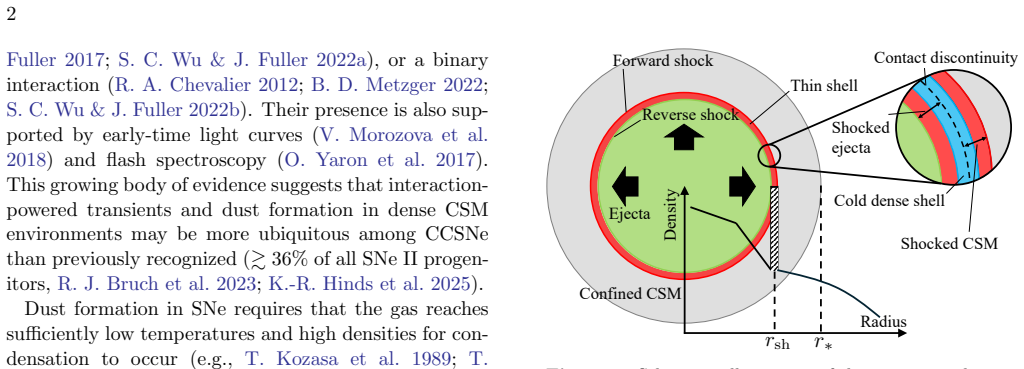
The load-bearing mechanism is the cold dense shell (CDS): a thin, radiatively cooled layer of shocked gas that forms near the contact discontinuity when supernova ejecta collide with confined circumstellar material. The authors track its growth with a thin-shell approximation for mass and momentum conservation of the shocked region, adding mass to the CDS as hot gas cools on the free-free cooling timescale. Once the forward shock passes the outer edge of the confined CSM, the shell expands freely and cools adiabatically with $T_{\rm gas}\propto r_{\rm sh}^{-1}$ and $\rho_{\rm CDS}\propto r_{\rm sh}^{-3}$, quickly reaching the dust condensation threshold of $T_{\rm d,max}=2000$ K. Dust is assumed to form instantaneously and completely below that threshold, and the infrared luminosity is computed from a Planck function, a power-law grain-size distribution, and a photon escape probability that converts total dust mass into the observable mass.
What would settle it
Time-resolved mid-infrared photometry of a Type II supernova with independently confirmed confined CSM (from flash spectroscopy or early light-curve bumps). The model predicts dust emission that rises sharply over a few days, peaks at a level corresponding to $10^{-3}$ to $0.1\,M_\odot$ of condensed metals, and then decays over roughly a year; a flat infrared light curve, a rise much longer than the $\sim r_{\rm sh}/c$ light-crossing time, or a peak far below the predicted level would rule out the complete-instantaneous-condensation scenario.
Extended reading notes
Core claim
The central claim is that a cold dense shell (CDS) — a thin, radiatively cooled layer formed between the forward and reverse shocks when supernova ejecta collide with confined circumstellar material — is a robust dust-formation site. Under a wide range of CSM masses and radial extents the shell forms and then cools rapidly by adiabatic expansion after it breaks out of the CSM, with $T_{\rm gas}\propto r_{\rm sh}^{-1}$. Assuming all metals in the shell condense into dust once the temperature drops below $2000$ K, the dust mass ranges from roughly $10^{-3}\,M_\odot$ to $0.1\,M_\odot$. The calculated infrared emission rises within about ten days, resembling the light curves of kilonovae (the infrared transients from neutron-star mergers), and the model is broadly consistent with the infrared excess of SN 1998S, corresponding to a dust mass near $10^{-2}\,M_\odot$. The high shell density is also expected to favor larger grains that survive later reverse shocks better.
Load-bearing premise
The whole prediction hangs on dust condensing completely and immediately once the shell cools below about $2000$ K, and on that dust staying at the gas temperature with no reheating; if condensation is incomplete or delayed, or the dust thermally decouples, the quoted dust masses and kilonova-like infrared rise are upper limits rather than expectations.
Editorial extensions
If this is right
- Type II supernovae with confined CSM may each produce $10^{-3}$ to $0.1\,M_\odot$ of dust, making CSM interaction a potentially major dust source alongside condensation in the ejecta itself.
- The dust emission rises within about ten days and can resemble kilonova light curves, so kilonova searches must treat such infrared signals as possible contaminants, though the slower decay offers a way to distinguish them.
- Because the CDS is denser than the inner ejecta, grains may grow larger and survive the later reverse shock better, allowing some of this dust to reach the galactic dust reservoir; the authors estimate a cumulative contribution of roughly $5\times10^6\,M_\odot$ per galaxy over 10 Gyr at assumed rates.
- The model reproduces the SN 1998S infrared excess with a total dust mass near $10^{-2}\,M_\odot$, consistent with the lower limit inferred from observations.
Reading between the lines
- I infer that the rapid infrared rise is itself a probe of CSM structure: measuring its rise time and peak would constrain the radius and mass of the confined CSM independently of optical light-curve fitting.
- I infer that the complete-instantaneous-condensation assumption is likely optimistic, since CO formation can lock up carbon, but the qualitative dependence on CSM mass and extent should survive a more detailed chemical-kinetics treatment.
- I infer that the same adiabatic-cooling channel should operate in other interaction-powered transients with confined CSM, such as Type IIn supernovae and luminous blue variable eruptions, so dust formation through this channel may be common across transient classes.
Editorial analysis
A structured set of objections, weighed in public.
Referee Report
Summary. The paper proposes that confined circumstellar material (CSM) around Type II supernovae, formed by eruptive mass loss shortly before core collapse, provides a favorable site for dust formation. The authors use the CHIPS code to model the pre-explosion mass eruption, a thin-shell approximation for the shock interaction, and a cooling-based prescription for the formation of a cold dense shell (CDS). They then assume complete, instantaneous condensation of all metals once the CDS temperature falls below 2000 K, compute dust masses in the range ~10^-3 to 0.1 M_sun, and calculate IR light curves assuming dust and gas are in thermal equilibrium. They compare the model with IR observations of SN 1998S and argue that the rapidly rising IR emission could contaminate kilonova searches. The paper is transparent about several key assumptions and lists them as caveats in Section 4.3.
Significance. If the quantitative predictions hold, this work would establish confined CSM interaction as a robust and potentially ubiquitous dust formation channel in Type II SNe, with observational consequences for kilonova searches. The study is timely given the growing observational evidence for confined CSM around many SN II progenitors. The authors build on an open-source, publicly available code (CHIPS), explore a parameter space of CSM mass and extent, and make a concrete comparison with SN 1998S. The qualitative mechanism—radiative shock formation of a CDS followed by adiabatic cooling—is plausible and not in dispute. The quantitative claims, however, rest on strong simplifying assumptions that the paper itself flags, so the stated dust masses and IR luminosities should be viewed as upper limits pending more detailed condensation and radiative-transfer modeling.
major comments (4)
- [Section 4.3, Eqs. (15)-(16) and Fig. 8] The assumed dust temperature Td = (0.5-1)Tgas is load-bearing for all IR luminosity predictions, including the kilonova-like rise. In the free-expansion phase the shell becomes optically thin, so radiative cooling of grains should decouple Td from Tgas; since Ld scales as Td^4 (and even more steeply in the Wien tail, Eq. 26), an overestimate of Td by only a factor of two yields roughly an order-of-magnitude overestimate in luminosity. The caveat in Section 4.3 is appreciated, but a quantitative radiative-equilibrium calculation (or a physically motivated Td(t) from heating/cooling balance) is needed to support the claimed IR light curves and the kilonova-contamination argument.
- [Section 2.5 and Section 3.2] The assumption that all metals in the CDS condense instantaneously when T < 2000 K (Eq. 15) gives an upper limit on dust mass, as the paper itself acknowledges in Section 4.3 regarding CO locking. Nevertheless, the abstract and Section 3.2 present the range 10^-3-0.1 M_sun as the expected dust mass. Since this range is the central quantitative claim, the paper should clearly label it as an upper limit throughout and provide a more quantitative assessment of carbon depletion by CO formation rather than deferring chemical kinetics entirely to future work.
- [Eq. (8) and Section 3.1] The CDS mass prescription dMCDS/dt ~ Mhot/tau_cool is a crude order-of-magnitude estimate, and the cooling timescale in Eq. (11) uses only free-free emission, which is inaccurate below ~10^7 K where line cooling dominates. Because the ejecta-side CDS mass dominates the final dust yield (Section 3.1), the results are sensitive to this prescription. The authors should test the sensitivity of the dust mass to alternative cooling functions or to a more detailed shocked-shell treatment, or at least quantify the uncertainty introduced by this approximation.
- [Section 3.4 and Fig. 7] The SN 1998S comparison changes tinj from 11 yr to 8 yr and Eej from 2.5 x 10^51 erg to 3 x 10^51 erg relative to the previous best-fit model of Takei et al. (2022), without demonstrating that the adjusted parameters still reproduce the optical light curve. This makes the comparison a consistency check rather than a prediction. The paper should either fit the optical and IR data simultaneously or show explicitly that the adjusted model remains consistent with the optical observations used in the earlier fit.
minor comments (5)
- [Title/Abstract] The title contains a spacing artifact: 'F ormation' should be 'Formation'.
- [Section 3 (intro sentence)] 'The simulation are conducted' should be 'The simulations are conducted'.
- [Section 4.1] 'Shuttering can also fragment larger grains' appears to be a typo for 'Sputtering can also fragment larger grains'.
- [Figure 5] The y-axis label 'Ld, [erg s 1 m 1]' should be 'L_d [erg s^-1 um^-1]' to indicate per-micron luminosity.
- [Affiliation 4] 'Postdam-Golm' should be 'Potsdam-Golm'.
Circularity Check
No constructively circular derivation; the central CDS/dust-yield chain is self-contained, but the SN 1998S comparison is an in-sample consistency test using the authors' own previously fitted and then adjusted parameters.
-
fitted input called prediction
[Section 3.4, Figure 7 (SN 1998S comparison)]
"Y. Takei et al. (2022) derived the model parameters, Eej = 2.5 × 10^51 erg, MZAMS = 20 M⊙, finj = 0.7, tinj = 11 yr, by fitting the optical light curve of SN 1998S with a model constructed using CHIPS. In this section, we investigate whether the same parameter set can also reproduce the light curve of dust. ... For this comparison, we slightly adjusted the parameters from the best-fit parameters of Y. Takei et al. (2022), changing tinj from 11 yr to 8 yr and Eej from 2.5 × 10^51 erg to 3 × 10^51 erg."
The claimed 'broad consistency with observations of SN 1998S' is presented as validation, but the parameters were originally fit to that same supernova's optical light curve in the authors' own CHIPS framework, and two of them are then changed for the IR comparison. The IR light curve is therefore not an independent prediction but an in-sample consistency check with ad hoc parameter adjustment. This does not propagate back into the main dust-mass or CDS-formation derivation, which is computed from shock dynamics and standard condensation assumptions.
full rationale
Walking the derivation chain: (1) CHIPS simulates the pre-SN mass eruption and is used to construct the confined CSM; the code is open-source and the underlying equations are described, so citing the authors' previous CHIPS papers is tool attribution rather than load-bearing circularity. (2) The thin-shell shock evolution, CDS mass estimate, and adiabatic cooling law T_gas ∝ r_sh^-1 follow from standard Rankine-Hugoniot, free-free cooling, and self-similar ejecta profiles with external references (Matzner & McKee 1999; Moriya et al. 2013; Sutherland & Dopita 1993). (3) The dust mass is obtained by assuming complete, instantaneous condensation of all metals below 2000 K, which the paper explicitly labels an upper limit and later qualifies with CO-locking and finite-condensation caveats; this is a stated assumption, not a disguised input. (4) The IR luminosity uses Eq. (16) with T_d = (0.5-1)T_gas, again an openly acknowledged simplification; its sensitivity to T_d is discussed in Section 4.3. No equation reduces by construction to an earlier fitted output, and no uniqueness or ansatz is imported solely through self-citation. The one weakness is the SN 1998S comparison, which uses parameters fit to the same event in the authors' earlier work and then adjusted, making it a consistency check rather than an external prediction. That is a minor validation issue, not a circular definition of the central claim, so the circularity score is 2.
Assumptions & free parameters
free parameters (4)
- finj (injected energy / envelope binding energy) =
0.3, 0.4, 0.5, 0.6, 0.8 (grid); 0.7 for SN 1998S in Takei et al. 2022
- tinj (time from CSM ejection to core collapse) =
3-15 yr grid; adjusted to 8 yr for SN 1998S (prior best fit 11 yr)
- Eej (explosion energy) =
1e51 erg in grid; 3e51 erg for SN 1998S comparison
- Td/Tgas ratio =
0.5 to 1 (bracket)
assumptions (8)
- domain assumption Spherical symmetry of the SN ejecta, CSM, and shock interaction.
- domain assumption The CSM density profile follows the analytic form of Tsuna et al. 2021 fitted to CHIPS output (Eq. 5), with outer exponent nout = 12.
- domain assumption Thin-shell approximation valid; shell width negligible (Section 2.3).
- domain assumption Post-shock gas cools predominantly by free-free emission, and the CDS cools to TCDS ~ 1e4 K via the Sutherland & Dopita cooling function (Eq. 14).
- domain assumption After breakout at r*, the CDS expands freely and cools adiabatically as Tgas proportional to r_sh^-1 and rho_CDS proportional to r_sh^-3 (Eqs. 12-13), with no reheating or mixing.
- ad hoc to paper All metals in the CDS condense into dust instantaneously once T < Td,max = 2000 K (Section 2.5).
- ad hoc to paper Dust temperature equals gas temperature, Td = (0.5-1) Tgas (Sections 3.4 and 4.3).
- standard math Broken power-law ejecta density profile of Matzner & McKee 1999 (Eq. 1) with fixed inner slope delta = 1.
Cite this review
Pith. "Pith review of Confined Circumstellar Material as a Dust Formation Site in Type II Supernovae." pith.science (2026). https://pith.science/paper/B5ENKD66
@misc{pith2026250722763,
  author       = {Pith},
  title        = {Pith review of: Confined Circumstellar Material as a Dust Formation Site in Type II Supernovae},
  year         = {2026},
  howpublished = {\url{https://pith.science/paper/B5ENKD66}},
  note         = {Machine review of arXiv:2507.22763}
}
abstract
We propose a model for dust formation in Type II supernovae (SNe) interacting with confined circumstellar material (CSM), motivated by recent time-domain surveys that have revealed a substantial fraction of SN progenitors to be surrounded by CSM ejected shortly before core-collapse. We simulate the pre-SN mass eruption and the resulting confined CSM using the open-source code CHIPS, and follow the subsequent evolution of the SN ejecta and its interaction with the CSM. We show that a cold dense shell (CDS) is formed at the radiative shock under a wide range of conditions and later undergoes rapid adiabatic cooling during free expansion, leading to efficient dust condensation. The resulting dust mass ranges from $\sim10^{-3}\,M_\odot$ to $0.1\,M_\odot$, depending on the mass and spatial extent of the CSM. We further calculate the infrared (IR) emission from the newly formed dust and find broad consistency with observations of SN~1998S. Notably, the IR light curve exhibits a rapid rise within $\lesssim10\,{\rm d}$, closely resembling that of kilonovae (KNe). This suggests that dust emission powered by confined CSM interaction may be also discovered in KN searches. Moreover, the high-density environment of the CDS may allow dust grains to grow to larger sizes, enhancing their survivability against destruction by reverse shocks propagating from the interstellar medium at later times.
Figures


Figures from the paper (4 more)


Reference graph
Works this paper leans on
-
[1]
Abbott, B. P., Abbott, R., Abbott, T. D., et al. 2017, ApJL, 848, L12, doi: 10.3847/2041-8213/aa91c9
-
[2]
Asplund, M., Grevesse, N., Sauval, A. J., & Scott, P. 2009, ARA&A, 47, 481, doi: 10.1146/annurev.astro.46.060407.145222
arXiv 2009
-
[3]
2025, arXiv e-prints, arXiv:2506.15900, doi: 10.48550/arXiv.2506.15900
Barna, T., Fremling, C., Ahumada, T., et al. 2025, arXiv e-prints, arXiv:2506.15900, doi: 10.48550/arXiv.2506.15900
-
[4]
2007, MNRAS, 378, 973, doi: 10.1111/j.1365-2966.2007.11829.x
Bianchi, S., & Schneider, R. 2007, MNRAS, 378, 973, doi: 10.1111/j.1365-2966.2007.11829.x
arXiv 2007
-
[5]
Blanton, M. R., Hogg, D. W., Bahcall, N. A., et al. 2003, ApJ, 592, 819, doi: 10.1086/375776
doi:10.1086/375776 2003
-
[6]
Bouchet, P., & Danziger, I. J. 1993, A&A, 273, 451
1993
-
[7]
2013, ApJ, 779, 115, doi: 10.1088/0004-637X/779/2/115
Bovy, J., & Rix, H.-W. 2013, ApJ, 779, 115, doi: 10.1088/0004-637X/779/2/115
-
[8]
J., Gal-Yam, A., Schulze, S., et al
Bruch, R. J., Gal-Yam, A., Schulze, S., et al. 2021, ApJ, 912, 46, doi: 10.3847/1538-4357/abef05
Show all 94 references
-
[9]
J., Gal-Yam, A., Yaron, O., et al
Bruch, R. J., Gal-Yam, A., Yaron, O., et al. 2023, ApJ, 952, 119, doi: 10.3847/1538-4357/acd8be
2023 doi
-
[10]
M., Whitelock, P
Catchpole, R. M., Whitelock, P. A., Feast, M. W., et al. 1988, MNRAS, 231, 75P, doi: 10.1093/mnras/231.1.75P
1988 doi
-
[11]
Chevalier, R. A. 1982, ApJ, 258, 790, doi: 10.1086/160126
1982 doi
-
[12]
Chevalier, R. A. 2012, ApJL, 752, L2, doi: 10.1088/2041-8205/752/1/L2
2012 doi
- [13]
-
[14]
D., Deneault, E
Clayton, D. D., Deneault, E. A. N., & Meyer, B. S. 2001, ApJ, 562, 480, doi: 10.1086/323467
2001 doi
-
[15]
D., Liu, W., & Dalgarno, A
Clayton, D. D., Liu, W., & Dalgarno, A. 1999, Science, 283, 1290, doi: 10.1126/science.283.5406.1290
1999
-
[16]
S., Berger, E., Villar, V
Cowperthwaite, P. S., Berger, E., Villar, V. A., et al. 2017, ApJL, 848, L17, doi: 10.3847/2041-8213/aa8fc7
2017 doi
- [17]
-
[18]
2024, A&A, 685, A44, doi: 10.1051/0004-6361/202348642
Dastidar, R., Pignata, G., Dukiya, N., et al. 2024, A&A, 685, A44, doi: 10.1051/0004-6361/202348642
2024 doi
-
[19]
2019, MNRAS, 483, 887, doi: 10.1093/mnras/sty3138
Davies, B., & Dessart, L. 2019, MNRAS, 483, 887, doi: 10.1093/mnras/sty3138
2019 doi
- [20]
-
[21]
T., Dale, D
Draine, B. T., Dale, D. A., Bendo, G., et al. 2007, ApJ, 663, 866, doi: 10.1086/518306
2007 doi
-
[22]
R., Piro, A
Drout, M. R., Piro, A. L., Shappee, B. J., et al. 2017, Science, 358, 1570, doi: 10.1126/science.aaq0049
2017 doi
- [23]
-
[24]
Dwek, E., Galliano, F., & Jones, A. P. 2007, ApJ, 662, 927, doi: 10.1086/518430
2007 doi
-
[25]
Dwek, E., Sarangi, A., & Arendt, R. G. 2019, ApJL, 871, L33, doi: 10.3847/2041-8213/aaf9a8
2019 doi
- [27]
-
[28]
D., Chevalier, R
Fox, O. D., Chevalier, R. A., Dwek, E., et al. 2010, ApJ, 725, 1768, doi: 10.1088/0004-637X/725/2/1768
2010 doi
-
[29]
D., Chevalier, R
Fox, O. D., Chevalier, R. A., Skrutskie, M. F., et al. 2011, ApJ, 741, 7, doi: 10.1088/0004-637X/741/1/7
2011 doi
-
[30]
R., Vincenzi, M., et al
Frohmaier, C., Angus, C. R., Vincenzi, M., et al. 2021, MNRAS, 500, 5142, doi: 10.1093/mnras/staa3607
2021 doi
-
[31]
2017, MNRAS, 470, 1642, doi: 10.1093/mnras/stx1314
Fuller, J. 2017, MNRAS, 470, 1642, doi: 10.1093/mnras/stx1314
2017 doi
- [32]
-
[33]
2014, Nature, 511, 326, doi: 10.1038/nature13558
Gall, C., Hjorth, J., Watson, D., et al. 2014, Nature, 511, 326, doi: 10.1038/nature13558
2014 doi
-
[34]
B., Modjaz, M., et al
Graur, O., Bianco, F. B., Modjaz, M., et al. 2017, ApJ, 837, 121, doi: 10.3847/1538-4357/aa5eb7
2017 doi
-
[35]
R., Millman, K
Harris, C. R., Millman, K. J., van der Walt, S. J., et al. 2020, Nature, 585, 357, doi: 10.1038/s41586-020-2649-2
2020 doi
-
[36]
A., Sollerman, J., et al
Hinds, K.-R., Perley, D. A., Sollerman, J., et al. 2025, Monthly Notices of the Royal Astronomical Society, 541, 135, doi: 10.1093/mnras/staf888
2025 doi
-
[37]
2023, ApJL, 955, L8, doi: 10.3847/2041-8213/acf299
Hiramatsu, D., Tsuna, D., Berger, E., et al. 2023, ApJL, 955, L8, doi: 10.3847/2041-8213/acf299
2023 doi
-
[38]
2012, ApJ, 761, 96, doi: 10.1088/0004-637X/761/2/96
Hoang, T., & Lazarian, A. 2012, ApJ, 761, 96, doi: 10.1088/0004-637X/761/2/96
2012 doi
-
[39]
Hunter, J. D. 2007, Computing in Science & Engineering, 9, 90, doi: 10.1109/MCSE.2007.55
2007 doi
-
[40]
S., Bauer, E
Jermyn, A. S., Bauer, E. B., Schwab, J., et al. 2023, ApJS, 265, 15, doi: 10.3847/1538-4365/acae8d
2023 doi
-
[41]
R., & Barnes, J
Kasen, D., Badnell, N. R., & Barnes, J. 2013, ApJ, 774, 25, doi: 10.1088/0004-637X/774/1/25
2013 doi
-
[42]
2017, Nature, 551, 80, doi: 10.1038/nature24453
Ramirez-Ruiz, E. 2017, Nature, 551, 80, doi: 10.1038/nature24453
2017 doi
-
[43]
1987, Progress of Theoretical Physics, 77, 1402, doi: 10.1143/PTP.77.1402
Kozasa, T., & Hasegawa, H. 1987, Progress of Theoretical Physics, 77, 1402, doi: 10.1143/PTP.77.1402
1987 doi
-
[44]
1989, ApJ, 344, 325, doi: 10.1086/167801
Kozasa, T., Hasegawa, H., & Nomoto, K. 1989, ApJ, 344, 325, doi: 10.1086/167801
1989 doi
-
[45]
2020, A&A, 635, A127, doi: 10.1051/0004-6361/201937226 14
Kuriyama, N., & Shigeyama, T. 2020, A&A, 635, A127, doi: 10.1051/0004-6361/201937226 14
2020 doi
-
[46]
Laor, A., & Draine, B. T. 1993, ApJ, 402, 441, doi: 10.1086/172149
1993 doi
-
[47]
D., Li, C., Filippenko, A
Li, W. D., Li, C., Filippenko, A. V., & Moran, E. C. 1998, IAUC, 6829, 1
1998
-
[48]
K., et al
Maeda, K., Nozawa, T., Sahu, D. K., et al. 2013, ApJ, 776, 5, doi: 10.1088/0004-637X/776/1/5
2013 doi
-
[49]
S., Rumpl, W., & Nordsieck, K
Mathis, J. S., Rumpl, W., & Nordsieck, K. H. 1977, ApJ, 217, 425, doi: 10.1086/155591
1977 doi
-
[50]
Mattila, S., Meikle, W. P. S., Lundqvist, P., et al. 2008, MNRAS, 389, 141, doi: 10.1111/j.1365-2966.2008.13516.x
2008
- [51]
-
[52]
Metzger, B. D. 2022, ApJ, 932, 84, doi: 10.3847/1538-4357/ac6d59
2022 doi
-
[53]
J., Maeda, K., Taddia, F., et al
Moriya, T. J., Maeda, K., Taddia, F., et al. 2013, MNRAS, 435, 1520, doi: 10.1093/mnras/stt1392
2013 doi
-
[54]
L., & Valenti, S
Morozova, V., Piro, A. L., & Valenti, S. 2017, ApJ, 838, 28, doi: 10.3847/1538-4357/aa6251
2017 doi
-
[55]
L., & Valenti, S
Morozova, V., Piro, A. L., & Valenti, S. 2018, ApJ, 858, 15, doi: 10.3847/1538-4357/aab9a6
2018 doi
-
[56]
2006, NuPhA, 777, 424, doi: 10.1016/j.nuclphysa.2006.05.008
Maeda, K. 2006, NuPhA, 777, 424, doi: 10.1016/j.nuclphysa.2006.05.008
2006 doi
-
[57]
2013, ApJ, 776, 24, doi: 10.1088/0004-637X/776/1/24
Nozawa, T., & Kozasa, T. 2013, ApJ, 776, 24, doi: 10.1088/0004-637X/776/1/24
2013 doi
-
[58]
2006, ApJ, 648, 435, doi: 10.1086/505639
Nozawa, T., Kozasa, T., & Habe, A. 2006, ApJ, 648, 435, doi: 10.1086/505639
2006 doi
-
[59]
2007, ApJ, 666, 955, doi: 10.1086/520621
Nozawa, T., Kozasa, T., Habe, A., et al. 2007, ApJ, 666, 955, doi: 10.1086/520621
2007 doi
-
[60]
2010, ApJ, 713, 356, doi: 10.1088/0004-637X/713/1/356
Nozawa, T., Kozasa, T., Tominaga, N., et al. 2010, ApJ, 713, 356, doi: 10.1088/0004-637X/713/1/356
2010 doi
-
[61]
2003, ApJ, 598, 785, doi: 10.1086/379011
Nozawa, T., Kozasa, T., Umeda, H., Maeda, K., & Nomoto, K. 2003, ApJ, 598, 785, doi: 10.1086/379011
2003 doi
-
[62]
2008, ApJ, 684, 1343, doi: 10.1086/589961
Nozawa, T., Kozasa, T., Tominaga, N., et al. 2008, ApJ, 684, 1343, doi: 10.1086/589961
2008 doi
-
[63]
E., & Ferland, G
Osterbrock, D. E., & Ferland, G. J. 2006, Astrophysics of gaseous nebulae and active galactic nuclei
2006
-
[64]
2011, ApJS, 192, 3, doi: 10.1088/0067-0049/192/1/3
Paxton, B., Bildsten, L., Dotter, A., et al. 2011, ApJS, 192, 3, doi: 10.1088/0067-0049/192/1/3
2011 doi
-
[65]
2013, ApJS, 208, 4, doi: 10.1088/0067-0049/208/1/4
Paxton, B., Cantiello, M., Arras, P., et al. 2013, ApJS, 208, 4, doi: 10.1088/0067-0049/208/1/4
2013 doi
-
[66]
2015, ApJS, 220, 15, doi: 10.1088/0067-0049/220/1/15
Paxton, B., Marchant, P., Schwab, J., et al. 2015, ApJS, 220, 15, doi: 10.1088/0067-0049/220/1/15
2015 doi
-
[67]
B., et al
Paxton, B., Schwab, J., Bauer, E. B., et al. 2018, ApJS, 234, 34, doi: 10.3847/1538-4365/aaa5a8
2018 doi
-
[68]
2019, ApJS, 243, 10, doi: 10.3847/1538-4365/ab2241
Paxton, B., Smolec, R., Schwab, J., et al. 2019, ApJS, 243, 10, doi: 10.3847/1538-4365/ab2241
2019 doi
-
[69]
Pozzo, M., Meikle, W. P. S., Fassia, A., et al. 2004, MNRAS, 352, 457, doi: 10.1111/j.1365-2966.2004.07951.x
2004
-
[70]
2012, MNRAS, 423, L92, doi: 10.1111/j.1745-3933.2012.01264.x
Quataert, E., & Shiode, J. 2012, MNRAS, 423, L92, doi: 10.1111/j.1745-3933.2012.01264.x
2012
-
[71]
Ragot, B. R. 2002, ApJ, 568, 232, doi: 10.1086/338883
2002 doi
-
[72]
Sarangi, A., & Slavin, J. D. 2022, ApJ, 933, 89, doi: 10.3847/1538-4357/ac713d
2022 doi
-
[73]
Schlegel, E. M. 1990, MNRAS, 244, 269
1990
-
[74]
D., Temim, T., et al
Shahbandeh, M., Fox, O. D., Temim, T., et al. 2025, ApJ, 985, 262, doi: 10.3847/1538-4357/adce77
2025 doi
-
[75]
W., Smith, B
Silvia, D. W., Smith, B. D., & Shull, J. M. 2010, ApJ, 715, 1575, doi: 10.1088/0004-637X/715/2/1575
2010 doi
-
[76]
D., Dwek, E., Mac Low, M.-M., & Hill, A
Slavin, J. D., Dwek, E., Mac Low, M.-M., & Hill, A. S. 2020, ApJ, 902, 135, doi: 10.3847/1538-4357/abb5a4
2020 doi
-
[77]
V., & Chornock, R
Smith, N., Li, W., Filippenko, A. V., & Chornock, R. 2011, MNRAS, 412, 1522, doi: 10.1111/j.1365-2966.2011.17229.x
2011
-
[78]
Spyromilio, J., Meikle, W. P. S., Learner, R. C. M., & Allen, D. A. 1988, Nature, 334, 327, doi: 10.1038/334327a0
1988 doi
-
[79]
S., & Dopita, M
Sutherland, R. S., & Dopita, M. A. 1993, ApJS, 88, 253, doi: 10.1086/191823
1993 doi
-
[80]
2014, ApJL, 789, L6, doi: 10.1088/2041-8205/789/1/L6
Takami, H., Nozawa, T., & Ioka, K. 2014, ApJL, 789, L6, doi: 10.1088/2041-8205/789/1/L6
2014 doi
-
[81]
2024, ApJ, 961, 67, doi: 10.3847/1538-4357/ad0da4
Takei, Y., Tsuna, D., Ko, T., & Shigeyama, T. 2024, ApJ, 961, 67, doi: 10.3847/1538-4357/ad0da4
2024 doi
-
[82]
2022, ApJ, 929, 177, doi: 10.3847/1538-4357/ac60fe
Takei, Y., Tsuna, D., Kuriyama, N., Ko, T., & Shigeyama, T. 2022, ApJ, 929, 177, doi: 10.3847/1538-4357/ac60fe
2022 doi
-
[83]
M., Fox, O
Tinyanont, S., Kasliwal, M. M., Fox, O. D., et al. 2016, ApJ, 833, 231, doi: 10.3847/1538-4357/833/2/231
2016 doi
-
[84]
D., Shahbandeh, M., et al
Tinyanont, S., Fox, O. D., Shahbandeh, M., et al. 2025, ApJ, 985, 198, doi: 10.3847/1538-4357/adccc0
2025 doi
-
[85]
2001, MNRAS, 325, 726, doi: 10.1046/j.1365-8711.2001.04486.x
Todini, P., & Ferrara, A. 2001, MNRAS, 325, 726, doi: 10.1046/j.1365-8711.2001.04486.x
2001
-
[86]
2023a, MNRAS, 526, 4801, doi: 10.1093/mnras/stad3043
Tsuna, D., Nakazato, Y., & Hartwig, T. 2023a, MNRAS, 526, 4801, doi: 10.1093/mnras/stad3043
-
[87]
2023, PASJ, 75, L19, doi: 10.1093/pasj/psad041
Tsuna, D., & Takei, Y. 2023, PASJ, 75, L19, doi: 10.1093/pasj/psad041
2023 doi
-
[88]
2021, PASJ, 73, 1128, doi: 10.1093/pasj/psab063
Tsuna, D., Takei, Y., Kuriyama, N., & Shigeyama, T. 2021, PASJ, 73, 1128, doi: 10.1093/pasj/psab063
2021 doi
-
[89]
2023b, ApJ, 945, 104, doi: 10.3847/1538-4357/acbbc6
Tsuna, D., Takei, Y., & Shigeyama, T. 2023b, ApJ, 945, 104, doi: 10.3847/1538-4357/acbbc6
-
[90]
J., Yang, S., et al
Valenti, S., Sand, D. J., Yang, S., et al. 2017, ApJL, 848, L24, doi: 10.3847/2041-8213/aa8edf Van Bemmel, N., Zhang, J., Cooke, J., et al. 2025, MNRAS, 537, 3332, doi: 10.1093/mnras/staf332
2017 doi
-
[91]
E., et al
Virtanen, P., Gommers, R., Oliphant, T. E., et al. 2020, Nature Methods, 17, 261, doi: 10.1038/s41592-019-0686-2
2020 doi
- [92]
- [93]
- [94]
-
[95]
A., Gal-Yam, A., et al
Yaron, O., Perley, D. A., Gal-Yam, A., et al. 2017, Nature Physics, 13, 510, doi: 10.1038/nphys4025
2017 doi
Reviewed August 6, 2026 · model on record in the stance chip above.
Discussion (0). Sign in to comment.