REVIEW 4 major objections 6 minor 49 references
Bayesian Optimization applied for accelerated Virtual Validation of the Autonomous Driving Function
T0 review · 4 major / 6 minor · reviewed 2026-08-06 · deepseek-v4-flash
Pith's one-line read Bayesian optimization finds all critical driving scenarios with one to two orders of magnitude fewer simulations.
desk verdict The case study is honest and the benchmark is useful, but the 'orders of magnitude' claim rests on an oracle stopping rule and a strawman baseline; it merits peer review with major revision. read the letter →
The pith
A machine-rendered reading of the paper's core claim, the machinery that carries it, and where it could break.
The reading
What carries the argument
The load-bearing mechanism is the Bayesian Optimization loop: a Gaussian process with a squared exponential kernel models the map from scenario parameters to a criticality metric; an acquisition function then selects the next parameter set, the co-simulation evaluates the metric, and the surrogate is refit. Thompson Sampling is the acquisition function that naturally balances exploration and exploitation, and it is compared with Probability of Improvement. Critical regions are defined by DBSCAN clustering of the exhaustive baseline results, and the loop stops when at least one simulation has landed in every cluster that the baseline identified, subject to an upper budget one order of magnitude below the baseline count. The two metrics used are the maximum lateral displacement of the ego vehicle (continuous) and the MPC solver's infeasibility status (discrete), which correspond to the two failure modes: off-road excursions and solver failure.
What would settle it
Construct a parameter space where a genuine critical region lies between the grid lines of the baseline discretization, so the baseline and its DBSCAN clusters do not contain it; run the BO framework with the paper's stopping rule. If the loop terminates having hit every baseline-identified cluster but never the hidden region, the completeness claim fails.
Extended reading notes
Core claim
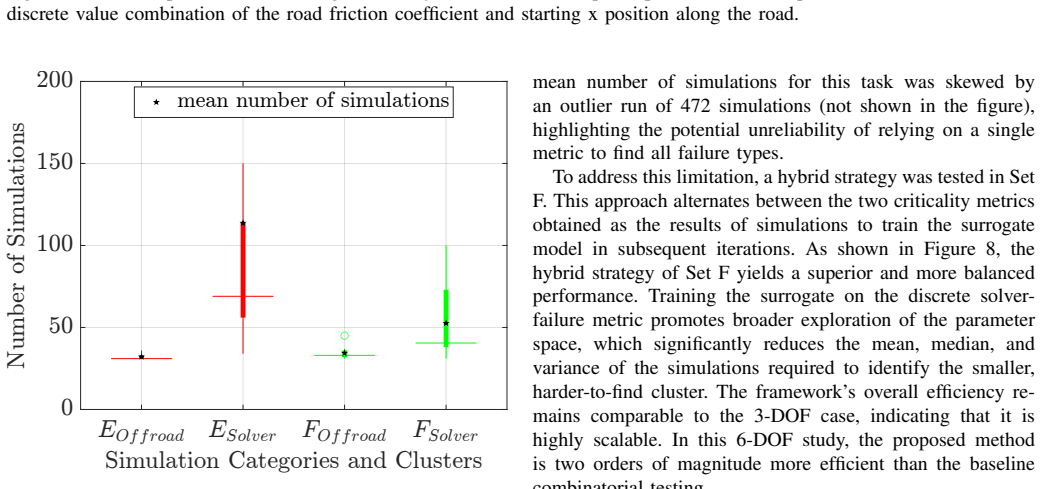
The paper claims that critical-scenario discovery for an autonomous driving function can be treated as a black-box optimization problem: find the scenario parameters $x$ that maximize a criticality metric $f(x)$ computed by one simulation run. A Bayesian Optimization loop with a Gaussian process surrogate and an acquisition function recovers all critical regions found by exhaustive combinatorial testing while using a fraction of the simulation budget. In the 3-parameter case, 15 seed simulations plus acquisition iterations found both critical clusters in under 100 simulations on average, against a 1,331-run full-factorial baseline; in the 6-parameter case, 30 seed simulations plus iterations matched clusters found in a 19,800-run baseline. The paper further claims that the workflow is scenario-agnostic, so any logical scenario with continuous parameters inside an operational design domain can be plugged into the same loop, and that the hybrid strategy of alternating the criticality metric used to train the surrogate is what makes the higher-dimensional search reliable.
Load-bearing premise
The evaluation assumes that the DBSCAN clusters found in the exhaustive baseline are the complete and correct set of critical regions, and that finding one simulation in each cluster is enough to prove all critical scenarios were discovered.
Editorial extensions
If this is right
- A validation campaign can substitute a BO-guided search for a full-factorial sweep and still claim to have seen the same critical regions, at a fraction of the simulation cost.
- Continuous criticality metrics, like maximum lateral displacement, should guide the surrogate when possible; discrete metrics alone rely on exploration and can miss clusters under exploitative acquisition functions.
- Acquisition functions that balance exploration and exploitation, such as Thompson Sampling, are more reliable for multi-cluster discovery than a greedy Probability of Improvement.
- In higher-dimensional parameter spaces, alternating the metric used to train the surrogate is the paper's recommended fix for reliably finding small, hard-to-locate failure clusters.
- The framework's scenario-agnostic formulation means the same loop can be re-applied to other logical scenarios and other driving functions without changing the optimization machinery.
Reading between the lines
- An implication the authors leave implicit is that the stopping rule presupposes the baseline-identified clusters are the complete set of critical regions; in a real development setting with no exhaustive baseline, the loop would need an alternative stopping rule such as a budget cap or a surrogate-convergence criterion.
- A natural stress test would be to run the same BO loop on the same motion planner with a critical region deliberately placed between the grid lines of the baseline discretization; the reported speed-up is defined relative to the grid, not to an oracle.
- The hybrid metric strategy suggests a general recipe: when failure modes are heterogeneous, no single scalar objective captures them all, so alternating or multi-objective acquisition may be necessary.
- A direct extension is to multi-agent urban scenarios by treating all agents' initial poses and behaviors as the parameter vector and using a collision or near-miss metric as the objective; the machinery would carry over intact.
Editorial analysis
A structured set of objections, weighed in public.
Referee Report
Summary. This paper introduces a Bayesian optimization (BO) framework for discovering safety-critical scenarios during virtual validation of an autonomous driving function. The logical scenario parameters (first three, then six) are searched by a Gaussian-process surrogate and an acquisition function (Thompson Sampling or probability of improvement) against a criticality metric: maximum lateral displacement or MPC solver status. The case study is an MPC-based motion planner in a two-lane highway with a preceding vehicle; the baseline is a full-factorial discretization (1,331 runs in 3D and 19,800 runs in 6D), and DBSCAN clustering of the baseline results defines the critical clusters. BO runs are stopped when at least one point in each baseline-defined critical cluster has been found, and the paper reports mean/median counts below 100 in 3D and around 100-200 in 6D, claiming one to two orders of magnitude fewer simulations than brute-force DoE.
Significance. Accelerated critical-scenario search is an important problem, and the paper offers a transparent case study with two failure modes, repeated random-seed experiments, and a clearly described co-simulation setup. The central quantitative claim, however, is not established by the current evaluation: the stopping rule uses the baseline cluster labels as targets, no comparison to random sampling or Latin hypercube sampling at equal budget is provided, and the success criterion of one point per cluster is weak. If the authors reframe the claim as targeted re-identification of known critical clusters and add appropriate comparator methods, the work would be a useful empirical contribution. The paper does not provide code or data, which limits reproducibility.
major comments (4)
- [Section IV, stopping criterion] The paper states: 'The iteration of the Bayesian Optimization framework simulations terminate when at least one instance in each of the critical clusters identified in the baseline simulations are identified.' Because the target clusters are produced by the exhaustive baseline, the simulation counts in Figures 6 and 8 are hitting times for a known target set, not the cost of discovering unknown critical regions. In a real validation campaign the clusters are unknown without first running the baseline that the method is meant to replace. The abstract's claim that the framework 'identifies hazardous situations ... using orders of magnitude fewer simulations' is therefore not demonstrated as a de novo discovery cost. Please either add a deployable stopping rule and evaluate de novo discovery, or explicitly reframe the results as targeted search for known clusters and adjust the title and abstract claims accordingly.
- [Section V, Figures 6-8] No comparison is made against random sampling, Latin hypercube sampling, or any other model-free search at the same simulation budget. This matters because the off-road cluster occupies 56 of 1,331 points (~4%) in 3D, and in 6D the two critical clusters together occupy 6,894 of 19,800 points (~35%). At budgets of 50-200 simulations, random or LHS sampling would be expected to hit these clusters by chance a substantial fraction of the time. The reported one-to-two-order speed-up relative to the full-factorial grid does not establish that BO itself is responsible for the efficiency. Same-budget random/LHS detection rates should be reported, and the BO advantage over these baselines should be quantified.
- [Section V-A, DBSCAN clustering and success criterion] The success criterion is defined as finding at least one instance in each baseline-derived critical cluster. This is weak because it does not measure coverage of the critical regions, and the clusters themselves depend on the arbitrarily chosen baseline discretization and on the DBSCAN hyperparameters (eps, min_samples), which are not reported. A single point in a cluster could be an artifact of the grid or of the clustering parameters, and critical regions missed by the baseline grid are invisible to the evaluation. Please report the DBSCAN hyperparameters, provide a sensitivity analysis of the clusters, and use a stronger discovery metric such as the volume fraction of each cluster that is covered, or require multiple points per cluster.
- [Section V-B and Figure 8] The statistical reporting is not complete enough to support the scalability claims. The 'hybrid strategy' of Set F, said to alternate between the two criticality metrics, is never defined (no schedule, no equations, no pseudocode). Figure 8's caption labels the categories as A and B although the text discusses Sets E and F, and the text states that a 472-simulation outlier in Set E is omitted from the figure while the reported mean is affected by it. Furthermore, in the 3D case, sets C and D that failed to find both clusters in some runs have their means excluded (Section V-A), which biases the acquisition-function comparison. Please report success rates, include all runs (including failures and outliers), and give an exact definition of the hybrid metric alternation.
minor comments (6)
- [Abstract and I-D.2] The claim that this is the first work applying such a framework to a developed ADF is not supported by the cited related work, since references [34]-[36] already apply BO or scenario-exploration methods to automated-driving test-case search; please temper the novelty claim or explain the precise distinction.
- [Section IV, paragraph after Table I] The sentence 'Different combinations of the acquisition functions and Hence this paper also benchmarks for the stopping criteria...' is ungrammatical and should be revised.
- [Table I and Table II] Table I has an extra bracket in the x_0,ego range ('[-0.5,0.5]]'), and Table II's caption reverses the mapping of Clusters 1 and 3 to off-road events and a priori solver failure relative to the description in Section V-A.
- [Figure 8 caption] The caption uses 'A' and 'B' for the two simulation sets, while the text refers to Sets E and F; the caption should be corrected for consistency.
- [Equation (7)] The probability-of-improvement formula does not specify the behavior when the posterior variance sigma(x) is zero; standard implementations add a small jitter, which should be stated.
- [Section III-B and Sections V-A/V-B] The GP surrogate is trained on the discrete solver-status metric (values such as 0 and 4) using a Gaussian likelihood and a squared-exponential kernel; the authors should justify this treatment of a discrete response or use a surrogate model better suited to classification outputs.
Circularity Check
Efficiency claim is measured with an oracle stopping rule: the BO run stops once it hits the baseline's DBSCAN clusters, so 'orders of magnitude fewer simulations' is a hitting-time to known targets rather than a de novo discovery cost.
-
other
[Section IV (Framework Validation Setup), stopping-criterion paragraph; Section V-A, baseline ground-truth paragraph]
"The iteration of the Bayesian Optimization framework simulations terminate when at least one instance in each of the critical clusters identified in the baseline simulations are identified. ... This comprehensive dataset serves as the ground truth for validating the sample efficiency of the Bayesian optimization approach, which seeks to discover these same critical regions using significantly fewer simulations."
The reported speed-up in Figures 6 and 8 is the number of simulations needed to hit at least one point in each precomputed baseline cluster, because the stopping rule defines success using the exhaustive baseline's DBSCAN clusters. The abstract's central claim--that the framework 'identifies hazardous situations ... using orders of magnitude fewer simulations'--is therefore demonstrated only as the cost of hitting a target set that is known in advance from the very brute-force DoE the method is meant to replace. The BO surrogate does not fit those cluster labels, so this is evaluation circularity rather than fitting-to-a-parameter circularity; the method still has independent content, but the headline efficiency number is not a de novo discovery cost.
full rationale
The BO loop itself is not derivationally circular: the Gaussian Process surrogate is trained only on the criticality metric outputs of the simulations, and the acquisition function selects new points without seeing the baseline DBSCAN cluster labels. No load-bearing self-citation chain is present; references to the authors' earlier motion-planner work are used only to describe the case-study ADF, not to justify the BO result. However, the evaluation protocol makes the central efficiency claim self-referential in an important way. The stopping criterion in Section IV uses 'at least one instance in each of the critical clusters identified in the baseline simulations' as the success condition, and Section V-A calls the baseline dataset the 'ground truth' for 'discover[ing] these same critical regions.' Thus the mean/median counts in Figures 6 and 8 are hitting times to a set of targets that is unknown in a real validation campaign without first running the exhaustive DoE. The claim of 'one to two orders of magnitude fewer simulations' is therefore conditional on oracle knowledge of the very clusters the method is supposed to discover. This is partial evaluation circularity, not a complete reduction of the derivation to its inputs, so a score of 4 is appropriate; concerns about whether DBSCAN clusters are complete or correct are correctness risks, not circularity.
Assumptions & free parameters
free parameters (6)
- GP hyperparameters (length scales, signal variance, noise) =
estimated by maximizing log marginal likelihood on each dataset
- PI margin parameter xi =
not specified
- Seed sample size factor =
5x parameter dimension (15 for 3D, 30 for 6D)
- Off-road failure threshold =
3.5 m lateral displacement
- Baseline discretization steps =
e.g., 2 m/s speed steps, 5 m distance steps, giving 1331 and 19800 grid points
- DBSCAN hyperparameters (eps, min_samples) =
not reported
assumptions (6)
- standard math Standard GP regression and BO convergence assumptions (zero-mean GP prior, SE kernel, marginal likelihood hyperparameter fitting).
- domain assumption The IPG CarMaker plus MPC co-simulation is a faithful oracle for the ADF's real-world behavior.
- domain assumption Control Barrier Functions prevent collisions, so off-road events and solver infeasibility are the only failure modes.
- ad hoc to paper The DBSCAN clusters from the exhaustive baseline are the complete ground-truth set of critical regions.
- domain assumption Wind and road friction are not modeled in the planner and act as unmodeled disturbances.
- ad hoc to paper The discretization of the full-factorial baseline is representative of exhaustive testing cost.
Cite this review
Pith. "Pith review of Bayesian Optimization applied for accelerated Virtual Validation of the Autonomous Driving Function." pith.science (2026). https://pith.science/paper/7E7SBSS7
@misc{pith2026250722769,
  author       = {Pith},
  title        = {Pith review of: Bayesian Optimization applied for accelerated Virtual Validation of the Autonomous Driving Function},
  year         = {2026},
  howpublished = {\url{https://pith.science/paper/7E7SBSS7}},
  note         = {Machine review of arXiv:2507.22769}
}
read the original abstract
Rigorous Verification and Validation (V&V) of Autonomous Driving Functions (ADFs) is paramount for ensuring the safety and public acceptance of Autonomous Vehicles (AVs). Current validation relies heavily on simulation to achieve sufficient test coverage within the Operational Design Domain (ODD) of a vehicle, but exhaustively exploring the vast parameter space of possible scenarios is computationally expensive and time-consuming. This work introduces a framework based on Bayesian Optimization (BO) to accelerate the discovery of critical scenarios. We demonstrate the effectiveness of the framework on an Model Predictive Controller (MPC)-based motion planner, showing that it identifies hazardous situations, such as off-road events, using orders of magnitude fewer simulations than brute-force Design of Experiments (DoE) methods. Furthermore, this study investigates the scalability of the framework in higher-dimensional parameter spaces and its ability to identify multiple, distinct critical regions within the ODD of the motion planner used as the case study .
Figures


Figures from the paper (6 more)


Reference graph
Works this paper leans on
-
[1]
N. Kalra and S. M. Paddock, “Driving to safety: How many miles of driving would it take to demonstrate autonomous vehicle reliability?” Transportation Research Part A: Policy and Practice , vol. 94, pp. 182–193, 2016. [Online]. Available: https://www.sciencedirect.com/scie nce/article/pii/S0965856416302129
work page 2016
-
[2]
L. Vater, M. Sonntag, J. Hiller, P. Schaudt, and L. Eckstein, “A system- atic approach towards the definition of the terms edge case and corner case for automated driving,” in 2023 3rd International Conference on Electrical, Computer, Communications and Mechatronics Engineering (ICECCME), 2023, pp. 1–6
work page 2023
-
[3]
Finding critical scenarios for automated driving systems: A systematic mapping study,
X. Zhang, J. Tao, K. Tan, M. T ¨orngren, J. M. G. S ´anchez, M. R. Ramli, X. Tao, M. Gyllenhammar, F. Wotawa, N. Mohan, M. Nica, and H. Felbinger, “Finding critical scenarios for automated driving systems: A systematic mapping study,” IEEE Trans. Softw. Eng., vol. 49, no. 3, p. 991–1026, 2023. [Online]. Available: https://doi.org/10.1109/TSE.2022.3170122
-
[4]
Challenges in autonomous vehicle testing and validation,
P. Koopman and M. Wagner, “Challenges in autonomous vehicle testing and validation,” SAE Int. J. Trans. Safety , 2016
work page 2016
-
[5]
Virtual testing of automated driving systems. a survey on validation methods,
R. Don `a and B. Ciuffo, “Virtual testing of automated driving systems. a survey on validation methods,” IEEE Access, vol. 10, pp. 24 349–24 367, 2022
work page 2022
-
[6]
On the Need for a Statistical Foundation in Scenario-Based Testing of Autonomous Vehicles
X. Zhao, R. Aghazadeh-Chakherlou, C.-H. Cheng, P. Popov, and L. Strigini, “On the need for a statistical foundation in scenario- based testing of autonomous vehicles,” 2025. [Online]. Available: https://arxiv.org/abs/2505.02274
work page Pith review arXiv 2025
-
[7]
United Nations Economic Commission for Europe, “Addendum 156 – un regulation no. 157 uniform provisions concerning the approval of vehicles with regards to automated lane keeping system,” 2021, accessed: 2024-06-10. [Online]. Available: https: //unece.org/transport/documents/2021/03/standards/un-regulation-no-1 57-automated-lane-keeping-systems-alks
work page 2021
-
[8]
for Standardization of Automation and M
A. for Standardization of Automation and M. Systems, Evolving Land- scapes Of Collaborative Testing For Adas & Ad . ASAM e.V ., 2022
work page 2022
Show all 49 references
-
[9]
Validation of x-in-the-loop approaches for virtual homologation of automated driving functions,
S. Riedmaier, J. Nesensohn, C. Gutenkunst, B. Schick, T. D ¨user, and H. Abdellatif, “Validation of x-in-the-loop approaches for virtual homologation of automated driving functions,” in 11. Grazer Symposium Virtual Vehicle(GSVF) Graz, 15./16.05. 2018 , 2018
2018
-
[10]
Vehicle-in-virtual-environment (vve) method for autonomous driving system development, evaluation and demonstration,
X. Cao, H. Chen, S. Y . Gelbal, B. Aksun-Guvenc, and L. Guvenc, “Vehicle-in-virtual-environment (vve) method for autonomous driving system development, evaluation and demonstration,” Sensors, vol. 23, no. 11, 2023. [Online]. Available: https://www.mdpi.com/1424-8220/23 /11/5088
2023
-
[11]
Correlation of software- in-the-loop simulation with physical testing for autonomous driving,
Z. Fei, M. Andersson, and A. Tingberg, “Correlation of software- in-the-loop simulation with physical testing for autonomous driving,”
-
[12]
A survey on scenario-based testing for automated driving systems in high-fidelity simulation,
Z. Zhong, Y . Tang, Y . Zhou, V . de Oliveira Neves, Y . Liu, and B. Ray, “A survey on scenario-based testing for automated driving systems in high-fidelity simulation,” 2021. [Online]. Available: https://arxiv.org/abs/2112.00964
2021 arXiv
-
[13]
Gas: Generating fast & accurate surrogate models for simulations of autonomous vehicle systems,
K. Joshi, C. Hsieh, S. Mitra, and S. Misailovic, “Gas: Generating fast & accurate surrogate models for simulations of autonomous vehicle systems,” in 2024 IEEE 35th International Symposium on Software Reliability Engineering (ISSRE) , 2024, pp. 260–271
2024
-
[14]
Autonovi-sim: Autonomous vehicle simulation platform with weather, sensing, and traffic control,
A. Best, S. Narang, L. Pasqualin, D. Barber, and D. Manocha, “Autonovi-sim: Autonomous vehicle simulation platform with weather, sensing, and traffic control,” in 2018 IEEE/CVF Conference on Com- puter Vision and Pattern Recognition Workshops (CVPRW) , 2018, pp. 1161–11 618
2018
-
[15]
Waymax: An accelerated, data-driven simulator for large-scale autonomous driving research,
C. Gulino, J. Fu, W. Luo, G. Tucker, E. Bronstein, Y . Lu, J. Harb, X. Pan, Y . Wang, X. Chen, J. D. Co-Reyes, R. Agarwal, R. Roelofs, Y . Lu, N. Montali, P. Mougin, Z. Yang, B. White, A. Faust, R. McAllister, D. Anguelov, and B. Sapp, “Waymax: An accelerated, data-driven simu...
-
[16]
A scenario-based platform for testing autonomous vehicle behavior prediction models in simulation,
F. Indaheng, E. Kim, K. Viswanadha, J. Shenoy, J. Kim, D. J. Fremont, and S. A. Seshia, “A scenario-based platform for testing autonomous vehicle behavior prediction models in simulation,” 2021. [Online]. Available: https://arxiv.org/abs/2110.14870
2021 arXiv
-
[17]
A rule-defined adaptive mpc based motion planner for autonomous driving applications,
M. I. I. Sathyamangalam Imran, S. S. Awasthi, M. Khayyat, S. Arrigoni, and F. Braghin, “A rule-defined adaptive mpc based motion planner for autonomous driving applications,” in 16th International Symposium on Advanced Vehicle Control . Cham: Springer Nature Switzerland, 2024,...
2024
-
[18]
Data basis for scenario-based validation of had on high- ways,
J. Bock, R. Krajewski, L. Eckstein, J. Klimke, J. Sauerbier, and A. Zlocki, “Data basis for scenario-based validation of had on high- ways,” in 27th Aachen colloquium automobile and engine technology , 2018, pp. 8–10
2018
-
[19]
A framework for definition of logical scenarios for safety assurance of automated driving,
H. Weber, J. Bock, J. Klimke, C. Roesener, J. Hiller, R. Krajewski, A. Zlocki, and L. E. and, “A framework for definition of logical scenarios for safety assurance of automated driving,” Traffic Injury Prevention , vol. 20, no. sup1, pp. S65–S70, 2019
2019
-
[20]
Pegasus—first steps for the safe introduction of automated driving,
PEGASUS Consortium, “Pegasus—first steps for the safe introduction of automated driving,” in Verification and Validation of Automated Driving Functions, 2019, project funded by the German Federal Ministry for Economic Affairs and Energy (BMWi); defines scenario-based testing m...
2019
-
[21]
Verification & Validation Methods (VVM) for Automated Vehicles,
Fraunhofer IESE et al., “Verification & Validation Methods (VVM) for Automated Vehicles,” Project page, Fraunhofer IESE / ASAM, 2019–2023, german Federal Ministry-funded extension of PEGASUS scenario-based validation to SAE L4/5 urban use cases. [Online]. Available: https://ww...
2019
-
[22]
SET Level: Safety for the autonomous mobility of the future,
Fraunhofer LBF and partners, “SET Level: Safety for the autonomous mobility of the future,” Fraunhofer LBF project page, 2022, develops flexible simulation platforms for VDA L4/L5 automated driving validation. [Online]. Available: https://www.lbf.fraunhofer.de/en/project s/set...
2022
-
[23]
Webots.hpc: A parallel simulation pipeline for autonomous vehicles,
M. Franchi, R. Kahn, M. Chowdhury, S. Khan, K. Kennedy, L. Ngo, and A. Apon, “Webots.hpc: A parallel simulation pipeline for autonomous vehicles,” in Practice and Experience in Advanced Research Computing 2022: Revolutionary: Computing, Connections, You , ser. PEARC ’22. New Y...
2022
-
[24]
NVIDIA Introduces DRIVE Constellation Simulation System to Safely Drive Autonomous Vehicles Billions of Miles in Virtual Reality,
H. Marinez, “NVIDIA Introduces DRIVE Constellation Simulation System to Safely Drive Autonomous Vehicles Billions of Miles in Virtual Reality,” NVIDIA Newsroom, Mar 2018, [Online]. Available: https://nvidianews.nvidia.com/news/nvidia-introduces-drive-constellati on-simulation-...
2018
-
[25]
Ansys A Vxcelerate Autonomy: End-to-end simulation platform for autonomous vehicle validation,
Ansys, Inc., “Ansys A Vxcelerate Autonomy: End-to-end simulation platform for autonomous vehicle validation,” Product overview / press release, December 19, 2023, accessed: 2025-06-25. [Online]. Available: https://www.ansys.com/products/av-simulation/ansys-avxcelerate-auton omy
2023
-
[26]
Multi-objective reinforcement learning for critical scenario generation of autonomous vehicles,
J. Wu, C. Lu, A. Arrieta, and S. Ali, “Multi-objective reinforcement learning for critical scenario generation of autonomous vehicles,” 2025. [Online]. Available: https://arxiv.org/abs/2502.15792
2025 arXiv
-
[27]
Dense reinforcement learning for safety validation of autonomous vehicles,
S. Feng, H. Sun, X. Yan, H. Zhu, Z. Zou, S. Shen, and H. X. Liu, “Dense reinforcement learning for safety validation of autonomous vehicles,” Nature, vol. 615, no. 7953, pp. 620–627, 2023
2023
-
[28]
Safety-critical scenario generation via reinforcement learning based editing,
H. Liu, L. Zhang, S. K. Sastry Hari, and J. Zhao, “Safety-critical scenario generation via reinforcement learning based editing,” in 2024 IEEE International Conference on Robotics and Automation (ICRA) , 2024, pp. 14 405–14 412
2024
-
[29]
Dynnpc: Finding more violations induced by ads in simulation testing through dynamic npc behavior generation,
Y . Lu, Y . Tian, D. Wang, B. Chen, and X. Peng, “Dynnpc: Finding more violations induced by ads in simulation testing through dynamic npc behavior generation,” 2025. [Online]. Available: https://arxiv.org/abs/2411.19567
2025
-
[30]
Testing of autonomous vehicles using surrogate models and stochastic optimization,
H. Beglerovic, M. Stolz, and M. Horn, “Testing of autonomous vehicles using surrogate models and stochastic optimization,” in 2017 IEEE 20th International Conference on Intelligent Transportation Systems (ITSC) , 2017, pp. 1–6
2017
-
[31]
Variable-fidelity model selection for stochastic simulation,
J. Mullins and S. Mahadevan, “Variable-fidelity model selection for stochastic simulation,” Reliability Engineering & System Safety , vol. 131, pp. 40–52, 2014. [Online]. Available: https://www.sciencedirect. com/science/article/pii/S0951832014001331
2014
-
[32]
Genetic algorithm-based test parameter optimization for adas system testing,
F. Kl ¨uck, M. Zimmermann, F. Wotawa, and M. Nica, “Genetic algorithm-based test parameter optimization for adas system testing,” in 2019 IEEE 19th International Conference on Software Quality, Reliability and Security (QRS) , 2019, pp. 418–425
2019
-
[33]
Testing vision-based control systems using learnable evolutionary algorithms,
R. Ben Abdessalem, S. Nejati, L. C. Briand, and T. Stifter, “Testing vision-based control systems using learnable evolutionary algorithms,” in 2018 IEEE/ACM 40th International Conference on Software Engi- neering (ICSE), 2018, pp. 1016–1026
2018
-
[34]
Identification of test cases for automated driving systems using bayesian optimization,
B. Gangopadhyay, S. Khastgir, S. Dey, P. Dasgupta, G. Montana, and P. Jennings, “Identification of test cases for automated driving systems using bayesian optimization,” in 2019 IEEE Intelligent Transportation Systems Conference (ITSC) , 2019, pp. 1961–1967
2019
-
[35]
An application of scenario exploration to find new scenarios for the devel- opment and testing of automated driving systems in urban scenarios,
B. Sch ¨utt, M. Heinrich, S. Marahrens, J. M. Z ¨ollner, and E. Sax, “An application of scenario exploration to find new scenarios for the devel- opment and testing of automated driving systems in urban scenarios,” in Proceedings of the 8th International Conference on Vehicle ...
2022
-
[36]
A bayesian optimization method for finding the worst-case scenarios of autonomous vehicles,
Y . Huang, J. Sun, and Y . Tian, “A bayesian optimization method for finding the worst-case scenarios of autonomous vehicles,” IEEE Transactions on Intelligent Transportation Systems , vol. 26, no. 1, pp. 529–543, 2025
2025
-
[37]
A framework for definition of logical scenarios for safety assurance of automated driving,
H. Weber, J. Bock, J. Klimke, C. Roesener, J. Hiller, R. Krajewski, A. Zlocki, and L. Eckstein, “A framework for definition of logical scenarios for safety assurance of automated driving,” Traffic injury prevention, vol. 20, no. sup1, pp. S65–S70, 2019
2019
-
[38]
Criticality metrics for automated driving: A review and suitability analysis of the state of the art,
L. Westhofen, C. Neurohr, T. Koopmann, M. Butz, B. Sch ¨utt, F. Utesch, B. Neurohr, C. Gutenkunst, and E. B ¨ode, “Criticality metrics for automated driving: A review and suitability analysis of the state of the art,” Archives of Computational Methods in Engineering , vol. 30,...
2023
-
[39]
R. L. Iman, Latin Hypercube Sampling . John Wiley & Sons, Ltd,
-
[40]
A tutorial on bayesian optimization,
P. I. Frazier, “A tutorial on bayesian optimization,” 2018. [Online]. Available: https://arxiv.org/abs/1807.02811
2018 arXiv
-
[41]
Matlab version: 9.8.0 (r2020b),
T. M. Inc., “Matlab version: 9.8.0 (r2020b),” Natick, Massachusetts, United States, 2020. [Online]. Available: https://www.mathworks.com
2020
-
[42]
Carmaker,
IPG Automotive GmbH, “Carmaker,” Karlsruhe, Germany, 2020. [Online]. Available: https://ipg-automotive.com/products-services/simu lation-software/carmaker/
2020
-
[43]
Fast integrators with sensitivity propagation for use in CasADi,
J. Frey, J. De Schutter, and M. Diehl, “Fast integrators with sensitivity propagation for use in CasADi,” 2023
2023
-
[44]
acados – a modular open-source framework for fast embedded optimal control,
R. Verschueren, G. Frison, D. Kouzoupis, J. Frey, N. van Duijkeren, A. Zanelli, B. Novoselnik, T. Albin, R. Quirynen, and M. Diehl, “acados – a modular open-source framework for fast embedded optimal control,” Mathematical Programming Computation , 2021
2021
-
[45]
Virtual validation and uncertainty quantification of an adaptive model predictive controller-based motion planner for autonomous driving systems,
M. I. I. Sathyamangalam Imran, S. S. Awasthi, M. Khayyat, S. Arrigoni, and F. Braghin, “Virtual validation and uncertainty quantification of an adaptive model predictive controller-based motion planner for autonomous driving systems,” Future Transportation , vol. 4, no. 4, pp....
2024
-
[46]
A density-based al- gorithm for discovering clusters in large spatial databases with noise,
M. Ester, H.-P. Kriegel, J. Sander, and X. Xu, “A density-based al- gorithm for discovering clusters in large spatial databases with noise,” in Proceedings of the Second International Conference on Knowledge Discovery and Data Mining , ser. KDD’96. AAAI Press, 1996, p. 226–231
1996
-
[2008]
Available: https://onlinelibrary.wiley.com/doi/abs/10.1 002/9780470061596.risk0299
[Online]. Available: https://onlinelibrary.wiley.com/doi/abs/10.1 002/9780470061596.risk0299
-
[2023]
Available: https://arxiv.org/abs/2310.08710
[Online]. Available: https://arxiv.org/abs/2310.08710
-
[2024]
Available: https://arxiv.org/abs/2406.03040
[Online]. Available: https://arxiv.org/abs/2406.03040
Reviewed August 6, 2026 · model on record in the stance chip above.
Discussion (0). Continue with ORCID to comment.