Hawkes Processes with Variable Length Memory: Existence, Inference and Application to Neuronal Activity
Pith reviewed 2026-05-19 02:41 UTC · model grok-4.3
The pith
Nonlinear Hawkes processes with variable length memory exist and can be inferred by likelihood maximization, generalizing models for reset-prone systems like neurons.
A machine-rendered reading of the paper's core claim, the machinery that carries it, and where it could break.
Core claim
The central claim is that a multivariate nonlinear Hawkes process with variable length memory exists under suitable conditions on the intensity functions, and that a likelihood-based estimation procedure can identify whether a given subprocess follows classical or variable-memory dynamics. In the variable-memory case the intensity of a subprocess depends only on the history after its own last event, while still satisfying the integrability requirements needed for the point process to be well-defined.
What carries the argument
The variable-length-memory intensity function, which renders a subprocess independent of all history before its most recent event while preserving the overall existence conditions of the multivariate point process.
If this is right
- The model can represent neuronal spiking where each spike resets dependence on earlier activity.
- The same likelihood procedure distinguishes classical Hawkes behavior from reset behavior on the same dataset.
- Existence is guaranteed for both excitatory and inhibitory nonlinear intensities that satisfy the variable-memory independence condition.
- The framework applies directly to any multivariate point process in which some components exhibit event-triggered memory resets.
Where Pith is reading between the lines
- Similar reset mechanisms could be introduced into other point-process families such as Cox or renewal processes for applications outside neuroscience.
- The inference method might be adapted to streaming data for online detection of memory-length changes.
- Connections to marked point processes or self-correcting processes could be explored by treating the last-event time as an explicit mark.
- Empirical tests on additional datasets would show in which regimes the variable-memory extension improves predictive accuracy over standard Hawkes fits.
Load-bearing premise
The intensity of each subprocess can be defined to ignore history before its last event without violating the conditions required for the existence proof to go through.
What would settle it
Generating data from the proposed variable-memory model and then checking whether the likelihood maximizer recovers the true parameters or whether the simulated process satisfies the existence criteria would confirm or refute the claims.
Figures
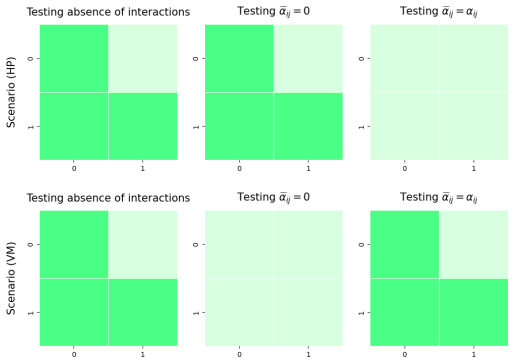


read the original abstract
Multivariate Hawkes processes are past-dependant point processes originally introduced to model excitation effects, later extended to a nonlinear framework to account for the opposite effect, known as inhibition. Motivated by applications in neuroscience, where the memory of a neuron may reset upon firing, we introduce a new class of nonlinear Hawkes processes with variable length memory. Our model generalises classical Hawkes processes, with or without inhibition, describing the situation where the probability of an event occurring within a given subprocess may depend differently on the history before and after its last event. In particular, if the subprocess does not depend on the history before its last event, it is said to have a variable length memory. Our main contributions are to prove existence of such processes, and to derive a workable likelihood maximisation method, capable of identifying both classical and variable memory dynamics. We demonstrate the effectiveness of our approach both on synthetic data, and on a neuronal activity dataset.
Editorial analysis
A structured set of objections, weighed in public.
Referee Report
Summary. The manuscript introduces a new class of nonlinear Hawkes processes with variable length memory, generalizing classical models to allow the intensity of a subprocess to depend differently on history before and after its last event. The main contributions are a proof of existence for such processes and the derivation of a likelihood maximization method for inference that can identify both classical and variable memory dynamics. The approach is illustrated on synthetic data and a neuronal activity dataset.
Significance. Should the existence result hold under the stated conditions and the inference method prove consistent, this work offers a meaningful extension to Hawkes process modeling, particularly suited for neuroscience applications where neuronal memory may reset upon firing. The capacity to distinguish memory types through likelihood maximization adds practical value for analyzing spiking data.
major comments (2)
- [Existence section (likely §3)] The proof of existence needs to address whether the variable-length memory truncation preserves the necessary Lipschitz continuity or boundedness conditions for the intensity function. Standard arguments for nonlinear Hawkes processes rely on these to ensure no finite-time explosion; the paper should explicitly verify that the reset mechanism does not violate them, perhaps by providing a uniform bound independent of the number of events.
- [Inference section (likely §4)] The derivation of the likelihood function for the variable memory model should include a discussion of identifiability and consistency of the maximizer, especially when the model can reduce to classical Hawkes under certain parameter choices.
minor comments (2)
- [Abstract] Change 'past-dependant' to 'past-dependent'.
- [Throughout] Ensure consistent notation for the intensity function and history measures.
Simulated Author's Rebuttal
We thank the referee for their constructive comments, which help strengthen the presentation of our results on variable-length-memory Hawkes processes. We address each major comment below.
read point-by-point responses
-
Referee: [Existence section (likely §3)] The proof of existence needs to address whether the variable-length memory truncation preserves the necessary Lipschitz continuity or boundedness conditions for the intensity function. Standard arguments for nonlinear Hawkes processes rely on these to ensure no finite-time explosion; the paper should explicitly verify that the reset mechanism does not violate them, perhaps by providing a uniform bound independent of the number of events.
Authors: We agree that the existence argument should explicitly confirm preservation of the required conditions. In the revised manuscript we will add a short lemma showing that, under the same Lipschitz and boundedness assumptions used for the classical nonlinear Hawkes process, the variable-length truncation yields an intensity that remains Lipschitz continuous with a constant independent of history length and admits a uniform bound independent of the number of events, thereby ruling out finite-time explosion by the standard arguments. revision: yes
-
Referee: [Inference section (likely §4)] The derivation of the likelihood function for the variable memory model should include a discussion of identifiability and consistency of the maximizer, especially when the model can reduce to classical Hawkes under certain parameter choices.
Authors: We thank the referee for this suggestion. The revised manuscript will expand the inference section with a paragraph on identifiability, explicitly noting that the variable-memory model nests the classical Hawkes process (recovered when the pre-reset kernel coefficients are set to zero) and that the parameter space remains identifiable under mild separation conditions. We will also sketch consistency of the maximum-likelihood estimator by appealing to standard regularity conditions for point-process likelihoods, with a reference to existing results in the literature. revision: yes
Circularity Check
Derivation chain is self-contained; no circular reductions identified
full rationale
The paper defines a new class of nonlinear Hawkes processes with variable-length memory, proves existence under stated conditions, and derives a likelihood maximization procedure for inference. These steps rely on standard point-process theory (compensators, intensity functions) and do not reduce any claimed existence result or estimator to a fitted quantity, self-citation chain, or input by construction. The model specification (truncation at last event) is logically prior to both the existence argument and the subsequent parameter estimation; no equation or theorem is shown to be equivalent to its own inputs. The paper is therefore self-contained against external benchmarks for the purpose of this circularity check.
Axiom & Free-Parameter Ledger
axioms (1)
- domain assumption The intensity function satisfies conditions that guarantee existence of the point process even when memory is truncated after the last event.
Lean theorems connected to this paper
-
IndisputableMonolith/Foundation/AbsoluteFloorClosure.leanreality_from_one_distinction unclear?
unclearRelation between the paper passage and the cited Recognition theorem.
We introduce a new class of nonlinear Hawkes processes with variable length memory... prove existence... likelihood maximisation method
What do these tags mean?
- matches
- The paper's claim is directly supported by a theorem in the formal canon.
- supports
- The theorem supports part of the paper's argument, but the paper may add assumptions or extra steps.
- extends
- The paper goes beyond the formal theorem; the theorem is a base layer rather than the whole result.
- uses
- The paper appears to rely on the theorem as machinery.
- contradicts
- The paper's claim conflicts with a theorem or certificate in the canon.
- unclear
- Pith found a possible connection, but the passage is too broad, indirect, or ambiguous to say the theorem truly supports the claim.
Reference graph
Works this paper leans on
-
[1]
" write newline "" before.all 'output.state := FUNCTION fin.entry add.period write newline FUNCTION new.block output.state before.all = 'skip after.block 'output.state := if FUNCTION new.sentence output.state after.block = 'skip output.state before.all = 'skip after.sentence 'output.state := if if FUNCTION not #0 #1 if FUNCTION and 'skip pop #0 if FUNCTIO...
-
[2]
Asmussen, S. (2003). Applied Probability and Queues , volume 51 of Stochastic Modelling and Applied Probability . New York: Springer
work page 2003
-
[3]
Bacry, E., Bompaire, M., Gaïffas, S., & Muzy, J.-F. (2020). Sparse and low-rank multivariate Hawkes processes. Journal of Machine Learning Research , 21(50), 1--32
work page 2020
-
[4]
Benjamini, Y. & Hochberg, Y. (1995). Controlling the False Discovery Rate : A Practical and Powerful Approach to Multiple Testing . Journal of the Royal Statistical Society: Series B (Methodological) , 57(1), 289--300
work page 1995
-
[5]
Bonnet, A., Dion, C., Gindraud, F., & Lemler, S. (2022). Neuronal Network Inference and Membrane Potential Model using Multivariate Hawkes Processes . Journal of Neuroscience Methods , 372, 109550
work page 2022
-
[6]
Bonnet, A., Herrera, M. M., & Sangnier, M. (2023). Inference of multivariate exponential Hawkes processes with inhibition and application to neuronal activity. Statistics and Computing , 33(4), 91
work page 2023
-
[7]
Bonnet, A. & Sangnier, M. (2025). Nonparametric estimation of Hawkes processes with RKHSs . In Proceedings of The 28th International Conference on Artificial Intelligence and Statistics (pp.\ 3574--3582).: PMLR
work page 2025
-
[8]
Brémaud, P. & Massoulié, L. (1996). Stability of nonlinear Hawkes processes. The Annals of Probability , 24(3), 1563--1588
work page 1996
-
[9]
Costa, M., Graham, C., Marsalle, L., & Tran, V. C. (2020). Renewal in Hawkes processes with self-excitation and inhibition. Advances in Applied Probability , 52(3), 879--915
work page 2020
-
[10]
Daley, D. J. & Vere-Jones (2003). An Introduction to the Theory of Point Processes , volume 1 of Probability and its Applications . New York: Springer-Verlag, 2 edition
work page 2003
-
[11]
Daley, D. J. & Vere-Jones, D. (2008). An introduction to the Theory of Point Processes , volume 2 of Probability and its Applications . Springer-Verlag, 2 edition
work page 2008
- [12]
-
[13]
Duval, C., Luçon, E., & Pouzat, C. (2022). Interacting Hawkes processes with multiplicative inhibition. Stochastic Processes and their Applications , 148, 180--226
work page 2022
-
[14]
Galves, A. & Löcherbach, E. (2013). Infinite Systems of Interacting Chains with Memory of Variable Length — A Stochastic Model for Biological Neural Nets . Journal of Statistical Physics , 151(5), 896--921
work page 2013
-
[15]
Galves, A. & Löcherbach, E. (2016). Modeling networks of spiking neurons as interacting processes with memory of variable length. Journal de la Société Française de Statistique , 157(1), 17--32
work page 2016
-
[16]
Galves, A., Löcherbach, E., & Pouzat, C. (2024). Probabilistic Spiking Neuronal Nets : Neuromathematics for the Computer Era . Lecture Notes on Mathematical Modelling in the Life Sciences . Cham: Springer International Publishing
work page 2024
-
[17]
Hawkes, A. G. (1971). Spectra of some self-exciting and mutually exciting point processes. Biometrika , 58(1), 83--90
work page 1971
-
[18]
Hodara, P. & Löcherbach, E. (2017). Hawkes processes with variable length memory and an infinite number of components. Advances in Applied Probability , 49, 84--107
work page 2017
- [19]
- [20]
-
[21]
C., Tuleau-Malot, C., Bessaih, T., Rivoirard, V., Bouret, Y., Leresche, N., & Reynaud-Bouret, P
Lambert, R. C., Tuleau-Malot, C., Bessaih, T., Rivoirard, V., Bouret, Y., Leresche, N., & Reynaud-Bouret, P. (2018). Reconstructing the functional connectivity of multiple spike trains using Hawkes models. Journal of Neuroscience Methods , 297, 9--21
work page 2018
-
[22]
Lemonnier, R. & Vayatis, N. (2014). Nonparametric Markovian Learning of Triggering Kernels for Mutually Exciting and Mutually Inhibiting Multivariate Hawkes Processes . In T. Calders, F. Esposito, E. Hüllermeier, & R. Meo (Eds.), Machine Learning and Knowledge Discovery in Databases (pp.\ 161--176). Berlin, Heidelberg: Springer
work page 2014
-
[23]
Lotz, A. (2024). A sparsity test for multivariate Hawkes processes
work page 2024
-
[24]
Mei, H. & Eisner, J. (2017). The neural hawkes process: a neurally self-modulating multivariate point process. In Proceedings of the 31st International Conference on Neural Information Processing Systems , NIPS '17 (pp.\ 6757--6767). Red Hook, NY, USA: Curran Associates Inc
work page 2017
-
[25]
Meng, Z., Wan, K., Huang, Y., Li, Z., Wang, Y., & Zhou, F. (2024). Interpretable Transformer Hawkes Processes : Unveiling Complex Interactions in Social Networks . In Proceedings of the 30th ACM SIGKDD Conference on Knowledge Discovery and Data Mining , KDD '24 (pp.\ 2200--2211). New York, NY, USA: Association for Computing Machinery
work page 2024
-
[26]
Nicvert, L., Donnet, S., Keith, M., Peel, M., Somers, M. J., Swanepoel, L. H., Venter, J., Fritz, H., & Dray, S. (2024). Using the multivariate Hawkes process to study interactions between multiple species from camera trap data. Ecology , 105(4), e4237
work page 2024
-
[27]
Ogata, Y. (1978). The asymptotic behaviour of maximum likelihood estimators for stationary point processes. Annals of the Institute of Statistical Mathematics , 30(2), 243--261
work page 1978
-
[28]
Ogata, Y. (1981). On Lewis ' simulation method for point processes. IEEE Transactions on Information Theory , 27(1), 23--31
work page 1981
-
[29]
Ogata, Y. (1988). Statistical Models for Earthquake Occurrences and Residual Analysis for Point Processes . Journal of the American Statistical Association , 83(401), 9--27
work page 1988
-
[30]
Olinde, J. & Short, M. (2020). A Self -limiting Hawkes Process : Interpretation , Estimation , and Use in Crime Modeling . 2020 IEEE International Conference on Big Data , (pp.\ 3219)
work page 2020
-
[31]
Pan, Z., Wang, Z., Phillips, J. M., & Zhe, S. (2021). Self-adaptable point processes with nonparametric time decays. In Proceedings of the 35th International Conference on Neural Information Processing Systems , NIPS '21 (pp.\ 4594--4606). Red Hook, NY, USA: Curran Associates Inc
work page 2021
-
[32]
Petersen, P. C. & Berg, R. W. (2016). Lognormal firing rate distribution reveals prominent fluctuation–driven regime in spinal motor networks. eLife , 5, e18805
work page 2016
-
[33]
C., Lindén, H., Vestergaard, M., & Berg, R
Radosevic, M., Willumsen, A., Petersen, P. C., Lindén, H., Vestergaard, M., & Berg, R. W. (2019). Decoupling of timescales reveals sparse convergent CPG network in the adult spinal cord. Nature Communications , 10(1)
work page 2019
-
[34]
Reynaud-Bouret, P., Rivoirard, V., Grammont, F., & Tuleau-Malot, C. (2014). Goodness-of-fit tests and nonparametric adaptive estimation for spike train analysis. Journal of Mathematical Neuroscience , 4, 3
work page 2014
-
[35]
Rizoiu, M.-A., Lee, Y., Mishra, S., & Xie, L. (2017). A Tutorial on Hawkes Processes for Events in Social Media
work page 2017
-
[36]
Strata, P. & Harvey, R. (1999). Dale's principle. Brain Res. Bull. , 50, 349--50
work page 1999
-
[37]
Sulem, D., Rivoirard, V., & Rousseau, J. (2023). Scalable and adaptive variational Bayes methods for Hawkes processes
work page 2023
-
[38]
Sulem, D., Rivoirard, V., & Rousseau, J. (2024). Bayesian estimation of nonlinear Hawkes processes. Bernoulli , 30(2), 1257--1286
work page 2024
-
[39]
Virtanen, P., Gommers, R., Oliphant, T. E., Haberland, M., Reddy, T., Cournapeau, D., Burovski, E., Peterson, P., Weckesser, W., Bright, J., van der Walt, S. J., Brett, M., Wilson, J., Millman, K. J., Mayorov, N., Nelson, A. R. J., Jones, E., Kern, R., Larson, E., Carey, C. J., Polat, I., Feng, Y., Moore, E. W., VanderPlas, J., Laxalde, D., Perktold, J., ...
work page 2020
-
[40]
Zhang, Q., Lipani, A., Lipani, A., & Yilmaz, E. (2020). Self-attentive Hawkes process. In Proceedings of the 37th International Conference on Machine Learning , volume 119 of ICML '20 (pp.\ 11183--11193).: JMLR.org
work page 2020
-
[41]
Zuo, S., Jiang, H., Li, Z., Zhao, T., & Zha, H. (2020). Transformer Hawkes process. In Proceedings of the 37th International Conference on Machine Learning , volume 119 of ICML '20 (pp.\ 11692--11702).: JMLR.org
work page 2020
discussion (0)
Sign in with ORCID, Apple, or X to comment. Anyone can read and Pith papers without signing in.