REVIEW 3 major objections 5 minor 2 cited by
Foundation Models for Clean Energy Forecasting: A Comprehensive Review
T0 review · 3 major / 5 minor · reviewed 2026-08-06 · deepseek-v4-flash
Pith's one-line read This review argues that large pretrained foundation models are becoming the practical route to accurate, adaptable wind and solar forecasting.
desk verdict Useful survey skeleton, but its central performance numbers are untraceable to the cited sources, so it is not yet a reliable map of the field. read the letter →
The pith
A machine-rendered reading of the paper's core claim, the machinery that carries it, and where it could break.
The reading
What carries the argument
The carrying mechanism is the time-series foundation model: a large transformer pre-trained on massive, heterogeneous time-series corpora and adapted to downstream tasks. The review's taxonomy organizes these models by architecture (transformer, graph, hybrid), pre-training objective (generative, masked, contrastive), and adaptation method (zero-shot, full fine-tuning, parameter-efficient fine-tuning such as LoRA and adapters, and prompting). The transferable temporal representations learned during pre-training are what let one model serve many wind, solar, and load forecasting tasks with little or no task-specific data.
What would settle it
A replication study that runs Chronos, Lag-Llama, TimesFM, TimeGPT-1, and Aurora together with a well-tuned LSTM or trained-from-scratch transformer on the same wind and solar datasets, at matched input lengths, and finds no accuracy advantage for the foundation models would falsify the review's central comparative claim.
Extended reading notes
Core claim
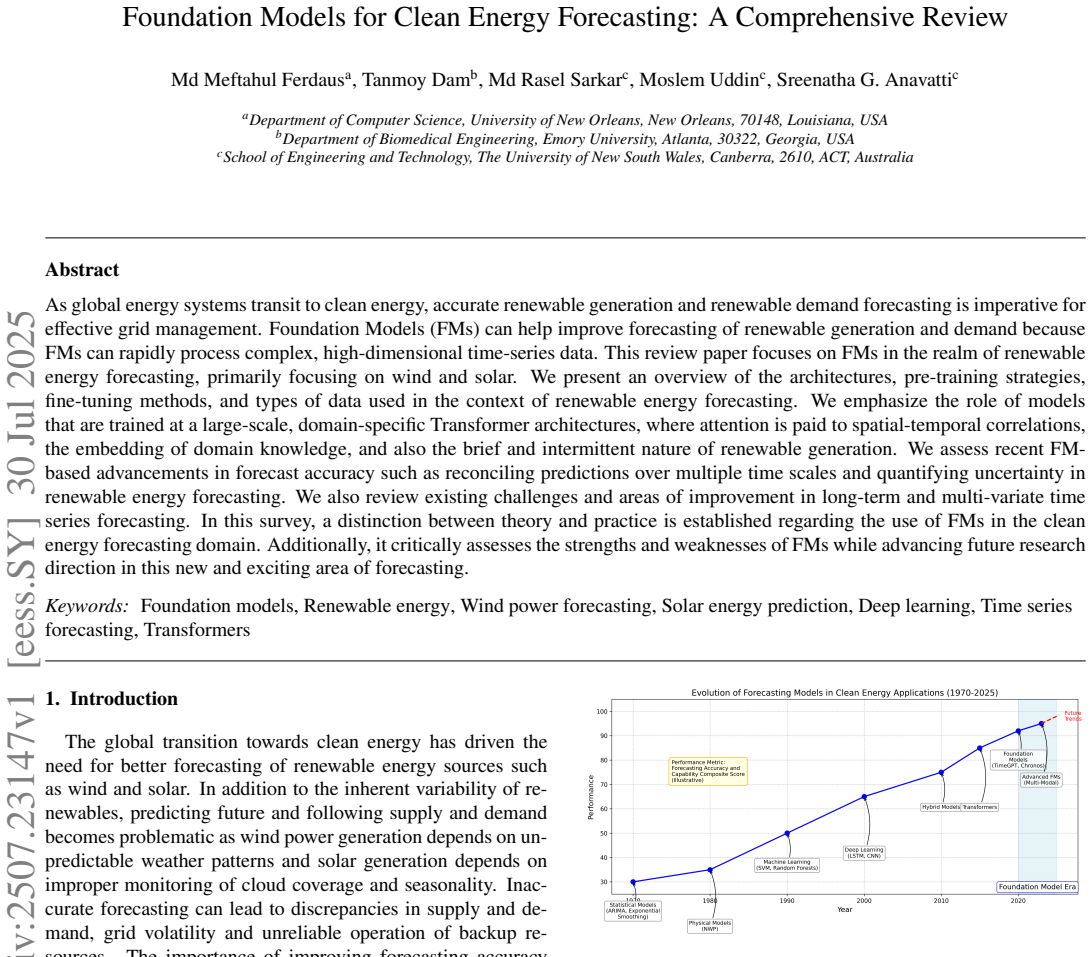
The central claim is that time-series foundation models—transformers pretrained on large, heterogeneous collections of time-series data—perform at least as well as, and in several cited cases better than, models trained from scratch for renewable forecasting. The review's evidence base is a comparison of model families: Chronos cuts solar forecasting error by 15–20%, Lag-Llama improves wind power prediction by 8%, TimesFM reaches near-fully-trained accuracy in zero-shot settings, and Aurora forecasts about 30% faster than numerical weather prediction with comparable accuracy. These results are used to argue that foundation models unify clean energy forecasting: one pretrained model can adapt to diverse tasks, integrate weather, satellite, sensor, and grid data, and output probabilistic forecasts that support risk-aware grid operations.
Load-bearing premise
The review's conclusions stand on the accuracy of the quantitative results it reports from cited studies—especially the 15–20% solar error reduction for Chronos and the 8% wind improvement for Lag-Llama—because the review itself adds no new experiments.
Editorial extensions
If this is right
- A single pretrained foundation model could replace many bespoke forecasters, so a utility would fine-tune one model for wind, solar, and load across regions instead of retraining from scratch.
- Zero-shot forecasting would give usable predictions for new solar farms or wind plants with little or no local history, shortening the deployment cycle for new renewable assets.
- Probabilistic and scenario-based outputs would let operators size operating reserves and hedge market positions using forecast distributions rather than single point estimates.
- Parameter-efficient fine-tuning methods such as LoRA and adapters would make large pretrained models usable by organizations with modest compute and limited labeled data.
- The reported scaling behavior suggests that expanding pretraining data and model size will continue to improve renewable forecasting accuracy, with diminishing returns at very large scales.
Reading between the lines
- The practical payoff of the reported gains would show up mostly in faster deployment and lower reserve costs, not just in smaller error metrics, because zero-shot and probabilistic outputs change how forecasts are used operationally.
- The taxonomy implies a testable extension: an energy-specific pretraining corpus enriched with synthetic extreme events should improve tail-risk forecasting more than a generic time-series corpus of the same size.
- An independent head-to-head benchmark on standardized wind and solar datasets, with matched input lengths and retraining budgets, would be needed to confirm the 15–20% solar and 8% wind figures the review cites.
- The convergence toward graph-based, physics-informed, and multi-task architectures suggests the next generation of energy foundation models will combine physical constraints with learned representations rather than using pure sequence transformers.
Editorial analysis
A structured set of objections, weighed in public.
Referee Report
Summary. The manuscript is a systematic literature review of foundation models (FMs) for clean energy forecasting, focusing on wind and solar but also covering electricity load. It surveys roughly 218 references, proposes a taxonomy based on architecture, pre-training paradigm, adaptation method, and data modality, and reviews modeling innovations, uncertainty quantification, interpretability, and computational efficiency. The review contains no new experiments; its central conclusion, stated in Section 7, is that FMs 'represent a significant step forward' for operational renewable forecasting. The quantitative evidence for this conclusion comes primarily from Section 3.3 and Table 1, which report specific performance improvements for Chronos, Lag-Llama, TimesFM, TimeGPT-1, Aurora, GridFM, and physics-informed FMs.
Significance. If the survey's comparative claims are accurate and traceable, the paper would be a useful synthesis and taxonomy for a fast-moving area, and its catalog of challenges and future directions would be of value to practitioners. The review is strongest as an organizing framework: it covers architectural variants, pre-training objectives, fine-tuning methods, data fusion strategies, uncertainty quantification, interpretability, and scalability, and it gives explicit credit to recent primary sources. However, the headline conclusion depends on quantitative performance claims in Table 1 and Section 3.3 that are not tied to specific findings in the cited papers, and the search protocol is not reproducible as reported. Because the review adds no new empirical evidence, the significance of the central claim is currently conditional on source verification.
major comments (3)
- [§3.3 and Table 1] The central quantitative evidence for the review's conclusion consists of the entries in Table 1: Chronos reduces solar forecasting error by 15-20%, Lag-Llama improves wind power prediction by 8%, Aurora is 30% faster than NWP, and similar claims for TimesFM, TimeGPT-1, GridFM, and physics-informed FMs. The table gives only model-level citations, not per-claim sources, and the text in Section 3.3 repeats these numbers without any additional reference. As far as I can determine from the cited preprints, these specific results are not reported there: Chronos (Ansari et al., arXiv:2403.07815) evaluates on general time-series benchmarks rather than solar forecasting, Lag-Llama (Rasul et al., arXiv:2310.08278) does not report an 8% wind improvement, and Aurora (Bodnar et al., arXiv:2405.13063) does not state a '30% faster than NWP' result. Since Section 7's conclusion rests on these numbers and the manuscript adds no experiments, the evidentiary basis of the headline claim is currently unsupported. Each quantitative entry should be replaced with a verifiable, per-claim citation (including dataset, baseline, and metric), or the quantitative claims should be removed and the table relabeled as a qualitative summary.
- [§3.2, §4.1, §4.2] The definition of 'FM' is internally inconsistent and one key citation is misassigned. Section 3.2 introduces 'Finite mixture (FM) models' in the context of TimeGPT-1, Chronos, and Time-MoE, which contradicts the abstract and the remainder of the manuscript, where FM stands for 'Foundation Model.' In addition, Section 4.1 attributes TimeGPT-1's cross-domain generalization to reference [65] (Hou et al., 2025), and Section 4.2 again cites [65] for encoder-decoder transformer structures 'such TimeGPT-1.' Reference [65] is a paper on transformer load forecasting and overload detection, not the TimeGPT-1 paper, which is correctly cited as [34] (Garza et al., 2023) in Section 3.1. These errors place claims about a flagship model on the wrong source and need correction.
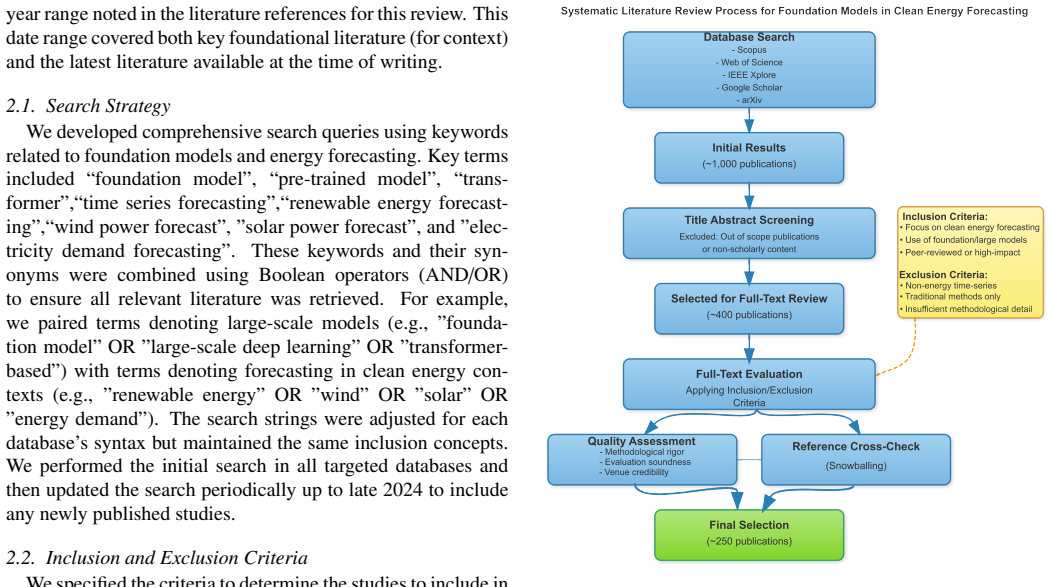
- [§2.1–§2.3] The methodology section presents the review as a systematic literature review but omits the information needed to reproduce it. The text states that 'approximately 250 publications' were included, yet the reference list contains 218 entries; no PRISMA-style stage-by-stage counts, database-specific query strings, deduplication numbers, or screening/exclusion totals are provided. Section 2.1 lists keyword sets but not the full Boolean queries, and Section 2.3 does not report how many records were screened at each stage. This is not merely a formatting issue: the review's usefulness as a systematic synthesis depends on the completeness and reproducibility of the search, and the current description does not support the claimed scale of the corpus.
minor comments (5)
- [§5.3] The sentence 'A case study from a grid operator showed that a hybrid machine learning model ... could reduce the day ahead forecasting mean absolute error (MAE) by 20%' provides no citation for the case study; please add a source or remove the specific percentage. The same paragraph's claim about FMs trained on global reanalysis data would also benefit from a supporting reference.
- [§4.4] 'Rasoul et al. said that fine-tuning Lag-Llama...' should read 'Rasul et al.'; the name is spelled correctly in reference [78].
- [§3.3] The sentence 'it can transfer common temporal properties (that after 8-10 years - all interruptions - still relative to past years) to the new task [77]' is unclear and should be rewritten; as written it is difficult to identify the intended claim about temporal transfer.
- [Figure 3] Figure 3 is described as a 'Comparative Analysis of Forecasting Approaches' and displays a heatmap of 'key performance metrics,' but no underlying data, evaluation protocol, or source is given. If the figure is a schematic, it should be labeled as such; if it is empirical, it needs a source or a reference to the benchmark from which the values are taken.
- [§3.2] There is a typographical error in 'even greater capacity' rendered as 'evengreater capacity'; please fix throughout the manuscript, where similar spacing errors appear (e.g., 'di fferent', 'o ffers', 'e ffective').
Circularity Check
No circularity: the review synthesizes external literature with no self-referential derivation chain.
full rationale
This paper is a literature review, not a derivation or modeling study. Its central claims (e.g., FMs improve renewable forecasting accuracy, Chronos reduces solar error, Lag-Llama improves wind prediction) are presented as summaries of cited external works, and the paper adds no new experiments or fitted parameters. There is no evidence of the authors citing their own prior work, no imported uniqueness theorem, and no ansatz smuggled in via self-citation. The closest issues are traceability and fidelity concerns: Table 1 lacks per-claim citations, the claimed ~250 included studies exceeds the 218 listed references, the Section 3.2 definition of FM as 'Finite mixture' is a technical error, and the specific performance numbers attributed to Chronos, Lag-Llama, and Aurora may not be verifiable in the cited primary papers. These are soundness, accuracy, and reporting-integrity concerns, not circularity: none of the review's conclusions are equivalent by construction to its inputs, and no load-bearing step reduces to a self-citation or a fitted quantity renamed as a prediction. Under the hard rules requiring an explicit reduction (Eq. X = Eq. Y by construction, or fitted parameter renamed as prediction) no such reduction can be exhibited, so the appropriate finding is no significant circularity.
Assumptions & free parameters
assumptions (3)
- domain assumption The cited primary literature supports the specific findings attributed to it in the survey, especially the quantitative performance numbers in Table 1.
- domain assumption The keyword-based search over Scopus, Web of Science, IEEE Xplore, Google Scholar, and arXiv from 2016 to 2024 captured the relevant literature.
- domain assumption The chosen taxonomy dimensions, architecture, pre-training paradigm, adaptation method, and application domain, are the appropriate organizing axes for this literature.
Cite this review
Pith. "Pith review of Foundation Models for Clean Energy Forecasting: A Comprehensive Review." pith.science (2026). https://pith.science/paper/GNJHTCXS
@misc{pith2026250723147,
  author       = {Pith},
  title        = {Pith review of: Foundation Models for Clean Energy Forecasting: A Comprehensive Review},
  year         = {2026},
  howpublished = {\url{https://pith.science/paper/GNJHTCXS}},
  note         = {Machine review of arXiv:2507.23147}
}
read the original abstract
As global energy systems transit to clean energy, accurate renewable generation and renewable demand forecasting is imperative for effective grid management. Foundation Models (FMs) can help improve forecasting of renewable generation and demand because FMs can rapidly process complex, high-dimensional time-series data. This review paper focuses on FMs in the realm of renewable energy forecasting, primarily focusing on wind and solar. We present an overview of the architectures, pretraining strategies, finetuning methods, and types of data used in the context of renewable energy forecasting. We emphasize the role of models that are trained at a large scale, domain specific Transformer architectures, where attention is paid to spatial temporal correlations, the embedding of domain knowledge, and also the brief and intermittent nature of renewable generation. We assess recent FM based advancements in forecast accuracy such as reconciling predictions over multiple time scales and quantifying uncertainty in renewable energy forecasting. We also review existing challenges and areas of improvement in long-term and multivariate time series forecasting. In this survey, a distinction between theory and practice is established regarding the use of FMs in the clean energy forecasting domain. Additionally, it critically assesses the strengths and weaknesses of FMs while advancing future research direction in this new and exciting area of forecasting.
Figures

Figures from the paper (4 more)


Forward citations
Cited by 2 Pith papers
-
FETS Benchmark: Foundation Models Enable Scalable and Generalizable Energy Time Series Forecasting
Foundation models outperform dataset-specific machine learning in energy time series forecasting across 54 datasets in 9 categories.
-
FETS Benchmark: Foundation Models Enable Scalable and Generalizable Energy Time Series Forecasting
Covariate-informed zero-shot time-series foundation models beat task-specifically tuned XGBoost and random forests in aggregate on a 54-dataset energy forecasting benchmark.
Reference graph
Works this paper leans on
-
[65]
Y . Hou, C. Ma, X. Li, Y . Sun, H. Yu, Z. Fang, Time series foundation model for improved transformer load forecasting and overload detection, Energies 18 (3) (2025) 660
2025
-
[34]
Garza, C
A. Garza, C. Challu, M. Mergenthaler-Canseco, Timegpt-1, ArXiv (2023)
2023
-
[1]
O. Mane, A. Zagade, S. Sonpatki, S. Chavan, K. Nimbalkar, Forecasting renewable energy production using ai-based weather prediction models, International Journal For Multidisciplinary Research (2024). doi:10. 36948/ijfmr.2024.v06i03.21917
2024
-
[2]
X. Zhou, J. Ye, S. Zhao, M. Jin, Z. Hou, C.-S. Yang, Z. Li, Y . Wen, X. Yuan, Towards universal large-scale foundational model for nat- ural gas demand forecasting, ArXiv abs /2409.15794 (2024). doi: 10.48550/arXiv.2409.15794
work page Pith review arXiv doi:10.48550/arxiv.2409.15794 2024
-
[3]
Z. Li, X. Qiu, P. Chen, Y . Wang, H. Cheng, Y . Shu, J. Hu, C. Guo, A. Zhou, Q. Wen, C. S. Jensen, B. Yang, Foundts: Comprehensive and unified benchmarking of foundation models for time series forecasting (2024)
2024
-
[4]
N. Sergeev, P. Matrenin, A review of international experi- ence in forecasting renewable energy generation using ma- chine learning methods, iPolytech Journal (2023). doi: 10.21285/1814-3520-2023-2-354-369
-
[5]
A.-H. Jung, D.-H. Lee, J.-Y . Kim, C. K. Kim, H.-G. Kim, Y .-S. Lee, Re- gional photovoltaic power forecasting using vector autoregression model in south korea, Energies (2022). doi:10.3390/en15217853
-
[6]
Zou, Survey of wind power output power forecasting technology, Highlights in Science, Engineering and Technology (2023)
Y . Zou, Survey of wind power output power forecasting technology, Highlights in Science, Engineering and Technology (2023). doi:10. 54097/hset.v50i.8490
2023
Show all 216 references
-
[7]
Alpackaya, M
I. Alpackaya, M. H. Fallah, N. Mounika, S. Sood, S. Rajvanshi, S. Lakhanpal, P. Cajla, A. Sharma, Y . S. Lalitha, Renewable energy fore- casting using deep learning techniques, E3S Web of Conferences (2024). doi:10.1051/e3sconf/202458101011
2024
-
[8]
N. E. Benti, M. D. Chaka, A. Semie, Forecasting renewable energy gen- eration with machine learning and deep learning: Current advances and future prospects, Sustainability (2023). doi:10.3390/su15097087
2023 doi
-
[9]
T. S. Pham, D. Nguyen, N. D. M. Phan, Wind energy forecasting: A comparative analysis of machine learning approaches, in: 2023 8th International Scientific Conference on Applying New Technology in Green Buildings (ATiGB), 2023, pp. 195–200. doi:10.1109/ ATiGB59969.2023.10364510
2023
-
[10]
K. E. Bassey, Solar energy forecasting with deep learning technique, Engineering Science & Technology Journal (2023). doi:10.51594/ estj.v4i2.1286
2023
-
[11]
Mohan, R
L. Mohan, R. Durga, Evaluation of renewable energy forecasting (ref) technique using by machine learning, in: 2023 International Con- ference on New Frontiers in Communication, Automation, Manage- ment and Security (ICCAMS), V ol. 1, 2023, pp. 1–8. doi:10.1109/ ICCAMS60113.202...
2023
-
[12]
Saeed, S
F. Saeed, S. Aldera, Adaptive renewable energy forecasting utiliz- ing a data-driven pca-transformer architecture, IEEE Access 12 (2024) 109269–109280. doi:10.1109/ACCESS.2024.3440226
2024
-
[13]
M. J. Walczewski, H. W ¨ohrle, Prediction of electricity generation using onshore wind and solar energy in germany, Energies (2024). doi:10. 3390/en17040844
2024
-
[14]
Ghazaei, O
E. Ghazaei, O. Feizi, A. Ghavifekr, M. Salim, A. Hassanzadeh, Wind farm power prediction with transformer encoder, in: 2024 9th Interna- tional Conference on Technology and Energy Management (ICTEM), 2024, pp. 1–5. doi:10.1109/ICTEM60690.2024.10631900
2024
-
[15]
X. Dai, G. Liu, W. Hu, Z. Lei, H. Zhou, Learning from chatgpt: A transformer-based model for wind power forecasting, in: 2023 IEEE International Conference on Environment and Electrical Engineering and 2023 IEEE Industrial and Commercial Power Systems Europe (EEEIC / I&CPS Eur...
2023
-
[16]
H. Han, X. Liang, K. Zhu, Multi-modal transformer-based wind power prediction by utilizing heterogeneous sources 13159 (2024) 131591H – 131591H–6. doi:10.1117/12.3024579
2024 doi
-
[17]
Ghasemi, M
A. Ghasemi, M. Hashemi, Harnessing the power of transformer learning with long-term memory for renewable energy forecasting, 2023 IEEE Virtual Conference on Communications (VCC) (2023) 171–176 doi: 10.1109/VCC60689.2023.10475044
2023
- [18]
-
[19]
Joseph, A
S. Joseph, A. A. Jo, E. D. Raj, Improving time series forecasting accu- racy with transformers: A comprehensive analysis with explainability, in: 2024 Third International Conference on Electrical, Electronics, In- formation and Communication Technologies (ICEEICT), 2024, pp. 1...
2024
-
[20]
Rasul, A
K. Rasul, A. Ashok, A. R. Williams, A. Khorasani, G. Adamopou- los, R. Bhagwatkar, M. Bilovs, H. Ghonia, N. Hassen, A. Schneider, S. Garg, A. Drouin, N. Chapados, Y . Nevmyvaka, I. Rish, Lag-llama: Towards foundation models for probabilistic time series forecasting, ArXiv abs/...
-
[21]
A. Das, W. Kong, R. Sen, Y . Zhou, A decoder-only foundation model for time-series forecasting, arXiv preprint arXiv:2310.10688 (2023)
2023 arXiv
-
[23]
M. K. Bharti, R. Wadhvani, M. Gyanchandani, M. Gupta, Transformer- based multivariate time series forecasting, in: 2024 IEEE International Students’ Conference on Electrical, Electronics and Computer Sci- ence (SCEECS), 2024, pp. 1–6. doi:10.1109/SCEECS61402.2024. 10482217
2024 arXiv
-
[24]
Uremovi ´c, M
N. Uremovi ´c, M. Bizjak, P. Sukiˇc, G. ˇStumberger, B. ˇZalik, N. Lukaˇc, A new framework for multivariate time series forecasting in energy man- agement system, IEEE Transactions on Smart Grid 14 (2023) 2934–
2023
-
[27]
Mundotiya, P
P. Mundotiya, P. Mathuria, H. Tiwari, Comprehensive review on un- certainty in wind power forecasting-models and challenges, in: 2022 2nd International Conference on Innovative Sustainable Computational Technologies (CISCT), 2022, pp. 1–6. doi:10.1109/CISCT55310. 2022.10046605
2022
-
[28]
Borrotti, Quantifying uncertainty with conformal prediction for heat- 22 ing and cooling load forecasting in building performance simulation, En- ergies (2024)
M. Borrotti, Quantifying uncertainty with conformal prediction for heat- 22 ing and cooling load forecasting in building performance simulation, En- ergies (2024). doi:10.3390/en17174348
2024 doi
-
[29]
Bommasani, D
R. Bommasani, D. A. Hudson, E. Adeli, R. Altman, S. Arora, S. von Arx, M. S. Bernstein, J. Bohg, A. Bosselut, E. Brunskill, et al., On the opportunities and risks of foundation models, arXiv preprint arXiv:2108.07258 (2021)
2021 arXiv
-
[30]
Germ ´an-Morales, A
M. Germ ´an-Morales, A. Rivera-Rivas, M. D ´ıaz, C. Carmona, Transfer learning with foundational models for time series forecasting using low- rank adaptations, arXiv preprint arXiv:2410.11539 (2024)
2024 arXiv
-
[31]
Liang, H
Y . Liang, H. Wen, Y . Nie, Y . Jiang, M. Jin, D. Song, S. Pan, Q. Wen, Foundation models for time series analysis: A tutorial and survey, in: Proceedings of the 30th ACM SIGKDD conference on knowledge dis- covery and data mining, 2024, pp. 6555–6565
2024
-
[32]
Meyer, D
M. Meyer, D. Zapata, S. Kaltenpoth, O. Mueller, Benchmarking time series foundation models for short-term household electricity load fore- casting, arXiv preprint arXiv:2410.09487 (2024)
2024
-
[33]
A. F. Ansari, L. Stella, C. Turkmen, X. Zhang, P. Mercado, H. Shen, O. Shchur, S. S. Rangapuram, S. P. Arango, S. Kapoor, et al., Chronos: Learning the language of time series, arXiv preprint arXiv:2403.07815 (2024)
2024 arXiv
-
[35]
Dalal, R
L. Dalal, R. Verma, R. Chahar, Beyond words: Adapting nlp method- ologies for time series forecasting challenges, in: 2023 4th Interna- tional Conference on Intelligent Technologies (CONIT), 2024, pp. 1–8. doi:10.1109/CONIT61985.2024.10627058
2023
-
[36]
L. Yang, Y . Wang, X. Fan, I. Cohen, Y . Zhao, Z. Zhang, Vitime: A visual intelligence-based foundation model for time series forecasting, ArXiv abs/2407.07311 (2024). doi:10.48550/arXiv.2407.07311
2024 doi
-
[37]
H. Chai, S. Zhang, X. Qi, Y . Li, Fomo: A foundation model for mobile traffic forecasting with diffusion model, ArXiv (2024)
2024
-
[38]
Makridakis, M
S. Makridakis, M. Hibon, Arma models and the box–jenkins methodol- ogy, Journal of forecasting 16 (3) (1997) 147–163
1997
-
[39]
J. H. Stock, M. W. Watson, Vector autoregressions, Journal of Economic perspectives 15 (4) (2001) 101–115
2001
-
[40]
Lerch, B
S. Lerch, B. Schulz, M. E. Ayari, S. Baran, Post-processing numerical weather prediction ensembles for probabilistic solar irradiance forecast- ing, Solar Energy (2021). doi:10.1016/J.SOLENER.2021.03.023
2021 doi
-
[41]
Wu, Y .-C
Y .-K. Wu, Y .-C. Wu, J.-S. Hong, L. T. Phan, Q. Phan, Probabilistic forecast of wind power generation with data processing and numeri- cal weather predictions, IEEE Transactions on Industry Applications 57 (2021) 36–45. doi:10.1109/TIA.2020.3037264
2021
-
[42]
Vennila, S
A. Vennila, S. Balambigai, P. V , S. U. P, V . Kavyashree, M. Jinisha, Pre- dicting solar and wind power production with the weather map data ap- proach, in: 2024 International Conference on Signal Processing, Com- putation, Electronics, Power and Telecommunication (IConSCEPT)...
2024
-
[43]
Kumhar, A
B. Kumhar, A. Saxena, M. Nagar, Advanced threat intelligence fore- casting using machine learning algorithms, in: 2023 IEEE International Conference on ICT in Business Industry & Government (ICTBIG), 2023, pp. 1–7. doi:10.1109/ICTBIG59752.2023.10456004
2023
-
[44]
Andrews, O
J. Andrews, O. Gkountouna, E. Blaisten-Barojas, Forecasting molecular dynamics energetics of polymers in solution from supervised machine learning, Chemical Science 13 (2022) 7021–7033. doi:10.1039/ d2sc01216b
2022
-
[45]
Ayyıldız, Prediction of stock market index movements with machine learning (2023)
N. Ayyıldız, Prediction of stock market index movements with machine learning (2023). doi:10.58830/ozgur.pub354
2023 doi
-
[46]
Moraitis, L
N. Moraitis, L. Tsipi, D. V ouyioukas, Machine-learning-based path loss prediction for in-cabin wireless networks, in: 2024 IEEE International Conference on Machine Learning for Communication and Networking (ICMLCN), 2024, pp. 393–398. doi:10.1109/ICMLCN59089.2024. 10624765
2024
-
[47]
Deep, Advanced financial market forecasting: integrating monte carlo simulations with ensemble machine learning models, Quantitative Finance and Economics (2024)
A. Deep, Advanced financial market forecasting: integrating monte carlo simulations with ensemble machine learning models, Quantitative Finance and Economics (2024). doi:10.3934/qfe.2024011
2024 doi
-
[48]
Hochreiter, Long short-term memory, Neural Computation MIT-Press (1997)
S. Hochreiter, Long short-term memory, Neural Computation MIT-Press (1997)
1997
-
[49]
Muza ffar, A
S. Muza ffar, A. Afshari, Short-term load forecasts using lstm networks, Energy Procedia 158 (2019) 2922–2927
2019
-
[50]
Eua-Arporn, S.-L
B. Eua-Arporn, S.-L. Huang, E. Kuruoglu, Enhancing neural network based hybrid learning with empirical wavelet transform for time se- ries forecasting, in: 2021 IEEE 33rd International Conference on Tools with Artificial Intelligence (ICTAI), 2021, pp. 386–390.doi:10.1109/ ICT...
2021
-
[51]
Ghide, S
L. Ghide, S. Wei, Y . Ding, Comparative study of wavelet-sarima and emd-sarima for forecasting daily temperature series, Interna- tional Journal of Analysis and Applications (2022). doi:10.28924/ 2291-8639-20-2022-17
2022
-
[52]
J. Wang, X. Peng, J. Wu, Y . Ding, B. Ali, Y . Luo, Y . Hu, K. Zhang, Sin- gular spectrum analysis-based hybrid models for emergency ambulance demand time series forecasting, IMA Journal of Management Mathe- matics (2023). doi:10.1093/imaman/dpad019
2023 doi
-
[53]
Li, C.-A
T.-L. Li, C.-A. Tsai, A new strategy of hybrid models using arima, ann, and dwt in time series modelling, in: Journal of Statistics: Advances in Theory and Applications, 2021. doi:doi.org/10.18642/jsata_ 7100122182
2021 doi
-
[54]
Darmawan, D
G. Darmawan, D. Rosadi, B. N. Ruchjana, Hybrid model of singular spectrum analysis and arima for seasonal time series data, CAUCHY (2022). doi:10.18860/ca.v7i2.14136
2022 doi
-
[55]
Weerasinghe, R
C. Weerasinghe, R. Loaiza-Maya, G. Martin, D. T. Frazier, Abc-based forecasting in state space models (2023)
2023
-
[56]
Ahmad, N
T. Ahmad, N. Zhou, Ensemble methods for probabilistic solar power forecasting: A comparative study, in: 2023 IEEE Power & Energy Society General Meeting (PESGM), 2023, pp. 1–5. doi:10.1109/ PESGM52003.2023.10253133
2023
-
[57]
Jensen, F
V . Jensen, F. Bianchi, S. Anfinsen, Ensemble conformalized quantile regression for probabilistic time series forecasting, IEEE Transactions on Neural Networks and Learning Systems PP (2022). doi:10.1109/ TNNLS.2022.3217694
2022
-
[58]
Doubleday, S
K. Doubleday, S. Jascourt, W. Kleiber, B. Hodge, Probabilistic so- lar power forecasting using bayesian model averaging, IEEE Transac- tions on Sustainable Energy 12 (2021) 325–337. doi:10.1109/TSTE. 2020.2993524
2021
-
[59]
Altho ff, J
S. Altho ff, J. H. Szabadv’ary, J. Anderson, L. Carlsson, Evaluation of conformal-based probabilistic forecasting methods for short-term wind speed forecasting, 2023, pp. 100–115
2023
-
[60]
H. Wu, J. Xu, J. Wang, M. Long, Autoformer: Decomposition trans- formers with auto-correlation for long-term series forecasting, ArXiv abs/2106.13008 (2021)
2021 arXiv
-
[61]
Laborda, S
J. Laborda, S. Ruano, I. Zamanillo, Multi-country and multi-horizon gdp forecasting using temporal fusion transformers, SSRN Electronic Jour- nal (2023). doi:10.2139/ssrn.4329721
2023 doi
-
[62]
C. Ying, J. Lu, Tfeformer: Temporal feature enhanced transformer for multivariate time series forecasting, IEEE Access 12 (2024) 153694– 153708. doi:10.1109/ACCESS.2024.3480953
2024
-
[63]
Oliveira, P
J. Oliveira, P. Ramos, Evaluating the e ffectiveness of time series trans- formers for demand forecasting in retail, Mathematics (2024). doi: 10.3390/math12172728
2024 doi
- [64]
- [66]
-
[67]
Panja, T
M. Panja, T. Chakraborty, U. Kumar, A. Hadid, Parnn: A probabilis- tic autoregressive neural network framework for accurate forecasting (2022)
2022
-
[68]
Evseenkov, D
A. Evseenkov, D. K. Kuchkildin, K. I. Krechetov, S. A. Ospishchev, V . Kotezhekov, E. Yudin, Short-term forecasting of well production based on a hybrid probabilistic approach, Day 2 Wed, October 13, 2021 (2021). doi:10.2118/206519-ms
2021 doi
- [69]
-
[70]
J. Wang, X. Wang, J. Guan, L. Zhang, T. Chang, W. Yu, St-transnet: A spatiotemporal transformer network for uncertainty estimation from a single deterministic precipitation forecast, Monthly Weather Review (2024). doi:10.1175/mwr-d-23-0097.1
2024 doi
-
[71]
Phan, Y .-K
Q.-T. Phan, Y .-K. Wu, Q. Phan, A hybrid wind power forecasting model 23 with xgboost, data preprocessing considering di fferent nwps, Applied Sciences (2021). doi:10.3390/APP11031100
2021 doi
- [72]
- [73]
-
[74]
X. Fang, G. Gong, G. Li, L. Chun, W. Li, P. Peng, A hybrid deep transfer learning strategy for short term cross-building energy prediction, Energy 215 (2021) 119208. doi:10.1016/j.energy.2020.119208
2021
- [75]
- [76]
-
[77]
Spencer, S
R. Spencer, S. Ranathunga, M. Boulic, A. van Heerden, T. Susn- jak, Transfer learning on transformers for building energy consump- tion forecasting–a comparative study, arXiv preprint arXiv:2410.14107 (2024)
2024 arXiv
-
[78]
Rasul, A
K. Rasul, A. Ashok, A. R. Williams, A. Khorasani, G. Adamopoulos, R. Bhagwatkar, M. Bilo ˇs, H. Ghonia, N. Hassen, A. Schneider, et al., Lag-llama: Towards foundation models for time series forecasting, in: R0-FoMo: Robustness of Few-shot and Zero-shot Learning in Large Founda...
2023
-
[79]
Bodnar, W
C. Bodnar, W. P. Bruinsma, A. Lucic, M. Stanley, J. Brandstetter, P. Gar- van, M. Riechert, J. Weyn, H. Dong, A. Vaughan, et al., Aurora: A foundation model of the atmosphere, arXiv preprint arXiv:2405.13063 (2024)
2024 arXiv
- [80]
-
[81]
Farhadloo, A
M. Farhadloo, A. Sharma, M. Yang, B. Jayaprakash, W. Northrop, S. Shekhar, Towards physics-guided foundation models, arXiv preprint arXiv:2502.15013 (2025)
2025 arXiv
-
[82]
Huang, J
M. Huang, J. Yin, Research on adversarial domain adaptation method and its application in power load forecasting, Mathematics (2022).doi: 10.3390/math10183223
2022 doi
-
[83]
Schreiber, B
J. Schreiber, B. Sick, Model selection, adaptation, and combination for transfer learning in wind and photovoltaic power forecasts, Energy and AI (2022). doi:10.1016/j.egyai.2023.100249
2022
-
[84]
Tortora, F
M. Tortora, F. Conte, G. Natrella, P. Soda, Matnet: Multi-level fusion and self-attention transformer-based model for multivariate multi-step day-ahead pv generation forecasting, arXiv preprint arXiv:2306.10356 (2023)
2023 arXiv
-
[85]
Cheng, K
J. Cheng, K. Huang, Z. Zheng, Fitting imbalanced uncertainties in multi- output time series forecasting, ACM Transactions on Knowledge Dis- covery from Data (2023). doi:10.1145/3584704
2023 doi
-
[86]
J. Deng, X. Chen, R. Jiang, X. Song, I. Tsang, A multi-view multi- task learning framework for multi-variate time series forecasting, ArXiv abs/2109.01657 (2021). doi:10.1109/tkde.2022.3218803
2021 arXiv
-
[87]
L. Li, Y . Dai, Z. Wei, S. Wei, Y . Zhang, N. Wei, Q. Li, Enforc- ing water balance in multitask deep learning models for hydrologi- cal forecasting, Journal of Hydrometeorology (2024). doi:10.1175/ jhm-d-23-0073.1
2024
-
[88]
Nikentari, H.-L
N. Nikentari, H.-L. Wei, Multi-task learning for time series forecasting using narmax-lstm, 2022 27th International Conference on Automation and Computing (ICAC) (2022) 1–6 doi:10.1109/ICAC55051.2022. 9911071
2022
-
[89]
Mendis, M
K. Mendis, M. Wickramasinghe, P. Marasinghe, Multivariate time series forecasting: A review, Proceedings of the 2024 2nd Asia Conference on Computer Vision, Image Processing and Pattern Recognition (2024). doi:10.1145/3663976.3664241
2024
-
[90]
Patil, K
A. Patil, K. Kulkarni, A hybrid machine learning - numerical weather prediction approach for day ahead solar irradiance prediction, in: 2024 IEEE 4th International Conference on Sustainable Energy and Fu- ture Electric Transportation (SEFET), 2024, pp. 1–6. doi:10.1109/ SEFET6...
2024
-
[91]
Bellinguer, R
K. Bellinguer, R. Girard, G. Bontron, G. Kariniotakis, Assessment of alternative ways to integrate weather predictions in photovoltaic gen- eration forecasting, EGU General Assembly (2021). doi:10.5194/ EGUSPHERE-EGU21-16091
2021
-
[92]
J. M. Bright, X. Sun, Statistical satellite-derived irradiance estimation: A case study in singapore, in: 2021 IEEE 48th Photovoltaic Spe- cialists Conference (PVSC), 2021, pp. 0835–0842. doi:10.1109/ PVSC43889.2021.9518398
2021
-
[93]
Tournadre, B
B. Tournadre, B. Gschwind, Y . Saint-Drenan, X. Chen, R. A. e Silva, P. Blanc, An alternative cloud index for estimating downwelling surface solar irradiance from various satellite imagers in the framework of a heliosat-v method, Atmospheric Measurement Techniques (2022).doi: ...
2022 doi
-
[94]
Gregor, B
P. Gregor, B. Mayer, T. Zinner, J. Schreder, L. Bugliaro, Towards seam- less irradiance nowcasting on intrahour to intraday scales using all-sky and satellite imagery, Tech. rep., Copernicus Meetings (2021)
2021
-
[95]
F. J. Rodr ´ıguez-Ben´ıtez, M. L ´opez-Cuesta, C. Arbizu-Barrena, M. M. Fern´andez-Le´on, M. ´A. Pamos-Ure ˜na, J. Tovar-Pescador, F. Santos- Alamillos, D. Pozo-V ´azquez, Assessment of new solar radiation now- casting methods based on sky-camera and satellite imagery, Applied...
2021
-
[96]
Logothetis, V
S.-A. Logothetis, V . Salamalikis, S. Wilbert, J. Remund, L. Zarzalejo, Y . Xie, B. Nouri, E. Ntavelis, J. Nou, L. Visser, M. Sengupta, M. P ´o, R. Chauvin, S. Grieu, W. van Sark, A. Kazantzidis, Forecasting of solar irradiance and ramp events with all-sky imagers (2021).doi:1...
2021
-
[97]
Suheb, J. V . N, Iot enabled smart metering in smart energy grid, in: 2022 IEEE North Karnataka Subsection Flagship International Confer- ence (NKCon), 2022, pp. 1–8. doi:10.1109/NKCon56289.2022. 10126752
2022
-
[98]
A. P. Kaur, M. Singh, Iot-based net meter for vehicle-to-grid application with time-of-use, in: 2023 Second International Conference On Smart Technologies For Smart Nation (SmartTechCon), 2023, pp. 153–158. doi:10.1109/SmartTechCon57526.2023.10391799
2023
-
[99]
Al-Haddad, A
Y . Al-Haddad, A. A. Ibrahim, R. Naeem, Forecasting energy consump- tion in smart grids: A comparative analysis of recurrent neural net- works, Iraqi Journal for Computers and Informatics (2024). doi: 10.25195/ijci.v50i1.492
2024 doi
-
[100]
Mlynek, V
P. Mlynek, V . Uher, J. Misurec, Forecasting of smart meters energy con- sumption for data analytics and grid monitoring, 2022 22nd International Scientific Conference on Electric Power Engineering (EPE) (2022) 1– 5doi:10.1109/EPE54603.2022.9814101
2022
-
[101]
Z. Chen, A. Amani, X. Yu, M. Jalili, Control and optimisation of power grids using smart meter data: A review, Sensors (Basel, Switzerland) 23 (2023). doi:10.3390/s23042118
2023 doi
-
[102]
L. Yuan, C. Ying, S. Yongfu, Z. Xuenan, L. Yucai, L. Yang, Research on short-term load forecasting under demand response of multi-type power grid connection based on dynamic electricity price, in: 2021 IEEE In- ternational Conference on Power, Intelligent Computing and Systems...
2021
-
[103]
Wang, Demand forecasting and resource scheduling of independent energy storage market in power grid with deep learning, Journal of Elec- trical Systems (2024)
Z. Wang, Demand forecasting and resource scheduling of independent energy storage market in power grid with deep learning, Journal of Elec- trical Systems (2024). doi:10.52783/jes.2609
2024 doi
-
[104]
Rawal, A
K. Rawal, A. Ahmad, A comparative analysis of supervised machine learning algorithms for electricity demand forecasting, in: 2022 Second International Conference on Power, Control and Computing Technolo- gies (ICPC2T), 2022, pp. 1–6. doi:10.1109/ICPC2T53885.2022. 9776960
2022
-
[105]
F. Cui, D. An, G. Zhang, A game strategy for demand response based on load monitoring in smart grid, Frontiers in Energy Research (2023). doi:10.3389/fenrg.2023.1240542
2023
-
[106]
Shaqour, H
A. Shaqour, H. Farzaneh, H. Almogdady, Day-ahead residential electric- ity demand response model based on deep neural networks for peak de- mand reduction in the jordanian power sector, Applied Sciences (2021). doi:10.3390/APP11146626
2021 doi
-
[107]
Schmude, S
J. Schmude, S. Roy, W. Trojak, J. Jakubik, D. S. Civitarese, S. Singh, J. Kuehnert, K. Ankur, A. Gupta, C. E. Phillips, et al., Prithvi wxc: Foun- dation model for weather and climate, arXiv preprint arXiv:2409.13598 24 (2024)
2024 arXiv
-
[108]
Paletta, G
Q. Paletta, G. Terr ´en-Serrano, Y . Nie, B. Li, J. Bieker, W. Zhang, L. Dubus, S. Dev, C. Feng, Advances in solar forecasting: Computer vision with deep learning, Advances in Applied Energy (2023) 100150
2023
-
[109]
S. J. Lee, Multimodal data fusion for estimating electricity access and demand, Ph.D. thesis, Massachusetts Institute of Technology (2023)
2023
-
[110]
Bharti, V
S. Bharti, V . Saini, R. Kumar, A. Vijayvargiya, Attention mechanism in deep learning for wind power forecasting, in: 2022 IEEE International Conference on Power Electronics, Drives and Energy Systems (PEDES), 2022, pp. 1–6. doi:10.1109/PEDES56012.2022.10080136
2022
-
[111]
A. Meng, S. Chen, Z. Ou, W. Ding, H. Zhou, J. Fan, H. Yin, A hy- brid deep learning architecture for wind power prediction based on bi- attention mechanism and crisscross optimization, Energy 238 (2022) 121795. doi:10.1016/J.ENERGY.2021.121795
2022
-
[112]
Zhang, C
Y . Zhang, C. Peng, A hybrid model based on deep learning and cross-attention for short-term wind power prediction, in: 2022 5th International Conference on Renewable Energy and Power Engineer- ing (REPE), 2022, pp. 351–355. doi:10.1109/REPE55559.2022. 9948810
2022
-
[113]
F. Chen, Y . Zhang, J. Yan, J. You, Y . Liu, M. B. Paskyabi, Ultra-short- term wind power forecasting based on attention mechanism, in: The 10th Renewable Power Generation Conference (RPG 2021), V ol. 2021, 2021, pp. 186–192. doi:10.1049/icp.2021.2387
2021
-
[114]
C. M. Sendanayake, M. A. Juman, T. W. Shan, T. C. Pin, Attention mechanisms in deep learning models for short-term energy load fore- casting, 2023 IEEE 21st Student Conference on Research and Devel- opment (SCOReD) (2023) 87–92doi:10.1109/SCOReD60679.2023. 10563696
2023
-
[115]
Z. Wang, Z. Zhu, G. Xiao, B. Bai, Y . Zhang, A transformer-based multi- entity load forecasting method for integrated energy systems, Frontiers in Energy Research 10 (2022). doi:10.3389/fenrg.2022.952420
2022
-
[116]
D. Cui, W. Xiang, Z. Zang, H. Yu, Z. Ou, Y . Mao, Z. He, Tem- poral fusion transformer with non-intrusive attention for data-driven electricity load forecasting, 2023 7th International Conference on Power and Energy Engineering (ICPEE) (2023) 275–281 doi:10. 1109/ICPEE60001.20...
2023
-
[117]
V . G. Morelli, M. P. Barbato, F. Piccoli, P. Napoletano, Multimodal fu- sion methods with vision transformers for remote sensing semantic seg- mentation, in: 2023 13th Workshop on Hyperspectral Imaging and Sig- nal Processing: Evolution in Remote Sensing (WHISPERS), 2023, pp....
2023
- [118]
-
[119]
Pellegrain, M
V . Pellegrain, M. Tami, M. Batteux, C. Hudelot, Streamult: Streaming multimodal transformer for heterogeneous and arbitrary long sequential data, ArXiv abs/2110.08021 (2021)
2021 arXiv
-
[120]
B. N. Palety, C. Mahalakshmi, Analysing the residential electricity consumption using smart meter, International Journal on Recent and Innovation Trends in Computing and Communication (2022). doi: 10.17762/ijritcc.v10i2s.5910
2022 doi
-
[121]
G. Rajendiran, Non-intrusive load monitoring: a promising path to the society for responsible energy utilization and sustainability, Proceedings of the Thirteenth ACM International Conference on Future Energy Sys- tems (2022). doi:10.1145/3538637.3539635
2022
-
[122]
T. K. Avordeh, S. Gyamfi, A. Opoku, The role of demand response in residential electricity load reduction using appliance shifting techniques, International Journal of Energy Sector Management (2021). doi:10. 1108/ijesm-05-2020-0014
2021
-
[123]
B. M. R. Vasuprada, D. A. Nasreen, Forecasting peak and appliance level demand using smart meter data, 2021
2021
-
[124]
D. A. Bashawyah, S. Qaisar, Machine learning based short-term load forecasting for smart meter energy consumption data in london house- holds, in: 2021 IEEE 12th International Conference on Electronics and Information Technologies (ELIT), 2021, pp. 99–102. doi:10.1109/ ELIT535...
2021
-
[125]
Liang, Y
R. Liang, Y . Deng, D. Xie, F. He, D. Wang, Enabling time-series foun- dation model for building energy forecasting via contrastive curriculum learning, arXiv preprint arXiv:2412.17285 (2024)
2024 arXiv
-
[126]
H. F. Hamann, et al., A perspective on foundation models for the electric power grid, arXiv preprint (2024). arXiv:2407.09434. URL https://arxiv.org/html/2407.09434v1
2024 arXiv
-
[127]
P. Phyo, Y . Byun, Hybrid ensemble deep learning-based approach for time series energy prediction, Symmetry 13 (2021) 1942. doi:10. 3390/sym13101942
2021
-
[128]
S. M. Jalali, G. Os ´orio, S. Ahmadian, M. Lotfi, V . A. Campos, M. Shafie- khah, A. Khosravi, J. Catal ˜ao, New hybrid deep neural architectural search-based ensemble reinforcement learning strategy for wind power forecasting, IEEE Transactions on Industry Applications 58 (2022) 15–
2022
-
[129]
J. A. Thaker, R. H ¨oller, M. Kapasi, Short-term solar irradiance predic- tion with a hybrid ensemble model using eumetsat satellite images, En- ergies (2024). doi:10.3390/en17020329
2024 doi
-
[130]
doi:10.1109/TIA.2021.3126272
2021
- [131]
-
[132]
Usmani, Z
M. Usmani, Z. Memon, K. U. Danyaro, R. Qureshi, Optimized multi- level multi-type ensemble (omme) forecasting model for univariate time series, IEEE Access 12 (2024) 35700–35715. doi:10.1109/ACCESS. 2024.3370679
2024
-
[133]
H. Xue, F. D. Salim, Promptcast: A new prompt-based learning paradigm for time series forecasting, IEEE Transactions on Knowledge and Data Engineering (2022). doi:10.1109/tkde.2023.3342137
2022
-
[134]
F. Jia, K. Wang, Y . Zheng, D. Cao, Y . Liu, Gpt4mts: Prompt-based large language model for multimodal time-series forecasting (2024) 23343– 23351doi:10.1609/aaai.v38i21.30383
2024 doi
-
[135]
Jawed, K
S. Jawed, K. Madhusudhanan, V . K. Yalavarthi, L. Schmidt-Thieme, Forecasting early with meta learning, 2023 International Joint Con- ference on Neural Networks (IJCNN) (2023) 1–8 doi:10.1109/ IJCNN54540.2023.10191229
2023
-
[136]
F. Xiao, L. Liu, J. Han, D. Guo, S. Wang, H. Cui, T. Peng, Meta-learning for few-shot time series forecasting, J. Intell. Fuzzy Syst. 43 (2022) 325–
2022
-
[137]
Germ´an-Morales, A
M. Germ´an-Morales, A. J. Rivera-Rivas, M. J. del, J. D´ıaz, C. J. Car- mona, Transfer learning with foundational models for time series fore- casting using low-rank adaptations (2024)
2024
-
[138]
Paischer, L
F. Paischer, L. Hauzenberger, T. Schmied, B. Alkin, M. Deisenroth, S. Hochreiter, One initialization to rule them all: Fine-tuning via ex- plained variance adaptation (2024)
2024
-
[139]
H. Shen, X. Shen, Y . Chen, Real-time microgrid energy scheduling using meta-reinforcement learning, Energies (2024). doi:10.3390/ en17102367
2024
-
[140]
Khanna, M
S. Khanna, M. Irgau, D. B. Lobell, S. Ermon, Explora: Parameter- efficient extended pre-training to adapt vision transformers under do- main shifts, ArXiv abs /2406.10973 (2024). doi:10.48550/arXiv. 2406.10973
2024 doi
- [141]
- [142]
-
[143]
Arpino, H
G. Arpino, H. Shih, W. Bruinsma, E. P. Martins, Gaussian processes for probabilistic electricity price forecasting (2021)
2021
-
[144]
Y . Liu, M. Zhu, J. Bai, Y . Qin, Y . Zhang, Short-term probabilistic forecasting of renewable energy generation with direct multistep-ahead strategy and recurrent neural network, 2022 4th International Confer- ence on Power and Energy Technology (ICPET) (2022) 975–980 doi: 10...
2022
-
[145]
Chaouch, Probabilistic wind speed forecasting for wind turbine allo- cation in the power grid, Energies (2023).doi:10.3390/en16227615
M. Chaouch, Probabilistic wind speed forecasting for wind turbine allo- cation in the power grid, Energies (2023).doi:10.3390/en16227615
2023 doi
-
[146]
C. Lyu, S. Eftekharnejad, Probabilistic solar generation forecasting for rapidly changing weather conditions, IEEE Access 12 (2024) 79091– 79103. doi:10.1109/ACCESS.2024.3407778
2024
-
[147]
J. Ye, B. Zhao, D. Liu, Q. Wei, Y . Wang, Tadnet: Temporal atten- tion decomposition networks for probabilistic energy forecasting, IEEE 25 Transactions on Power Systems 39 (2024) 7190–7202. doi:10.1109/ TPWRS.2024.3380388
2024
-
[148]
L. Li, R. Carver, I. Lopez-Gomez, F. Sha, J. Anderson, Generative em- ulation of weather forecast ensembles with di ffusion models, Science Advances 10 (2024). doi:10.1126/sciadv.adk4489
2024 doi
-
[149]
B. Tang, D. S. Matteson, Probabilistic transformer for time series analy- sis (2021) 23592–23608
2021
-
[151]
H. Liu, C. Liu, X. Jiang, X. Chen, S. Yang, X. Wang, Deep probabilis- tic time series forecasting using augmented recurrent input for dynamic systems, ArXiv abs/2106.05848 (2021)
2021 arXiv
-
[152]
Y . Sha, R. Sobash, D. J. Gagne, Improving ensemble extreme precipitation forecasts using generative artificial intelligence, ArXiv abs/2407.04882 (2024). doi:10.48550/arXiv.2407.04882
2024 doi
-
[153]
Verc ¸osa, V
L. Verc ¸osa, V . R. Borba, P. H. E. S. Lima, L. A. G. Malag´on, B. Giublin, J. F. L. Oliveira, An ensemble based hybrid system for residual forecast- ing in industrial data, Anais do 15. Congresso Brasileiro de Inteligˆencia Computacional (2021). doi:10.21528/cbic2021-31
2021 doi
-
[154]
X. Wang, L. Tong, Q. Zhao, Generative probabilistic time series fore- casting and applications in grid operations, 2024 58th Annual Con- ference on Information Sciences and Systems (CISS) (2024) 1–6 doi: 10.1109/CISS59072.2024.10480214
2024
-
[155]
Jeworrek, G
J. Jeworrek, G. West, R. Stull, Optimizing analog ensembles for sub- daily precipitation forecasts, Atmosphere (2022). doi:10.3390/ atmos13101662
2022
-
[156]
Baran, Parametric model for post-processing visibility ensemble forecasts, Advances in Statistical Climatology, Meteorology and Oceanography (2023)
´Agnes Baran, S. Baran, Parametric model for post-processing visibility ensemble forecasts, Advances in Statistical Climatology, Meteorology and Oceanography (2023). doi:10.5194/ascmo-10-105-2024
2023 doi
-
[157]
Skøien, K
J. Skøien, K. Bogner, P. Salamon, F. Wetterhall, On the implementation of post-processing of runoff forecast ensembles, Journal of Hydromete- orology (2021). doi:10.1175/jhm-d-21-0008.1
2021 doi
- [158]
-
[159]
V . Z. Zheng, L. Sun, Mvg-crps: A robust loss function for multivariate probabilistic forecasting (2024)
2024
-
[160]
L ´opez-Ruiz, C
S. L ´opez-Ruiz, C. I. H. Castellanos, K. Rodr ´ıguez-V´azquez, Multi- objective framework for quantile forecasting in financial time series us- ing transformers, in: Proceedings of the Genetic and Evolutionary Com- putation Conference, 2022. doi:10.1145/3512290.3528740
2022
-
[161]
K. Wang, Y . Zhang, F. Lin, J. Wang, M. Zhu, Nonparametric probabilis- tic forecasting for wind power generation using quadratic spline quan- tile function and autoregressive recurrent neural network, IEEE Trans- actions on Sustainable Energy 13 (2022) 1930–1943. doi:10.1109/ ...
2022
- [162]
- [163]
- [164]
-
[165]
Hekler, T
A. Hekler, T. Brinker, F. Buettner, Test time augmentation meets post- hoc calibration: Uncertainty quantification under real-world conditions, ArXiv abs/2303.02644 (2023). doi:10.1609/aaai.v37i12.26735
2023 arXiv
-
[166]
Bic ¸ici, H
E. Bic ¸ici, H. Saribas, Calibrating neural networks for ctr prediction, 2023 31st Signal Processing and Communications Applications Con- ference (SIU) (2023) 1–4doi:10.1109/SIU59756.2023.10223867
2023
- [167]
-
[168]
J. D. Lara, O. Dowson, K. Doubleday, B. Hodge, D. S. Callaway, A multi-stage stochastic risk assessment with markovian representation of renewable power, IEEE Transactions on Sustainable Energy 13 (2022) 414–426. doi:10.1109/tste.2021.3114615
2022
-
[169]
Y .-H. Lin, G. Li, A bayesian deep learning framework for rul pre- diction incorporating uncertainty quantification and calibration, IEEE Transactions on Industrial Informatics 18 (2022) 7274–7284. doi: 10.1109/TII.2022.3156965
2022
-
[170]
Z. Ye, Y . He, F. Luo, Evaluation study of deep learning-based mod- els on probabilistic power load forecasting, 2023 IEEE 7th Conference on Energy Internet and Energy System Integration (EI2) (2023) 4312– 4317doi:10.1109/EI259745.2023.10512431
2023
-
[171]
C. Wang, Y . Wang, Z. Ding, K. Zhang, Probabilistic multi-energy load forecasting for integrated energy system based on bayesian transformer network, IEEE Transactions on Smart Grid 15 (2024) 1495–1508. doi: 10.1109/TSG.2023.3296647
2024
-
[172]
M. Draz, F. Pagel, S. Albayrak, Probabilistic risk assessment in power systems with high wind energy penetration, IEEE Access 12 (2024) 140097–140111. doi:10.1109/ACCESS.2024.3463882
2024
-
[173]
Kim, Quantization robust pruning with knowledge distillation, IEEE Access 11 (2023) 26419–26426
J. Kim, Quantization robust pruning with knowledge distillation, IEEE Access 11 (2023) 26419–26426. doi:10.1109/ACCESS.2023. 3257864
2023 doi
-
[174]
K. Feng, L. Xu, D. Zhao, S. Liu, X. Huang, Toward model compres- sion for a deep learning–based solar flare forecast on satellites, The Astrophysical Journal Supplement Series 268 (2023). doi:10.3847/ 1538-4365/ace96a
2023
-
[175]
Huang, W
T. Huang, W. Dong, F. Wu, X. Li, G. Shi, Uncertainty-driven knowl- edge distillation for language model compression, IEEE/ACM Transac- tions on Audio, Speech, and Language Processing 31 (2023) 2850–2858. doi:10.1109/TASLP.2023.3289303
2023
- [176]
-
[177]
W. Li, X. Meng, C. Chen, H. Mi, H. Wang, Bidformer: A transformer- based model via bidirectional sparse self-attention mechanism for long sequence time-series forecasting, in: 2023 IEEE International Confer- ence on Systems, Man, and Cybernetics (SMC), 2023, pp. 4076–4082. doi...
2023
-
[178]
M. Mnif, S. Sahnoun, M. Djemaa, A. Fakhfakh, O. Kanoun, Exploring model compression techniques for e fficient 1d cnn-based hand gesture recognition on resource-constrained edge devices, 2024 IEEE 7th In- ternational Conference on Advanced Technologies, Signal and Image Process...
2024
-
[180]
L. Wen, Q. Hu, C. Guo, A. Hu, M. Zhang, Cross-scale attention for long- term time series forecasting, IEEE Signal Processing Letters 31 (2024) 2675–2679. doi:10.1109/LSP.2024.3439103
2024
-
[181]
G. Chen, H. Wang, Y . Liu, M. Zhang, F. Zhang, Resformer: Com- bine quadratic linear transformation with efficient sparse transformer for long-term series forecasting, Intelligent Data Analysis (2023). doi: 10.3233/ida-227006
2023 doi
- [182]
-
[183]
R. Liu, C. Wei, Y . Yang, W. Wang, B. Yuan, H. Yang, Y . Liu, A dynamic execution neural network processor for fine-grained mixed- precision model training based on online quantization sensitivity anal- ysis, IEEE Journal of Solid-State Circuits 59 (2024) 3082–3093. doi: 10.11...
2024
-
[184]
R. Ding, Y . Chen, Y .-T. Lan, W. Zhang, Drformer: Multi-scale trans- former utilizing diverse receptive fields for long time-series forecasting, ArXiv abs/2408.02279 (2024). doi:10.1145/3627673.3679724
2024 arXiv
-
[185]
Z. Xie, S. Raskar, M. Emani, Throughput-oriented and accuracy-aware dnn training with bfloat16 on gpu, 2022 IEEE International Parallel and Distributed Processing Symposium Workshops (IPDPSW) (2022) 1084– 1087doi:10.1109/IPDPSW55747.2022.00176
2022
-
[186]
M. Jain, S. Ghosh, S. Nandanoori, Workload characterization of a time- series prediction system for spatio-temporal data, Proceedings of the 19th ACM International Conference on Computing Frontiers (2022). doi:10.1145/3528416.3530242
2022
-
[187]
Santos, P
F. Santos, P. Rech, A. Kritikakou, O. Sentieys, Evaluating the impact of mixed-precision on fault propagation for deep neural networks on gpus, 2022 IEEE Computer Society Annual Symposium on VLSI (ISVLSI) (2022) 327–327doi:10.1109/ISVLSI54635.2022.00071
2022
-
[188]
F. A. Nahid, W. Ongsakul, N. M. M., T. Laopaiboon, Hybrid neural networks for renewable energy forecasting, Advances in Computer and Electrical Engineering (2021). doi:10.4018/978-1-7998-3970-5. ch011
2021 doi
-
[189]
Nadeem, M
A. Nadeem, M. F. Hanif, M. S. Naveed, M. T. Hassan, M. Gul, N. Hus- nain, J. Mi, Ai-driven precision in solar forecasting: Breakthroughs in machine learning and deep learning, AIMS Geosciences (2024). doi:10.3934/geosci.2024035
2024 doi
-
[190]
Lermer, C
M. Lermer, C. Reich, D. Abdeslam, Hybrid ai improves energy fore- 26 casts by combining fuzzy rules, evolutionary strategies and neural net- works, in: IECON 2021 – 47th Annual Conference of the IEEE Indus- trial Electronics Society, 2021, pp. 1–6. doi:10.1109/IECON48115. 2021.9589186
2021
-
[191]
Watermeyer, T
M. Watermeyer, T. Mobius, O. Grothe, F. Musgens, A hybrid model for day-ahead electricity price forecasting: Combining fundamental and stochastic modelling (2023)
2023
- [192]
- [193]
-
[194]
Aguilera-Martos, A
I. Aguilera-Martos, A. Herrera-Poyatos, J. Luengo, F. Herrera, Local attention: Enhancing the transformer architecture for efficient time series forecasting, 2024 International Joint Conference on Neural Networks (IJCNN) (2024) 1–8doi:10.1109/IJCNN60899.2024.10650762
2024
-
[195]
Q. Li, J. Qin, D. Sun, F. Shi, D. Cui, J. Xie, Linwa: Linear weights attention for time series forecasting, 2024 International Joint Conference on Neural Networks (IJCNN) (2024) 1–8doi:10.1109/IJCNN60899. 2024.10650033
2024
- [196]
- [197]
-
[198]
Ioannou, A
G. Ioannou, A. Stafylopatis, The issue of baselines in explainability methods, 2023 IEEE International Conference on Data Mining Work- shops (ICDMW) (2023) 958–965 doi:10.1109/ICDMW60847.2023. 00127
2023
-
[199]
Baric, P
D. Baric, P. Fumi ´c, D. Horvatic, T. Lipi´c, Benchmarking attention-based interpretability of deep learning in multivariate time series predictions, Entropy 23 (2021). doi:10.3390/e23020143
2021 doi
- [200]
-
[201]
Y . Zhuo, Z. Ge, Ig2: Integrated gradient on iterative gradient path for feature attribution, IEEE Transactions on Pattern Analysis and Ma- chine Intelligence 46 (2024) 7173–7190. doi:10.1109/TPAMI.2024. 3388092
2024 doi
- [202]
- [203]
-
[204]
Sigut, F
J. Sigut, F. Fumero, R. Arnay, J. Est ´evez, T. D´ıaz-Alem´an, Interpretable surrogate models to approximate the predictions of convolutional neural networks in glaucoma diagnosis, Machine Learning: Science and Tech- nology 4 (2023). doi:10.1088/2632-2153/ad0798
2023 doi
-
[205]
Heidari, P
F. Heidari, P. Taslakian, G. Rabusseau, Explaining graph neural net- works using interpretable local surrogates (2023) 146–155
2023
-
[206]
Ozyegen, I
O. Ozyegen, I. Ilic, M. Cevik, Evaluation of interpretability methods for multivariate time series forecasting, Applied Intelligence (2021) 1– 17doi:10.1007/s10489-021-02662-2
2021 doi
- [207]
- [208]
-
[209]
van Sprang, E
A. van Sprang, E. Acar, W. Zuidema, Enforcing interpretability in time series transformers: A concept bottleneck framework (2024)
2024
- [210]
- [211]
-
[212]
X. Gou, L. Hu, D. Wang, X. Zhang, A fundamental model with stable interpretability for tra ffic forecasting, in: Proceedings of the 1st ACM SIGSPATIAL International Workshop on Geo-Privacy and Data Utility for Smart Societies, 2023. doi:10.1145/3615889.3628510
2023
-
[213]
Harel, U
N. Harel, U. Obolski, R. Gilad-Bachrach, Inherent inconsistencies of feature importance (2022)
2022
-
[214]
G. Airlangga, Decoding energy usage predictions: An application of xai techniques for enhanced model interpretability, Indonesian Journal of Artificial Intelligence and Data Mining (2024). doi:10.24014/ ijaidm.v7i2.29041
2024
-
[215]
Kaneko, Interpretation of machine learning models for data sets with many features using feature importance, ACS Omega 8 (2023) 23218– 23225
H. Kaneko, Interpretation of machine learning models for data sets with many features using feature importance, ACS Omega 8 (2023) 23218– 23225. doi:10.1021/acsomega.3c03722
2023 doi
-
[216]
Zheng, J
Q. Zheng, J. Zheng, F. Mei, A. Gao, X. Zhang, Y . Xie, Tcn-gat mul- tivariate load forecasting model based on shap value selection strategy in integrated energy system, Frontiers in Energy Research 11 (2023). doi:10.3389/fenrg.2023.1208502
2023
-
[217]
Samimi, A
R. Samimi, A. Alyousef, D. Baranzini, H. Meer, Boosting interpretabil- ity of non-readable deep learning forecasts: the case of buildings’ energy consumptions prediction, in: Proceedings of the Thirteenth ACM Inter- national Conference on Future Energy Systems, 2022. doi:10.11...
2022
-
[218]
Toubeau, J
J. Toubeau, J. Bottieau, Y . Wang, F. Vall ´ee, Interpretable probabilistic forecasting of imbalances in renewable-dominated electricity systems, IEEE Transactions on Sustainable Energy 13 (2022) 1267–1277. doi: 10.1109/tste.2021.3092137. 27
2022
-
[220]
Zeng, Enhancing the interpretability of shap values using large lan- guage models, ArXiv abs/2409.00079 (2024)
X. Zeng, Enhancing the interpretability of shap values using large lan- guage models, ArXiv abs/2409.00079 (2024). doi:10.48550/arXiv. 2409.00079
2024 doi
-
[341]
doi:10.3233/jifs-212228
-
[2947]
doi:10.1109/TSG.2022.3224559
2022
Reviewed August 6, 2026 · model on record in the stance chip above.
Discussion (0). Sign in to comment.