REVIEW 5 major objections 5 minor 82 references
Discovery of a Pair of Galaxies with Both Hosting X-ray Binary Candidates at $z=2.544$
T0 review · 5 major / 5 minor · reviewed 2026-08-06 · deepseek-v4-flash
Pith's one-line read This paper argues that the X-ray emission from both galaxies in the UDF3/UDF3-2 pair at z=2.544 is dominated by high-mass X-ray binaries, making them the highest-redshift non-AGN galaxies with individual X-ray detections.
desk verdict A worthwhile candidate paper whose 'two individual X-ray detections' claim rides on an under-explained deblend; the UDF3 HMXB case is plausible, UDF3-2 is not yet secure, and the SFR/metallicity inconsistencies need a round of fixing. read the letter →
The pith
A machine-rendered reading of the paper's core claim, the machinery that carries it, and where it could break.
The reading
What carries the argument
The argument runs on three mutually reinforcing diagnostics. The BPT diagram, the standard emission-line separator between star-forming galaxies and AGN, uses [N II]/H$\alpha$ versus [O III]/H$\beta$ and [S II]/H$\alpha$ versus [O III]/H$\beta$ to place UDF3 in the H II region-like star-forming locus. SED fitting with stellar, dust-emission, and AGN-torus templates finds $f_{\rm AGN}<10^{-6}$, so the infrared radiation is fully accounted for by dust heated by young stars. The specific star formation rate (star formation per unit stellar mass), $\mathrm{sSFR}>10^{-8.5}\,\mathrm{yr^{-1}}$, selects HMXBs as the relevant X-ray population, and a forward 2D Gaussian model of the X-ray image deblends the close pair into the two individual X-ray luminosities compared with the $L_X$/SFR--$z$ relation.
What would settle it
Re-model the 7 Ms X-ray image with a simultaneous two-point-source fit, or observe the pair with a deeper X-ray exposure: if UDF3-2's counts fall below a $3\sigma$ excess once UDF3's point spread function is subtracted, the individual HMXB detection claim fails. A high-resolution X-ray spectrum showing an AGN-like power law and iron line, or a radio-loud counterpart, would overturn the non-AGN conclusion.
Extended reading notes
Core claim
The paper's central claim is that the X-ray emission from both members of the pair is dominated by high-mass X-ray binaries (HMXBs), compact objects accreting from massive stellar companions, rather than by AGN. The supporting argument combines the BPT line-ratio classification, SED fitting that finds an AGN torus fraction below $10^{-6}$, and specific star formation rates above $10^{-8.5}\,\mathrm{yr^{-1}}$, the regime where HMXBs dominate X-ray output. UDF3 is a dusty starburst with a short, intense star formation episode of about 15 Myr, matching the window of peak HMXB formation efficiency; UDF3-2 is a main-sequence star-forming galaxy with a steadier history. After forward 2D Gaussian deblending of the X-ray image, the individual 2--10 keV luminosities are $L_X=(1.43\pm0.40)\times10^{42}\ \mathrm{erg\,s^{-1}}$ and $L_X=(0.40\pm0.12)\times10^{42}\ \mathrm{erg\,s^{-1}}$. The authors conclude that the pair is the highest-redshift star-forming galaxy pair with X-ray detected in individual members, with UDF3 lying about 0.5 dex below the $L_X$/SFR--$z$ relation while UDF3-2 agrees with it.
Load-bearing premise
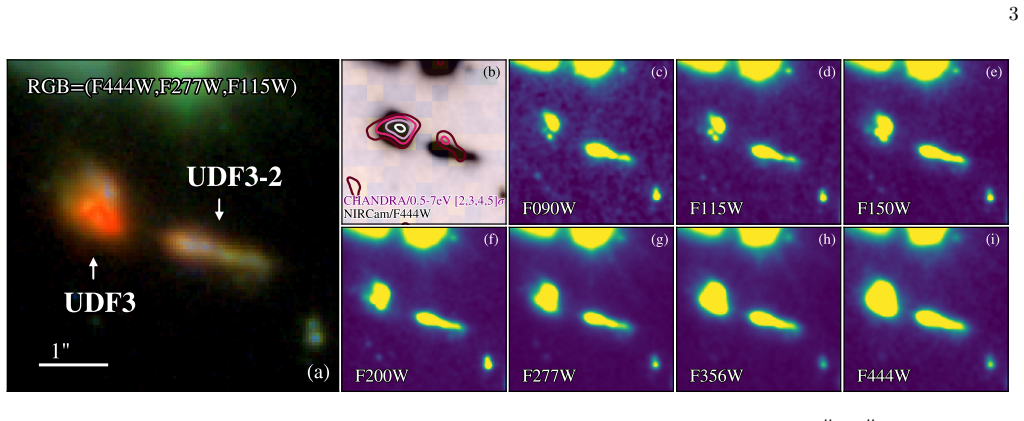
The claim hinges on the assumption that the X-ray counts assigned to the fainter galaxy UDF3-2 are a genuine, separately detectable source, not a blending artifact of its brighter neighbor UDF3, which lies only about 1.8 arcseconds away.
Editorial extensions
If this is right
- If the HMXB interpretation is right, UDF3 and UDF3-2 become the highest-redshift non-AGN galaxies with individual X-ray detections, at $z=2.544$.
- UDF3's $\approx0.5$ dex deficit below the $L_X$/SFR--$z$ relation becomes a direct observable of how starburst-driven metal enrichment suppresses Roche-lobe overflow and HMXB luminosity.
- X-ray luminosity thresholds commonly used to flag AGN (such as $L_X>3\times10^{42}\ \mathrm{erg\,s^{-1}}$) will misclassify starbursting galaxies at high redshift unless XRB population constraints are included.
- Deep X-ray surveys combined with infrared space observatories can build a statistical sample of XRB-dominated galaxies at $z>2$, tightening the link between cosmic star formation and the X-ray background.
Reading between the lines
- Editorial inference: the observed spread in $\log(L_X/\mathrm{SFR})$ at fixed redshift may have two drivers, metallicity and starburst phase, so stacking analyses that average over both could wash out the predicted (1+z) enhancement.
- Editorial inference: a clean test would be X-ray spectral hardness ratios for the pair; HMXB-dominated emission should show a softer, cutoff-like spectrum than AGN power laws, checkable with future deeper X-ray observations.
- Editorial inference: if interacting pairs preferentially host such HMXB-dominated X-rays, merger rate evolution could modulate the $L_X$/SFR--$z$ relation independently of metallicity, complicating its use as a pure metallicity indicator.
- Editorial inference: applying the same BPT-plus-SED exclusion to existing deep X-ray fields should yield more X-ray-bright, AGN-free galaxies at $z>2$, raising the estimated XRB contribution to the cosmic X-ray background.
Editorial analysis
A structured set of objections, weighed in public.
Referee Report
Summary. The paper reports the discovery of a galaxy pair (UDF3 and UDF3-2) at z = 2.544 in GOODS-S, based on JWST/NIRSpec spectra for UDF3, VANDELS absorption-line spectroscopy for UDF3-2, Chandra 7 Ms X-ray imaging, and multi-wavelength photometry from HST, JWST, MIRI, ALMA, and VLA. The central claims are that both galaxies individually exhibit X-ray emission dominated by high-mass X-ray binaries rather than AGN, with 2–10 keV luminosities of (1.43 ± 0.40) × 10^42 erg/s and (0.40 ± 0.12) × 10^42 erg/s, respectively, and that they constitute the highest-redshift non-AGN galaxies with individual X-ray detections reported to date. The authors use a BPT diagram for UDF3, SED fitting with Prospector, and a comparison of LX/SFR with redshift-dependent relations to support the HMXB interpretation. A secondary claim is that UDF3 lies approximately 0.5 dex below the LX/SFR–z relation, attributed to rapid starburst and metallicity effects.
Significance. If the central claims are correct, this paper would provide rare, individual detections of X-ray binaries in galaxies near the peak of cosmic star formation, with implications for the LX/SFR relation, HMXB formation efficiency, and the unresolved cosmic X-ray background. The multi-wavelength data set is rich and the authors make a reasonable effort to cross-check the SED-derived properties with a non-parametric SFH and an H-alpha-based SFR. The paper is also commendable for using public archival data and for comparing against established LX/SFR–z relations. However, the significance rests heavily on two pillars: (1) the deblending of the two Chandra sources separated by only ~1.8 arcsec, and (2) the exclusion of AGN in UDF3-2, which lacks any emission-line diagnostics. Both pillars currently have gaps that could change the conclusions, so the significance is conditional on those issues being resolved.
major comments (5)
- [Section 2.2] The individual X-ray detection of UDF3-2 is not demonstrated. The text states that "both sources show >3σ detections" in the full-band image, but the only quantitative information provided is the combined 0.5–7 keV flux, the combined 0.5–2 keV flux, and a joint photon index. The individual luminosities are then said to come from "forward 2D Gaussian modeling," but no details are given about the PSF model, the number of components, whether source positions were free or fixed, the per-component detection significance, or any comparison against a single-source model. Table 2 lists no Chandra counterpart (XID '-') for UDF3-2 in the Luo et al. (2016) 7 Ms catalog, and the two sources are separated by only ~1.8 arcsec, where the Chandra PSF wings are non-negligible. Since the claim that both galaxies host X-ray binaries and the "individual detections" in the title and abstract depend entirely on this deblending, the authors must provide a more rigorous justification: per-source significance maps or Bayesian posterior probabilities, a two-source versus one-source likelihood test, and a treatment of systematic uncertainties from the PSF model and photon index.
- [Section 4.2 and Table 1] The claim that "the contribution from the AGN dust torus is negligible, with fAGN < 10^-6" is not supported by the reported posterior values in Table 1. The table gives log fagn = -6.2+0.3-0.5 for UDF3 and -8.6+4.3-4.3 for UDF3-2. The 84th percentile upper limits are therefore approximately log fagn ≈ -5.9 (≈1.3 × 10^-6) for UDF3 and ≈ -4.3 (≈5 × 10^-5) for UDF3-2. These bounds are not below 10^-6, especially for UDF3-2, whose AGN fraction posterior is extremely broad. Because UDF3-2 lacks BPT or other emission-line diagnostics, its non-AGN classification rests entirely on this photometric SED decomposition. The authors should quote the actual upper limits (e.g., 90% or 95% credible intervals) and discuss the implications of an AGN fraction as high as ~10^-4 for the interpretation of the X-ray emission.
- [Section 4.2 and Figure 4] The reduced chi-square of the SED fit for UDF3 is reported as 10.2 in Figure 4, indicating a poor fit. The authors attribute the discrepancies to incomplete PAH modeling in the Draine & Li (2007) model, but the derived SFR of 529 M_sun/yr and stellar mass are nevertheless used as input to the LX/SFR comparison and the claimed 0.5 dex offset. A reduced chi-square of 10 means the model is not a statistically acceptable description of the photometry, so the posterior-derived parameters and their uncertainties are not reliable as quoted. The authors should either improve the SED modeling to achieve an acceptable fit or quantify how the fit residuals propagate into the SFR and hence into the LX/SFR offset. This is a load-bearing issue for the paper's central interpretation of UDF3's X-ray properties.
- [Section 4.3] The H-alpha-based SFR of 153 ± 69 M_sun/yr is about 0.5 dex lower than the SED-based SFR of 529 M_sun/yr, yet the paper adopts the SED SFR for the LX/SFR comparison and claims that UDF3 lies approximately 0.5 dex below the relation. The discrepancy is acknowledged but not reconciled; the text moves from the H-alpha SFR to the conclusion that systematic uncertainties remain, without a quantitative explanation. If the true SFR is closer to the H-alpha value—which may be a more direct tracer of recent star formation—the offset from the LX/SFR–z relation would be substantially reduced and the physical interpretation (metal enrichment suppressing Roche-lobe overflow efficiency) would no longer be strongly supported. The authors need to discuss the different timescales (10 Myr for SED, instantaneous for H-alpha), extinction corrections, aperture effects, and the systematic uncertainties in the Kennicutt (1998) calibration, and show explicitly how the LX/SFR offset changes if the H-alpha SFR is adopted.
- [Section 4.1] The BPT diagram analysis is performed only for UDF3, since UDF3-2 has no detected emission lines. The abstract states that "the ionized emission lines, which are primarily driven by H II region-like processes" applies to the pair, but this is only directly verified for UDF3. For UDF3-2, the non-AGN conclusion rests on the SED decomposition (see the comment on fagn) and on the LX/SFR scaling. The paper should explicitly state that the non-AGN classification of UDF3-2 is photometric and thus model-dependent, and it should discuss the possibility that a weak AGN or a low-luminosity AGN could contribute to the claimed 0.40 × 10^42 erg/s X-ray luminosity without leaving a clear imprint in the available photometry or the unresolved X-ray spectrum.
minor comments (5)
- [Section 2.2] The quoted intrinsic 0.5–7 keV luminosity of 4.55+1.41-1.22 × 10^42 erg/s would benefit from a statement of the assumed luminosity distance or the explicit cosmology used for the k-correction; the cosmology is given in the introduction but not repeated here.
- [Table 1] The units for the parameter 'tau' are listed as 'Gyr^-1' in the table and in the text description, but the e-folding time of a delayed-tau SFH should be in Gyr, not Gyr^-1. Please correct this typographical error.
- [Figure 4] The label '2 r = 10.2' in the figure is nonstandard; this presumably denotes the reduced chi-square, which is usually written as χ²_ν or χ²_red. Please use standard notation.
- [Section 4.3] The quoted 1σ uncertainties on log(LX/SFR) for UDF3 (±0.2 dex) appear underestimated given the reported LX uncertainty of ±28% and SFR uncertainty of +64/-88 (≈12-17%); simple error propagation yields roughly ±0.3 dex. Please check the error propagation.
- [Appendix] There is a typo: 'tabel 3' should be 'Table 3'.
Circularity Check
No significant circularity: the X-ray binary interpretation rests on external sSFR and LX/SFR calibrations plus independent BPT and SED AGN exclusion, while the deblending of UDF3-2 is a measurement robustness issue rather than a circular reduction.
full rationale
The derivation chain is self-contained against external benchmarks. The paper measures the joint Chandra X-ray flux and photon index, then deblends via forward 2D Gaussian modeling to obtain per-galaxy X-ray luminosities; these are data products, not assumed conclusions. The SFR and sSFR come from independent Prospector SED fitting, and the conclusion that high-mass XRBs dominate is supported by the literature threshold sSFR > 1e-10 yr^-1 (Lehmer et al. 2010, 2019) plus the absence of AGN signatures from the BPT diagram and a negligible AGN fraction from SED fitting (fAGN < 1e-6). The LX/SFR comparison uses external benchmarks (Lehmer et al. 2016, Aird et al. 2016, Fornasini et al. 2019) rather than the same fitted parameters. The only self-citations (Lyu et al. 2022, 2024) concern PAH modeling details and general motivation and are not load-bearing. The potential weakness that UDF3-2 lacks a counterpart in the Luo et al. 7 Ms catalog and is only ~1.8 arcsec from UDF3 is a statistical and deblending robustness risk in the individual-detection claim, but it is not circular: the individual luminosities are outputs of a forward model, not inputs to the physical conclusion. No equation reduces to its own input, and no uniqueness theorem or ansatz is smuggled in via self-citation.
Assumptions & free parameters
free parameters (6)
- SFR (UDF3) =
529 +64/-88 Msun/yr
- SFR (UDF3-2) =
34 +6/-6 Msun/yr
- Stellar age tage (UDF3) =
0.015 +0.003/-0.001 Gyr
- dust2 (UDF3) =
2.0 +/-0.1
- log fagn (UDF3 and UDF3-2) =
-6.2 and -8.6
- X-ray photon index Gamma =
2.44
assumptions (5)
- domain assumption Case B recombination with Halpha/Hbeta = 2.86
- domain assumption The 0.5-7 keV to 2-10 keV conversion assumes a single power law with photon index Gamma=2.44
- domain assumption High specific SFR (above 1e-10 per year) implies HMXBs dominate the X-ray emission
- domain assumption The delayed-tau SFH and FSPS/Draine-Li/Nenkova templates correctly model the galaxies' SEDs
- domain assumption BPT classification boundaries remain valid at z=2.5 despite known metallicity shifts
Cite this review
Pith. "Pith review of Discovery of a Pair of Galaxies with Both Hosting X-ray Binary Candidates at $z=2.544$." pith.science (2026). https://pith.science/paper/ZDNH44QQ
@misc{pith2026250723230,
  author       = {Pith},
  title        = {Pith review of: Discovery of a Pair of Galaxies with Both Hosting X-ray Binary Candidates at $z=2.544$},
  year         = {2026},
  howpublished = {\url{https://pith.science/paper/ZDNH44QQ}},
  note         = {Machine review of arXiv:2507.23230}
}
abstract
Among high-redshift galaxies, aside from active galactic nuclei (AGNs), X-ray binaries (XRBs) can be significant sources of X-ray emission. XRBs play a crucial role in galaxy evolution, reflecting the stellar populations of galaxies and regulating star formation through feedback, thereby shaping galaxy structure. In this study, we report a spectroscopically confirmed X-ray emitting galaxy pair (UDF3 and UDF3-2) at $z = 2.544$. By combining multi-wavelength observations from JWST/NIRSpec MSA spectra, JWST/NIRCam and MIRI imaging, Chandra, HST, VLT, ALMA, and VLA, we analyze the ionized emission lines, which are primarily driven by H II region-like processes. Additionally, we find that the mid-infrared radiation can be fully attributed to dust emission from galaxy themselves. Our results indicate that the X-ray emission from these two galaxies is dominated by high-mass XRBs, with luminosities of $L_X= (1.43\pm0.40) \times 10^{42} \, \text{erg} \, \text{s}^{-1}$ for UDF3, and $(0.40\pm0.12) \times 10^{42} \, \text{erg} \, \text{s}^{-1}$ for UDF3-2. Furthermore, we measure the star formation rate (SFR) of $529_{-88}^{+64}$ $M_\odot$ yr$^{-1}$ for UDF3, placing it $\approx$ 0.5 dex below the $L_X$/SFR-$z$ relation. This offset reflects the redshift-dependent enhancement of $L_X$/SFR-$z$ relation, which is influenced by metallicity and serves as a key observable for XRB evolution. In contrast, UDF3-2, with the SFR of $34_{-6}^{+6}$ $M_\odot$ yr$^{-1}$, aligns well with the $L_X$/SFR-$z$ relation. This galaxy pair represents the highest-redshift non-AGN-dominated galaxies with individual X-ray detections reported to date. This finding suggests that the contribution of XRBs to galaxy X-ray emission at high redshift may be underestimated.
Figures


Figures from the paper (2 more)


Reference graph
Works this paper leans on
-
[1]
A., Aghanim, N., Arnaud, M., et al
Ade, P. A., Aghanim, N., Arnaud, M., et al. 2016, Astronomy & Astrophysics, 594, A13
2016
-
[2]
2016, Monthly Notices of the Royal Astronomical Society, 465, 3390
Aird, J., Coil, A., & Georgakakis, A. 2016, Monthly Notices of the Royal Astronomical Society, 465, 3390
2016
-
[3]
SMILES Initial Data Release: Unveiling the Obscured Universe with MIRI Multi-band Imaging
Alberts, S., Lyu, J., Shivaei, I., et al. 2024, arXiv preprint arXiv:2405.15972
work page Pith review arXiv 2024
-
[4]
Antoniou, V., & Zezas, A. 2016, Monthly Notices of the Royal Astronomical Society, 459, 528 10 T able 2.Basic Information and Photometry of the Galaxy Pair Galaxy ID JADES ID SMILES ID XID NIRSpec ID V ANDELS ID RA JADES DECJADES UDF3 209117 1271 718 1180-14279 - 53.160609 -27.776249 UDF3-2 209116 1269 - - CDFS015798 53.160157 -27.776414 acs wfc f435w acs...
work page 2016
-
[5]
Artale, M. C., Tissera, P. B., & Pellizza, L. 2015, Monthly Notices of the Royal Astronomical Society, 448, 3071 Astropy Collaboration, Price-Whelan, A. M., Sip˝ ocz, B., G¨ unther, H., et al. 2018, The Astronomical Journal, 156, 123 Astropy Collaboration, Price-Whelan, A. M., Lim, P. L.,
work page 2015
-
[6]
2022, The Astrophysical Journal, 935, 167 Astropy Collaboration, Robitaille, T
Earl, N., et al. 2022, The Astrophysical Journal, 935, 167 Astropy Collaboration, Robitaille, T. P., Tollerud, E. J.,
work page 2022
-
[7]
2013, Astronomy & Astrophysics, 558, A33
Greenfield, P., et al. 2013, Astronomy & Astrophysics, 558, A33
work page 2013
-
[8]
2017, Astronomy & Astrophysics, 608, A1
Bacon, R., Conseil, S., Mary, D., et al. 2017, Astronomy & Astrophysics, 608, A1
work page 2017
Show all 82 references
-
[9]
A., Phillips, M
Baldwin, J. A., Phillips, M. M., & Terlevich, R. 1981, Publications of the Astronomical Society of the Pacific, 93, 5
1981
-
[10]
R., Lehmer, B
Basu-Zych, A. R., Lehmer, B. D., Hornschemeier, A. E., et al. 2012, The Astrophysical Journal, 762, 45
2012
-
[11]
2004, The Astrophysical Journal, 601, L147
Belczynski, K., Kalogera, V., Zezas, A., & Fabbiano, G. 2004, The Astrophysical Journal, 601, L147
2004
-
[12]
J., Groves, B., & Dopita, M
Bian, F., Kewley, L. J., Groves, B., & Dopita, M. A. 2020, Monthly Notices of the Royal Astronomical Society, 493, 580
2020
-
[13]
A., Rodriguez, J., & James, J
Bodaghee, A., Tomsick, J. A., Rodriguez, J., & James, J. B. 2011, The Astrophysical Journal, 744, 108
2011
-
[14]
M., Popping, G., et al
Bottrell, C., Yesuf, H. M., Popping, G., et al. 2024, Monthly Notices of the Royal Astronomical Society, 527, 6506
2024
-
[15]
Brorby, M., Kaaret, P., Prestwich, A., & Mirabel, I. F. 2016, Monthly Notices of the Royal Astronomical Society, 457, 4081 11
2016
-
[16]
2019, Astronomy & Astrophysics, 632, A79 Calabr` o, A., Daddi, E., Fensch, J., et al
Buat, V., Ciesla, L., Boquien, M., Ma lek, K., & Burgarella, D. 2019, Astronomy & Astrophysics, 632, A79 Calabr` o, A., Daddi, E., Fensch, J., et al. 2019, Astronomy & Astrophysics, 632, A98
2019
-
[17]
Conroy, C., & Gunn, J. E. 2010, The Astrophysical Journal, 712, 833
2010
-
[18]
E., & White, M
Conroy, C., Gunn, J. E., & White, M. 2009, The Astrophysical Journal, 699, 486
2009
-
[19]
2012, The Astrophysical Journal, 748, 50
Cowie, L., Barger, A., & Hasinger, G. 2012, The Astrophysical Journal, 748, 50
2012
-
[20]
L., Gonzalez-Lopez, J., Barger, A
Cowie, L. L., Gonzalez-Lopez, J., Barger, A. J., et al. 2018, The Astrophysical Journal, 865, 106
2018
-
[21]
Das, A., Mesinger, A., Pallottini, A., Ferrara, A., & Wise, J. H. 2017, Monthly Notices of the Royal Astronomical Society, 469, 1166
2017
-
[22]
2012, Monthly Notices of the Royal Astronomical Society, 421, 213
Dijkstra, M., Gilfanov, M., Loeb, A., & Sunyaev, R. 2012, Monthly Notices of the Royal Astronomical Society, 421, 213
2012
-
[23]
T., & Li, A
Draine, B. T., & Li, A. 2007, The Astrophysical Journal, 657, 810
2007
-
[24]
J., Biggs, A
Dunlop, J., McLure, R. J., Biggs, A. D., et al. 2017, Monthly Notices of the Royal Astronomical Society, 466, 861
2017
-
[25]
J., Willott, C., Alberts, S., et al
Eisenstein, D. J., Willott, C., Alberts, S., et al. 2023, arXiv preprint arXiv:2306.02465
2023 arXiv
-
[26]
2023, Monthly Notices of the Royal Astronomical Society, 522, 3986
Ferrara, A., Pallottini, A., & Dayal, P. 2023, Monthly Notices of the Royal Astronomical Society, 522, 3986
2023
-
[27]
M., Civano, F., & Suh, H
Fornasini, F. M., Civano, F., & Suh, H. 2020, Monthly Notices of the Royal Astronomical Society, 495, 771
2020
-
[28]
M., Kriek, M., Sanders, R
Fornasini, F. M., Kriek, M., Sanders, R. L., et al. 2019, The Astrophysical Journal, 885, 65
2019
-
[29]
2013, The Astrophysical Journal, 764, 41
Fragos, T., Lehmer, B., Tremmel, M., et al. 2013, The Astrophysical Journal, 764, 41
2013
-
[30]
2018, Astronomy & Astrophysics, 620, A152
Franco, M., Elbaz, D., B´ ethermin, M., et al. 2018, Astronomy & Astrophysics, 620, A152
2018
-
[31]
2005, Nature, 436, 819
Gallo, E., Fender, R., Kaiser, C., et al. 2005, Nature, 436, 819
2005
-
[32]
2022, The Astrophysical Journal, 926, 80
Garg, P., Narayanan, D., Byler, N., et al. 2022, The Astrophysical Journal, 926, 80
2022
-
[33]
2021, Astronomy & Astrophysics, 647, A150
Garilli, B., McLure, R., Pentericci, L., et al. 2021, Astronomy & Astrophysics, 647, A150
2021
-
[34]
2004, Monthly Notices of the Royal Astronomical Society, 349, 146
Gilfanov, M. 2004, Monthly Notices of the Royal Astronomical Society, 349, 146
2004
-
[35]
2023, in Handbook of X-ray and Gamma-ray Astrophysics (Springer), 1–38
Gilfanov, M., Fabbiano, G., Lehmer, B., & Zezas, A. 2023, in Handbook of X-ray and Gamma-ray Astrophysics (Springer), 1–38
2023
-
[36]
2003, Monthly Notices of the Royal Astronomical Society, 339, 793 G¨ uver, T., &¨Ozel, F
Grimm, H.-J., Gilfanov, M., & Sunyaev, R. 2003, Monthly Notices of the Royal Astronomical Society, 339, 793 G¨ uver, T., &¨Ozel, F. 2009, Monthly Notices of the Royal Astronomical Society, 400, 2050
2003
-
[37]
R., Millman, K
Harris, C. R., Millman, K. J., Van Der Walt, S. J., et al. 2020, Nature, 585, 357
2020
-
[38]
2024, Monthly Notices of the Royal Astronomical Society: Letters, 530, L7
Haskell, P., Das, S., Smith, D., et al. 2024, Monthly Notices of the Royal Astronomical Society: Letters, 530, L7
2024
-
[39]
2024, Preprint at https://arxiv
Heintz, K., et al. 2024, Preprint at https://arxiv. org/abs/2404.02211
2024 arXiv
-
[40]
Hunter, J. D. 2007, Computing in science & engineering, 9, 90 Iben Jr, I., Tutukov, A. V., & Yungelson, L. R. 1995, Astrophysical Journal Supplement v. 100, p. 217, 100, 217
2007
-
[41]
D., Leja, J., Conroy, C., & Speagle, J
Johnson, B. D., Leja, J., Conroy, C., & Speagle, J. S. 2021, The Astrophysical Journal Supplement Series, 254, 22
2021
-
[42]
F., Prochaska, J
Kaplan, K. F., Prochaska, J. X., Herbert-Fort, S., Ellison, S. L., & Dessauges-Zavadsky, M. 2010, Publications of the Astronomical Society of the Pacific, 122, 619
2010
-
[43]
M., Tremonti, C., et al
Kauffmann, G., Heckman, T. M., Tremonti, C., et al. 2003, Monthly Notices of the Royal Astronomical Society, 346, 1055 Kennicutt Jr, R. C. 1998, Annual Review of Astronomy and Astrophysics, 36, 189
2003
-
[44]
2001, The Astrophysical Journal, 556, 121
Trevena, J. 2001, The Astrophysical Journal, 556, 121
2001
-
[45]
J., Groves, B., Kauffmann, G., & Heckman, T
Kewley, L. J., Groves, B., Kauffmann, G., & Heckman, T. 2006, Monthly Notices of the Royal Astronomical Society, 372, 961
2006
-
[46]
J., Maier, C., Yabe, K., et al
Kewley, L. J., Maier, C., Yabe, K., et al. 2013, The Astrophysical Journal Letters, 774, L10
2013
-
[47]
2013, The Astrophysical Journal Letters, 775, L16
Kriek, M., & Conroy, C. 2013, The Astrophysical Journal Letters, 775, L16
2013
-
[48]
2001, Monthly Notices of the Royal Astronomical Society, 322, 231
Kroupa, P. 2001, Monthly Notices of the Royal Astronomical Society, 322, 231
2001
-
[49]
2010, The Astrophysical Journal, 724, 559
Lehmer, B., Alexander, D., Bauer, F., et al. 2010, The Astrophysical Journal, 724, 559
2010
-
[50]
2016, The Astrophysical Journal, 825, 7
Lehmer, B., Basu-Zych, A., Mineo, S., et al. 2016, The Astrophysical Journal, 825, 7
2016
-
[51]
D., Eufrasio, R
Lehmer, B. D., Eufrasio, R. T., Tzanavaris, P., et al. 2019, The Astrophysical Journal Supplement Series, 243, 3
2019
-
[52]
D., Monson, E
Lehmer, B. D., Monson, E. B., Eufrasio, R. T., et al. 2024, The Astrophysical Journal, 977, 189
2024
-
[53]
Speagle, J. S. 2019, The Astrophysical Journal, 876, 3
2019
-
[54]
H., van den Heuvel, E
Lewin, W. H., van den Heuvel, E. P., & van Paradijs, J. 1997, X-ray Binaries, Vol. 26 (Cambridge University Press)
1997
-
[55]
M., Jing, Y., & White, S
Li, C., Kauffmann, G., Heckman, T. M., Jing, Y., & White, S. D. 2008, Monthly Notices of the Royal Astronomical Society, 385, 1903
2008
-
[56]
2010, The Astrophysical Journal, 725, 1984 12
Linden, T., Kalogera, V., Sepinsky, J., et al. 2010, The Astrophysical Journal, 725, 1984 12
2010
-
[57]
2024, arXiv preprint arXiv:2412.01358
Llerena, M., Pentericci, L., Napolitano, L., et al. 2024, arXiv preprint arXiv:2412.01358
2024 arXiv
-
[58]
2016, The Astrophysical Journal Supplement Series, 228, 2
Luo, B., Brandt, W., Xue, Y., et al. 2016, The Astrophysical Journal Supplement Series, 228, 2
2016
-
[59]
H., & Rujopakarn, W
Lyu, J., Alberts, S., Rieke, G. H., & Rujopakarn, W. 2022, The Astrophysical Journal, 941, 191
2022
-
[60]
H., et al
Lyu, J., Alberts, S., Rieke, G. H., et al. 2024, The Astrophysical Journal, 966, 229
2024
-
[61]
2017, The Astrophysical Journal, 840, 39
Madau, P., & Fragos, T. 2017, The Astrophysical Journal, 840, 39
2017
-
[62]
2012, Monthly Notices of the Royal Astronomical Society, 419, 2095
Mineo, S., Gilfanov, M., & Sunyaev, R. 2012, Monthly Notices of the Royal Astronomical Society, 419, 2095
2012
-
[63]
2023, Astronomy & Astrophysics, 672, A99
Misra, D., Kovlakas, K., Fragos, T., et al. 2023, Astronomy & Astrophysics, 672, A99
2023
-
[64]
2024, arXiv preprint arXiv:2402.08911
Nakazato, Y., Ceverino, D., & Yoshida, N. 2024, arXiv preprint arXiv:2402.08911
2024
-
[65]
2008, The Astrophysical Journal, 685, 160
Elitzur, M. 2008, The Astrophysical Journal, 685, 160
2008
-
[66]
R., Wilson, K
Patton, D. R., Wilson, K. D., Metrow, C. J., et al. 2020, Monthly Notices of the Royal Astronomical Society, 494, 4969
2020
-
[67]
Pettini, M., & Pagel, B. E. 2004, Monthly Notices of the Royal Astronomical Society, 348, L59
2004
-
[68]
2003, Astronomy & Astrophysics, 399, 39
Ranalli, P., Comastri, A., & Setti, G. 2003, Astronomy & Astrophysics, 399, 39
2003
-
[69]
2024, The Astrophysical Journal, 975, 83
Rieke, G., Alberts, S., Shivaei, I., et al. 2024, The Astrophysical Journal, 975, 83
2024
-
[70]
H., Alonso-Herrero, A., Weiner, B., et al
Rieke, G. H., Alonso-Herrero, A., Weiner, B., et al. 2009, The Astrophysical Journal, 692, 556
2009
-
[71]
J., Robertson, B., Tacchella, S., et al
Rieke, M. J., Robertson, B., Tacchella, S., et al. 2023, The Astrophysical Journal Supplement Series, 269, 16
2023
-
[72]
H., et al
Rujopakarn, W., Dunlop, J., Rieke, G. H., et al. 2016, The Astrophysical Journal, 833, 12
2016
-
[73]
E., Sanders, R
Shapley, A. E., Sanders, R. L., Reddy, N. A., Topping, M. W., & Brammer, G. B. 2023, The Astrophysical Journal, 954, 157
2023
-
[74]
2007, Astronomy Letters, 33, 437
Shtykovskiy, P., & Gilfanov, M. 2007, Astronomy Letters, 33, 437
2007
-
[75]
Speagle, J. S. 2020, Monthly Notices of the Royal Astronomical Society, 493, 3132
2020
-
[76]
2020, Monthly Notices of the Royal Astronomical Society, 497, 3504
Tetarenko, A., Rosolowsky, E., Miller-Jones, J., & Sivakoff, G. 2020, Monthly Notices of the Royal Astronomical Society, 497, 3504
2020
-
[77]
C., & Sivakoff, G
Miller-Jones, J. C., & Sivakoff, G. R. 2018, Monthly Notices of the Royal Astronomical Society, 475, 448
2018
-
[78]
2013, The Astrophysical Journal, 766, 19
Tremmel, M., Fragos, T., Lehmer, B., et al. 2013, The Astrophysical Journal, 766, 19
2013
-
[79]
Veilleux, S., & Osterbrock, D. E. 1987, Astrophysical Journal Supplement Series (ISSN 0067-0049), vol. 63, Feb. 1987, p. 295-310. NSERC-supported research., 63, 295
1987
-
[80]
E., et al
Virtanen, P., Gommers, R., Oliphant, T. E., et al. 2020, Nature methods, 17, 261
2020
-
[81]
2024, arXiv preprint arXiv:2405.01473
Wang, B., Leja, J., de Graaff, A., et al. 2024, arXiv preprint arXiv:2405.01473
2024 arXiv
-
[82]
2012, Astronomy & Astrophysics, 546, A36
Zhang, Z., Gilfanov, M., & Bogd´ an,´A. 2012, Astronomy & Astrophysics, 546, A36
2012
Reviewed August 6, 2026 · model on record in the stance chip above.
Discussion (0). Sign in to comment.