REVIEW 2 major objections 5 minor 62 references
An optimal preconditioner for high-order scheme arising from multi-dimensional Riesz space fractional diffusion equations with variable coefficients
T0 review · 2 major / 5 minor · reviewed 2026-08-06 · deepseek-v4-flash
Pith's one-line read The paper claims that a Crank–Nicolson fourth-order fractional centered difference scheme for multi-dimensional Riesz space fractional diffusion equations with variable coefficients is unconditionally stable and convergent with error…
desk verdict Solid CN-4FCD scheme with a real gap in the stability proof; convergence and preconditioner analyses are worth refereeing. read the letter →
The pith
A machine-rendered reading of the paper's core claim, the machinery that carries it, and where it could break.
The reading
What carries the argument
The load-bearing object is the sine-transform-based preconditioner $P_\tau^{m+1} = \bar{r}^{m+1/2} + \tau(T)$, where $T = \sum_{i=1}^d \eta_i I \otimes S_{n_i}^{(\alpha_i)} \otimes I$ is the symmetric multilevel Toeplitz matrix from the 4FCD spatial discretization and $\tau(T)$ replaces each Toeplitz block by its optimal approximation in the $\tau$ algebra, the matrices diagonalized by the discrete sine transform. The individual blocks $P_{\alpha_i}$ are symmetric positive definite matrices built from the same generating function, and the key quantitative input is the bound $3/8 \le \lambda(P_{\alpha_i}^{-1} S_{n_i}^{(\alpha_i)}) \le 2$, so the Toeplitz part is controlled by the sine transform while the diagonal coefficient term $D$ is handled by comparing the Rayleigh quotient of $D$ with the scalar average $\bar{r}$. The stability proof uses the similarity transform $(D^{1/2})(D^{-1}T)(D^{-1/2}) = D^{-1/2} T D^{-1/2}$ to express the amplification matrix's eigenvalues as $(1-\lambda)/(1+\lambda)$ with $\lambda > 0$, and the convergence proof rests on a lower bound $\langle Tu,u\rangle \ge C K_{\min}\Delta t \|u\|^2$ obtained through a spectral estimate for each Toeplitz block.
What would settle it
Compute the extreme eigenvalues of $P_\tau^{-1}(D^{m+1/2}+T)$ on a sequence of nested grids for a coefficient function with a large ratio $\hat r/\check r$; if the smallest eigenvalue drops below $\min\{\check r/\hat r, 3/8\}$ or the largest exceeds $\max\{\hat r/\check r, 2\}$, Theorem 3.1 is false. Alternatively, run the scheme on a solution with regularity just below $L^{4+\mu}$ and observe a spatial convergence order noticeably below four.
Extended reading notes
Core claim
On the paper's own terms, the central discovery is that the fourth-order fractional centered difference operator, with generating function $S(\alpha)(\omega) = [1 + \frac{\alpha}{24}(2 - \omega - \omega^{-1})](2 - \omega - \omega^{-1})^{\alpha/2}$, produces a discrete linear system whose symmetric multilevel Toeplitz part is uniformly well conditioned relative to a sine-transform-based $\tau$ preconditioner. The paper proves the CN-4FCD scheme is unconditionally stable and convergent with $\|u^m - U^m\| \le C(\Delta t^2 + h_1^4 + \cdots + h_d^4)$ (Theorem 2.2), and that every eigenvalue of $P_\tau^{-1}(D^{m+1/2} + T)$ lies between $\min\{\check{r}^{m+1/2}/\hat{r}^{m+1/2}, 3/8\}$ and $\max\{\hat{r}^{m+1/2}/\check{r}^{m+1/2}, 2\}$ (Theorem 3.1), bounds that do not depend on grid spacings. Because the spectrum is uniformly bounded away from zero and infinity, the preconditioned conjugate gradient method converges in $O(1)$ iterations as the mesh is refined, which the authors describe as an optimal preconditioner.
Load-bearing premise
The whole argument assumes the exact solution is smooth enough in a fractional Sobolev sense (lying in $L^{4+\mu}(\mathbb{R})$ in each spatial variable) so that the $O(h^4)$ spatial truncation error bound holds; for rougher solutions, the claimed fourth-order convergence is not established.
Editorial extensions
If this is right
- The CN-4FCD scheme is unconditionally stable and converges as $O(\Delta t^2 + \sum_i h_i^4)$ in the discrete $L^2$ norm for any dimension, with no restriction on spatial step sizes.
- The coefficient matrix retains the same symmetric multilevel Toeplitz-plus-diagonal structure as the second-order FCD scheme, so fourth-order accuracy does not add extra storage or per-iteration cost.
- The preconditioned spectrum lies in $[\min\{\check r/\hat r, 3/8\}, \max\{\hat r/\check r, 2\}]$ independent of mesh size, so PCG iteration counts stay $O(1)$ under grid refinement.
- In the reported two- and three-dimensional examples, the proposed $P_\tau$-CG method uses the fewest iterations and shortest CPU time among the compared circulant- and splitting-based preconditioners.
- The authors state this is the first theoretical analysis of PCG convergence for a high-order scheme applied to variable-coefficient Riesz space fractional diffusion equations.
Reading between the lines
- The same two-sided eigenvalue-bound strategy should extend to any high-order symmetric discretization of fractional diffusion whose symbol is positive and whose $\tau$ approximation has a known relative spectrum; a testable extension is swapping 4FCD for another compact fourth-order stencil and checking whether the constants $3/8$ and $2$ still hold.
- The stability proof's symmetrization trick suggests that unconditional stability might also be provable for non-symmetric fractional operators such as the Riemann-Liouville form if a cheap similarity transform can be found, a direction the authors flag as future work.
- If the exact solution's regularity falls below $L^{4+\mu}(\mathbb{R})$ in any spatial variable, the fourth-order spatial claim should degrade; one could measure empirical convergence order on low-regularity data to locate the threshold at which the preconditioner's speed is no longer paired with fourth-order accuracy.
- The optimality claimed here is spectral, meaning a condition number bounded independently of $n$; a stronger asymptotic statement about the preconditioned symbol as $n \to \infty$ could be computed explicitly within the $\tau$-algebra framework.
Editorial analysis
A structured set of objections, weighed in public.
Referee Report
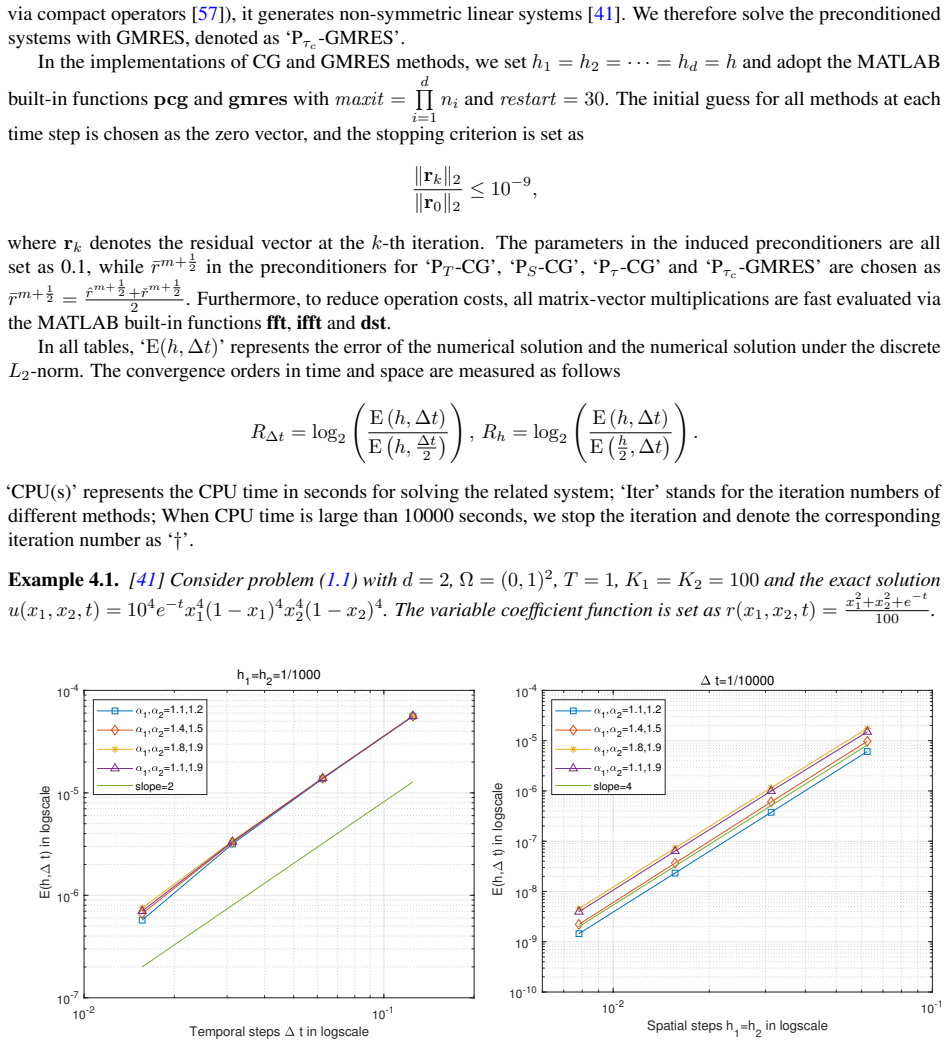
Summary. The paper proposes a Crank-Nicolson fourth-order fractional centered difference (CN-4FCD) scheme for d-dimensional Riesz space fractional diffusion equations with variable coefficients. The authors claim unconditional stability and convergence of order O(Δt^2 + h_1^4 + ... + h_d^4) in the discrete L2 norm, and they construct a symmetric positive definite sine-transform-based preconditioner Pτ = r̄^{m+1/2} I + τ(T) whose associated preconditioned matrix has spectrum uniformly bounded independently of the mesh size, implying mesh-independent PCG convergence. The theoretical results are supported by two-dimensional and three-dimensional numerical experiments comparing the proposed preconditioner with several existing circulant and sine-transform preconditioners.
Significance. The main contributions are a high-order scheme that preserves the symmetric multilevel Toeplitz-plus-diagonal structure and a preconditioner with a clean spectral analysis. The energy-based convergence proof in Theorem 2.2 is rigorous and uses the new Lemma 2.2 to obtain explicit constants, and the spectral analysis of the preconditioner in Theorem 3.1 follows correctly from Lemma 3.2 and Proposition 2. The numerical experiments are consistent with the claimed orders and with mesh-independent iteration counts. However, the stability theorem as stated is not proven by the argument given, and the convergence theorem omits the regularity assumptions needed for the fourth-order spatial truncation bound. These are fixable but load-bearing issues.
major comments (2)
- [Section 2, Theorem 2.1] The proof of unconditional stability shows only that each iteration matrix B_m = (I + (D^{m+1/2})^{-1}T)^{-1}(I - (D^{m+1/2})^{-1}T) has spectral radius less than 1. This is insufficient for stability: B_m is not symmetric in a fixed inner product, and since D^{m+1/2} changes with m, a uniform bound on products B_{M-1}...B_0 does not follow from a per-step spectral radius bound. The authors should replace this argument with an energy estimate, for example by multiplying the homogeneous error equation by (ε^{m+1}+ε^m)^T or by ε^{m+1}-ε^m, which would yield a genuine norm bound; the ingredients for such an estimate already appear in the proof of Theorem 2.2. As written, Theorem 2.1 does not establish the claimed unconditional stability.
- [Section 2, Lemma 2.1 and Theorem 2.2] The error estimate (2.31) depends on the truncation bound (2.7), which in turn requires the exact solution to belong to the fractional Sobolev space L_{4+μ}(R) in each spatial variable after zero extension, as stated in Lemma 2.1. Theorem 2.2 states no regularity or boundary-compatibility assumptions on the solution of (1.1). Without such assumptions the claimed O(h_1^4 + ... + h_d^4) spatial convergence does not follow. The theorem should state the regularity hypotheses explicitly, and the paper should note that the manufactured solutions in Section 4 satisfy them.
minor comments (5)
- [Example 4.2] The problem statement says 'K1 = 100, K2 = 85, K2 = 103'; the second 'K2' should presumably be 'K3'.
- [Section 2, equation (2.22)] The symbol ||u||_2 is used both for the discrete L2 norm and for the Euclidean vector 2-norm; this double use is confusing and should be clarified.
- [Section 4] The tables use the symbol N without a definition; please state explicitly that N denotes n_i+1 (or the number of unknowns per dimension).
- [Theorem 3.1, proof] In (3.5) the inequalities are written as strict ('3/8 < ... < 2') while Lemma 3.2 states non-strict bounds; align the notation for consistency.
- [Figures 2 and 4] The captions contain 'difference fractional orders', which should be 'different fractional orders'.
Circularity Check
No significant circularity; the derivation chain is self-contained apart from routine external and self-citations that provide independent support.
full rationale
The paper's stability and convergence claims are not reductions of fitted quantities. Theorem 2.2 rests on Lemma 2.2, which is derived in the paper from the symbol lower bound (2.27) and elementary eigenvector estimates; the energy identity (2.33)-(2.39) is a standard and self-contained argument. Lemma 2.1 is an external approximation result from [58]. The preconditioner claim (Theorem 3.1) depends on Lemma 3.2, quoted from the authors' earlier paper [60], but that lemma is a parameter-free spectral bound with stated assumptions that do not include the present target result, so under the review rules it counts as independent support rather than a circular self-citation. The numerical examples use manufactured exact solutions and are not fitted predictions. The only notable concern is the proof of Theorem 2.1, which argues from a per-step spectral radius bound to unconditional stability; for time-varying diagonal D^{m+1/2} this does not automatically bound products of the iteration matrices. That is a correctness or proof-gap issue, not a circularity, and no equation in the paper reduces a claimed conclusion to its own input.
Assumptions & free parameters
assumptions (3)
- domain assumption The 4FCD approximation error is O(h^4) for solutions in L_{4+mu}(R) (Lemma 2.1, Ref. [58]).
- domain assumption The spectral bounds 3/8 <= lambda(P_{alpha_i}^{-1} S_{n_i}) <= 2 (Lemma 3.2, Ref. [60]).
- domain assumption The generating function S^{(alpha)}(e^{i theta}) is nonnegative and not identically zero for 1 < alpha < 2, so each S is SPD.
Cite this review
Pith. "Pith review of An optimal preconditioner for high-order scheme arising from multi-dimensional Riesz space fractional diffusion equations with variable coefficients." pith.science (2026). https://pith.science/paper/BHEK4O7O
@misc{pith2026250723408,
  author       = {Pith},
  title        = {Pith review of: An optimal preconditioner for high-order scheme arising from multi-dimensional Riesz space fractional diffusion equations with variable coefficients},
  year         = {2026},
  howpublished = {\url{https://pith.science/paper/BHEK4O7O}},
  note         = {Machine review of arXiv:2507.23408}
}
read the original abstract
In this paper, we propose an efficient method for solving multi-dimensional Riesz space fractional diffusion equations with variable coefficients. The Crank-Nicolson (CN) method is used for temporal discretization, while the fourth-order fractional centered difference (4FCD) method is employed for spatial discretization. Using a novel technique, we show that the CN-4FCD scheme for the multi-dimensional case is unconditionally stable and convergent, achieving second-order accuracy in time and fourth-order accuracy in space with respect to the discrete L2-norm. Moreover, leveraging the symmetric multi-level Toeplitz-like structure of the coefficient matrix in the discrete linear systems, we enhance the computational efficiency of the proposed scheme with a sine transform-based preconditioner, ensuring a mesh-size-independent convergence rate for the conjugate gradient method. Finally, two numerical examples validate the theoretical analysis and demonstrate the superior performance of the proposed preconditioner compared to existing methods.
Figures


Figures from the paper (1 more)

Reference graph
Works this paper leans on
-
[58]
H. F. Ding, C. P. Li, High-order numerical algorithm and error analysis for the two-dimensional nonlinear spatial fractional complex Ginzburg–Landau equation, Communications in Nonlinear Science and Numerical Simulation 120 (2023) 107160
work page 2023
-
[60]
W. Qu, Y . Y . Huang, S. Hon, S. L. Lei, A novel fourth-order scheme for two-dimensional Riesz space fractional nonlinear reaction-diffusion equations and its optimal preconditioned solver, Numerical Linear Algebra with Applications 32 (2025) e70005
work page 2025
-
[1]
D. A. Benson, S. W. Wheatcraft, M. M. Meerschaert, Application of a fractional advection-dispersion equation, Water Resour. Res. 36 (2000) 1403–1412
work page 2000
-
[2]
D. A. Benson, S. W. Wheatcraft, M. M. Meerschaert, The fractional-order governing equation of L´evy motion, Water Resour. Res. 36 (2000) 1413–1423
work page 2000
-
[3]
R. L. Magin, Fractional Calculus in Bioengineering, Begell House Redding, New York, 2006
work page 2006
-
[4]
J. Bai, X. C. Feng, Fractional-order anisotropic diffusion for image denoising, IEEE Tran. Image Proc. 16 (2007) 2492–2502
work page 2007
-
[5]
M. Raberto, E. Scalas, F. Mainardi, Waiting-times and returns in high-frequency financial data: an empirical study, Physica A 314 (2002) 749–755
work page 2002
-
[6]
M. M. Meerschaert, C. Tadjeran, Finite difference approximations for fractional advection–dispersion flow equations, J. Compt. Appl. Math. 172 (2004) 65–77
work page 2004
Show all 62 references
-
[7]
M. M. Meerschaert, C. Tadjeran, Finite difference approximations for two-sided space-fractional partial differential equations, Appl. Numer. Math. 56 (2006) 80–90
2006
-
[8]
Sousa, C
E. Sousa, C. Li, A weighted finite difference method for the fractional diffusion equation based on the Riemann–Liouville derivative, Appl. Numer. Math. 90 (2015) 22–37
2015
-
[9]
W. Y . Tian, H. Zhou, W. H. Deng, A class of second order difference approximations for solving space fractional diffusion equations, Math. Comput. 84 (2015) 1703–1727
2015
-
[10]
F. R. Lin, Z. H. She, Stability and convergence of 3-point WSGD schemes for two-sided space fractional advection-diffusion equations with variable coefficients, Appl. Numer. Math. 167 (2021) 281–307
2021
-
[11]
F. R. Lin, W. D. Liu, The accuracy and stability of CN-WSGD schemes for space fractional diffusion equation, J. Comput. Appl. Math. 363 (2020) 77–91
2020
-
[12]
Z. H. She, A class of unconditioned stable 4-point WSGD schemes and fast iteration methods for space fractional diffusion equations, J. Sci. Comput. 92 (2022) 1–35. 18
2022
-
[13]
C. Zhu, B. Zhang, H. Fu, J. Liu, Efficient second-order ADI difference schemes for three-dimensional Riesz space-fractional diffusion equations, Comput. Math. Appl. 98 (2021) 24–39
2021
-
[14]
Y . Y . Huang, W. Qu, S. L. Lei, Onτ-preconditioner for a novel fourth-order difference scheme of two-dimensional Riesz space-fractional diffusion equations, Computers & Mathematics with Applications 145 (2023) 124–140
2023
-
[15]
H. F. Fu, Y . N. Sun, H. Wang, X. C. Zheng, Stability and convergence of a Crank–Nicolson finite volume method for space fractional diffusion equations, Appl. Numer. Math. 139 (2019) 38–51
2019
-
[16]
Donatelli, M
M. Donatelli, M. Mazza, S. Serra-Capizzano, Spectral analysis and multigrid methods for finite volume approximations of space-fractional diffusion equations, SIAM J. Sci. Comput. 40 (2018) A4007–A4039
2018
-
[17]
F. W. Liu, P. Zhuang, I. Turner, K. Burrage, V . Anh, A new fractional finite volume method for solving the fractional diffusion equation, Appl. Math. Model. 38 (2014) 3871–3878
2014
-
[18]
H. F. Fu, H. Liu, H. Wang, A finite volume method for two-dimensional Riemann-Liouville space-fractional diffusion equation and its efficient implementation, Journal of Computational Physics 388 (2019) 316–334
2019
-
[19]
W. Qu, Z. Li, Fast direct solver for CN-ADI-FV scheme to two-dimensional Riesz space-fractional diffusion equations, Appl. Math. Comput. 401 (2021) 126033
2021
-
[20]
Y . J. Jiang, J. T. Ma, High-order finite element methods for time-fractional partial differential equations, J. Comput. Appl. Math. 235 (2011) 3285–3290
2011
-
[21]
B. T. Jin, R. Lazarov, J. Pasciak, Z. Zhou, Error analysis of a finite element method for the space-fractional parabolic equation, SIAM J. Numer. Anal. 52 (2014) 2272–2294
2014
-
[22]
W. Bu, Y . Tang, J. Yang, Galerkin finite element method for two-dimensional riesz space fractional diffusion equations, Journal of Computational Physics 276 (2014) 26–38
2014
-
[23]
H. K. Pang, H. W. Sun, Multigrid method for fractional diffusion equations, J. Comput. Phys. 231 (2012) 693–703
2012
-
[24]
Moghaderi, M
H. Moghaderi, M. Dehghan, M. Donatelli, M. Mazza, Spectral analysis and multigrid preconditioners for two-dimensional space-fractional diffusion equations, J. Comput. Phys. 350 (2017) 992–1011
2017
-
[25]
X.-l. Lin, M. K. Ng, H.-W. Sun, A multigrid method for linear systems arising from time-dependent two-dimensional space-fractional diffusion equations, Journal of Computational Physics 336 (2017) 69–86
2017
-
[26]
S. L. Lei, H. W. Sun, A circulant preconditioner for fractional diffusion equations, J. Comput. Phys. 242 (2013) 715–725
2013
-
[27]
S. L. Lei, X. Chen, X. H. Zhang, Multilevel circulant preconditioner for high-dimensional fractional diffusion equations, East Asian J. Appl. Math. 6 (2016) 109–130
2016
-
[28]
X. Q. Jin, F. R. Lin, Z. Zhao, Preconditioned iterative methods for two-dimensional space-fractional diffusion equations, Commun. Comput. Phys. 18 (2015) 469–488
2015
-
[29]
Z. H. She, C. X. Lao, H. Yang, F. R. Lin, Banded preconditioners for Riesz space fractional diffusion equations, J. Sci. Comput. 86 (2021) 1–22
2021
-
[30]
J. Y . Pan, R. H. Ke, M. K. Ng, H. W. Sun, Preconditioning techniques for diagonal-times-Toeplitz matrices in fractional diffusion equations, SIAM J. Sci. Comput. 36 (2014) A2698–A2719
2014
-
[31]
Donatelli, M
M. Donatelli, M. Mazza, S. Serra-Capizzano, Spectral analysis and structure preserving preconditioners for fractional diffusion equations, J. Comput. Phys. 307 (2016) 262–279
2016
-
[32]
Aceto, M
L. Aceto, M. Mazza, A rational preconditioner for multi-dimensional riesz fractional diffusion equations, Computers & Mathematics with Applications 143 (2023) 372–382
2023
-
[33]
Huang, X
X. Huang, X. L. Lin, M. K. Ng, H. W. Sun, Spectral analysis for preconditioning of multi-dimensional Riesz fractional diffusion equations, Numer. Math. Theor. Meth. Appl. 15 (2022) 565–591
2022
-
[34]
C. H. Zhang, J. W. Yu, X. Wang, A fast second-order scheme for nonlinear Riesz space-fractional diffusion equations, Numer. Algor. (2022) 1–24
2022
-
[35]
S. Y . Hon, C. Li, R. L. Sormani, R. Krause, S. Serra-Capizzano, Symbol-based multilevel blockτ preconditioners for multilevel block toeplitz systems: Glt-based analysis and applications, arXiv preprint arXiv:2409.20363 (2024)
2024 arXiv
-
[36]
Huang, S
Y .-Y . Huang, S. Y . Hon, L.-K. Chou, S.-L. Lei, Optimal preconditioners for nonsymmetric multilevel toeplitz systems with application to solving non-local evolutionary partial differential equations, arXiv preprint arXiv:2409.15770 (2024)
2024 arXiv
-
[37]
C. Li, S. Hon, Multilevel tau preconditioners for symmetrized multilevel toeplitz systems with applications to solving space fractional diffusion equations, SIAM Journal on Matrix Analysis and Applications 46 (2025) 487–508
2025
-
[38]
Huang, P
Y .-Y . Huang, P. Y . Fung, S. Y . Hon, X.-L. Lin, An efficient preconditioner for evolutionary partial differential equations withθ-method in time discretization, Journal of Scientific Computing 103 (2025) 1–24
2025
-
[39]
Z. Z. Bai, K. Y . Lu, Fast matrix splitting preconditioners for higher dimensional spatial fractional diffusion equations, Journal of Computational Physics 404 (2020) 109117
2020
-
[40]
Zhang, X
X. Zhang, X. M. Gu, Y . L. Zhao, H. Li, C. Y . Gu, Two fast and unconditionally stable finite difference methods for riesz fractional diffusion equations with variable coefficients, Applied Mathematics and Computation 462 (2024) 128335
2024
-
[41]
Z. H. She, X. Zhang, X. M. Gu, S. Serra Capizzano, On τ-preconditioners for a quasi-compact difference scheme to Riesz fractional diffusion equations with variable coefficients, arXiv preprint arXiv:2404.10221 (2024)
2024 arXiv
-
[42]
Z. Z. Bai, K. Y . Lu, J. Y . Pan, Diagonal and Toeplitz splitting iteration methods for diagonal-plus-Toeplitz linear systems from spatial fractional diffusion equations, Numerical Linear Algebra with Applications 24 (2017) e2093
2017
-
[43]
M. K. Ng, J. Pan, Approximate inverse circulant-plus-diagonal preconditioners for Toeplitz-plus-diagonal matrices, SIAM Journal on Scientific Computing 32 (2010) 1442–1464
2010
-
[44]
K. Y . Lu, Diagonal and circulant or skew-circulant splitting preconditioners for spatial fractional diffusion equations, Comput. Appl. Math. 37 (2018) 4196–4218
2018
-
[45]
D. Bini, F. Benedetto, A new preconditioner for the parallel solution of positive definite toeplitz systems, in: Proceedings of the second annual ACM Symposium on Parallel Algorithms and Architectures, 1990, pp. 220–223
1990
-
[46]
Serra, Superlinear PCG methods for symmetric Toeplitz systems, Math
S. Serra, Superlinear PCG methods for symmetric Toeplitz systems, Math. Comput. 68 (1999) 793–803. 19
1999
-
[47]
X. Lu, Z. W. Fang, H. W. Sun, Splitting preconditioning based on sine transform for time-dependent Riesz space fractional diffusion equations, J. Appl. Math. Comput. 66 (2021) 673–700
2021
-
[48]
S. P. Tang, Y . M. Huang, A lopsided scaled DTS preconditioning method for the discrete space-fractional diffusion equations, Appl. Math. Lett. 131 (2022) 108022
2022
-
[49]
X. H. Shao, C. B. Kang, A preconditioner based on sine transform for space fractional diffusion equations, Appl. Numer. Math. 178 (2022) 248–261
2022
-
[50]
S. P. Tang, Y . M. Huang, A new diagonal and Toeplitz splitting preconditioning method for solving time-dependent Riesz space-fractional diffusion equations, Applied Mathematics Letters 149 (2024) 108901
2024
-
[51]
M. L. Zeng, J. F. Yang, G. F. Zhang, On τ matrix-based approximate inverse preconditioning technique for diagonal-plus-Toeplitz linear systems from spatial fractional diffusion equations, J. Compt. Appl. Math. (2022) 114088
2022
-
[52]
Greenbaum, V
A. Greenbaum, V . Pt´ak, Z. e. k. Strakoˇs, Any nonincreasing convergence curve is possible for gmres, Siam journal on matrix analysis and applications 17 (1996) 465–469
1996
-
[53]
Greenbaum, Z
A. Greenbaum, Z. Strakos, Matrices that generate the same Krylov residual spaces, Springer, 1994
1994
-
[54]
M. D. Ortigueira, Riesz potential operators and inverses via fractional centred derivatives, Int. J. Math. Math. Sci. 2006 (2006)
2006
-
[55]
C ¸ elik, M
C. C ¸ elik, M. Duman, Crank-Nicolson method for the fractional diffusion equation with the Riesz fractional derivative, J. Comput. Phys. 231 (2012) 1743–1750
2012
-
[56]
Zhang, X
X. Zhang, X. M. Gu, Y . L. Zhao, Two fast finite difference methods for a class of variable-coefficient fractional diffusion equations with time delay, Communications in Nonlinear Science and Numerical Simulation 140 (2025) 108358
2025
-
[57]
Z. P. Hao, Z. Z. Sun, W. R. Cao, A fourth-order approximation of fractional derivatives with its applications, Journal of Computational Physics 281 (2015) 787–805
2015
-
[59]
R. H. F. Chan, X. Q. Jin, An introduction to iterative Toeplitz solvers, SIAM, 2007
2007
-
[61]
X. L. Lin, M. K. Ng, H. W. Sun, Efficient preconditioner of one-sided space fractional diffusion equation, BIT Numerical Mathematics 58 (2018) 729–748
2018
-
[62]
Greenbaum, Iterative methods for solving linear systems, SIAM, 1997
A. Greenbaum, Iterative methods for solving linear systems, SIAM, 1997. 20
1997
Reviewed August 6, 2026 · model on record in the stance chip above.
Discussion (0). Sign in to comment.