REVIEW 4 major objections 5 minor 44 references
Quantum simulation of Helmholtz equations via Schr{\"o}dingerization
T0 review · 4 major / 5 minor · reviewed 2026-08-06 · deepseek-v4-flash
Pith's one-line read Quantum algorithm solves indefinite Helmholtz systems with O(κ² polylog ε⁻¹) queries, cut to O(κ polylog ε⁻¹) by a simple preconditioner.
desk verdict A real but incremental extension of Schrödingerization to Helmholtz; the unpreconditioned algorithm is plausible, but the advertised preconditioned speedup rests on an unproved spectral-gap assumption. read the letter →
The pith
A machine-rendered reading of the paper's core claim, the machinery that carries it, and where it could break.
The reading
What carries the argument
The carrying mechanism is the pair formed by damped dynamics and the warped phase. The damped second-order system with critical damping $\gamma = 2\sigma_{\min}(A)$ is the part that converts an indefinite algebraic problem into a stable evolution whose convergence is controlled by the smallest singular value $\sigma_{\min}(A)$; the warped phase transformation $W(t,p) = e^{-p}V_f(t)$ is the part that rewrites this evolution as a linear convection equation, which after Fourier discretization in $p$ becomes the unitary Hamiltonian system with $H = D_p \otimes H_1 - I \otimes H_2$. Recovery of the solution at $p \ge p_\diamond = \tfrac{1}{2}$ costs only constant-sized factors, and the Fourier modes enter through $D_p$. The preconditioner enters through the same machinery with $A$ replaced by $PA$, so the complexity improvement is inherited from the condition-number reduction.
What would settle it
Run the preconditioned algorithm on a uniform grid and compute $\kappa(PA)$ for a sequence of wavenumbers $k$ chosen so that $k^2$ falls within one spectral spacing $O(h)$ of a discrete-Laplacian eigenvalue (for example, $k^2 = \mu_s^2 + h^2$). If the measured condition number grows like $O(k^2)$ instead of $O(k)$ on such near-resonant cases, the advertised $\widetilde{O}(k^2 \,\mathrm{polylog}\,\varepsilon^{-1})$ complexity is not established for all high-frequency inputs; a uniform $O(k)$ bound across all non-resonant $k$ would support it.
Extended reading notes
Core claim
The paper's discovery is that indefinite linear systems can be solved by Schrödingerization without first forming the normal equations. For $Ax=b$ with $A$ indefinite and invertible, it studies the damped second-order dynamics $\frac{d^2v}{dt^2} + \gamma \frac{dv}{dt} = -A^\dagger A v + A^\dagger b$ with critical damping $\gamma = 2\sigma_{\min}(A)$; the solution $v(t)$ approaches $x$ with error $O(e^{-\sigma_{\min}(A)t})$, so the convergence time depends on $\kappa(A)$, not $\kappa^2(A)$. Written as a first-order system with matrix $M = \begin{bmatrix} 0 & -A^\dagger \\ A & -\gamma I \end{bmatrix}$, this ODE is Schrödingerized by the warped phase $W(t,p) = e^{-p}V_f(t)$, producing a Hamiltonian $H = D_p \otimes H_1 - I \otimes H_2$ whose simulation by QSVT and quantum Fourier transforms yields the state $|x\rangle$. The complexity analysis gives $O(\kappa^2 \log^2(1/\varepsilon))$ queries to the Hamiltonian block-encoding oracles and $O(\kappa \log(1/\varepsilon))$ queries to the state-preparation oracle. For the Helmholtz case, the paper proposes $P^{-1} = -\Delta_h + k^2 I$, argues its eigenvalue ratios against $A$ are $(\mu_j^2-k^2)/(\mu_j^2+k^2)$ with $|\lambda_j(PA)| \le 1$ and minimum about $\delta_0/k$, hence $\kappa(PA) = O(k)$, and concludes the preconditioned complexity is $\widetilde{O}(k^2 \log^2(1/\varepsilon))$.
Load-bearing premise
The load-bearing premise is that the simple preconditioner $P^{-1} = -\Delta_h + k^2 I$ really gives $\kappa(PA) = O(k)$; the paper's eigenvalue argument assumes the discrete Laplacian eigenvalue closest to $k^2$ sits at $k + \delta_0$ with $\delta_0 \ll k$, and it never bounds how small $\delta_0$ can be, so near resonance $\delta_0 \sim O(h) \sim O(1/k)$ would yield $\kappa(PA) \sim O(k^2)$ instead.
Editorial extensions
If this is right
- Any indefinite invertible system $Ax=b$ can be solved by this damped-dynamics Schrödingerization with $O(\kappa^2 \,\mathrm{polylog}\,\varepsilon^{-1})$ Hamiltonian queries, so the construction is not limited to Helmholtz.
- For the Helmholtz setting $N \sim k^d$ and $\kappa = O(k^2)$, the total cost $\widetilde{O}(k^4 \log^2 \varepsilon^{-1})$ improves on the earlier quantum linear-system baseline and, for $d>2$, beats the classical conjugate-gradient complexity $O(k^{2+d} \log \varepsilon^{-1})$.
- With the preconditioner $P^{-1} = -\Delta_h + k^2 I$, the query complexity drops to $\widetilde{O}(k^2 \log^2 \varepsilon^{-1})$ (Corollary 1), and the reported experiments show the evolution time $T$ shrinking to $O(k)$ for $k=10$ and $k=30$.
- The asymptotic dispersion correction removes the leading dispersion error, so the finite-difference discretization does not suffer the usual pollution effect at high wave numbers, keeping the grid size and hence the qubit count manageable.
Reading between the lines
- Because $A$ and $P^{-1}$ are both polynomials in the discrete Laplacian, the preconditioning analysis can be read as a scalar function $\varphi(\mu^2) = (\mu^2-k^2)/(\mu^2+k^2)$; designing polynomial preconditioners that keep this ratio large uniformly in $k$ is the natural next step the paper leaves open.
- The true crossover with classical solvers depends on constants hidden in $\widetilde{O}$—the number of $p$-grid points, the block-encoding factors $\alpha_i$, and the smoothness of $\psi(p)$—so an implementation-level cost estimate would identify the first problem sizes where the quantum advantage appears.
- Near a resonance $k^2 \approx \mu_s^2$, the condition number $\kappa(PA)$ can degrade to $O(k^2)$ on a grid, so a wavenumber-aware or shifted version of the preconditioner would be the first robustness test of the advertised speedup.
Editorial analysis
A structured set of objections, weighed in public.
Referee Report
Summary. The paper proposes a quantum algorithm for solving discrete Helmholtz equations using the Schrödingerization framework. The indefinite linear system Ax=b is first transformed into a damped dynamical system with convergence rate governed by σmin(A), then converted into a Schrödinger-type evolution via a warped phase transformation, and finally simulated with Hamiltonian simulation techniques. The main theoretical claims are a query complexity of O(κ² polylog ε⁻¹) for general indefinite systems (Theorem 4.1) and, with the preconditioner P⁻¹ = −Δ_h + k²I, an improved complexity of O(κ polylog ε⁻¹) or O(k² polylog ε⁻¹) for Helmholtz problems (Corollary 1, Table 1). Numerical experiments in 1D are presented to support the convergence of the method. The paper concludes with a discussion of limitations and future work on more advanced preconditioners.
Significance. If the complexity claims are correct, this would be the first quantum algorithm tailored to the indefinite Helmholtz operator, offering a potential improvement over HHL and classical iterative solvers in high dimensions (d>2). The Schrödingerization-based approach is general for indefinite systems and the 1D experiments agree with the theoretical convergence rates. However, the advertised preconditioned speedup relies on an unproven spectral-gap estimate in Section 5, and there are internal inconsistencies in the recovery-step analysis that affect the overall complexity. The paper is therefore promising but not yet reliable in its strongest claims.
major comments (4)
- [Section 5, Eq. (30)] The claimed bound κ(PA)=O(k) is not established. The argument in Section 5 sets μ_s = k + δ0 with δ0 ≪ k and derives |λ_s(PA)| ≈ |δ0|/k by dropping higher-order terms, but it provides no lower bound on |δ0|. For a d-dimensional grid with h ∼ k⁻¹, the spacing of the eigenvalues μ_j of −Δ_h near k² is O(k^{2−d}) in the mean, and the corresponding spacing in μ is O(k^{1−d}); for d ≥ 2 and unlucky non-resonant wavenumbers, δ0 can be far smaller than O(1), making κ(PA) = O(k/|δ0|) potentially O(k²) or worse. Since Corollary 1 and the abstract's preconditioned complexity claim O(κ polylog ε⁻¹) depend directly on κ(PA)=O(k), this is a load-bearing gap. The paper's own statements that the analysis is 'simple but rough' (Section 5) and the preconditioner 'suboptimal' (Section 7) support this concern. A rigorous spectral-gap bound, or an explicit exclusion of wavenumbers in a resonance neighborhood, is needed.
- [Section 3.2.1, Theorem 3.4 and text after Eq. (13)] The assertion that p♦ = 1/2 appears inconsistent with the eigenvalue structure of H1 defined in (13). For the matrix H1 = [[M_D, I/2], [I/2, 0]] with M_D = diag(0, −γI), the 2×2 block with d=0 yields eigenvalues ±1/2, so the largest eigenvalue of H1 is λ_max(H1) = 1/2. By Theorem 3.4, p♦ = max{λ_max(H1) T, 0} = T/2. Since T = Θ(σmin(A)^{-1} log(1/ε)) by (11), p♦ is Θ(κ(A) log(1/ε)), not O(1). This directly affects the truncation bounds (18) and the success-probability estimate (26), both of which assume p♦ is a small constant. If p♦ is large, the recovery weight e^p becomes exponentially large and the algorithm's efficiency claim fails. The authors should either correct the eigenvalue analysis or explain why p♦ can be taken as 1/2 despite this calculation.
- [Section 3.2, Eq. (12)] The homogeneous embedding in (12) sets Vf(0) = [0; T F]. With this initial data, the steady state of the extended system is V_f = [T x; T F], so v(T) converges to T x, not x as stated in Theorem 3.3. The complexity analysis in Section 4.2 uses ∥T b∥ in the denominator of the success probability (around Eq. (25)–(27)), which suggests the factor T is intentional; however, if v(T) = T x, then the amplitude-amplification repetition count g in (27) becomes T ∥b∥/∥v(T)∥ = ∥b∥/∥x∥, independent of T, rather than O(κ(A) log(1/ε)). If instead the T in Vf(0) is a typo and F is intended, then the expressions involving ∥T b∥ must be revised. Either way, the scaling of the source term and the resulting query complexity require clarification.
- [Theorem 4.1] The statement says '△p = O(logε)', which is dimensionally inconsistent: Δp is a mesh size that should tend to zero as the number of Fourier modes grows, while log ε is typically a large negative quantity. This choice of Δp is also never used in the proof in a way that makes the dependence on N_p concrete. If the intended scaling is Δp = O(1/log(1/ε)) or similar, then the effect on ν_max = max|ν_k| and on the overall complexity should be stated explicitly. As written, the parameter choices in Theorem 4.1 are not well-posed and the complexity expression cannot be fully audited.
minor comments (5)
- [Introduction] The word 'unitary' is misspelled as 'uninary' in the first paragraph; 'specifically' in the third paragraph should be capitalized.
- [Eq. (5)] The matrix notation 'A = [-1 2 - k̂² h² -1]' is ambiguous; the tridiagonal structure should be displayed clearly, e.g., with diagonal entries 2 − k̂²h² and off-diagonals −1.
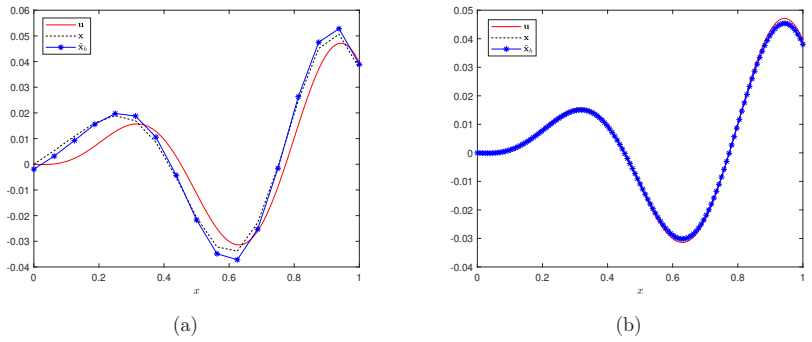
- [Figure 3] The caption refers to both v(t) and x(t); the text should clarify that v(t) is the DDS trajectory and x is the exact solution of the linear system, so the reader can interpret the two panels.
- [Table 1] The entry for 'Original HHL' gives complexity O(k⁴ ε⁻¹), but standard HHL has query complexity O(κ² log(1/ε)) or O(κ log(1/ε)) with QSVT-based improvements. Please justify the ε⁻¹ dependence or correct the entry, since it affects the comparison table's accuracy.
- [Section 6] The numerical experiments are restricted to 1D; the paper would benefit from a 2D or 3D example to demonstrate the behavior of the preconditioned complexity, given that the theoretical advantage over CG is claimed for d>2.
Circularity Check
No significant circularity: the main derivation is an application of previously proven Schrödingerization results to a new problem class; the preconditioner estimate is a rough spectral analysis, not a self-referential input.
full rationale
The paper's derivation chain is not circular. The Helmholtz problem is reduced to a linear system (1), then to a damped dynamical system (8) whose steady state is the solution; Lemmas 3.1 and 3.2 give explicit convergence rates with proofs. The Schrödingerization machinery, including the recovery Theorem 3.4, is imported from the authors' prior work, but these are stated theorems with proofs and clear assumptions, not conclusions that assume the target Helmholtz result. The complexity Theorem 4.1 follows from explicit block-encoding and QSVT query counts (24), the evolution time (11), and the amplitude-amplification repetition count (27). No fitted parameter is renamed as a prediction, and no quantity is defined in terms of the claimed outcome. The preconditioner analysis in Section 5 derives an explicit eigenvalue formula (30) for PA; the subsequent claim κ(PA)=O(k) relies on an unproved lower bound on |δ0|, the distance from the wavenumber k to the nearest discrete Laplacian eigenvalue. This is a genuine mathematical rigor gap, not circularity: the analysis is transparently labeled 'simple but rough' and the preconditioner is called 'suboptimal' in Section 7. The self-citations to prior Schrödingerization papers are load-bearing as foundational machinery, but they constitute independent prior proofs, not a chain that reduces the current claim to itself. Therefore the paper exhibits no circular reasoning by the standards of identifiable self-definition or fitted-input-as-prediction.
Assumptions & free parameters
assumptions (4)
- domain assumption A is invertible and indefinite, so B=A†A is positive definite and the damped ODE converges to x.
- ad hoc to paper The preconditioned matrix PA has condition number O(k), which is derived from eigenvalue ratios (30) with a near-resonant Laplacian eigenvalue μ_s=k+δ0.
- domain assumption The recovery formula Vf=e^p W(T,p) with p♦=1/2 and the Fourier discretization error estimates hold for this construction.
- domain assumption Initial data ψ(p) can be chosen smooth enough to give exponential accuracy in the p discretization.
Cite this review
Pith. "Pith review of Quantum simulation of Helmholtz equations via Schr{\"o}dingerization." pith.science (2026). https://pith.science/paper/PYUCYQH5
@misc{pith2026250723547,
  author       = {Pith},
  title        = {Pith review of: Quantum simulation of Helmholtz equations via Schr\"odingerization},
  year         = {2026},
  howpublished = {\url{https://pith.science/paper/PYUCYQH5}},
  note         = {Machine review of arXiv:2507.23547}
}
abstract
The Helmholtz equation is a prototypical model for time-harmonic wave propagation. Numerical solutions become increasingly challenging as the wave number $k$ grows, due to the equation's elliptic yet noncoercive character and the highly oscillatory nature of its solutions, with wavelengths scaling as $1/k$. These features lead to strong indefiniteness and large system sizes. We present a quantum algorithm for solving such indefinite problems, built upon the Schr\"odingerization framework. This approach reformulates linear differential equations into Schr\"odinger-type systems by capturing the steady state of damped dynamics. A warped phase transformation lifts the original problem to a higher-dimensional formulation, making it compatible with quantum computation. To suppress numerical pollution, the algorithm incorporates asymptotic dispersion correction. It achieves a query complexity of $\mathcal{O}(\kappa^2\text{polylog}\varepsilon^{-1})$, where $\kappa$ is the condition number and $\varepsilon$ the desired accuracy. For the Helmholtz equation, a simple preconditioner further reduces the complexity to $\mathcal{O}(\kappa\text{polylog}\varepsilon^{-1})$. Our constructive extension to the quantum setting is broadly applicable to all indefinite problems.
Figures


Figures from the paper (1 more)

Reference graph
Works this paper leans on
-
[1]
T. Airaksinen, E. Heikkola, A. Pennanen, and J. Toivanen . An algebraic multigrid based shifted-laplacian preconditioner for the helmholtz equation. J. Comput. Phys. , 226(1):1196–1210, 2007
work page 2007
-
[3]
D. W. Berry. High-order quantum algorithm for solving lin ear differential equations. Journal of Physics A: Mathematical and Theoretical , 47(10):105301, feb 2014
work page 2014
-
[4]
M. Bollhöfer, M. J. Grote, and O. Schenk. Algebraic multil evel preconditioner for the helmholtz equation in heterogeneous media. SIAM J. Sci. Comput. , 31(5):3781–3805, 2009
work page 2009
-
[5]
A. M. Childs, R. Kothari, and R. D. Somma. Quantum algorit hm for systems of linear equations with exponentially improved dependence o n precision. SIAM J. Comput. , 46(6):1920–1950, 2017
work page 1920
-
[6]
A. M. Childs and J. P. Liu. Quantum spectral methods for di fferential equa- tions. Comm. Math. Phys. C , 375:1427–1457, 2020
work page 2020
-
[7]
A. M. Childs, J. P. Liu, and A. Ostrander. High-precision quantum algorithms for partial differential equations. Quantum, 5:574, November 2021
work page 2021
-
[8]
P. H. Cocquet and M. J. Gander. How large a shift is needed i n the shifted helmholtz preconditioner for its effective inversion by mul tigrid? SIAM J. Sci. Comput., 39(2):A438–A478, 2017. 18
work page 2017
-
[9]
P. H. Cocquet and M. J. Gander. Asymptotic dispersion cor rection in gen- eral finite difference schemes for helmholtz problems. SIAM J. Sci. Comput. , 46(2):A670–A696, 2024
work page 2024
Show all 44 references
-
[10]
P. C. S. Costa, S. Jordan, and A. Ostrander. Quantum algo rithm for simulating the wave equation. Phys. Rev. A , 99:012323, Jan 2019
2019
-
[11]
D. Deutsch. Quantum theory, the church–turing princip le and the universal quantum computer. Proceedings of the Royal Society of London. A. Mathe- matical and Physical Sciences , 400(1818):97–117, 1985
1985
-
[12]
P DiVincenzo
D. P DiVincenzo. Quantum computation. Science, 270(5234):255–261, 1995
1995
-
[13]
Ekert and R
A. Ekert and R. Jozsa. Quantum algorithms: entanglemen t–enhanced infor- mation processing. Philosophical Transactions of the Royal Society of London. Series A: Mathematical, Physical and Engineering Sciences , 356(1743):1769– 1782, 1998
1998
-
[14]
Engel, G
A. Engel, G. Smith, and S. E. Parker. Quantum algorithm f or the vlasov equation. Phys. Rev. A , 100:062315, Dec 2019
2019
-
[15]
Y. A. Erlangga and R. Nabben. On a multilevel krylov meth od for the helmholtz equation preconditioned by shifted laplacian. Electron. Trans. Nu- mer. Anal. , 31:403–424, 2008
2008
-
[16]
Y. A. Erlangga, C. W. Oosterlee, and C. Vuik. A novel mult igrid based pre- conditioner for heterogeneous helmholtz problems. SIAM J. Sci. Comput. , 27(4):1471–1492, 2006
2006
-
[17]
Y. A. Erlangga, C. Vuik, and C. W. Oosterlee. On a class of preconditioners for solving the helmholtz equation. Appl. Numer. Math. , 50(3):409–425, 2004
2004
-
[18]
Y. A. Erlangga, C. Vuik, and C. W. Oosterlee. Comparison of multigrid and incomplete lu shifted-laplace preconditioners for the inh omogeneous helmholtz equation. Appl. Numer. Math. , 56(5):648–666, 2006
2006
-
[19]
R. P. Feynman. Simulating physics with computers. Internat. J. Theoret. Phys., 21:467–488, 1982
1982
-
[20]
Freiser and P
M. Freiser and P. Marcus. A survey of some physical limit ations on computer elements. IEEE Transactions on Magnetics , 5(2):82–90, 1969
1969
-
[21]
M. J. Gander, I. G. Graham, and E. A. Spence. Applying gmr es to the helmholtz equation with shifted laplacian preconditionin g: what is the largest shift for which wavenumber-independent convergence is gua ranteed? Numer. Math., 131:567–614, 2015
2015
-
[22]
Gilyén, Y
A. Gilyén, Y. Su, G. H. Low, and N. Wiebe. Quantum singula r value trans- formation and beyond: exponential improvements for quantu m matrix arith- metics. In Proceedings of the 51st Annual ACM SIGACT Symposium on The- ory of Computing , STOC 2019, page 193–204, New York, NY, ...
2019
-
[23]
Gilyén, Y
A. Gilyén, Y. Su, G. H. Low, and N. Wiebe. Quantum singula r value trans- formation and beyond: exponential improvements for quantu m matrix arith- metics. In Proceedings of the 51st Annual ACM SIGACT Symposium on Theory of Computing, pages 193–204, 2019. 19
2019
-
[24]
A. W. Harrow, A. Hassidim, and S. Lloyd. Quantum algorit hm for linear systems of equations. Phys. Rev. Lett. , 103:150502, Oct 2009
2009
-
[25]
J. Hu, S. Jin, and L. Zhang. Quantum algorithms for multi scale partial differ- ential equations. Multiscale Model. Simul. , 22(3):1030–1067, 2024
2024
-
[26]
Ihlenburg and I
F. Ihlenburg and I. Babuška. Finite element solution of t he helmholtz equation with high wave number part i: The h-version of the fem. Comput. Math. Appl. , 30(9):9–37, 1995
1995
-
[27]
S. Jin, N. Liu, and C. Ma. On schrödingerization based qu antum algorithms for linear dynamical systems with inhomogeneous terms. arXiv:2402.14696, 2024
2024 arXiv
-
[28]
S. Jin, N. Liu, and C. Ma. Schrödingerisation based comp utationally stable algorithms for ill-posed problems in partial differe ntial equations. arXiv:2403.19123, 2024
2024 arXiv
-
[29]
S. Jin, N. Liu, C. Ma, and Y. Yu. On the schrödingerizatio n method for linear non-unitary dynamics with optimal dependence on mat rix queries. Arxiv:2505.00370v1, 2025
2025
-
[30]
S. Jin, N. Liu, C. Ma, and Y. Yu. Quantum preconditioning method for linear systems problems via schrödingerization. Arxiv:2505.06866, 2025
2025 arXiv
-
[31]
S. Jin, N. Liu, and Y. Yu. Quantum simulation of partial d ifferential equations via schrödingerisation, 2022
2022
-
[32]
S. Jin, N. Liu, and Y. Yu. Quantum simulation of partial d ifferential equations: Applications and detailed analysis. Phys. Rev. A , 108:032603, Sep 2023
2023
-
[33]
S. Jin, N. Liu, and Y. Yu. Quantum simulation of partial d ifferential equations via schrödingerization. Phys. Rev. Lett. , 133:230602, Dec 2024
2024
-
[34]
Klappenecker and M
A. Klappenecker and M. Rotteler. Discrete cosine trans forms on quantum computers. In ISPA 2001. Proceedings of the 2nd International Symposium on Image and Signal Processing and Analysis. In conjunction with 23rd Inter- national Conference on Information Technology Interfaces...
2001
-
[35]
G. H. Low and I. L. Chuang. Hamiltonian Simulation by Qub itization. Quan- tum, 3:163, July 2019
2019
-
[36]
M. M. M. Made. Incomplete factorization-based precond itionings for solving the helmholtz equation. Internat. J. Numer. Methods Engrg. , 50(5):1077–1101, 2001
2001
-
[37]
J. M. Melenk and S. Sauter. Wavenumber explicit converg ence analysis for galerkin discretizations of the helmholtz equation. SIAM J. Numer. Anal. , 49(3):1210–1243, 2011
2011
-
[38]
Montanaro and S
A. Montanaro and S. Pallister. Quantum algorithms and t he finite element method. Phys. Rev. A , 93:032324, Mar 2016
2016
-
[39]
B. Reps, W. Vanroose, and H. Zubair. On the indefinite helm holtz equation: Complex stretched absorbing boundary layers, iterative an alysis, and precon- ditioning. J. Comput. Phys. , 229(22):8384–8405, 2010. 20
2010
-
[40]
A. H. Sheikh, D. Lahaye, and C. Vuik. On the convergence o f shifted laplace preconditioner combined with multilevel deflation. Numer. Linear Algebra Appl., 20(4):645–662, 2013
2013
-
[41]
P. W. Shor. Algorithms for quantum computation: discre te logarithms and factoring. In Proceedings 35th Annual Symposium on Foundations of Comput er Science, pages 124–134, 1994
1994
-
[42]
E. A. Spence. A simple proof that the hp-fem does not suffe r from the pollution effect for the constant-coefficient full-space helmholtz equ ation. Adv. Comput. Math., 49(2):27–49, 2023
2023
-
[43]
A. Steane. Quantum computing. Rep. Progr. Phys. , 61(2):117, feb 1998
1998
-
[44]
M. B. van Gijzen, Y. A. Erlangga, and C. Vuik. Spectral ana lysis of the discrete helmholtz operator preconditioned with a shifted laplacian. SIAM J. Sci. Comput. , 29(5):1942–1958, 2007
1942
-
[45]
Zhu and H
L. Zhu and H. Wu. Preasymptotic error analysis of cip-fe m and fem for helmholtz equation with high wave number. part ii: hp version. SIAM J. Numer. Anal. , 51(3):1828–1852, 2013. 21
2013
Reviewed August 6, 2026 · model on record in the stance chip above.
Discussion (0). Sign in to comment.