REVIEW 4 major objections 6 minor 31 references
Non-Terrestrial Network Models Using Stochastic Geometry: Planar or Spherical?
T0 review · 4 major / 6 minor · reviewed 2026-08-06 · deepseek-v4-flash
Pith's one-line read This paper gives a quantitative rule for choosing between flat and curved network models, built on a paired point-process construction and an optimal altitude formula.
desk verdict A useful quantitative framework for choosing planar vs. spherical SG models, but the reported error numbers are best-case because the planar altitude is optimized and the two point processes share random draws. read the letter →
The pith
A machine-rendered reading of the paper's core claim, the machinery that carries it, and where it could break.
The reading
What carries the argument
The load-bearing object is the paired-generation scheme of Algorithm 1: each point is a single uniform draw $(u,v)$, simultaneously realized as a spherical-cap location and a planar-disk location. The spherical point receives polar angle $\theta_s = \arccos(1 - u(1-\cos\theta_{\max}))$ and azimuth $2\pi v$, while the planar point receives radius $\rho_p = \sqrt{u}\,\rho_{\max}$ and the same azimuth. This coupling is what guarantees homogeneity (Theorem 1), asymptotic similarity (Theorem 2), and a deterministic, non-random relative error between the two models. The second mechanism is the relative-error estimator (Algorithm 2), which sweeps the planar altitude $h_p$ and records the minimum relative error and the altitude $h_{\mathrm{opt}}$; Proposition 1 supplies $h_{\mathrm{opt}}$ in closed form by equating the expected $\mathrm{(t2)}$ metrics in the limit $N_s \to \infty$.
What would settle it
For a fixed LEO geometry with $R_s = R_\oplus + 550$ km and $\theta_{\max} = \arccos(R_\oplus/R_s)$, generate independent spherical and planar binomial point processes of equal intensity, not the coupled pair from Algorithm 1, and compute the relative error of the coverage probability at the paper's optimal altitude $h_{\mathrm{opt}}$. If the uncoupled error exceeds the paper's reported value or the 0.1 percent threshold by more than a small factor, the coupling and the altitude formula understate the true modeling gap.
Extended reading notes
Core claim
On the paper's own terms, the central discovery is that a spherical binomial point process and a planar one can be constructed from the same random draws so that both are homogeneous and, as the Earth's radius diverges, they coincide point for point. This construction (Algorithm 1) makes the relative error between the two models a deterministic function of altitude, region, and metric rather than a Monte Carlo artifact. The paper then proves that for one of the six metrics, the discrete Wasserstein distance to the typical user, the planar altitude that exactly zeroes the expected relative error is $h_{\mathrm{opt}} = R_\oplus + \sqrt{R_\oplus^2 - \tfrac{1}{2}\rho_{\max}^2 - (1+\cos\theta_{\max}) R_s R_\oplus + R_s^2}$, with $R_s = R_\oplus + h_s$, and numerically shows the same altitude stays near-optimal, within about 8.5 percent, for the other five metrics. The consequence is a quantitative, tunable threshold: below a chosen relative error, say 0.1 percent, planar modeling is recommended; above it, spherical modeling is necessary.
Load-bearing premise
The reported error thresholds assume that the gap between planar and spherical models is fairly measured by comparing two point processes that share the same random draws and that use the tuned optimal planar altitude, rather than independently generated processes or a planar process placed at the actual deployment altitude.
Editorial extensions
If this is right
- With $h_{\mathrm{opt}}$ from Proposition 1, the outer search loop of Algorithm 2 can be skipped, cutting the complexity of relative-error estimation from $O(N_{\mathrm{in}} N_{\mathrm{out}})$ to $O(N_{\mathrm{in}})$.
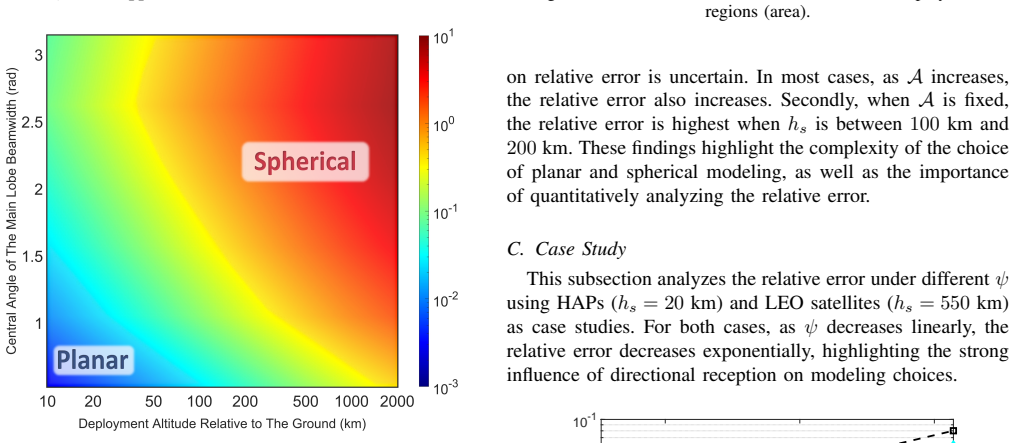
- For high-altitude platforms at 20 km, planar modeling keeps the relative error under 0.1 percent even for a receiver main lobe as wide as $\psi = \pi/2$; for LEO satellites at 550 km, spherical modeling becomes necessary once the main lobe exceeds about $\pi/12$.
- Because the six metrics can disagree, the thresholds are metric-specific: an acceptable planar error for average SINR does not automatically imply an acceptable error for coverage probability or achievable rate.
- Holding the deployment area fixed, the relative error peaks between roughly 100 and 200 km altitude, so the planar approximation is not simply monotone in altitude.
- The relative error grows as the receive beamwidens, so directional antennas at the user side are a key enabler of planar approximation at higher altitudes.
Reading between the lines
- The coupled-sampling trick is a form of common random numbers; on independently generated planar and spherical deployments the same error metric would likely report larger gaps, so the recommended thresholds should be treated as optimistic until validated on uncoupled processes.
- The $h_{\mathrm{opt}}$ formula can be read as the tangent-plane altitude that best compensates Earth's curvature over a given spherical cap; it could be reused for other spherical-cap planar projections, for example in radar coverage or atmospheric-science modeling.
- The paper's future-work suggestion of weighting single-layer errors points to a natural multi-layer extension: choose $h_{\mathrm{opt}}$ per layer independently and combine the relative errors in a weighted sum, giving a decomposition of total modeling error into per-layer contributions.
- A metric-independent bound on the relative error might be derivable from the distance CDFs in Lemma 1 and Lemma 2, since both CDFs are explicit functions of altitude and cap size; the paper does not attempt this.
Signed reviews
Editorial analysis
A structured set of objections, weighed in public.
Referee Report
Summary. This paper studies whether planar or spherical stochastic geometry models should be used for non-terrestrial networks (NTNs). It proposes Algorithm 1, which generates paired planar and spherical binomial point processes from the same uniform random draws, and proves that both are homogeneous and asymptotically similar as the sphere radius grows with the cap area fixed. It then defines six similarity metrics (three topology-based, three system-level), develops Algorithm 2 to estimate the relative error between the two models, and derives a closed-form optimal planar altitude for the squared-distance metric. Numerical results for HAP and LEO altitudes and for different beamwidths and deployment areas lead to recommended error thresholds and modeling choices.
Significance. The mathematical core of the paper—the homogeneity of Algorithm 1's point processes and their asymptotic similarity—is plausible and, apart from typos in the appendix, correctly derived. The explicit algorithm and the closed-form optimal altitude in Proposition 1 are useful and reproducible, and the paper would fill a real gap by giving a quantitative alternative to the empirical 20-km rule for choosing between planar and spherical models. However, the central quantitative claims depend on two protocol choices that make the reported relative errors best-case: the planar and spherical processes are generated from the same random draws, and the planar altitude is tuned to minimize the error rather than being set to the nominal deployment altitude. These issues must be addressed before the practical recommendations can be accepted.
major comments (4)
- [Algorithm 1, steps 3–5; Algorithm 2, step 8] The same random variables u(n), v(n) are used to generate both the spherical and the planar point processes. For metric (t1), the Earth-mover distance is therefore computed between configurations that are paired point-by-point by construction; this is not the transport distance between two independent realizations of the two models and will systematically underestimate the modeling gap. For the other metrics the coupling acts as a variance-reduction device, but it means that the relative errors in Figs. 3–7 do not reflect the error a practitioner would see when drawing an independent planar or spherical configuration. Please repeat the comparison with independently generated planar and spherical processes from the same parameters, or justify explicitly why the paired comparison is the correct definition of the model gap, and quantify the difference between the two protocols.
- [Algorithm 2, lines 2–13; Sec. V] The outer loop of Algorithm 2 selects hp to minimize the relative error, and the numerical results in Sec. V use this optimized altitude rather than the nominal deployment altitude hs = Rs − R⊕. For the LEO case (hs = 550 km), the optimized altitude hopt − R⊕ is approximately 389 km; for the HAP case (hs = 20 km), it is roughly 14 km. A planar model placed at the actual deployment altitude would incur a larger error than the figures report, so the 0.1% thresholds and the conclusion that planar modeling is often sufficient for HAPs are best-case statements. Please report the relative error at hp = Rs − R⊕ alongside the optimized value, and discuss whether hopt is meant as a physical altitude or as a tuned proxy parameter.
- [Sec. V.C; Fig. 2] The case-study conclusions (HAP versus LEO, beamwidth thresholds) are based on relative errors at the metric-specific optimal altitudes found by Algorithm 2, not on a single recommended altitude. Proposition 1 is derived only for metric (t2), and its generalization to other metrics is validated in Fig. 2 only for the LoS cap θmax = arccos(R⊕/Rs). The paper should either derive or empirically verify the optimal-altitude behavior for the beam-angle and fixed-area scenarios, or present the sensitivity of the conclusions to the choice of altitude within the admissible range.
- [Sec. V, Figs. 3–7] No error bars or confidence intervals are provided for any Monte Carlo curve, and the values of Nin, Nout, and the number of channel realizations for the system-level metrics are not stated. Since the paper makes quantitative recommendations based on small relative errors (e.g., the 0.1% threshold), the statistical uncertainty of these estimates must be quantified before the thresholds can be considered reliable.
minor comments (6)
- [Appendix B, near Eqs. (13)–(14)] The text 'When ρmax = Rs cos θmax' should read 'ρmax = Rs sin θmax'; otherwise the subsequent algebra does not follow. Also, Eq. (13) is missing a factor of 4 in the second term, although the term vanishes in the limit and does not affect the conclusion.
- [Appendix E, Eq. (26)] The spherical-cap area should be A = 2π R_s^2 (1 − cos θmax), not 2πR_s(1 − cos θmax); Eq. (6) is consistent with the corrected formula, so this appears to be a typographical error.
- [Algorithm 2] The input list of Algorithm 2 omits ρmax; the paper should state explicitly that ρmax = Rs sin θmax is used, as required by Theorem 2.
- [Sec. V.A] The sentence 'the y-axis is in units of %, for example, 100% = 0.01' is confusing; it should presumably read '1% = 0.01'.
- [Fig. 2] The figure uses θmax = arccos(R⊕/Rs), but this is not stated in the caption; clarify which cap geometry applies to each figure.
- [References] The reference for Slivnyak's theorem [26] is a general probability text; a standard point-process reference would be more appropriate.
Circularity Check
Relative-error results reduce to the paired generation and to minimizing over the planar altitude; the reported planar-spherical gap is a tuned best case rather than an independent model comparison.
-
fitted input called prediction
[Algorithm 2 (Sec. IV-A), Sec. IV-C, Figs. 3-7 (Sec. V)]
"Therefore, the Algorithm 2 traverses the altitudes within this range through an outer loop to find the optimal altitude hopt where the relative error is minimized, ensuring the uniqueness of the relative error obtained by the algorithm."
The quantity reported as 'relative error' is, by construction, the minimum over the planar-altitude parameter hp of |gs-gp|/gs: Algorithm 2 keeps only Emin and hopt. Figures 3-7 and the 0.1% thresholds use this minimized value, not the error of a planar model placed at the actual deployment altitude hs = Rs - R⊕. The paper's case studies use hopt - R⊕ values well below hs (for LEO, roughly 389 km versus 550 km; for HAP, roughly 13.7 km versus 20 km), so the planar model is tuned to make the error small. The modeling recommendation is therefore forced by the optimization rather than measuring the nominal planar-versus-spherical gap.
-
self definitional
[Algorithm 1 (Sec. III-B), Theorem 2 (Sec. III-C), Appendix B]
"u(n) ← rand(0, 1), v(n) ← rand(0, 1). θ_s^(n) ← arccos(1 − u(n)(1 − cos θmax)), ρ_p^(n) ← √u(n)ρmax. φ_s^(n) ← 2πv(n), φ_p^(n) ← 2πv(n)."
The same uniforms u(n), v(n) drive both the spherical and planar coordinates, and the azimuth angles are set equal. The proof of Theorem 2 then shows that, with ρmax = Rs sinθmax, both radial coordinates converge to the same function √(u(n)S/π). Thus the 'asymptotically similar' property is a direct consequence of the paired construction in Algorithm 1; the two point processes are not independent realizations. Metrics such as (t1) therefore measure the transport cost under this pre-arranged pointwise coupling, which is smaller by construction than the gap between independently generated planar and spherical BPPs. The similarity result is definitional to the algorithm rather than an independent confirmation of model equivalence.
full rationale
Theorems 1-2 and Lemma 1 are internally derived from the inversion-sampling construction and are not imported from prior work, and no load-bearing self-citation is present. The circularity is confined to the evaluation protocol: Algorithm 1 couples the planar and spherical point processes through shared random draws, and Algorithm 2 optimizes hp before reporting Emin. Consequently, the headline relative-error numbers and the planar-versus-spherical modeling recommendations are best-case values that reduce, by construction, to the optimization objective. Proposition 1 is an analytic minimizer of metric (t2) and is not itself circular, but using that minimizer (or its per-metric counterpart from Algorithm 2) as the basis for the error thresholds makes the reported gap a fitted minimum rather than the error at the nominal deployment altitude. The mathematical core of the paper is plausible and self-contained, yet the central empirical claim is partially circular because the reported metric is the minimum of the quantity being measured. Score is therefore 6.
Assumptions & free parameters
free parameters (3)
- Planar altitude hp (optimized) =
hopt = R⊕ + sqrt(R⊕^2 - 0.5 ρmax^2 - (1+cosθmax)R⊕Rs + Rs^2)
- Np, number of NTPs =
20
- Acceptable relative error threshold =
0.1%
assumptions (6)
- domain assumption NTP positions follow a homogeneous binomial point process on a spherical cap or a planar disk.
- standard math Slivnyak's theorem allows placing the typical user at (R⊕, 0, 0) without loss of generality.
- ad hoc to paper Asymptotic similarity is defined in the limit Rs to infinity with fixed cap area S, and the planar altitude hp is restricted to (Rs cos θmax, Rs).
- standard math The optimal altitude derivation assumes Ns to infinity and uses the law of large numbers to replace the empirical mean with an expectation.
- domain assumption Channel models from [8] and [30], including fading and uni-directional antenna gain, are assumed for system-level metrics.
- ad hoc to paper The acceptable relative-error threshold of 0.1% is chosen by the authors.
Cite this review
Pith. "Pith review of Non-Terrestrial Network Models Using Stochastic Geometry: Planar or Spherical?." pith.science (2026). https://pith.science/paper/E5BKS2IZ
@misc{pith2026250800010,
  author       = {Pith},
  title        = {Pith review of: Non-Terrestrial Network Models Using Stochastic Geometry: Planar or Spherical?},
  year         = {2026},
  howpublished = {\url{https://pith.science/paper/E5BKS2IZ}},
  note         = {Machine review of arXiv:2508.00010}
}
read the original abstract
With the explosive deployment of non-terrestrial networks (NTNs), the computational complexity of network performance analysis is rapidly escalating. As one of the most suitable mathematical tools for analyzing large-scale network topologies, stochastic geometry (SG) enables the representation of network performance metrics as functions of network parameters, thus offering low-complexity performance analysis solutions. However, choosing between planar and spherical models remains challenging. Planar models neglect Earth's curvature, causing deviations in high-altitude NTN analysis, yet are still often used for simplicity. This paper introduces relative error to quantify the gap between planar and spherical models, helping determine when planar modeling is sufficient. To calculate the relative error, we first propose a point process (PP) generation algorithm that simultaneously generates a pair of homogeneous and asymptotically similar planar and spherical PPs. We then introduce several typical similarity metrics, including topology-related and network-level metrics, and further develop a relative error estimation algorithm based on these metrics. In addition, we derive an analytical expression for the optimal planar altitude, which reduces computational complexity and provides theoretical support for planar approximation. Finally, numerical results investigate how deployment altitude and region affect NTN modeling, with case studies on HAP and LEO satellite constellations.
Figures


Figures from the paper (4 more)



Reference graph
Works this paper leans on
-
[1]
B. E. Y . Belmekki and M.-S. Alouini, “Unleashing the potential of networked tethered flying platforms: Prospects, challenges, and applica- tions,” IEEE Open Journal of Vehicular Technology, vol. 3, pp. 278–320, 2022
work page 2022
-
[2]
Cellular network from the sky: Toward people-centered smart communities,
B. E. Y . Belmekki, A. J. Aljohani, S. A. Althubaity, A. Al Harthi, K. Bean, A. Aijaz, and M.-S. Alouini, “Cellular network from the sky: Toward people-centered smart communities,” IEEE Open Journal of the Communications Society, 2024, early Access
work page 2024
-
[3]
Direct-to-smartphone for 6G NTN: Technical routes, challenges, and key technologies,
Y . He, Y . Xiao, S. Zhang, M. Jia, and Z. Li, “Direct-to-smartphone for 6G NTN: Technical routes, challenges, and key technologies,” IEEE Network, vol. 38, no. 4, pp. 128–135, 2024
work page 2024
-
[4]
Modeling and analysis of non-terrestrial networks by spherical stochastic geometry: A survey,
R. Wang, M. A. Kishk, and M.-S. Alouini, “Modeling and analysis of non-terrestrial networks by spherical stochastic geometry: A survey,” IEEE Communications Surveys & Tutorials , 2025, early Access
work page 2025
-
[5]
Z. Qiu and W. Wang, “Performance analysis and simulation of large- scale LEO constellation under a stochastic geometric perspective,” in ICC 2023-IEEE International Conference on Communications . IEEE, 2023, pp. 3425–3431
work page 2023
-
[6]
Ultra-dense LEO satellite- based communication systems: A novel modeling technique,
R. Wang, M. A. Kishk, and M.-S. Alouini, “Ultra-dense LEO satellite- based communication systems: A novel modeling technique,” IEEE Communications Magazine, vol. 60, no. 4, pp. 25–31, 2022
work page 2022
-
[7]
Spectrum sharing for high altitude platform networks,
Z. Gao, Z. Wei, Z. Wang, J. Zhu, G. Deng, and Z. Feng, “Spectrum sharing for high altitude platform networks,” in International Conference on Communications in China (ICCC) . IEEE, 2019, pp. 411–415
work page 2019
-
[8]
Coverage and rate analysis for vertical heterogeneous networks (VHetNets),
M. Alzenad and H. Yanikomeroglu, “Coverage and rate analysis for vertical heterogeneous networks (VHetNets),” IEEE Transactions on Wireless Communications, vol. 18, no. 12, pp. 5643–5657, 2019
work page 2019
Show all 31 references
-
[9]
Stochastic geometry-based analysis of cache-enabled hybrid satellite- aerial-terrestrial networks with non-orthogonal multiple access,
X. Zhang, B. Zhang, K. An, G. Zheng, S. Chatzinotas, and D. Guo, “Stochastic geometry-based analysis of cache-enabled hybrid satellite- aerial-terrestrial networks with non-orthogonal multiple access,” IEEE Transactions on Wireless Communications , vol. 21, no. 2, pp. 1272– 1287, 2021
2021
-
[10]
Satellite-aerial com- munications with multi-aircraft interference,
Y . Tian, G. Pan, H. ElSawy, and M.-S. Alouini, “Satellite-aerial com- munications with multi-aircraft interference,” IEEE Transactions on Wireless Communications, vol. 22, no. 10, pp. 7008–7024, 2023
2023
-
[11]
Nonhomogeneous stochastic geometry anal- ysis of massive LEO communication constellations,
N. Okati and T. Riihonen, “Nonhomogeneous stochastic geometry anal- ysis of massive LEO communication constellations,” IEEE Transactions on Communications, vol. 70, no. 3, pp. 1848–1860, 2022
2022
-
[12]
UA V-aided post- disaster cellular networks: A novel stochastic geometry approach,
M. Matracia, M. A. Kishk, and M.-S. Alouini, “UA V-aided post- disaster cellular networks: A novel stochastic geometry approach,” IEEE Transactions on Vehicular Technology , vol. 72, no. 7, pp. 9406–9418, 2023
2023
-
[13]
HAPS in the non-terrestrial network nexus: Prospective architectures and performance insights,
Z. Lou, B. E. Youcef Belmekki, and M.-S. Alouini, “HAPS in the non-terrestrial network nexus: Prospective architectures and performance insights,” IEEE Wireless Communications , vol. 30, no. 6, pp. 52–58, 2023
2023
-
[14]
Spectrum sharing between high altitude platform network and terrestrial network: Modeling and performance analysis,
Z. Wei, L. Wang, Z. Gao, H. Wu, N. Zhang, K. Han, and Z. Feng, “Spectrum sharing between high altitude platform network and terrestrial network: Modeling and performance analysis,” IEEE Transactions on Communications, vol. 71, no. 6, pp. 3736–3751, 2023
2023
-
[15]
Orchestrating heterogeneous NTNs: From stochastic geometry to resource allocation,
M. A. Bliss, F. J. Block, T. C. Royster, C. G. Brinton, and D. J. Love, “Orchestrating heterogeneous NTNs: From stochastic geometry to resource allocation,” IEEE Transactions on Aerospace and Electronic Systems, 2024, early Access
2024
-
[16]
Performance analysis of satellite-terrestrial integrated radio access networks based on stochastic geometry,
Y . Sun and R. Li, “Performance analysis of satellite-terrestrial integrated radio access networks based on stochastic geometry,” 2024, available online: https://arxiv.org/abs/2404.09506
2024 arXiv
-
[17]
Performance analysis of end-to-end LEO satellite-aided shore-to-ship communications: A stochastic geometry approach,
X. Hu, B. Lin, X. Lu, P. Wang, N. Cheng, Z. Yin, and W. Zhuang, “Performance analysis of end-to-end LEO satellite-aided shore-to-ship communications: A stochastic geometry approach,” IEEE Transactions on Wireless Communications, 2024, early Access
2024
-
[18]
Theoretical and simulation-based anal- ysis of terrestrial interference to LEO satellite uplinks,
A. Yastrebova, I. Angervuori, N. Okati, M. Vehkaper ¨a, M. H ¨oyhty¨a, R. Wichman, and T. Riihonen, “Theoretical and simulation-based anal- ysis of terrestrial interference to LEO satellite uplinks,” in Global Communications Conference (GLOBECOM) . IEEE, 2020, pp. 1–6
2020
-
[19]
A tractable approach for predicting pass duration in dense satellite networks,
A. Al-Hourani, “A tractable approach for predicting pass duration in dense satellite networks,” IEEE Communications Letters, vol. 25, no. 8, pp. 2698–2702, 2021
2021
-
[20]
Downlink coverage and rate analysis of low Earth orbit satellite constellations using stochastic geometry,
N. Okati, T. Riihonen, D. Korpi, I. Angervuori, and R. Wichman, “Downlink coverage and rate analysis of low Earth orbit satellite constellations using stochastic geometry,” IEEE Transactions on Com- munications, vol. 68, no. 8, pp. 5120–5134, 2020
2020
-
[21]
Modeling and analysis of downlink communications in a heterogeneous LEO satellite network,
C.-S. Choi, “Modeling and analysis of downlink communications in a heterogeneous LEO satellite network,” IEEE Transactions on Wireless Communications, 2024, early Access. 11
2024
-
[22]
Modeling and analysis of GEO satellite networks,
D.-H. Jung, H. Nam, J. Choi, and D. J. Love, “Modeling and analysis of GEO satellite networks,” 2023, available online: https://arxiv.org/abs/2312.15924
2023 arXiv
-
[23]
Evaluating the accuracy of stochastic geometry based models for LEO satellite networks analysis,
R. Wang, M. A. Kishk, and M.-S. Alouini, “Evaluating the accuracy of stochastic geometry based models for LEO satellite networks analysis,” IEEE Communications Letters , vol. 26, no. 10, pp. 2440–2444, 2022
2022
-
[24]
Session duration between handovers in dense LEO satellite networks,
A. Al-Hourani, “Session duration between handovers in dense LEO satellite networks,” IEEE Wireless Communications Letters , vol. 10, no. 12, pp. 2810–2814, 2021
2021
-
[25]
Meta distribution of the SIR in a narrow-beam LEO uplink,
I. Angervuori, M. Haenggi, and R. Wichman, “Meta distribution of the SIR in a narrow-beam LEO uplink,” IEEE Transactions on Communi- cations, 2025, early Access
2025
-
[26]
Feller, An introduction to probability theory and its applications, Volume 2
W. Feller, An introduction to probability theory and its applications, Volume 2. John Wiley & Sons, 1991, vol. 81
1991
-
[27]
Ultra reliable low latency routing in LEO satellite constellations: A stochastic geometry approach,
R. Wang, M. A. Kishk, and M.-S. Alouini, “Ultra reliable low latency routing in LEO satellite constellations: A stochastic geometry approach,” IEEE Journal on Selected Areas in Communications , vol. 42, no. 5, pp. 1231–1245, 2024
2024
-
[28]
A metric for distributions with applications to image databases,
Y . Rubner, C. Tomasi, and L. J. Guibas, “A metric for distributions with applications to image databases,” in Sixth international conference on computer vision. IEEE, 1998, pp. 59–66
1998
-
[29]
Nearest neighbor and contact distance distribution for binomial point process on spherical surfaces,
A. Talgat, M. A. Kishk, and M.-S. Alouini, “Nearest neighbor and contact distance distribution for binomial point process on spherical surfaces,” IEEE Communications Letters , vol. 24, no. 12, pp. 2659– 2663, 2020
2020
-
[30]
Stochastic geometry-based analysis of LEO satellite communica- tion systems,
——, “Stochastic geometry-based analysis of LEO satellite communica- tion systems,” IEEE Communications Letters , vol. 25, no. 8, pp. 2458– 2462, 2021
2021
-
[31]
Reliability analysis of multi- hop routing in multi-tier LEO satellite networks,
R. Wang, M. A. Kishk, and M.-S. Alouini, “Reliability analysis of multi- hop routing in multi-tier LEO satellite networks,” IEEE Transactions on Wireless Communications, vol. 23, no. 3, pp. 1959–1973, 2023
1959
Reviewed August 6, 2026 · model on record in the stance chip above.
Discussion (0). Continue with ORCID to comment.