REVIEW 3 major objections 5 minor 93 references
Discovery of an $\rm[Fe/H] \sim -4.8$ Star in $Gaia$ XP Spectra
T0 review · 3 major / 5 minor · reviewed 2026-08-06 · deepseek-v4-flash
Pith's one-line read The paper reports a star, GDR3_526285, with $\rm[Fe/H] = -4.82 \pm 0.25$, among the lowest iron abundances ever measured, and argues its near-absence of carbon points to dust-cooled star formation in the early universe.
desk verdict Genuine new ultra metal-poor star, but the headline [Fe/H] depends on adopted reddening and 1D LTE; the discovery holds, the exact number is provisional. read the letter →
The pith
A machine-rendered reading of the paper's core claim, the machinery that carries it, and where it could break.
The reading
What carries the argument
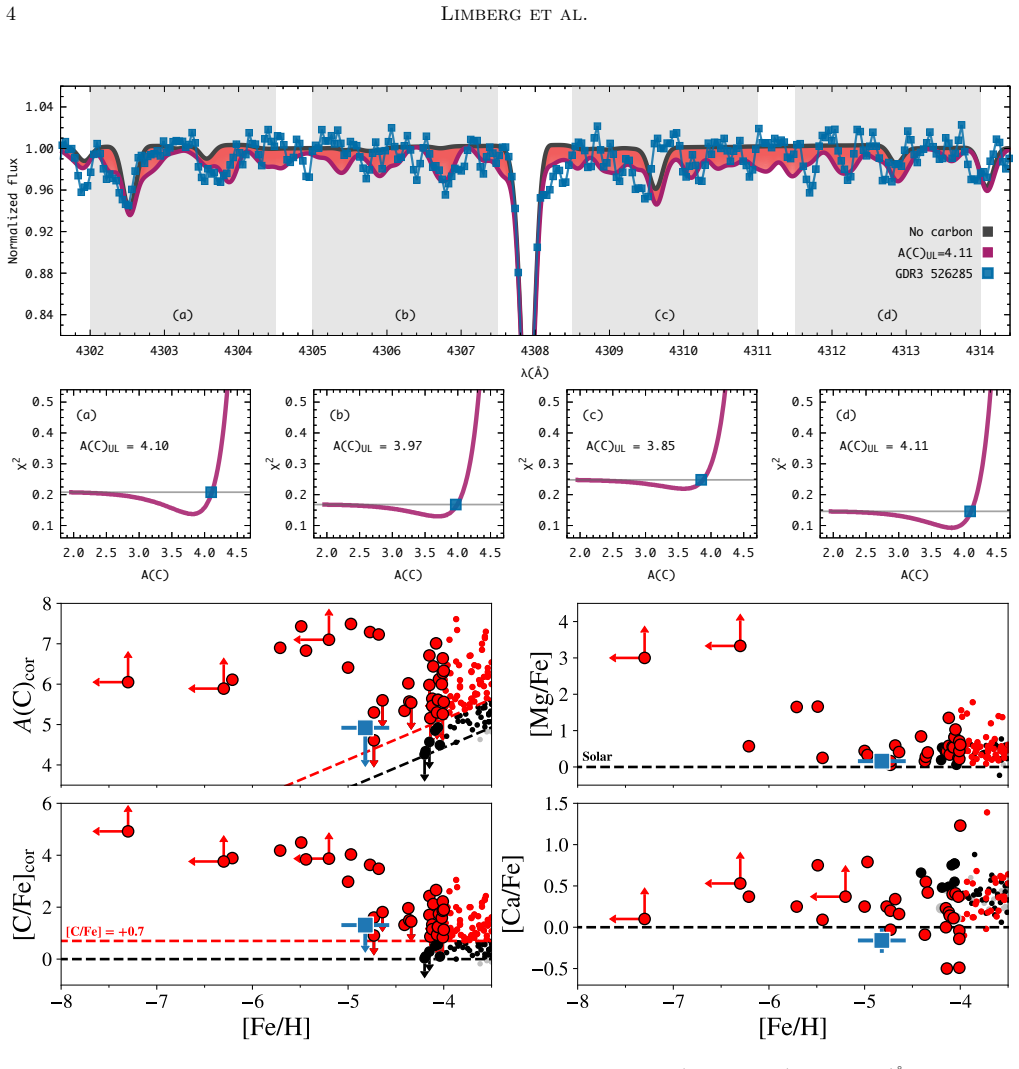
The argument is carried by a two-stage funnel. First, an all-sky candidate search: a machine-learning metallicity model trained on high-resolution abundances is applied to the Gaia satellite's low-resolution BP/RP (XP) spectra, yielding a predicted $\rm[Fe/H]\approx-3.5$ for this star, and photometric colors plus an XP-based parameter catalog mark it as a cool red giant. Second, the confirmation stage: high-resolution echelle spectra provide 30 Fe I line equivalent widths, and a one-dimensional, local-thermodynamic-equilibrium plane-parallel model atmosphere with an empirical gravity-to-microturbulence relation converts them into $\rm[Fe/H] = -4.82 \pm 0.25$. The carbon claim then runs through a spectral-synthesis $\chi^2$ upper limit on the CH G-band, an evolutionary correction of $+0.68$ dex added to $\rm[C/Fe]$, and a published cooling threshold $D_{\rm trans}$ that decides whether carbon/oxygen line cooling or dust cooling must be invoked for the gas that formed the star.
What would settle it
A 3D non-LTE re-analysis of the same iron lines, or an independent temperature from interferometry or asteroseismology, that moves $\rm[Fe/H]$ above $-4$ would overturn the UMP classification; a definitive detection of the CH G-band at higher signal-to-noise with $\rm[C/Fe]_{\rm cor}$ above $+1.18$ would weaken the dust-cooled formation argument.
Extended reading notes
Core claim
On its own terms, the paper establishes that the star Gaia DR3 5262850721755411072 is a genuine ultra metal-poor red giant. Using equivalent widths of 30 Fe I lines in a 1D LTE analysis with photometric $T_{\rm eff} = 4596$ K and isochrone $\log g = 0.88$, it derives $\rm[Fe/H] = -4.82 \pm 0.25$. The carbon abundance is an upper limit, $A({\rm C}) < 4.11$ ($\rm[C/H] < -4.32$, $\rm[C/Fe] < +0.50$), which becomes $\rm[C/Fe]_{\rm cor} < +1.18$ when the expected evolutionary depletion of carbon on the giant branch is added back. Summing the measured species with assumed oxygen and nitrogen enhancements of $+0.6$ dex gives $Z \lesssim 1.0 \times 10^{-6}$. The paper interprets these numbers as a sign that this low-mass star formed from near-metal-free gas cooled by dust grains, and its orbit suggests it was either scattered by the infalling Magellanic system or stripped from it.
Load-bearing premise
The abundance scale rests on a one-dimensional, local-thermodynamic-equilibrium model atmosphere with an adopted photometric temperature and an isochrone gravity; if the true temperature or line formation differs, the exact iron and carbon values shift, although the star would probably remain ultra metal-poor.
Editorial extensions
If this is right
- GDR3_526285 joins SDSS J102915+172927 as one of only two known stars with $\rm[Fe/H]<-4.5$ that show no strong carbon enhancement, so the census of non-CEMP ultra metal-poor stars grows by one.
- The total metal mass fraction $Z \lesssim 1\times10^{-6}$ places this star among the lowest-metallicity gas reservoirs known, close to the level expected for gas enriched by a single first-generation supernova.
- Because its carbon upper limit is below the level where fine-structure line cooling can operate, its existence supports dust cooling as a viable channel for forming low-mass stars in near-metal-free gas.
- Backward orbit integrations including an infalling Magellanic system bind over half of the plausible orbits to the LMC two billion years ago, suggesting the Milky Way may have acquired this star from the Magellanic Clouds.
Reading between the lines
- If the same Gaia XP selection is pushed to fainter magnitudes or applied to the bulge and disk, the discovery rate of carbon-normal ultra metal-poor stars could rise enough to map how their fraction changes with Galactic environment.
- A nitrogen measurement would be the highest-value next observation: nitrogen dominates the paper's $Z$ estimate, so a lower $\rm[N/Fe]$ would push $Z$ below $10^{-6}$, while a higher one could shift the star toward the carbon-enhanced regime.
- If the Magellanic association is confirmed with more stars, this object would connect first-star nucleosynthesis to the stripping history of the Magellanic Clouds, tying UMP chemistry to galaxy accretion events.
- The same XP-based method could be retrained to target carbon-enhanced stars rather than red giants, offering a complementary test of first-supernova yields.
Editorial analysis
A structured set of objections, weighed in public.
Referee Report
Summary. The paper reports the discovery of GDR3_526285, a star identified from Gaia XP spectra as an ultra metal-poor red giant and confirmed with Magellan/MIKE high-resolution spectroscopy. The authors derive Teff = 4596 ± 65 K from color–Teff calibrations with an adopted E(B−V) = 0.1622, log g = 0.88 from an isochrone, and microturbulence from an empirical relation, then measure [Fe/H] = −4.82 ± 0.25 from 30 Fe I lines in 1D LTE. They obtain a carbon upper limit of [C/H] < −4.32, which after an evolutionary correction becomes [C/Fe]_cor < +1.18, and estimate a total metal mass fraction Z < 1.0 × 10^−6. They further argue from kinematics that the star may be associated with the Magellanic system. The paper frames the result as one of the most metal-poor stars known and as a demonstration of the Gaia XP selection methodology.
Significance. If the central abundance holds, GDR3_526285 is among the most iron-poor stars known and is notable for its low carbon upper limit, making it a potentially non-carbon-enhanced UMP star that could constrain early star-formation cooling channels. The Gaia XP selection method is scalable and could yield more such targets. The paper is transparent about many of its assumptions, and the Monte Carlo treatment of statistical uncertainties and the explicit statement of the no-extinction case are commendable. However, the headline quantitative claims ([Fe/H], [C/H], Z) rest on adopted extinction, 1D LTE atmospheres, and an isochrone-based log g; the quoted error bars do not include these systematics, so the exact numerical values should be treated as conditional.
major comments (3)
- [§3.1, Table 1] The effective temperature is derived from color–Teff calibrations after correcting for E(B−V) = 0.1622 from Schlafly & Finkbeiner (2011), and the text itself notes that a no-extinction case would give Teff ≈ 4320 K and [Fe/H] < −5. Because d[Fe I]/dTeff for cool metal-poor giants is roughly 0.04–0.06 dex per 100 K, the 276 K difference shifts [Fe/H] by about 0.2–0.3 dex, comparable to the entire quoted 1σ uncertainty. The quoted [Fe/H] = −4.82 ± 0.25 therefore does not include the dominant systematic. Please either determine Teff from an independent method (e.g., excitation balance in the MIKE spectrum or a full spectral energy distribution fit) or report the headline metallicity as a range that includes the no-extinction case, and propagate this systematically into [C/H], [C/Fe]_cor, and Z.
- [§3.1, §3.2] The surface gravity is adopted from a 12 Gyr Y2 isochrone at [Fe/H] = −3.5 with [α/Fe] = +0.4, which is already an extrapolation for a star with [Fe/H] ≈ −4.8, and the microturbulence is set from an empirical log g–ξ relation. The paper notes that a different log g–ξ relation (Roederer et al. 2014) would lower ξ by up to ~0.5 km s^−1 and give [Fe/H] = −4.69. These are systematic effects on the central abundance, yet they are not included in the 0.25 dex error bar. A quantitative propagation of plausible log g and ξ ranges into the final [Fe/H] and the carbon upper limit is needed to make the stated uncertainties complete.
- [§4, Z estimate] The total metal mass fraction Z < 1.0 × 10^−6 is computed assuming [O/Fe] = [N/Fe] = +0.6, as in Caffau et al. (2011), and uses the upper-limit carbon abundance. The resulting Z is therefore an upper limit that is conditional on unmeasured oxygen and nitrogen. The paper acknowledges the assumption, but the claim that GDR3_526285 has one of the lowest metal mass fractions ever found depends on it; enhanced N or O could raise Z substantially. Please state this dependence more prominently and provide the Z value for the no-extinction case as well, since that case changes the adopted Teff and therefore all abundances.
minor comments (5)
- [Abstract, §4, §5] The source ID is misspelled as 'GDR3_526585' in the abstract, in the Z estimate in §4, and in the summary; it should be 'GDR3_526285' throughout.
- [Abstract] The phrase 'an useful' should be 'a useful'.
- [§4] The sentence 'this stars has one of the lowest overall metal mass fractions' contains a subject-verb agreement error and should read 'this star has'.
- [§2.1] The selection method relies on several catalogs that are not yet published (Yao et al. 2023, Mardini et al. in prep.), which limits reproducibility; please clarify the public availability of these catalogs or describe the relevant selection criteria in sufficient detail.
- [§3.2] In the carbon upper-limit section, the four wavelength windows used in the χ² minimization are shown in Figure 2 but not specified in the text; listing the exact wavelength ranges would improve reproducibility.
Circularity Check
No significant circularity: the final [Fe/H] and [C/H] come from new high-resolution MIKE spectroscopy, not from the Gaia XP regression used to select the candidate.
full rationale
GDR3_526285 was selected from an XGBoost XP regression of Yao et al. (2023) and corroborated by Andrae et al. (2023) and Mardini et al. (in prep.), with predicted metallicities (-3.5, -2.9, <-2.9) that are all much higher than the final value. The final [Fe/H] = -4.82 ± 0.25 is not the regression output; it is measured from 30 Fe I equivalent widths in a new MIKE spectrum using MOOG 1D LTE analysis with independently adopted Teff, log g, and xi (Table 1, Sections 2.2 and 3.1). No equation maps the XP prediction into the spectroscopic abundance. The Teff dependence on adopted E(B-V)=0.162 is openly quantified: with no extinction, Teff ≈ 4320 K and [Fe/H] < -5 (Section 3.1). This is a parameter-sensitivity limitation, not a circular reduction, since the Fe measurement is not defined by the reddening assumption. Self-citations (Yao et al. 2023; Placco et al. 2014, 2024; Ji et al. 2023; Mardini et al. in prep.) supply catalogs, empirical corrections, and analysis tools that are external to this target and would apply to any star; none of them encodes the headline abundance or carbon upper limit as an input. The carbon upper limit uses a published chi2 method (Placco et al. 2024) on the observed G band, and the evolutionary correction (Placco et al. 2014) is a post hoc literature value, not fitted to GDR3_526285. The Z and D_trans numbers are arithmetic from these independently measured abundances with stated assumptions. Thus the central claim is self-contained against the selection machinery; the minor self-citations are not load-bearing, and no derivation step reduces by construction.
Assumptions & free parameters
free parameters (6)
- Assumed stellar mass M_star =
0.78 +/- 0.10 M_sun
- Adopted E(B - V) =
0.1622 mag
- Assumed [O/Fe] for Z and Dtrans =
+0.6 dex
- Assumed [N/Fe] for Z =
+0.6 dex
- Isochrone metallicity and alpha enhancement for logg =
[Fe/H] = -3.5, [alpha/Fe] = +0.4
- LMC mass in orbit model =
1.5 x 10^11 M_sun
assumptions (7)
- domain assumption 3D and non-LTE effects on Fe I and CH line formation are small compared with the quoted uncertainties.
- domain assumption The Schlafly & Finkbeiner (2011) reddening E(B - V) = 0.1622 is correct for this line of sight.
- domain assumption The 12 Gyr, [Fe/H] = -3.5, [alpha/Fe] = +0.4 Y2 isochrone correctly places the star on the red giant branch with logg = 0.88.
- domain assumption The evolutionary carbon depletion correction of +0.68 dex from Placco et al. (2014) applies to this star.
- domain assumption The Asplund et al. (2009) solar abundances and the linemake line list are appropriate for the abundance zero point.
- domain assumption The McMillan (2017) Galactic potential and the Vasiliev et al. (2021) Milky Way plus LMC potential describe the orbit environment.
- domain assumption The Gaia XP machine-learning metallicity predictions from Yao et al. (2023), Andrae et al. (2023), and Mardini et al. (in prep.) are reliable enough for candidate selection.
Cite this review
Pith. "Pith review of Discovery of an $\rm[Fe/H] \sim -4.8$ Star in $Gaia$ XP Spectra." pith.science (2026). https://pith.science/paper/DWDGQHFV
@misc{pith2026250800067,
  author       = {Pith},
  title        = {Pith review of: Discovery of an $\rm[Fe/H] \sim -4.8$ Star in $Gaia$ XP Spectra},
  year         = {2026},
  howpublished = {\url{https://pith.science/paper/DWDGQHFV}},
  note         = {Machine review of arXiv:2508.00067}
}
abstract
We report on the discovery of GDR3_526285 ($Gaia$ DR3 Source ID 5262850721755411072), a star with $\rm[Fe/H] = -4.82 \pm 0.25$ and one of the lowest metal ($\text{atomic number} > 2$) mass fractions ever found ($Z_{\rm GDR3\_526585} \lesssim 1.0 \times 10^{-6}$). We first identified it as an ultra metal-poor (UMP; $\rm[Fe/H] < -4$) red giant-branch (RGB) star candidate in the $Gaia$ BP/RP (XP) spectro-photometric catalog ($Gaia$ $G$ magnitude $\approx$15). A combination of multi-band photometry and high-resolution spectroscopic analysis under local thermodynamic equilibrium confirmed the status of GDR3_526285 as a distant ($\approx$24 kpc from the Sun) RGB star ($T_{\rm eff} = 4596\,{\rm K}$, $\log g = 0.88$) in the Milky Way's outer halo. We obtain only an upper limit for the carbon abundance of $\rm[C/H] < -4.32$, resulting in $\rm[C/Fe] < +0.50$. A correction for the evolutionary carbon depletion ($\Delta \rm[C/Fe] = +0.68$) brings the nominal carbon-to-iron ratio upper limit to $\rm[C/Fe]_{\rm cor} < +1.18$. Given its extraordinarily low [C/H], GDR3_526285 likely formed from gas cooled via dust grains rather than fine structure line cooling. The kinematics of GDR3_526285 suggests that this star was either dynamically perturbed by the infall of the Magellanic system or was formerly a member of the Magellanic Clouds and was later stripped by the Milky Way. Our results showcase the potential of an all-sky search for low-metallicity targets with $Gaia$ XP and confirm that the methodology described here is an useful "treasure map" for finding additional UMP stars.
Figures


Reference graph
Works this paper leans on
-
[1]
2018, ApJS, 238, 36 2, 4, 10
Abohalima, A., & Frebel, A. 2018, ApJS, 238, 36 2, 4, 10
2018
-
[2]
S., Youakim, K., Gonz´ alez Hern´ andez, J
Aguado, D. S., Youakim, K., Gonz´ alez Hern´ andez, J. I., et al. 2019, MNRAS, 490, 2241 2
2019
-
[3]
Anders, F., Khalatyan, A., Queiroz, A. B. A., et al. 2022, A&A, 658, A91 5, 7, 9
2022
-
[4]
2023, ApJS, 267, 8 2, 3, 5
Andrae, R., Rix, H.-W., & Chandra, V. 2023, ApJS, 267, 8 2, 3, 5
2023
-
[5]
C., Christlieb, N., et al
Aoki, W., Beers, T. C., Christlieb, N., et al. 2007, ApJ, 655, 492 2
2007
-
[6]
Arentsen, A., Placco, V. M., Lee, Y. S., et al. 2022, arXiv e-prints, arXiv:2206.04081 2
work page Pith review arXiv 2022
-
[7]
2005, ARA&A, 43, 481 9
Asplund, M. 2005, ARA&A, 43, 481 9
2005
-
[8]
J., & Scott, P
Asplund, M., Grevesse, N., Sauval, A. J., & Scott, P. 2009, ARA&A, 47, 481 7, 9 Astropy Collaboration, Robitaille, T. P., Tollerud, E. J., et al. 2013, A&A, 558, A33 7 Astropy Collaboration, Price-Whelan, A. M., Sip˝ ocz, B. M., et al. 2018, AJ, 156, 123 7
2009
Show all 93 references
-
[9]
O., Chiti, A., Limberg, G., et al
Barbosa, F. O., Chiti, A., Limberg, G., et al. 2025, arXiv e-prints, arXiv:2504.03593 2, 6
2025 arXiv
-
[10]
S., Christlieb, N., Beers, T
Barklem, P. S., Christlieb, N., Beers, T. C., et al. 2005, A&A, 439, 129 3, 5, 6
2005
-
[11]
C., & Christlieb, N
Beers, T. C., & Christlieb, N. 2005, ARA&A, 43, 531 1
2005
-
[12]
A., Gunnels, S
Bernstein, R., Shectman, S. A., Gunnels, S. M., Mochnacki, S., & Athey, A. E. 2003, in Society of Photo-Optical Instrumentation Engineers (SPIE) Conference Series, Vol. 4841, Instrument Design and Performance for Optical/Infrared Ground-based Telescopes, ed. M. Iye & A. F. M. ...
2003
-
[13]
2025, arXiv e-prints, arXiv:2504.06335 2
Bonifacio, P., Caffau, E., Fran¸ cois, P., & Spite, M. 2025, arXiv e-prints, arXiv:2504.06335 2
2025 arXiv
-
[14]
Bonifacio, P., Monai, S., & Beers, T. C. 2000, AJ, 120, 2065 6
2000
-
[15]
2015, A&A, 579, A28 10 —
Bonifacio, P., Caffau, E., Spite, M., et al. 2015, A&A, 579, A28 10 —. 2018, A&A, 612, A65 10
2015
-
[16]
2011, Nature, 477, 67 2, 9, 10
Caffau, E., Bonifacio, P., Fran¸ cois, P., et al. 2011, Nature, 477, 67 2, 9, 10
2011
-
[17]
2016, A&A, 595, L6 10
Caffau, E., Bonifacio, P., Spite, M., et al. 2016, A&A, 595, L6 10
2016
-
[18]
2024, A&A, 691, A245 2, 9, 10
Caffau, E., Bonifacio, P., Monaco, L., et al. 2024, A&A, 691, A245 2, 9, 10
2024
-
[19]
Casagrande, L., & VandenBerg, D. A. 2018, MNRAS, 479, L102 5, 6
2018
-
[20]
R., Ji, A., & Holmbeck, E
Casey, A. R., Ji, A., & Holmbeck, E. 2025, smhr: Automatic curve-of-growth analyses of high-resolution stellar spectra, Astrophysics Source Code Library, record ascl:2502.025, , 6
2025
-
[21]
Castelli, F., & Kurucz, R. L. 2003, in Modelling of Stellar Atmospheres, ed. N. Piskunov, W. W. Weiss, & D. F
2003
-
[22]
2004, A&A, 416, 1117 2
Cayrel, R., Depagne, E., Spite, M., et al. 2004, A&A, 416, 1117 2
2004
-
[23]
J., Moles, M., Crist´ obal-Hornillos, D., et al
Cenarro, A. J., Moles, M., Crist´ obal-Hornillos, D., et al. 2019, A&A, 622, A176 2
2019
-
[24]
P., Conroy, C., et al
Chandra, V., Naidu, R. P., Conroy, C., et al. 2023, ApJ, 956, 110 8, 9, 10
2023
-
[25]
2016, arXiv e-prints, arXiv:1603.02754 2
Chen, T., & Guestrin, C. 2016, arXiv e-prints, arXiv:1603.02754 2
2016 arXiv
-
[26]
2017, MNRAS, 472, L115 9
Chiaki, G., Tominaga, N., & Nozawa, T. 2017, MNRAS, 472, L115 9
2017
-
[27]
2024, Nature Astronomy, 8, 637 2, 3, 9
Chiti, A., Mardini, M., Limberg, G., et al. 2024, Nature Astronomy, 8, 637 2, 3, 9
2024
-
[28]
2016, ApJ, 823, 102 7
Choi, J., Dotter, A., Conroy, C., et al. 2016, ApJ, 823, 102 7
2016
-
[29]
J., et al
Christlieb, N., Gustafsson, B., Korn, A. J., et al. 2004, ApJ, 603, 708 10
2004
-
[30]
G., Christlieb, N., Thompson, I., et al
Cohen, J. G., Christlieb, N., Thompson, I., et al. 2013, ApJ, 778, 56 2
2013
-
[31]
2024, A&A, 684, A75 2
Curti, M., Maiolino, R., Curtis-Lake, E., et al. 2024, A&A, 684, A75 2
2024
-
[32]
M., Wright, E
Cutri, R. M., Wright, E. L., Conrow, T., et al. 2021, VizieR Online Data Catalog: AllWISE Data Release (Cutri+ 2013), VizieR On-line Data Catalog: II/328. Originally published in: IPAC/Caltech (2013), , 5
2013
-
[33]
L., Allington-Smith, J
Davies, R. L., Allington-Smith, J. R., Bettess, P., et al. 1997, in Society of Photo-Optical Instrumentation Engineers (SPIE) Conference Series, Vol. 2871, Optical Telescopes of Today and Tomorrow, ed. A. L. Ardeberg, 1099–1106 3 De Angeli, F., Weiler, M., Montegriffo, P., et ...
1997 arXiv
-
[34]
Demarque, P., Woo, J.-H., Kim, Y.-C., & Yi, S. K. 2004, ApJS, 155, 667 3, 5, 6
2004
-
[35]
2016, ApJS, 222, 8 7
Dotter, A. 2016, ApJS, 222, 8 7
2016
-
[36]
2018, Research Notes of the American Astronomical Society, 2, 210 7
Drimmel, R., & Poggio, E. 2018, Research Notes of the American Astronomical Society, 2, 210 7
2018
-
[37]
P., Jacobson, H
Frebel, A., Chiti, A., Ji, A. P., Jacobson, H. R., & Placco, V. M. 2015, ApJL, 810, L27 10
2015
-
[38]
P., Ezzeddine, R., et al
Frebel, A., Ji, A. P., Ezzeddine, R., et al. 2019, ApJ, 871, 146 10
2019
-
[39]
L., & Bromm, V
Frebel, A., Johnson, J. L., & Bromm, V. 2007, MNRAS, 380, L40 9
2007
-
[40]
Frebel, A., & Norris, J. E. 2015, ARA&A, 53, 631 1
2015
-
[41]
2005, Nature, 434, 871 10 12 Limberg et al
Frebel, A., Aoki, W., Christlieb, N., et al. 2005, Nature, 434, 871 10 12 Limberg et al. Gaia Collaboration, Prusti, T., de Bruijne, J. H. J., et al. 2016, A&A, 595, A1 2 Gaia Collaboration, Vallenari, A., Brown, A. G. A., et al. 2023, A&A, 674, A1 2, 5
2005
-
[42]
A., Daflon, S., Placco, V
Galarza, C. A., Daflon, S., Placco, V. M., et al. 2022, A&A, 657, A35 2
2022
-
[43]
2016, in Society of Photo-Optical Instrumentation Engineers (SPIE) Conference Series, Vol
Gimeno, G., Roth, K., Chiboucas, K., et al. 2016, in Society of Photo-Optical Instrumentation Engineers (SPIE) Conference Series, Vol. 9908, Ground-based and Airborne Instrumentation for Astronomy VI, ed. C. J
2016
-
[44]
Simard, & H
Evans, L. Simard, & H. Takami, 99082S 3 Gravity Collaboration, Abuter, R., Amorim, A., et al. 2018, A&A, 615, L15 7
2018
-
[45]
J., Christlieb, N., et al
Hansen, T., Hansen, C. J., Christlieb, N., et al. 2014, ApJ, 787, 162 10
2014
-
[46]
Heger, A., & Woosley, S. E. 2010, ApJ, 724, 341 2
2010
-
[47]
A., Templeton, M., Terrell, D., et al
Henden, A. A., Templeton, M., Terrell, D., et al. 2016, VizieR Online Data Catalog, II/336 5
2016
-
[48]
M., Hansen, T
Holmbeck, E. M., Hansen, T. T., Beers, T. C., et al. 2020, ApJS, 249, 30 2
2020
-
[49]
N., Tominaga, N., Kobayashi, C., & Nomoto, K
Ishigaki, M. N., Tominaga, N., Kobayashi, C., & Nomoto, K. 2018, ApJ, 857, 46 1
2018
-
[50]
R., Keller, S., Frebel, A., et al
Jacobson, H. R., Keller, S., Frebel, A., et al. 2015, ApJ, 807, 171 2
2015
-
[51]
P., Simon, J
Ji, A. P., Simon, J. D., Roederer, I. U., et al. 2023, AJ, 165, 100 3, 5, 6
2023
-
[52]
D., Conroy, C., Naidu, R
Johnson, B. D., Conroy, C., Naidu, R. P., et al. 2020, ApJ, 900, 103 8
2020
-
[53]
R., Nordlander, T., et al
Karovicova, I., White, T. R., Nordlander, T., et al. 2020, A&A, 640, A25 6
2020
-
[54]
C., Bessell, M
Keller, S. C., Bessell, M. S., Frebel, A., et al. 2014, Nature, 506, 463 2, 10
2014
-
[55]
Kelson, D. D. 2003, PASP, 115, 688 3
2003
-
[56]
2023, Research Notes of the American Astronomical Society, 7, 214 3
Labrie, K., Simpson, C., Cardenes, R., et al. 2023, Research Notes of the American Astronomical Society, 7, 214 3
2023
-
[57]
2022, ApJ, 931, 147 2
Li, H., Aoki, W., Matsuno, T., et al. 2022, ApJ, 931, 147 2
2022
-
[58]
Limberg, G., Queiroz, A. B. A., Perottoni, H. D., et al. 2023, ApJ, 946, 66 8
2023
-
[59]
K., Frebel, A., & Chiti, A
Mardini, M. K., Frebel, A., & Chiti, A. 2024, MNRAS, 529, L60 3
2024
-
[60]
K., Frebel, A., Chiti, A., et al
Mardini, M. K., Frebel, A., Chiti, A., et al. 2022, ApJ, 936, 78 9
2022
-
[61]
McMillan, P. J. 2017, MNRAS, 465, 76 7, 9, 10 Mendes de Oliveira, C., Ribeiro, T., Schoenell, W., et al. 2019, MNRAS, 489, 241 2
2017
-
[62]
2021, A&A, 653, A90 5, 6
Mucciarelli, A., Bellazzini, M., & Massari, D. 2021, A&A, 653, A90 5, 6
2021
-
[63]
2010, ApJ, 723, 1618 6, 8
Nigra, L. 2010, ApJ, 723, 1618 6, 8
2010
-
[64]
S., Da Costa, G
Nordlander, T., Bessell, M. S., Da Costa, G. S., et al. 2019, MNRAS, 488, L109 10
2019
-
[65]
E., & Yong, D
Norris, J. E., & Yong, D. 2019, ApJ, 879, 37 10
2019
-
[66]
A., Wolf, C., Bessell, M
Onken, C. A., Wolf, C., Bessell, M. S., et al. 2024, PASA, 41, e061 5, 7
2024
-
[67]
Pace, A. B. 2024, arXiv e-prints, arXiv:2411.07424 8
2024
-
[68]
D., Placco, V
Perottoni, H. D., Placco, V. M., Almeida-Fernandes, F., et al. 2024, A&A, 691, A138 2
2024
-
[69]
M., Almeida-Fernandes, F., Arentsen, A., et al
Placco, V. M., Almeida-Fernandes, F., Arentsen, A., et al. 2022, ApJS, 262, 8 2
2022
-
[70]
M., Frebel, A., Beers, T
Placco, V. M., Frebel, A., Beers, T. C., & Stancliffe, R. J. 2014, ApJ, 797, 21 2, 4, 7, 9, 10
2014
-
[71]
M., Gupta, A
Placco, V. M., Gupta, A. F., Almeida-Fernandes, F., et al. 2024, ApJ, 977, 12 7
2024
-
[72]
M., Limberg, G., Chiti, A., et al
Placco, V. M., Limberg, G., Chiti, A., et al. 2025, arXiv e-prints, arXiv:2506.19163 2, 6, 8, 9
2025 arXiv
-
[73]
A., Hoppe, R., Bergemann, M., et al
Popa, S. A., Hoppe, R., Bergemann, M., et al. 2023, A&A, 670, A25 9
2023
-
[74]
Queiroz, A. B. A., Anders, F., Santiago, B. X., et al. 2018, MNRAS, 476, 2556 7
2018
-
[75]
U., Preston, G
Roederer, I. U., Preston, G. W., Thompson, I. B., et al. 2014, AJ, 147, 136 2, 6
2014
-
[76]
U., Sakari, C
Roederer, I. U., Sakari, C. M., Placco, V. M., et al. 2018, ApJ, 865, 129 7
2018
-
[77]
Roman, N. G. 1950, ApJ, 112, 554 1
1950
-
[78]
C., & Sneden, C
Rossi, S., Beers, T. C., & Sneden, C. 1999, in Astronomical Society of the Pacific Conference Series, Vol. 165, The Third Stromlo Symposium: The Galactic Halo, ed. B. K
1999
-
[79]
X., Brauer, D
Santiago, B. X., Brauer, D. E., Anders, F., et al. 2016, A&A, 585, A42 7
2016
-
[80]
F., & Finkbeiner, D
Schlafly, E. F., & Finkbeiner, D. P. 2011, ApJ, 737, 103 5, 6, 7
2011
-
[81]
J., Finkbeiner, D
Schlegel, D. J., Finkbeiner, D. P., & Davis, M. 1998, ApJ, 500, 525 6, 8
1998
-
[82]
F., Cutri, R
Skrutskie, M. F., Cutri, R. M., Stiening, R., et al. 2006, AJ, 131, 1163 5, 6 Sk´ ulad´ ottir,´A., Salvadori, S., Amarsi, A. M., et al. 2021, ApJL, 915, L30 2
2006
-
[83]
Sneden, C. A. 1973, PhD thesis, University of Texas, Austin 6 An UMP star fromGaia XP 13
1973
-
[84]
S., Kraft, R
Sobeck, J. S., Kraft, R. P., Sneden, C., et al. 2011, AJ, 141, 175 6
2011
-
[85]
2017, MNRAS, 471, 2587 2
Starkenburg, E., Martin, N., Youakim, K., et al. 2017, MNRAS, 471, 2587 2
2017
-
[86]
S., Bonifacio, P., et al
Starkenburg, E., Aguado, D. S., Bonifacio, P., et al. 2018, MNRAS, 481, 3838 2, 9, 10
2018
-
[87]
2023, Galaxies, 11, 59 9
Vasiliev, E. 2023, Galaxies, 11, 59 9
2023
-
[88]
2021, MNRAS, 501, 2279 8, 10
Vasiliev, E., Belokurov, V., & Erkal, D. 2021, MNRAS, 501, 2279 8, 10
2021
-
[89]
Laevens, B. P. M. 2017, MNRAS, 466, 3741 7
2017
-
[90]
2019, ApJ, 877, 116 5, 7
Wang, S., & Chen, X. 2019, ApJ, 877, 116 5, 7
2019
-
[91]
D., Placco, V
Whitten, D. D., Placco, V. M., Beers, T. C., et al. 2019, A&A, 622, A182 2 —. 2021, ApJ, 912, 147 2
2019
-
[92]
P., Koposov, S
Yao, Y., Ji, A. P., Koposov, S. E., & Limberg, G. 2023, arXiv e-prints, arXiv:2303.17676 2
2023 arXiv
-
[93]
2001, ApJS, 136, 417 3, 5, 6
Yi, S., Demarque, P., Kim, Y.-C., et al. 2001, ApJS, 136, 417 3, 5, 6
2001
Reviewed August 6, 2026 · model on record in the stance chip above.
Discussion (0). Continue with ORCID to comment.