REVIEW 4 major objections 6 minor 1 cited by
Deep Joint Source-Channel Coding for Small Satellite Applications
T0 review · 4 major / 6 minor · reviewed 2026-08-06 · deepseek-v4-flash
Pith's one-line read A single attention-modulated neural codec matches specialized models across satellite channel states while adding only 0.25% parameters.
desk verdict A useful consolidation of prior DJSCC work with a new robustness study; the Markov-state dynamics gap keeps the strongest claim from being fully supported. read the letter →
The pith
A machine-rendered reading of the paper's core claim, the machinery that carries it, and where it could break.
The reading
What carries the argument
The load-bearing mechanism is the channel-conditioned attention module. After each residual block of the ResNet-based encoder and decoder, the module applies global average pooling to the feature map, concatenates the result with a vector of current channel parameters ($\alpha$, $\psi$, $MP$, SNR), and feeds this through two fully connected layers with ReLU and sigmoid activations. The output is a set of scaling factors that are multiplied element-wise into the feature map. This lets the same network adjust its internal representation to different channel states at run time, with negligible parameter overhead, rather than requiring a separate trained model per condition.
What would settle it
Run a transmission experiment in which the channel state switches from line-of-sight to deep shadow in the middle of a single image (or during a pass), following the Markov transition probabilities from the channel model. If ADJSCC-SAT's PSNR at the end of the image is significantly worse than a specialized deep-shadow model's, or if the reconstruction exhibits a sharp quality cliff at the switching instant, the claim that the adaptable model handles rapidly varying conditions would be contradicted.
Extended reading notes
Core claim
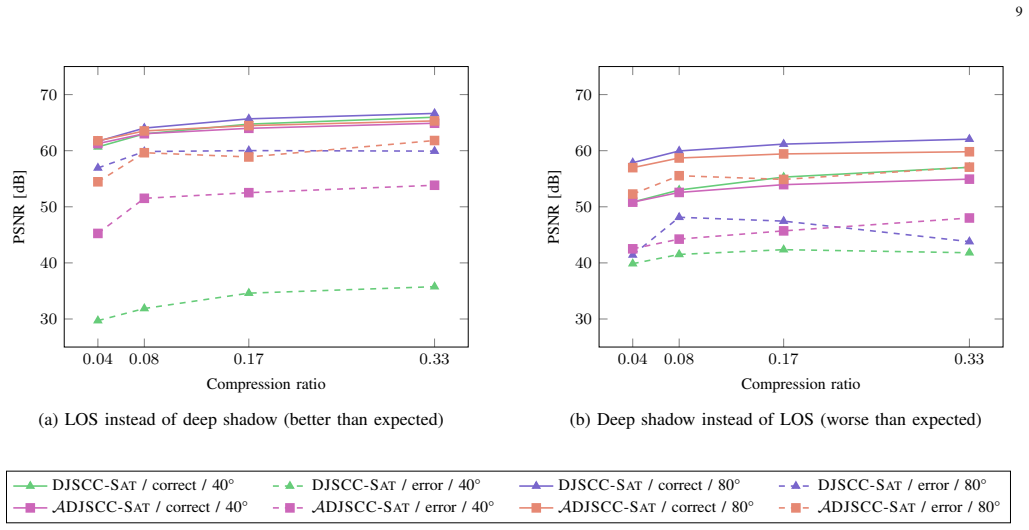
The paper claims that a single adaptable neural codec, ADJSCC-SAT, can match the reconstruction quality of a family of specialized DJSCC-SAT networks trained individually for each environment, shadowing state, and elevation angle. The adaptation is achieved by inserting attention modules after each residual block in the encoder and decoder; these modules concatenate the channel parameters (the Loo distribution parameters $\alpha$, $\psi$, $MP$, and the SNR) with pooled feature context and predict per-feature scaling factors that re-weight the feature maps. Across compression ratios from 0.04 to 0.33 on Sentinel-2 data in an urban environment, ADJSCC-SAT reaches PSNR values comparable to the specialized baselines, with the attention modules accounting for only 0.25% of model parameters. When the channel estimate is wrong, either the SNR is miscalculated or the shadowing state is misidentified, ADJSCC-SAT outperforms the non-adaptable baseline, especially in the worse-than-expected case where the link is assumed to be line-of-sight but is actually in deep shadow.
Load-bearing premise
The paper's evaluation treats each shadowing state as a fixed training and test condition, even though its channel model includes a Markov chain for state transitions; the claim that the system handles 'rapidly varying channel conditions' thus rests on the untested assumption that per-state static adaptation transfers to a link that changes state during a pass.
Editorial extensions
If this is right
- One ADJSCC-SAT model can serve a satellite across all shadowing states and elevation angles, replacing the storage and update burden of many specialized models.
- The attention mechanism generalizes to other channel parameters, so the same architecture could be re-purposed for new environments or link types without retraining a full network.
- Robustness to channel estimation errors improves operational reliability, since real systems rarely know the exact channel state.
- Training cost drops: a single training run covers a range of conditions instead of one run per condition.
Reading between the lines
- The paper defines a Markov chain for state transitions but evaluates only static states; a time-varying channel during a contact could reveal whether the attention-based adaptation is truly dynamic.
- The attention scaling factors might be interpretable: they could be analyzed to see what features the network emphasizes in deep shadow vs. line-of-sight, potentially enabling lightweight channel-state inference at the receiver.
- The same conditioning approach could be applied to other deep source-channel codecs or to non-vision data, as the mechanism is generic.
- The storage saving (0.25% overhead) suggests the channel-conditioned manifold is low-dimensional; one could try compressing or quantizing the scaling factors further.
Editorial analysis
A structured set of objections, weighed in public.
Referee Report
Summary. The paper develops and evaluates two deep joint source-channel coding (DJSCC) systems for small-satellite Earth observation. The first, DJSCC-SAT, is a ResNet-style encoder-decoder trained end-to-end over a Fontán/Loo statistical satellite channel model with LOS, shadow, and deep-shadow states. The second, ADJSCC-SAT, adds attention modules conditioned on channel parameters so that a single network can be reparameterized for different conditions. Experiments on Sentinel-2 images compare ADJSCC-SAT against per-condition DJSCC-SAT baselines in an urban environment, and study robustness to SNR and channel-state mismatches. The abstract's key claims are that ADJSCC-SAT performs comparably to specialized networks with 0.25% parameter overhead and is more robust to estimation errors.
Significance. The work addresses a real and timely deployment problem: making DJSCC usable across many channel conditions without storing one model per condition. The use of a statistical multi-state channel model rather than AWGN, the quantitative storage-overhead claim, and the two mismatch experiments are concrete strengths. If the results are confirmed with variance estimates and extended to time-varying channels, the adaptable architecture would be a practically useful contribution. The main weaknesses are the absence of Markov-chain temporal evaluation, single-run comparisons, and restriction of the adaptable-model comparison to a single environment.
major comments (4)
- [Section IV-B, V-B to V-D] The Markov-chain dynamics introduced in Section IV-B are never exercised. Every experiment trains and evaluates with a single shadowing state held fixed (as stated in V-B for per-condition models and V-C/V-D for the urban comparison), so there is no test in which the channel changes state during a transmission or follows a transition sequence. Because the attention modules are conditioned on one channel-parameter vector per forward pass, the paper does not specify how state changes are detected or how often the conditioning input would be updated. Since the introduction and abstract motivate the work by 'harsh, varying channel conditions,' this omission leaves the central time-varying claim unvalidated. I would expect at least a Markov-chain-based evaluation (e.g., generating state sequences from the transition matrix and reporting average PSNR over a pass) and a statement of the assumed state-estimation cadence.
- [Section V, Figures 9-11] All experiments appear to be single runs with no error bars or significance testing. The central comparison in Figure 9 shows gaps that are often small (especially at compression ratio 0.33), and the robustness claims in Figures 10 and 11 are similarly based on one curve per configuration. Without multiple seeds or confidence intervals, the claims 'comparable performance' and 'outperforms the non-adaptable baseline' are not quantitatively grounded. Please provide variance information or at least state the number of runs and show error bars.
- [Section V-C, Figure 9] The adaptable architecture is compared with the baseline only in an urban environment, at two elevation angles. The channel model defines five environments, and the conclusion claims the framework is suited to 'diverse channel conditions.' Urban is a reasonable stress test, but a second environment (e.g., suburban or intermediate tree shadow) is needed to support the generality claim about a single network covering a wide range of conditions.
- [Section V-D, Figure 11a] In the 'better-than-expected' case, both architectures perform worse when the channel is actually LOS but the system is configured for deep shadow, and this degradation is unexplained. This is counterintuitive and important for the robustness story, because it suggests that mismatch harms performance through something other than raw channel quality (e.g., power normalization or the decoder's prior). The paper should analyze this behavior; as written, it weakens the interpretation that attention-based adaptivity confers a general robustness advantage.
minor comments (6)
- [Section II] There is a typo: 'accross' should be 'across' in the paragraph describing the Fontán model.
- [Section IV-B, Eqs. (5)-(6)] Clarify that L in Eq. (6) is a power ratio and must be converted to dB before use in Eq. (5); as written, the units are inconsistent with the statement that all quantities in Eq. (5) are in decibel.
- [Section V-A] Report the exact train/validation/test split sizes and any data augmentation, not just the total of 14,439 images.
- [Section V-D, Figure 11] The text should define the solid/dashed lines of Figure 11 in the body, not only in the legend, and state explicitly that SNR is held at the training value in the state-mismatch scenario.
- [Section IV-C] The 0.25% parameter-overhead figure should be backed by a table of parameter counts for the base and attention modules.
- [Figure 8] The legend line '40° 80° open suburban ...' is difficult to parse; separate the elevation and environment legends clearly.
Circularity Check
No significant circularity: the paper's claims are empirical comparisons rather than derivations, and its self-citations are not load-bearing.
full rationale
The paper is an empirical evaluation of two learned JSCC architectures and does not derive a theoretical result from a premise that already contains the conclusion. The attention-based adaptable model ADJSCC-SAT is explicitly built on the externally published attention-module work of Xu et al. [52], and the self-citations [15], [17], [18] are used to identify the authors' own preliminary architectures, not to justify a uniqueness theorem or to forbid alternatives. The central comparison between ADJSCC-SAT and DJSCC-SAT is a measured performance result: both systems are trained on the same Sentinel-2 data and the same Fontan channel model, and the adaptable model's parity and robustness are reported from test-set PSNR values rather than being forced by construction. The fact that ADJSCC-SAT receives channel parameters as input is a design choice, not a circular step, because the claim is that a single network can use those parameters to match multiple specialized networks, which is an empirical outcome. Similarly, the paper's Markov-chain channel description being used only in static per-state evaluation is a validation gap or correctness risk, not a circularity: it does not make any predicted quantity equal to an input by definition. The self-citations present in the introduction and architecture description are incremental-history citations rather than load-bearing evidence for the paper's conclusions, so the appropriate finding is no significant circularity.
Assumptions & free parameters
assumptions (5)
- domain assumption The Fontán et al. [16] land mobile satellite channel model, with parameters from [49], is representative of LEO satellite-to-ground links at 2150 MHz.
- domain assumption The satellite and ground station know the current channel state (α, ψ, MP and SNR) and can feed these values into the attention modules in real time.
- domain assumption A single complex channel gain h sampled from the Loo distribution is sufficient to model the channel for each transmitted symbol block (flat fading, no frequency selectivity or Doppler spread).
- domain assumption Training with MSE loss on normalized Sentinel-2 patches yields PSNR values that reflect practical image utility for Earth observation applications.
- domain assumption The BigEarthNet Serbia summer subset, after cloud removal, band 10 exclusion, and resampling, is representative of the satellite's downlink data distribution.
Cite this review
Pith. "Pith review of Deep Joint Source-Channel Coding for Small Satellite Applications." pith.science (2026). https://pith.science/paper/LPURPCYA
@misc{pith2026250800715,
  author       = {Pith},
  title        = {Pith review of: Deep Joint Source-Channel Coding for Small Satellite Applications},
  year         = {2026},
  howpublished = {\url{https://pith.science/paper/LPURPCYA}},
  note         = {Machine review of arXiv:2508.00715}
}
read the original abstract
Small satellites used for Earth observation generate vast amounts of high-dimensional data, but their operation in low Earth orbit creates a significant communication bottleneck due to limited contact times and harsh, varying channel conditions. While deep joint source-channel coding (DJSCC) has emerged as a promising technique, its practical application to the complex satellite environment remains an open question. This paper presents a comprehensive DJSCC framework tailored for satellite communications. We first establish a basic system, DJSCC-SAT, and integrate a realistic, multi-state statistical channel model to guide its training and evaluation. To overcome the impracticality of using separate models for every channel condition, we then introduce an adaptable architecture, ADJSCC-SAT, which leverages attention modules to allow a single neural network to adjust to a wide range of channel states with minimal overhead. Through extensive evaluation on Sentinel-2 multi-spectral data, we demonstrate that our adaptable approach achieves performance comparable to using multiple specialized networks while significantly reducing model storage requirements. Furthermore, the adaptable model shows enhanced robustness to channel estimation errors, outperforming the non-adaptable baseline. The proposed framework is a practical and efficient step toward deploying robust, adaptive DJSCC systems for real-world satellite missions.
Figures


Figures from the paper (8 more)


Forward citations
Cited by 1 Pith paper
-
On-Device Diffusion Transformer Policy for Efficient Robot Manipulation
LightDP combines network pruning with consistency distillation to make diffusion policies fast enough for real-time robot manipulation on mobile devices while keeping competitive accuracy.
Reference graph
Works this paper leans on
-
[1]
The CubeSat Program, Cal Poly SLO, CubeSat Design Specification, 2020, rev. 14
work page 2020
-
[2]
CubeSats: Cost-effective science and technology platforms for emerging and de- veloping nations ,
K. Woellert, P. Ehrenfreund, A. J. Ricco, and H. Hertzfeld, “ CubeSats: Cost-effective science and technology platforms for emerging and de- veloping nations ,” ASR, vol. 47, no. 4, 2011
work page 2011
-
[3]
Cubesat communications: Recent advances and future challenges,
N. Saeed, A. Elzanaty, H. Almorad, H. Dahrouj, T. Y . Al-Naffouri, and M.-S. Alouini, “Cubesat communications: Recent advances and future challenges,” IEEE Commun. Surv. Tutor ., vol. 22, no. 3, pp. 1839–1862,
-
[4]
K. Cahoy, A. Marinan, W. Marlow, T. Cordeiro, W. J. Blackwell, R. Bishop, et al., “Development of the microwave radiometer technology acceleration (mirata) cubesat for all-weather atmospheric sounding,” in IEEE International Geoscience and Remote Sensing Symposium (IGARSS), 2015, pp. 5304–5307. DOI: 10.1109/IGARSS.2015.7327032
-
[5]
A review on early forest fire detection systems using optical remote sensing,
P. Barmpoutis, P. Papaioannou, K. Dimitropoulos, and N. Grammalidis, “A review on early forest fire detection systems using optical remote sensing,” Sensors (Basel), vol. 20, no. 22, p. 6442, Nov. 11 2020. DOI: 10.3390/s20226442
-
[6]
Swarm-to-earth commu- nication in olfar,
A. Budianu, A. Meijerink, and M. Bentum, “Swarm-to-earth commu- nication in olfar,” Acta Astronaut. , vol. 107, pp. 14–19, 2015. DOI: 10.1016/j.actaastro.2014.10.041
-
[7]
Cubesat evolution: Analyzing cubesat capabilities for conducting science missions,
A. Poghosyan and A. Golkar, “Cubesat evolution: Analyzing cubesat capabilities for conducting science missions,” Prog. Aerosp. Sci. , vol. 88, pp. 59–83, 2017. DOI: 10.1016/j.paerosci.2016.11.002
-
[8]
Hyperspectral satellites, evolution, and development his- tory,
S.-E. Qian, “Hyperspectral satellites, evolution, and development his- tory,” IEEE J. Sel. Top. Appl. Earth Obs. Remote Sens. , vol. 14, pp. 7032–7056, 2021. DOI: 10.1109/JSTARS.2021.3090256
Show all 58 references
-
[9]
L2D2: Low latency distributed downlink for LEO satellites,
D. Vasisht, J. Shenoy, and R. Chandra, “L2D2: Low latency distributed downlink for LEO satellites,” in ACM SIGCOMM Conference , 2021. DOI: 10.1145/3452296.3472932
2021
-
[10]
State-of-the-art small spacecraft technology,
B. Yost and S. Weston, “State-of-the-art small spacecraft technology,” NASA Ames Research Center, Tech. Rep., 2023. [Online]. Available: https://www.nasa.gov/smallsat-institute/sst-soa/
2023
-
[11]
AI in space: Applications examples and challenges,
G. Furano, A. Tavoularis, and M. Rovatti, “AI in space: Applications examples and challenges,” in International Symposium on Defect and Fault Tolerance in VLSI and Nanotechnology Systems (DFT), 2020. DOI: 10.1109/DFT50435.2020.9250908 10
2020
-
[12]
T. M. Cover and J. A. Thomas, Elements of Information Theory . Wiley- Interscience, 1991
1991
-
[13]
Lossy joint source-channel coding in the finite blocklength regime,
V . Kostina and S. Verd´u, “Lossy joint source-channel coding in the finite blocklength regime,” IEEE Trans. Inf. Theory , vol. 59, no. 5, pp. 2545– 2575, 2013. DOI: 10.1109/TIT.2013.2238657
2013
-
[14]
Deep joint source-channel coding for wireless image transmission,
E. Bourtsoulatze, D. B. Kurka, and D. Gunduz, “Deep joint source-channel coding for wireless image transmission,” IEEE Trans. Cogn. Commun. Netw. , vol. 5, no. 3, pp. 567–579, 2019. DOI: 10.1109/TCCN.2019.2919300
2019
-
[15]
Joint source-and- channel coding for small satellite applications,
O. Kondrateva, S. Dietzel, and B. Scheuermann, “Joint source-and- channel coding for small satellite applications,” in 48th IEEE Confer- ence on Local Computer Networks, LCN. IEEE, 2023, pp. 1–9. DOI: 10.1109/LCN58197.2023.10223379
2023
-
[16]
Statistical modeling of the lms channel,
F. Fontan, M. Vazquez-Castro, C. Cabado, J. Garcia, and E. Kubista, “Statistical modeling of the lms channel,” IEEE Trans. V ehicular Tech- nol., vol. 50, no. 6, pp. 1549–1567, 2001. DOI: 10.1109/25.966585
2001 doi
-
[17]
Adaptable deep joint source-and-channel coding for small satellite applications,
O. Kondrateva, S. Dietzel, and B. Scheuermann, “Adaptable deep joint source-and-channel coding for small satellite applications,” 2024. [Online]. Available: https://arxiv.org/abs/2407.18146
2024 arXiv
-
[18]
Efficient Communication for Data-intensive Ap- plications in Small Satellite Networks,
O. Kondrateva, “Efficient Communication for Data-intensive Ap- plications in Small Satellite Networks,” PhD thesis, 2025, DOI: 10.18452/32566
2025 doi
-
[19]
[On- line]
European Space Agency (ESA), Overview of Sentinel-2 mission. [On- line]. Available: https://sentinel.esa.int/web/sentinel/missions/sentinel-2
-
[20]
Energy efficient jpeg 2000 image transmission over wireless sensor networks,
W. Yu, Z. Sahinoglu, and A. Vetro, “Energy efficient jpeg 2000 image transmission over wireless sensor networks,” in IEEE Global Telecom- munications Conference (GlobeCom), vol. 5, 2004, pp. 2738–2743 V ol.5. DOI: 10.1109/GLOCOM.2004.1378853
2000 arXiv
-
[21]
Joint source channel matching for a wireless image transmission,
S. Appadwedula, D. Jones, K. Ramchandran, and L. Qian, “Joint source channel matching for a wireless image transmission,” in International Conference on Image Processing (ICIP), vol. 2, 1998, pp. 137–141 vol.2. DOI: 10.1109/ICIP.1998.723333
1998
-
[22]
Robust joint source-channel coding for image transmission over wireless channels,
J. Cai and C. W. Chen, “Robust joint source-channel coding for image transmission over wireless channels,” IEEE Trans. Circ. Syst. Video Tech., vol. 10, no. 6, pp. 962–966, 2000. DOI: 10.1109/76.867934
-
[23]
Joint source-channel coding for deep space image transmission using rateless codes,
O. Y . Bursalioglu, G. Caire, and D. Divsalar, “Joint source-channel coding for deep space image transmission using rateless codes,” in Information Theory and Applications Workshop , 2011, pp. 1–10. DOI: 10.1109/ITA.2011.5743568
2011
-
[24]
Model-free training of end-to-end commu- nication systems,
F. A. Aoudia and J. Hoydis, “Model-free training of end-to-end commu- nication systems,” IEEE J. Sel. Areas Comm. , vol. 37, no. 11, pp. 2503– 2516, 2019. DOI: 10.1109/JSAC.2019.2933891
2019
-
[25]
Bandwidth-agile image transmission with deep joint source-channel coding,
D. B. Kurka and D. G ¨und¨uz, “Bandwidth-agile image transmission with deep joint source-channel coding,” IEEE Trans. Wirel. Commun. , vol. 20, no. 12, pp. 8081–8095, 2021. DOI: 10.1109/TWC.2021.3090048
2021
-
[26]
Deepjscc-q: Channel input constrained deep joint source-channel coding,
T.-Y . Tung, D. B. Kurka, M. Jankowski, and D. G ¨und¨uz, “Deepjscc-q: Channel input constrained deep joint source-channel coding,” in IEEE International Conference on Communications (ICC) , 2022, pp. 3880–
2022
-
[28]
Deep joint source-channel coding for wireless image transmission with adaptive rate control,
M. Yang and H.-S. Kim, “Deep joint source-channel coding for wireless image transmission with adaptive rate control,” in ICASSP 2022 - 2022 IEEE International Conference on Acoustics, Speech and Signal Processing (ICASSP), 2022, pp. 5193–5197. DOI: 10.1109/ICASSP43922.2022.9746335
2022
-
[29]
Deep joint source-channel coding for transmission of correlated sources over awgn channels,
Z. Xuan and K. Narayanan, “Deep joint source-channel coding for transmission of correlated sources over awgn channels,” in IEEE International Conference on Communications , 2021, pp. 1–6. DOI: 10.1109/ICC42927.2021.9500692
2021
-
[30]
Learning end-to-end lossy image compression: A benchmark,
Y . Hu, W. Yang, Z. Ma, and J. Liu, “Learning end-to-end lossy image compression: A benchmark,” IEEE Trans. Pattern Anal. Mach. Intell. , vol. 44, no. 8, pp. 4194–4211, Aug. 2022
2022
-
[31]
Spectral-spatial feature partitioned extraction based on CNN for multispectral image com- pression,
F. Kong, K. Hu, Y . Li, D. Li, and S. Zhao, “Spectral-spatial feature partitioned extraction based on CNN for multispectral image com- pression,” Remote Sens. (Basel) , vol. 13, no. 1, p. 9, 2020. DOI: 10.3390/rs13010009
2020 doi
-
[32]
Reduced-complexity end-to-end variational autoencoder for on board satellite image compression,
V . Alves de Oliveira, M. Chabert, T. Oberlin, C. Poulliat, M. Bruno, C. Latry, et al., “Reduced-complexity end-to-end variational autoencoder for on board satellite image compression,” Remote Sens. (Basel) , vol. 13, no. 3, p. 447, 2021. DOI: 10.3390/rs13030447
2021 doi
-
[33]
Satellite image compression and denoising with neural networks,
V . Alves de Oliveira, M. Chabert, T. Oberlin, C. Poulliat, M. Bruno, C. Latry, et al., “Satellite image compression and denoising with neural networks,” IEEE Geosci. Remote Sens. Lett. , vol. 19, pp. 1–5, 2022. DOI: 10.1109/LGRS.2022.3145992
2022
-
[34]
A residual network framework based on weighted feature channels for multispectral im- age compression,
F. Kong, S. Zhao, Y . Li, D. Li, and Y . Zhou, “A residual network framework based on weighted feature channels for multispectral im- age compression,” Ad Hoc Netw. , vol. 107, p. 102272, 2020. DOI: 10.1016/j.adhoc.2020.102272
2020
-
[35]
Shindaisat: A visible light communication exper- imental micro-satellite,
A. Nakajima, N. Sako, M. Kamemura, Y . Wakayama, A. Fukuzawa, H. Sugiyama, et al., “Shindaisat: A visible light communication exper- imental micro-satellite,” in International Conference on Space Optical Systems and Applications (ICSOS) , 2012
2012
-
[36]
Cubesat-scale high- speed laser downlinks,
R. Welle, S. Janson, D. Rowen, and T. Rose, “Cubesat-scale high- speed laser downlinks,” in Reinventing Space Conference , 2018. DOI: 10.1007/978-3-319-32817-1 2
2018 doi
-
[37]
A statistical model for a land mobile satellite link,
C. Loo, “A statistical model for a land mobile satellite link,” IEEE Trans. V ehicular Technol., vol. 34, no. 3, 1985
1985
-
[38]
G. E. Corazza and F. Vatalaro, A statistical model for land mobile satellite channels and its application to nongeostationary orbit systems , vol. 43. IEEE Transactions on Vehicular Technology, 1994
1994
-
[39]
A channel model for nongeostationary orbiting satellite system,
S.-H. Hwang, K.-J. Kim, J.-Y . Ahn, and K.-C. Whang, “A channel model for nongeostationary orbiting satellite system,” in IEEE V ehicular Technology Conference (VTC) , vol. 1, 1997
1997
-
[40]
A study of a land mobile satellite chan- nel model with asymmetrical doppler power spectrum and lognormally distributed line-of-sight component,
M. Patzold, Y . Li, and F. Laue, “A study of a land mobile satellite chan- nel model with asymmetrical doppler power spectrum and lognormally distributed line-of-sight component,” IEEE Trans. V ehicular Technol. , vol. 47, no. 1, pp. 297–310, 1998. DOI: 10.1109/25.661055
1998 doi
-
[41]
Sat04-2: Accurate and novel modeling of the land mobile satellite channel using reversible jump markov chain monte carlo technique,
S. Scalise, C. Alasseur, L. Husson, and H. Ernst, “Sat04-2: Accurate and novel modeling of the land mobile satellite channel using reversible jump markov chain monte carlo technique,” in IEEE Global Telecommunica- tions Conference (GlobeCom), 2006. DOI: 10.1109/GLOCOM.2006.522
2006 doi
-
[42]
Dual-polarized nar- rowband mimo lms channel measurements in urban environments,
V . Nikolaidis, N. Moraitis, and A. G. Kanatas, “Dual-polarized nar- rowband mimo lms channel measurements in urban environments,” IEEE Trans. Antenn. Propag. , vol. 65, no. 2, pp. 763–774, 2017. DOI: 10.1109/TAP.2016.2637862
2017
-
[43]
Finite-state markov chains channel model for cubesats communication uplink,
J. J. Lopez-Salamanca, L. O. Seman, M. D. Berejuck, and E. A. Bezerra, “Finite-state markov chains channel model for cubesats communication uplink,” IEEE Trans. Aerosp. Electron. Syst., vol. 56, no. 1, pp. 142–154,
-
[44]
An evaluation of low-cost vision proces- sors for efficient star identification,
S. Agarwal, E. Hervas-Martin, J. Byrne, A. Dunne, J. Luis Espinosa- Aranda, and D. Rijlaarsdam, “An evaluation of low-cost vision proces- sors for efficient star identification,” Sensors (Basel) , vol. 20, no. 21, p. 6250, Nov. 2 2020. DOI: 10.3390/s20216250
2020 doi
-
[45]
Benchmarking deep learning inference of remote sensing imagery on the qualcomm snapdragon and intel movidius myriad x processors on- board the international space station,
E. Dunkel, J. Swope, Z. Towfic, S. Chien, D. Russell, J. Sauvageau, et al., “Benchmarking deep learning inference of remote sensing imagery on the qualcomm snapdragon and intel movidius myriad x processors on- board the international space station,” in IEEE International Geosc...
2022
-
[46]
DOI: 10.1109/TAES.2019.2911769
2019
-
[47]
[Online]
European Space Agency (ESA), (2015) Sentinel-2 user handbook. [Online]. Available: https://sentinel.esa.int/documents/247904/685211/ Sentinel-2 User Handbook
2015
-
[48]
Deep residual learning for image recognition,
K. He, X. Zhang, S. Ren, and J. Sun, “Deep residual learning for image recognition,” in 2016 IEEE Conference on Computer Vision and Pattern Recognition (CVPR) , 2016, pp. 770–778. DOI: 10.1109/CVPR.2016.90
2016 doi
-
[49]
The ϕ-sat-1 mission: The first on-board deep neural network demonstrator for satellite earth observation,
G. Giuffrida, L. Fanucci, G. Meoni, M. Bati ˇc, L. Buckley, A. Dunne, et al., “The ϕ-sat-1 mission: The first on-board deep neural network demonstrator for satellite earth observation,” IEEE Trans. Geosci. Re- mote Sens., vol. 60, pp. 1–14, 2022. DOI: 10.1109/TGRS.2021.3125567
2022
-
[50]
Review of generative models for the narrowband land mobile satellite propagation channel,
F. P ´erez-Font´an, A. Mayo, D. Marote, R. Prieto-Cerdeira, P. Mari ˜no, F. Machado, et al., “Review of generative models for the narrowband land mobile satellite propagation channel,” Int. J. Satell. Commun. Netw. , vol. 26, no. 4, 2008
2008
-
[51]
Designing the commu- nication sub-system for nanosatellite cubesat missions: Operational and implementation perspectives,
O. Popescu, J. S. Harris, and D. C. Popescu, “Designing the commu- nication sub-system for nanosatellite cubesat missions: Operational and implementation perspectives,” in IEEE SoutheastCon, 2016, pp. 1–5. DOI: 10.1109/SECON.2016.7506756
2016
-
[52]
Characteri- zation of the land mobile-satellite (LMS) channel at L and S bands: Narrowband measurements,
H. Smith, S. K. Barton, J. G. Gardiner, and M. Sforza, “Characteri- zation of the land mobile-satellite (LMS) channel at L and S bands: Narrowband measurements,” 1992, ESA AOPs 104 433/114 473
1992
-
[53]
BigEarth- Net: A large-scale benchmark archive for remote sensing image un- derstanding,
G. Sumbul, M. Charfuelan, B. Demir, and V . Markl, “BigEarth- Net: A large-scale benchmark archive for remote sensing image un- derstanding,” in IEEE International Geoscience and Remote Sens- ing Symposium , Yokohama, Japan, 2019, pp. 5901–5904. DOI: 10.1109/IGARSS.2019.8900532
2019
-
[54]
BigEarthNet-MM: A large-scale, multimodal, multilabel 11 benchmark archive for remote sensing image classification and retrieval [software and data sets],
G. Sumbul, A. de Wall, T. Kreuziger, F. Marcelino, H. Costa, P. Bene- vides, et al., “BigEarthNet-MM: A large-scale, multimodal, multilabel 11 benchmark archive for remote sensing image classification and retrieval [software and data sets],” IEEE Geosci. Remote Sens. Mag. , vo...
2021
-
[55]
Wireless image transmission using deep source channel coding with attention modules,
J. Xu, B. Ai, W. Chen, A. Yang, P. Sun, and M. Rodrigues, “Wireless image transmission using deep source channel coding with attention modules,” IEEE Trans. Circ. Syst. Video Tech. , vol. 32, no. 4, pp. 2315– 2328, 2022. DOI: 10.1109/TCSVT.2021.3082521
2022
-
[56]
[Online]
Tensorflow. [Online]. Available: https://www.tensorflow.org/
-
[58]
[Online]
Keras. [Online]. Available: https://keras.io/
-
[2020]
DOI: 10.1109/COMST.2020.2990499
2020
-
[3885]
DOI: 10.1109/ICC45855.2022.9838671
2022
Reviewed August 6, 2026 · model on record in the stance chip above.
Discussion (0). Sign in to comment.