REVIEW 5 major objections 4 minor 3 cited by
A Novel Formation Channel for Supermassive Black Hole Binaries in the Early Universe via Primordial Black Holes
T0 review · 5 major / 4 minor · reviewed 2026-08-06 · deepseek-v4-flash
Pith's one-line read Simulations show a 10^6-solar-mass primordial black hole can trigger the collapse of a gas cloud into a 10^5-solar-mass companion, forming a supermassive black hole binary at redshift 20-10.
desk verdict A plausible PBH-catalyzed DCBH binary channel with honest caveats; the q~0.1 prediction is a resolution-limited inference, not a secure result. read the letter →
The pith
A machine-rendered reading of the paper's core claim, the machinery that carries it, and where it could break.
The reading
What carries the argument
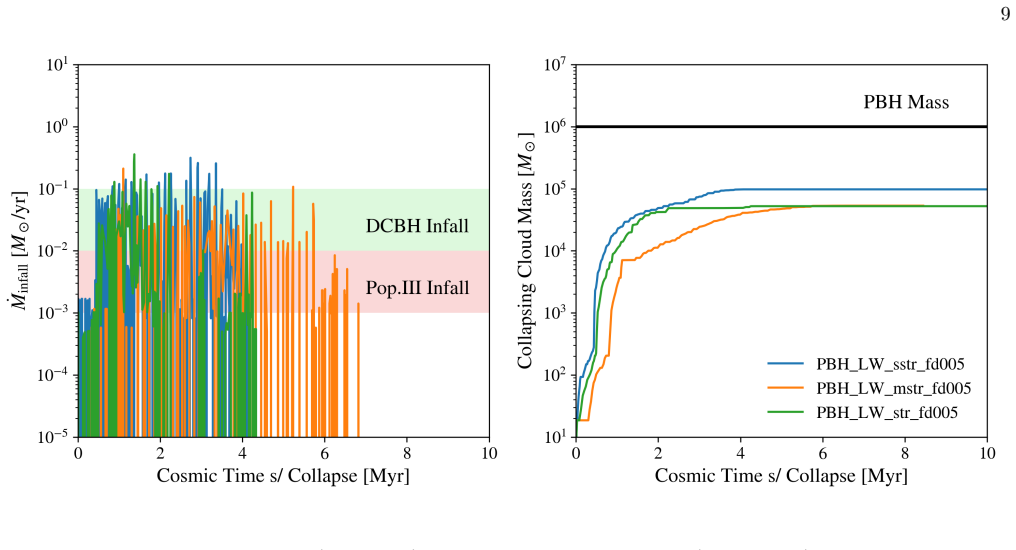
The mechanism is wake-collapse around an accreting PBH. The load-bearing pieces are the Lyman-Werner intensity fitting formula (Eq. 4), derived from ADAF and thin-disk spectral models, which dissociates H$_2$ and H$^-$ and shifts cooling to atomic hydrogen; the Bondi-Hoyle accretion scheme with a radiative-efficiency interpolation between advection-dominated and thin-disk regimes; the baryon-dark matter streaming velocity offset that displaces the gas center of mass from the PBH; and a sink-particle criterion ($n_H\gtrsim10^6\,\mathrm{cm}^{-3}$, $t_{\mathrm{survive}}\gtrsim t_{\mathrm{ff}}$) that tags collapsing cloud gas. The physical identity carrying the argument is the Jeans-rate scaling $\dot{M}_{\mathrm{infall}}\sim c_s^3/G$, which turns atomic-cooling temperatures ($\sim5000-10^4$ K) into super-Eddington inflow rates of $0.01-0.1\,M_\odot\,\mathrm{yr}^{-1}$, above the threshold for forming direct-collapse black hole seeds.
What would settle it
A radiation-hydrodynamic simulation that resolves the sub-parsec collapse and finds the atomically-cooling cloud fragments into many low-mass protostars, starving any single protostar of accretion, would remove the DCBH seed and with it the predicted $q\sim0.1$ binary.
Extended reading notes
Core claim
The central claim is that a PBH-DCBH pair naturally forms when three conditions coincide: a $\sim10^6\,M_\odot$ PBH accreting at a few percent of Eddington, Lyman-Werner radiation from its accretion flow that keeps H$_2$ abundance low, and baryon-dark matter streaming of $v_{b\chi}\gtrsim0.8\sigma_{b\chi}$. Under those conditions, the simulations produce a gravitationally unstable, atomically-cooling cloud of $\sim10^5\,M_\odot$ in the PBH wake, offset from the PBH by roughly 10 pc, with inflow rates high enough to feed a bloated supermassive star that collapses into a direct-collapse black hole. The resulting systems start with mass ratio $q\sim O(0.1)$ and separation of about 10 pc at redshift $z\sim20-10$. The paper does not simulate the final seed collapse; it establishes the conditions and argues, from infall rates and cloud masses, that DCBH formation is the expected outcome.
Load-bearing premise
The channel assumes the infalling gas feeds a single central protostar, because the simulations do not resolve the sub-parsec turbulence, radiative transfer, and angular-momentum transport that decide whether the cloud forms one supermassive star or fragments into many cores.
Editorial extensions
If this is right
- SMBH binaries can assemble in situ before galactic mergers, giving a plausible route to the massive black holes JWST sees at $z\gtrsim7$ without requiring heavy seeds from other channels.
- The predicted $q\sim0.1$, $\sim10$ pc binaries are direct search templates for ALMA and for dual-AGN signatures in Little Red Dots.
- Rapid accretion onto the secondary after formation can drive the mass ratio toward unity, so these systems may end up as strong millihertz gravitational-wave sources for LISA and TianQin.
- The collapse outcome is stochastic in streaming velocity, implying a formation rate set by the high-velocity tail of the streaming distribution rather than by the mean.
- Even if fragmentation prevents a single DCBH, the resulting dense star cluster would still produce observable extreme-mass-ratio inspirals, tidal disruption events, and intermediate-mass black hole mergers.
Reading between the lines
- One untested corollary is that this channel would also produce off-nuclear massive black holes—secondaries not at galaxy centers—which could show up as offset X-ray sources or as high-redshift electromagnetic counterparts to gravitational waves.
- The same wake-collapse logic may extend to other PBH masses: the dimensionless condition is that the PBH's Lyman-Werner bubble suppresses H$_2$ cooling while the streaming wake provides a seed overdensity, so lighter PBHs with faster accretion could be probed with the same machinery.
- A statistical prediction follows from the single-seed assumption: if this channel dominates, the secondary seed masses should cluster near $\sim10^5\,M_\odot$ with little scatter, whereas fragmentation would produce a broad low-mass distribution.
- The authors' simulation volume represents a tiny effective PBH abundance; folding the per-PBH collapse condition into a full PBH mass function would give a cosmic merger rate that could be compared directly with the LISA stochastic background.
Editorial analysis
A structured set of objections, weighed in public.
Referee Report
Summary. This paper uses cosmological hydrodynamical simulations of an isolated ~10^6 Msun primordial black hole to argue that accretion-driven Lyman-Werner feedback, combined with baryon-dark matter streaming velocities v_bchi >= 0.8 sigma_bchi, suppresses H2 cooling and triggers the collapse of atomically-cooling gas clouds into ~10^5 Msun direct-collapse black hole seeds at z ~ 20-10. The authors identify dense collapsing cores in runs with streaming 0.8-1.6 sigma, infer high gas infall rates, and interpret the ratio of the collapsing-core mass to the PBH mass as forming SMBH binaries with q ~ 0.05-0.1 and separations ~10 pc. The paper then discusses potential electromagnetic and gravitational-wave signatures, including links to Little Red Dots and LISA/TianQin sources.
Significance. If the proposed channel holds, it offers a novel in situ route to high-redshift SMBH binaries, with concrete, falsifiable predictions for mass ratios, separations, and multi-messenger observability. The manuscript is transparent about many of its limitations, builds on a well-established simulation code, and makes its initial-condition generator publicly available. However, the central quantitative predictions rest on several under-tested or unresolved ingredients: the sustained inflow-rate claim is weaker than the abstract states, the single-progenitor assumption is unresolved at sub-pc scales, and key parameters and thresholds are tested with only a single realization or a single fiducial value. The significance is therefore conditional on closing these gaps.
major comments (5)
- [§3.2, Fig. 4, Abstract] The abstract and Section 5 state that the collapsing clouds exhibit sustained inflow rates Mdot_infall >= 0.01-0.1 Msun/yr, which is the canonical DCBH threshold, but the body of Section 3.2 and Figure 4 report rates that consistently exceed ~1e-3 Msun/yr with peaks frequently surpassing ~1e-2 Msun/yr. The sustained rate is therefore an order of magnitude below the quoted critical range; only peaks reach it. This mismatch is load-bearing because the 'ideal conditions for DCBH formation' claim is the bridge from simulated clouds to supermassive stars, and the abstract currently overstates what the simulations show.
- [§3.2 and §4] The binary mass ratio q ~ 0.05-0.1 is obtained by equating the simulated collapsing-cloud mass with the mass of a single secondary black hole, under the explicit assumption that the inflow feeds a single protostar. The same section acknowledges that sub-pc processes such as turbulence, radiative transfer, and angular momentum transport are unresolved and could instead produce a rotationally supported disk or fragmentation into multiple cores; if fragmentation-induced starvation operates, the secondary mass and q are not the simulated m_col. Because Section 4 presents q ~ 0.1 and ~10 pc separations as baseline predictions, this unresolved scale is load-bearing for the central claim rather than a minor caveat.
- [§2.3] The ad hoc veto on sink formation at z>200 is introduced to avoid numerical artifacts, but no test is shown demonstrating that high-redshift dense structures are indeed spurious rather than physical collapse events. Since the proposed channel targets z ~ 20-10, the veto may not change the final conclusions, yet the paper should justify it with a resolution study or by following one vetoed event; otherwise the collapse criterion is not consistently applied.
- [§2.1, Table 1, §3.1] The threshold v_bchi >= 0.8 sigma_bchi is inferred from a single 0.4 sigma run without collapse and a single 0.8 sigma run with collapse. The paper itself notes the stochastic nature of collapse and the lack of a clear trend with streaming amplitude. With one realization per velocity, the apparent threshold could be sampling noise; multiple realizations per streaming value, or an analytic criterion, are needed to support a 'critical regime' claim.
- [Table 1, §2.2] All successful collapse runs use the fiducial thermal feedback coupling epsilon_r = 0.005; the runs that vary epsilon_r (0.05, 0.005, 0.0005) have no streaming and do not collapse, while the streaming runs hold epsilon_r fixed. Since epsilon_r is a free parameter and the paper identifies it as critical in prior work, the central result is not demonstrated to be robust to epsilon_r in the regime where collapse actually occurs.
minor comments (4)
- [Equation (4)] Please define all symbols in the equation caption and state explicitly whether J_LW is an unshielded or self-shielded intensity; the text later applies a shielding factor, but Eq. (4) appears to give unshielded values.
- [Figure 2] The blue star marking the collapsing cloud and the black dot marking the PBH are very small; larger markers or a zoomed inset would make the ~10 pc separation and the relative velocity vectors clearer.
- [References] The reference list contains two distinct 2025 entries by Zhang, Liu, and Bromm (one Zenodo, one ApJ); please use year-letter suffixes and disambiguate in the text so the reader can tell which prior work is being cited.
- [Table 1] The entries without collapse use '-' for z_col, but the footnote explaining symbols does not define '-'; please add a short definition for clarity.
Circularity Check
The q~0.1 binary prediction is the simulated cloud mass divided by the assumed PBH mass under an unresolved single-protostar assumption, and the collapse outcome relies on a fiducial feedback efficiency inherited from the authors' prior work.
-
self definitional
[Sec. 3.2 (Mass Inflow and DCBH Formation Criterion); also abstract, Sec. 4, Sec. 5]
"Comparing the mass of this collapsed core with that of the central PBH yields a mass ratio of q∼0.05–0.1, confirming the emergence of a massive binary system. ... we have assumed that the inflow feeds a single protostar. ... the sink particles do not represent individual stars but are only meant to estimate the mass of collapsing gas that would form stars and DCBHs at the limit of our resolution."
The secondary black hole is not actually simulated. In the sink-particle formalism, the future DCBH mass is defined as the accumulated collapsing-gas mass m_col, while the primary mass m_BH = 10^6 Msun is a fixed input. The reported mass ratio is therefore q = m_col/m_BH by construction, i.e., the simulated clump mass normalized by the assumed PBH mass, rather than an independent binary-dynamical prediction. The additional mapping from m_col to a single ~1e5 Msun black hole is an explicit, unresolved assumption: the paper admits that sub-pc turbulence, radiative transfer, and angular momentum transport could instead produce a disk or multiple cores, in which case the same m_col would not produce a single secondary BH and q~0.1 would not follow.
-
self citation load bearing
[Sec. 3.1, fiducial heating efficiency paragraph; Sec. 2.2; Table 1]
"we focus on conditions for DCBH formation around a fiducial heating efficiency value of ϵr ∼0.5%, previously identified by S. Zhang et al. (2025) as critical to the formation of collapsing gas clouds in the absence of L W radiation."
The successful streaming cases (PBH LW str/mstr/sstr fd005) all use ϵr = 0.005, a value described in Sec. 2.2 as a free parameter and taken from the same authors' prior work, where it was identified as critical for cloud collapse. No streaming run is presented with other ϵr values, so the claimed 'critical regime' for DCBH formation is conditional on a self-cited calibration rather than on an independently fixed physical parameter. This is a load-bearing self-citation, although the LW suppression of H2 cooling and the streaming-induced wake are independent physical ingredients, so the circularity is partial rather than complete.
full rationale
The paper's physical machinery is largely self-contained: hydrodynamical evolution around a PBH, Bondi accretion, LW feedback from external spectral fits (Takhistov et al.), and comparison of infall rates to literature DCBH thresholds are not circular. The circularity is concentrated in the headline binary prediction. The secondary object is never resolved; its mass is defined as the accumulated sink-particle mass, and the reported q~0.1 is that sink mass divided by the input 1e6 Msun PBH mass under a single-protostar assumption. Even though the cloud mass is a simulation output, the mapping from cloud mass to a single secondary BH is an input assumption, so q is not an independent prediction. The paper honestly flags sub-pc fragmentation as unresolved, but the abstract and conclusions present q~O(0.1) without that caveat. Additionally, the collapse outcome is obtained only for ϵr = 0.005, a fiducial value inherited from the same authors' prior work and described there as 'critical' to cloud collapse, so a self-citation carries a load-bearing calibration. These issues make the central quantitative claim partially circular rather than fully forced: the LW suppression of H2 and the streaming-induced wake are independent physical effects, and infall rates are checked against external benchmarks.
Assumptions & free parameters
free parameters (5)
- epsilon_r (thermal feedback coupling efficiency) =
0.005 fiducial; 0.05, 0.005, 0.0005 tested
- minimum baryon-DM streaming velocity for collapse =
>=0.8 sigma_bchi (grid: 0.4, 0.8, 1.2, 1.6)
- sink particle density threshold =
n_H >= 1e6 cm^-3
- early-collapse veto =
no sink formation at z>200
- PBH mass =
1e6 Msun
assumptions (7)
- standard math Bondi-Hoyle accretion formula (Eq. 1) governs gas accretion onto the PBH.
- domain assumption Lambda-CDM cosmology with Planck18 parameters.
- domain assumption PBHs of ~1e6 Msun exist in the early universe.
- domain assumption LW radiation from PBH accretion suppresses H2 cooling, shifting coolant to atomic hydrogen.
- ad hoc to paper The unresolved sub-pc gas inflow feeds a single protostar (SMS).
- ad hoc to paper Feedback is isotropic thermal injection with no mechanical outflows or radiative transfer.
- domain assumption Effective PBH mass fraction in the simulation is below 6e-4.
Cite this review
Pith. "Pith review of A Novel Formation Channel for Supermassive Black Hole Binaries in the Early Universe via Primordial Black Holes." pith.science (2026). https://pith.science/paper/QVTRX23S
@misc{pith2026250800774,
  author       = {Pith},
  title        = {Pith review of: A Novel Formation Channel for Supermassive Black Hole Binaries in the Early Universe via Primordial Black Holes},
  year         = {2026},
  howpublished = {\url{https://pith.science/paper/QVTRX23S}},
  note         = {Machine review of arXiv:2508.00774}
}
abstract
We present a novel formation channel for supermassive black hole (SMBH) binaries in the early Universe, driven by primordial black holes (PBHs). Using high-resolution hydrodynamical simulations, we explore the role of massive PBHs ($m_{BH} \sim 10^6 M_\odot$) in catalyzing the formation of direct-collapse black holes (DCBHs), providing a natural in situ pathway for binary SMBH formation. PBHs enhance local overdensities, accelerate structure formation, and exert thermal feedback on the surrounding medium via accretion. Lyman-Werner (LW) radiation from accreting PBHs suppresses H$2$ cooling, shifting the dominant gas coolant to atomic hydrogen. When combined with significant baryon-dark matter streaming velocities ($v_{b\chi} \gtrsim 0.8 \sigma_{b\chi}$, where $\sigma_{b\chi}$ is the root-mean-square streaming velocity), these effects facilitate the formation of dense, gravitationally unstable, atomically cooling gas clouds in the PBH's wake. These clouds exhibit sustained high inflow rates ($\dot{M}_{infall} \gtrsim 0.01 - 0.1 M_\odot yr^{-1}$), providing ideal conditions for DCBH formation from rapidly growing supermassive stars of $\sim 10^5 M_\odot$ at redshifts $z \sim 20 - 10$. The resulting systems form SMBH binaries with initial mass ratios $q \sim O(0.1)$ and separations of $\sim 10$ pc. Such PBH-DCBH binaries provide testable predictions for JWST and ALMA, potentially explaining select high-$z$ sources such as the Little Red Dots (LRDs), and represent gravitational-wave sources for future missions like LISA and TianQin-bridging early-Universe black hole physics, multi-messenger astronomy, and dark matter theory.
Figures


Figures from the paper (1 more)
Forward citations
Cited by 3 Pith papers
-
ATLAS. II. Extremely High Incidence of Balmer Line Absorption with Predominant Blueshifts in LRDs: Statistical Insights through Comparison with Type 1 AGNs
Balmer-line absorption occurs in ~35% (14/40) of JWST little-red-dot AGNs, roughly 850x the rate in SDSS type-1 AGNs, with mostly slow blueshifted absorber velocities.
-
Fuzzy dark matter soliton core hosting a supermassive black hole as a dense low-mass perturber in strong gravitational lensing
A soliton core of fuzzy dark matter, compressed by an embedded supermassive black hole, reproduces the observed mass profile of the ~10^6 Msun perturber in JVAS B1938+666 for FDM mass ~3.6e-21 eV and subhalo mass ~7e6 Msun.
-
Inflation driven by repulsive-like primordial black holes
Repulsive-like primordial black holes in the Swiss-cheese framework produce quasi-de Sitter expansion, enabling inflation with evaporation reheating and acting as early dark energy for certain masses and densities.
Reference graph
Works this paper leans on
-
[1]
Abel, T., Anninos, P., Zhang, Y., & Norman, M. L. 1997, NewA, 2, 181, doi: 10.1016/S1384-1076(97)00010-9
-
[2]
Afshordi, N., McDonald, P., & Spergel, D. N. 2003, ApJL, 594, L71, doi: 10.1086/378763
doi:10.1086/378763 2003
-
[3]
2016, MNRAS, 459, 4209, doi: 10.1093/mnras/stw929
Khochfar, S. 2016, MNRAS, 459, 4209, doi: 10.1093/mnras/stw929
-
[4]
Agazie, G., Anumarlapudi, A., Archibald, A. M., et al. 2023, ApJL, 951, L50, doi: 10.3847/2041-8213/ace18a Ali-Ha ¨ ımoud, Y., & Kamionkowski, M. 2017, PhRvD, 95, 043534, doi: 10.1103/PhysRevD.95.043534
-
[5]
Amaro-Seoane, P., Audley, H., Babak, S., et al. 2017, arXiv e-prints, arXiv:1702.00786, doi: 10.48550/arXiv.1702.00786 Astropy Collaboration, Robitaille, T. P., Tollerud, E. J., et al. 2013, A&A, 558, A33, doi: 10.1051/0004-6361/201322068 Astropy Collaboration, Price-Whelan, A. M., Sip˝ ocz, B. M., et al. 2018, AJ, 156, 123, doi: 10.3847/1538-3881/aabc4f ...
-
[6]
Becerra, F., Marinacci, F., Bromm, V., & Hernquist, L. E. 2018a, MNRAS, 480, 5029, doi: 10.1093/mnras/sty2210
-
[7]
Hernquist, L. E. 2018b, ApJ, 857, 138, doi: 10.3847/1538-4357/aab8f4
-
[8]
Begelman, M. C., Blandford, R. D., & Rees, M. J. 1980, Nature, 287, 307, doi: 10.1038/287307a0
doi:10.1038/287307a0 1980
Show all 141 references
-
[10]
M., Dokuchaev, V
Belotsky, K. M., Dokuchaev, V. I., Eroshenko, Y. N., et al. 2019, Eur. Phys. J. C, 79, 246, doi: 10.1140/epjc/s10052-019-6741-4 Bogd´ an,´A., Goulding, A. D., Natarajan, P., et al. 2024, Nature Astronomy, 8, 126, doi: 10.1038/s41550-023-02111-9
2019 doi
-
[11]
2013, Reports on Progress in Physics, 76, 112901, doi: 10.1088/0034-4885/76/11/112901
Bromm, V. 2013, Reports on Progress in Physics, 76, 112901, doi: 10.1088/0034-4885/76/11/112901
2013 doi
-
[12]
S., & Larson, R
Bromm, V., Coppi, P. S., & Larson, R. B. 2002, ApJ, 564, 23, doi: 10.1086/323947
2002 doi
-
[13]
2003, ApJ, 596, 34, doi: 10.1086/377529
Bromm, V., & Loeb, A. 2003, ApJ, 596, 34, doi: 10.1086/377529
2003 doi
-
[14]
2022, ApJ, 926, 205, doi: 10.3847/1538-4357/ac332d
Cappelluti, N., Hasinger, G., & Natarajan, P. 2022, ApJ, 926, 205, doi: 10.3847/1538-4357/ac332d
2022 doi
-
[15]
2021a, Physics of the Dark Universe, 31, 100755, doi: 10.1016/j.dark.2020.100755
Carr, B., Clesse, S., Garc ´ ıa-Bellido, J., & K¨ uhnel, F. 2021a, Physics of the Dark Universe, 31, 100755, doi: 10.1016/j.dark.2020.100755
2020
-
[16]
2021b, Reports on Progress in Physics, 84, 116902, doi: 10.1088/1361-6633/ac1e31
Carr, B., Kohri, K., Sendouda, Y., & Yokoyama, J. 2021b, Reports on Progress in Physics, 84, 116902, doi: 10.1088/1361-6633/ac1e31
-
[17]
2020, Annual Review of Nuclear and Particle Science, 70, 355, doi: 10.1146/annurev-nucl-050520-125911
Carr, B., & K¨ uhnel, F. 2020, Annual Review of Nuclear and Particle Science, 70, 355, doi: 10.1146/annurev-nucl-050520-125911
2020 doi
-
[18]
2018, MNRAS, 478, 3756, doi: 10.1093/mnras/sty1204
Carr, B., & Silk, J. 2018, MNRAS, 478, 3756, doi: 10.1093/mnras/sty1204
2018 doi
-
[19]
Carr, B. J. 1975, ApJ, 201, 1, doi: 10.1086/153853
1975 doi
-
[20]
B., Liu, B., & Bromm, V
Casanueva-Villarreal, C., Padilla, N., Tissera, P. B., Liu, B., & Bromm, V. 2025, A&A, 699, A49, doi: 10.1051/0004-6361/202554032
2025 doi
-
[21]
L., & Ben-Dayan, I
Chluba, J., Erickcek, A. L., & Ben-Dayan, I. 2012, ApJ, 758, 76, doi: 10.1088/0004-637X/758/2/76
2012 doi
-
[22]
H., Aghanim, N., et al
Chluba, J., Abitbol, M. H., Aghanim, N., et al. 2021, Experimental Astronomy, 51, 1515, doi: 10.1007/s10686-021-09729-5
2021 doi
-
[23]
2020, MNRAS, 494, 2851, doi: 10.1093/mnras/staa863
Chon, S., & Omukai, K. 2020, MNRAS, 494, 2851, doi: 10.1093/mnras/staa863
2020 doi
-
[24]
2025, MNRAS, 539, 2561, doi: 10.1093/mnras/staf598
Chon, S., & Omukai, K. 2025, MNRAS, 539, 2561, doi: 10.1093/mnras/staf598
2025 doi
-
[25]
E., Stasyszyn, F., & Padilla, N
Colazo, P. E., Stasyszyn, F., & Padilla, N. 2024, A&A, 685, L8, doi: 10.1051/0004-6361/202449565
2024 doi
- [26]
-
[27]
2025, arXiv e-prints, arXiv:2506.08116, doi: 10.48550/arXiv.2506.08116 De Luca, V., Desjacques, V., Franciolini, G., Malhotra, A., & Riotto, A
Dayal, P., & Maiolino, R. 2025, arXiv e-prints, arXiv:2506.08116, doi: 10.48550/arXiv.2506.08116 De Luca, V., Desjacques, V., Franciolini, G., Malhotra, A., & Riotto, A. 2019, JCAP, 2019, 018, doi: 10.1088/1475-7516/2019/05/018 De Luca, V., Franciolini, G., Pani, P., & Riotto,...
2025 doi
-
[28]
2018, ApJS, 239, 35, doi: 10.3847/1538-4365/aaee8c
Diemer, B. 2018, ApJS, 239, 35, doi: 10.3847/1538-4365/aaee8c
2018 doi
-
[29]
T., & Bertoldi, F
Draine, B. T., & Bertoldi, F. 1996, ApJ, 468, 269, doi: 10.1086/177689 EPTA Collaboration, InPTA Collaboration, Antoniadis, J., et al. 2023, A&A, 678, A50, doi: 10.1051/0004-6361/202346844 Escriv` a, A. 2022, Universe, 8, 66, doi: 10.3390/universe8020066
1996 doi
-
[30]
2013, ApJL, 777, L14, doi: 10.1088/2041-8205/777/1/L14
Fiacconi, D., Mayer, L., Roˇ skar, R., & Colpi, M. 2013, ApJL, 777, L14, doi: 10.1088/2041-8205/777/1/L14
2013 doi
-
[31]
Fragione, G., Loeb, A., Kocsis, B., & Rasio, F. A. 2022, ApJ, 933, 170, doi: 10.3847/1538-4357/ac75d0
2022 doi
-
[32]
2013, ARA&A, 51, 163, doi: 10.1146/annurev-astro-082812-141029
Galli, D., & Palla, F. 2013, ARA&A, 51, 163, doi: 10.1146/annurev-astro-082812-141029
2013 doi
-
[33]
D., Greene, J
Goulding, A. D., Greene, J. E., Setton, D. J., et al. 2023, ApJL, 955, L24, doi: 10.3847/2041-8213/acf7c5
2023 doi
-
[34]
E., Labbe, I., Goulding, A
Greene, J. E., Labbe, I., Goulding, A. D., et al. 2024, ApJ, 964, 39, doi: 10.3847/1538-4357/ad1e5f Haemmerl´ e, L. 2021, A&A, 647, A83, doi: 10.1051/0004-6361/202039686 Haemmerl´ e, L., Woods, T. E., Klessen, R. S., Heger, A., &
2024 doi
-
[35]
Whalen, D. J. 2018, MNRAS, 474, 2757, doi: 10.1093/mnras/stx2919
2018 doi
-
[37]
1971, Monthly Notices of the Royal Astronomical Society, 152, 75
Hawking, S. 1971, Monthly Notices of the Royal Astronomical Society, 152, 75
1971
-
[38]
P., Whalen, D
Herrington, N. P., Whalen, D. J., & Woods, T. E. 2023, MNRAS, 521, 463, doi: 10.1093/mnras/stad572
2023 doi
-
[39]
Hirano, S., Yoshida, N., Sakurai, Y., & Fujii, M. S. 2018, ApJ, 855, 17, doi: 10.3847/1538-4357/aaaaba
2018 doi
-
[40]
Hirano, S., Zhu, N., Yoshida, N., Spergel, D., & Yorke, H. W. 2015, ApJ, 814, 18, doi: 10.1088/0004-637X/814/1/18
2015 doi
-
[41]
2017, National Science Review, 4, 707, doi: 10.1093/nsr/nwx126 13
Hobbs, G., & Dai, S. 2017, National Science Review, 4, 707, doi: 10.1093/nsr/nwx126 13
2017 doi
-
[42]
2024, JCAP, 2024, 021, doi: 10.1088/1475-7516/2024/04/021
Hooper, D., Ireland, A., Krnjaic, G., & Stebbins, A. 2024, JCAP, 2024, 021, doi: 10.1088/1475-7516/2024/04/021
2024 doi
-
[43]
Hopkins, P. F. 2015, MNRAS, 450, 53, doi: 10.1093/mnras/stv195
2015 doi
-
[44]
2013, ApJ, 778, 178, doi: 10.1088/0004-637X/778/2/178
Yoshida, N. 2013, ApJ, 778, 178, doi: 10.1088/0004-637X/778/2/178
2013 doi
-
[45]
2024, PhRvD, 110, 103540, doi: 10.1103/PhysRevD.110.103540
Huang, H.-L., Jiang, J.-Q., & Piao, Y.-S. 2024, PhRvD, 110, 103540, doi: 10.1103/PhysRevD.110.103540
2024 doi
-
[46]
2018, ApJL, 863, L36, doi: 10.3847/2041-8213/aad8ad
Inayoshi, K., Ichikawa, K., & Haiman, Z. 2018, ApJL, 863, L36, doi: 10.3847/2041-8213/aad8ad
2018 doi
-
[47]
2024, ApJ, 966, 164, doi: 10.3847/1538-4357/ad344c
Inayoshi, K., Kashiyama, K., Li, W., et al. 2024, ApJ, 966, 164, doi: 10.3847/1538-4357/ad344c
2024 doi
-
[48]
2014, MNRAS, 445, L109, doi: 10.1093/mnrasl/slu151
Inayoshi, K., Omukai, K., & Tasker, E. 2014, MNRAS, 445, L109, doi: 10.1093/mnrasl/slu151
2014 doi
- [49]
-
[50]
2020, ARA&A, 58, 27, doi: 10.1146/annurev-astro-120419-014455
Inayoshi, K., Visbal, E., & Haiman, Z. 2020, ARA&A, 58, 27, doi: 10.1146/annurev-astro-120419-014455
2020 doi
-
[51]
2019, PhRvD, 100, 083528, doi: 10.1103/PhysRevD.100.083528
Inman, D., & Ali-Ha ¨ ımoud, Y. 2019, PhRvD, 100, 083528, doi: 10.1103/PhysRevD.100.083528
2019 doi
-
[52]
2024, PASJ, 76, 850, doi: 10.1093/pasj/psae054
Ito, M., & Omukai, K. 2024, PASJ, 76, 850, doi: 10.1093/pasj/psae054
2024 doi
-
[53]
2024, PhRvD, 109, 123524, doi: 10.1103/PhysRevD.109.123524
Jiao, H., Brandenberger, R., & Refregier, A. 2024, PhRvD, 109, 123524, doi: 10.1103/PhysRevD.109.123524
2024 doi
-
[55]
2021, PhRvL, 126, 011101, doi: 10.1103/PhysRevLett.126.011101
Kashlinsky, A. 2021, PhRvL, 126, 011101, doi: 10.1103/PhysRevLett.126.011101
2021 doi
-
[56]
2019, PhRvD, 100, 103521, doi: 10.1103/PhysRevD.100.103521
Kawasaki, M., & Murai, K. 2019, PhRvD, 100, 103521, doi: 10.1103/PhysRevD.100.103521
2019 doi
-
[57]
S., & Glover, S
Klessen, R. S., & Glover, S. C. O. 2023, ARA&A, 61, 65, doi: 10.1146/annurev-astro-071221-053453
2023 doi
-
[58]
D., Finkelstein, S
Kocevski, D. D., Finkelstein, S. L., Barro, G., et al. 2025, ApJ, 986, 126, doi: 10.3847/1538-4357/adbc7d
2025 doi
-
[59]
2025, JCAP, 2025, 020, doi: 10.1088/1475-7516/2025/04/020
Kogut, A., Aghanim, N., Chluba, J., et al. 2025, JCAP, 2025, 020, doi: 10.1088/1475-7516/2025/04/020
2025 doi
-
[60]
2022, PhRvD, 106, 043539, doi: 10.1103/PhysRevD.106.043539
Kohri, K., Sekiguchi, T., & Wang, S. 2022, PhRvD, 106, 043539, doi: 10.1103/PhysRevD.106.043539
2022 doi
-
[61]
I., Greene, J
Kokorev, V., Caputi, K. I., Greene, J. E., et al. 2024, ApJ, 968, 38, doi: 10.3847/1538-4357/ad4265 Kov´ acs, O. E., Bogd´ an,´A., Natarajan, P., et al. 2024, ApJL, 965, L21, doi: 10.3847/2041-8213/ad391f Labb´ e, I., van Dokkum, P., Nelson, E., et al. 2023, Nature, 616, 266, ...
2024 doi
-
[62]
E., Bezanson, R., et al
Labbe, I., Greene, J. E., Bezanson, R., et al. 2025, ApJ, 978, 92, doi: 10.3847/1538-4357/ad3551
2025 doi
-
[63]
L., Finkelstein, S
Larson, R. L., Finkelstein, S. L., Kocevski, D. D., et al. 2023, ApJL, 953, L29, doi: 10.3847/2041-8213/ace619
2023 doi
-
[64]
A., Khochfar, S., Schleicher, D., & Whalen, D
Latif, M. A., Khochfar, S., Schleicher, D., & Whalen, D. J. 2021, MNRAS, 508, 1756, doi: 10.1093/mnras/stab2708
2021 doi
-
[65]
A., Khochfar, S., & Whalen, D
Latif, M. A., Khochfar, S., & Whalen, D. 2020, ApJL, 892, L4, doi: 10.3847/2041-8213/ab7c61
2020 doi
-
[66]
A., Whalen, D
Latif, M. A., Whalen, D. J., Khochfar, S., Herrington, N. P., & Woods, T. E. 2022, Nature, 607, 48, doi: 10.1038/s41586-022-04813-y
2022 doi
-
[67]
Leung, G. C. K., Finkelstein, S. L., P´ erez-Gonz´ alez, P. G., et al. 2024, arXiv e-prints, arXiv:2411.12005. https://arxiv.org/abs/2411.12005
2024 arXiv
-
[68]
2025, Reports on Progress in Physics, 88, 056901, doi: 10.1088/1361-6633/adc9be
Li, E.-K., Liu, S., Torres-Orjuela, A., et al. 2025, Reports on Progress in Physics, 88, 056901, doi: 10.1088/1361-6633/adc9be
2025 doi
-
[69]
2018, MNRAS, 476, 1826, doi: 10.1093/mnras/sty350
Liu, B., & Bromm, V. 2018, MNRAS, 476, 1826, doi: 10.1093/mnras/sty350
2018 doi
-
[70]
2022, ApJL, 937, L30, doi: 10.3847/2041-8213/ac927f
Liu, B., & Bromm, V. 2022, ApJL, 937, L30, doi: 10.3847/2041-8213/ac927f
2022 doi
- [71]
-
[72]
2024, MNRAS, 534, 290, doi: 10.1093/mnras/stae2066
Liu, B., Gurian, J., Inayoshi, K., et al. 2024, MNRAS, 534, 290, doi: 10.1093/mnras/stae2066
2024 doi
-
[73]
2022, MNRAS, 514, 2376, doi: 10.1093/mnras/stac1472
Liu, B., Zhang, S., & Bromm, V. 2022, MNRAS, 514, 2376, doi: 10.1093/mnras/stac1472
2022 doi
-
[74]
Liu, S., Wang, L., Hu, Y.-M., Tanikawa, A., & Trani, A. A. 2024, MNRAS, 533, 2262, doi: 10.1093/mnras/stae1946
2024 doi
-
[75]
2006, MNRAS, 371, 1813, doi: 10.1111/j.1365-2966.2006.10801.x
Lodato, G., & Natarajan, P. 2006, MNRAS, 371, 1813, doi: 10.1111/j.1365-2966.2006.10801.x
2006
-
[76]
Loeb, A., & Rasio, F. A. 1994, ApJ, 432, 52, doi: 10.1086/174548
1994 doi
-
[77]
B., et al
Lu, P., Takhistov, V., Gelmini, G. B., et al. 2021, ApJL, 908, L23, doi: 10.3847/2041-8213/abdcb6
2021 doi
-
[78]
Lu, Y., Picker, Z. S. C., & Kusenko, A. 2024, PhRvD, 109, 123016, doi: 10.1103/PhysRevD.109.123016
2024 doi
-
[79]
2016, Classical and Quantum Gravity, 33, 035010, doi: 10.1088/0264-9381/33/3/035010
Luo, J., Chen, L.-S., Duan, H.-Z., et al. 2016, Classical and Quantum Gravity, 33, 035010, doi: 10.1088/0264-9381/33/3/035010
2016 doi
-
[80]
F., Ma, X., et al
Ma, L., Hopkins, P. F., Ma, X., et al. 2021, MNRAS, 508, 1973, doi: 10.1093/mnras/stab2713
2021 doi
-
[81]
J., Ostriker, J
Mack, K. J., Ostriker, J. P., & Ricotti, M. 2007, ApJ, 665, 1277, doi: 10.1086/518998
2007 doi
-
[82]
2024, A&A, 691, A145, doi: 10.1051/0004-6361/202347640
Maiolino, R., Scholtz, J., Curtis-Lake, E., et al. 2024, A&A, 691, A145, doi: 10.1051/0004-6361/202347640
2024 doi
- [83]
-
[84]
2024, ApJL, 965, L4, doi: 10.3847/2041-8213/ad35c7
Matsuoka, Y., Izumi, T., Onoue, M., et al. 2024, ApJL, 965, L4, doi: 10.3847/2041-8213/ad35c7
2024 doi
-
[85]
2025, arXiv e-prints, arXiv:2503.18850, doi: 10.48550/arXiv.2503.18850 14
Matteri, A., Ferrara, A., & Pallottini, A. 2025, arXiv e-prints, arXiv:2503.18850, doi: 10.48550/arXiv.2503.18850 14
2025 doi
-
[86]
P., Brammer, G., et al
Matthee, J., Naidu, R. P., Brammer, G., et al. 2024, ApJ, 963, 129, doi: 10.3847/1538-4357/ad2345
2024 doi
-
[87]
1975, A&A, 38, 5 Milosavljevi´ c, M., & Merritt, D
Meszaros, P. 1975, A&A, 38, 5 Milosavljevi´ c, M., & Merritt, D. 2003a, in American Institute of Physics Conference Series, Vol. 686, The Astrophysics of Gravitational Wave Sources, ed. J. M. Centrella (AIP), 201–210, doi: 10.1063/1.1629432 Milosavljevi´ c, M., & Merritt, D. 2...
1975 doi
-
[88]
2020, JCAP, 2020, 017, doi: 10.1088/1475-7516/2020/03/017
Mirbabayi, M., Gruzinov, A., & Nore˜ na, J. 2020, JCAP, 2020, 017, doi: 10.1088/1475-7516/2020/03/017
2020 doi
-
[89]
2022, MNRAS, 517, 1584, doi: 10.1093/mnras/stac2495
Sumiyoshi, K. 2022, MNRAS, 517, 1584, doi: 10.1093/mnras/stac2495
2022 doi
-
[90]
2018, PhRvD, 97, 043525, doi: 10.1103/PhysRevD.97.043525
Nakama, T., Carr, B., & Silk, J. 2018, PhRvD, 97, 043525, doi: 10.1103/PhysRevD.97.043525
2018 doi
-
[91]
2023, ApJL, 955, L27, doi: 10.3847/2041-8213/acf8c9
Naoz, S., & Haiman, Z. 2023, ApJL, 955, L27, doi: 10.3847/2041-8213/acf8c9
2023 doi
-
[92]
2025, ApJ, 989, 75, doi: 10.3847/1538-4357/ade706
Napolitano, L., Castellano, M., Pentericci, L., et al. 2025, ApJ, 989, 75, doi: 10.3847/1538-4357/ade706
2025 doi
-
[93]
2024, ApJL, 960, L1, doi: 10.3847/2041-8213/ad0e76
Natarajan, P., Pacucci, F., Ricarte, A., et al. 2024, ApJL, 960, L1, doi: 10.3847/2041-8213/ad0e76
2024 doi
-
[94]
2017, MNRAS, 467, 3475, doi: 10.1093/mnras/stx362
Negri, A., & Volonteri, M. 2017, MNRAS, 467, 3475, doi: 10.1093/mnras/stx362
2017 doi
-
[95]
P., & Haiman, Z
Oh, S. P., & Haiman, Z. 2002, ApJ, 569, 558, doi: 10.1086/339393 Planck Collaboration, Aghanim, N., Akrami, Y., et al. 2020, A&A, 641, A6, doi: 10.1051/0004-6361/201833910 Popovi´ c, L.ˇC. 2012, NewAR, 56, 74, doi: 10.1016/j.newar.2011.11.001
2002 doi
-
[96]
T., Lesgourgues, J., & Sharma, D
Pritchard, X., Byrnes, C. T., Lesgourgues, J., & Sharma, D. 2025, JCAP, 07, 079, doi: 10.1088/1475-7516/2025/07/079
2025 doi
-
[97]
R., Clark, P
Prole, L. R., Clark, P. C., Klessen, R. S., Glover, S. C. O., & Pakmor, R. 2022, MNRAS, 516, 2223, doi: 10.1093/mnras/stac2327
2022 doi
- [98]
- [99]
-
[100]
J., Zic, A., Shannon, R
Reardon, D. J., Zic, A., Shannon, R. M., et al. 2023, ApJL, 951, L6, doi: 10.3847/2041-8213/acdd02
2023 doi
-
[101]
2024, The Open Journal of Astrophysics, 7, 72, doi: 10.33232/001c.123239
Regan, J., & Volonteri, M. 2024, The Open Journal of Astrophysics, 7, 72, doi: 10.33232/001c.123239
2024 doi
-
[102]
A., Wise, J
Regan, J. A., Wise, J. H., Woods, T. E., et al. 2020, The Open Journal of Astrophysics, 3, 15, doi: 10.21105/astro.2008.08090
2020
-
[103]
S., Schleicher, D., Glover, S
Reinoso, B., Klessen, R. S., Schleicher, D., Glover, S. C. O., & Solar, P. 2023, MNRAS, 521, 3553, doi: 10.1093/mnras/stad790
2023 doi
-
[104]
D., Abdikamalov, E., et al
Reisswig, C., Ott, C. D., Abdikamalov, E., et al. 2013, PhRvL, 111, 151101, doi: 10.1103/PhysRevLett.111.151101
2013 doi
-
[105]
P., & Mack, K
Ricotti, M., Ostriker, J. P., & Mack, K. J. 2008, ApJ, 680, 829, doi: 10.1086/587831
2008 doi
-
[106]
H., & Miller, M
Roedig, C., Krolik, J. H., & Miller, M. C. 2014, ApJ, 785, 115, doi: 10.1088/0004-637X/785/2/115
2014 doi
-
[107]
D., & Cornish, N
Romano, J. D., & Cornish, N. J. 2017, Living Reviews in Relativity, 20, 2, doi: 10.1007/s41114-017-0004-1
2017 doi
-
[108]
S., & Hirano, S
Sakurai, Y., Yoshida, N., Fujii, M. S., & Hirano, S. 2017, MNRAS, 472, 1677, doi: 10.1093/mnras/stx2044
2017 doi
-
[109]
2018, Classical and Quantum Gravity, 35, 063001, doi: 10.1088/1361-6382/aaa7b4
Sasaki, M., Suyama, T., Tanaka, T., & Yokoyama, S. 2018, Classical and Quantum Gravity, 35, 063001, doi: 10.1088/1361-6382/aaa7b4
2018 doi
-
[110]
Schauer, A. T. P., Boylan-Kolchin, M., Colston, K., et al. 2023, ApJ, 950, 20, doi: 10.3847/1538-4357/accc2c
2023 doi
-
[111]
2019, MNRAS, 484, 3510, doi: 10.1093/mnras/stz013
Ceverino, D. 2019, MNRAS, 484, 3510, doi: 10.1093/mnras/stz013
2019 doi
-
[112]
Schauer, A. T. P., Regan, J., Glover, S. C. O., & Klessen, R. S. 2017, MNRAS, 471, 4878, doi: 10.1093/mnras/stx1915
2017 doi
-
[113]
2013, MNRAS, 433, L1, doi: 10.1093/mnrasl/slt034
Sesana, A. 2013, MNRAS, 433, L1, doi: 10.1093/mnrasl/slt034
2013 doi
-
[114]
2025, ApJ, 978, 58, doi: 10.3847/1538-4357/ad93a4
Shibata, M., Fujibayashi, S., Jockel, C., & Kawaguchi, K. 2025, ApJ, 978, 58, doi: 10.3847/1538-4357/ad93a4
2025 doi
-
[115]
Shibata, M., & Shapiro, S. L. 2002, ApJL, 572, L39, doi: 10.1086/341516
2002 doi
-
[116]
2013, ApJ, 772, 112, doi: 10.1088/0004-637X/772/2/112
Silk, J. 2013, ApJ, 772, 112, doi: 10.1088/0004-637X/772/2/112
2013 doi
-
[117]
A., Reinoso, B., Schleicher, D
Solar, P. A., Reinoso, B., Schleicher, D. R. G., Klessen, R. S., & Banerjee, R. 2025, A&A, 699, A64, doi: 10.1051/0004-6361/202450903
2025 doi
-
[118]
2005, MNRAS, 364, 1105, doi: 10.1111/j.1365-2966.2005.09655.x
Springel, V. 2005, MNRAS, 364, 1105, doi: 10.1111/j.1365-2966.2005.09655.x
2005
-
[119]
2011, ApJL, 730, L1, doi: 10.1088/2041-8205/730/1/L1
Stacy, A., Bromm, V., & Loeb, A. 2011, ApJL, 730, L1, doi: 10.1088/2041-8205/730/1/L1
2011 doi
-
[120]
W., Shu, F
Stahler, S. W., Shu, F. H., & Taam, R. E. 1980, ApJ, 241, 637, doi: 10.1086/158377
1980 doi
-
[121]
Suazo, M., Prieto, J., Escala, A., & Schleicher, D. R. G. 2019, ApJ, 885, 127, doi: 10.3847/1538-4357/ab45eb
2019 doi
-
[122]
Sugimura, K., Omukai, K., & Inoue, A. K. 2014, MNRAS, 445, 544, doi: 10.1093/mnras/stu1778
2014 doi
-
[123]
B., et al
Takhistov, V., Lu, P., Gelmini, G. B., et al. 2022, JCAP, 2022, 017, doi: 10.1088/1475-7516/2022/03/017
2022 doi
-
[124]
J., Finkelstein, S
Taylor, A. J., Finkelstein, S. L., Kocevski, D. D., et al. 2025, ApJ, 986, 165, doi: 10.3847/1538-4357/add15b 15
2025 doi
-
[125]
2021, ApJ, 907, 74, doi: 10.3847/1538-4357/abcfc2
Toyouchi, D., Inayoshi, K., Hosokawa, T., & Kuiper, R. 2021, ApJ, 907, 74, doi: 10.3847/1538-4357/abcfc2
2021 doi
-
[126]
2023, MNRAS, 518, 1601, doi: 10.1093/mnras/stac3191
Toyouchi, D., Inayoshi, K., Li, W., Haiman, Z., & Kuiper, R. 2023, MNRAS, 518, 1601, doi: 10.1093/mnras/stac3191
2023 doi
-
[127]
2017, MNRAS, 470, 1121
Tremmel, M., Karcher, M., Governato, F., et al. 2017, MNRAS, 470, 1121
2017
-
[128]
2022, MNRAS, 511, 616, doi: 10.1093/mnras/stac062 ¨Ubler, H., Maiolino, R., P´ erez-Gonz´ alez, P
Trinca, A., Schneider, R., Valiante, R., et al. 2022, MNRAS, 511, 616, doi: 10.1093/mnras/stac062 ¨Ubler, H., Maiolino, R., P´ erez-Gonz´ alez, P. G., et al. 2024, MNRAS, 531, 355, doi: 10.1093/mnras/stae943
2022 doi
-
[129]
J., & Byrd, G
Valtaoja, L., Valtonen, M. J., & Byrd, G. G. 1989, ApJ, 343, 47, doi: 10.1086/167683
1989 doi
-
[130]
2022, MNRAS, 515, 5106, doi: 10.1093/mnras/stac2043
Wang, L., Tanikawa, A., & Fujii, M. 2022, MNRAS, 515, 5106, doi: 10.1093/mnras/stac2043
2022 doi
-
[131]
2025, arXiv e-prints, arXiv:2504.18144, doi: 10.48550/arXiv.2504.18144
Wang, Z., Ma, Y., Li, Y., et al. 2025, arXiv e-prints, arXiv:2504.18144, doi: 10.48550/arXiv.2504.18144
2025 doi
-
[132]
2022, PhRvD, 106, 103010, doi: 10.1103/PhysRevD.106.103010
Haiman, Z. 2022, PhRvD, 106, 103010, doi: 10.1103/PhysRevD.106.103010
2022 doi
-
[133]
White, S. D. M., & Frenk, C. S. 1991, ApJ, 379, 52, doi: 10.1086/170483
1991 doi
-
[134]
White, S. D. M., & Rees, M. J. 1978, MNRAS, 183, 341, doi: 10.1093/mnras/183.3.341
1978 doi
-
[135]
Wolcott-Green, J., Haiman, Z., & Bryan, G. L. 2011, MNRAS, 418, 838, doi: 10.1111/j.1365-2966.2011.19538.x
2011
-
[136]
E., Patrick, S., Whalen, D
Woods, T. E., Patrick, S., Whalen, D. J., & Heger, A. 2024, ApJ, 960, 59, doi: 10.3847/1538-4357/ad054a
2024 doi
-
[137]
E., Agarwal, B., Bromm, V., et al
Woods, T. E., Agarwal, B., Bromm, V., et al. 2019, PASA, 36, e027, doi: 10.1017/pasa.2019.14
2019 doi
-
[138]
2023, Research in Astronomy and Astrophysics, 23, 075024, doi: 10.1088/1674-4527/acdfa5 Zel’dovich, Y
Xu, H., Chen, S., Guo, Y., et al. 2023, Research in Astronomy and Astrophysics, 23, 075024, doi: 10.1088/1674-4527/acdfa5 Zel’dovich, Y. B. 1970, A&A, 5, 84 Zel’dovich, Y. B., & Novikov, I. D. 1967, Soviet Ast., 10, 602
2023 doi
-
[139]
2024a, ApJ, 975, 139, doi: 10.3847/1538-4357/ad7b0d
Zhang, S., Bromm, V., & Liu, B. 2024a, ApJ, 975, 139, doi: 10.3847/1538-4357/ad7b0d
-
[140]
2024b, MNRAS, 528, 180, doi: 10.1093/mnras/stad3986
Zhang, S., Liu, B., & Bromm, V. 2024b, MNRAS, 528, 180, doi: 10.1093/mnras/stad3986
-
[141]
2025, Zenodo, doi: 10.5281/zenodo.17025634
Zhang, S., Liu, B., & Bromm, V. 2025, Zenodo, doi: 10.5281/zenodo.17025634
2025 doi
-
[142]
2025, ApJ, 987, 185, doi: 10.3847/1538-4357/adddb4
Zhang, S., Liu, B., Bromm, V., et al. 2025, ApJ, 987, 185, doi: 10.3847/1538-4357/adddb4
2025 doi
-
[143]
2025, JCAP, 2025, 040, doi: 10.1088/1475-7516/2025/04/040
Ziparo, F., Gallerani, S., & Ferrara, A. 2025, JCAP, 2025, 040, doi: 10.1088/1475-7516/2025/04/040
2025 doi
-
[144]
2022, MNRAS, 517, 1086, doi: 10.1093/mnras/stac2705
Ziparo, F., Gallerani, S., Ferrara, A., & Vito, F. 2022, MNRAS, 517, 1086, doi: 10.1093/mnras/stac2705
2022 doi
Reviewed August 6, 2026 · model on record in the stance chip above.
Discussion (0). Sign in to comment.