REVIEW 2 major objections 4 minor 1 cited by
Classification of polyhedral graphs by numbers of common neighbours
T0 review · 2 major / 4 minor · reviewed 2026-08-06 · deepseek-v4-flash
Pith's one-line read The paper proves a complete three-way classification of polyhedra by their sets of common-neighbour counts.
desk verdict A credible and substantial classification of polyhedral graphs by common-neighbour sets, with one unshipped finite enumeration worth verifying before acceptance. read the letter →
The pith
A machine-rendered reading of the paper's core claim, the machinery that carries it, and where it could break.
The reading
What carries the argument
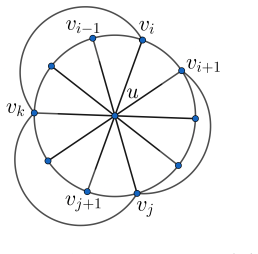
The argument is carried by the type set $A(G)=\{|N(u,v)| : u,v\in V(G), u\ne v\}$ together with three structural tools. First, the reduction lemmas show that in a planar graph $2\in A$ whenever some $a\ge3$ lies in $A$, and $2\in A$ is equivalent to containing a 4-cycle, so the absence of $2$ forces $A\subseteq\{0,1\}$. Second, for radius-1 polyhedra the plane neighbourhood $\Gamma_u(G)$ of a dominating vertex is a pyramid, so the graph is a pyramid plus added edges; this yields the characterizations of $W_3$ and $W_4$. Third, for radius at least 2 and $0\notin A$, a bound $p\le4M^2+3M+2$ on the order follows from domination in planar graphs of diameter 2, which is what turns the types $\{1,2\},\{1,2,3\},\{1,2,4\}$ into finite searches plus explicit families.
What would settle it
Re-run the enumeration of Section 2 with an independent, certified program that lists all 3-connected planar triangulations on at most 12 vertices and checks whether $1\notin A(G)$; finding any such graph beyond the six named $S_2,S_3,S_4,S_8,S_9,S_{10}$ (and beyond bipyramids and $T_\ell$) would disprove Theorem 1.3.
Extended reading notes
Core claim
The central discovery is that the common-neighbour spectrum $A(G)$ is a classifying invariant for polyhedra: the paper proves a trichotomy for every finite set $A$ of non-negative integers. If $1\notin A$, Theorem 1.3 states that $G\in S_1$ exactly, with the full type decomposition in Table 1—tetrahedron, cube, icosahedron, octahedron, the graphs $T_3, T_4, T_\ell$, the ten exceptions $S_1,\dots,S_{10}$, and the bipyramids. If $1\in A$, Theorem 1.4 asserts that $A(G)$ is one of the listed types, and for each listed type the corresponding polyhedra are either characterized (e.g. $A=\{0,1\}$ exactly when no 4-cycles are present), bounded in order by $24,47,78$ outside the named families, equal to $B_\ell$ or $B'_\ell$ for even $\ell\ge6$, or proven to occur infinitely often via explicit constructions. Together these two theorems exhaust all possible types.
Load-bearing premise
The completeness of Table 1 rests on a computer enumeration of all triangulations with up to 12 vertices, reported in Section 2; if that enumeration missed any triangulation with $1\notin A$, the classification would be incomplete and later statements relying on Table 1 would inherit the gap.
Editorial extensions
If this is right
- For every finite set $A$ of non-negative integers, exactly one of the trichotomy outcomes holds: all polyhedra of type $A$ are classified, infinitely many exist, or none exist.
- A polyhedron has $A=\{0,1\}$ if and only if it contains no 4-cycles, hence every polyhedron of girth at least 5 has type $\{0,1\}$.
- All polyhedra of type $\{1,2\}$, $\{1,2,3\}$, or $\{1,2,4\}$ are, outside orders $p\le24$, $p\le47$, and $p\le78$ respectively, exactly the $n$-gonal pyramids, the class $W_3$, and the class $W_4$.
- For even $\ell\ge6$, the only polyhedra with $1\in A$, $0,3,4\notin A$, and $\ell\in A$ are $B_\ell$ and $B'_\ell$.
- A polyhedron on at least 25 vertices has $A=\{0,1,2\}$ if and only if it is not a pyramid, contains a 4-cycle, and contains no subgraph isomorphic to $K(2,3)$.
Reading between the lines
- The trichotomy is special to planarity: Lemma 3.1 does not hold for general graphs, since complete graphs satisfy $A(K_n)=\{n-2\}$, so the same three-outcome classification cannot be expected for all graphs.
- The order bounds $24,47,78$ come from a generic domination bound for planar diameter-2 graphs; a sharper bound of that kind would shrink the finite checks and could make the classification effectively verifiable by enumeration.
- The caterpillar and gluing constructions of Section 6 provide infinite families with prescribed common-neighbour sets; these families could serve as explicit generators for testing network algorithms that use common-neighbour similarity.
Editorial analysis
A structured set of objections, weighed in public.
Referee Report
Summary. The paper classifies polyhedra (planar 3-connected graphs) by their type A(G), the set of all numbers |N(u,v)| of common neighbours over pairs of distinct vertices. Theorem 1.3 characterizes all polyhedra with 1 not in A: they are exactly the family S1 (bipyramids, T_l = P_l + K2, and ten exceptional graphs), with the type list of Table 1. Theorem 1.4 covers every polyhedron with 1 in A through Table 2: for the types {1,2}, {1,2,3} and {1,2,4}, everything outside a finite order bound (p <= 24, 47, 78) lies in a named infinite family (pyramids, W3, W4); the type {1,2,l} with l even >= 6 is exactly B_l or B'_l; the type {0,1} is exactly the class of polyhedra with no 4-cycles; {0,1,2} is characterized for order at least 25; and three construction propositions in Section 6 yield infinitely many polyhedra for the types {1,2,3} union A'_4, {1,2,4} union A'_5, and {0,1,2} union A'_3. Section 5 proves that no other types occur, giving the abstract's trichotomy: for every finite set A, the authors classify all polyhedra of that type, or construct infinitely many, or prove that none exist. The strategy combines a diameter-two domination bound (Lemma 3.5, via Goddard and Henning), a classification of radius-one polyhedra (Lemmas 4.1-4.3 and Propositions 4.4-4.5), a structural theorem for the type {1,2,l} (Proposition 5.1), and a small computer enumeration in Section 2 for triangulations of maximum degree at most 5.
Significance. If correct, the trichotomy is a complete, sharp classification of all planar 3-connected graphs by their common-neighbour spectrum, substantially extending the author's earlier classification of planar Deza graphs [8]; the statement is falsifiable, since a single polyhedron whose type is absent from Tables 1 and 2 would refute it. The analytic core is genuinely parameter-free: I re-derived the degree-bound reduction p <= 12 in Section 2 for Delta <= 5, the bound p <= 4M^2 + 3M + 2 in Lemma 3.5 from the Goddard-Henning domination input, the 24/47/78 arithmetic in Corollary 4.6, and the case split of Proposition 5.2, and found them consistent. The constructions in Section 6 are explicit, and Propositions 6.1 and 6.2 ship executable Mathematica verification code, a genuine reproducibility asset. Two caveats are load-bearing: the completeness of Theorem 1.3 (and the contrapositive step G not in S1 implies 1 in A that feeds Proposition 4.4 and hence most of Table 2) rests on an unshipped computer enumeration, and the proof of Lemma 3.6 contains an invalid counting step, although the lemma's statement is true.
major comments (2)
- [Section 2 (enumeration of triangulations with up to 12 vertices)] Section 2, paragraph following the equation 12 = 3p3 + 2p4 + p5 >= p: the only-if direction of Theorem 1.3 for triangulations of maximum degree at most 5 is completed solely by the sentence stating that all triangulations with up to 12 vertices were inspected, with code available on request. This step is load-bearing: a missed triangulation (for instance one with type {0,2} or {2,4} on at most 12 vertices) would falsify Table 1, and the contrapositive that G not in S1 implies 1 in A is used in Proposition 4.4, hence in Proposition 4.5 and Corollaries 4.6 and 4.7, and therefore in Table 2's rows {1,2}, {1,2,3}, {1,2,4}, and {0,1,2}. The code is not shipped: Appendix A provides Mathematica code only for Propositions 6.1 and 6.2, so this step is neither derived nor certified in the manuscript. Since there are only about 9,000 unlabeled triangulations of the sphere with up to 12 vertices, the authors should ship the generating and checking code together with a certificate (for instance the complete list of such triangulations and their type sets), or replace the enumeration with a hand-checkable argument.
- [Section 3, Lemma 3.6 and Eq. (3.1)] Section 3, Lemma 3.6, Eqs. (3.1) and the preceding paragraph: the deduction that f3 = f/2 does not follow from the statement that, for each vertex, exactly half of the faces containing it are triangular. Summing that statement over all vertices gives 3f3 = sum_{i>=5} i f_i (there are no 4-cycles, since A = {1} contradicts Corollary 3.3), which implies only f3 >= 5f/8; the displayed chain 2q >= 3f/2 + 5 sum_{i>=5} f_i = 3f/2 + 5(f - f3) = 3f/2 + 5f/2 = 4f uses f3 = f/2 in the last equality, so the contradiction 4p + 4r - 8 = 4q >= 4p + 4r is not obtained as written. The preceding pairing argument (u, v1, v2, then u, v3, v4, and so forth) also assumes without proof that the perfect matching induced by unique common neighbours pairs consecutive vertices in the cyclic order around u. The lemma's statement is nevertheless true: with A = {1}, every pair of vertices has exactly one common neighbour, and the Friendship Theorem forces a windmill graph, which is not 3-connected when it has at least two triangles (and K3 is not a polyhedron), so Corollary 3.7 and Proposition 5.2 stand once the proof is repaired. The proof as printed needs that repair.
minor comments (4)
- [Section 3, Lemma 3.5] The proof of Lemma 3.5 excludes the unique graph of Figure 9 from the Goddard-Henning domination statement [4, Theorem 2], but does not verify the claimed bound p <= 4M^2 + 3M + 2 for that exceptional graph. Since the applications in Corollary 4.6 require only the bounds 24, 47, and 78, an explicit check of that single graph, or a sentence explaining that its order lies below these bounds, would close the gap.
- [Section 5, Proposition 5.2] In the first case of Proposition 5.2, the proof that 2 not in A implies A = {0,1} rules out A = {1} via Lemma 3.6, but does not rule out A = {0} or A = empty; these are impossible for a connected graph of order at least 4 with diameter at least 2, and one sentence would suffice.
- [Section 1, definition of S1] The symbol S1 is overloaded: it denotes both the family S1 := {bipyramids} union {T_l} union {S_i} and the exceptional graph S1 (the cube) in Figure 2 and Table 1; this should be disambiguated to avoid confusion in the statements of Theorem 1.3 and Proposition 4.4.
- [Sections 1 and 6, typography] The phrase 'Theorems 1.3 and Theorems 1.4' in Section 1 should read 'Theorems 1.3 and 1.4', and the opening sentence of Section 6, 'To complete the proof of Theorem 1.3', should refer to Theorem 1.4, since Theorem 1.3 is proved in Section 2.
Circularity Check
No significant circularity: the derivations are self-contained; the only external step is an unshipped finite enumeration, which is a reproducibility concern, not circularity.
full rationale
The paper's main claims (Theorems 1.3 and 1.4) are proved by structural arguments on plane graphs. Theorem 1.3 reduces the 1-not-in-A case to three regimes: quadrangulation (cube), triangulation with maximum degree at least 6 (bipyramids, T_l, S5-S7), and triangulations with maximum degree at most 5. In the last regime, the paper invokes an exhaustive computer check of all triangulations on at most 12 vertices to list six further exceptions. This enumeration is asserted rather than shipped, so it is a verification and completeness risk, but it is not circular: the finite check is independent of the theorem being proved and is not a fitted parameter, a redefinition, or the same as the target classification. The remaining chain—Lemma 3.1 through Corollary 3.7, Propositions 4.4, 4.5, 4.8, 5.1, 5.2, and the constructions of Section 6—does not assume the target classifications. Self-citations to [8], [9], and [10] supply standard or previously established facts (Hamiltonian cycles in 2-connected outerplanar graphs, caterpillar degree sequences, and previously constructed examples for A = {0,1,2}); these are not used in a way that reduces a predicted quantity to its own input. No equation in the paper is equivalent to its assumptions by construction, and no fitted parameter is renamed as a prediction. Therefore no circular step is present, and the circularity score is 0.
Assumptions & free parameters
assumptions (5)
- standard math Every 2-connected outerplanar graph is Hamiltonian and contains at least two vertices of degree 2
- domain assumption Every planar graph of diameter 2 has domination number at most 2, except one explicitly listed graph
- domain assumption The computer enumeration of all triangulations on up to 12 vertices is exhaustive and correct
- standard math Whitney's theorem: every 3-connected planar graph has a unique spherical embedding
- standard math Euler's formula and the handshaking lemma for planar graphs
Cite this review
Pith. "Pith review of Classification of polyhedral graphs by numbers of common neighbours." pith.science (2026). https://pith.science/paper/NXIUCNVI
@misc{pith2026250801349,
  author       = {Pith},
  title        = {Pith review of: Classification of polyhedral graphs by numbers of common neighbours},
  year         = {2026},
  howpublished = {\url{https://pith.science/paper/NXIUCNVI}},
  note         = {Machine review of arXiv:2508.01349}
}
abstract
We propose a classification of polyhedra (planar, $3$-connected graphs) according to their type i.e., their set of quantities of common neighbours for each pair of distinct vertices. For every (finite) set of non-negative integers, we either classify all the polyhedra of that type, or construct infinitely many polyhedra of that type, or prove that none exist. This problem is related to the theory of strongly regular and Deza graphs, distances in graphs, and degree sequences. There is potential for application to complex networks and data science.
Figures


Figures from the paper (14 more)




Forward citations
Cited by 1 Pith paper
-
Automorphism Groups in Extremal Families of Polyhedral Graphs
Every minimum-order 3-polytopal graph with all degrees 3..n (n≥14) is asymmetric, and automorphism groups are classified for four other extremal polyhedral families.
Reference graph
Works this paper leans on
- [8]
-
[1]
C. Dalfó. A survey on the missing Moore graph.Linear Algebra and its Applications, 569:1–14, 2019
work page 2019
-
[2]
M. Erickson, S. Fernando, W. Haemers, D. Hardy, and J. Hemmeter. Deza graphs: A general- ization of strongly regular graph.Journal of Combinatorial Designs, 7(6):395–405, 1999
work page 1999
-
[3]
A. Gavrilyuk, S. Goryainov, and V. Kabanov. On the vertex connectivity of Deza graphs. Proceedings of the Steklov Institute of Mathematics, 285:68–77, 2014
work page 2014
-
[4]
W. Goddard and M. A. Henning. Domination in planar graphs with small diameter.Journal of Graph Theory, 40(1):1–25, 2002
work page 2002
-
[5]
Deza graphs: a survey and new results
S. Goryainov and L. V. Shalaginov. Deza graphs: a survey and new results.arXiv:2103.00228
-
[6]
G. Joret and C. Rambaud. Neighborhood complexity of planar graphs. Combinatorica, 44(5):1115–1148, 2024
work page 2024
-
[7]
S. Li, J. Huang, Z. Zhang, J. Liu, T. Huang, and H. Chen. Similarity-based future common neighbors model for link prediction in complex networks.Scientific reports, 8(1):17014, 2018
work page 2018
Show all 17 references
-
[9]
R. W. Maffucci. Regularity and separation for Sierpiński products of graphs.arXiv:2506.16864
-
[10]
R. W. Maffucci. Characterising 3-polytopes of radius one with unique realisation.Australasian Journal of Combinatorics, 89(2):268–293, 2024
2024
-
[11]
Papadopoulos, R
F. Papadopoulos, R. Aldecoa, and D. Krioukov. Network geometry inference using common neighbors. Physical Review E, 92(2):022807, 2015
2015
-
[12]
Reidl, F
F. Reidl, F. S. Villaamil, and K. Stavropoulos. Characterising bounded expansion by neigh- bourhood complexity. European Journal of Combinatorics, 75:152–168, 2019
2019
-
[13]
Wang and F
H. Wang and F. Murtagh. A study of the neighborhood counting similarity.IEEE Transactions on Knowledge and Data Engineering, 20(4):449–461, 2008
2008
-
[14]
Wang and L
H. Wang and L. Shang. Opinion dynamics in networks with common-neighbors-based connec- tions. Physica A: Statistical Mechanics and its Applications, 421:180–186, 2015
2015
-
[15]
R. Wang, Y. Li, S. Lin, W. Wu, H. Xie, Y. Xu, and J. C. Lui. Common neighbors matter: Fast random walk sampling with common neighbor awareness.IEEE Transactions on Knowledge and Data Engineering, 35(5):4570–4584, 2022
2022
-
[16]
H. Whitney. Congruent graphs and the connectivity of graphs.American Journal of Mathe- matics, 54(1):150–168, 1932
1932
-
[17]
L. Yao, L. Wang, L. Pan, and K. Yao. Link prediction based on common-neighbors for dynamic social network. Procedia Computer Science, 83:82–89, 2016. 26
2016
Reviewed August 6, 2026 · model on record in the stance chip above.
Discussion (0). Continue with ORCID to comment.