REVIEW 5 major objections 6 minor 21 references
VLH: Vision-Language-Haptics Foundation Model
T0 review · 5 major / 6 minor · reviewed 2026-08-06 · deepseek-v4-flash
Pith's one-line read A single model turns two camera views and a language command into both drone flight and haptic output.
desk verdict Real novelty in the VLA-plus-aerial-haptics integration, but the abstract's 100% texture accuracy is a user-study number, not a VLH model result—send it to referees, not desk reject. read the letter →
The pith
A machine-rendered reading of the paper's core claim, the machinery that carries it, and where it could break.
The reading
What carries the argument
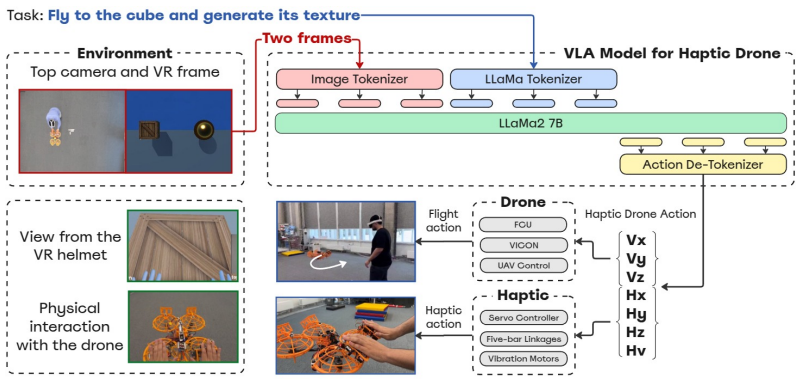
The load-bearing object is the 7-dimensional action vector that couples flight and touch in one control loop. The named hardware is the inverse five-bar linkage array: two sets of five-bar mechanisms mounted on the drone that push against the user's hands to create localized force and vibration. The model's job is to map two aligned camera frames plus a language command to that vector, so every perceptual decision carries a haptic consequence. The fine-tuned OpenVLA backbone is quantized to INT8 and served at 4–5 Hz, and the dataset is organized as 450 visual-physical-action combinations across three shapes and three texture categories.
What would settle it
A concrete test is to deliberately offset the two input frames by a known translation and measure whether target-acquisition success stays at 56.7%; if it does, the synchronization premise is not load-bearing. A second check is to rerun the texture-discrimination protocol and see whether the claimed 100% accuracy reproduces.
Extended reading notes
Core claim
The paper's central claim is that a single vision-language-action model can treat haptic feedback as a generative output rather than a pre-programmed response. The authors fine-tune OpenVLA, a 7-billion-parameter open vision-language-action model, with LoRA on 450 multimodal scenarios; each scenario pairs an egocentric virtual-reality frame, an exocentric top-down drone frame, and a natural language command with a 7D action vector $(V_x, V_y, V_z, H_x, H_y, H_z, H_v)$. The first three components steer the drone, the next three command directional forces on the drone's dual inverse five-bar linkage arrays, and the last sets vibration intensity. In 90 real flights the system is reported to reach target objects in 56.7% of trials, with a mean reach time of 21.3 s and a mean pose error of 0.24 m, and to generalize at 70.0% (visual), 54.4% (motion), 40.0% (physical), and 35.0% (semantic) on novel tasks. The abstract and conclusion additionally report 100% texture discrimination.
Load-bearing premise
The two camera views are assumed to be synchronized and aligned in position and orientation, but the paper reports no calibration procedure, synchronization mechanism, or alignment error.
Editorial extensions
If this is right
- Haptic patterns can be learned from data instead of hand-programmed, so new virtual objects can carry touch without manual design.
- Flight control and feedback share one learned representation, so the model can adjust touch in the same loop that steers the drone.
- INT8 quantization at 4–5 Hz is enough for closed-loop aerial interaction, suggesting that deployment on modest GPU hardware is realistic.
- The generalization gap is ordered visual > motion > physical > semantic, so enlarging the dataset along physical and semantic axes should improve the weakest behaviors.
Reading between the lines
- The same 7D action interface could transfer to other dual-camera teleoperation settings, such as remote inspection or search, where one operator view and one world view are both available.
- A natural next step the paper leaves implicit is to invert the mapping: use the haptic command as a diagnostic signal for what the model believes it is touching.
- The reported ordering of generalization results suggests that adding physical and semantic training data will yield larger gains than simply expanding visual variety.
Editorial analysis
A structured set of objections, weighed in public.
Referee Report
Summary. The paper presents VLH, a vision-language-action model fine-tuned from OpenVLA via LoRA on a custom dataset of 450 multimodal scenarios. The model takes two camera views (an egocentric VR camera and a top-down drone camera) plus a natural language command and outputs a 7D action vector (Vx, Vy, Vz, Hx, Hy, Hz, Hv), intended to unify drone velocity control with mid-air haptic feedback delivered by a quadcopter equipped with dual inverse five-bar linkage arrays. The reported evaluation consists of (i) a user study in which twelve participants recognized nine haptic patterns (three shapes × three vibration levels), (ii) generalization tests across visual, motion, physical, and semantic axes with reported percentages 70.0%, 54.4%, 40.0%, and 35.0%, and (iii) flight experiments reporting a 56.7% target-acquisition success rate, a mean reach time of 21.3 s, and a mean pose error of 0.24 m. The abstract and conclusion additionally claim 100% accuracy in texture discrimination.
Significance. The idea of treating haptic feedback as a generative output of a vision-language-action model, rather than as a pre-programled reactive channel, is timely and potentially relevant to aerial human-robot interaction and VR. The hardware platform—a quadcopter with two inverse five-bar linkage arrays—is a concrete engineering contribution, and the real-robot flight experiments go beyond pure simulation. However, the significance of the work is currently undermined by a central claim–evidence mismatch: no reported experiment measures the correctness of the model's haptic outputs. The user study in Section 5.1 measures human perception of haptic patterns, not the VLH model's ability to produce correct haptic commands from visual and language inputs. Because the paper's core novelty is the haptic channel, this gap is load-bearing. The generalization and flight metrics also lack precise definitions and statistical support. If the authors add a model-level haptic evaluation and tighten the metric definitions, the contribution could become solid; as it stands, the paper does not support its central claims.
major comments (5)
- [Abstract, Section 5.1] The abstract and conclusion claim '100% accuracy in texture discrimination' by VLH, but Section 5.1 is a human perception study: twelve participants recognized nine haptic patterns, and Tables 1–3 report human confusion matrices and an ANOVA on human responses. No experiment in the paper measures the VLH model's haptic outputs (Hx, Hy, Hz, Hv) against ground truth. This claim must be either supported by a model-level evaluation that compares model outputs to known object/texture labels, or removed.
- [Section 5.2] The generalization percentages (visual 70.0%, motion 54.4%, physical 40.0%, semantic 35.0%) are reported without any definition of 'success', without per-task or per-trial counts, and without confidence intervals or statistical tests. It is also unclear whether success requires correct haptic output, correct flight action, or both. This is load-bearing because generalization is a core claim of the paper; please define the metric, report the number of trials per axis, and provide confidence intervals or raw data.
- [Section 5.3] The flight success rate of 56.7% is defined only as 'the percentage of flights that reached the target area within an acceptable threshold', but the threshold value is never specified. Figure 6 mentions 'stable hovering for at least 5 sec' for green trajectories, yet the text does not state the hover threshold or the success criterion used for the reported 56.7%. The paper also provides no baseline (e.g., OpenVLA without haptic output, a waypoint controller, or random actions) against which this success rate can be interpreted. Please specify the threshold and add a baseline comparison.
- [Section 3.2] The model inputs are described as 'two synchronized top-down frames ... both aligned in position and orientation', but the paper reports no calibration procedure, synchronization mechanism, or alignment error between the real-world flight camera and the VR camera. Misalignment between these frames would systematically corrupt the learned mapping from pixels to drone velocities and haptic commands. Please report how the frames were calibrated and synchronized, and quantify the alignment error.
- [Section 4] The training dataset is said to pair real drone trajectories with VR frames and 'haptic signals (Hx, Hy, Hz, Hv)', but there is no description of how these ground-truth haptic labels were generated or validated. Without a defined reference standard for the haptic signal, it is impossible to assess whether the model's haptic outputs are correct. Please specify the label-generation procedure and, ideally, evaluate haptic outputs against an external benchmark or ground-truth haptic recordings.
minor comments (6)
- [Section 4 heading] The heading contains a typo: 'Traning' should be 'Training'.
- [Throughout] The term 'UA V' is inconsistently spaced; it should be written as 'UAV'.
- [Table 1] The confusion-matrix header is garbled ('circle square cone%' and 'Answers (Predicted Class)' with misaligned rows); please reformat the table so that actual and predicted classes are clearly labeled.
- [Section 5.1] The ANOVA description states that 'the interaction between vibration and temperature was not significant'; this should read 'vibration and shape'.
- [Introduction] The contributions list says 'empirical validation through real-world experiments demonstrating 57% positional alignment', which differs from the abstract's '56.7% success rate for target acquisition'. Please reconcile these numbers and clarify what 'positional alignment' means.
- [Section 2, Reference [16]] The text states that 'Helix represents a generalist VLA model', but the cited reference [16] is about serving large language models over heterogeneous GPUs, not about a VLA model. Please cite the correct Helix robotics model or revise the sentence.
Circularity Check
No load-bearing circularity: the derivation is a fine-tuning pipeline over an external base model, and the unsupported 100% texture-discrimination claim is an evidence gap rather than a circular reduction.
full rationale
We walked the derivation chain: VLH fine-tunes the public OpenVLA-7b backbone with LoRA on a bespoke dataset of 450 multimodal scenarios, producing a 7D action vector that appends haptic components (Hx, Hy, Hz, Hv) to the baseline velocity outputs. The training labels are the dataset paired haptic signals, and the reported generalization results are described as held-out tasks across visual, motion, physical, and semantic axes. That is a standard train/evaluation separation; nothing in the paper reduces one reported quantity to another by construction. The self-citations in the related work (RaceVLA, CognitiveDrone, OmniRace, Evolution 6.0) are used only to position the contribution and are not load-bearing assumptions. No uniqueness theorem is imported from the authors' prior work, and the OpenVLA backbone is an external, independently developed model. The one serious problem is the abstract and conclusion claim of '100% accuracy in texture discrimination': Section 5.1 is explicitly a human perception study of nine device-rendered patterns, with combined recognition averaging 57%, and Section 5.3 measures only success rate, reach time, and pose error, never the correctness of the model's haptic outputs against ground truth. This is a claim-evidence mismatch and a missing evaluation, but it is not a case of a fitted parameter being renamed a prediction, nor a result being defined in terms of its own input. The paper's derivation is therefore not circular; the unsupported claim should be weighed as a validity/support concern, not a circularity concern. Score 0.
Assumptions & free parameters
free parameters (6)
- LoRA rank =
32
- Learning rate =
5e-4
- Training steps =
4000
- Success hover threshold =
not specified
- Haptic pattern design =
3 shapes x 3 vibration levels
- Number of multimodal scenarios =
450
assumptions (6)
- domain assumption OpenVLA-7b backbone provides a transferable vision-language-action representation for drone control after LoRA fine-tuning.
- domain assumption INT8 quantization preserves the quality of the 7D action outputs.
- domain assumption The egocentric VR frame and top-down drone frame are synchronized and aligned.
- ad hoc to paper The haptic signals in the training dataset are correct ground truth for object textures and shapes.
- domain assumption Vicon motion capture provides accurate ground truth for drone position and for the flight success metric.
- ad hoc to paper Users' ability to recognize device-rendered haptic patterns transfers to the model's haptic outputs during flight.
Cite this review
Pith. "Pith review of VLH: Vision-Language-Haptics Foundation Model." pith.science (2026). https://pith.science/paper/MBD3YIJG
@misc{pith2026250801361,
  author       = {Pith},
  title        = {Pith review of: VLH: Vision-Language-Haptics Foundation Model},
  year         = {2026},
  howpublished = {\url{https://pith.science/paper/MBD3YIJG}},
  note         = {Machine review of arXiv:2508.01361}
}
read the original abstract
We present VLH, a novel Visual-Language-Haptic Foundation Model that unifies perception, language, and tactile feedback in aerial robotics and virtual reality. Unlike prior work that treats haptics as a secondary, reactive channel, VLH synthesizes mid-air force and vibration cues as a direct consequence of contextual visual understanding and natural language commands. Our platform comprises an 8-inch quadcopter equipped with dual inverse five-bar linkage arrays for localized haptic actuation, an egocentric VR camera, and an exocentric top-down view. Visual inputs and language instructions are processed by a fine-tuned OpenVLA backbone - adapted via LoRA on a bespoke dataset of 450 multimodal scenarios - to output a 7-dimensional action vector (Vx, Vy, Vz, Hx, Hy, Hz, Hv). INT8 quantization and a high-performance server ensure real-time operation at 4-5 Hz. In human-robot interaction experiments (90 flights), VLH achieved a 56.7% success rate for target acquisition (mean reach time 21.3 s, pose error 0.24 m) and 100% accuracy in texture discrimination. Generalization tests yielded 70.0% (visual), 54.4% (motion), 40.0% (physical), and 35.0% (semantic) performance on novel tasks. These results demonstrate VLH's ability to co-evolve haptic feedback with perceptual reasoning and intent, advancing expressive, immersive human-robot interactions.
Figures


Figures from the paper (4 more)


Reference graph
Works this paper leans on
- [1]
-
[2]
R. Hinchet, V . Vechev, H. Shea, and O. Hilliges. Dextres: Wearable haptic feedback for grasping in vr via a thin form-factor electrostatic brake. In Proc. of the 31st Annual ACM Symposium on User Interface Software and Technology, UIST ’18, page 901–912, 2018
work page 2018
-
[3]
D. McLaren, J. Gao, X. Yin, R. Reis Guerra, P. Vyas, C. Morton, X. L. Cang, Y . Chen, Y . Sun, Y . Li, J. D. W. Madden, and K. E. MacLean. What is affective touch made of? a soft capacitive sensor array reveals the interplay between shear, normal stress and individuality. InProc. of the 37th Annual ACM Symposium on User Interface Software and Technology, ...
work page 2024
-
[4]
Y . Sung, K. John, S. H. Yoon, and H. Seifi. Hapticgen: Generative text-to-vibration model for streamlining haptic design. In Proc. of the 2025 CHI Conf. on Human Factors in Computing Systems, pages 1–24, 2025
work page 2025
-
[5]
H. Wang. Haptic repurposing with genai. 2024. arXiv:2406.07228
work page Pith review arXiv 2024
- [6]
-
[7]
V . Serpiva, A. Lykov, A. Myshlyaev, M. H. Khan, A. A. Abdulkarim, O. Sautenkov, and D. Tsetserukou. Racevla: Vla-based racing drone navigation with human-like behaviour. 2025. arXiv:2503.02572
arXiv 2025
- [8]
Show all 21 references
-
[9]
S. Hong. Vibration-based wearable haptic feedback device and its applications. Theoretical and Natural Science, 17:104–109, 2023
2023
-
[10]
Huang, Z
B. Huang, Z. Wang, Q. Cheng, S. Ren, H. Cai, A. A. Valdivia, K. Mahadevan, and D. Wigdor. Aerohaptix: A wearable vibrotactile feedback system for enhancing collision avoidance in uav teleoperation. IEEE Robotics and Automation Letters, 10(5):4260–4267, 2025
2025
-
[11]
Shi and G
Y . Shi and G. Shen. Haptic sensing and feedback techniques toward virtual reality. Research, 7:0333, 2024
2024
-
[12]
Brohan, N
A. Brohan, N. Brown, J. Carbajal, Y . Chebotar, X. Chen, K. Choromanski, T. Ding, D. Driess, A. Dubey, C. Finn, et al. Rt-2: Vision-language-action models transfer web knowledge to robotic control. 2023. arXiv:2307.15818
2023 arXiv
-
[13]
Vuong, S
Q. Vuong, S. Levine, H. R. Walke, K. Pertsch, A. Singh, R. Doshi, C. Xu, J. Luo, L. Tan, D. Shah, et al. Open x-embodiment: Robotic learning datasets and rt-x models. In Towards Generalist Robots: Learning Paradigms for Scalable Skill Acquisition@ CoRL2023, 2023
2023
-
[14]
M. H. Khan, A. Myshlyaev, A. Lykov, M. A. Cabrera, and D. Tsetserukou. Evolution 6.0: Evolving robotic capabilities through generative design. 2025. arXiv:2502.17034
2025
-
[15]
M. J. Kim, K. Pertsch, S. Karamcheti, T. Xiao, A. Balakrishna, S. Nair, R. Rafailov, E. Foster, G. Lam, P. Sanketi, Q. Vuong, T. Kollar, B. Burchfiel, R. Tedrake, D. Sadigh, S. Levine, P. Liang, and C. Finn. Openvla: An open-source vision-language-action model. 2024. arXiv:240...
2024 arXiv
-
[16]
Y . Mei, Y . Zhuang, X. Miao, J. Yang, Z. Jia, and R. Vinayak. Helix: Serving large language models over heterogeneous gpus and network via max-flow. In Proc. of the 30th ACM Int. Conf. on Architectural Support for Programming Languages and Operating Systems, Volume 1, ASPLOS ...
2025
-
[17]
Hoppe, P
M. Hoppe, P. Knierim, T. Kosch, M. Funk, L. Futami, S. Schneegass, N. Henze, A. Schmidt, and T. Machulla. Vrhapticdrones: Providing haptics in virtual reality through quadcopters. In Proc. of the 17th Int. Conf. on Mobile and Ubiquitous Multimedia , MUM ’18, page 7–18, 2018
2018
-
[18]
Serpiva, A
V . Serpiva, A. Fedoseev, S. Karaf, A. A. Abdulkarim, and D. Tsetserukou. Omnirace: 6d hand pose estimation for intuitive guidance of racing drone. In IEEE/RSJ Int. Conf. on Int. Robots and Systems (IROS), pages 2508–2513, 2024
2024
-
[19]
Mellet, A
J. Mellet, A. Berra, S. Marcellini, M. ´Angel Trujillo Soto, G. Heredia, F. Ruggiero, and V . Lip- piello. Design and control of an omnidirectional aerial robot with a miniaturized haptic joystick for physical interaction. 2024. arXiv:2410.09003
2024 arXiv
-
[20]
Jongbloed, R
J. Jongbloed, R. Chaker, and E. Lavou ´e. Immersive procedural training in virtual reality: A systematic literature review. Comput. Educ., 221(C), Nov. 2024
2024
-
[21]
Klingenberg, R
S. Klingenberg, R. Bosse, R. E. Mayer, et al. Does embodiment in virtual reality boost learning transfer? testing an immersion-interactivity framework. Educational Psychology Review, 36: 116, 2024. 11
2024
Reviewed August 6, 2026 · model on record in the stance chip above.
Discussion (0). Continue with ORCID to comment.