REVIEW 2 major objections 5 minor 23 references
A strategy to avoid particle depletion in recursive Bayesian inference
T0 review · 2 major / 5 minor · reviewed 2026-08-06 · deepseek-v4-flash
Pith's one-line read This paper argues that replacing multinomial resampling in prior-proposal recursive Bayes with a regularized Gaussian mixture proposal eliminates particle depletion and, in simulation, brings recursive posteriors into close agreement with…
desk verdict A practical, well-illustrated fix for particle depletion in recursive Bayes, but the core proposal is the Liu–West kernel in new clothes and the accuracy claim rests on simulation rather than a bias argument. read the letter →
The pith
A machine-rendered reading of the paper's core claim, the machinery that carries it, and where it could break.
The reading
What carries the argument
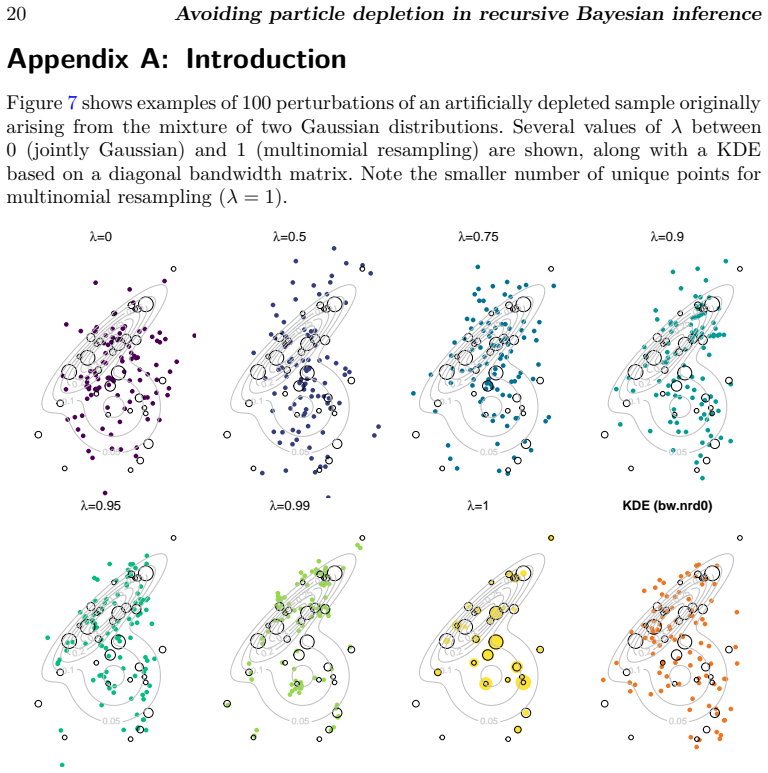
The central object is the regularized kernel density proposal of Eq. (8), a mixture of Gaussians in which each component is centered at $\lambda \tilde\theta + (1-\lambda)\bar\theta$ and has covariance $S_\theta - \lambda S_\theta \lambda'$. This mixture has continuous support, so proposals are unique with probability one; its mean equals the sample mean, and its variance converges to the target variance as the sample size grows, under a mild mixing condition on the previous sample. The same cancellation that makes PP-RB cheap survives because the proposal is meant to approximate the transient posterior, so the stage-$j$ acceptance ratio reduces to the likelihood ratio $[y_j \mid \theta^*]/[y_j \mid \theta_{t-1}]$. A scalar $\lambda$ interpolates between fully Gaussian proposals ($\lambda = 0$) and multinomial resampling ($\lambda = 1$), and blocking is implemented by conditioning this Gaussian mixture, which yields a weighted mixture of Gaussians for each block.
What would settle it
Run SPP-RB on a model whose transient posteriors are far from Gaussian (strongly skewed or bimodal) with a small per-stage sample size $M$, and compare the final samples with an all-at-once analysis: if the discrepancy is well beyond Monte Carlo error, the central claim fails. A more direct version is to compute the exact Metropolis-Hastings acceptance ratio including the proposal density of Eq. (8) and measure how far the simplified ratio of Eqs. (3)-(4) deviates from it on the same chain.
Extended reading notes
Core claim
The central claim is that the collapse of samples in recursive Bayesian inference can be avoided without sacrificing the simplicity of prior-proposal Metropolis-Hastings by replacing multinomial resampling with a regularized kernel density proposal. Given a sample $\{\theta_i\}$ from the previous transient posterior, SPP-RB first picks one member uniformly and then perturbs it with a Gaussian centered at a convex combination of that member and the sample mean, with covariance $S_\theta - \lambda S_\theta \lambda'$. The tuning parameter $\lambda = 1$ recovers multinomial resampling (PP-RB), $\lambda = 0$ assumes the transient posterior is Gaussian, and intermediate values interpolate between the two. The paper shows that the marginal mean matches and the marginal variance converges to the target variance as the stage sample size grows, and that the same cancellation in the Metropolis-Hastings ratio holds, so only the likelihood of the current batch enters. The discovery is empirical: in simulation, the smoothed proposals give final posteriors that agree with all-at-once analyses far better than traditional PP-RB, and the method admits blocked updates for high-dimensional parameter spaces.
Load-bearing premise
The load-bearing premise is that a Gaussian-smoothed version of the previous sample approximates the true transient posterior closely enough that the Metropolis-Hastings ratio with the proposal density omitted still produces samples from essentially the correct posterior; the paper supports this with simulation, not with a bias bound or consistency theorem.
Editorial extensions
If this is right
- Because proposals come from a continuous distribution, the number of unique values in the sample no longer decreases across stages, so particle depletion is avoided by construction rather than by resampling tricks.
- SPP-RB retains the PP-RB cost structure: only the current batch's likelihood appears in the acceptance ratio, and drawing from the mixture requires no expensive density evaluations beyond the proposal's own Gaussian draws.
- Blocked Metropolis-within-Gibbs updates become usable in recursive Bayes, because conditioning the Gaussian mixture on the current out-of-block values gives a tractable proposal; this addresses the otherwise crippling drop in acceptance rates as the parameter dimension grows.
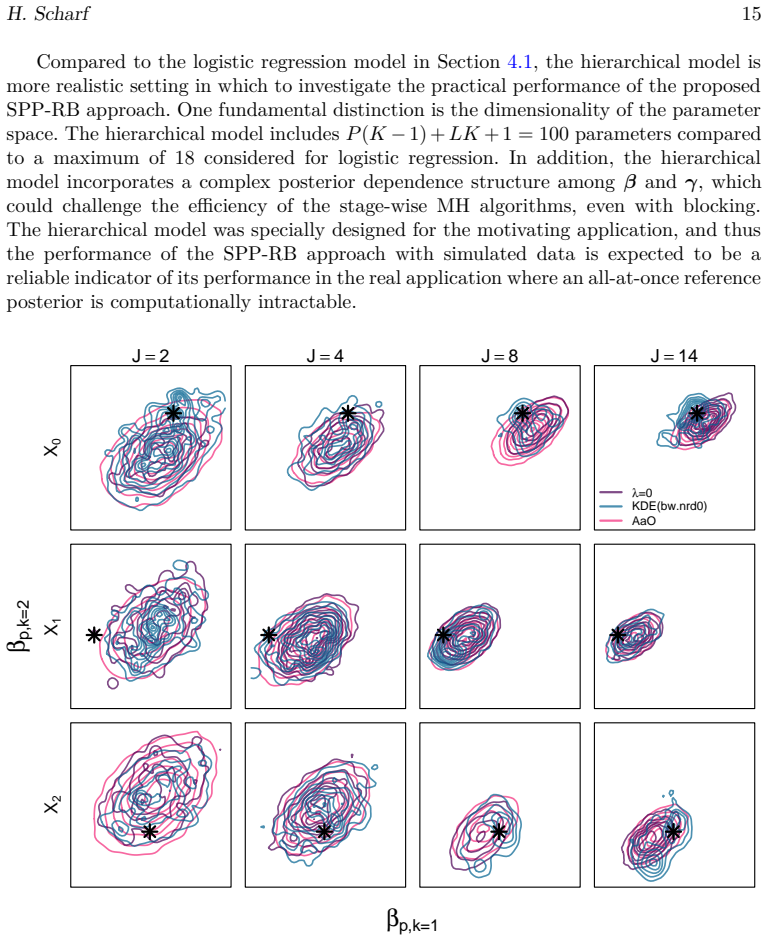
- In the paper's simulations, SPP-RB with $\lambda = 0$ tracks the all-at-once posterior far more closely than multinomial PP-RB or diagonal-bandwidth kernel density proposals, for both a logistic regression with up to 18 parameters and a 100-parameter hierarchical species distribution model.
- Running the same recursive procedure under several different data partitions provides a practical diagnostic: when the algorithm is working, the final-stage samples from all partitions coincide with each other and with an all-at-once fit when one is available.
Reading between the lines
- The paper leaves implicit that the same regularized-smoothing device could be dropped into any particle or sequential Monte Carlo scheme that resamples with replacement, as a generic antidegeneracy mechanism.
- Because $\lambda = 0$ performed best in simulation, a natural next question is whether $\lambda$ can be chosen data-adaptively, for example by minimizing disagreement among multiple partition sequences rather than fixing it in advance.
- The asymptotic variance-matching argument in the appendix assumes the covariance between draws in the previous sample decays fast enough; if it does not, the smoothed proposal's variance may not match the target's, a failure mode that could be probed by running SPP-RB with highly autocorrelated stage-one samples.
- The multi-partition diagnostic could be turned into a formal convergence test that tells practitioners when to increase the stage sample size or adjust $\lambda$, rather than relying on visual agreement.
Editorial analysis
A structured set of objections, weighed in public.
Referee Report
Summary. The paper proposes Smoothed Prior-Proposal Recursive Bayesian inference (SPP-RB), a modification of the PP-RB framework that replaces multinomial resampling of the previous posterior sample with proposals drawn from a smoothed, continuous-support approximation of that sample. For a tuning parameter lambda, the proposal is either a Gaussian centered at the sample mean (lambda = 0) or a regularized Gaussian mixture (lambda > 0). The paper derives a simplified Metropolis-Hastings acceptance ratio that retains only the likelihood ratio, develops a block-update extension, introduces a multi-partition diagnostic for checking convergence, and evaluates the method on simulated logistic regression and hierarchical species distribution models. The main claim is that SPP-RB avoids particle depletion and produces posterior samples substantially closer to all-at-once MCMC reference posteriors than traditional PP-RB.
Significance. If the approximation underlying SPP-RB is valid, the method could be a practical tool for recursive Bayesian inference on data sets too large for all-at-once analysis, and the observation that continuous-support proposals eliminate particle depletion is useful. The paper's simulation design is careful: it includes repeated stage-1 samples, comparisons to all-at-once MCMC across multiple transient stages, and a diagnostic based on multiple partition sequences. The central weakness is theoretical: the simplified MH ratio drops the proposal-density term even though the SPP-RB proposal is only an approximation to the previous posterior, and the paper provides only asymptotic first- and second-moment matching rather than a bound on the resulting approximation error. The paper itself acknowledges this by calling the output an 'approximate sample' in Section 5, but it does not quantify the error or specify conditions under which the approximation is reliable. The contribution is therefore best viewed as an empirically motivated heuristic rather than a validated algorithm.
major comments (2)
- [Section 3, Eqs. (3)-(4)] The cancellation of the proposal-density term in the MH ratio is valid only when the proposal distribution equals the previous transient posterior [theta | y_{1:j-1}] exactly. In SPP-RB the proposal is the regularized KDE (9), or the Gaussian N(theta_bar, S_theta) when lambda = 0, which in general is not equal to the previous posterior. Consequently, the acceptance probability used by the algorithm is not the correct MH acceptance probability for its proposal; for lambda = 0 the chain's stationary distribution is proportional to L_j(theta) N(theta | theta_bar, S_theta), not the intended target L_j(theta)[theta | y_{1:j-1}]. Section 2.3 and Appendix B establish only asymptotic first- and second-moment agreement, which does not control the density ratio [theta | y_{1:j-1}] / q(theta). The paper needs either a bias bound or a consistency theorem for the simplified ratio, or a clear restatement that the method is a heuristic approximation with explicit limitations.
- [Section 3.2 and Section 5] The multi-partition diagnostic is necessary but not sufficient for correctness: agreement among final samples generated from different partitions provides evidence that the recursive algorithm is stable, but it does not prove that the common distribution is the true target posterior. The paper acknowledges this by referring to an 'approximate sample', but the central claim in Section 1.2 that SPP-RB 'dramatically reduces the discrepancy between target posteriors' is supported only by the two simulation studies. As written, this over-generalizes the simulation evidence. The authors should either provide a theoretical guarantee (even under restrictive conditions) or explicitly bound the scope of validity and discuss settings where the approximation could fail.
minor comments (5)
- [Section 2.3] The covariance matrix S_theta - Lambda S_theta Lambda' appearing in Eq. (8) is only guaranteed to be positive semidefinite for the scalar form Lambda = lambda I with lambda in [0,1]; the general matrix case needs an explicit condition to ensure a valid proposal distribution.
- [Section 4.2, Figure 6 caption] The caption refers to 'spatial random effects (phi)', but the hierarchical model description in Section 4.2 does not include such a parameter; the figure caption is inconsistent with the model.
- [Appendix B] The phrase 'law of total variation' should be 'law of total variance'.
- [Section 4.2] The function name 'bw.nrw0' should be 'bw.nrd0'.
- [Section 1.2] The statement that SPP-RB 'ensures that all proposed values are unique' is true under continuous support, but uniqueness alone does not guarantee representativeness of the target distribution; this phrasing may overstate the benefit.
Circularity Check
No significant circularity: SPP-RB is validated against independent all-at-once MCMC benchmarks, with Lambda treated as a user-chosen tuning parameter rather than a fitted constant.
full rationale
The paper does not fit any parameter to the benchmarks it predicts against. The SPP-RB proposal in Eqs. (8)-(9) is constructed from the preceding stage's sample with a user-chosen regularization matrix Lambda, and Lambda is evaluated over a grid (lambda = 0, 0.25, 0.5, 0.75, 0.9, 0.95, 0.99, 1) in Section 4.1, not estimated to minimize the KS discrepancy against the all-at-once posterior. The benchmark posteriors are produced by independent all-at-once NUTS/Stan and NIMBLE analyses (Sections 4.1 and 4.2), so the comparison is external to the recursive algorithm. The MH simplification in Eqs. (3)-(4) is inherited from PP-RB (Hooten et al. 2021, cited as an external prior method), and SPP-RB's use of the same ratio with a smoothed proposal is an approximation whose error is not bounded. The paper explicitly labels the output an 'approximate sample' in Section 5, acknowledging this limitation. That is a correctness risk, not circular reasoning: no claimed prediction is defined in terms of the benchmark, and no load-bearing step reduces by construction to its own inputs. The only self-citation (Scharf et al. 2024) motivates the species distribution application and is not used to justify the SPP-RB derivation. Consequently, no circular step can be exhibited, and the appropriate score is 0.
Assumptions & free parameters
free parameters (1)
- lambda =
0 (recommended); grid 0, 0.25, 0.5, 0.75, 0.9, 0.95, 0.99, 1 in simulations
assumptions (3)
- domain assumption Transient posteriors are approximately multivariate normal, so lambda equals 0 Gaussian proposals are adequate.
- ad hoc to paper The discrepancy between the smoothed proposal in Eq. (8) and the true transient posterior is small enough that the simplified MH ratio in Eqs. (3)-(4) remains valid.
- domain assumption The sample-based covariance estimator S-theta is asymptotically unbiased under the dependence condition in Eq. (19).
Cite this review
Pith. "Pith review of A strategy to avoid particle depletion in recursive Bayesian inference." pith.science (2026). https://pith.science/paper/XKPCBRXE
@misc{pith2026250801572,
  author       = {Pith},
  title        = {Pith review of: A strategy to avoid particle depletion in recursive Bayesian inference},
  year         = {2026},
  howpublished = {\url{https://pith.science/paper/XKPCBRXE}},
  note         = {Machine review of arXiv:2508.01572}
}
read the original abstract
Recursive Bayesian inference, in which posterior beliefs are updated in light of accumulating data, is a tool for implementing Bayesian models in applications with streaming and/or very large data sets. As the posterior of one iteration becomes the prior for the next, beliefs are updated sequentially instead of all-at-once. Thus, recursive inference is relevant for both streaming data and settings where data too numerous to be analyzed together can be partitioned into manageable pieces. In practice, posteriors are characterized by samples obtained using, e.g., acceptance/rejection sampling in which draws from the posterior of one iteration are used as proposals for the next. While simple to implement, such filtering approaches suffer from particle depletion, degrading each sample's ability to represent its target posterior. As a remedy, we investigate generating proposals from a smoothed version of the preceding sample's empirical distribution. The method retains computationally valuable properties of similar methods, but without particle depletion, and we demonstrate its accuracy in simulation. We apply the method to data simulated from both a simple, logistic regression model as well as a hierarchical model originally developed for classifying forest vegetation in New Mexico using satellite imagery.
Figures


Figures from the paper (10 more)




Reference graph
Works this paper leans on
-
[1]
Agresti, A. (2002). Categorical Data Analysis . John Wiley & Sons, Hoboken, N.J, second edition
work page 2002
-
[2]
Andrieu, C., Doucet, A., and Holenstein, R. (2010). Particle M arkov chain M onte C arlo methods. Journal of the Royal Statistical Society Series B: Statistical Methodology , 72(3):269--342
work page 2010
-
[3]
Assal, T., Anderson, P., and Sibold, J. (2015). Mapping forest functional type in a forest-shrubland ecotone using spot imagery and predictive habitat distribution modelling. Remote Sensing Letters , 6:755--764
work page 2015
-
[4]
Bürkner, P.-C. (2017). brms : An R package for Bayesian multilevel models using Stan . Journal of Statistical Software , 80(1):1--28
work page 2017
-
[5]
D., Lee, D., Goodrich, B., Betancourt, M., Brubaker, M., Guo, J., Li, P., and Riddell, A
Carpenter, B., Gelman, A., Hoffman, M. D., Lee, D., Goodrich, B., Betancourt, M., Brubaker, M., Guo, J., Li, P., and Riddell, A. (2017). Stan: A probabilistic programming language. Journal of statistical software , 76(1)
work page 2017
-
[6]
Chacón, J. E. and Duong, T. (2018). Multivariate Kernel Smoothing and Its Applications . Number 160 in Monographs on Statistics and Applied Probability . CRC Press, Taylor & Francis Group, Boca Raton, FL
work page 2018
-
[7]
de Valpine , P., Paciorek, C., Turek, D., Michaud, N., Anderson-Bergman, C., Obermeyer, F., Wehrhahn Cortes , C., Rodrìguez, A., Temple Lang , D., and Paganin, S. (2024). NIMBLE : MCMC , Particle Filtering, and Programmable Hierarchical Modeling . R package version 1.1.0
work page 2024
-
[8]
de Valpine , P., Turek, D., Paciorek, C., Anderson-Bergman, C., Temple Lang , D., and Bodik, R. (2017). Programming with models: writing statistical algorithms for general model structures with NIMBLE . Journal of Computational and Graphical Statistics , 26:403--413
work page 2017
Show all 23 references
-
[9]
and Ghosh, S
Gelfand, A. and Ghosh, S. (2013). Hierarchical modeling. In Damien, P., Dellaportas, P., Polson, N. G., and Stephens, D. A., editors, Bayesian Theory and Applications , chapter 3, pages 33--49. Oxford University Press, Oxford
2013
-
[10]
Gelfand, A., Silander, J., Wu, S.-s., Latimer, A., Lewis, P., Rebelo, A., and Holder, M. (2006). Explaining species distribution patterns through hierarchical modeling. Bayesian Analysis , 1
2006
-
[11]
, Stern, Hal S
Gelman, A., Carlin, John B. , Stern, Hal S. , Dunson, David B. , Vehtari, Aki , and Rubin, Donald B. (2014). Bayesian data analysis . Chapman & Hall / CRC texts in statistical science. CRC Press, Boca Raton, third edition edition
2014
-
[12]
and Thuiller, W
Guisan, A. and Thuiller, W. (2005). Predicting species distribution: offering more than simple habitat models. Ecology Letters , 8(9):993--1009
2005
-
[13]
Hartigan, J. A. (1983). Asymptotic Normality of Posterior Distributions . In Bayes Theory , Springer Series in Statistics . Springer, New York, NY
1983
-
[14]
D., Gelman, A., et al
Hoffman, M. D., Gelman, A., et al. (2014). The no-u-turn sampler: adaptively setting path lengths in hamiltonian monte carlo. J. Mach. Learn. Res. , 15(1):1593--1623
2014
-
[15]
B., Johnson, D
Hooten, M. B., Johnson, D. S., and Brost, B. M. (2021). Making recursive Bayesian inference accessible. The American Statistician , 75(2):185--194
2021
-
[16]
Kass, R. E. and Steffey, D. (1989). Approximate bayesian inference in conditionally independent hierarchical models (parametric empirical bayes models). Journal of the American Statistical Association , 84(407):717--726
1989
-
[17]
Lunn, D., Barrett, J., Sweeting, M., and Thompson, S. (2013). Fully Bayesian Hierarchical Modelling in Two Stages , with Application to Meta - Analysis . Journal of the Royal Statistical Society Series C: Applied Statistics , 62(4):551--572
2013
-
[18]
Neal, R. M. (2003). Slice sampling. The annals of statistics , 31(3):705--767
2003
-
[19]
R: A Language and Environment for Statistical Computing
R Core Team (2025). R: A Language and Environment for Statistical Computing . R Foundation for Statistical Computing, Vienna, Austria
2025
-
[20]
Scharf, H., Schierbaum, J., Matsumoto, H., and Assal, T. (2024). Predicting species-level vegetation cover using large satellite imagery data sets
2024
-
[21]
Silverman, B. W. (2018). Density Estimation for Statistics and Data Analysis . Number v.26 in Chapman and Hall / CRC Monographs on Statistics and Applied Probability . Routledge, Boca Raton
2018
-
[22]
, " * write output.state after.block = add.period write newline
ENTRY address author booktitle chapter edition editor howpublished institution journal key month note number organization pages publisher school series title type url volume year label extra.label sort.label short.list INTEGERS output.state before.all mid.sentence after.senten...
-
[23]
write newline
" write newline "" before.all 'output.state := FUNCTION n.dashify 't := "" t empty not t #1 #1 substring "-" = t #1 #2 substring "--" = not "--" * t #2 global.max substring 't := t #1 #1 substring "-" = "-" * t #2 global.max substring 't := while if t #1 #1 substring * t #2 gl...
Reviewed August 6, 2026 · model on record in the stance chip above.
Discussion (0). Continue with ORCID to comment.