REVIEW 5 major objections 4 minor 48 references
Decoding the Alzheimer's Continuum: Interpretable Multi-Gate Routing for Diagnosis and Transition Prediction
T0 review · 5 major / 4 minor · reviewed 2026-08-06 · deepseek-v4-flash
Pith's one-line read M3AD shows that a single T1-weighted structural MRI can drive both three-class Alzheimer's diagnosis (95.13% accuracy) and cognitive transition prediction (97.76% accuracy), with routing analysis separating stable from progressive MCI.
desk verdict A plausible architecture and a sensible transition-labeling idea, but the evaluation likely leaks subjects across folds and the paper's own numbers contradict each other; headline accuracies should not be trusted as reported. read the letter →
The pith
A machine-rendered reading of the paper's core claim, the machinery that carries it, and where it could break.
The reading
What carries the argument
The load-bearing object is the multi-gate mixture-of-experts (MMoE) layer inserted into the blocks of a Swin Transformer V2 backbone whose last two stages are replaced by tokenized MLP components. For each task—diagnosis and transition—a separate gating network computes a softmax-weighted combination of expert outputs, so the model can share general structural features while preserving task-specific routes. Expert specialization comes from an initial label-guided masked-image-modeling pretraining stage, and clinical priors (age, sex, and estimated total intracranial volume, eTIV) are fused into image features at the second hierarchical stage through an adaptive attention mechanism. This design is what lets the two tasks be optimized jointly with reduced gradient interference, and it is also what produces the interpretable per-expert activation profiles used for the stable-versus-progressive MCI analysis.
What would settle it
Regroup the primary longitudinal cohort by subject, put all visits of each subject in a single cross-validation fold, retrain under the same protocol, and check whether ternary accuracy stays near 95.13% and transition accuracy near 97.76%; a material drop would show the headline numbers depend on scan-level leakage.
Extended reading notes
Core claim
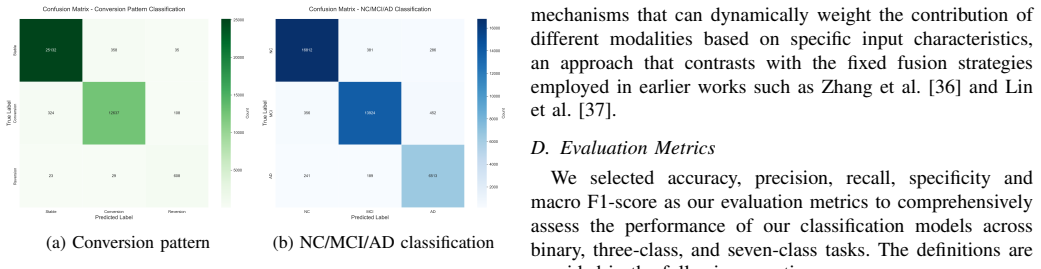
On the authors' account, the central discovery is that diagnosis and longitudinal transition can be learned jointly in a single representation space, and that the routing choices of a multi-gate mixture-of-experts model carry clinical meaning. The framework keeps shared experts that model structural features common to the whole NC-MCI-AD continuum and diagnosis-specific experts (two each for NC, MCI, and AD) that are specialized during a label-guided masked-image-modeling pretraining stage. Two attention-based gates then route each input to appropriate experts for the diagnosis task and the change task. The paper reports that this joint formulation reaches 95.13% accuracy on NC/MCI/AD classification and 97.76% accuracy on stable/conversion/reversion prediction, while the same model trained only for diagnosis reaches 94.80%, so multi-task learning yields a direct accuracy gain in addition to the new prognostic output. The routing analysis is claimed to reveal distinct expert-activation signatures that separate stable MCI from progressive MCI, giving a mechanistic basis for individual progression-risk stratification.
Load-bearing premise
The reported accuracies assume the three-fold cross-validation splits subjects, not individual scans, so that repeated visits from the same patient never appear in both training and test folds.
Editorial extensions
If this is right
- A single T1-weighted structural MRI scan, plus age, sex, and head size, is enough to obtain both a stage diagnosis and a transition prediction; no PET, CSF, or genetic data are needed for the reported numbers.
- Multi-task training improves diagnosis itself, from 94.80% single-task to 95.13% joint, so modeling progression is not a trade-off but a contribution to diagnostic accuracy.
- Per-subject expert-activation signatures could be used as a continuous progression-risk readout for MCI patients, rather than only a three-way stable/conversion/reversion label.
- The open-source preprocessing pipeline and code make the evaluation reproducible on other cohorts, which is a precondition for clinical deployment.
Reading between the lines
- Because the primary longitudinal dataset contributes 8,243 scans but only 1,680 labeled participants, the 95.13% and 97.76% figures should be re-checked with a subject-stratified cross-validation; if a patient's repeated scans straddle folds, the model could be recognizing the person rather than the disease stage.
- The transition task is highly imbalanced: 65.3% of patterns are stable, 33.0% are conversion, and only 1.7% are reversion, so the 97.76% accuracy is partly a reflection of that distribution; reversion accuracy in particular rests on very few cases.
- The routing signatures may be compressible into a scalar risk score that external cohorts with MCI follow-up could validate, but the paper itself does not yet provide such an external validation.
- The shared-versus-specialized expert split is a generic design that could plausibly transfer to other neurodegenerative continua where both stage and transition are clinically meaningful.
Editorial analysis
A structured set of objections, weighed in public.
Referee Report
Summary. The paper proposes M3AD, a multi-task multi-gate mixture-of-experts framework built on a Swin Transformer V2 backbone with Tok-MLP components, for joint Alzheimer's disease diagnosis and cognitive-transition prediction from T1-weighted sMRI. The model integrates clinical priors (age, sex, eTIV) via adaptive fusion and uses a two-stage training protocol with SimMIM-style pretraining. The authors report 95.13% three-class NC/MCI/AD accuracy, 99.15% binary NC/AD accuracy, and 97.76% conversion-pattern accuracy, and they claim that routing analysis reveals expert-activation signatures that distinguish stable from progressive MCI. The manuscript also contributes an open-source preprocessing pipeline and a code repository.
Significance. If the reported evaluation were valid, the paper would be a useful contribution: it combines interpretable routing with multi-task learning on a large multi-dataset collection (12,037 scans), and it attempts to model the NC-MCI-AD continuum rather than only static classification. The open-source preprocessing pipeline and the provision of code are concrete strengths. However, the current evidence does not support the headline claims: the cross-validation procedure appears to allow subject-level leakage, the abstract and body disagree on the transition-prediction accuracy, the proposed architecture is not clearly better than its own Swin-v2 baseline in Table IV, and the state-of-the-art comparisons are not controlled for cohort and class balance. These issues concern the central claims and must be resolved before the significance of the work can be assessed.
major comments (5)
- [III-B, Table I] Section III-B states only that the authors use '3-fold cross-validation across different random seeds,' with no mention of subject-level grouping. Table I lists 8,243 ADNI scans but only 1,680 diagnosis labels (782 NC, 590 MCI, 308 AD) and a sex count (2,494 M + 1,399 F = 3,893) that matches neither the scan count nor the label count, which implies that ADNI contains repeated scans from the same participants. Under random scan-level splits, the same participant can appear in both training and test folds, allowing the model to exploit subject identity rather than generalize across disease states. This is especially damaging for the conversion-prediction task, where the label is defined from a later visit of the same subject; if an earlier visit is in the training fold and a later visit is in the test fold, near-perfect accuracy can be expected. A subject-level split, or at least a demonstration that no participant's scans straddle folds, is required before the reported 95.13% diagnosis accuracy and 97.76% conversion accuracy can be credited.
- [Abstract vs. Section IV-B/Table IV] The abstract reports '94.87% for transition prediction,' while Section IV-B and Table IV report 97.76% conversion-pattern accuracy for the same M3AD-C3 model. Both numbers are presented as central results, so this discrepancy must be resolved: if 94.87% is correct, the body and Table IV are wrong, and if 97.76% is correct, the abstract is wrong. The authors should correct the erroneous number and check that no other reported metrics suffer from similar inconsistencies.
- [Section IV-A, Table IV] The 'Standard Swin v2 for Multi-task Training' rows in Table IV report higher diagnosis accuracy (97.39% for M3AD-C9 and 96.32% for M3AD-C3) than the proposed architecture (94.72% and 95.13%, respectively), yet the text claims that the modified architecture 'demonstrates superior performance in the comprehensive multi-task framework' and that the difference 'becomes more apparent when considering the multi-task learning scenario.' This is internally contradictory. The authors must either provide a corrected baseline comparison or revise the claim that the architectural modifications improve diagnosis accuracy; as written, the table undermines the central contribution.
- [Tables II and III] The claimed state-of-the-art improvements are not supported by controlled comparisons. Table III evaluates the proposed models on 4,311 NC and 573 AD subjects, while MCLNC is evaluated on 588 NC and 212 AD subjects, and the class balances differ substantially across all compared methods. Accuracy is highly sensitive to cohort composition and class balance, so the 'improvements of 4.69% and 0.55%, respectively, over state-of-the-art approaches' cannot be established unless the comparisons are made on the same test sets or with matched class distributions. The authors should report matched evaluations or clearly frame the comparison as cross-study rather than head-to-head.
- [Tables IV and V, Section III-B] Multiple model variants (C3 vs. C9, fusion stage, fusion type, pretraining strategy) are evaluated on the same 3-fold cross-validation, and the best-performing variant is then selected and reported as the main result, without a separate validation split. This post-hoc selection on the test folds can inflate the reported performance and should be acknowledged or avoided with a nested validation procedure. The small standard deviations across folds do not address selection bias on the same folds.
minor comments (4)
- [Figure 1 caption] The Figure 1 caption lists Parkinson's Disease (PD) among the classes, although the manuscript is about Alzheimer's disease; this appears to be leftover text from a different paper and should be corrected.
- [Table IV] The 'Standard Swin v2 for Multi-task Training' rows in Table IV report point values without standard deviations, while all other rows report mean (standard deviation); the authors should report the variance for these baselines as well.
- [Abstract and Section I] The phrase 'using only T1-weighted sMRI' is in tension with the method's use of age, sex, and eTIV as model inputs; the authors should qualify the modality claim to clarify that demographic priors are additional non-imaging inputs.
- [Equation (12)] Equation (12) defines C_fusion with two cases for s=3 and s<3, but the indexing convention for fusion stages s in {0,1,2,3} is not immediately clear; please clarify whether the embedding dimension is doubled for s=3 or for s<3.
Circularity Check
No significant circularity: M3AD's reported results are empirical outputs of an externally grounded architecture, and the transition-prediction task is not constructed from the diagnosis output.
full rationale
Walking the claimed derivation chain—preprocessing, MMoE routing, clinical-prior fusion, two-stage training, and evaluation—I find no step in which a stated output is defined in terms of the very quantity it is supposed to predict. The diagnosis head and the transition-prediction head are separate supervised outputs; the 3-class change labels (Stable/Conversion/Reversion) are defined from longitudinal diagnosis changes, not from the model's own diagnosis predictions, so the 97.76% transition accuracy is not forced by the 95.13% diagnosis accuracy by construction. The gating and expert-specialization equations (Eqs. 7–9 and 15–19) are standard supervised objectives whose targets are external labels. The only cited prior work by the present authors used as supporting evidence is [19] (Y. Jiang and Y. Shen, M4oE), which supports the general claim that MMoE 'has demonstrated strong performance in neuroimaging applications'; this citation is not load-bearing because the architecture itself is attributed to the original external MMoE paper [9], and no uniqueness or ansatz claim rests on [19]. The remaining concerns—scan-level 3-fold cross-validation on longitudinal ADNI data and post-hoc selection of the M3AD-C3 variant on the same folds—are evaluation-validity issues that could bias or inflate the reported numbers, but they are not cases of a prediction reducing to its own inputs by definition or by self-citation. The internal inconsistency between the abstract's 94.87% and Section IV-B's 97.76% transition accuracy is a reporting discrepancy, not a circular reduction. Accordingly, no circular step is exhibited.
Assumptions & free parameters
free parameters (5)
- Task loss weights alpha and beta =
alpha=1, beta=1
- SimMIM mask ratio =
0.6
- Expert-specialization loss weight lambda =
not specified
- Number of experts and shared experts =
E=8, E_s=2
- Clinical fusion stage =
Stage 2
assumptions (3)
- domain assumption ADNI diagnostic labels (CN/MCI/AD) and derived Stable/Conversion/Reversion labels are accurate ground truth for cognitive transitions.
- domain assumption Repeated scans of the same subject are independent samples in the 3-fold cross-validation.
- domain assumption The preprocessing pipeline (HD-BET, SyN registration, z-score intensity normalization) preserves AD-relevant atrophy information after registration to MNI152.
Cite this review
Pith. "Pith review of Decoding the Alzheimer's Continuum: Interpretable Multi-Gate Routing for Diagnosis and Transition Prediction." pith.science (2026). https://pith.science/paper/LF53UWTH
@misc{pith2026250801819,
  author       = {Pith},
  title        = {Pith review of: Decoding the Alzheimer's Continuum: Interpretable Multi-Gate Routing for Diagnosis and Transition Prediction},
  year         = {2026},
  howpublished = {\url{https://pith.science/paper/LF53UWTH}},
  note         = {Machine review of arXiv:2508.01819}
}
abstract
Alzheimer's disease (AD) manifests as a continuous progression from normal cognition (NC) through mild cognitive impairment (MCI) to dementia. However, most deep learning approaches reduce this continuum to disjointed classification tasks, largely ignoring dynamic stage transitions. To decode this complex progression, we propose M$^3$AD, a unified framework that jointly addresses three-class diagnosis classification and diagnosis stage transition prediction using only T1-weighted sMRI. M$^3$AD leverages an interpretable multi-gate mixture of experts architecture, employing specialized routing mechanisms to dynamically capture both diagnosis-specific pathological patterns and shared structural features across the continuum. It further integrates clinical priors (age, sex, eTIV) via adaptive attention fusion to enhance generalization. M$^3$AD achieves 95.13% accuracy, compared to 90.44% reported by MCLNC under its original experimental setting, and 94.87% for transition prediction. Crucially, analyzing the multi-gate routing reveals distinct expert activation signatures distinguishing stable from progressive MCI, providing a mechanistic basis for individual-level progression risk stratification. Code is available at https://github.com/csyfjiang/M3AD.
Figures


Figures from the paper (3 more)


Reference graph
Works this paper leans on
-
[1]
M. Hao and J. Chen, “Trend analysis and future predictions of global burden of alzheimer’s disease and other dementias: a study based on the global burden of disease database from 1990 to 2021,”BMC medicine, vol. 23, no. 1, p. 378, 2025
work page 1990
-
[2]
Alzheimer’s disease: epidemi- ology and clinical progression,
A. A. Tahami Monfared, Byrneset al., “Alzheimer’s disease: epidemi- ology and clinical progression,”Neurology and therapy, vol. 11, no. 2, pp. 553–569, 2022
work page 2022
-
[3]
Y .-h. Chouet al., “Cortical excitability and plasticity in alzheimer’s disease and mild cognitive impairment: A systematic review and meta- analysis of transcranial magnetic stimulation studies,”Ageing research reviews, vol. 79, p. 101660, 2022
work page 2022
-
[4]
Neuroplasticity and mri: a perfect match,
J. Hamaideet al., “Neuroplasticity and mri: a perfect match,”NeuroIm- age, vol. 131, pp. 13–28, 2016
work page 2016
-
[5]
A. Alorfet al., “Multi-label classification of alzheimer’s disease stages from resting-state fmri-based correlation connectivity data and deep learning,”Computers in Biology and Medicine, vol. 151, p. 106240, 2022
work page 2022
-
[6]
Comprehensive systematic computation on alzheimer’s disease classification,
P. Upadhyayet al., “Comprehensive systematic computation on alzheimer’s disease classification,”Archives of Computational Methods in Engineering, vol. 31, no. 8, pp. 4773–4804, 2024
work page 2024
-
[7]
Deep learning-based hippocampus asymmetry assess- ment for alzheimer’s disease diagnosis,
F. Zhanget al., “Deep learning-based hippocampus asymmetry assess- ment for alzheimer’s disease diagnosis,”Medical Physics, 2025
work page 2025
-
[8]
Gradnorm: Gradient normalization for adaptive loss balancing in deep multitask networks,
Z. Chenet al., “Gradnorm: Gradient normalization for adaptive loss balancing in deep multitask networks,” inInternational conference on machine learning. PMLR, 2018, pp. 794–803
work page 2018
Show all 48 references
-
[9]
Modeling task relationships in multi-task learning with multi-gate mixture-of-experts,
J. Ma, Z. Zhao, X. Yi, J. Chen, L. Hong, and E. H. Chi, “Modeling task relationships in multi-task learning with multi-gate mixture-of-experts,” inProceedings of the 24th ACM SIGKDD international conference on knowledge discovery & data mining, 2018, pp. 1930–1939
2018
-
[10]
Modeling multi-task model merging as adaptive projective gradient descent,
Y . Wei, A. Tang, L. Shen, Z. Hu, C. Yuan, and X. Cao, “Modeling multi-task model merging as adaptive projective gradient descent,”arXiv preprint arXiv:2501.01230, 2025
2025 arXiv
-
[11]
Convolutional neural networks for classification of alzheimer’s disease: overview and reproducible evaluation,
J. Wenet al., “Convolutional neural networks for classification of alzheimer’s disease: overview and reproducible evaluation,”Medical image analysis, vol. 63, p. 101694, 2020
2020
-
[12]
Alzheimer’s disease diagnosis from multi-modal data via feature inductive learning and dual multilevel graph neural network,
B. Leiet al., “Alzheimer’s disease diagnosis from multi-modal data via feature inductive learning and dual multilevel graph neural network,” Medical Image Analysis, vol. 97, p. 103213, 2024
2024
-
[13]
Multimodal and multiscale deep neural networks for the early diagnosis of alzheimer’s disease using structural mr and fdg-pet images,
D. Luet al., “Multimodal and multiscale deep neural networks for the early diagnosis of alzheimer’s disease using structural mr and fdg-pet images,”Scientific reports, vol. 8, no. 1, p. 5697, 2018
2018
-
[14]
Automated brain extraction of multisequence mri using artificial neural networks,
F. Isenseeet al., “Automated brain extraction of multisequence mri using artificial neural networks,”Human brain mapping, vol. 40, no. 17, pp. 4952–4964, 2019
2019
-
[15]
The ANTsX ecosystem for quantitative biological and medical imaging,
N. J. Tustisonet al., “The ANTsX ecosystem for quantitative biological and medical imaging,”Scientific Reports, vol. 11, no. 1, p. 9068, 2021
2021
-
[16]
Denseformer-moe: A dense transformer foundation model with mixture of experts for multi-task brain image analysis,
R. Dinget al., “Denseformer-moe: A dense transformer foundation model with mixture of experts for multi-task brain image analysis,”IEEE Transactions on Medical Imaging, 2025
2025
-
[17]
nnu-net: a self-configuring method for deep learning- based biomedical image segmentation,
F. Isenseeet al., “nnu-net: a self-configuring method for deep learning- based biomedical image segmentation,”Nature methods, vol. 18, no. 2, pp. 203–211, 2021
2021
-
[18]
M4: Multi-proxy multi-gate mixture of experts network for multiple instance learning in histopathology image analysis,
J. Liet al., “M4: Multi-proxy multi-gate mixture of experts network for multiple instance learning in histopathology image analysis,”Medical Image Analysis, vol. 103, p. 103561, 2025
2025
-
[19]
M4oE: A Foundation Model for Medical Mul- timodal Image Segmentation with Mixture of Experts ,
Y . Jiang and Y . Shen, “ M4oE: A Foundation Model for Medical Mul- timodal Image Segmentation with Mixture of Experts ,” inproceedings of Medical Image Computing and Computer Assisted Intervention – MICCAI 2024, vol. LNCS 15012. Springer Nature Switzerland, October 2024
2024
-
[20]
Feature fusion and detection in alzheimer’s disease using a novel genetic multi-kernel svm based on mri imaging and gene data,
X. Menget al., “Feature fusion and detection in alzheimer’s disease using a novel genetic multi-kernel svm based on mri imaging and gene data,”Genes, vol. 13, no. 5, p. 837, 2022
2022
-
[21]
Challenges in multi-task learning for fmri-based diagnosis: benefits for psychiatric conditions and cnvs would likely require thousands of patients,
A. Harveyet al., “Challenges in multi-task learning for fmri-based diagnosis: benefits for psychiatric conditions and cnvs would likely require thousands of patients,”Imaging Neuroscience, vol. 2, pp. 1–20, 2024
2024
-
[22]
Swin transformer v2: Scaling up capacity and resolu- tion. 2022 ieee,
Z. Liuet al., “Swin transformer v2: Scaling up capacity and resolu- tion. 2022 ieee,” inCVF Conference on Computer Vision and Pattern Recognition (CVPR), 2021, pp. 11 999–12 009
2022
-
[23]
Unext: Mlp-based rapid medical image segmentation network,
J. M. J. Valanarasu and V . M. Patel, “Unext: Mlp-based rapid medical image segmentation network,” inInternational conference on medical image computing and computer-assisted intervention. Springer, 2022, pp. 23–33
2022
-
[24]
Multimodal contrastive learning with neuroimaging and cognitive tests for alzheimer’s disease diagnosis,
L. Zhaoet al., “Multimodal contrastive learning with neuroimaging and cognitive tests for alzheimer’s disease diagnosis,” in2024 IEEE International Conference on Bioinformatics and Biomedicine (BIBM). IEEE, 2024, pp. 2971–2976
2024
-
[25]
Computational visual attention systems and their cog- nitive foundations: A survey,
S. Frintropet al., “Computational visual attention systems and their cog- nitive foundations: A survey,”ACM Transactions on Applied Perception (TAP), vol. 7, no. 1, pp. 1–39, 2010
2010
-
[26]
Simmim: A simple framework for masked image modeling,
Z. Xieet al., “Simmim: A simple framework for masked image modeling,” inProceedings of the IEEE/CVF conference on computer vision and pattern recognition, 2022, pp. 9653–9663
2022
-
[27]
Moe-nuseg: Enhancing nuclei segmentation in histol- ogy images with a two-stage mixture of experts network,
X. Wuet al., “Moe-nuseg: Enhancing nuclei segmentation in histol- ogy images with a two-stage mixture of experts network,”Alexandria Engineering Journal, vol. 110, pp. 557–566, 2025
2025
-
[28]
A longitudinal resource for studying connectome de- velopment and its psychiatric associations during childhood,
R. H. Tobeet al., “A longitudinal resource for studying connectome de- velopment and its psychiatric associations during childhood,”Scientific data, vol. 9, no. 1, p. 300, 2022
2022
-
[29]
Open access series of imaging studies (oasis): cross- sectional mri data in young, middle aged, nondemented, and demented older adults,
D. S. Marcuset al., “Open access series of imaging studies (oasis): cross- sectional mri data in young, middle aged, nondemented, and demented older adults,”Journal of cognitive neuroscience, vol. 19, no. 9, pp. 1498– 1507, 2007
2007
-
[30]
Open access series of imaging studies: longitudinal mri data in nondemented and demented older adults,
——, “Open access series of imaging studies: longitudinal mri data in nondemented and demented older adults,”Journal of cognitive neuroscience, vol. 22, no. 12, pp. 2677–2684, 2010
2010
-
[31]
Monai: An open-source framework for deep learning in healthcare,
M. J. Cardosoet al., “Monai: An open-source framework for deep learning in healthcare,”arXiv preprint arXiv:2211.02701, 2022
2022 arXiv
-
[32]
Unbi- ased average age-appropriate atlases for pediatric studies,
V . S. Fonov, others., and Brain Development Cooperative Group, “Unbi- ased average age-appropriate atlases for pediatric studies,”NeuroImage, vol. 54, no. 1, pp. 313–327, 2011
2011
-
[33]
Multi-relation graph convolutional network for alzheimer’s disease diagnosis using structural mri,
J. Zhanget al., “Multi-relation graph convolutional network for alzheimer’s disease diagnosis using structural mri,”Knowledge-Based Systems, vol. 270, p. 110546, 2023
2023
-
[34]
Interpretable medical deep framework by logits-constraint attention guiding graph-based multi-scale fusion for alzheimer’s disease analysis,
J. Xuet al., “Interpretable medical deep framework by logits-constraint attention guiding graph-based multi-scale fusion for alzheimer’s disease analysis,”Pattern Recognition, vol. 152, p. 110450, 2024
2024
-
[35]
Multiscale spatial gradient features for 18f-fdg pet image-guided diagnosis of alzheimer’s disease,
X. Pan, A. D. N. Initiativeet al., “Multiscale spatial gradient features for 18f-fdg pet image-guided diagnosis of alzheimer’s disease,”Computer Methods and Programs in Biomedicine, vol. 180, p. 105027, 2019
2019
-
[36]
Multi-modal cross-attention network for alzheimer’s disease diagnosis with multi-modality data,
J. Zhanget al., “Multi-modal cross-attention network for alzheimer’s disease diagnosis with multi-modality data,”Computers in biology and medicine, vol. 162, p. 107050, 2023
2023
-
[37]
Multiclass diagnosis of stages of alzheimer’s disease using linear discriminant analysis scoring for multimodal data,
W. Linet al., “Multiclass diagnosis of stages of alzheimer’s disease using linear discriminant analysis scoring for multimodal data,”Computers in biology and medicine, vol. 134, p. 104478, 2021
2021
-
[38]
Multimodal deep learning models for early detection of alzheimer’s disease stage,
J. Venugopalanet al., “Multimodal deep learning models for early detection of alzheimer’s disease stage,”Scientific reports, vol. 11, no. 1, p. 3254, 2021
2021
-
[39]
Patch-based deep multi-modal learning framework for alzheimer’s disease diagnosis using multi-view neuroimaging,
F. Liuet al., “Patch-based deep multi-modal learning framework for alzheimer’s disease diagnosis using multi-view neuroimaging,”Biomed- ical Signal Processing and Control, vol. 80, p. 104400, 2023
2023
-
[40]
3-d cnn-based multichannel contrastive learning for alzheimer’s disease automatic diagnosis,
J. Liet al., “3-d cnn-based multichannel contrastive learning for alzheimer’s disease automatic diagnosis,”IEEE Transactions on Instru- mentation and Measurement, vol. 71, pp. 1–11, 2022
2022
-
[41]
Multi-modal hypergraph diffusion network with dual prior for alzheimer classification,
A. I. Aviles-Riveroet al., “Multi-modal hypergraph diffusion network with dual prior for alzheimer classification,” inInternational Conference on Medical Image Computing and Computer-Assisted Intervention. Springer, 2022, pp. 717–727
2022
-
[42]
Integrating multimodal contrastive learning and cross- modal attention for alzheimer’s disease prediction in brain imaging genetics,
R. Zhouet al., “Integrating multimodal contrastive learning and cross- modal attention for alzheimer’s disease prediction in brain imaging genetics,” in2023 IEEE International Conference on Bioinformatics and Biomedicine (BIBM). IEEE, 2023, pp. 1806–1811
2023
-
[43]
Masked au- toencoders are scalable vision learners,
K. He, X. Chen, S. Xie, Y . Li, P. Doll ´ar, and R. Girshick, “Masked au- toencoders are scalable vision learners,” inProceedings of the IEEE/CVF conference on computer vision and pattern recognition, 2022, pp. 16 000–16 009
2022
-
[44]
Emerging properties in self-supervised vision transformers,
M. Caron, H. Touvron, I. Misra, H. J ´egou, J. Mairal, P. Bojanowski, and A. Joulin, “Emerging properties in self-supervised vision transformers,” inProceedings of the IEEE/CVF international conference on computer vision, 2021, pp. 9650–9660. VI. APPENDIX A. Data Preprocessing...
2021
-
[45]
Adaptive Fusion:Learns dynamic weights to balance imaging and clinical features (used in main model)
-
[46]
Concatenation Fusion:Concatenates features and projects back to original dimension: Xfused =Proj([X∥X clinical])(20)
-
[47]
5: Confusion matrices for multi-task learning performance evaluation
Addition Fusion:Weighted sum with learnable scaling factors: Xfused =α image ·X+α clinical ·X clinical (21) (a) Conversion pattern (b) NC/MCI/AD classification Fig. 5: Confusion matrices for multi-task learning performance evaluation. (a) Shows the three-class classification a...
-
[48]
Comparative analysis of these strategies is provided in the ablation studies
Hadamard Fusion:Element-wise multiplication with residual connection: Xfused =X+W proj(X⊙X clinical)(22) The fusion can occur at any of the four stages (0, 1, 2, or 3) in the hierarchical architecture. Comparative analysis of these strategies is provided in the ablation studie...
Reviewed August 6, 2026 · model on record in the stance chip above.
Discussion (0). Sign in to comment.