REVIEW 3 major objections 2 minor 47 references
Compact and robust optical frequency reference module based on reproducible and redistributable optical design
T0 review · 3 major / 2 minor · reviewed 2026-08-06 · deepseek-v4-flash
Pith's one-line read A 19-inch rack module achieves months-long frequency stability and 4g vibration tolerance using a modeled beam path and sub-millimeter-machined aluminum plate, making extensive optical alignment unnecessary.
desk verdict The submitted full text is a different paper (an AR evaluation platform); the OFR claims in the abstract have zero support in the document under review. read the letter →
The pith
A machine-rendered reading of the paper's core claim, the machinery that carries it, and where it could break.
The reading
What carries the argument
The modeled laser beam path combined with a custom-machined aluminum plate. The beam path is fully determined in the design model, and the plate's sub-millimeter machining accuracy physically enforces that geometry, so the optics land in the right places without iterative alignment. This is the mechanism that makes the module both mechanically stable and straightforward to reproduce.
What would settle it
Build a second module from the openly shared design files using equivalent machining but no manual alignment, then measure its optical output frequency under vibration sweeps up to 4g and continuous operation for several months. If the reproduced unit drifts out of specification or loses lock within that period, the central claims of alignment-free assembly and long-term stability would be refuted.
Extended reading notes
Core claim
A stabilized optical frequency reference (OFR) can be built from a modeled laser beam path encoded in a CAD design and realized as a custom-machined aluminum plate with sub-millimeter placement accuracy. The geometric precision of the machined plate replaces the usual active alignment procedure, so assembly becomes straightforward and highly reproducible. The resulting 19-inch rack-mountable module is claimed to stay frequency-stable for months with no user intervention and to tolerate mechanical vibrations up to 4g. The paper presents this as a demonstration that a robust OFR can be made openly reproducible: all mechanical and optical metadata are shared to allow others to build and adapt t
Load-bearing premise
The load-bearing premise is that the modeled laser beam path and the sub-millimeter machining accuracy of the custom aluminum plate are sufficient to place the optics correctly without extensive alignment and to keep the frequency stable for months; if the machining does not match the model or the environment exceeds design assumptions, the claimed long-term stability and alignment-free assembly collapse.
Editorial extensions
If this is right
- Users can reproduce the module from the shared design files without needing specialized alignment expertise or expensive alignment equipment.
- The combination of multi-month stability and 4g vibration tolerance makes the module suitable for deployment in vehicles, portable instruments, or other vibration-prone settings.
- Reducing the need for user intervention means lower maintenance burden over the module's operational lifetime.
- Openly sharing mechanical and optical metadata lowers the barrier to adapting the design for different wavelengths, laser sources, or packaging requirements.
Reading between the lines
- If sub-millimeter fabrication is truly sufficient, a similar modeled-beam-path approach could replace manually aligned optical benches in other compact instruments, not just frequency references.
- The web-based CAD workflow suggests the design could be parameterized for different target frequencies or component choices, though the paper does not demonstrate such adaptation.
- The reported stability and vibration robustness hold for the tested environment; an independent reproduction using the shared files would test whether the alignment-free claim generalizes across builds.
- Because the module runs unattended for months, a natural extension would be to characterize how its long-term drift responds to temperature cycles and aging, which the abstract does not address.
Editorial analysis
A structured set of objections, weighed in public.
Referee Report
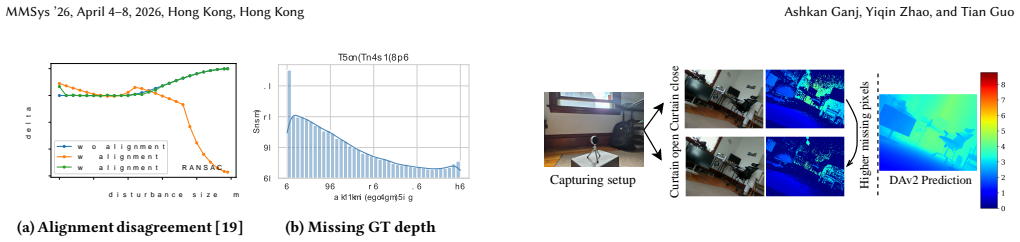
Summary. The submission consists of an abstract for a compact, rack-mountable optical frequency reference (OFR) module and a full text that is an unrelated paper on augmented-reality evaluation (arXiv:2508.04102v2, "AR as an Evaluation Playground"). The abstract claims that the module maintains frequency-stable operation for several months, withstands vibrations up to 4g, is assembled from a custom-machined aluminum plate with sub-millimeter placement accuracy, and is reproducible via openly shared design files. The supplied full text contains none of the supporting material: no optical design, no modeled beam path, no mechanical drawings, no stability or vibration measurements, and no discussion of frequency references. As submitted, the manuscript cannot be evaluated as a physics/atom-ph paper because the body does not correspond to the abstract.
Significance. If the claimed OFR module were real and supported by data, it would be a significant practical contribution: a compact, reproducible, vibration-tolerant frequency reference is valuable for quantum technologies, optical communications, and metrology. The emphasis on open design files and alignment-free assembly is also a strength in principle. However, the submitted full text is a different paper entirely, so none of these contributions can be assessed. There is no experimental evidence, no design description, and no reproducibility artifact within the manuscript. The significance therefore cannot be established from this document.
major comments (3)
- [Full text (all sections)] The supplied full text is "AR as an Evaluation Playground: Bridging Metric and Visual Perception of Computer Vision Models" (arXiv:2508.04102v2), not a paper on optical frequency references. Sections 1 through 7 and the reference list discuss computer-vision evaluation, depth estimation, lighting estimation, and an AR platform called ARCADE. There is no mention of laser beam paths, aluminum plates, frequency stability, vibration testing, or OFR design. Consequently, every central claim in the abstract is unsupported by the body of the manuscript. This is a load-bearing omission: the manuscript cannot be reviewed as submitted.
- [Abstract] Even if the full text were the correct paper, the headline claims—"frequency-stable operation for several months" and "robustness to mechanical vibrations up to 4g"—are presented without any definition of the stability metric (e.g., Allan deviation, frequency error, lock status), the type of optical frequency reference, the test environment, or the vibration test protocol (axis, frequency range, duration). No error bars or comparison to existing systems are given. The reader cannot assess the validity or reproducibility of these quantitative claims.
- [Abstract] The abstract says the optical subsystem is "designed based on a modeled laser beam path" and that optical elements are placed "with sub-millimeter accuracy" on a custom-machined aluminum plate, enabling assembly "without extensive alignment." No modeling details, tolerance analysis, machining specifications, or assembly validation are present in the manuscript. The claim that all design files are "openly shared" is also unverified, since no repository, file list, or access information appears in the text.
minor comments (2)
- [Abstract] The phrase "several months" is too vague for a frequency-stability claim; a quantitative duration and stability measure (e.g., fractional frequency offset or Allan deviation at specific averaging times) are needed.
- [Abstract] The vibration specification "4g" should state the frequency range, axis, and whether the module was operational during vibration or merely survived it.
Circularity Check
No circularity: abstract reports direct engineering measurements and contains no derivation, fitting, or load-bearing self-citation.
full rationale
The abstract describes a compact optical frequency reference module and reports direct engineering outcomes: sub-millimeter placement accuracy on a machined aluminum plate, frequency-stable operation for several months, and robustness to vibrations up to 4g. These are empirical performance claims, not derived quantities. There is no equation, no fitted parameter later renamed as a prediction, and no self-citation invoked as a premise. The supplied full-text body is an unrelated arXiv paper on augmented-reality evaluation; this mismatch affects verifiability of the abstract's claims, but it does not constitute circular reasoning under the specified patterns. No step in the abstract's reasoning reduces to its own inputs by construction. Therefore the appropriate circularity score is 0.
Assumptions & free parameters
assumptions (3)
- domain assumption The custom-machined aluminum plate can be fabricated with sub-millimeter accuracy as modeled.
- domain assumption The modeled laser beam path correctly predicts the physical optical alignment.
- domain assumption Frequency stability for several months assumes a stable environment or sufficient passive isolation.
Cite this review
Pith. "Pith review of Compact and robust optical frequency reference module based on reproducible and redistributable optical design." pith.science (2026). https://pith.science/paper/FOVD2I4C
@misc{pith2026250804103,
  author       = {Pith},
  title        = {Pith review of: Compact and robust optical frequency reference module based on reproducible and redistributable optical design},
  year         = {2026},
  howpublished = {\url{https://pith.science/paper/FOVD2I4C}},
  note         = {Machine review of arXiv:2508.04103}
}
read the original abstract
Stabilized optical frequency references (OFRs) are indispensable for atom-based quantum technologies, optical communications, and precision metrology. As these systems become more sophisticated, demands for compactness, robustness, and straightforward reproduction have grown. In this work, we present a robust 19-inch rack-mountable OFR module designed via a web-based CAD workflow that allows straightforward redistribution and reproduction. Its optical subsystem, designed based on a modeled laser beam path, places optical elements with sub-millimeter accuracy on a custom-machined aluminum plate, allowing straightforward assembly without extensive alignment and providing high mechanical stability. The module maintains frequency-stable operation for several months without user intervention and exhibits high robustness to mechanical vibrations up to 4g. All design files, including mechanical and optical metadata, are openly shared for straightforward reproduction and adaptation.
Figures


Figures from the paper (7 more)


Reference graph
Works this paper leans on
-
[1]
2025. COCO Detection Evaluation. https://cocodataset.org/#detection-eval. Accessed: 2025-06-16
work page 2025
-
[2]
2025.Multimodal Object Detection Using Depth and Image Data for Manufacturing Parts. arXiv:https://asmedigitalcollection.asme.org/MSEC/proceedings- pdf/MSEC2025/89022/V002T16A001/7543143/v002t16a001-msec2025- 155144.pdf doi:10.1115/MSEC2025-155144
-
[3]
Apple. 2017. https://developer.apple.com/augmented-reality/
work page 2017
-
[4]
Gilad Baruch, Zhuoyuan Chen, Afshin Dehghan, Tal Dimry, Yuri Feigin, Peter Fu, Thomas Gebauer, Brandon Joffe, Daniel Kurz, Arik Schwartz, and Elad Shul- man. 2021. ARKitScenes - A Diverse Real-World Dataset For 3D Indoor Scene Understanding Using Mobile RGB-D Data. InNeurIPS. https://arxiv.org/pdf/2111. 08897.pdf
work page 2021
-
[5]
Shariq Farooq Bhat, Reiner Birkl, Diana Wofk, Peter Wonka, and Matthias Müller
-
[6]
Sonia Castelo, Joao Rulff, Erin McGowan, Bea Steers, Guande Wu, Shaoyu Chen, Iran Roman, Roque Lopez, Ethan Brewer, Chen Zhao, Jing Qian, Kyunghyun Cho, He He, Qi Sun, Huy Vo, Juan Bello, Michael Krone, and Claudio Silva. 2024. ARGUS: Visualization of AI-Assisted Task Guidance in AR.IEEE Transactions on Visualization and Computer Graphics30, 1 (2024), 131...
arXiv 2024
-
[7]
Francesco Croce, Maksym Andriushchenko, Vikash Sehwag, Edoardo Debenedetti, Nicolas Flammarion, Mung Chiang, Prateek Mittal, and Matthias Hein. 2021. RobustBench: a standardized adversarial robustness benchmark. In Thirty-fifth Conference on Neural Information Processing Systems Datasets and Benchmarks Track. https://openreview.net/forum?id=SSKZPJCt7B
work page 2021
-
[8]
Chang, Manolis Savva, Maciej Halber, Thomas Funkhouser, and Matthias Nießner
Angela Dai, Angel X. Chang, Manolis Savva, Maciej Halber, Thomas Funkhouser, and Matthias Nießner. 2017. ScanNet: Richly-annotated 3D Reconstructions of Indoor Scenes. InProc. Computer Vision and Pattern Recognition (CVPR), IEEE
2017
Show all 47 references
-
[9]
Ashkan Ganj, Hang Su, and Tian Guo. 2025. HybridDepth: Robust Metric Depth Fusion by Leveraging Depth from Focus and Single-Image Priors. InProceedings of the Winter Conference on Applications of Computer Vision (W ACV). 973–982
2025
-
[10]
Ashkan Ganj, Yiqin Zhao, Federico Galbiati, and Tian Guo. 2023. Toward scalable and controllable AR experimentation. InProceedings of the 1st ACM Workshop on Mobile Immersive Computing, Networking, and Systems. ACM, New York, NY, USA, 237–246
2023
-
[11]
Ashkan Ganj, Yiqin Zhao, Hang Su, and Tian Guo. 2024. Mobile AR Depth Estimation: Challenges & Prospects. InProceedings of the 25th International Workshop on Mobile Computing Systems and Applications(<conf-loc>, <city>San Diego</city>, <state>CA</state>, <country>USA</country>...
2024
-
[12]
Marc-André Gardner, Kalyan Sunkavalli, Ersin Yumer, Xiaohui Shen, Emiliano Gambaretto, Christian Gagné, and Jean-François Lalonde. 2017. Learning to Predict Indoor Illumination from a Single Image.ACM Transactions on Graphics (2017)
2017
-
[13]
Justine Giroux, Mohammad Reza Karimi Dastjerdi, Yannick Hold-Geoffroy, Javier Vazquez-Corral, and Jean-François Lalonde. 2024. Towards a Perceptual Evalua- tion Framework for Lighting Estimation. InIEEE/CVF Conference on Computer Vision and Pattern Recognition (CVPR)
2024
-
[14]
Bo Han, Parth Pathak, Songqing Chen, and Lap-Fai Craig Yu. 2022. CoMIC: A Collaborative Mobile Immersive Computing Infrastructure for Conducting Multi-user XR Research.IEEE Netw.(2022), 1–9
2022
-
[15]
Muhammad Huzaifa, Rishi Desai, Samuel Grayson, Xutao Jiang, Ying Jing, Jae Lee, Fang Lu, Yihan Pang, Joseph Ravichandran, Finn Sinclair, Boyuan Tian, Hengzhi Yuan, Jeffrey Zhang, and Sarita V Adve. 2021. ILLIXR: Enabling End-to-End Extended Reality Research. In2021 IEEE Intern...
2021
-
[16]
Nuwan Janaka, Shengdong Zhao, David Hsu, Sherisse Tan Jing Wen, and Chun Keat Koh. 2024. TOM: A Development Platform For Wearable Intelli- gent Assistants. InCompanion of the 2024 on ACM International Joint Conference on Pervasive and Ubiquitous Computing. 837–843
2024
-
[17]
Hyoukjun Kwon, Krishnakumar Nair, Jamin Seo, Jason Yik, Debabrata Mohap- atra, Dongyuan Zhan, Jinook Song, Peter Capak, Peizhao Zhang, Peter Vajda, Colby Banbury, Mark Mazumder, Liangzhen Lai, Ashish Sirasao, Tushar Krishna, Harshit Khaitan, Vikas Chandra, and Vijay Janapa Red...
2023
-
[18]
Jin Han Lee, Myung-Kyu Han, Dong Wook Ko, and Il Hong Suh. 2019. From big to small: Multi-scale local planar guidance for monocular depth estimation. arXiv preprint arXiv:1907.10326(2019)
2019 arXiv
-
[19]
Zhenyu Li, Haotong Lin, Jiashi Feng, Peter Wonka, and Bingyi Kang. 2025. BenchDepth: Are We on the Right Way to Evaluate Depth Foundation Mod- els?arXiv preprint arXiv:2507.15321(2025)
2025 arXiv
-
[20]
Jiahao Lu, Tianyu Huang, Peng Li, Zhiyang Dou, Cheng Lin, Zhiming Cui, Zhen Dong, Sai-Kit Yeung, Wenping Wang, and Yuan Liu. 2025. Align3R: Aligned Monocular Depth Estimation for Dynamic Videos. InComputer Vision and Pattern Recognition (CVPR)
2025
-
[21]
Maxim Maximov, Kevin Galim, and Laura Leal-Taixé. 2020. Focus on defocus: bridging the synthetic to real domain gap for depth estimation. InProceedings of the IEEE/CVF conference on computer vision and pattern recognition. 1071–1080
2020
-
[22]
Jishnu Mukhoti, Tsung-Yu Lin, Bor-Chun Chen, Ashish Shah, Philip H. S. Torr, Puneet K. Dokania, and Ser-Nam Lim. 2023. Raising the Bar on the Evaluation of Out-of-Distribution Detection. InProceedings of the IEEE/CVF International Conference on Computer Vision Workshops (ICCVW...
2023
-
[23]
Pushmeet Kohli Nathan Silberman, Derek Hoiem and Rob Fergus. 2012. Indoor Segmentation and Support Inference from RGBD Images. InECCV
2012
-
[24]
Seyedmohammad Nouraniboosjin and Fatemeh Ganji. 2024. Too Hot To Be True: Temperature Calibration for Higher Confidence in NN-assisted Side-channel Analysis.Cryptology ePrint Archive(2024)
2024
-
[25]
Seyedmohammad Nouraniboosjin and Fatameh Ganji. 2025. Uncertainty estima- tion in neural network-enabled side-channel analysis and links to explainability. (2025)
2025
-
[26]
Pakkapon Phongthawee, Worameth Chinchuthakun, Nontaphat Sinsunthithet, Amit Raj, Varun Jampani, Pramook Khungurn, and Supasorn Suwajanakorn. 2023. DiffusionLight: Light Probes for Free by Painting a Chrome Ball. InArXiv
2023
-
[27]
Luigi Piccinelli, Yung-Hsu Yang, Christos Sakaridis, Mattia Segu, Siyuan Li, Luc Van Gool, and Fisher Yu. 2024. UniDepth: Universal Monocular Metric Depth Estimation. InIEEE Conference on Computer Vision and Pattern Recognition (CVPR)
2024
-
[28]
Tahmid Rafi, Xueling Zhang, and Xiaoyin Wang. 2022. PredART: Towards automatic oracle prediction of object placements in augmented reality testing. In Proceedings of the 37th IEEE/ACM International Conference on Automated Software Engineering. ACM, New York, NY, USA
2022
-
[29]
René Ranftl, Alexey Bochkovskiy, and Vladlen Koltun. 2021. Vision Transformers for Dense Prediction.ArXiv preprint(2021)
2021
-
[30]
Albert Tung, Josiah Wong, Ajay Mandlekar, Roberto Martín-Martín, Yuke Zhu, Li Fei-Fei, and Silvio Savarese. 2021. Learning Multi-Arm Manipulation Through Collaborative Teleoperation. In2021 IEEE International Conference on Robotics and Automation (ICRA). 9212–9219
2021
-
[31]
Guangcong Wang, Yinuo Yang, Chen Change Loy, and Ziwei Liu. 2022. StyleLight: HDR Panorama Generation for Lighting Estimation and Editing. InEuropean Conference on Computer Vision (ECCV)
2022
-
[32]
Jamie Watson, Mohamed Sayed, Zawar Qureshi, Gabriel J Brostow, Sara Vicente, Oisin Mac Aodha, and Michael Firman. 2023. Virtual Occlusions Through Implicit Depth. InProceedings of the Conference on Computer Vision and Pattern Recognition (CVPR)
2023
-
[33]
Chengyuan Xu, Radha Kumaran, Noah Stier, Kangyou Yu, and Tobias Höllerer
-
[34]
Xuhai Xu, Anna Yu, Tanya R. Jonker, Kashyap Todi, Feiyu Lu, Xun Qian, João Marcelo Evangelista Belo, Tianyi Wang, Michelle Li, Aran Mun, Te-Yen Wu, Junxiao Shen, Ting Zhang, Narine Kokhlikyan, Fulton Wang, Paul Soren- son, Sophie Kim, and Hrvoje Benko. 2023. XAIR: A Framework ...
2023
-
[35]
Weilong Yan, Ming Li, Haipeng Li, Shuwei Shao, and Robby T. Tan. 2025. Synthetic-to-Real Self-supervised Robust Depth Estimation via Learning with Mo- tion and Structure Priors. InProceedings of the IEEE/CVF Conference on Computer Vision and Pattern Recognition (CVPR). 21880–21890
2025
-
[36]
Lihe Yang, Bingyi Kang, Zilong Huang, Xiaogang Xu, Jiashi Feng, and Heng- shuang Zhao. 2024. Depth Anything: Unleashing the Power of Large-Scale Unlabeled Data. InCVPR
2024
-
[37]
Lihe Yang, Bingyi Kang, Zilong Huang, Zhen Zhao, Xiaogang Xu, Jiashi Feng, and Hengshuang Zhao. 2024. Depth Anything V2.arXiv:2406.09414(2024)
2024 arXiv
-
[38]
Yung-hao Yang, Zitang Sun, Taiki Fukiage, and Shin’ya Nishida. 2025. HuPer- Flow: A Comprehensive Benchmark for Human vs. Machine Motion Estimation Comparison. InProceedings of the IEEE/CVF Conference on Computer Vision and Pattern Recognition (CVPR). In press
2025
-
[39]
Juheon Yi and Youngki Lee. 2020. Heimdall: mobile GPU coordination platform for augmented reality applications. InProceedings of the 26th Annual Interna- tional Conference on Mobile Computing and Networking (MobiCom ’20, Article 35). Association for Computing Machinery, New Yo...
2020
-
[40]
Ji Zhang and Sanjiv Singh. 2015. Visual-lidar odometry and mapping: Low-drift, robust, and fast. In2015 IEEE international conference on robotics and automation (ICRA). IEEE, 2174–2181
2015
-
[41]
Efros, Eli Shechtman, and Oliver Wang
Richard Zhang, Phillip Isola, Alexei A. Efros, Eli Shechtman, and Oliver Wang
-
[42]
Yiqin Zhao and Tian Guo. 2021. Xihe: A 3D Vision-Based Lighting Estimation Framework for Mobile Augmented Reality. InProceedings of the 19th Annual International Conference on Mobile Systems, Applications, and Services (MobiSys’21). MMSys ’26, April 4–8, 2026, Hong Kong, Hong ...
2021
-
[43]
Yiqin Zhao and Tian Guo. 2024. Demo: ARFlow: A Framework for Simplifying AR Experimentation Workflow. InProceedings of the 25th International Workshop on Mobile Computing Systems and Applications(<conf-loc>, <city>San Diego</city>, <state>CA</state>, <country>USA</country>, </...
2024
-
[44]
Sharon Zhou, Mitchell L Gordon, Ranjay Krishna, Austin Narcomey, Li Fei-Fei, and Michael S Bernstein. 2019. HYPE: A benchmark for Human eYe Perceptual Evaluation of generative models.arXiv [cs.CV](April 2019)
2019
-
[2018]
arXiv:1801.03924 [cs.CV] https://arxiv.org/abs/1801.03924
The Unreasonable Effectiveness of Deep Features as a Perceptual Metric. arXiv:1801.03924 [cs.CV] https://arxiv.org/abs/1801.03924
- [2023]
-
[2024]
In2024 IEEE International Symposium on Mixed and Augmented Reality (ISMAR)
Multimodal 3D Fusion and In-Situ Learning for Spatially Aware AI. In2024 IEEE International Symposium on Mixed and Augmented Reality (ISMAR). IEEE, 485–494
Reviewed August 6, 2026 · model on record in the stance chip above.
Discussion (0). Sign in to comment.