Nonlinear Dynamics of Kink Configurations: From Small to Large Kink Collisions
Pith reviewed 2026-05-21 22:42 UTC · model grok-4.3
The pith
The critical velocity for small kink separation varies non-monotonically with the potential parameter λ.
A machine-rendered reading of the paper's core claim, the machinery that carries it, and where it could break.
Core claim
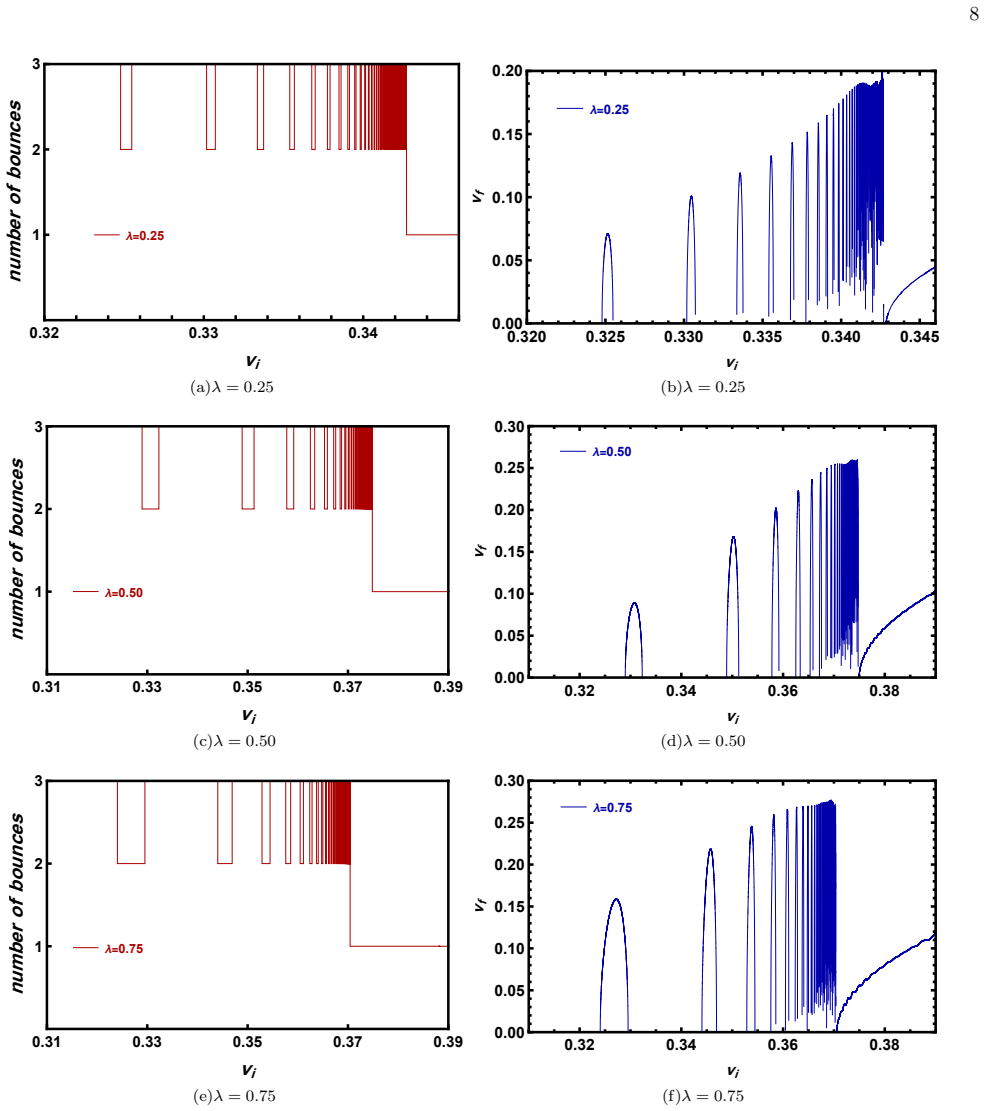
In the parameterized model the small-kink solutions support vibrational modes that generate resonance windows and bion formation, whereas the large-kink solutions support none. The critical velocity separating small-kink pairs therefore depends non-monotonically on λ. Small-kink collisions produce large kinks preferentially at lower λ where the mass difference is reduced. Large-kink collisions in turn produce small-kink pairs, with the number of pairs rising with both λ and initial velocity because translational kinetic energy is transferred into the potential energy needed to create the smaller defects.
What carries the argument
The one-parameter family of potentials U_λ(χ) that interpolates between distinct small-kink and large-kink solutions and controls both their mass difference and the spectrum of small-kink vibrational modes.
If this is right
- Resonance windows and bion formation disappear at higher λ because vibrational frequencies fall.
- Large kinks emerge from small-kink collisions most readily at low λ where the mass difference is smallest.
- Large-kink scattering yields more small-kink pairs as both λ and collision speed increase through energy transfer from translational motion.
- Large kinks exhibit simpler scattering dynamics than small kinks because they lack internal modes.
Where Pith is reading between the lines
- Tuning λ could serve as a practical control knob for selecting which kink species is produced in nonlinear media.
- The same mass-difference and energy-transfer mechanism may govern defect creation in other field theories that admit multiple topological solutions.
- The non-monotonic critical-velocity curve implies the existence of discrete λ values at which small-kink stability changes abruptly.
Load-bearing premise
The numerical integration scheme and boundary conditions faithfully reproduce the continuum dynamics of the nonlinear wave equation without introducing artifacts that alter the observed resonance windows or kink-production statistics.
What would settle it
An independent simulation or analytic calculation that finds the critical velocity for small-kink separation to be a strictly monotonic function of λ would falsify the reported non-monotonic dependence.
Figures



read the original abstract
This study explores the scattering dynamics of kinks within a nonlinear system governed by a parameterized potential $U_\lambda(\chi)$, examining the distinct behaviors of small and large kinks across a range of $\lambda$ values and initial velocities. For small kinks, we investigate the critical velocity for separation, the influence of vibrational modes, resonance phenomena, and the conditions under which large kinks emerge from collisions. Our findings reveal that the critical velocity exhibits a non-monotonic dependence on the parameter $\lambda$, reflecting the evolving stability of small kinks, while the decreasing frequency of vibrational modes with increasing $\lambda$ diminishes resonance effects, leading to simpler scattering dynamics at higher $\lambda$. The formation of large kinks from small kink collisions is favored at lower $\lambda$, where the mass difference between small and large kinks is reduced. Conversely, large kink scattering consistently results in the production of small kinks, with the number of small kink pairs growing as both $\lambda$ and initial velocity increase, a process driven by energy transfer from the translational modes of large kinks to the potential energy required for small kink creation. The absence of vibrational modes in large kinks contrasts with their presence in small kinks, where such modes give rise to complex phenomena like bion formation and resonance. These results underscore the pivotal role of $\lambda$ in shaping kink interactions and offer valuable insights into the dynamics of topological defects in nonlinear systems, with potential implications for understanding similar phenomena in condensed matter physics and related fields.
Editorial analysis
A structured set of objections, weighed in public.
Referee Report
Summary. The paper numerically studies kink scattering in a one-parameter family of nonlinear wave equations with potential U_λ(χ). For small kinks it reports a non-monotonic dependence of the critical separation velocity on λ, resonance windows linked to vibrational-mode frequencies that decrease with λ, and preferential production of large kinks at low λ. Large-kink collisions are found to produce increasing numbers of small-kink pairs with rising λ and velocity, driven by translational-to-potential energy transfer; large kinks lack internal modes while small kinks exhibit bion formation and resonances.
Significance. If the reported collision statistics and λ-dependences are robust, the work supplies concrete, falsifiable numerical predictions for how a single control parameter tunes the balance between resonant and non-resonant kink dynamics, with direct relevance to topological defects in condensed-matter and field-theory models.
major comments (2)
- [Numerical Methods] Numerical Methods section: no convergence tests (grid spacing, time-step size, domain size) or error bars are reported on the critical velocities or kink-production counts extracted from the time-dependent solutions. Because the central claims rest on the precise location of resonance windows and the non-monotonicity of the critical velocity, the absence of these diagnostics leaves open the possibility that the reported λ-dependence is influenced by integrator or boundary artifacts.
- [§4.1] §4.1 and associated figures: the statement that resonance windows are “tied to vibrational-mode frequencies” is not supported by an explicit tabulation or plot comparing the computed mode frequencies (or their λ-dependence) to the observed resonance velocities; without this comparison the attribution remains qualitative and load-bearing for the interpretation of the scattering data.
minor comments (2)
- [Figures] Figure captions should explicitly state the range of initial velocities, the precise definition of “critical velocity,” and the criterion used to count produced kinks.
- [Discussion] A short paragraph comparing the observed large-kink production rates to any available analytic estimates (e.g., energy thresholds) would strengthen the discussion.
Simulated Author's Rebuttal
We thank the referee for the careful reading and constructive comments on our manuscript. We address each major comment below and describe the revisions that will be incorporated to strengthen the numerical validation and interpretive support.
read point-by-point responses
-
Referee: [Numerical Methods] Numerical Methods section: no convergence tests (grid spacing, time-step size, domain size) or error bars are reported on the critical velocities or kink-production counts extracted from the time-dependent solutions. Because the central claims rest on the precise location of resonance windows and the non-monotonicity of the critical velocity, the absence of these diagnostics leaves open the possibility that the reported λ-dependence is influenced by integrator or boundary artifacts.
Authors: We agree that explicit convergence diagnostics are essential to substantiate the robustness of the reported critical velocities and resonance windows. In the revised manuscript we will add a new subsection to the Numerical Methods section that reports convergence tests with respect to spatial grid spacing, time-step size, and domain size. We will also include error bars on the extracted critical velocities and kink-production statistics, obtained from ensembles of runs at multiple resolutions. These additions will confirm that the non-monotonic λ-dependence and resonance structure are not numerical artifacts. revision: yes
-
Referee: [§4.1] §4.1 and associated figures: the statement that resonance windows are “tied to vibrational-mode frequencies” is not supported by an explicit tabulation or plot comparing the computed mode frequencies (or their λ-dependence) to the observed resonance velocities; without this comparison the attribution remains qualitative and load-bearing for the interpretation of the scattering data.
Authors: We acknowledge that a direct quantitative comparison would make the link between resonance windows and vibrational modes more rigorous. In the revised §4.1 we will insert a new figure (or table) that overlays the computed vibrational-mode frequencies as a function of λ against the observed resonance velocities extracted from the scattering simulations. This explicit comparison will provide quantitative support for the attribution and strengthen the physical interpretation. revision: yes
Circularity Check
No circularity: all claims extracted from direct numerical integration of the nonlinear wave equation
full rationale
The paper presents results from numerical simulations of kink scattering in the parameterized potential U_λ(χ). Key observations—the non-monotonic critical velocity versus λ for small-kink separation, resonance windows tied to vibrational frequencies, and preferential large-kink production at low λ—are obtained by integrating the equations of motion forward in time and post-processing the trajectories. No step reduces a reported quantity to a fitted parameter defined in terms of itself, nor does any central claim rest on a self-citation chain whose validity is presupposed by the present work. The derivation chain is therefore self-contained against external benchmarks (the continuum PDE and its numerical solution).
Axiom & Free-Parameter Ledger
free parameters (2)
- λ
- initial velocity
axioms (2)
- standard math The system obeys a relativistic nonlinear wave equation derived from the potential U_λ(χ).
- domain assumption Both small and large kink solutions exist and remain stable over the studied range of λ.
Lean theorems connected to this paper
-
IndisputableMonolith/Cost/FunctionalEquation.leanwashburn_uniqueness_aczel unclear?
unclearRelation between the paper passage and the cited Recognition theorem.
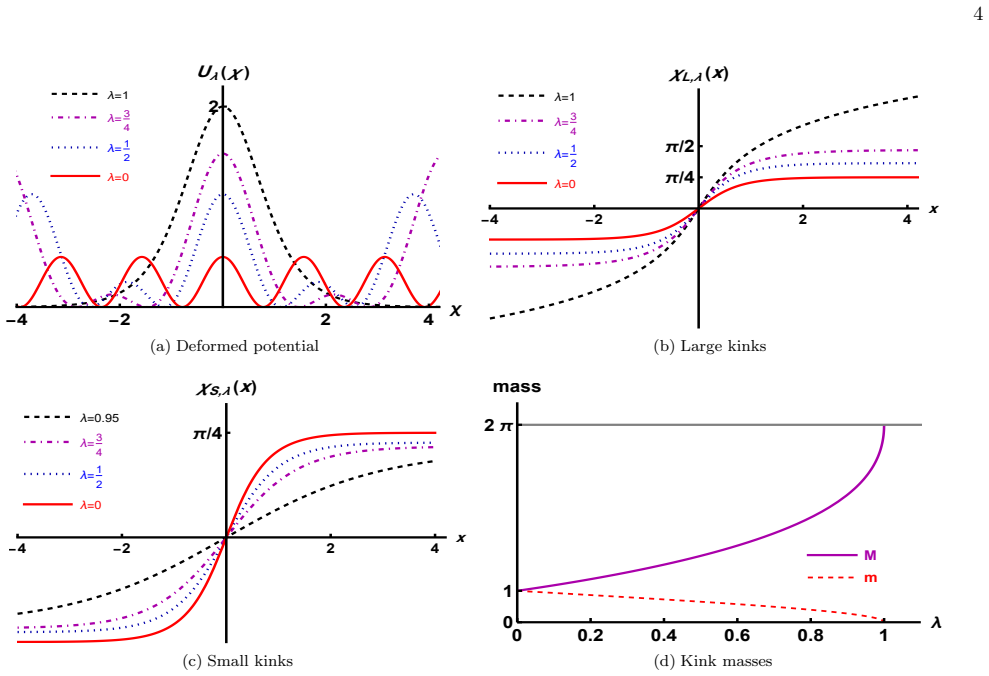
The resulting potential is shown in Fig. 1(a), Uλ(χ)=½(2cn²(χ,λ)−θ²)²dn²(χ,λ). ... classical mass = ∫(dχ/dx)² dx with explicit λ-dependent expressions (26)–(27).
-
IndisputableMonolith/Foundation/ArithmeticFromLogic.leanembed_strictMono_of_one_lt unclear?
unclearRelation between the paper passage and the cited Recognition theorem.
Stability analysis yields Schrödinger-like equation (−d²/dx² + vK,λ(x))ηn=ωn²ηn with vS,λ and vL,λ plotted in Fig. 2; resonance windows tied to vibrational frequencies ω1(λ).
What do these tags mean?
- matches
- The paper's claim is directly supported by a theorem in the formal canon.
- supports
- The theorem supports part of the paper's argument, but the paper may add assumptions or extra steps.
- extends
- The paper goes beyond the formal theorem; the theorem is a base layer rather than the whole result.
- uses
- The paper appears to rely on the theorem as machinery.
- contradicts
- The paper's claim conflicts with a theorem or certificate in the canon.
- unclear
- Pith found a possible connection, but the passage is too broad, indirect, or ambiguous to say the theorem truly supports the claim.
Reference graph
Works this paper leans on
-
[1]
R. Rajaraman, Solitons and Instantons: An Introduc- tion to Solitons and Instantons in Quantum Field The- ory, North-Holland (1982)
work page 1982
-
[2]
A. Vilenkin, and E. P. S. Shellard, Cosmic Strings and Other Topological Defects , Cambridge University Press (2000)
work page 2000
-
[3]
N. Manton, and P. Sutcliffe, Topological Solitons, Cam- bridge University Press, Cambridge University Press (2004)
work page 2004
-
[4]
Y. M. Shnir, Topological and Non-Topological Solitons in Scalar Field Theories , Cambridge University Press (2018)
work page 2018
-
[5]
A. R. Bishop, J. A. Krumhansl, and S. E. Trullinger, Solitons in condensed matter: A paradigm , Physica D 1 (1980) 1
work page 1980
-
[6]
S. V. Suchkov, A. A. Sukhorukov, J. Huang, S. V. Dmitriev, C. Lee, and Yu. S. Kivshar, Nonlinear switching and solitons in PT-symmetric photonic sys- tems, Laser Photonics Rev. 10 (2016) 2, 177-213
work page 2016
-
[7]
A. E. Miroshnichenko, S. V. Dmitriev, A. A. Vasiliev and T. Shigenari, Inelastic three-soliton collisions in a weakly discrete sine-Gordon system, Nonlinearity. 13 (2000) 837
work page 2000
-
[8]
S. V. Dmitriev, P. G. Kevrekidis, and Y. S. Kivshar, Radiationless energy exchange in three-soliton collisions, Phys. Rev. E 78 (2008) 046604
work page 2008
-
[9]
Extreme values of elastic strain and energy in sine-Gordon multi-kink collisions
A. Moradi Marjaneh, A. Askari, D. Saadatmand, and S.V. Dmitriev, Extreme values of elastic strain and en- ergy in sine-Gordon multi-kink collisions , Eur. Phys. J. B 91 (2018) 22 [ arXiv:1710.10159]
work page internal anchor Pith review Pith/arXiv arXiv 2018
-
[10]
Makhankov, Dynamics of classical solitons (in non- integrable systems), Phys
V.G. Makhankov, Dynamics of classical solitons (in non- integrable systems), Phys. Rep. 35 (1978) 1
work page 1978
-
[11]
D. K. Campbell, J. F. chonfeld, C. A. Wingate, Reso- nance structure in kink-antikink interactions in φ4 the- ory, Physica D 9 (1980) 1-2
work page 1980
-
[12]
High energy density in the collision of $N$ kinks in the $\phi^4$ model
A. Moradi Marjaneh, D. Saadatmand, K. Zhou, S.V. Dmitriev, and M.E. Zomorrodian, High energy density in the collision of N kinks in the ϕ4 model, 11 Commun. Nonlinear Sci. Numer. Simulat. 49 (2017) 30 [arXiv:1605.09767]
work page internal anchor Pith review Pith/arXiv arXiv 2017
-
[13]
A. Askari, A. Moradi Marjaneh, Z. G. Rakhmatul- lina, M. Ebrahimi-Loushab, D. Saadatmand, V. A. Gani, P. G. Kevrekidis, and S. V. Dmitriev, Collision of φ4 kinks free of the Peierls-Nabarro barrier in the regime of strong discreteness , Chaos, Solitons and Fractals 138 (2020) 109854 [ arXiv:1912.07953]
- [14]
- [15]
-
[16]
Multi-kink collisions in the $\phi^6$ model
A. Moradi Marjaneh, V. A. Gani, D. Saadatmand, S. V. Dmitriev, and K. Javidan, Multi-kink collisions in the ϕ6 model, JHEP 07 (2017) 028 [ arXiv:1704.08353]
work page internal anchor Pith review Pith/arXiv arXiv 2017
-
[17]
V. A. Gani, and A. Moradi Marjaneh, Asymmetric kink solutions of hyperbolically deformed model , Journal of Physics: Conference Series 1690 (2020) 012096
work page 2020
-
[18]
D. Saadatmand, and A. Moradi Marjaneh, Scattering of the asymmetric φ6 kinks from a PT -symmetric perturba- tion: creating multiple kink–antikink pairs from phonons , Eur. Phys. J. B 95 (2022) 144 [ arXiv:2201.03277]
- [19]
-
[20]
D. Saadatmand, A. Moradi Marjaneh, A. Askari, and H. Weigel, Phonons scattering off discrete asymmet- ric solitons in the absence of a Peierls-Nabarro poten- tial, Chaos, Solitons and Fractals 180 (2024) 114550 [arXiv:2308.02322]
-
[21]
A. Khare, I. C. Christov, and A. Saxena, Succes- sive phase transitions and kink solutions in ϕ8, ϕ10, and ϕ12 field theories, Phys. Rev. E 90 (2014) 023208 [arXiv:1402.6766]
work page internal anchor Pith review Pith/arXiv arXiv 2014
-
[22]
P. A. Blinov, V. A. Gani, and A. Moradi Marjaneh, From thin to thick domain walls: An example of the φ8 model, Journal of Physics: Conference Series 1690 (2020) 012082
work page 2020
- [23]
- [24]
-
[25]
Scattering of kinks of the sinh-deformed $\varphi^4$ model
D. Bazeia, E. Belendryasova, and V. A. Gani, Scattering of kinks of the sinh-deformed ϕ4 model, Eur. Phys. J. C 78 (2018) 340 [ arXiv:1710.04993]
work page internal anchor Pith review Pith/arXiv arXiv 2018
-
[26]
A. Moradi Marjaneh, F. C. Simas, and D. Bazeia Collisions of kinks in deformed φ4 and φ6 mod- els, Chaos, Solitons and Fractals 164 (2022) 112723 [arXiv:2207.00835]
-
[27]
A. Moradi Marjaneh, F. C. Simas, and D. Bazeia Scattering of kinks in scalar-field models with higher- order self-interactions , Ann. Phys. 470 (2024) 169777 [arXiv:2402.00270]
-
[28]
D. K. Campbell, M. Peyrard, and P. Sodano, Kink- antikink interactions in the double sine-Gordon equation , Physica D 19 (1986) 165
work page 1986
-
[29]
Interaction Properties of the Periodic and Step-like Solutions of the Double-Sine-Gordon Equation
M. Peyravi, A. Montakhab, N. Riazi, and A. Gharaati, Interaction Properties of the Periodic and Step-like So- lutions of the Double-Sine-Gordon Equation , Eur. Phys. J. B 72 (2009) 269 [ arXiv:0802.2776]
work page internal anchor Pith review Pith/arXiv arXiv 2009
-
[30]
V.A. Gani, A. Moradi Marjaneh, A. Askari, E. Be- lendryasova, and D. Saadatmand, Scattering of the dou- ble sine-Gordon kinks , Eur. Phys. J. C 78 (2018) 345 [arXiv:1711.01918]
work page internal anchor Pith review Pith/arXiv arXiv 2018
-
[31]
Y. Zolotaryuk, IO. Starodub, Moving Embedded Soli- tons in the Discrete Double Sine-Gordon Equation , Non- linear Systems, Vol.2, Understanding Complex Systems. Springer, Cham (2018)
work page 2018
-
[32]
A new look at the double sine-Gordon kink-antikink scattering
E. Belendryasova, V.A. Gani, A. Moradi Marjaneh, D. Saadatmand, and A. Askari, A new look at the dou- ble sine-Gordon kink-antikink scattering, J. Phys.: Conf. Ser. 1205 (2019) 012007 [ arXiv:1810.00667]
work page internal anchor Pith review Pith/arXiv arXiv 2019
- [33]
-
[34]
F. Hadipour, D. Saadatmand, M. Ashhadi, A. Moradi Marjaneh, I. Evazzade, A. Askari, and S. V. Dmitriev, Interaction of phonons with discrete breathers in one-dimensional chain with tunable type of anharmonicity, Phys. Lett. A 384 (2020) 126100
work page 2020
- [35]
- [36]
-
[37]
From sine-Gordon to vacuumless systems in flat and curved spacetimes
D. Bazeia, and D. C. Moreira, From sine-Gordon to vacu- umless systems in flat and curved spacetimes , Eur. Phys. J. C 77 (2017) 884 [ arXiv:1703.06363]
work page internal anchor Pith review Pith/arXiv arXiv 2017
-
[38]
A discrete phi^4 system without Peierls-Nabarro barrier
J.M. Speight, A discrete ϕ4 system without a Peierls–Nabarro barrier , Nonlinearity 10, 1615 (1997) [arXiv:patt-sol/9703005]
work page internal anchor Pith review Pith/arXiv arXiv 1997
-
[39]
P.G. Kevrekidis, On a class of discretizations of Hamil- tonian nonlinear partial differential equations, Physica D 183, 68 (2003)
work page 2003
-
[40]
S. Flach, A.V. Gorbach, Discrete breathers — Advances in theory and applications , Phys. Rep. 467, 1 (2008)
work page 2008
-
[41]
Zh. G. Rakhmatullina, P. G. Kevrekidis and S. V. Dmitriev, Non-symmetric kinks in Klein-Gordon chains free of the Peierls-Nabarro potential, IOP Conf. Series: Materials Science and Engineering. 447 (2018) 012057
work page 2018
-
[42]
Discrete Klein-Gordon models with static kinks free of the Peierls-Nabarro potential
S.V. Dmitriev, P.G. Kevrekidis, N. Yoshikawa, Discrete Klein–Gordon models with static kinks free of the Peierls– Nabarro potential , J. Phys. A: Math. Gen. 38, 7617 (2005) [arXiv:nlin/0506001]
work page internal anchor Pith review Pith/arXiv arXiv 2005
-
[43]
D. Bazeia, L. Losano, and J.M.C. Malbouisson, De- formed defects , Phys. Rev. D 66 (2002) 101701(R) [arXiv:hep-th/0209027]
work page internal anchor Pith review Pith/arXiv arXiv 2002
-
[44]
Deformed defects with applications to braneworlds
D. Bazeia and L. Losano, Deformed defects with appli- cations to braneworlds , Phys. Rev. D 73 (2006) 025016 [arXiv:hep-th/0511193]
work page internal anchor Pith review Pith/arXiv arXiv 2006
-
[45]
A. Khare and A. Saxena, Novel Deformation Func- tion Creating or Destroying any Number of Even Kink Solutions, Phys. Lett. A 424 (2022) 127830 [arXiv:2107.07048]
- [46]
-
[47]
J. Sampaio, J. Grollier, P. J. Metaxas, Domain Wall Mo- tion in Nanostructures. Chapter 8. In Magnetism of Sur- faces, Interfaces, and Nanoscale Materials. Edited by R. E. Camley, Z. Celinski, R. L. Stamps. Handbook of Sur- face Science, 5 (2015) 335
work page 2015
-
[48]
M. D. DeJong and K. L. Livesey, Analytic theory for the switch from Bloch to N´ eel domain wall in nanowires with perpendicular anisotropy, Phys. Rev. B 92 (2015) 214420 [arXiv:1510.07673]
work page internal anchor Pith review Pith/arXiv arXiv 2015
discussion (0)
Sign in with ORCID, Apple, or X to comment. Anyone can read and Pith papers without signing in.