REVIEW 3 major objections 4 minor 1 cited by
Rational minimax approximation of matrix-valued functions
T0 review · 3 major / 4 minor · reviewed 2026-08-05 · deepseek-v4-flash
Pith's one-line read This paper claims that matrix-valued rational minimax approximation can be solved by maximizing a dual problem over the probability simplex, and that a checkable strong-duality condition certifies when the recovered rational function is the
desk verdict A genuine and mostly correct block extension of the d-Lawson framework, but the rational-case convergence theory does not cover the β=1 used in experiments. read the letter →
The pith
A machine-rendered reading of the paper's core claim, the machinery that carries it, and where it could break.
The reading
What carries the argument
The key object is the dual function $d(w)$, defined for each weight vector $w$ on the simplex as the minimum, subject to $\sum_\ell w_\ell |q(x_\ell)|^2=1$, of the weighted sum of squared Frobenius deviations. For fixed $w$, this minimum is the smallest eigenvalue of a Hermitian positive semidefinite pencil $(A_w,B_w)$, and after Vandermonde-with-Arnoldi orthogonalization its square root is the smallest singular value of a structured tall matrix. The Lawson update $w_\ell \leftarrow w_\ell \|F(x_\ell)-R(x_\ell)\|_F^\beta / \sum_i w_i \|F(x_i)-R(x_i)\|_F^\beta$ is a projected gradient ascent step for $d$, so each iteration only requires one thin SVD and one closed-form weight update. The pape
What would settle it
Take a discrete rational approximation of type $(n,d)$ with $d\ge1$ and a known exact minimax error (for instance a scalar rational function with a known equioscillation point distribution). Run m-d-Lawson to convergence and compute the duality gap (4.5), $|e(R)-d(w)|/e(R)$. If the gap stabilizes at a strictly positive value, the sufficient condition (4.1) is violated for that instance, so no global optimality certificate is obtained; collecting such instances would reveal when the paper's central guarantee actually applies.
Extended reading notes
Core claim
The central claim is that the matrix-valued rational minimax problem (1.2) can be solved through the dual maximization (2.19) over the simplex, and that m-d-Lawson is a reliable solver for that dual. The linearized primal (2.6) admits a Lagrange dual function $d(w)$ defined by a constrained minimum that, for fixed weights, reduces to the smallest eigenvalue of a Hermitian positive semidefinite pencil—equivalently, to the smallest singular value of a tall matrix built from weighted Vandermonde bases. Theorem 4.1 is the paper's hinge: if $w^*$ maximizes the dual and the rational function $R^*$ recovered from the minimizer of $d(w^*)$ satisfies $e(R^*) = \max_{x_\ell \in X} \|F(x_\ell)-R^*(x_\e
Load-bearing premise
The load-bearing premise is that, for rational approximations with denominator degree $d\ge1$, the computed dual maximizer produces a rational function whose largest squared Frobenius error exactly equals the dual value; this equality is not guaranteed in advance and is only verified after the computation through the duality gap (4.5).
Editorial extensions
If this is right
- If the sufficient condition (4.1) holds, the computed $R^*$ is a provable global solution of (1.2), giving users a numerical certificate of optimality via the duality gap (4.5).
- For matrix-valued polynomial minimax approximation ($d=0$), strong duality is unconditional, so m-d-Lawson with $\beta\in(0,2)$ monotonically increases $d(w)$ and converges to the global minimax polynomial.
- Complementary slackness implies the optimal weight vector is supported only on extreme points, so non-extreme nodes can be discarded to reduce cost without changing the solution.
- At least $\min_{i,j}(n_{ij}+2)$ extreme points must exist at the optimum, a matrix analogue of the equioscillation property that can be used as a sanity check.
- In the rational case ($d\ge1$), the framework inherits a Ruttan-type strong-duality behavior: the condition is frequently satisfied in practice, so the scalar success of d-Lawson extends to block/vector-valued functions.
Reading between the lines
- Beyond the paper: if strong duality holds generically for matrix-valued rational problems, m-d-Lawson would provide a certified alternative to RMSE-based fitting in multiport microwave modeling and nonlinear eigenvalue problems, where worst-case error is the operative metric.
- Beyond the paper: the duality gap (4.5) can be used as an adaptive certification switch—run Lawson until the gap is small, then declare the fit minimax; a persistent gap would signal a type or node-set change rather than more iterations.
- Beyond the paper: the same dual formulation likely extends to other matrix norms, such as the spectral norm, by replacing the Frobenius trace terms with the dominant singular value of the error matrix and reweighting by the corresponding singular vectors.
- Beyond the paper: because Example 2.1 shows the infimum in (1.2) can be unattainable, any practical solver must distinguish the certified regime (gap zero) from the merely approximate regime—a distinction the paper's framework makes explicit.
Editorial analysis
A structured set of objections, weighed in public.
Referee Report
Summary. The paper develops a duality-based framework for discrete rational minimax approximation of matrix-valued functions with a common scalar denominator, minimizing the worst-case Frobenius-norm error over sampled nodes. It reformulates the original problem (1.2) as a linearized optimization (2.6), derives the Lagrange dual problem (2.19), and proves weak duality (Theorem 2.3). Strong duality is established conditionally in Theorem 4.1 via the checkable equality d(w*) = e(R*), and unconditionally for the polynomial case d=0 in Theorem 4.2. The proposed algorithm, m-d-Lawson (Algorithm 1), generalizes Lawson's iteration to the matrix-valued setting using the dual function. Section 7 gives convergence results: a monotonicity statement for the polynomial case for beta in [0,2], and for the rational case only a local monotonicity result for sufficiently small Lawson exponent beta (Theorem 7.2). Numerical experiments compare m-d-Lawson with v-AAA-Lawson, block-AAA, RKFIT, Loewner and VF on three test problems.
Significance. If the framework is fully validated, the paper would provide a principled optimization formulation and a practical algorithm for a problem class that is usually handled by heuristics; this is a useful extension of the authors' scalar d-Lawson work to matrix-valued functions with a common denominator. The block treatment in Sections 2 and 4 is algebraically coherent, and the sufficient-condition/checkable-gap perspective in Theorem 4.1 is genuinely useful. The paper also ships reproducible MATLAB code and gives extensive comparisons, which strengthens its practical value. However, the convergence guarantee for the rational case, which is the central computational claim, is considerably weaker than the narrative suggests: Theorem 7.2 does not cover the implemented beta=1 regime and does not prove convergence to a dual maximizer.
major comments (3)
- [Section 7.3, Theorem 7.2 and Section 6, Algorithm 1] The only convergence result for the rational case d >= 1 is local: for each fixed k, there exists beta0(k) > 0 such that d(w^(k+1)) >= d(w^(k)) for all beta in (0, beta0(k)). It establishes neither a uniform beta0, nor convergence of {d(w^(k))} to max_{w in S} d(w). Yet Algorithm 1 is implemented and evaluated with beta = 1 (Section 6, Step 5), a regime to which the theorem provides no guarantee even for a single step. Therefore the abstract and Section 1 claim that 'convergence analysis of m-d-Lawson is established' overstates the proved statement; the monotone decrease of the duality gap in Example 8.2 is empirical evidence, not a consequence of the stated theorem.
- [Section 7.3, Theorem 7.2 assumptions] Theorem 7.2 assumes d(w^(k)) is a simple eigenvalue of the pencil and, in the proof, that q(beta) is continuously differentiable near beta = 0. It also assumes (A1) and (A2). None of these conditions is verified or monitored in the numerical experiments of Section 8, and no experiment reports the behavior for beta other than 1. Thus the numerical protocol is not covered by the theorem's hypotheses either. The authors should either prove a theorem valid for beta = 1 under verifiable assumptions, or state explicitly that beta = 1 is a heuristic choice for rational problems and the convergence theory applies only to sufficiently small Lawson exponents.
- [Section 4, Theorem 4.1 and stopping criterion (6.1)] For rational d >= 1, the optimality of a computed R* rests on the a posteriori condition d(w*) = e(R*) in (4.1). The paper gives no result showing that m-d-Lawson, with either beta = 1 or the small beta of Theorem 7.2, drives the duality gap (4.5) to zero or that a sequence of iterates reaches a dual maximizer. Hence the central claim that m-d-Lawson solves the dual problem (2.19) and hence the original problem (1.2) is conditional in two layers: strong duality must hold for the instance, and the iteration must converge to a maximizer. This limitation should be stated prominently as a theorem-level restriction, not only as a numerical check.
minor comments (4)
- [Title and Abstract] The title spacing 'matrix-valued function s' and the abstract 'minima x approximation' should be corrected. Proofreading is needed.
- [Example 8.3, Section 8] The text says '401 (i.e., m = 400) equidistant sampled frequencies' but then lists m = 400; this is inconsistent. Also Example 8.1's 'interval [1,100]i' should be written as {i omega : 1 <= omega <= 100} for clarity.
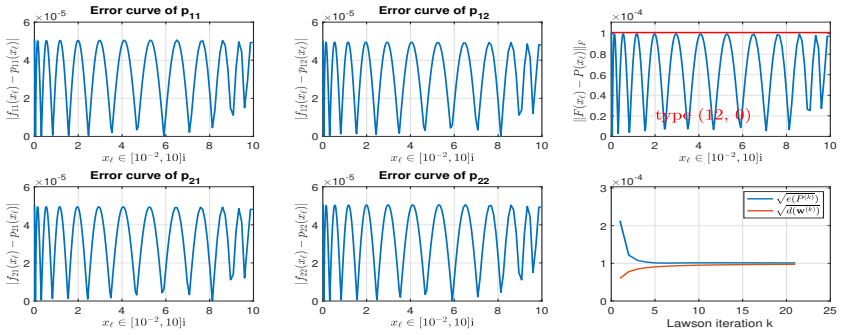
- [Figure captions] Figure 8.1 caption says 'the up-right represents' and 'demonstrates' where 'upper-right' and 'shows' are intended. Please also check that Figure 8.5's subfigure labels are legible in print.
- [Throughout] Several proofs are stated as 'same as [45]' or 'adapted from [43]' with details omitted. This is acceptable for a generalization, but the paper would benefit from a short summary of which algebraic steps in the block setting are new and which are direct transcriptions of the scalar arguments.
Circularity Check
No circular derivation: the matrix-valued extension is independently obtained; several convergence proofs import scalar-case results from the authors' prior papers, but these are prior independent results and are not used as an unproven equivalent of the present claim.
full rationale
The paper's central derivation is not circular. The dual problem (2.19) is obtained by a straightforward Lagrange-duality calculation from the linearized minimax problem (2.6); weak duality (2.15) follows from the definition of d(w), and the strong-duality sufficient condition (4.1) is proved directly from weak duality plus the definition of the infimum. No fitted parameter is relabeled as a prediction: the algorithm maximizes the dual function and then checks the duality gap (4.5), which is an a posteriori certificate rather than an input. The proofs do rely heavily on the same authors' prior scalar results: Theorem 2.1 is a 'parallel generalization' of [43, Theorem 2.1], Theorem 2.2 is 'adopted by a slight modification' of [43, Theorem 2.4], Theorem 2.3 is an 'extension' of [45, Theorem 2.2], and Theorem 7.2 'adapts [43, Theorem 5.2]'. These are self-citations, and they are numerous, but they cite separate prior works with their own proofs, and the present paper supplies the block-structured matrix-valued argument rather than simply renaming the scalar result. The cited lemmas are not the same as the present conclusion, and the matrix-valued reformulation (common denominator, block Vandermonde, generalized eigenvalue dual function) is derived here independently of those citations. The most serious limitation is that the rational-case convergence theorem (Theorem 7.2) only guarantees monotonicity for sufficiently small β, while the implemented algorithm uses β = 1; this is a correctness/completeness gap, not a circularity. Overall, there is no step in which an equation is defined in terms of the target quantity, no fitted input is called a prediction, and no uniqueness theorem from the authors' prior work is used to force the chosen approach. Score 2 reflects the heavy but non-load-bearing self-citation.
Assumptions & free parameters
free parameters (1)
- Lawson exponent beta =
1 (chosen in experiments, Step 5 of Algorithm 1)
assumptions (6)
- domain assumption The sample nodes are distinct and m >= max_{i,j}(n_ij + d + 2), as stated in (1.4).
- domain assumption The common-denominator representation R(x) = P(x)/q(x) is used, and q(x_l) is nonzero at all nodes for the solution; zeros are handled by cancellation (Section 2.1).
- domain assumption For Theorem 2.2, the sufficient condition 0 <= d <= min_{i,j} n_ij is assumed.
- ad hoc to paper Convergence analysis in Section 7 assumes (A1) q^(k)(x_l) != 0 for all l,k and (A2) |J_w^(k)| >= max{d+1, max n_ij+1}.
- standard math The trace-minimization principle for Hermitian positive semidefinite pencils [25] is used to justify that the dual function value is the smallest generalized eigenvalue.
- standard math Slater's condition holds for the polynomial case (Theorem 4.2).
Cite this review
Pith. "Pith review of Rational minimax approximation of matrix-valued functions." pith.science (2026). https://pith.science/paper/WV4TZVS4
@misc{pith2026250806378,
  author       = {Pith},
  title        = {Pith review of: Rational minimax approximation of matrix-valued functions},
  year         = {2026},
  howpublished = {\url{https://pith.science/paper/WV4TZVS4}},
  note         = {Machine review of arXiv:2508.06378}
}
abstract
In this paper, we present a rigorous framework for rational minimax approximation of matrix-valued functions that generalizes classical scalar approximation theory. Given sampled data $\{(x_\ell, {F}(x_\ell))\}_{\ell=1}^m$ where ${F}:\mathbb{C} \to \mathbb{C}^{s \times t}$ is a matrix-valued function, we study the problem of finding a matrix-valued rational approximant ${R}(x) = {P}(x)/q(x)$ (with ${P}:\mathbb{C} \to \mathbb{C}^{s \times t}$ a matrix-valued polynomial and $q(x)$ a nonzero scalar polynomial of prescribed degrees) that minimizes the worst-case Frobenius norm error over the given nodes: $$ \inf_{{R}(x) = {P}(x)/q(x)} \max_{1 \leq \ell \leq m} \|{F}(x_\ell) - {R}(x_\ell)\|_{\rm F}. $$ By reformulating this min-max optimization problem through Lagrangian duality, we derive a maximization dual problem over the probability simplex. We analyze weak and strong duality properties and establish a sufficient condition ensuring that the solution of the dual problem yields the minimax approximant $R(x)$. For numerical implementation, we propose an efficient method (\textsf{m-d-Lawson}) to solve the dual problem, generalizing Lawson's iteration to matrix-valued functions. Convergence analysis of \textsf{m-d-Lawson} is established. Numerical experiments are conducted and compared to state-of-the-art approaches, demonstrating its efficiency as a novel computational framework for matrix-valued rational approximation.
Figures


Figures from the paper (2 more)


Forward citations
Cited by 1 Pith paper
-
Rational Minimax Approximations for Matrix-Valued Functions: Existence, Optimality and Algorithms
Matrix-valued rational minimax approximants with a common denominator are proved to exist on dense point sets, with Kolmogorov/Ruttan optimality certificates and an equivalence to the m-d-Lawson dual conditions.
Reference graph
Works this paper leans on
-
[45]
L.-H. Zhang, L. Yang, W. H. Yang and Y.-N. Zhang, A convex dua l problem for the rational minimax approximation and Lawson’s iteration, Math. Comp. , 94 (2025), 2457–2494, DOI: https://doi.org/10.1090/mcom/4021
-
[43]
L.-H. Zhang and S. Han, A convergence analysis of Lawson’s iter ation for computing polynomial and rational minimax approximations, SIAM J. Numer. Anal. , URL https: //arxiv.org/abs/2401.00778v3, to appear
-
[1]
A. C. Antoulas, S. Lefteriu and A. C. Ionita, Chapter 8: A Tutorial Introduction to the Loewner Framework for Model Reduction , 335–376, SIAM Publications, 2017, URL https: //epubs.siam.org/doi/abs/10.1137/1.9781611974829.ch8
-
[2]
I. Barrodale and J. Mason, Two simple algorithms for discrete rat ional approximation, Math. Comp., 24 (1970), 877–891
work page 1970
-
[3]
M. Berljafa and S. G¨ uttel, Generalized rational Krylov decompo sitions with an application to rational approximation, SIAM J. Matrix Anal. Appl. , 36 (2015), 894–916, URL https: //doi.org/10.1137/140998081
-
[4]
M. Berljafa and S. G¨ uttel, The RKFIT algorithm for nonlinear rat ional approximation, SIAM J. Sci. Comput. , 39 (2017), A2049–A2071, URL https://doi.org/10.1137/15M1025426
-
[5]
S. Boyd and L. Vandenberghe, Convex Optimization , Cambridge University Press, 2004. 39 -0.2 -0.15 -0.1 -0.05 0 -1 -0.5 0 0.5 1 original and computed zeros of pD computed original -0.1 -0.05 0 0.05 0.1 -1 -0.5 0 0.5 1 original and computed zeros of pN computed original -0.1 -0.08 -0.06 -0.04 -0.02 0 0.02 -1 -0.8 -0.6 -0.4 -0.2 0 original and computed zero...
work page 2004
-
[6]
P. D. Brubeck, Y. Nakatsukasa and L. N. Trefethen, Vanderm onde with Arnoldi, SIAM Rev., 63 (2021), 405–415
work page 2021
Show all 46 references
-
[7]
A. K. Cline, Rate of convergence of Lawson’s algorithm, Math. Comp. , 26 (1972), 167–176
1972
-
[8]
Deschrijver, M
D. Deschrijver, M. Mrozowski, T. Dhaene and D. de Zutter, Mac romodeling of multiport systems using a fast implementation of the vector fitting method, IEEE Microw. Wireless Compon. Lett., 18 (2008), 383–385. 40
2008
-
[9]
Drmaˇ c, S
Z. Drmaˇ c, S. Gugercin and C. Beattie, Quadrature-based vector fitting fo r discretized H2 approximation, SIAM J. Sci. Comput. , 37 (2015), A625–A652, URL https://doi.org/10.1 137/140961511
2015
-
[10]
Ellacott and J
S. Ellacott and J. Williams, Linear Chebyshev approximation in the c omplex plane using Lawson’s algorithm, Math. Comp. , 30 (1976), 35–44
1976
-
[11]
G. H. Elliott, The construction of Chebyshev approximations in the comple x plane, PhD thesis, Faculty of Science (Mathematics), University of London, 1978
1978
-
[12]
Filip, Y
S.-I. Filip, Y. Nakatsukasa, L. N. Trefethen and B. Beckerman n, Rational minimax approxima- tion via adaptive barycentric representations, SIAM J. Sci. Comput. , 40 (2018), A2427–A2455
2018
-
[13]
G. H. Golub and C. F. Van Loan, Matrix Computations, 4th edition , Johns Hopkins University Press, Baltimore, Maryland, 2013
2013
-
[14]
I. V. Gosea and S. G¨ uttel, Algorithms for the rational approx imation of matrix-valued func- tions, SIAM J. Sci. Comput. , 43 (2021), A3033–A3054, URL https://doi.org/10.1137/20 M1324727
2021 doi
-
[15]
I. V. Gosea, C. Poussot-Vassal and A. C. Antoulas, Chapter 15 - Data-driven modeling and control of large-scale dynamical systems in the Loewner fram ework: Methodology and applications, in Numerical Control: Part A (eds. E. Tr´ elat and E. Zuazua), vol. 23 of Handbook of Nume...
2022
-
[16]
Gustavsen, Improving the pole relocating properties of vec tor fitting, IEEE Trans
B. Gustavsen, Improving the pole relocating properties of vec tor fitting, IEEE Trans. Power Deliv., 21 (2006), 1587–1592
2006
-
[17]
Gustavsen, Matrix Fitting Toolbox, 2009, Https://www.sinte f.no/en/software/vector- fitting/downloads/matrix-fitting-toolbox/
B. Gustavsen, Matrix Fitting Toolbox, 2009, Https://www.sinte f.no/en/software/vector- fitting/downloads/matrix-fitting-toolbox/
2009
-
[18]
Gustavsen and A
B. Gustavsen and A. Semlyen, Rational approximation of frequ ency domain responses by vector fitting, IEEE Trans. Power Deliv. , 14 (1999), 1052–1061
1999
-
[19]
M. H. Gutknecht, On complex rational approximation. Part I: T he characterization problem, in Computational Aspects of Complex Analysis (H. Werneret at. ,eds.). Dordrecht : Reidel , 1983, 79–101
1983
-
[20]
G¨ uttel and F
S. G¨ uttel and F. Tisseur, The nonlinear eigenvalue problem, Acta Numer. , 26 (2017), 1–94
2017
-
[21]
G¨ uttel, G
S. G¨ uttel, G. M. Negri Porzio and F. Tisseur, Robust rational approximations of nonlinear eigenvalue problems, SIAM J. Sci. Comput. , 44 (2022), A2439–A2463, URL https://doi. org/10.1137/20M1380533
2022 doi
-
[22]
N. J. Higham, G. M. N. Porzio and F. Tisseur, An updated set of nonlinear eigenvalue problems, Tech. report MIMS EPrint 2019.5, Manchester, United Kingdom, 2 019, URL http: //eprints.maths.manchester.ac.uk/, Http://eprints.maths.manchester.ac.uk/
2019
-
[23]
J. M. Hokanson, Multivariate rational approximation using a sta bilized Sanathanan-Koerner iteration, 2020, URL arXiv:2009.10803v1
2020 arXiv
-
[24]
C. L. Lawson, Contributions to the Theory of Linear Least Maximum Approxi mations, PhD thesis, UCLA, USA, 1961. 41
1961
-
[25]
Liang, R.-C
X. Liang, R.-C. Li and Z. Bai, Trace minimization principles for posit ive semi-definite pencils, Linear Algebra Appl. , 438 (2013), 3085–3106
2013
-
[26]
Lietaert, K
P. Lietaert, K. Meerbergen, J. P´ erez and B. Vandereycken , Automatic rational approximation and linearization of nonlinear eigenvalue problems, IMA J. Numer. Anal. , 42 (2022), 1087– 1115
2022
-
[27]
A. J. Mayo and A. Antoulas, A framework for the solution of the generalized realization problem, Linear Algebra Appl. , 425 (2007), 634–662
2007
-
[28]
Nakatsukasa, O
Y. Nakatsukasa, O. S` ete and L. N. Trefethen, The AAA algor ithm for rational approximation, SIAM J. Sci. Comput. , 40 (2018), A1494–A1522
2018
-
[29]
Nakatsukasa and L
Y. Nakatsukasa and L. N. Trefethen, An algorithm for real an d complex rational minimax approximation, SIAM J. Sci. Comput. , 42 (2020), A3157–A3179
2020
-
[30]
Nocedal and S
J. Nocedal and S. Wright, Numerical Optimization , 2nd edition, Springer, New York, 2006
2006
-
[31]
J. R. Rice, The approximation of functions , Addison-Wesley publishing Company, 1969
1969
-
[32]
Ruttan, A characterization of best complex rational appro ximants in a fundamental case, Constr
A. Ruttan, A characterization of best complex rational appro ximants in a fundamental case, Constr. Approx. , 1 (1985), 287–296
1985
-
[33]
Y. Saad, M. El-Guide and A. Mi¸ edlar, A rational approximation method for the nonlinear eigenvalue problem, Technical report, 2020, URL https://arxiv.org/abs/1901.01188v2
2020 arXiv
-
[34]
E. B. Saff and R. S. Varga, Nonuniqueness of best approximatin g complex rational functions, Bull. Amer. Math. Soc. , 83 (1977), 375–377
1977
-
[35]
Thiran and M.-P
J.-P. Thiran and M.-P. Istace, Optimality and uniqueness conditio ns in complex rational Chebyshev approximation with examples, Constr. Approx. , 9 (1993), 83–103
1993
-
[36]
Traina, Cauchy Method Modeling: Applied to Computer-Aided Tuning o f Microwave Filters and Duplexers , VDM Verlag Dr
D. Traina, Cauchy Method Modeling: Applied to Computer-Aided Tuning o f Microwave Filters and Duplexers , VDM Verlag Dr. M¨ uller, 2010
2010
-
[37]
Traina, G
D. Traina, G. Macchiarella and T. K. Sarkar, Robust formulation s of the Cauchy method suitable for microwave duplexers modeling, IEEE Trans. Microw. Theory Tech. , 55 (2007), 974–982
2007
-
[38]
L. N. Trefethen, Approximation Theory and Approximation Practice, Extende d Edition, SIAM, 2019
2019
-
[39]
Williams, Numerical Chebyshev approximation in the complex plan e, SIAM J
J. Williams, Numerical Chebyshev approximation in the complex plan e, SIAM J. Numer. Anal., 9 (1972), 638–649
1972
-
[40]
Williams, Characterization and computation of rational Cheby shev approximations in the complex plane, SIAM J
J. Williams, Characterization and computation of rational Cheby shev approximations in the complex plane, SIAM J. Numer. Anal. , 16 (1979), 819–827
1979
-
[41]
D. E. Wulbert, On the characterization of complex rational app roximations, Illinois J. Math. , 24 (1980), 140–155
1980
-
[42]
Yang, L.-H
L. Yang, L.-H. Zhang and Y. Zhang, The Lq-weighted dual prog ramming of the linear Chebyshev approximation and an interior-point method, Adv. Comput. Math. , 50:80 (2024). 42
2024
-
[44]
Zhang, Y
L.-H. Zhang, Y. Su and R.-C. Li, Accurate polynomial fitting and e valuation via Arnoldi, Numer. Algebr. Control. , 14 (2024), 526–546
2024
-
[46]
Zhang, Y.-N
L.-H. Zhang, Y.-N. Zhang, L. Yang and R.-W. Xiao, A AAA-type alg orithm for the mi- crowave duplexer filtering, Numer. Algorithms , Https://doi.org/10.1007/s11075-025-02058-0, to appear. 43
Reviewed August 5, 2026 · model on record in the stance chip above.
Discussion (0). Continue with ORCID to comment.