REVIEW 4 major objections 4 minor 95 references
Gapless fracton quantum spin liquid and emergent photons in a 2D spin-1 model
T0 review · 4 major / 4 minor · reviewed 2026-08-05 · deepseek-v4-flash
Pith's one-line read A square-lattice spin-1 model is presented as the first spin model with quantum dynamics to realize a gapless rank-2 U(1) fracton quantum spin liquid, with emergent photons evidenced by suppressed fourfold pinch points and power-law correla
desk verdict Convincing QMC + field theory case for a gapless rank-2 U(1) fracton spin liquid in a 2D spin-1 model; the compactness/instanton caveat keeps it from being air-tight. read the letter →
The pith
A machine-rendered reading of the paper's core claim, the machinery that carries it, and where it could break.
The reading
What carries the argument
The load-bearing object is the rank-2 Gauss law $\partial_\mu\partial_\nu E^{\mu\nu}=0$ for a traceless symmetric matrix-valued 'electric field' $E^{\mu\nu}$, discretized as the eight-site constraint $C_{\otimes}=S^z_1+S^z_2-S^z_3-S^z_4+S^z_5+S^z_6-S^z_7-S^z_8=0$. Tunneling is generated by the eight-site ring-exchange 'fluctuator' $F_{\otimes}=S^+_1S^-_2S^-_3S^+_4S^+_5S^-_6S^-_7S^+_8$, which commutes with all constraints. Mapping spins to conjugate rotor variables $A^{xy/xx}_i$ and $E^{xy/xx}_i$ gives the solvable Gaussian field theory $H_{\mathrm{eff}}=\frac{U}{2}\sum(E^{xy})^2+\frac{U}{2}\sum(E^{xx})^2+\frac{K}{2}\sum B_{\otimes}^2+\frac{W}{2}\sum N_{\otimes}^2$, where the gauge-invariant
What would settle it
Measure the dynamical spin structure factor $S(q,\omega)$ at $\mu=0.9J'$ in the diagonal-stripe sector: a true gapless rank-2 photon shows a mode with $\omega(q)\propto q^2$ and spectral weight vanishing as $q^2$ at the pinch point, whereas instanton proliferation would open a finite gap and restore pinch-point intensity. Alternatively, on larger lattices ($L\ge 48$), test whether the collapse of $S(q)/q^2$ onto the angular function $g(\varphi)$ persists or whether the suppression crosses over to $q^4$ or to an ordering peak at $q=(\pi/2,\pi/2)$.
Extended reading notes
Core claim
The paper's central claim is that the spin-1 spiderweb model on the square lattice — $H=H_1+H_2+H_3$ with eight-site constraints $C_{\otimes}=0$, an eight-site ring-exchange term $F_{\otimes}$, and a chemical potential for flippable clusters — hosts a gapless rank-2 U(1) fracton quantum spin liquid in its ground-state sector and in generic low-energy sectors. The constraints discretize the charge-free rank-2 Gauss law $\partial_\mu\partial_\nu E^{\mu\nu}=0$, so a single spin flip fractionalizes into four immobile fractons; the ring exchange generates coherent dynamics within the constrained subspace. Using Green function Monte Carlo, the authors find that for $0.81J'\le\mu\le J'$ the ground-
Load-bearing premise
The Gaussian rotor field theory used to interpret the numerics assumes the emergent gauge field $B$ fluctuates only mildly around zero, so that phase-slip events ($B\to B+2\pi$) do not proliferate; finite-size Green function Monte Carlo cannot fully exclude a small photon gap in the thermodynamic limit.
Editorial extensions
If this is right
- The model supplies a microscopic Hamiltonian for which a higher-rank U(1) gauge theory is not just an analogy but a quantitatively tested effective description, giving a concrete starting point for deriving corrections and excitation spectra beyond the Gaussian level.
- The predicted signatures — fourfold pinch points suppressed as $S(q)\sim q^2$ and correlations decaying as $|R|^{-4}$ — are directly measurable in neutron scattering or synthetic quantum simulator experiments, so the phase can be searched for in engineered square-lattice spin-1 systems.
- Because the phase persists in generic excited sectors and even has a wider stability window there, experiments and simulations that avoid the fragmented ground state can still reach the spin liquid, which is relevant for slow non-ergodic dynamics.
- The stability of the phase over $0.81J'\le\mu\le J'$ away from the solvable point shows that the spin liquid is a genuine phase, not merely a fine-tuned critical point at the exactly solvable $\mu=J'$.
- Weak transverse perturbations generate the ring-exchange term in perturbation theory, so implementing only the classical constraint part of the model may be enough to realize the spin liquid in synthetic platforms.
Reading between the lines
- The same rotor mapping should apply to any fracton-free sector, so the rank-2 U(1) description likely extends to parent states not enumerated here; preparing other periodic or random fracton-free configurations and fitting the same field-theory parameters would test this universality.
- If the absence of Lorentz invariance is what suppresses instantons, then adding terms that push the effective theory toward a Lorentz-invariant form (for example, by changing the relative coefficients of electric and magnetic energy) should re-open a confinement transition; this is a tunable test of the proposed mechanism.
- Fragmentation weakens from spin-1/2 to spin-1, suggesting that higher-spin versions of the spiderweb model may exhibit even weaker fragmentation and larger spin-liquid stability regions; a spin-2 analogue would be a natural next step.
- The $q^2$ pinch-point suppression is a general fingerprint of a gapless rank-2 photon; searching for the same collapse of $S(q)/q^2$ in other constrained spin models could identify new fracton spin liquids without requiring a full field-theory fit.
Editorial analysis
A structured set of objections, weighed in public.
Referee Report
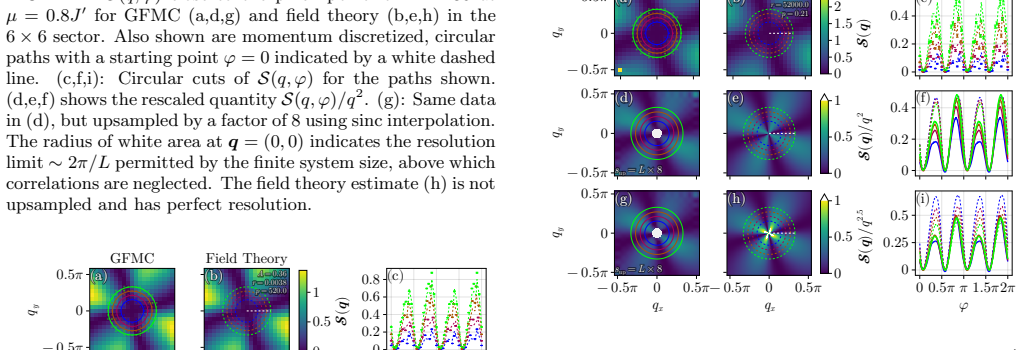
Summary. The paper introduces a spin-1 'spiderweb' model on the square lattice: H1 enforces local eight-site constraints C=0, H2 is an eight-site ring-exchange term F, and H3 is a chemical potential for flippable clusters. For J' << J the model is stochastic and studied with Green function Monte Carlo up to L=36. In the ground-state sector (identified as the diagonal stripe sector) the authors find, for 0.8J' < μ ≤ J', a phase with no conventional order, fourfold pinch points in S(q), quadratic suppression of S(q) near the pinch points, and real-space correlations decaying approximately as |R|^-4. They derive an effective rank-2 U(1) rotor field theory, expand the compact cos B term to quadratic order, add a phenomenological 90-degree-rotation-symmetry-breaking term, and fit S(q) to the GFMC data with three parameters (A,r,p). The same spin-liquid signatures are reported in a 6×6 excited sector and in three random excited sectors. The paper concludes that the model realizes a gapless rank-2 U(1) fracton quantum spin liquid with emergent photons in 2+1 spacetime dimensions.
Significance. If the gapless interpretation is correct, this is the first microscopic quantum spin model to realize a gapless rank-2 U(1) fracton quantum spin liquid, with emergent photons in 2+1D despite the usual Polyakov instanton obstruction. The paper has notable strengths: the parameter-free collapse S(q)/q^2 around the pinch points (Supplementary Fig. 11) is a robust, non-trivial signature; error bars are obtained from 14 independent GFMC runs; exact enumeration of small constrained subspaces and of Hilbert-space fragmentation sectors is included; and the code and data are publicly available. These features make the numerical evidence substantially stronger than a purely phenomenological fit. The main weakness is that the central 'gapless photon' interpretation relies on an uncontrolled Gaussian expansion of a compact gauge field, with no quantitative control over instanton effects, and the finite-size numerics cannot exclude a small photon gap.
major comments (4)
- [Sec. V and Eq. (9)] The central claim of gapless emergent photons depends on the expansion of the compact field B in Eq. (9) to quadratic order. The paper itself states that the assumption 'is not necessarily fulfilled' and concedes that 'an extremely small photon gap and weak order can never be fully excluded'. For L=36 the momentum resolution is 2π/L≈0.17, so a photon mass below this scale is invisible; the |R|^-4 correlation decay over distances up to ~18 sites likewise cannot exclude a correlation length larger than the system. The suggestion that the absence of Lorentz invariance suppresses Polyakov instantons is not supported by any estimate of the instanton action in the lattice theory. This is load-bearing for the 'gapless photons in 2+1D' conclusion. Please provide a quantitative instanton-action estimate, a direct gap/twist probe, or explicitly reformulate the conclusion as 'gapless within numeric
- [Sec. IV.B, Eq. (12), Supplementary G] The statement that the GFMC structure factor 'accurately matches' the field theory is based on three fitted parameters (A,r,p), and the asymmetry term Eq. (12) is introduced after the numerical asymmetry is observed. The fitted parameters vary widely across sectors and μ (e.g., p from 0.0053 to 520 and r from 3.8×10^-3 to 2.58×10^6 in the supplementary fits). This weakens the quantitative comparison. The parameter-free S(q)/q^2 collapse in Supplementary Fig. 11 is the most convincing evidence and should be foregrounded. The line-shape fits would be more compelling if the three parameters were shown to be constrained by independent observables, or if p were derived from the parent-state symmetry rather than fitted.
- [Sec. IV.A] The identification of the global ground-state sector is not exhaustive. The enumeration covers only 4×4 parent states, and the paper explicitly acknowledges that a lower-energy sector connected to a periodic 6×6 tiling cannot be excluded. The argument that the absence of 6×6 Bragg peaks in the sampled sectors rules out such a sector is not logically sufficient: correlations in sampled sectors do not constrain the energy of an unsampled sector. To support the ground-state claim, either provide an energy lower bound covering all sectors or state the result as holding among the enumerated/random sectors. The excited-sector results already give an independent and robust demonstration of the QSL, so this caveat does not undermine those conclusions.
- [Supplementary App. H, Eq. (51)] The analytical derivation of the |R|^-4 correlation decay modifies the lattice constraint vector, L1=-4s_x s_y → -2s_x s_y, and asserts that the radial decay is unaffected. This is plausible because the homogeneous scaling in q is unchanged, but the angular structure of S(q) is modified. Since the power-law decay is one of the central experimental signatures, the claim should be verified by a numerical Fourier transform of the exact Eq. (47) or by an explicit argument that the angular anisotropy does not affect the large-|R| asymptotics.
minor comments (4)
- [Fig. 3] The caption and text refer to 'sector number 6 (foreground)' and to a background staircase state; this is hard to parse. Consider labeling the sectors with arrows or letters in the figure.
- [Throughout] The arXiv text contains rendering artifacts such as 'f¨ ur', '⧹⧹⧹', and inline symbols that may confuse readers. Please ensure the published version uses standard notation.
- [Sec. VI A] The claim that the many-walker formalism introduces 'no systematic bias regardless of the number of walkers' is strong. Please add a reference or benchmark showing that non-linear observables are unbiased, or soften the wording.
- [Sec. II] The repeated use of subscripts and overlines for sublattice/site labels is notationally dense. A table summarizing symbols (similar to Supplementary Table III) would improve readability if placed in the main text.
Circularity Check
Partial circularity: the field-theory S(q) is a best fit with fitting parameters (A,r,p) and the rank-2 Gauss law is built into the model by construction, but parameter-free scaling collapse and |R|^-4 decay provide independent support.
-
fitted input called prediction
[Section IV.B, after Eq. (12), and Fig. 5]
"The field theory also predicts the spin structure factor S(q) which we can compare with the numerical results from GFMC by taking the parameters U,K and W as fit parameters ... To obtain the best fit to these field theory parameters, we define three independent fitting parameters (A, r, p) through (K, W, U, U') = (4A^2, 1, r, pr)."
The 'prediction' of S(q) is not parameter-free: the excellent agreement shown in Fig. 5 is the result of a best fit to the same data with three free parameters, one of which (p) was introduced after observing the rotational asymmetry. The shape constraints are real, but the headline 'accurately match the prediction' conflates a fitted curve with an independent theoretical prediction. This does not by itself invalidate the phase claim, because the q^2 scaling collapse and |R|^-4 decay are checked separately, but it is a genuine fitted-input-called-prediction step.
-
self definitional
[Supplementary Material, Section A]
"By inserting Eqs. (18) and (19) into Eq. (17), we arrive at the constraint C=0 introduced in the main text. This construction guarantees the existence of an emergent classical rank-2 U(1) gauge theory in the Gaussian approximation..."
The model's central constraint C=0 is constructed by discretizing the very rank-2 Gauss law that the paper later 'discovers' in the Gaussian approximation and identifies with fourfold pinch points. Thus the rank-2 gauge structure is an input of the model, not an emergent prediction. The gapless photon and pinch-point suppression are not contained in this construction, so the quantum spin liquid claim retains independent content; nevertheless, the classical pinch-point part of the 'prediction' reduces to the model definition.
full rationale
The paper is a strong numerical study with a transparent methodology, and its central claim is not wholly circular. However, two steps in the derivation chain are partially circular. First, the field-theory comparison in Sec. IV.B explicitly takes U, K, W (and later U') as fit parameters, so the nearly perfect agreement in Fig. 5 is a best fit rather than an independent prediction; the p-term is introduced post hoc to capture the observed rotational asymmetry. Second, the rank-2 Gauss law and the associated fourfold pinch points are not emergent but are baked into the model: Supplement A derives C=0 by discretizing the continuum rank-2 Gauss law, so the Gaussian approximation recovers the input structure. These are real circular/self-definitional features. On the other hand, the central gapless-photon claim is supported by parameter-free checks: the S(q)/q^2 scaling collapse in Figs. 11-12, the analytic |R|^-4 real-space decay, and the GFMC observation of a first-order transition out of the ordered phase at finite μ. The paper also explicitly flags the instanton/phase-slip assumption and the finite-size limitation, which is an honest statement of the load-bearing assumption rather than a hidden circularity. Self-citations to companion paper [47] are not load-bearing for the gapless-photon result; they provide background on the spin-1/2 model and fragmentation. Score 4 reflects the partial circularity from fitted predictions and by-construction gauge structure, while acknowledging the independent numerical content that prevents a score of 6 or higher.
Assumptions & free parameters
free parameters (3)
- A (global scale of S(q)) =
0.36 (diagonal stripe, mu=0.9J'); 0.43 to 515 (6x6 sector)
- r = U/W =
0.0063 (diagonal stripe mu=0.9); 15.9 to 2.58e6 (6x6 sector)
- p = U'/U =
340 (diagonal stripe mu=0.9); 0.0053 to 520 (6x6 and random sectors)
assumptions (6)
- domain assumption J' << J, so the low-energy manifold is the constrained subspace with C = 0 for all clusters
- domain assumption The spin-1 Hilbert space can be represented by compact rotors with integer electric field E and S_z = E, with S_z in {-1,0,1} enforced by the U term
- domain assumption B fluctuates mildly around 0 so cos(B) expands to quadratic order, i.e., instantons do not proliferate
- domain assumption The ground state lies in one of the sectors generated by 4x4 periodic parent configurations
- ad hoc to paper The phenomenological asymmetry term Eq. (12) is the correct minimal modification for the diagonal stripe parent state
- ad hoc to paper The replacement L1 = -4 s_x s_y to -2 s_x s_y in Appendix H preserves the radial decay of correlations
Cite this review
Pith. "Pith review of Gapless fracton quantum spin liquid and emergent photons in a 2D spin-1 model." pith.science (2026). https://pith.science/paper/YMY5S2VU
@misc{pith2026250806605,
  author       = {Pith},
  title        = {Pith review of: Gapless fracton quantum spin liquid and emergent photons in a 2D spin-1 model},
  year         = {2026},
  howpublished = {\url{https://pith.science/paper/YMY5S2VU}},
  note         = {Machine review of arXiv:2508.06605}
}
read the original abstract
Gapless fracton quantum spin liquids are exotic phases of matter described by higher-rank U(1) gauge theories which host gapped and immobile fracton matter excitations as well as gapless photons. Despite well-known field theories, no spin models beyond purely classical systems have been identified to realize these phases. Using error-controlled Green function Monte Carlo, here we investigate a square lattice spin-1 model that shows precise signatures of a fracton quantum spin liquid without indications of conventional ordering. Specifically, the magnetic response exhibits characteristic patterns of suppressed pinch points that accurately match the prediction of a rank-2 U(1) field theory and reveals the existence of emergent photon excitations in 2+1 spacetime dimensions. Remarkably, this type of fracton quantum spin liquid is not only identified in the system's ground state but also in generic low-energy sectors of a strongly fragmented Hilbert space.
Figures


Figures from the paper (11 more)




Reference graph
Works this paper leans on
-
[1]
Balents, Spin liquids in frustrated magnets, Nature 464, 199 (2010)
L. Balents, Spin liquids in frustrated magnets, Nature 464, 199 (2010)
2010
-
[2]
Savary and L
L. Savary and L. Balents, Quantum spin liquids: a re- view, Rep. Prog. Phys.80, 016502 (2016)
2016
-
[3]
Wen, Quantum orders and symmetric spin liquids, Phys
X.-G. Wen, Quantum orders and symmetric spin liquids, Phys. Rev. B65, 165113 (2002)
2002
-
[4]
F. J. Wegner, Duality in Generalized Ising Models and Phase Transitions without Local Order Parameters, Journal of Mathematical Physics12, 2259 (1971)
1971
-
[5]
Rantner and X.-G
W. Rantner and X.-G. Wen, Electron Spectral Function and Algebraic Spin Liquid for the Normal State of Un- derdoped HighT c Superconductors, Phys. Rev. Lett.86, 3871 (2001)
2001
-
[6]
Hermele, M
M. Hermele, M. P. A. Fisher, and L. Balents, Pyrochlore photons: TheU(1) spin liquid in aS= 1 2 three- dimensional frustrated magnet, Phys. Rev. B69, 064404 (2004)
2004
-
[7]
D. A. Huse, W. Krauth, R. Moessner, and S. L. Sondhi, Coulomb and Liquid Dimer Models in Three Dimensions, Phys. Rev. Lett.91, 167004 (2003)
2003
-
[8]
UsingV ij =V ji, denoting the change in the spin configuration asF k ∈ ±1 and further defining the effective local fieldh i =m i + P j Vjixj, we may express this ratio as log ψT(x′) ψT(x) = 8X k=1 h k Fk + 1 2 X kk′ V k k′ FkFk′ (15) which may be computed inO(1) complexity, independent of the system size [86]. Due to this efficient evaluation, we found th...
Show all 95 references
-
[9]
Benton, O
O. Benton, O. Sikora, and N. Shannon, Seeing the light: Experimental signatures of emergent electromagnetism in a quantum spin ice, Phys. Rev. B86, 075154 (2012)
2012
-
[10]
Rasmussen, Y.-Z
A. Rasmussen, Y.-Z. You, and C. Xu, Stable Gap- less Bose Liquid Phases without any Symmetry (2016), arXiv:1601.08235 [cond-mat.str-el]
2016 arXiv
-
[11]
Pretko, Subdimensional particle structure of higher rankU(1) spin liquids, Phys
M. Pretko, Subdimensional particle structure of higher rankU(1) spin liquids, Phys. Rev. B95, 115139 (2017)
2017
-
[12]
Pretko, Generalized electromagnetism of subdimen- sional particles: A spin liquid story, Phys
M. Pretko, Generalized electromagnetism of subdimen- sional particles: A spin liquid story, Phys. Rev. B96, 13 035119 (2017)
2017
-
[13]
Xu, Gapless bosonic excitation without symmetry breaking: An algebraic spin liquid with soft gravitons, Phys
C. Xu, Gapless bosonic excitation without symmetry breaking: An algebraic spin liquid with soft gravitons, Phys. Rev. B74, 224433 (2006)
2006
-
[14]
R. M. Nandkishore and M. Hermele, Fractons, Annu. Rev. Condens. Matter Phys.10, 295 (2019)
2019
-
[15]
Gromov and L
A. Gromov and L. Radzihovsky, Colloquium: Fracton matter, Rev. Mod. Phys.96, 011001 (2024)
2024
-
[16]
Pretko, X
M. Pretko, X. Chen, and Y. You, Fracton phases of mat- ter, Int. J. Mod. Phys. A35, 2030003 (2020)
2020
-
[17]
You, Quantum Liquids: Emergent higher-rank gauge theory and fractons (2024), arXiv:2403.17074 [cond- mat.str-el]
Y. You, Quantum Liquids: Emergent higher-rank gauge theory and fractons (2024), arXiv:2403.17074 [cond- mat.str-el]
2024 arXiv
-
[18]
Vijay, J
S. Vijay, J. Haah, and L. Fu, A new kind of topological quantum order: A dimensional hierarchy of quasiparti- cles built from stationary excitations, Phys. Rev. B92, 235136 (2015)
2015
-
[19]
Vijay, J
S. Vijay, J. Haah, and L. Fu, Fracton topological order, generalized lattice gauge theory, and duality, Phys. Rev. B94, 235157 (2016)
2016
-
[20]
Chamon, Quantum Glassiness in Strongly Correlated Clean Systems: An Example of Topological Overprotec- tion, Phys
C. Chamon, Quantum Glassiness in Strongly Correlated Clean Systems: An Example of Topological Overprotec- tion, Phys. Rev. Lett.94, 040402 (2005)
2005
-
[21]
Haah, Local stabilizer codes in three dimensions with- out string logical operators, Phys
J. Haah, Local stabilizer codes in three dimensions with- out string logical operators, Phys. Rev. A83, 042330 (2011)
2011
-
[22]
Bravyi, B
S. Bravyi, B. Leemhuis, and B. M. Terhal, Topological order in an exactly solvable 3D spin model, Ann. Phys. (N.Y.)326, 839 (2011)
2011
-
[23]
Yoshida, Exotic topological order in fractal spin liq- uids, Phys
B. Yoshida, Exotic topological order in fractal spin liq- uids, Phys. Rev. B88, 125122 (2013)
2013
-
[24]
Castelnovo and C
C. Castelnovo and C. Chamon, Topological quantum glassiness, Philos. Mag.92, 304 (2012)
2012
-
[25]
Slagle and Y
K. Slagle and Y. B. Kim, Fracton Topological Order from Nearest-Neighbor Two-Spin Interactions and Dualities, Physical Review B96, 165106 (2017)
2017
-
[26]
Kitaev, Anyons in an exactly solved model and be- yond, Ann
A. Kitaev, Anyons in an exactly solved model and be- yond, Ann. Phys.321, 2 (2006), january Special Issue
2006
-
[27]
M. J. P. Gingras and P. A. McClarty, Quantum spin ice: a search for gapless quantum spin liquids in py- rochlore magnets, Reports on Progress in Physics77, 056501 (2014)
2014
-
[28]
S. D. Pace, S. C. Morampudi, R. Moessner, and C. R. Laumann, Emergent Fine Structure Constant of Quan- tum Spin Ice Is Large, Phys. Rev. Lett.127, 117205 (2021)
2021
-
[29]
Singh, S
Y. Singh, S. Manni, J. Reuther, T. Berlijn, R. Thomale, W. Ku, S. Trebst, and P. Gegenwart, Relevance of the Heisenberg-Kitaev Model for the Honeycomb Lattice Iri- datesA 2IrO3, Phys. Rev. Lett.108, 127203 (2012)
2012
-
[30]
Banerjee, C
A. Banerjee, C. A. Bridges, J. Q. Yan, A. A. Aczel, L. Li, M. B. Stone, G. E. Granroth, M. D. Lumsden, Y. Yiu, J. Knolle, S. Bhattacharjee, D. L. Kovrizhin, R. Moess- ner, D. A. Tennant, D. G. Mandrus, and S. E. Nagler, Proximate Kitaev quantum spin liquid behaviour in a honey...
2016
-
[31]
Banerjee, J
A. Banerjee, J. Yan, J. Knolle, C. A. Bridges, M. B. Stone, M. D. Lumsden, D. G. Mandrus, D. A. Tennant, R. Moessner, and S. E. Nagler, Neutron scattering in the proximate quantum spin liquidα-RuCl 3, Science356, 1055 (2017)
2017
-
[32]
Banerjee, P
A. Banerjee, P. Lampen-Kelley, J. Knolle, C. Balz, A. A. Aczel, B. Winn, Y. Liu, D. Pajerowski, J. Yan, C. A. Bridges, A. T. Savici, B. C. Chakoumakos, M. D. Lums- den, D. A. Tennant, R. Moessner, D. G. Mandrus, and S. E. Nagler, Excitations in the field-induced quantum spin l...
2018
-
[33]
L. Pan, N. J. Laurita, K. A. Ross, B. D. Gaulin, and N. P. Armitage, A measure of monopole inertia in the quantum spin ice Yb 2Ti2O7, Nature Physics12, 361 (2016)
2016
-
[34]
Sibille, N
R. Sibille, N. Gauthier, H. Yan, M. Ciomaga Hat- nean, J. Ollivier, B. Winn, U. Filges, G. Balakrishnan, M. Kenzelmann, N. Shannon, and T. Fennell, Experi- mental signatures of emergent quantum electrodynamics in Pr2Hf 2O7, Nature Physics14, 711 (2018)
2018
-
[35]
Gaudet, E
J. Gaudet, E. M. Smith, J. Dudemaine, J. Beare, C. R. C. Buhariwalla, N. P. Butch, M. B. Stone, A. I. Kolesnikov, G. Xu, D. R. Yahne, K. A. Ross, C. A. Marjerrison, J. D. Garrett, G. M. Luke, A. D. Bianchi, and B. D. Gaulin, Quantum Spin Ice Dynamics in the Dipole-Octupole Py-...
2019
-
[36]
B. Gao, T. Chen, D. W. Tam, C.-L. Huang, K. Sas- mal, D. T. Adroja, F. Ye, H. Cao, G. Sala, M. B. Stone, C. Baines, J. A. T. Verezhak, H. Hu, J.-H. Chung, X. Xu, S.-W. Cheong, M. Nallaiyan, S. Spagna, M. B. Maple, A. H. Nevidomskyy, E. Morosan, G. Chen, and P. Dai, Experimenta...
2019
-
[37]
Bhardwaj, S
A. Bhardwaj, S. Zhang, H. Yan, R. Moessner, A. H. Nevidomskyy, and H. J. Changlani, Sleuthing out ex- otic quantum spin liquidity in the pyrochlore magnet Ce2Zr2O7, npj Quantum Materials7, 51 (2022)
2022
-
[38]
E. M. Smith, O. Benton, D. R. Yahne, B. Placke, R. Sch¨ afer, J. Gaudet, J. Dudemaine, A. Fitterman, J. Beare, A. R. Wildes, S. Bhattacharya, T. DeLazzer, C. R. C. Buhariwalla, N. P. Butch, R. Movshovich, J. D. Garrett, C. A. Marjerrison, J. P. Clancy, E. Kermarrec, G. M. Luke...
2022
-
[39]
B. Gao, F. Desrochers, D. W. Tam, P. Steffens, A. Hiess, Y. Su, S.-W. Cheong, Y. B. Kim, and P. Dai, Emergent photons and fractionalized excitations in a quantum spin liquid (2024), arXiv:2404.04207 [cond-mat.str-el]
2024 arXiv
-
[40]
H. Yan, O. Benton, L. D. C. Jaubert, and N. Shannon, Rank–2U(1) Spin Liquid on the Breathing Pyrochlore Lattice, Phys. Rev. Lett.124, 127203 (2020)
2020
-
[41]
Benton and R
O. Benton and R. Moessner, Topological Route to New and Unusual Coulomb Spin Liquids, Phys. Rev. Lett. 127, 107202 (2021)
2021
-
[42]
Davier, F
N. Davier, F. A. G´ omez Albarrac ´ ın, H. D. Rosales, and P. Pujol, Combined approach to analyze and classify fam- ilies of classical spin liquids, Phys. Rev. B108, 054408 (2023)
2023
-
[43]
H. Yan, O. Benton, R. Moessner, and A. H. Nevidom- skyy, Classification of Classical Spin Liquids: Typol- ogy and Resulting Landscape (2023), arXiv:2305.00155 [cond-mat.str-el]
2023 arXiv
-
[44]
H. Yan, O. Benton, A. H. Nevidomskyy, and R. Moess- ner, Classification of Classical Spin Liquids: De- tailed Formalism and Suite of Examples (2023), arXiv:2305.19189 [cond-mat.str-el]
2023 arXiv
-
[45]
Niggemann, Y
N. Niggemann, Y. Iqbal, and J. Reuther, Quantum Ef- fects on Unconventional Pinch Point Singularities, Phys- 14 ical Review Letters130, 196601 (2023)
2023
-
[46]
S. Han, A. S. Patri, and Y. B. Kim, Realization of frac- tonic quantum phases in the breathing pyrochlore lattice, Phys. Rev. B105, 235120 (2022)
2022
-
[47]
Polyakov, Quark confinement and topology of gauge theories, Nuclear Physics B120, 429 (1977)
A. Polyakov, Quark confinement and topology of gauge theories, Nuclear Physics B120, 429 (1977)
1977
-
[48]
Niggemann, M
N. Niggemann, M. Adhikary, Y. Schaden-Thillmann, and J. Reuther, Classical fracton spin liquid and hilbert space fragmentation in a 2d spin-1/2 model, Phys. Rev. B113, 165118 (2026)
2026
-
[49]
Browaeys and T
A. Browaeys and T. Lahaye, Many-Body Physics with Individually Controlled Rydberg Atoms, Nature Physics 16, 132 (2020)
2020
-
[50]
Giudici, M
G. Giudici, M. D. Lukin, and H. Pichler, Dynamical Preparation of Quantum Spin Liquids in Rydberg Atom Arrays, Physical Review Letters129, 090401 (2022)
2022
-
[51]
Labuhn, D
H. Labuhn, D. Barredo, S. Ravets, S. de L´ es´ eleuc, T. Macr ` ı, T. Lahaye, and A. Browaeys, Tunable two- dimensional arrays of single rydberg atoms for realizing quantum ising models, Nature534, 667 (2016)
2016
-
[52]
Moessner and S
R. Moessner and S. L. Sondhi, Three-dimensional resonating-valence-bond liquids and their excitations, Phys. Rev. B68, 184512 (2003)
2003
-
[53]
Sikora, N
O. Sikora, N. Shannon, F. Pollmann, K. Penc, and P. Fulde, Extended quantumU(1)-liquid phase in a three- dimensional quantum dimer model, Phys. Rev. B84, 115129 (2011)
2011
-
[54]
Fancelli, R
A. Fancelli, R. Flores-Calder´ on, O. Benton, B. Lake, R. Moessner, and J. Reuther, Fragile spin liquid in three dimensions, Phys. Rev. B111, 134413 (2025)
2025
-
[55]
Moessner and S
R. Moessner and S. L. Sondhi, Resonating Valence Bond Phase in the Triangular Lattice Quantum Dimer Model, Phys. Rev. Lett.86, 1881 (2001)
2001
-
[56]
D. S. Rokhsar and S. A. Kivelson, Superconductivity and the Quantum Hard-Core Dimer Gas, Phys. Rev. Lett.61, 2376 (1988)
1988
-
[57]
Adler, D
D. Adler, D. Wei, M. Will, K. Srakaew, S. Agrawal, P. Weckesser, R. Moessner, F. Pollmann, I. Bloch, and J. Zeiher, Observation of Hilbert space fragmentation and fractonic excitations in 2D, Nature636, 80 (2024)
2024
-
[58]
M. Will, R. Moessner, and F. Pollmann, Realization of Hilbert Space Fragmentation and Fracton Dynamics in Two Dimensions, Phys. Rev. Lett.133, 196301 (2024)
2024
-
[59]
Feng and B
X. Feng and B. Skinner, Hilbert space fragmentation pro- duces an effective attraction between fractons, Phys. Rev. Res.4, 013053 (2022)
2022
-
[60]
A. Prem, S. Vijay, Y.-Z. Chou, M. Pretko, and R. M. Nandkishore, Pinch point singularities of tensor spin liq- uids, Phys. Rev. B98, 165140 (2018)
2018
-
[61]
Pai and M
S. Pai and M. Hermele, Fracton fusion and statistics, Phys. Rev. B100, 195136 (2019)
2019
-
[62]
Xu and J
C. Xu and J. E. Moore, Strong-weak coupling self-duality in the two-dimensional quantum phase transition ofp+ ipsuperconducting arrays, Phys. Rev. Lett.93, 047003 (2004)
2004
-
[63]
Yan, Hyperbolic Fracton Model, Subsystem Sym- metry, and Holography, Physical Review B99, 155126 (2019)
H. Yan, Hyperbolic Fracton Model, Subsystem Sym- metry, and Holography, Physical Review B99, 155126 (2019)
2019
-
[64]
J. P. Ibieta-Jimenez, L. N. Q. Xavier, M. Petrucci, and P. Teotonio-Sobrinho, Fractonlike Phases from Subsys- tem Symmetries, Physical Review B102, 045104 (2020)
2020
-
[65]
Calandra Buonaura and S
M. Calandra Buonaura and S. Sorella, Numerical study of the two-dimensional Heisenberg model using a Green function Monte Carlo technique with a fixed number of walkers, Phys. Rev. B57, 11446 (1998)
1998
-
[66]
Becca and S
F. Becca and S. Sorella,Quantum Monte Carlo ap- proaches for correlated systems(Cambridge University Press, 2017)
2017
-
[67]
Z. Zeng, G. Giudici, and H. Pichler, Quantum Dimer Models with Rydberg Gadgets, Physical Review Re- search7, L012006 (2025)
2025
-
[68]
Senthil, L
T. Senthil, L. Balents, S. Sachdev, A. Vishwanath, and M. P. A. Fisher, Quantum Criticality beyond the Landau-Ginzburg-Wilson Paradigm, Physical Review B 70, 144407 (2004)
2004
-
[69]
Fradkin, D
E. Fradkin, D. A. Huse, R. Moessner, V. Oganesyan, and S. L. Sondhi, Bipartite Rokhsar–Kivelson Points and Cantor Deconfinement, Physical Review B69, 224415 (2004)
2004
-
[70]
Note that the +-shaped minima at the pinch point origin are finite-size effects which always correspond to the four momenta closest to the pinch point atanysystem sizeL with their volume shrinking to zero forL→ ∞
-
[71]
M. B. Hastings and T. Koma, Spectral gap and expo- nential decay of correlations, Communications in Math- ematical Physics265, 781 (2006)
2006
-
[72]
Jers´ ak, T
J. Jers´ ak, T. Neuhaus, and P. Zerwas, U(1) lattice gauge theory near the phase transition, Physics Letters B133, 103 (1983)
1983
-
[73]
Campos, A
I. Campos, A. Cruz, and A. Taranc´ on, First order signa- tures in 4d pure compact u(1) gauge theory with toroidal and spherical topologies, Physics Letters B424, 328 (1998)
1998
-
[74]
Vettorazzo and P
M. Vettorazzo and P. de Forcrand, Finite temperature phase transition in the 4d compact u(1) lattice gauge theory, Physics Letters B604, 82 (2004)
2004
-
[75]
Hart and R
O. Hart and R. Nandkishore, Spectroscopic fingerprints of gapless type-II fracton phases, Phys. Rev. B105, L180416 (2022)
2022
-
[76]
Ebadi, T
S. Ebadi, T. T. Wang, H. Levine, A. Keesling, G. Se- meghini, A. Omran, D. Bluvstein, R. Samajdar, H. Pich- ler, W. W. Ho, S. Choi, S. Sachdev, M. Greiner, V. Vuleti´ c, and M. D. Lukin, Quantum phases of matter on a 256-atom programmable quantum simulator, Nature 595, 227 (2021)
2021
-
[77]
Scholl, M
P. Scholl, M. Schuler, H. J. Williams, A. A. Eberharter, D. Barredo, K.-N. Schymik, V. Lienhard, L.-P. Henry, T. C. Lang, T. Lahaye, A. M. L¨ auchli, and A. Browaeys, Quantum simulation of 2d antiferromagnets with hun- dreds of rydberg atoms, Nature595, 233 (2021)
2021
-
[78]
Semeghini, H
G. Semeghini, H. Levine, A. Keesling, S. Ebadi, T. T. Wang, D. Bluvstein, R. Verresen, H. Pichler, M. Kali- nowski, R. Samajdar, A. Omran, S. Sachdev, A. Vish- wanath, M. Greiner, V. Vuleti´ c, and M. D. Lukin, Prob- ing topological spin liquids on a programmable quantum simul...
2021
-
[79]
M. Tian, R. Samajdar, and B. Gadway, Engineering frus- trated rydberg spin models by graphical floquet modula- tion, Phys. Rev. Lett.135, 253001 (2025)
2025
-
[80]
X. Wu, F. Yang, S. Yang, K. Mølmer, T. Pohl, M. K. Tey, and L. You, Manipulating synthetic gauge fluxes via multicolor dressing of rydberg-atom arrays, Phys. Rev. Res.4, L032046 (2022)
2022
-
[81]
M¨ ogerle, K
J. M¨ ogerle, K. Brechtelsbauer, A. Gea-Caballero, J. Prior, G. Emperauger, G. Bornet, C. Chen, T. Lahaye, A. Browaeys, and H. B¨ uchler, Spin-1 haldane phase in a chain of rydberg atoms, PRX Quantum6, 020332 (2025)
2025
-
[82]
Robert and T
A. Robert and T. Bienaim´ e, Qudit Encoding in Rydberg 15 Blockaded Arrays of Atoms (2025), arXiv:2502.06465 [quant-ph]
2025 arXiv
-
[83]
V. S. Liu, M. Bintz, M. Block, R. Samajdar, J. Kemp, and N. Y. Yao, Supersolidity and Simplex Phases in Spin- 1 Rydberg Atom Arrays (2024), arXiv:2407.17554 [cond- mat.quant-gas]
2024 arXiv
-
[84]
Trivedi and D
N. Trivedi and D. M. Ceperley, Ground-state correlations of quantum antiferromagnets: A Green-function Monte Carlo study, Phys. Rev. B41, 4552 (1990)
1990
-
[85]
J. H. Hetherington, Observations on the statistical iter- ation of matrices, Phys. Rev. A30, 2713 (1984)
1984
-
[86]
Ralko, M
A. Ralko, M. Ferrero, F. Becca, D. Ivanov, and F. Mila, Dynamics of the Quantum Dimer Model on the Triangu- lar Lattice: Soft Modes and Local Resonating Valence- Bond Correlations, Physical Review B74, 134301 (2006)
2006
-
[87]
Whilehcontains a sum over all sites, it only needs to be updated after each move ash j →h j + P k Vik,jFk, while the ratio of wavefunctions needs to be evaluated∼L×L times before each move
-
[88]
Carleo and M
G. Carleo and M. Troyer, Solving the quan- tum many-body problem with artificial neu- ral networks, Science355, 602 (2017), https://www.science.org/doi/pdf/10.1126/science.aag2302
2017 doi
-
[89]
H.-Y. Lin, Y. Guo, R.-Q. He, Z. Y. Xie, and Z.-Y. Lu, Green’s function Monte Carlo combined with projected entangled pair state approach to the frustratedJ 1−J2 Heisenberg model, Phys. Rev. B109, 235133 (2024)
2024
-
[90]
K. J. Runge, Quantum Monte Carlo calculation of the long-range order in the Heisenberg antiferromagnet, Phys. Rev. B45, 7229 (1992)
1992
-
[91]
P. Sala, T. Rakovszky, R. Verresen, M. Knap, and F. Pollmann, Ergodicity Breaking Arising from Hilbert Space Fragmentation in Dipole-Conserving Hamiltoni- ans, Phys. Rev. X10, 011047 (2020)
2020
-
[92]
Khudorozhkov, A
A. Khudorozhkov, A. Tiwari, C. Chamon, and T. Neu- pert, Hilbert Space Fragmentation in a 2D Quantum Spin System with Subsystem Symmetries, SciPost Physics13, 098 (2022)
2022
-
[93]
Stahl, O
C. Stahl, O. Hart, A. Khudorozhkov, and R. Nandk- ishore, Strong Hilbert Space Fragmentation and Fractons from Subsystem and Higher-Form Symmetries (2025), arXiv:2505.15889 [cond-mat]
2025
-
[94]
K. Lee, A. Pal, and H. J. Changlani, Frustration-induced emergent Hilbert space fragmentation, Physical Review B103, 235133 (2021)
2021
-
[95]
ı X Exy (f 2 −f 4 +f 6 −f 8 ) # × exp
J. Colpa, Diagonalization of the quadratic boson hamil- tonian, Physica A: Statistical Mechanics and its Appli- cations93, 327 (1978). A. DERIV A TION OF THE GROUND ST A TE CONSTRAINT Here, we briefly summarize the derivation of the ground state constraintC = 0, found in more ...
1978
Reviewed August 5, 2026 · model on record in the stance chip above.
Discussion (0). Sign in to comment.