REVIEW 2 major objections 5 minor 34 references
Investigation of Low-Energy Particle Remnants in High-Energy Collisions at the LHC with a Skipper-CCD detector
T0 review · 2 major / 5 minor · reviewed 2026-08-05 · deepseek-v4-flash
Pith's one-line read MOSKITA, the first skipper-CCD at the LHC, finds no beam-correlated low-energy excess in its 2024 data.
desk verdict A genuinely new proof-of-principle: first skipper-CCD at an LHC IP, careful null result, and an honest mCP limit; the run-6 background reuse is a real but fixable flaw. read the letter →
The pith
A machine-rendered reading of the paper's core claim, the machinery that carries it, and where it could break.
The reading
What carries the argument
The analysis rests on the skipper-CCD's ability to resolve single electrons by averaging many non-destructive measurements of each pixel, which sets the detection threshold near 0.8 e− per pixel. The statistical engine is the profile-likelihood ratio built from a per-image Poisson likelihood, with expected signal $s_i = \Delta E \, \epsilon_i \, L_i$ and expected background $b_i = \Delta E \, \epsilon_i \, R_b$, where $L_i$ is the image's integrated luminosity and $R_b$ is the background rate measured from zero-luminosity images; the background normalization is profiled and p-values come from Monte Carlo pseudo-experiments. Event selection uses eight masks (border, hot-column, transfer-gate-
What would settle it
A reader could rerun the likelihood analysis excluding run 6 from the background anchor and check whether the combined p0 = 0.059 and the 4–7 e− upper limit of 7.8 events change materially; a drop of p0 below 0.01 or a limit shift beyond quoted uncertainties would undercut the robustness of the no-correlation claim. A second check is to monitor the post-Pb-Pb single-electron and high-energy rates over time: a decaying afterglow would support neutron activation, while a flat persistent rate would point to a stable environmental change.
Extended reading notes
Core claim
The central result is a null test: over the 2024 run, the rate of ionization events with charge at or below 20 electrons does not track LHC luminosity. The test uses a per-image profile likelihood in which expected signal counts scale with each image's integrated luminosity and the background rate is fixed by images taken with the beam off. For proton-proton data, all energy bins are consistent with background; for Pb-Pb data, the 7-electron bin shows a local p-value of 0.017, which the paper treats as a fluctuation because the look-elsewhere probability across the ten bins is 0.29. The combined pp and Pb-Pb p-value for the background-only hypothesis in the 4–7 electron range is 0.059. The p
Load-bearing premise
The main load-bearing premise is that beam-off images, especially run 6 taken after the Pb-Pb run, faithfully represent the background that would exist during beam-on runs; if those images carry residual neutron-activation afterglow, the background rate is biased and the null-hypothesis test is weakened.
Editorial extensions
If this is right
- A skipper-CCD with sub-electron noise can operate and take science data in the LHC environment, opening the door to larger deployments near collision points.
- The low-energy proton-proton data yield the first collider constraints on millicharged particles from this detector technology, even though they do not compete with existing limits.
- The post-Pb-Pb increase in high-energy and single-electron rates, if caused by neutron activation, implies that heavy-ion runs create a lingering background that future beam-off calibrations must model.
- The combined pp and Pb-Pb p-value of 0.059, while not significant, gives a concrete motive for more exposure and lower background rather than being a discovery claim.
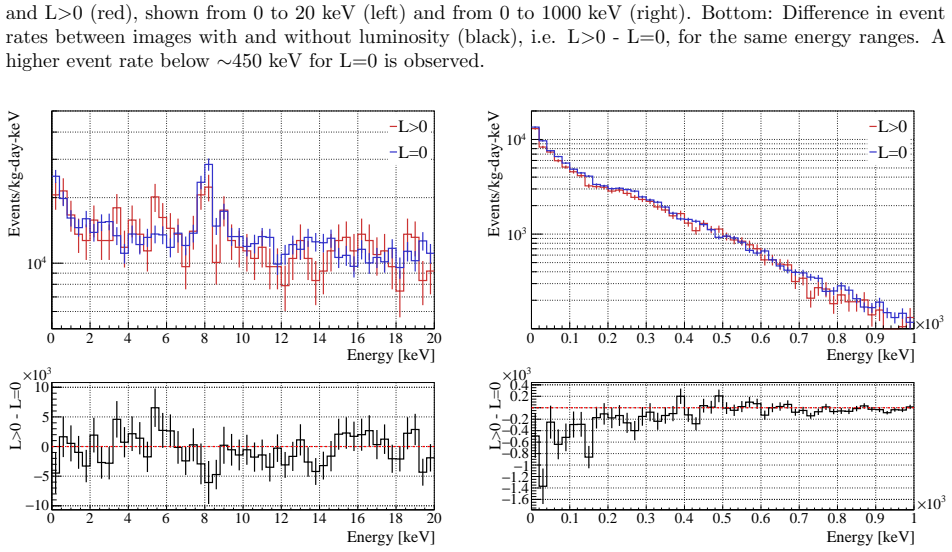
- Comparing beam-on and beam-off spectra above 450 keV shows cosmic muons dominate, while the sub-450 keV excess disappears when post-Pb-Pb images are excluded, pointing to an environmental origin rather than a prompt collision signal.
- The model-independent rate tables can be reused to test any new-physics model predicting few-electron deposits, not just millicharged particles.
Reading between the lines
- If run 6 is contaminated by the afterglow of Pb-Pb collisions, the reported p-values for the proton-proton period are conservatively biased toward background; rerunning the likelihood with cleaner beam-off anchors could either reveal a small beam-correlated excess or sharpen the limits.
- The coincidence between the elevated single-electron rate and the high-energy rate after Pb-Pb suggests a single physical mechanism such as lattice damage or activation; tracking the time evolution of both rates over weeks would test this without new hardware.
- The same site, 33 m from the interaction point behind 17 m of rock, could host a segmented multi-CCD array; with the per-image luminosity bookkeeping already in place, a 100-gram-class detector would make the projected HL-LHC sensitivity reach testable.
- The 7-electron Pb-Pb excess, though consistent with a fluctuation, is the kind of low-energy anomaly that a dedicated beam-on/beam-off interleaved run could confirm or refute with modest additional exposure.
Editorial analysis
A structured set of objections, weighed in public.
Referee Report
Summary. This paper reports the deployment and first-year operation of MOSKITA, a 2.2 g skipper-CCD installed ~33 m from the CMS interaction point. Using 2024 LHC data from proton-proton and Pb-Pb runs, the authors report model-independent event rates in two ionization regions (≤20e- and >20e-), perform a profile-likelihood test of the null hypothesis that low-energy event rates are uncorrelated with beam luminosity, and find no significant correlation in either period. They also present high-energy spectra comparing images with and without luminosity, observe a post-Pb-Pb rate increase that is flagged for future investigation, and derive a 95% C.L. exclusion limit on millicharged particles using the low-energy pp results. The paper concludes that skipper-CCD technology is viable for new-physics searches at high-energy colliders.
Significance. If the null result and detector-characterization claims hold, this is the first operation of a skipper-CCD at an LHC interaction point and a useful technical demonstration for future low-threshold experiments at colliders. The strengths of the paper include the detailed description of detector operation, a masking algorithm optimized on run 1 to avoid bias, Monte-Carlo-based efficiency corrections, per-image likelihood tests with pseudo-experiments, and explicit reporting of the main limitations. The mCP constraint is admittedly not competitive, but it is a genuine first constraint from this detector class at the LHC. However, the background definition for the central null test is not robust, because zero-luminosity images from a period with elevated post-Pb-Pb rates are reused in both the pp and Pb-Pb samples and no sensitivity check is shown.
major comments (2)
- [Sec. 6, 6.2, 6.3; Eq. (2)] The null-test background R_b in Eq. (2) is computed from images with L_i=0. Section 6 states that run 6, a no-collision period taken after the Pb-Pb run, is included as L=0 in the pp sample. Section 6.2 reports that the high-energy event rate and the single-electron rate rose after Pb-Pb and remained elevated through run 6, possibly from neutron activation, and Figure 18 shows that excluding post-Pb-Pb images removes the L>0 vs. L=0 discrepancy. Therefore R_b for the pp period is likely biased high relative to the pp-era background. This biases the pp p-values in Table 4 toward weaker sensitivity, makes the combined p0=0.059 in Sec. 6.1 uninterpretable, and also affects the mCP upper limit in Sec. 7, which uses the same pp R_b. Please repeat the likelihood analysis excluding run 6 (or modeling a time-dependent R_b) and report how the 4-7 e- p-value, the combined p0, and the mCP limit cha
- [Sec. 6.3, Eqs. (1)-(3)] The statistical treatment of the background is ambiguous and potentially consequential. Eq. (2) defines b_i via a single R_b 'computed from images with L_i=0', which suggests R_b is fixed; but Eq. (3) profiles over b, and the text says the b_i are maximized for a given mu, which would treat R_b as a free parameter and could allow beam-correlated events to be absorbed into the background. The manuscript should state exactly which parameters are profiled, whether R_b is fitted or fixed, and how the finite uncertainty of an L=0-derived R_b is propagated. This matters directly for the p-values in Tables 4 and 5.
minor comments (5)
- [Sec. 6.1] The statements 'We expect 271 2e- events and 1 3e- event from pile-up' are not derived in the text. Please give the formula or reference used to compute these expectations, including the treatment of SER pile-up across pixels.
- [Eq. (2)] Please define the units of ΔE, epsilon_i, L_i, and R_b explicitly. Table 4 reports exposures in g-day and rates as events per exposure, so the role of the bin-width factor ΔE in Eq. (2) is not dimensionally transparent and should be clarified.
- [Sec. 6.1] The combination of pp and Pb-Pb p-values into p0=0.059 is not described. If a Fisher or Stouffer combination is used, state it and justify independence; otherwise, present the two p-values separately given the shared run 6 background sample.
- [Sec. 5.2] The detection efficiency is based on 50,000 simulated images, but the statistical uncertainty on the efficiency per energy bin is not quoted. Please report it or argue that it is negligible compared with the statistical uncertainties in Tables 4 and 5.
- [Throughout] Typos and minor wording issues: 'Frecuency' in Figure 13 captions; 'reanges' in Sec. 6.2; 'ocurred' in Sec. 2.2.1; inconsistent capitalization of 'milliQan'/'Milliqan'; and the label 'Moskita' in Figure 19 should be 'MOSKITA' for consistency.
Circularity Check
No meaningful circularity: the low-energy null test is a genuine likelihood comparison with external luminosity values and L=0 background images; the run-6 reuse and mask optimization are systematic/selection concerns, not reductions of the result to its inputs.
full rationale
The analysis is an experimental measurement rather than a derivation. Equations (1)-(3) define a profile likelihood in which the signal expectation is s_i = ΔE × ε_i × L_i and the background expectation is b_i = ΔE × ε_i × R_b, with R_b estimated from images with L_i = 0. Nothing in this construction is fitted to the quantity being predicted: the p-values for μ = 0 are obtained from Monte Carlo pseudo-experiments, and the background rate is fixed from zero-luminosity images before the test. The mCP limit in Sec. 7 uses an external Pythia flux, an external dielectric-response cross section, and the independently obtained 95% C.L. event-count upper limit; no parameter of the mCP model is fitted to the MOSKITA data. The detection efficiency in Sec. 5.2 is computed from simulated images and is not used as an input that assumes the conclusion. The masking algorithm is optimized on run 1 images, and run 1 is included in the pp sample; this is a potential overfitting or selection-bias concern, but it does not force the no-correlation result by construction — the null test retains genuine statistical content. The reuse of run 6 as L=0 background in both periods, together with the elevated post-Pb-Pb rates explicitly flagged as an unresolved hypothesis ('will be investigated in future work' in Sec. 6.2), is a legitimate systematic weakness in the background model, but it is not circularity: an overestimated R_b makes the null hypothesis easier to accept, so the result is not manufactured by the construction. The self-citations (SENSEI, Oscura, MOSKITA setup, readout electronics) are technical references and are not load-bearing as uniqueness theorems or as fitted predictions. Overall score 1: the central claim is independent of its inputs, with only minor self-referential technical citations.
Assumptions & free parameters
free parameters (3)
- Event-selection mask parameters (border, bleeding-zone, halo radius, hot-column MAD, serial-register distance cuts) =
border=10 px; bleeding=100 px right and 30 px above; halo radius=25 px; hot-column >5 MAD; serial-register criteria 30 p
- Per-image 1-e detection threshold =
typically 0.65 to 0.9 e- (Fig. 10)
- Hot-zone mask regions =
spatial regions from run 1 maps (Fig. 15)
assumptions (4)
- domain assumption Images with zero luminosity provide an unbiased estimate of the background during beam-on images.
- domain assumption The Pythia8 simulation of milliQan [22] gives the correct mCP flux from pp collisions at 13.6 TeV, including propagation through 17 m of rock and the CMS magnetic field, and proton-bremsstrahlung production is negligible.
- domain assumption The dielectric response model [23] and silicon ionization yield model [24] convert mCP energy loss into detected electron counts correctly over the 4 to 7 e- range.
- standard math The Poisson profile likelihood and Monte Carlo pseudo-experiments provide valid p-values and 95% C.L. upper limits.
Cite this review
Pith. "Pith review of Investigation of Low-Energy Particle Remnants in High-Energy Collisions at the LHC with a Skipper-CCD detector." pith.science (2026). https://pith.science/paper/YEIJ3ANM
@misc{pith2026250806749,
  author       = {Pith},
  title        = {Pith review of: Investigation of Low-Energy Particle Remnants in High-Energy Collisions at the LHC with a Skipper-CCD detector},
  year         = {2026},
  howpublished = {\url{https://pith.science/paper/YEIJ3ANM}},
  note         = {Machine review of arXiv:2508.06749}
}
abstract
We deployed MOSKITA $\sim$33 m away from the CMS collision point, the first skipper-CCD detector probing low-energy particles produced in high-energy collisions at the Large Hadron Collider (LHC). In this work, we search for beam-related events using data collected in 2024 during beam-on and beam-off periods. The dataset corresponds to integrated luminosities of 113.3 fb$^{-1}$ and 1.54 nb$^{-1}$ for the proton-proton and Pb-Pb collision periods, respectively. We report observed event rates in a model-independent framework across two ionization regions: $\leq20e^-$ and $>20e^-$. For the low-energy region, we perform a likelihood analysis to test the null hypothesis of no beam-correlated signal. We found no significant correlation during proton-proton and Pb-Pb collisions. For the high-energy region, we present the energy spectra for both collision periods and compare event rates for images with and without luminosity. We observe a slight increase in the event rate following the Pb-Pb collisions, coinciding with a rise in the single-electron rate, which will be investigated in future work. Using the low-energy proton-proton results, we place 95% C.L. constraints on the mass-millicharge parameter space of millicharged particles. Overall, the results in this work demonstrate the viability of skipper-CCD technology to explore new physics at high-energy colliders and motivate future searches with more massive detectors.
Figures


Figures from the paper (16 more)




Reference graph
Works this paper leans on
-
[1]
Sterile neutrino oscillations: the global picture,
J. Kopp, P. A. N. Machado, M. Maltoni, and T. Schwetz, “Sterile neutrino oscillations: the global picture,” JHEP, vol. 2013, no. 5, p. 50, 2013
work page 2013
-
[2]
S. Schramm, “Searching for New Physics in Hadronic Final States with Run 2 Proton–Proton Collision Data at the LHC,” Symmetry, vol. 14, no. 6, p. 1173, 2022
work page 2022
-
[3]
Dark Photon Searches via Higgs Boson Production at the LHC and Beyond,
S. Biswas, E. Gabrielli, and B. Mele, “Dark Photon Searches via Higgs Boson Production at the LHC and Beyond,” Symmetry, vol. 14, no. 8, p. 1522, 2022
work page 2022
-
[4]
Two U(1)’s and ϵ charge shifts,
B. Holdom, “Two U(1)’s and ϵ charge shifts,” Physics Letters B , vol. 166, no. 2, pp. 196–198, 1986
work page 1986
-
[5]
Single-Electron and Single-Photon Sensitivity with a Silicon Skipper CCD,
J. Tiffenberg, M. Sofo-Haro, A. Drlica-Wagner, R. Essig, Y. Guardincerri, S. Holland, T. Volansky, and T.-T. Yu, “Single-Electron and Single-Photon Sensitivity with a Silicon Skipper CCD,” Phys. Rev. Lett., vol. 119, p. 131802, Sept. 2017
work page 2017
-
[6]
SENSEI: Direct-Detection Results on sub-GeV Dark Matter from a New Skipper CCD,
L. Barak, I. M. Bloch, M. Cababie, G. Cancelo, L. Chaplinsky, F. Chierchie, M. Crisler, A. Drlica- Wagner, R. Essig, J. Estrada, E. Etzion, G. F. Moroni, D. Gift, S. Munagavalasa, A. Orly, D. Rodrigues, A. Singal, M. S. Haro, L. Stefanazzi, J. Tiffenberg, S. Uemura, T. Volansky, and T.-T. Yu, “SENSEI: Direct-Detection Results on sub-GeV Dark Matter from a...
work page 2020
-
[7]
Search by the SENSEI Experiment for Millicharged Particles Pro- duced in the NuMI Beam,
L. Barak, I. M. Bloch, A. M. Botti, M. Cababie, G. Cancelo, B. A. Cervantes-Vergara, L. Chaplinsky, M. Crisler, A. Drlica-Wagner, R. Essig, J. Estrada, E. Etzion, G. F. Moroni, S. E. Holland, Y. Korn, I. Lawson, S. Luoma, S. Munagavalasa, A. Orly, S. E. Perez, D. Rodrigues, N. A. Saffold, S. Scorza, A. Singal, M. S. Haro, L. Stefanazzi, K. Stifter, J. Tif...
work page 2024
-
[8]
A. A. Aguilar-Arevalo, J. C. D’Olivo, Y. Sarkis, N. Avalos, X. Bertou, P. Bellino, C. Bonifazi, A. Botti, G. Cancelo, J. Estrada, R. Ford, K. Kuk, A. Lathrop, J. Tiffenberg, M. Cababi´ e, B. A. Cervantes- Vergara, C. Chavez, F. Chierchie, D. Delgado, E. Depaoli, J. a. dos Anjos, H. P. Lima, G. F. Moroni, A. R. F. Neto, B. Kilminster, P. Lemos, K. Maslova,...
work page 2025
Show all 34 references
-
[9]
Search for millicharged particles in proton-proton collisions at √s = 13.6 TeV,
S. Alcott, Z. Bhatti, J. Brooke, C. Campagnari, M. Carrigan, M. Citron, R. De Los Santos, A. De Roeck, C. Dorofeev, T. Du, J. Goldstein, F. Golf, N. Gonzalez, A. Haas, J. Heymann, C. S. Hill, D. Imani, M. Joyce, K. Larina, R. Loos, S. Lowette, H. Mei, D. W. Miller, B. Peng, S....
2025
-
[10]
Searching for minicharged particles at the energy frontier with the MoEDAL-MAPP experiment at the LHC,
M. Kalliokoski, V. A. Mitsou, M. de Montigny, A. Mukhopadhyay, P.-P. A. Ouimet, J. Pinfold, A. Shaa, and M. Staelens, “Searching for minicharged particles at the energy frontier with the MoEDAL-MAPP experiment at the LHC,” JHEP, vol. 2024, p. 137, Apr. 2024
2024
-
[11]
Prospects and Opportunities with an upgraded F ASER Neutrino Detector during the HL-LHC era: Input to the EPPSU,
R. Mammen Abraham, X. Ai, S. Alonso-Monsalve, J. Anders, C. Antel, A. Ariga, T. Ariga, J. Atkinson, F. U. Bernlochner, T. Boeckh, J. Boyd, et al. , “Prospects and Opportunities with an upgraded F ASER Neutrino Detector during the HL-LHC era: Input to the EPPSU,” arXiv e-prints...
2025 arXiv
-
[12]
Input to the ESPPU 2026 update: Searching for millicharged particles with the FORMOSA experiment at the CERN LHC,
M. Citron, F. Golf, K. Gunthoti, A. Haas, C. S. Hill, D. Imani, S. Kelly, M. Liu, S. Lowette, A. De Roeck, S. Neha Santpur, R. Schmitz, J. Steenis, D. Stuart, Y.-D. Tsai, J. S. Tafoya Vargas, T. Wybouw, and J. Yoo, “Input to the ESPPU 2026 update: Searching for millicharged pa...
2026
-
[13]
FLArE up dark sectors with EM form factors at the LHC forward physics facility,
F. Kling, J.-L. Kuo, S. Trojanowski, and Y.-D. Tsai, “FLArE up dark sectors with EM form factors at the LHC forward physics facility,” Nuclear Physics B , vol. 987, p. 116103, 2023
2023
-
[14]
Skipper-CCD sensors for the Oscura experiment: requirements and preliminary tests,
B. A. Cervantes-Vergara, S. Perez, J. Estrada, A. Botti, C. R. Chavez, F. Chierchie, N. Saffold, A. Aguilar-Arevalo, F. Alcalde-Bessia, N. Avalos, O. Baez, D. Baxter, X. Bertou, C. Bonifazi, G. Cancelo, N. Castell´ o-Mor, A. E. Chavarria, J. M. D. Egea, J. C. D’Olivo, C. Dreye...
2023
-
[15]
Skipper-CCDs: Current applications and future,
B. Cervantes-Vergara, S. Perez, J. D’Olivo, J. Estrada, D. Grimm, S. Holland, M. Sofo-Haro, and W. Wong, “Skipper-CCDs: Current applications and future,” Nuclear Instruments and Methods in Physics Research Section A: Accelerators, Spectrometers, Detectors and Associated Equipm...
2023
-
[16]
Sensitivity to millicharged particles in future proton-proton collisions at the LHC with the milliQan detector,
A. Ball, J. Brooke, C. Campagnari, M. Carrigan, M. Citron, A. De Roeck, M. Ezeldine, B. Francis, M. Gastal, M. Ghimire, J. Goldstein, F. Golf, A. Haas, R. Heller, C. S. Hill, L. Lavezzo, R. Loos, S. Lowette, B. Manley, B. Marsh, D. W. Miller, B. Odegard, R. Schmitz, F. Setti, ...
2021
-
[17]
Search for millicharged particles in proton-proton collisions at √s = 13 TeV,
A. Ball, G. Beauregard, J. Brooke, C. Campagnari, M. Carrigan, M. Citron, J. De La Haye, A. De Roeck, Y. Elskens, R. E. Franco, M. Ezeldine, B. Francis, M. Gastal, M. Ghimire, J. Goldstein, F. Golf, J. Guiang, A. Haas, R. Heller, C. S. Hill, L. Lavezzo, R. Loos, S. Lowette, G....
2020
-
[18]
The CMS experiment at the CERN LHC,
S. Chatrchyan, G. Hmayakyan, V. Khachatryan, A. M. Sirunyan, W. Adam, T. Bauer, T. Bergauer, H. Bergauer, M. Dragicevic, J. Er¨ o,et al. , “The CMS experiment at the CERN LHC,” JINST, vol. 3, p. S08004, Aug. 2008
2008
-
[19]
First Direct-Detection Results on Sub-GeV Dark Matter Using the SENSEI Detector at SNOLAB,
P. Adari, I. M. Bloch, A. M. Botti, M. Cababie, G. Cancelo, B. A. Cervantes-Vergara, M. Crisler, M. Daal, A. Desai, A. Drlica-Wagner, R. Essig, J. Estrada, E. Etzion, G. F. Moroni, S. E. Holland, J. Kehat, Y. Korn, I. Lawson, S. Luoma, A. Orly, S. E. Perez, D. Rodrigues, N. A....
2025
-
[20]
Low threshold acquisition controller for Skipper charge-coupled devices,
G. I. Cancelo, C. Chavez, F. Chierchie, J. Estrada, G. Fernandez-Moroni, E. E. Paolini, M. S. Haro, A. Soto, L. Stefanazzi, J. Tiffenberg, K. Treptow, N. Wilcer, and T. J. Zmuda, “Low threshold acquisition controller for Skipper charge-coupled devices,” JATIS, vol. 7, no. 1, p...
2021
-
[21]
Asymptotic formulae for likelihood-based tests of new physics,
G. Cowan, K. Cranmer, E. Gross, and O. Vitells, “Asymptotic formulae for likelihood-based tests of new physics,” The European Physical Journal C , vol. 71, p. 1554, Feb. 2011
2011
-
[22]
Pythia mCP Simulation
G. Beauregard, “Pythia mCP Simulation.” https://github.com/GBeauregard/milliqan-pyth-sim, 2018
2018
-
[23]
Collective excitations and low-energy ionization signatures of relativistic particles in silicon detectors,
R. Essig, R. Plestid, and A. Singal, “Collective excitations and low-energy ionization signatures of relativistic particles in silicon detectors,” Communications Physics, vol. 7, p. 416, Dec. 2024
2024
-
[24]
Ionization yield in silicon for eV-scale electron-recoil processes,
K. Ramanathan and N. Kurinsky, “Ionization yield in silicon for eV-scale electron-recoil processes,” Phys. Rev. D , vol. 102, p. 063026, Sept. 2020. 21
2020
-
[25]
Search- ing for millicharged particles with 1 kg of Skipper-CCDs using the NuMI beam at Fermilab,
S. Perez, D. Rodrigues, J. Estrada, R. Harnik, Z. Liu, B. A. Cervantes-Vergara, J. C. D’Olivo, R. D. Plestid, J. Tiffenberg, T.-T. Yu, A. Aguilar-Arevalo, F. Alcalde-Bessia, N. Avalos, O. Baez, D. Bax- ter, X. Bertou, C. Bonifazi, A. Botti, G. Cancelo, N. Castell´ o-Mor, A. E....
2024
-
[26]
First results from a multiplexed and massive instrument with sub-electron noise Skipper-CCDs,
F. Chierchie, C. Chavez, M. Sofo Haro, G. Fernandez Moroni, B. Cervantes-Vergara, S. Perez, J. Estrada, J. Tiffenberg, S. Uemura, and A. Botti, “First results from a multiplexed and massive instrument with sub-electron noise Skipper-CCDs,” JINST, vol. 18, p. P01040, Jan. 2023
2023
-
[27]
Confirmation of the spectral excess in DAMIC at SNOLAB with skipper CCDs,
A. Aguilar-Arevalo, I. Arnquist, N. Avalos, L. Barak, D. Baxter, X. Bertou, I. M. Bloch, A. M. Botti, M. Cababie, G. Cancelo, N. Castell´ o-Mor, B. A. Cervantes-Vergara, A. E. Chavarria, J. Cortabitarte- Guti´ errez, M. Crisler, J. Cuevas-Zepeda, A. Dastgheibi-Fard, C. De Domi...
2024
-
[28]
First Constraints from DAMIC-M on Sub-GeV Dark-Matter Particles Interacting with Electrons,
I. Arnquist, N. Avalos, D. Baxter, X. Bertou, N. Castell´ o-Mor, A. E. Chavarria, J. Cuevas-Zepeda, J. C. Guti´ errez, J. Duarte-Campderros, A. Dastgheibi-Fard, O. Deligny, C. De Dominicis, E. Estrada, N. Gadola, R. Ga ¨ ıor, T. Hossbach, L. Iddir, L. Khalil, B. Kilminster, A....
2023
-
[29]
Searches for CEνNS and Physics beyond the Standard Model using Skipper-CCDs at CONNIE,
A. A. Aguilar-Arevalo, N. Avalos, X. Bertou, C. Bonifazi, G. Cancelo, B. A. Cervantes-Vergara, C. Chavez, F. Chierchie, G. Coelho Corrˆ ea, J. C. D’Olivo, J. dos Anjos, J. Estrada, G. Fernandez Moroni, A. R. Fernandes Neto, R. Ford, B. Kilminster, K. Kuk, A. Lathrop, P. Lemos,...
2024 arXiv
-
[30]
Deployment and performance of a Low-Energy- Threshold Skipper-CCD inside a nuclear reactor,
E. Depaoli, D. Rodrigues, I. Sidelnik, P. Bellino, A. Botti, D. Delgado, M. Cababi´ e, F. Chierchie, J. Estrada, G. F. Moroni, S. Perez, and J. Tiffenberg, “Deployment and performance of a Low-Energy- Threshold Skipper-CCD inside a nuclear reactor,” JHEP, vol. 2024, p. 155, Oct. 2024
2024
-
[31]
Search for Millicharged Particles at SLAC,
A. A. Prinz, R. Baggs, J. Ballam, S. Ecklund, C. Fertig, J. A. Jaros, K. Kase, A. Kulikov, W. G. J. Langeveld, R. Leonard, T. Marvin, T. Nakashima, W. R. Nelson, A. Odian, M. Pertsova, G. Putallaz, and A. Weinstein, “Search for Millicharged Particles at SLAC,” Phys. Rev. Lett....
1998
-
[32]
Improved Limits on Mil- licharged Particles Using the ArgoNeuT Experiment at Fermilab,
R. Acciarri, C. Adams, J. Asaadi, B. Baller, T. Bolton, C. Bromberg, F. Cavanna, D. Edmunds, R. S. Fitzpatrick, B. Fleming, R. Harnik, C. James, I. Lepetic, B. R. Littlejohn, Z. Liu, X. Luo, O. Palamara, 22 G. Scanavini, M. Soderberg, J. Spitz, A. M. Szelc, W. Wu, and T. Yang,...
2020
-
[33]
Updated bounds on milli-charged particles,
S. Davidson, S. Hannestad, and G. Raffelt, “Updated bounds on milli-charged particles,” JHEP, vol. 2000, p. 003, May 2000
2000
-
[34]
Millicharged Particles in Neutrino Experiments,
G. Magill, R. Plestid, M. Pospelov, and Y.-D. Tsai, “Millicharged Particles in Neutrino Experiments,” Phys. Rev. Lett. , vol. 122, p. 071801, Feb. 2019. 23
2019
Reviewed August 5, 2026 · model on record in the stance chip above.
Discussion (0). Sign in to comment.