REVIEW 4 major objections 5 minor 39 references
Physical Layer Authentication Based on Hierarchical Variational Auto-Encoder for Industrial Internet of Things
T0 review · 4 major / 5 minor · reviewed 2026-08-05 · deepseek-v4-flash
Pith's one-line read The paper claims a threshold-free, unsupervised physical layer authentication scheme — a hierarchical variational auto-encoder trained on channel impulse responses — can identify legitimate IIoT transmitters without knowing attackers' chann
desk verdict A useful threshold-free PLA scheme with strong empirical results on NIST data, but the theoretical framing is shaky and some experimental details need tightening. read the letter →
The pith
A machine-rendered reading of the paper's core claim, the machinery that carries it, and where it could break.
The reading
What carries the argument
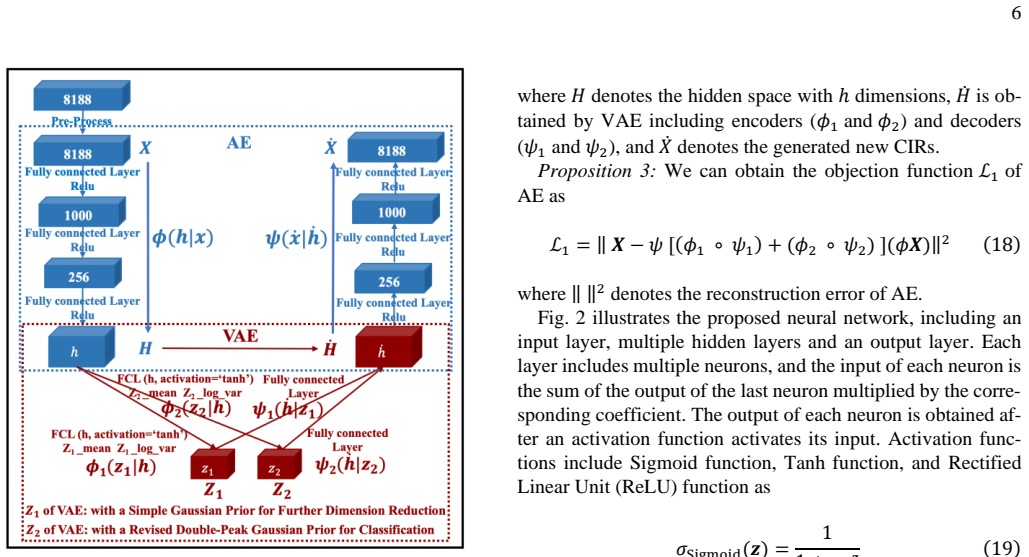
The load-bearing object is the hierarchical variational auto-encoder (HVAE). An AE module (three-layer encoder $\phi$, decoder $\psi$) reduces the 8,188-dimensional CIR input to a hidden space $H$; a VAE module then operates on $H$ through two latent units. $Z_1$ uses a single-peak Gaussian prior $\mathcal{N}(\mu,\sigma^2)$ and serves CIR reproduction; $Z_2$ uses the double-peak prior $\alpha\mathcal{N}(-\mu,\sigma^2)+(1-\alpha)\mathcal{N}(\mu,\sigma^2)$ to separate legitimate from spoofing samples. The total loss $\mathcal{L}=\mathcal{L}_1+\mathcal{L}_2+\mathcal{L}_3$ sums AE reconstruction error, VAE reconstruction/KL terms, and an approximated KL divergence against the double-peak prior.
What would settle it
Take CIR records from the same physical node position at several different times in the AF (mobile) dataset and map them to $Z_2$; do the same for a spoofing node a few positions ahead on the loop. If the within-node, across-time $Z_2$ distance is not reliably smaller than the distance to a nearby spoofing node, the core inequality $\mathcal{D}(\boldsymbol{X}[t_A]) < \mathcal{D}(\boldsymbol{X}[t_E])$ fails and that pair cannot be distinguished. A second check: rerun the AF experiment with a deliberately wrong $\alpha$ (e.g., ±20% off the true traffic proportion) and observe whether the F1 drop
Extended reading notes
Core claim
Central claim: transmitter identity can be read off the latent space of a variational auto-encoder. Authentication is reduced to a channel-difference function $\mathcal{D}(\boldsymbol{X}[n])=\|\boldsymbol{Z}_2[n]-\boldsymbol{Z}_2[0]\|_2^2$, with $Z_2$ the code of a VAE unit whose double-peak Gaussian prior $\alpha\mathcal{N}(-\mu,\sigma^2)+(1-\alpha)\mathcal{N}(\mu,\sigma^2)$ separates legitimate from spoofing CIRs. An AE front end compresses the 8,188-dimensional CIR; the VAE maps each CIR to a distribution rather than a point, avoiding over-fitting on few samples. The universal approximation theorem is invoked to prove the channel-to-position mapping is learnable by a neural network. Empir
Load-bearing premise
The load-bearing premise is Assumption 2, that the position-to-channel mapping is bijective — every transmitter position yields a unique channel impulse response. If two positions produce nearly identical CIRs, or the same position yields different CIRs at different times, then comparing CIR distances to a reference cannot reliably identify the sender. The paper explicitly concedes this cannot be proved analytically.
Editorial extensions
If this is right
- Authentication no longer requires attackers' prior channel information: training uses only Alice's reference CIR and the mixed received signals, so the scheme generalizes to scenarios where Eve's channel is unknown.
- Threshold traversal is eliminated: the decision rule compares latent-space distances and uses the traffic proportion $\alpha$ directly, removing the manual threshold search that traditional PLA requires.
- Small training sets suffice: 30 CIRs per node reach convergence in roughly 31 epochs, which matters when only a few channel records can be captured before the channel changes.
- Near spoofing nodes — the hardest case for the clustering-based ISE baseline — are authenticated with F1 = 1.0 in the static OATS data, and the gain over AE and VAE baselines in the mobile AF data ranges from 17.18% to 69.3%.
- The scheme generalizes in principle to multi-user authentication by replacing the double-peak Gaussian prior with a multi-peak one, though the paper notes a trade-off between the number of classes and authentication performance.
Reading between the lines
- The decision rule requires the traffic proportion $\alpha$ (Alice's emission frequency divided by total signal frequency), yet the loss function's double-peak prior is fixed at $\alpha=1/2$; how F1 degrades under a misestimated $\alpha$ is not reported and would be a direct, testable sensitivity check.
- Because the reference signal $\boldsymbol{X}[0]$ is frozen from the initialization phase, the scheme compares every later CIR against a fixed fingerprint; the paper's own online-versus-offline experiment implies performance decays as the transmitter moves away from the reference, so an adaptive reference-updating policy is a natural follow-up.
- The bijectivity assumption implies that closer transmitter positions should be harder to separate, which matches the observed F1 drop when the spoofing node starts within a few nodes of Alice; a confidence-aware rule that abstains or requests re-initialization when $Z_2$ distances are ambiguous would be a natural extension the paper does not explore.
Editorial analysis
A structured set of objections, weighed in public.
Referee Report
Summary. The paper proposes a threshold-free physical layer authentication (PLA) scheme based on a hierarchical variational auto-encoder (TF-HVAE) for industrial IoT. The architecture uses an AE module for CIR dimensionality reduction and a VAE module with two hidden variables: Z1 for CIR reconstruction with a standard Gaussian prior, and Z2 for authentication using a double-peak Gaussian 'prior' and a Euclidean-distance decision rule in the latent space. The authors claim that the authentication mapping can be approximated arbitrarily well by a neural network (Proposition 2) and that the scheme works without attackers' prior channel information and with few training samples. The method is evaluated on NIST OATS (static, Rician) and AF (mobile, Rayleigh) datasets, reporting F1=1.0 for all spoofing nodes on OATS and average F1=0.8825 on AF, with relative improvements of 17.18%, 31.4%, and 69.3% over TB-AE, TF-VAE, and TF-AE, respectively.
Significance. If the empirical results hold, the paper offers a practically attractive contribution: an unsupervised, threshold-free PLA method that does not require Eve's channel statistics for training and is validated on real industrial CIR measurements. The architecture is simple, and the ablations against AE and VAE baselines are controlled and consistent. However, the theoretical support is currently unsound: the proof of Proposition 2 is invalid, the Z2 loss is defined against a self-referential 'prior' that is not a true prior, and the central Assumption 2 (bijectivity of the position-to-channel mapping) is unproved and explicitly conceded as such. These issues affect the paper's foundational claims, not just its presentation, and they will need substantial revision before the paper can be considered for publication.
major comments (4)
- [Section II.D, Assumption 2 and Eqs. (5)-(11)] The entire authentication logic rests on Assumption 2, that the position-to-channel mapping Φ_t in Eq. (5) is bijective. The text concedes that this 'cannot be proved analytically' and cites [29],[30] for 'uniqueness and time-varying characteristics' of wireless channels. Those references are about deep-learning channel mapping/prediction, not about injectivity of measured CIRs with respect to physical position. If two distinct positions yield statistically indistinguishable CIR distances to the reference X[0], then the sorting rule (9)-(11) and the Euclidean criterion (39) cannot separate Alice from Eve. The OATS F1=1 result is consistent with injectivity, but the AF average F1=0.8825 (Table VIII) already shows confusion, and the paper does not determine whether that confusion stems from overlapping CIR distance distributions or from model error. I recommend either providing direct empi
- [Section II.E, Proposition 2 and Eq. (14)] The proof of Proposition 2 asserts that Φ_t^{-1} and the mappings (8), (10), (11) are continuous. This is not true of the authentication mapping as defined: the sorting operation in (9) is discontinuous at ties, and the hard thresholding in (10)-(11) is discontinuous at the αq boundary. The universal approximation theorem requires continuity on a compact set to guarantee uniform approximation in the sup norm. Thus the proof as written is invalid. This is a central claimed theoretical contribution, so it must be repaired, for example by restricting to the compact set where all D(X[n]) values are distinct and the decision boundary is not crossed, and stating an almost-everywhere or soft-decision version of the theorem.
- [Section III.D, Eqs. (34)-(35)] The 'prior' for Z2 in Eq. (34) is written as αN(-μ, σ²)+(1-α)N(μ, σ²), where μ and σ are the encoder's own mean and variance outputs for the same sample. The KL divergence in (35) then measures the posterior N(μ, σ²) against a distribution that depends on that same posterior. This is not a fixed prior, so the standard variational lower-bound interpretation is lost. Minimizing this term does not necessarily drive the posterior toward a well-defined target; for instance, if μ→0, the prior and posterior coincide trivially, making the term degenerate. If this double-peak term is intended as a regularizer to encourage bimodal separation, it should be presented as a data-dependent regularizer with a clear analysis of its behavior, or replaced by a fixed prior with learnable parameters m and s as in (35). This is a load-bearing issue because the paper claims a 'revised double-peak Gaussian dist
- [Appendix C, derivation of Eq. (36)] The derivation of the upper bound in Eq. (36) is not valid. The expression 'KL(2 * 1/2 N(μ,σ²) || ...)' is not a standard convexity inequality for KL divergence; the factor of 2 is applied incorrectly, and the resulting inequality does not follow. The bound also appears dimensionally inconsistent because it multiplies log 2 by s². Since Eq. (37) already provides an exact (though approximate) expression, Eq. (36) is not essential; if it is retained, it must be derived correctly.
minor comments (5)
- [Algorithm 2, line 2] The normalization step refers to 'by (11)', but the normalization is defined in Eq. (15). The equation number is wrong.
- [Section V.B.1, after Fig. 9] The text says 'Tables V, VI, and VII verify the superiority' when discussing OATS results; Tables IV, V, and VI are the relevant OATS average-F1 tables, while Table VII lists AF parameters. The cross-reference is incorrect.
- [Section III.B, Proposition 3] Typo: 'objection function' should be 'objective function'.
- [Section II.A, Eq. (15)] In the normalization formula, the denominator D[X_C] is said to be the variance, but for standard normalization it should be the standard deviation (the square root of variance). Using variance directly would change units and scale. Clarify the notation.
- [Section III.D, Eq. (34) vs Eq. (35)] The double-peak prior is written in Eq. (34) with means -μ, μ and variance σ², while Eq. (35) uses -m, m and s². The relationship between these two sets of parameters is not explained; this makes the loss expression confusing.
Circularity Check
Self-referential Z2 prior in Eq. (34) and an assumed-continuity Proposition 2; empirical F1 numbers are not forced, so moderate circularity.
-
self definitional
[Section III.D, Eqs. (34)-(35)]
"Denoting the prior of 𝑍2 as 𝑃(𝑍2), we use 𝑃(𝑍2)~𝛼𝒩(−𝜇, 𝜎2) + (1 − 𝛼)𝒩(𝜇, 𝜎2) (34) where 𝛼 is a weighting factor. ... ℒ3 = 𝐾𝐿(𝑁(𝜇, 𝜎2)||𝛼𝑁(−𝑚, 𝑠2) + (1 − 𝛼)𝑁(𝑚, 𝑠2)) (35)"
In the VAE module, μ and σ² are naturally read as the encoder's variational parameters (Section III.C, Eqs. (31)-(32)). Writing the Z2 prior as αN(-μ,σ²)+(1-α)N(μ,σ²) makes the target distribution in the KL term a function of the same posterior it is supposed to constrain. Thus L3 is not a regularization toward an independent prior; it enforces a self-consistency condition between the posterior and a mixture centered at the posterior's own current mean. Eq. (35) renames the prior parameters to m,s, but Eq. (34) as written supplies no independent source for these parameters. The claimed 'revised double-peak Gaussian prior' therefore reduces, as written, to a construction from the posterior rather than a well-posed prior. The empirical ranking is still learned from data, so the circularity i
-
other
[Section II.E, Proposition 2 and its proof]
"Since 𝚽𝑡−1, mapping (8), (10), and (11) are continuous mappings, we know that for ∀𝑿 ∈ ℂ such that 𝚽I&A(𝑿) is a continuous function. Based on (i), (ii), and the universal approximation theorem [31], Proposition 2 is proved."
The proof assumes the very regularity condition that makes the universal approximation theorem applicable: continuity of the channel-to-position mapping 𝚽I&A. That mapping is built from (8) with an unknown 𝒟 and from (10)-(11), which are sorting/threshold operations over discrete indices and are not continuous at ties/boundaries. The claimed first-principles result that PLA can be approximated by a neural network is therefore not derived; it is conditional on an unproved and questionable premise. This is a load-bearing proof gap rather than a direct prediction-equals-input reduction, but it is presented as a formal proof of existence and should be weighed in the verdict.
full rationale
The strongest circularity signal is in the design of the Z2 'prior.' Section III.D defines the prior as αN(-μ,σ²)+(1-α)N(μ,σ²), where the same μ,σ² are the variational parameters of the encoder. This makes the KL term in L3 compare the posterior to a distribution built from that same posterior, so the 'prior' carries no independent information. This is a genuine self-definitional component in the paper's central methodological contribution. Eq. (35) later writes the prior parameters as m,s, creating an ambiguity; but as printed, Eq. (34) is self-referential, and the paper does not define independent m,s values or a fitting procedure for them. I also flag Proposition 2 as an omitted-proof/circular-reasoning point: the proof simply asserts the continuity of 𝚽I&A in order to invoke the universal approximation theorem, without establishing it. Since (10)-(11) are sorting/threshold operations, continuity is not automatic and is in fact questionable. I do not treat Assumption 2 as circular: it is an explicitly stated, conceded unprovable assumption supported only by external citations [29][30], not a derived result. The use of the known proportion α in (9)-(12) to pick the first αq samples is an oracle-like decision rule, but it is not circular because the ranking produced by the network is still learned from data; it does, however, weaken the 'threshold-free' claim. The empirical F1 comparisons on NIST OATS/AF datasets are externally grounded and are not forced by construction, so the overall circularity is moderate rather than severe. No load-bearing self-citation chain was found; [19] is used as a baseline, not as justification for the method.
Assumptions & free parameters
free parameters (4)
- α (proportion of legitimate signals) =
varies by scenario; exact value per test batch not specified
- prior means m and variances s of the double-peak Gaussian =
not reported
- hidden dimensions h (AE) and z (VAE) =
h=64, z=32 in main simulations; h=128, z=64 in Table IX best
- learning rate β, batch size ζ, max iterations ρ =
not reported
assumptions (6)
- standard math Universal approximation theorem for multilayer feedforward networks
- domain assumption Assumption 1: Eves are located more than half a wavelength from Alice and Bob, so channels are spatially decorrelated
- domain assumption Assumption 2: The position-to-channel mapping is bijective
- ad hoc to paper Continuity of the composite authentication mapping Φ_I&A
- domain assumption Upper-layer authentication mechanisms can reliably detect pilot attacks and label the training phase
- standard math Variational inference assumptions for VAE (Gaussian posterior, reparameterization trick)
Cite this review
Pith. "Pith review of Physical Layer Authentication Based on Hierarchical Variational Auto-Encoder for Industrial Internet of Things." pith.science (2026). https://pith.science/paper/M5BYIE6K
@misc{pith2026250806794,
  author       = {Pith},
  title        = {Pith review of: Physical Layer Authentication Based on Hierarchical Variational Auto-Encoder for Industrial Internet of Things},
  year         = {2026},
  howpublished = {\url{https://pith.science/paper/M5BYIE6K}},
  note         = {Machine review of arXiv:2508.06794}
}
read the original abstract
Recently, Physical Layer Authentication (PLA) has attracted much attention since it takes advantage of the channel randomness nature of transmission media to achieve communication confidentiality and authentication. In the complex environment, such as the Industrial Internet of Things (IIoT), machine learning (ML) is widely employed with PLA to extract and analyze complex channel characteristics for identity authentication. However, most PLA schemes for IIoT require attackers' prior channel information, leading to severe performance degradation when the source of the received signals is unknown in the training stage. Thus, a channel impulse response (CIR)-based PLA scheme named "Hierarchical Variational Auto-Encoder (HVAE)" for IIoT is proposed in this article, aiming at achieving high authentication performance without knowing attackers' prior channel information even when trained on a few data in the complex environment. HVAE consists of an Auto-Encoder (AE) module for CIR characteristics extraction and a Variational Auto-Encoder (VAE) module for improving the representation ability of the CIR characteristic and outputting the authentication results. Besides, a new objective function is constructed in which both the single-peak and the double-peak Gaussian distribution are taken into consideration in the VAE module. Moreover, the simulations are conducted under the static and mobile IIoT scenario, which verify the superiority of the proposed HVAE over three comparison PLA schemes even with a few training data.
Figures

Reference graph
Works this paper leans on
-
[29]
Deep Learning for TDD and FDD Mas- sive MIMO: Mapping Channels in Space and Frequency,
M. Alrabeiah and A. Alkhateeb, "Deep Learning for TDD and FDD Mas- sive MIMO: Mapping Channels in Space and Frequency," 2019 53rd Asilomar Conference on Signals, Systems, and Computers , 2019, pp. 1465-1470
work page 2019
-
[30]
Deep Transfer Learning-Based Downlink Channel Prediction for FDD Massive MIMO Systems,
Y. Yang, F. Gao, Z. Zhong, B. Ai and A. Alkhateeb, "Deep Transfer Learning-Based Downlink Channel Prediction for FDD Massive MIMO Systems," in IEEE Transactions on Communications, vol. 68, no. 12, pp. 7485-7497, Dec. 2020
work page 2020
-
[1]
H. Xiong, Q. Mei, and Y. Zhao, “Efficient and Provably Secure Certifi- cateless Parallel Key-Insulated Signature without Pairing for IIoT Envi- ronments,” IEEE Syst. J., vol. 14, no. 1, pp. 310–320, March 2020
work page 2020
-
[2]
Towards 6G wireless communication networks: vision, enabling technologies, and new paradigm shifts,
X. You et al., “Towards 6G wireless communication networks: vision, enabling technologies, and new paradigm shifts,” Sci. China Inf. Sci., vol. 64, no. 1, 2021
work page 2021
-
[3]
D. Darsena et al., “Design and Performance Analysis of Channel Esti- mators Under Pilot Spoofing Attacks in Multiple-Antenna Systems,” vol. 15, pp. 3255–3269, 2020
work page 2020
-
[4]
J. Cao, Z. Yan, R. Ma, Y. Zhang, Y. Fu, and H. Li, “LSAA: A lightweight and secure access authentication scheme for both UE and mMTC devices in 5G networks,” IEEE Internet Things J., vol. 7, no. 6, pp. 5329–5344, June 2020
work page 2020
- [5]
-
[6]
Lightweight dynamic group rekeying for low-power wireless networks in IIoT,
E. Uchiteleva, A. R. Hussein, and A. Shami, “Lightweight dynamic group rekeying for low-power wireless networks in IIoT,” IEEE Internet Things J., vol. 7, no. 6, pp. 4972–4986, June 2020
work page 2020
Show all 39 references
-
[7]
Physical-Layer Security in Space Information Networks: A Survey,
B. Li, Z. Fei, C. Zhou, and Y. Zhang, “Physical-Layer Security in Space Information Networks: A Survey,” IEEE Internet Things J., vol. 7, no. 1, pp. 33–52, Jan. 2020
2020
-
[8]
Physical Layer Security for Next Generation Wireless Networks: Theories, Technologies, and Challenges,
Y. Liu, H. H. Chen, and L. Wang, “Physical Layer Security for Next Generation Wireless Networks: Theories, Technologies, and Challenges,” IEEE Commun. Surv. Tutorials, vol. 19, no. 1, pp. 347–376, Firstquarter 2017
2017
-
[9]
Reciprocity Calibration of TDD MIMO Channel for Interference Alignment,
H. Zhao, G. J. Pottie, and B. Daneshrad, “Reciprocity Calibration of TDD MIMO Channel for Interference Alignment,” IEEE Trans. Wirel. Commun., vol. 19, no. 5, pp. 3505–3516, May 2020
2020
-
[10]
Communication Theory of Secrecy Systems,
C. E. Shannon, “Communication Theory of Secrecy Systems,” Bell Syst. Tech. J., vol. 28, no. 4, pp. 656–715, 1949
1949
-
[11]
A Survey of Physical -Layer Authentication in Wireless Communications,
N. Xie, Z. Li, and H. Tan, “A Survey of Physical -Layer Authentication in Wireless Communications,” IEEE Commun. Surv. Tutorials, vol. 23, no. 1, pp. 282–310, Firstquarter 2021
2021
-
[12]
Multiuser Physical Layer Authentication in Internet of Things with Data Augmentation,
R. F. Liao et al., “Multiuser Physical Layer Authentication in Internet of Things with Data Augmentation,” IEEE Internet Things J., vol. 7, no. 3, pp. 2077–2088, March 2020
-
[13]
Optimized Coherent Integration -Based Radio Frequency Fingerprinting in Internet of Things,
F. Xie et al., “Optimized Coherent Integration -Based Radio Frequency Fingerprinting in Internet of Things,” IEEE Internet Things J., vol. 5, no. 5, pp. 3967–3977, Oct. 2018
2018
-
[14]
Threshold-Free Physical Layer Authentication Based on Machine Learning for Industrial Wireless CPS,
F. Pan et al., “Threshold-Free Physical Layer Authentication Based on Machine Learning for Industrial Wireless CPS,” IEEE Trans. Ind. Infor- matics, vol. 15, no. 12, pp. 6481–6491, Dec. 2019
2019
-
[15]
Two-factor authentication for IoT with location information,
M. N. Aman, M. H. Basheer, and B. Sikdar, “Two-factor authentication for IoT with location information,” IEEE Internet Things J., vol. 6, no. 2, pp. 3335–3351, April 2019
2019
-
[16]
Learning-aided physical layer authen- tication as an intelligent process,
H. Fang, X. Wang, and L. Hanzo, “Learning-aided physical layer authen- tication as an intelligent process,” IEEE Trans. Commun., vol. 67, no. 3, pp. 2260–2273, March 2019
2019
-
[17]
Testing equality of multiple power spectral density matrices,
D. Ramí rez, D. Romero, J. Via, R. Lopez-Valcarce, and I. Santamaria, “Testing equality of multiple power spectral density matrices,” IEEE Trans. Signal Process., vol. 66, no. 23, pp. 6268–6280, 1 Dec.1, 2018
2018
-
[18]
Physical Layer Authentication Enhancement Using Two-Dimensional Channel Quantization,
J. Liu and X. Wang, "Physical Layer Authentication Enhancement Using Two-Dimensional Channel Quantization," in IEEE Transactions on Wireless Communications, vol. 15, no. 6, pp. 4171-4182, June 2016
2016
-
[19]
Multiple Correlated Attributes Based Physical Layer Au- thentication in Wireless Networks,
S. Xia et al., “Multiple Correlated Attributes Based Physical Layer Au- thentication in Wireless Networks,” IEEE Trans. Veh. Technol., vol. 70, no. 2, pp. 1673–1687, Feb. 2021
2021
-
[20]
Tutorial on Variational Autoencoders,
C. Doersch, “Tutorial on Variational Autoencoders,” pp. 1 –23, 2021, [Online]. Available: http://arxiv.org/abs/1606.05908
2021 arXiv
-
[21]
Accelerating wireless channel autoencoders for short coherence -time communications,
M. E. Morocho-Cayamcela and W. Lim, “Accelerating wireless channel autoencoders for short coherence -time communications,” J. Commun. Networks, vol. 22, no. 3, pp. 215–222, June 2020
2020
-
[22]
Con- ditional variational autoencoder for prediction and feature recovery ap- plied to intrusion detection in iot,
M. Lopez-Martin, B. Carro, A. Sanchez-Esguevillas, and J. Lloret, “Con- ditional variational autoencoder for prediction and feature recovery ap- plied to intrusion detection in iot,” Sensors (Switzerland), vol. 17, no. 9, 2017
2017
-
[23]
Network Intrusion Detection Based on Supervised Adversarial Variational Auto -Encoder with Regularization,
Y. Yang, K. Zheng, B. Wu, Y. Yang, and X. Wang, “Network Intrusion Detection Based on Supervised Adversarial Variational Auto -Encoder with Regularization,” IEEE Access, vol. 8, pp. 42169–42184, 2020
2020
-
[24]
Information and com- munications technologies for sustainable development goals: State -of- the-art, needs and perspectives,
J. Wu, S. Guo, H. Huang, W. Liu, and Y. Xiang, “Information and com- munications technologies for sustainable development goals: State -of- the-art, needs and perspectives,” IEEE Commun. Surv. Tutorials, vol. 20, no. 3, pp. 2389 –2406, thirdquarter 2018, doi: 10.1109/COMST.201...
2018
-
[25]
An efficient detection algorithm of pilot spoofing attack in massive MIMO systems,
J. Zeng, D. Wang, W. Xu, and B. Li, “An efficient detection algorithm of pilot spoofing attack in massive MIMO systems,” Signal Processing, vol. 182, pp. 1396–1409, 2021
2021
-
[26]
Physical layer security in heterogeneous networks with pilot attack: A stochastic geometry ap- proach,
W. Wang, K. C. Teh, S. Luo, and K. H. Li, “Physical layer security in heterogeneous networks with pilot attack: A stochastic geometry ap- proach,” IEEE Trans. Commun., vol. 66, no. 12, pp. 6437 –6449, Dec. 2018
2018
-
[27]
Security enhancement for mobile edge computing through physical layer authentication,
R. F. Liao et al. , “Security enhancement for mobile edge computing through physical layer authentication,” IEEE Access, vol. 7, pp. 116390- 116401, 2019, doi: 10.1109/ACCESS.2019.2934122
2019
-
[28]
Deep con- volutional neural networks for massive MIMO fingerprint -based posi- tioning,
J. Vieira, E. Leitinger, M. Sarajlic, X. Li, and F. Tufvesson, “Deep con- volutional neural networks for massive MIMO fingerprint -based posi- tioning,” IEEE Int. Symp. Pers. Indoor Mob. Radio Commun. PIMRC, vol. 2017-October, no. 1, pp. 1–6, 2018
2017
-
[31]
Multilayer feedforward net- works are universal approximators,
K. Hornik, M. Stinchcombe, and H. White, “Multilayer feedforward net- works are universal approximators,” Neural Netw., vol. 2, no. 5, pp. 359– 366, 1989. 17
1989
-
[32]
Unsupervised repre- sentation learning with deep convolutional generative adversarial net- works,
Alec Radford, Luke Metz, and Soumith Chintala , “Unsupervised repre- sentation learning with deep convolutional generative adversarial net- works,” arXiv preprint arXiv:1511.06434, 2015
2015 arXiv
-
[33]
Conditional image generation with pixelcnn decod- ers,
Aaron Van den Oord, Nal Kalchbrenner, Lasse Espeholt, Oriol Vinyals, Alex Graves, et al., “Conditional image generation with pixelcnn decod- ers,” in Advances in Neural Information Processing Systems, pp. 4790– 4798, 2016
2016
-
[34]
V ariational autoencoders ,
Casper Kaae Sø nderby, Tapani Raiko, Lars Maalø e, Sø ren Kaae Sø n- derby, and Ole Winther. Ladder , “V ariational autoencoders ,” in Ad- vances in Neural Information Processing Systems, pp. 3738–3746, 2016
2016
-
[35]
An architecture for deep, hierarchical generative mod- els,
Philip Bachman, “An architecture for deep, hierarchical generative mod- els,” in Advances in Neural Information Processing Systems , pp. 4826- 4834, 2016
2016
-
[36]
Auto -encoding variational bayes,
D. P. Kingma and M. Welling, “Auto -encoding variational bayes,” 2nd Int. Conf. Learn. Represent. ICLR 2014 - Conf. Track Proc., no. Ml, pp. 1–14, 2014
2014
-
[37]
Evaluation: from precision, recall and F -measure to ROC, informedness, markedness and correlation,
Powers D M W., “Evaluation: from precision, recall and F -measure to ROC, informedness, markedness and correlation,” arXiv preprint arXiv:2010.16061, 2020
2010 arXiv
-
[38]
Industrial Wireless Systems: Radio Propagation Meas- urements,
R. Candell et al., “Industrial Wireless Systems: Radio Propagation Meas- urements,” NIST, Gaithersburg, MD, USA, Tech. Rep. Note 1951, 2017
1951
-
[39]
NIST channel sounder overview and channel meas- urements in manufacturing facilities,
J. T. Quimby et al., “NIST channel sounder overview and channel meas- urements in manufacturing facilities,” NIST, Gaithersburg, MD, USA, Tech. Rep. Note 1979, 2017
1979
Reviewed August 5, 2026 · model on record in the stance chip above.
Discussion (0). Sign in to comment.