REVIEW 4 major objections 5 minor 2 cited by
Towards Comprehensible Recommendation with Large Language Model Fine-tuning
T0 review · 4 major / 5 minor · reviewed 2026-08-05 · deepseek-v4-flash
Pith's one-line read CURec claims that fine-tuning an LLM with a recommender-based reward, in a chronological chain-of-thought correction loop, produces recommendation reasons that improve both ranking accuracy and human comprehensibility.
desk verdict Worth reading for its chronological CoT correction idea, but the closed-loop reward model makes the headline gains non-independent and needs an external validation test. read the letter →
The pith
A machine-rendered reading of the paper's core claim, the machinery that carries it, and where it could break.
The reading
What carries the argument
The load-bearing mechanism is the alternating loop of a recommendation-signal reward model and the LLM. The reward model encodes the user's interest pattern $p_u$ and the item's reason list $Q_i$ with a text encoder, matches them with multi-head attention, combines the matching vector with user and item ID embeddings through a Deep Interest Network, and is trained with a negative-log-likelihood ranking loss on real interactions. A newly sampled reason $q'_{ui}$ is appended to the list and scored by this model; the GRPO objective then updates the LLM in a single step, after which the updated LLM rewrites the pattern and appends the reason. This alternating, time-ordered loop is what the paper
What would settle it
Decisive test: train a second reward model on held-out labels using a frozen text encoder from the initial LLM, apply no fine-tuning to it, and use it to re-rank items after the LLM has been corrected by the original reward model. If the corrected LLM's advantage vanishes under this independent judge, the gains reflect overfitting to the original reward model rather than genuinely better reasons.
Extended reading notes
Core claim
The central claim is that recommendation quality and comprehensibility can be improved together by treating an item's content as a set of personalized reasons rather than as a static text description. For each user the LLM writes an interest pattern; for each user-item interaction it writes a recommendation reason; all reasons attached to an item form its reason list. A reward model, built like a sequential recommender, encodes the user pattern and the item's reasons and scores their match. CURec then fine-tunes the LLM by reinforcement learning to raise that score, correcting generated reasons chronologically as user interests and item reason lists evolve. Because the reward model is itself
Load-bearing premise
The load-bearing premise, introduced across Sections 4.3.2 and 4.4.1, is that the fixed reward model keeps giving honest quality scores after the LLM is fine-tuned to maximize those very scores; if the LLM's new text exploits blind spots in that fixed judge, the reward signal and the final ranking are both biased.
Editorial extensions
If this is right
- If CURec is right, the semantic-collaborative gap can be narrowed without changing the final recommender architecture: the same reward model serves as the ranker, so LLM reasoning is offloaded to offline feature generation.
- The reported ablations imply the correction loop is doing real work: dropping correction or dropping pattern/reason updates lowers Recall@5 and NDCG@5 on all three datasets.
- The attention-based matching of user pattern to item reason list outperforms average pooling, MLP, and self-attention fusion, suggesting that explicit alignment between interests and reasons is the effective mechanism for comprehensibility.
- Inference latency stays near that of a traditional sequential recommender, rather than that of calling an LLM at serving time, because the trained reward model does the ranking.
- Reason quality depends on LLM scale: the paper reports a sharp performance drop below about 3B parameters, tying the method's applicability to models with sufficient reasoning capacity.
Reading between the lines
- The reward model is trained once on embeddings from the initial LLM and then reused as judge and final recommender after the LLM has been fine-tuned to maximize that very judge. I read the paper as not testing whether the text encoder is frozen or whether the LLM's outputs exploit blind spots of the fixed reward model; if drift or reward hacking occurs, part of the reported gain could be an artifa
- A testable extension would be to keep a held-out second reward model trained on the original LLM's embeddings only, and re-rank the corrected reasons with it; if gains collapse, the chronological correction is fitting the judge rather than improving reason quality.
- The framework implies that item content representations should be dynamic, rebuilt as users interact, which has consequences for industrial deployment: a static precomputed item embedding would not carry the same collaborative-perspective benefit.
- Because the reason lists grow by appending, they may become redundant or noisy; a compression or summarization step over an item's reasons is a natural extension the paper does not explore.
Editorial analysis
A structured set of objections, weighed in public.
Referee Report
Summary. The paper proposes CURec, a framework for generating collaborative-aligned content features from LLMs to improve recommendation accuracy and comprehensibility. The approach has three stages: (1) RL-based recommendation alignment pretraining of an LLM on chain-of-thought recommendation tasks; (2) training a reward model that encodes LLM-generated user interest patterns and item recommendation reasons, then scores user-item matches via multi-head attention and a DIN-style head; (3) chronological CoT correction, where the LLM is fine-tuned with GRPO to maximize reward-model scores, alternating with updates to the stored patterns and reason lists. The trained reward model is also used as the final downstream recommender. Experiments on MovieLens-1M, Video Games, and Movies and TV report Recall and NDCG improvements over ten baselines, ablations of components, an efficiency comparison, and a qualitative case study.
Significance. If the reported gains are genuine, CURec offers a practical way to inject LLM reasoning into recommendation while keeping inference cheap, because the LLM is used offline and the deployed recommender is a lightweight attention/DIN model. The paper also targets an important problem—bridging semantic and collaborative perspectives—and provides a concrete pipeline with several design choices. However, the evaluation is compromised by a closed loop: the reward model is trained on embeddings from the initial LLM, used as the RL reward signal, and then reused as the final test-time recommender. The paper does not state whether the text encoder is frozen, and the final test metrics are therefore not independent of the optimization objective. The comprehensibility claim rests on a single case study. These issues prevent me from accepting the central claims as currently evidenced.
major comments (4)
- [Sec. 4.3.2 / 4.4.1 / 4.4.2] The reward model is trained once on embeddings from the initial LLM (Eq. 7), then used both as the RL reward in Eq. (12) and as the final downstream recommender in Sec. 4.4.2. The paper never states whether the text encoder used by the reward model is frozen during RL fine-tuning. If it is not frozen, the reward signal is non-stationary and the 'fixed' reward model is invalid; if it is frozen, RL can exploit the fixed scoring function's blind spots. Because the same function is the final evaluator, the Table 2 gains are not an independent test of recommendation quality. Please clarify the freezing status and provide a validation of the reward model on post-finetuning outputs, e.g., accuracy against held-out labels or an evaluation using an independent recommender that was not part of the reward signal.
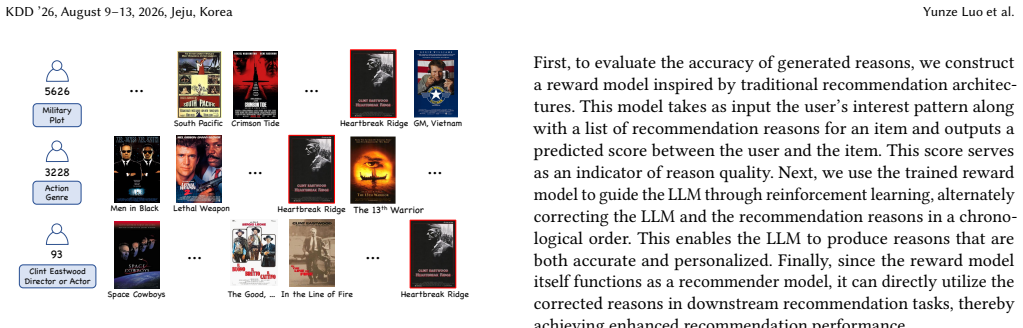
- [Sec. 5.5] The claim that corrected reasons 'enhance recommendation comprehensibility' is supported only by a single qualitative case study (Fig. 6). There is no human evaluation, no quantitative measure of reason accuracy or personalization, and no comparison of corrected versus uncorrected reasons. Given that the title and abstract foreground comprehensibility, this is a load-bearing claim that requires more than one illustrative example.
- [Sec. 5.2, Table 2] The text says CURec achieves 'significant improvements compared to all baseline methods,' but the experiments report no error bars, significance tests, or repeated runs. With a single run per dataset and 20+ metrics, statistical significance is not established. Additionally, Sec. 5.1.4 states only that Qwen2.5 is used, not the parameter scale; Fig. 5 shows strong dependence on scale, so it is unclear which scale produced Table 2 and whether the reported gains depend on an unreported large model.
- [Sec. 4.3.1 / 4.4.2] The initial user pattern p_u in Eq. (5) is generated from the user's entire training interaction sequence S_u, and then the chronological correction in Sec. 4.4.2 updates this pattern sequentially over training interactions. For an early interaction, the pattern already contains information from later training interactions, violating the stated chronological principle. This internal inconsistency could bias reward-model training and the correction process. Please clarify whether patterns are generated from prefix histories only, or justify the design.
minor comments (5)
- [Sec. 5.1.2] Typo: 'diffrernt' should be 'different'.
- [Table 4] Formatting issue: '7 .228' and '1 .052' contain stray spaces. Also, the table only reports time on two datasets; please state why Movies and TV is omitted.
- [Sec. 4.3.2, Eq. (9)] The user embedding e_u from the Transformer is based on item ID embeddings, while the pattern embedding e_p is from text. It would help to clarify how these two user representations are combined in the DIN input beyond concatenation in Eq. (10).
- [Sec. 4.4.2, Eq. (14)] Eq. (14) generates both an updated pattern and a new reason. Please clarify whether the reason used in the preceding RL step (Eq. 12) is generated with the old or the updated pattern, because this affects the reward assignment.
- [General] The paper does not include a limitations section. Given the closed-loop design and the single case study, a discussion of failure modes and potential reward hacking would be appropriate.
Circularity Check
No significant circularity; the reward model's dual use as objective and evaluator is a robustness limitation, not a definitional reduction.
full rationale
The paper's derivation chain is largely self-contained and does not reduce by construction. The recommendation-alignment pretraining uses a rule-based reward (format, legal, correctness), not a learned model. The reward model in Sec. 4.3.2 is trained on ground-truth interaction labels (Eq. 11) using patterns and reasons generated by LLM_pre. The chronological CoT correction (Sec. 4.4.1) then fine-tunes the LLM to maximize this reward model's score (Eq. 12), and the same model is later used as the downstream recommender (Sec. 4.4.2). This creates a closed loop: the reward signal and the final ranking score are the same function f. However, the loop is grounded by real interaction labels used to train f, and the reported test metrics (Table 2) are computed on held-out leave-one-out interactions not used to train f or fine-tune the LLM. Thus the reported gains are an empirical generalization claim, not a quantity equivalent to the trained parameters by construction. The main weakness is that the paper does not validate f's calibration on LLM_new-generated inputs, leaving open reward hacking and distribution shift; this is a correctness/robustness limitation, not a circular derivation. The comprehensibility claim (Sec. 5.5) rests on a single case study, but that is an evidential weakness, not circularity. Self-citations in the reference list are not load-bearing for the framework's derivation.
Assumptions & free parameters
free parameters (6)
- rating threshold for positive labels =
ratings > 3
- minimum user/item interaction counts =
users with >= 30 items, items with >= 10 interactions
- LLM fine-tuning learning rate =
5e-7 with cosine scheduler
- reward model learning rate, batch size, embedding dim =
1e-3, 128, 64
- LLM parameter scale for main results =
not reported
- GRPO group size G and KL penalty beta =
not reported
assumptions (6)
- standard math Attention mechanism and transformer architectures are valid for matching text embeddings
- standard math GRPO is a valid RL optimization for LLM fine-tuning
- domain assumption Item text descriptions are available and sufficient to infer recommendation reasons
- ad hoc to paper The reward model's predicted score is a valid proxy for recommendation-reason quality
- ad hoc to paper The fixed reward model remains valid when the LLM is fine-tuned against it
- ad hoc to paper Chronological correction does not introduce temporal leakage
invented entities (2)
-
User interest pattern (text summary of user taste)
independent evidence
-
Item recommendation reason (personalized text per user-item pair)
independent evidence
Cite this review
Pith. "Pith review of Towards Comprehensible Recommendation with Large Language Model Fine-tuning." pith.science (2026). https://pith.science/paper/2H3HU2KT
@misc{pith2026250807595,
  author       = {Pith},
  title        = {Pith review of: Towards Comprehensible Recommendation with Large Language Model Fine-tuning},
  year         = {2026},
  howpublished = {\url{https://pith.science/paper/2H3HU2KT}},
  note         = {Machine review of arXiv:2508.07595}
}
read the original abstract
Recommender systems have become increasingly ubiquitous in daily life. While traditional recommendation approaches primarily rely on ID-based representations or item-side content features, they often fall short in capturing the underlying semantics aligned with user preferences (e.g., recommendation reasons for items), leading to a semantic-collaborative gap. Recently emerged LLM-based feature extraction approaches also face a key challenge: how to ensure that LLMs possess recommendation-aligned reasoning capabilities and can generate accurate, personalized reasons to mitigate the semantic-collaborative gap. To address these issues, we propose a novel Content Understanding from a Collaborative Perspective framework (CURec), which generates collaborative-aligned content features for more comprehensive recommendations. \method first aligns the LLM with recommendation objectives through pretraining, equipping it with instruction-following and chain-of-thought reasoning capabilities. Next, we design a reward model inspired by traditional recommendation architectures to evaluate the quality of the recommendation reasons generated by the LLM. Finally, using the reward signals, CURec fine-tunes the LLM through RL and corrects the generated reasons to ensure their accuracy. The corrected reasons are then integrated into a downstream recommender model to enhance comprehensibility and recommendation performance. Extensive experiments on public benchmarks demonstrate the superiority of CURec over existing methods.
Figures


Figures from the paper (3 more)


Forward citations
Cited by 2 Pith papers
-
RecoReward: Recommender-Guided Multimodal Description Generation for Recommendation
A recommender-scored reinforcement reward trains an MLLM to produce a single content-only item description that improves live-stream recall offline and shows small online engagement gains.
-
RecoReward: Recommender-Guided Multimodal Description Generation for Recommendation
Training an MLLM with a recommender-affinity reward that contrasts historical engaged users with non-target users improves downstream recall for content-only item descriptions.
Reference graph
Works this paper leans on
-
[1]
Keqin Bao, Jizhi Zhang, Yang Zhang, Wenjie Wang, Fuli Feng, and Xiangnan He. 2023. TALLRec: An Effective and Efficient Tuning Framework to Align Large Language Model with Recommendation. In Proceedings of the 17th ACM Conference on Recommender Systems (Singapore, Singapore) (RecSys ’23) . As- sociation for Computing Machinery, New York, NY, USA, 1007–1014...
arXiv 2023
-
[2]
Millennium Bismay, Xiangjue Dong, and James Caverlee. 2024. ReasoningRec: Bridging Personalized Recommendations and Human-Interpretable Explanations through LLM Reasoning. arXiv:2410.23180 [cs.IR] https://arxiv.org/abs/2410. 23180
arXiv 2024
-
[3]
Zheng Chai, Qin Ren, Xijun Xiao, Huizhi Yang, Bo Han, Sijun Zhang, Di Chen, Hui Lu, Wenlin Zhao, Lele Yu, Xionghang Xie, Shiru Ren, Xiang Sun, Yaocheng Tan, Peng Xu, Yuchao Zheng, and Di Wu. 2025. LONGER: Scaling Up Long Sequence Modeling in Industrial Recommenders. arXiv:2505.04421 [cs.IR] https: //arxiv.org/abs/2505.04421
arXiv 2025
-
[4]
Gaode Chen, Ruina Sun, Yuezihan Jiang, Jiangxia Cao, Qi Zhang, Jingjian Lin, Han Li, Kun Gai, and Xinghua Zhang. 2024. A Multi-modal Modeling Framework for Cold-start Short-video Recommendation. In Proceedings of the 18th ACM Conference on Recommender Systems . 391–400
2024
-
[5]
Yongjun Chen, Zhiwei Liu, Jia Li, Julian McAuley, and Caiming Xiong. 2022. Intent Contrastive Learning for Sequential Recommendation. In Proceedings of the ACM Web Conference 2022 (Virtual Event, Lyon, France) (WWW ’22) . Association for Computing Machinery, New York, NY, USA, 2172–2182. https: //doi.org/10.1145/3485447.3512090
arXiv 2022
-
[6]
Heng-Tze Cheng, Levent Koc, Jeremiah Harmsen, Tal Shaked, Tushar Chandra, Hrishi Aradhye, Glen Anderson, Greg Corrado, Wei Chai, Mustafa Ispir, Rohan Anil, Zakaria Haque, Lichan Hong, Vihan Jain, Xiaobing Liu, and Hemal Shah
-
[7]
Jacob Devlin, Ming-Wei Chang, Kenton Lee, and Kristina Toutanova. 2019. BERT: Pre-training of Deep Bidirectional Transformers for Language Understanding. In Proceedings of the 2019 Conference of the North American Chapter of the Association for Computational Linguistics: Human Language Technologies, Volume 1 (Long and Short Papers), Jill Burstein, Christy...
doi:10.18653/v1/n 2019
-
[8]
Hao Ding, Yifei Ma, Anoop Deoras, Yuyang Wang, and Hao Wang. 2021. Zero- Shot Recommender Systems. arXiv:2105.08318 [cs.LG] https://arxiv.org/abs/ 2105.08318
arXiv 2021
Show all 55 references
-
[9]
Maxwell Harper and Joseph A
F. Maxwell Harper and Joseph A. Konstan. 2015. The MovieLens Datasets: History and Context. ACM Trans. Interact. Intell. Syst. 5, 4, Article 19 (dec 2015), 19 pages. https://doi.org/10.1145/2827872
2015 doi
-
[10]
Ruining He and Julian McAuley. 2016. VBPR: Visual Bayesian Personalized Ranking from Implicit Feedback. Proceedings of the AAAI Conference on Artificial Intelligence 30, 1 (Feb. 2016). https://doi.org/10.1609/aaai.v30i1.9973
2016 doi
-
[11]
Xiangnan He, Kuan Deng, Xiang Wang, Yan Li, YongDong Zhang, and Meng Wang. 2020. LightGCN: Simplifying and Powering Graph Convolution Network for Recommendation. In Proceedings of the 43rd International ACM SIGIR Confer- ence on Research and Development in Information Retrieva...
2020
-
[12]
Xiangnan He, Lizi Liao, Hanwang Zhang, Liqiang Nie, Xia Hu, and Tat-Seng Chua. 2017. Neural Collaborative Filtering. InProceedings of the 26th International Conference on World Wide Web(Perth, Australia) (WWW ’17). International World Wide Web Conferences Steering Committee, R...
2017
-
[13]
Yupeng Hou, Jiacheng Li, Zhankui He, An Yan, Xiusi Chen, and Julian McAuley
-
[14]
Yupeng Hou, Shanlei Mu, Wayne Xin Zhao, Yaliang Li, Bolin Ding, and Ji- Rong Wen. 2022. Towards Universal Sequence Representation Learning for Recommender Systems. In Proceedings of the 28th ACM SIGKDD Conference on Knowledge Discovery and Data Mining (Washington DC, USA) (KDD...
2022
-
[15]
Ziwei Ji, Nayeon Lee, Rita Frieske, Tiezheng Yu, Dan Su, Yan Xu, Etsuko Ishii, Ye Jin Bang, Andrea Madotto, and Pascale Fung. 2023. Survey of Hallucination in Natural Language Generation. ACM Comput. Surv. 55, 12, Article 248 (March 2023), 38 pages. https://doi.org/10.1145/3571730
2023 doi
- [16]
-
[17]
Wang-Cheng Kang and Julian McAuley. 2018. Self-Attentive Sequential Recom- mendation. arXiv:1808.09781 [cs.IR] https://arxiv.org/abs/1808.09781
2018 arXiv
-
[18]
Sein Kim, Hongseok Kang, Seungyoon Choi, Donghyun Kim, Minchul Yang, and Chanyoung Park. 2024. Large Language Models meet Collaborative Filtering: An Efficient All-round LLM-based Recommender System. In Proceedings of the 30th ACM SIGKDD Conference on Knowledge Discovery and D...
2024
- [19]
-
[20]
Yehuda Koren, Robert Bell, and Chris Volinsky. 2009. Matrix Factorization Techniques for Recommender Systems. Computer 42, 8 (2009), 30–37. https: //doi.org/10.1109/MC.2009.263
2009 doi
-
[21]
Jiacheng Li, Ming Wang, Jin Li, Jinmiao Fu, Xin Shen, Jingbo Shang, and Julian McAuley. 2023. Text Is All You Need: Learning Language Representations for Sequential Recommendation. In Proceedings of the 29th ACM SIGKDD Conference on Knowledge Discovery and Data Mining (Long Be...
2023
-
[22]
Ilya Loshchilov and Frank Hutter. 2019. Decoupled Weight Decay Regularization. arXiv:1711.05101 [cs.LG] https://arxiv.org/abs/1711.05101
2019 arXiv
-
[23]
Yunze Luo, Yuezihan Jiang, Yinjie Jiang, Gaode Chen, Jingchi Wang, Kaigui Bian, Peiyi Li, and Qi Zhang. 2025. Online Item Cold-Start Recommendation with Popularity-Aware Meta-Learning. In Proceedings of the 31st ACM SIGKDD Conference on Knowledge Discovery and Data Mining V.1 ...
2025
-
[24]
Ruihong Qiu, Zi Huang, Hongzhi Yin, and Zijian Wang. 2022. Contrastive Learn- ing for Representation Degeneration Problem in Sequential Recommendation. In Proceedings of the Fifteenth ACM International Conference on Web Search and Data Mining (Virtual Event, AZ, USA) (WSDM ’22...
2022
-
[25]
Qwen, :, An Yang, Baosong Yang, Beichen Zhang, Binyuan Hui, Bo Zheng, Bowen Yu, Chengyuan Li, Dayiheng Liu, Fei Huang, Haoran Wei, Huan Lin, Jian Yang, Jianhong Tu, Jianwei Zhang, Jianxin Yang, Jiaxi Yang, Jingren Zhou, Junyang Lin, Kai Dang, Keming Lu, Keqin Bao, Kexin Yang, ...
2025 arXiv
-
[26]
Yankun Ren, Zhongde Chen, Xinxing Yang, Longfei Li, Cong Jiang, Lei Cheng, Bo Zhang, Linjian Mo, and Jun Zhou. 2024. Enhancing Sequential Recom- menders with Augmented Knowledge from Aligned Large Language Models. In Proceedings of the 47th International ACM SIGIR Conference o...
2024
-
[27]
Zhihong Shao, Peiyi Wang, Qihao Zhu, Runxin Xu, Junxiao Song, Xiao Bi, Haowei Zhang, Mingchuan Zhang, Y. K. Li, Y. Wu, and Daya Guo. 2024. DeepSeek- Math: Pushing the Limits of Mathematical Reasoning in Open Language Models. arXiv:2402.03300 [cs.CL] https://arxiv.org/abs/2402.03300
2024 arXiv
-
[28]
Xiang-Rong Sheng, Feifan Yang, Litong Gong, Biao Wang, Zhangming Chan, Yujing Zhang, Yueyao Cheng, Yong-Nan Zhu, Tiezheng Ge, Han Zhu, Yuning Jiang, Jian Xu, and Bo Zheng. 2024. Enhancing Taobao Display Advertising with Multimodal Representations: Challenges, Approaches and In...
2024
-
[29]
Erfani, and Junhao Gan
Yixin Su, Rui Zhang, Sarah M. Erfani, and Junhao Gan. 2021. Neural Graph Matching based Collaborative Filtering. In Proceedings of the 44th International ACM SIGIR Conference on Research and Development in Information Retrieval (Virtual Event, Canada) (SIGIR ’21). Association ...
2021
-
[30]
Fei Sun, Jun Liu, Jian Wu, Changhua Pei, Xiao Lin, Wenwu Ou, and Peng Jiang
-
[31]
Jiaxi Tang and Ke Wang. 2018. Personalized Top-N Sequential Recommendation via Convolutional Sequence Embedding. In Proceedings of the Eleventh ACM International Conference on Web Search and Data Mining (Marina Del Rey, CA, USA) (WSDM ’18). Association for Computing Machinery,...
2018
-
[32]
Gomez, Łukasz Kaiser, and Illia Polosukhin
Ashish Vaswani, Noam Shazeer, Niki Parmar, Jakob Uszkoreit, Llion Jones, Aidan N. Gomez, Łukasz Kaiser, and Illia Polosukhin. 2017. Attention is all you need. In Proceedings of the 31st International Conference on Neural Information Processing Systems (Long Beach, California, ...
2017
-
[33]
Xiang Wang, Xiangnan He, Meng Wang, Fuli Feng, and Tat-Seng Chua. 2019. Neural Graph Collaborative Filtering. In Proceedings of the 42nd International ACM SIGIR Conference on Research and Development in Information Retrieval (SIGIR ’19). ACM, 165–174. https://doi.org/10.1145/3...
2019
-
[34]
Xinyi Wang, Shawn Tan, Mingyu Jin, William Yang Wang, Rameswar Panda, and Yikang Shen. 2025. Do Larger Language Models Imply Better Generalization? A Pretraining Scaling Law for Implicit Reasoning. arXiv:2504.03635 [cs.AI] https://arxiv.org/abs/2504.03635
2025 arXiv
-
[35]
Yining Wang, Liwei Wang, Yuanzhi Li, Di He, Tie-Yan Liu, and Wei Chen. 2013. A Theoretical Analysis of NDCG Type Ranking Measures. arXiv:1304.6480 [cs.LG]
2013 arXiv
-
[36]
Shu Wu, Yuyuan Tang, Yanqiao Zhu, Liang Wang, Xing Xie, and Tieniu Tan. 2019. Session-Based Recommendation with Graph Neural Networks. Proceedings of the AAAI Conference on Artificial Intelligence 33, 01 (Jul. 2019), 346–353. https: //doi.org/10.1609/aaai.v33i01.3301346
2019 doi
-
[37]
Yunjia Xi, Weiwen Liu, Jianghao Lin, Xiaoling Cai, Hong Zhu, Jieming Zhu, Bo Chen, Ruiming Tang, Weinan Zhang, and Yong Yu. 2024. Towards Open-World Recommendation with Knowledge Augmentation from Large Language Models. In Proceedings of the 18th ACM Conference on Recommender ...
2024
-
[38]
Lianghao Xia, Chao Huang, Jiao Shi, and Yong Xu. 2023. Graph-less Collaborative Filtering. In Proceedings of the ACM Web Conference 2023 (Austin, TX, USA) (WWW ’23). Association for Computing Machinery, New York, NY, USA, 17–27. https://doi.org/10.1145/3543507.3583196
2023
-
[39]
Lianghao Xia, Chao Huang, Yong Xu, Jiashu Zhao, Dawei Yin, and Jimmy Huang
-
[40]
Yu Xia, Rui Zhong, Hao Gu, Wei Yang, Chi Lu, Peng Jiang, and Kun Gai. 2025. Hierarchical Tree Search-based User Lifelong Behavior Modeling on Large Language Model. In Proceedings of the 48th International ACM SIGIR Confer- ence on Research and Development in Information Retrie...
2025
-
[41]
Yaowen Ye, Lianghao Xia, and Chao Huang. 2023. Graph Masked Autoencoder for Sequential Recommendation. In Proceedings of the 46th International ACM SIGIR Conference on Research and Development in Information Retrieval (Taipei, Taiwan) (SIGIR ’23). Association for Computing Mac...
2023
-
[42]
Zhenrui Yue, Sara Rabhi, Gabriel de Souza Pereira Moreira, Dong Wang, and Even Oldridge. 2023. LlamaRec: Two-Stage Recommendation using Large Language Models for Ranking. arXiv:2311.02089 [cs.IR] https://arxiv.org/abs/2311.02089
2023 arXiv
-
[43]
Jiani Zhang, Xingjian Shi, Shenglin Zhao, and Irwin King. 2019. STAR-GCN: stacked and reconstructed graph convolutional networks for recommender sys- tems. In Proceedings of the 28th International Joint Conference on Artificial Intelli- gence (Macao, China) (IJCAI’19). AAAI Pr...
2019
-
[44]
Yang Zhang, Keqin Bao, Ming Yan, Wenjie Wang, Fuli Feng, and Xiangnan He
-
[45]
Yang Zhang, Fuli Feng, Jizhi Zhang, Keqin Bao, Qifan Wang, and Xiangnan He
-
[46]
Bowen Zheng, Yupeng Hou, Hongyu Lu, Yu Chen, Wayne Xin Zhao, Ming Chen, and Ji-Rong Wen. 2024. Adapting Large Language Models by Integrating Collaborative Semantics for Recommendation. In 2024 IEEE 40th International Conference on Data Engineering (ICDE) . 1435–1448. https://d...
2024
-
[47]
Guorui Zhou, Xiaoqiang Zhu, Chenru Song, Ying Fan, Han Zhu, Xiao Ma, Yanghui Yan, Junqi Jin, Han Li, and Kun Gai. 2018. Deep Interest Network for Click- Through Rate Prediction. In Proceedings of the 24th ACM SIGKDD International Conference on Knowledge Discovery & Data Mining...
2018
-
[48]
Kun Zhou, Hui Wang, Wayne Xin Zhao, Yutao Zhu, Sirui Wang, Fuzheng Zhang, Zhongyuan Wang, and Ji-Rong Wen. 2020. S3-Rec: Self-Supervised Learning for Sequential Recommendation with Mutual Information Maximization. In Proceed- ings of the 29th ACM International Conference on In...
2020
-
[49]
In Proceedings of the 62nd Annual Meeting of the Association for Computational Linguistics (Volume 1: Long Papers), Lun-Wei Ku, Andre Martins, and Vivek Srikumar (Eds.)
Text-like Encoding of Collaborative Information in Large Language Models for Recommendation. In Proceedings of the 62nd Annual Meeting of the Association for Computational Linguistics (Volume 1: Long Papers), Lun-Wei Ku, Andre Martins, and Vivek Srikumar (Eds.). Association fo...
2024 doi
-
[55]
Xiangmin Zhou, Lei Chen, Chengkun He, Junfeng Wu, Weiyi Zhou, Jie Shao, and Yanchun Zhang. 2025. A Responsible and Extendable Context-Aware Recom- mender System. In Companion Proceedings of the ACM on Web Conference 2025 Towards Comprehensible Recommendation with Large Languag...
2025
-
[2016]
In Proceedings of the 1st Workshop on Deep Learning for Recommender Systems (Boston, MA, USA) (DLRS 2016)
Wide & Deep Learning for Recommender Systems. In Proceedings of the 1st Workshop on Deep Learning for Recommender Systems (Boston, MA, USA) (DLRS 2016). Association for Computing Machinery, New York, NY, USA, 7–10. https://doi.org/10.1145/2988450.2988454
2016
-
[2019]
In Proceedings of the 28th ACM International Conference on Information and Knowledge Management (Beijing, China) (CIKM ’19)
BERT4Rec: Sequential Recommendation with Bidirectional Encoder Rep- resentations from Transformer. In Proceedings of the 28th ACM International Conference on Information and Knowledge Management (Beijing, China) (CIKM ’19). Association for Computing Machinery, New York, NY, US...
-
[2022]
In Proceedings of the 45th International ACM SIGIR Conference on Research and Development in Information Retrieval (Madrid, Spain) (SIGIR ’22)
Hypergraph Contrastive Collaborative Filtering. In Proceedings of the 45th International ACM SIGIR Conference on Research and Development in Information Retrieval (Madrid, Spain) (SIGIR ’22). Association for Computing Machinery, New York, NY, USA, 70–79. https://doi.org/10.114...
-
[2024]
arXiv preprint arXiv:2403.03952 (2024)
Bridging Language and Items for Retrieval and Recommendation. arXiv preprint arXiv:2403.03952 (2024)
2024 arXiv
-
[2025]
IEEE Transactions on Knowledge and Data Engineering 37, 5 (2025), 2329–2340
CoLLM: Integrating Collaborative Embeddings Into Large Language Models for Recommendation. IEEE Transactions on Knowledge and Data Engineering 37, 5 (2025), 2329–2340. https://doi.org/10.1109/TKDE.2025.3540912
2025
Reviewed August 5, 2026 · model on record in the stance chip above.
Discussion (0). Sign in to comment.