REVIEW 4 major objections 5 minor 7 references
Multimodal learning enables instant ionizing radiation alerts on unmodified mobile phones for real-world emergency response
T0 review · 4 major / 5 minor · reviewed 2026-08-05 · deepseek-v4-flash
Pith's one-line read This paper claims that an ordinary smartphone camera, running only software, can detect hazardous ionizing radiation within six seconds by learning to recognize the faint, single-frame speckles that radiation leaves on a CMOS image sensor.
desk verdict Genuinely novel phone-based radiation alert without lens covering, but the 25 mRem/h threshold rests on an MLP fusion branch whose real-world generalization is unproven. read the letter →
The pith
A machine-rendered reading of the paper's core claim, the machinery that carries it, and where it could break.
The reading
What carries the argument
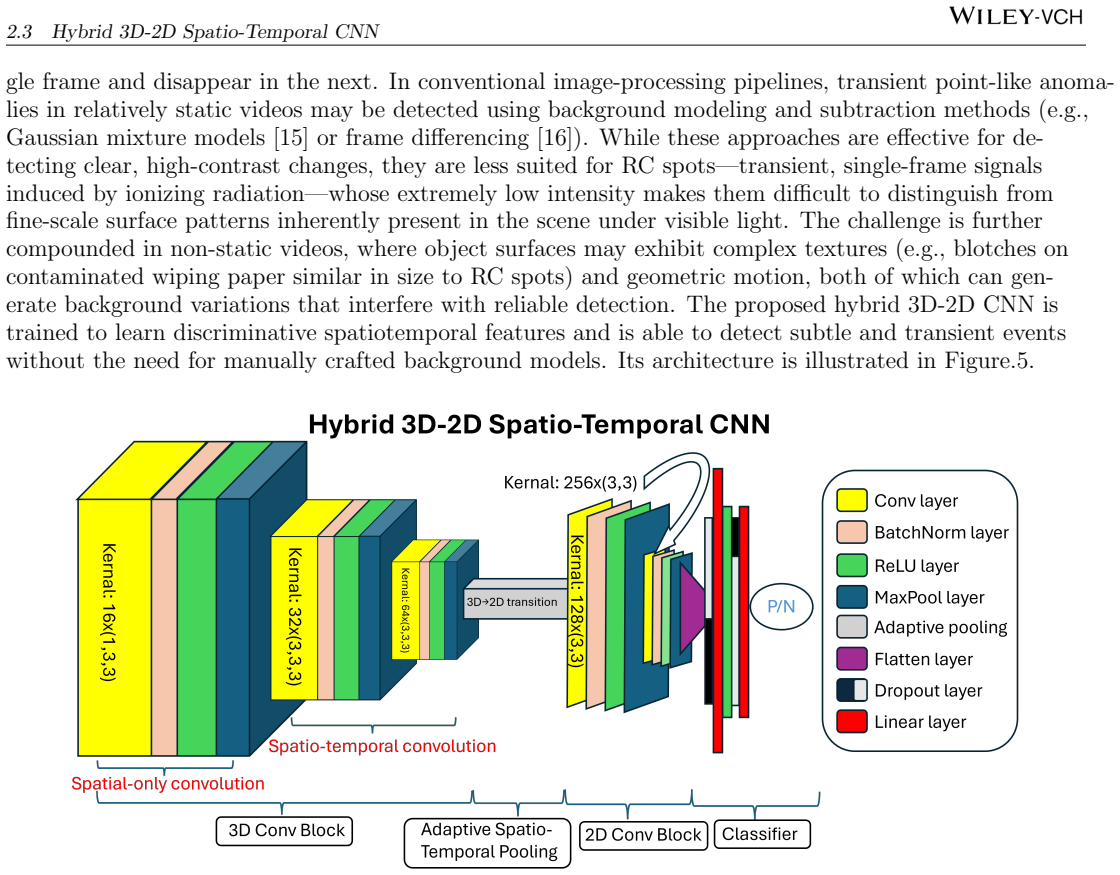
The load-bearing object is the RC spot: a sparse, single-frame bright speckle produced when an ionizing particle deposits charge in a CMOS pixel. The argument runs on a two-stage pipeline. First, a hybrid 3D-2D spatio-temporal CNN (three 3D convolutional layers followed by adaptive pooling and 2D convolution) classifies 50×50-pixel, 8-frame video segments as positive or negative for RC spots. Second, the detections are aggregated into a 21×38 signal map, paired with a brightness map, and fed to a dual-branch MLP together with seven statistics—total signal count, means and standard deviations of signal and brightness, the signal–brightness correlation coefficient, and a signal uniformity metr
What would settle it
Run sixty seconds of video with the same phone model pointed at a bright, textured, moving scene that contains no radiation source—for example, glossy wrapping paper under flickering LED light or foliage in sunlight—and count how often the system reports a dose rate above 25 mRem/h. The central claim would be falsified if false alarms occur at a rate far above what the paper's critical-level math predicts (roughly a handful of RC-spot-like detections per video at the reported 0.2% false-positive rate), because that would show brightness-fusion cannot suppress visual artifacts. A second check:
Extended reading notes
Core claim
The paper's central claim is that ionizing radiation can be detected from raw, uncovered mobile phone video by learning the visual signature of Radiation-caused Spots (RC spots): small, single-frame bright blotches produced when a gamma ray or secondary electron deposits charge in a CMOS pixel. A hybrid 3D-2D CNN classifies small video segments as containing an RC spot or not; a brightness map plus handcrafted statistics then feed an MLP that estimates dose rate, using the fact that true RC spots are uniform and random while visual false alarms cluster in bright areas. The reported system detects 25–280 mRem/h within six seconds (86–96% accuracy), classifies all tested videos correctly relat
Load-bearing premise
The load-bearing premise is that the 3D CNN's false-positive rate and recall measured on the limited validation data—including an external surface test with only 94 positive samples—generalize to the virtually infinite variety of real-world surfaces, lighting, and camera motion; the paper itself flags this uncertainty, and if it fails the brightness-fusion step cannot fully correct the dose estimate, making the 25 mRem/h alert threshold unreliable outside the tested condition
Editorial extensions
If this is right
- A six-second scan can warn that the local dose rate exceeds 25 mRem/h, the level at which four hours of exposure would reach the annual public dose limit of 100 mRem.
- No camera covering or special phone placement is needed, so the method works while holding the phone normally during an emergency.
- Extending the measurement to tens of minutes enables screening for low-level contamination near 0.6 mRem/h, such as a suspicious object or consumer product.
- Visual false alarms from bright, textured, or moving scenes are suppressed by the brightness-fusion step, which exploits the difference in spatial distribution between true radiation signals and visual artifacts.
- The intended use is an alert trigger: when the estimated dose rate crosses the threshold, the user's response is to move away, limiting exposure before a precise measurement is possible.
Reading between the lines
- The paper leaves cross-device transfer untested; because RC spots are a physical sensor response rather than a content feature, the same training recipe could plausibly be retrained for other modern phone models.
- The reported ~30% uncertainty in the reference ion-chamber measurements and the nine discrete training dose levels mean a deployed app would need a field-calibration study; the paper's accuracy numbers are measured under controlled conditions.
- Since the paper's critical-level calculation puts the theoretical six-second detection limit near 10 mRem/h in the low-false-positive regime, fusing several clips or multiple cameras could push the alert threshold below 25 mRem/h without lengthening the measurement.
Editorial analysis
A structured set of objections, weighed in public.
Referee Report
Summary. The paper presents a multimodal deep-learning framework for detecting ionizing radiation using an unmodified iPhone 15 Pro camera, without requiring camera occlusion or hardware modification. A hybrid 3D-2D CNN classifies short video segments as containing radiation-induced spots, and an MLP fuses the resulting signal distribution map with a brightness map to estimate dose rate. The authors report 86-96% accuracy for 25-280 mRem/h within six seconds, 87% accuracy for ~0.6 mRem/h with a 50-minute measurement, and independent validation with a Cs-137 source and a high-dose-rate Taylor source. The core claim is that this provides a practical emergency radiation alert tool for the public.
Significance. If the central claims are correct, this is a substantial practical advance: it would be the first demonstration that an unmodified consumer phone can serve as a radiation hazard alert device without covering the camera, addressing a real gap in public emergency response. The paper includes useful supporting contributions: an Allpix2-based CMOS sensor simulation, a critical-level analysis adapted from Currie, and independent external tests with Cs-137. However, the validation is narrow - one phone model, one radionuclide for training, nine discrete dose levels, indoor lighting, and a small external positive sample set. The load-bearing question is whether the false-positive suppression achieved by brightness fusion generalizes to arbitrary real-world scenes. The paper's own limitations section acknowledges this risk, but the evidence provided is not yet sufficient to support the strong claim that the method can reliably alert above the 25 mRem/h threshold outside the tested conditions.
major comments (4)
- [§2.4 and §4.4 (Eq. 3-6)] The full-video false-alarm rate after MLP fusion is not reported, and the paper's own numbers suggest this is critical. With Nseg = 15,960 segments and FPR ≈ 0.2%, CFP ≈ 32 false counts per six-second video. Using the paper's own linear calibration for the low-FP regime, Dose = 1.22 × Signal Counts + 3.88, those 32 counts correspond to ≈43 mRem/h, above the 25 mRem/h alert threshold. The MLP brightness-fusion branch is the only mechanism that suppresses such false alarms, but the external corn-husk validation reports only per-segment 3D-CNN FPR/recall (0.03% and 97%), not the end-to-end probability that a full non-radiation video triggers an alert after fusion. I request a clear report of the alert-level false-positive rate on non-radiation videos, with details of scene diversity; this should be a prerequisite for the central real-world emergency claim.
- [§2.3 and §2.4] Generalization of the brightness-fusion mechanism to arbitrary real-world scenes is not demonstrated. The MLP was trained on data from a single iPhone 15 Pro ultra-wide camera, one Am-241 source, nine discrete dose-rate levels, indoor illumination, and specifically placed box-surface materials. The external corn-husk test contains only 94 positive clips and does not report full-video alarm behavior after the MLP. The paper states in §2.3: 'given the virtually infinite variability in object surface patterns and ambient lighting conditions, it is possible that specific scenarios may trigger false positive signals not captured by this limited validation set.' This limitation bears directly on the central claim. Concrete tests are needed: multiple phone models/sensors, outdoor sunlight, moving textures, flickering lights, and camera-motion transients, with full-video false-alarm rates.
- [§4.4 (Eq. 3-5) and §2.4] The critical-level derivation is internally inconsistent. The paper defines N = CG − CFP, where CFP is an expected count estimated from FPR × Nseg. Under the null, the measured gross count is Poisson with mean CFP, so var(N) = CFP, not var(CG) + var(CFP) = CG + 2CFP. Using 2CFP overestimates σ0 by a factor of √2 and therefore overestimates LC and LD. This affects the reported theoretical detection-limit values (e.g., 'more than 40 counts' and '~55 mRem/h'). The empirical accuracy claims are separate, but the theoretical discussion of sensitivity limits should be corrected.
- [§4.1 and Fig. 2] The Allpix2 simulation is presented as 'Principal Verification', but the simulated sensor (2 × 2 µm pixels, 30 µm thickness, 300 e threshold, 1.8 V bias) is not validated against the actual iPhone 15 Pro ultra-wide CMOS sensor parameters. The linear relationship in Fig. 2c is a useful physics plausibility check, but it should be explicitly labeled as illustrative of CMOS response, not as a validated model of the specific sensor used in the experiments. If the authors wish to use this simulation as evidence for the sensor's detection threshold or efficiency, they should show that the assumed pixel geometry, noise, and threshold correspond to the hardware.
minor comments (5)
- [Abstract] 'low-level radiation (-0.6 mRem/h)' should read '~0.6 mRem/h'; the tilde is missing.
- [Figure 4 caption] 'The compassion between' should be 'The comparison between'.
- [§2.4] The phrase 'over 200 cases' is vague; report the number of video samples in the test set, their dose-rate levels, and the per-class accuracy with confidence intervals. The 'lowest observed performance of 50%' also needs context - how many samples and at which dose rates?
- [§4.3] The positive-sample annotation was performed by a single annotator with no reported inter-annotator agreement. This could introduce systematic label noise, especially for subtle RC spots. A brief discussion would be useful.
- [Data Availability] The data availability statement says 'available upon request' with no mention of code or trained model weights. For reproducibility of a deep-learning study with a custom training pipeline, releasing the trained model and a small validation dataset would be valuable, even if raw videos cannot be shared.
Circularity Check
No significant circularity: the central dose-rate claims rest on supervised training with independent external validation, not on self-citation or definitional reduction.
full rationale
The paper's claimed derivation chain is an empirical machine-learning calibration: a 3D CNN is trained on human-annotated video segments, and an MLP is regressed against ion-chamber dose-rate labels. Fitting a model to labeled data and then evaluating on held-out and external data is not circular. The two independent external tests (test (i): 37 kBq Cs-137, 87% accuracy; test (ii): Taylor source at 281 mRem/h, 96.8% accuracy) are separate from the training distribution and provide non-circular support for the central claim. The linear dose-rate/count relation (y = 1.22x + 3.88, R² = 0.918) is an empirical calibration in a low-FP regime, and its use in the critical-level analysis is a standard statistics-based detection-limit calculation, not a renamed prediction. The paper contains no load-bearing self-citations: references to Currie (1968) are external, standard detection-limit theory. The acknowledged limitations (small positive sample in corn-husk test, limited lighting/surface variability, FPR generalization) are validation/robustness concerns, not circularity. Overall, the derivation chain is self-contained relative to its empirical inputs, and no step reduces to its own output by construction.
Assumptions & free parameters
free parameters (3)
- Linear calibration slope and intercept =
slope = 1.22 (mRem/h per count), intercept = 3.88 mRem/h
- Brightness threshold for linear regime =
3.0 (unitless)
- 3D CNN/MLP weights and hyperparameters =
not fully specified
assumptions (4)
- standard math Poisson statistics for background/false positive counts (Currie critical level and detection limit equations)
- domain assumption Number of RC spots is linearly proportional to dose rate
- domain assumption RC spot occurrence is uniform across the sensor and independent of visible light content
- ad hoc to paper Allpix2 simulation with 2x2 micron pixels, 30 micron thickness, 300 electron threshold represents the radiation response of the iPhone 15 Pro ultra-wide camera
Cite this review
Pith. "Pith review of Multimodal learning enables instant ionizing radiation alerts on unmodified mobile phones for real-world emergency response." pith.science (2026). https://pith.science/paper/D5CVSXPO
@misc{pith2026250808541,
  author       = {Pith},
  title        = {Pith review of: Multimodal learning enables instant ionizing radiation alerts on unmodified mobile phones for real-world emergency response},
  year         = {2026},
  howpublished = {\url{https://pith.science/paper/D5CVSXPO}},
  note         = {Machine review of arXiv:2508.08541}
}
read the original abstract
In a radiation emergency, every second counts, yet the public rarely has immediate access to dedicated monitoring devices when they are needed most. Here, the first practical mobile phone-based emergency ionizing radiation detection method is presented that operates entirely without requiring camera coverage or additional hardware modifications. Utilizing a multimodal deep learning approach that integrates sparse radiation-induced signal distributions with the brightness patterns, the proposed framework effectively isolates subtle radiation signals from overwhelming visual interference. A hybrid 3D-2D convolutional neural network (CNN) identifies radiation-induced spots from raw mobile phone video, while a multi-layer perceptron (MLP) fuses the radiation signal and brightness maps for the dose rate estimation. The method detects hazardous dose rates (25-280 mRem/h) rapidly within six seconds (accuracy 86-96%), and low-level radiation (-0.6 mRem/h) with extended measurement durations achieves 87% accuracy. The developed method greatly enhances mobile phone radiation detection practicality and shows substantial potential as an accessible radiation emergency detection tool.
Figures


Figures from the paper (6 more)



Reference graph
Works this paper leans on
-
[17]
Vision transformer for small-size datasets, 2021
Sanghyun Lee, Donggyu An, and Sungroh Yoon. Vision transformer for small-size datasets, 2021. URL https://arxiv.org/abs/2112.13492
arXiv 2021
-
[18]
Efficient Training of Visual Transformers with Small Datasets
Yahui Liu, Enver Sangineto, Wei Bi, Nicu Sebe, Bruno Lepri, and Marco De Nadai. Efficient train- ing of visual transformers with small datasets, 2021. URL https://arxiv.org/abs/2106.03746
work page Pith review arXiv 2021
-
[19]
Radionuclide basics: Cesium-137, 2025
United States Environmental Protection Agency. Radionuclide basics: Cesium-137, 2025. URL https://www.epa.gov/radiation/radionuclide-basics-cesium-137 . Accessed: Aug 2025
work page 2025
-
[20]
Interpixel capacitance in the ir channel: Measurements made on orbit
Bertrand Hilbert and Peter McCullough. Interpixel capacitance in the ir channel: Measurements made on orbit. Technical Report WFC3 Instrument Science Report 2011-10, Space Telescope Sci- ence Institute, 2011
work page 2011
-
[21]
Techniques for accessibility evaluation and repair tools (aert), April 2000
W3C W AI Evaluation and Repair Tools Working Group. Techniques for accessibility evaluation and repair tools (aert), April 2000. URL https://www.w3.org/TR/AERT/. Accessed: Aug 2025
work page 2000
-
[22]
Lloyd A. Currie. Limits for qualitative detection and quantitative determination. application to radiochemistry. Analytical Chemistry, 40(3):586–593, 1968. doi: 10.1021/ac60259a007. URL https://pubs.acs.org/doi/10.1021/ac60259a007
-
[23]
L. A. Currie. Detection and quantification limits: basic concepts, international harmonization, and outstanding (”low-level”) issues. Applied Radiation and Isotopes , 61(2-3):145–149, 2004. doi: 10.1016/j.apradiso.2004.03.036. URL https://www.sciencedirect.com/science/article/pii/ S0969804304000971. 17
Reviewed August 5, 2026 · model on record in the stance chip above.
Discussion (0). Sign in to comment.