REVIEW 6 major objections 6 minor 60 references
Traffic Load-Aware Resource Management Strategy for Underwater Wireless Sensor Networks
T0 review · 6 major / 6 minor · reviewed 2026-08-15 · deepseek-v4-flash
Pith's one-line read In simulation, a traffic-aware MARL strategy that schedules links and adapts power/rate raises underwater network throughput by 92.8% to 351.6% over baselines.
desk verdict A credible UWSN resource-management paper with a genuinely new traffic-aware mechanism, but the NSGA-II action pruning likely ignores concurrent interference, and the evaluation is too narrow to settle whether the headline gains hold. read the letter →
The pith
A machine-rendered reading of the paper's core claim, the machinery that carries it, and where it could break.
The reading
What carries the argument
The load-bearing object is the reduced action set $A = \{\text{wait}, \hat{U}\}$: the NSGA-II filtering step takes the full product of transmission modes and transmit powers and keeps only the per-node Pareto-optimal tradeoffs between transmission delay and energy subject to the SINR threshold. This is what makes the deep MARL action space small enough to train. The second mechanism is the overhear information matrix $OI$, where each neighbor-load entry is weighted by a confidence $CF = \tanh(\Delta\delta_j / a)$ that replaces the raw acquisition time, so stale overheard traffic still informs scheduling. The third mechanism is the DRQN policy trained under CTDE: recurrent Q-networks handle partial observability, and a team reward based on successful receptions minus conflicts at the sink guides cooperative link scheduling.
What would settle it
Run the same single-hop setup at the highest traffic load with a MARL agent whose action space is the full product of the five modem modes and the transmit-power range instead of the NSGA-II-pruned set, and measure throughput and delivery ratio; if the unpruned agent does not match TARM, the pruning step is not responsible for the gains, and if the unpruned agent substantially beats TARM, the pruning assumption is falsified. A second check is to add a hidden interferer whose transmissions are not in any node's observation; if TARM's delivery ratio or throughput degrades sharply while the unpruned agent adapts, the confidence mechanism is not bridging the observation gap.
Extended reading notes
Core claim
The central claim is that TARM enables efficient and reliable communication in single-hop UWSNs by jointly optimizing link scheduling and per-node transmission parameters through deep MARL. Each agent's action comes from $A = \{\text{wait}, \hat{U}\}$, where $\hat{U}$ is a Pareto front of $(\text{mode}, \text{power})$ pairs produced by NSGA-II from the tradeoff between transmission time and energy under an SINR threshold. Agents observe their own queue, position, and physical-layer status plus a neighbor-load table whose entries are weighted by a hyperbolic-tangent confidence that decays as information ages; a deep recurrent Q-network selects actions, and centralized training with decentralized execution uses a sink-side reward of successful receptions minus conflicts. The paper reports that this design delivers the stated throughput gains over baselines while keeping delivery ratio near one, and that removing either local load information or overheard neighbor information degrades delay and reliability under high traffic.
Load-bearing premise
The action set each agent is allowed to choose from is built by NSGA-II from a per-node optimization problem whose SINR constraint does not include interference from simultaneous transmissions by other nodes; if concurrent interference makes the best coordinated mode-and-power choices fall outside that pruned Pareto set, the agent cannot select them and the claimed performance and complexity advantages would not hold.
Editorial extensions
If this is right
- If TARM's simulation results transfer to deployments, a UWSN can be run without a central scheduler or dedicated control-packet exchange, since nodes learn from traffic they already overhear.
- The gains over fixed-slot or Aloha-based access are largest under high traffic loads, so TARM is most valuable exactly when the acoustic channel is congested.
- Because TARM selects from an NSGA-II-pruned Pareto set, training and inference stay tractable as the number of modem modes and power levels grows.
- The confidence-weighted overhear mechanism converts long propagation delays and stale neighbor information from a liability into a scheduling input, enabling concurrent transmissions and higher channel utilization.
- TARM addresses throughput, delay, energy, delivery ratio, and channel utilization together rather than trading one objective against another, which is what the multi-objective ERCMOP formulation demands.
Reading between the lines
- Editorial inference: if the per-node Pareto pruning is the bottleneck, the same TARM architecture could be retrained with an unpruned or adaptively expanded action set in dense networks, and the comparison would show how much of the reported gain comes from the pruning step versus the learned policy.
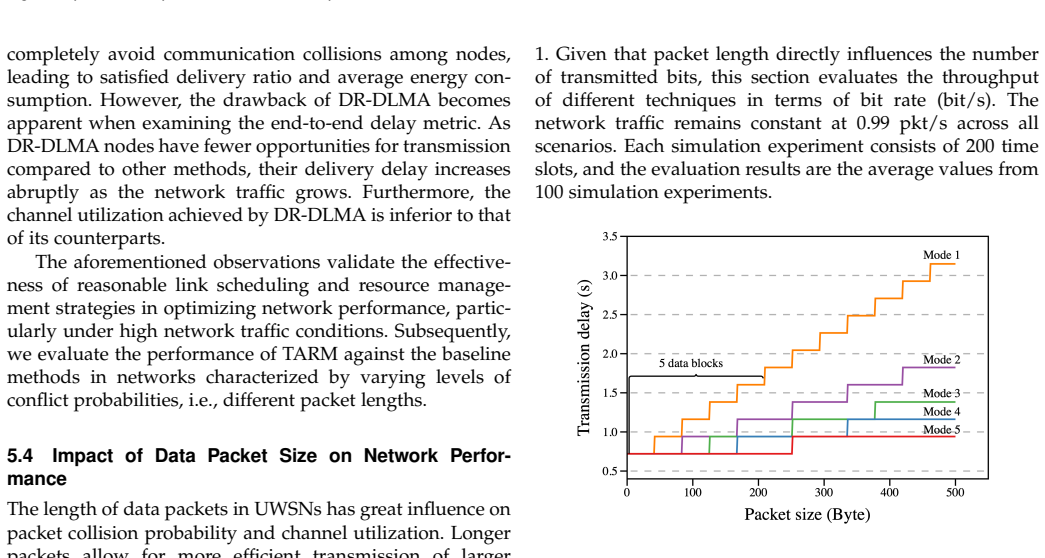
- Editorial inference: the 10-byte traffic-metadata overhead means TARM's advantage may shrink for very short packets; a sweep of packet lengths below 190 bytes would show whether the overhead can offset the scheduling gains.
- Editorial inference: because the simulation covers only single-hop networks, the natural next check is whether confidence-weighted overheard traffic remains useful in multi-hop settings where interference is no longer concentrated at one sink.
- Editorial inference: the Poisson traffic assumption is testable; bursty or non-stationary sources would stress the linear traffic estimator and the confidence decay model, and TARM's adaptability under such traffic is not established by the paper.
Signed reviews
Editorial analysis
A structured set of objections, weighed in public.
Referee Report
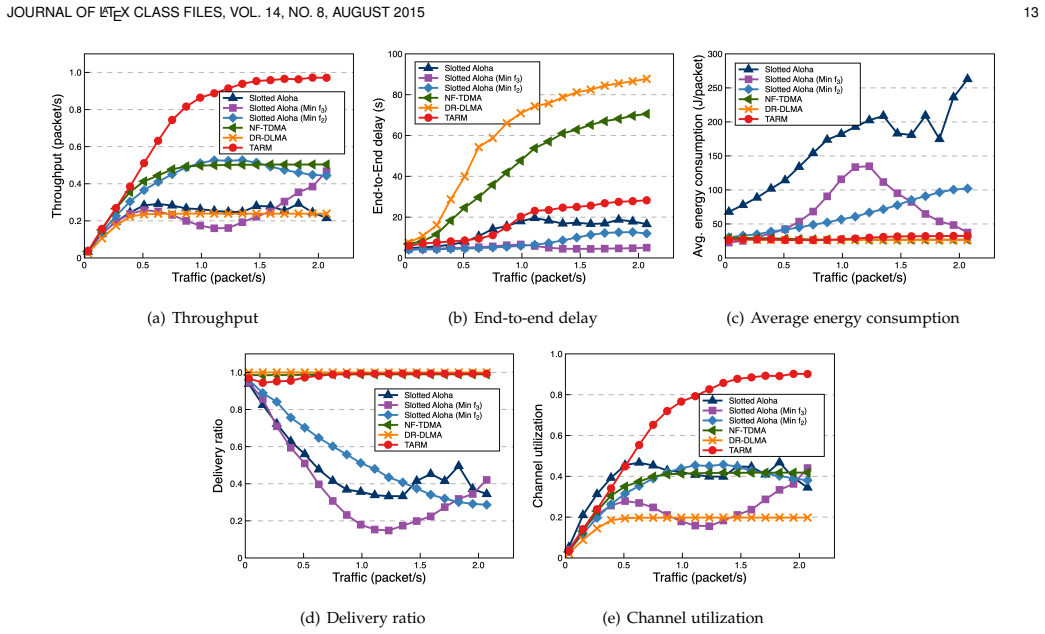
Summary. This paper addresses joint link scheduling and transmission parameter adaptation (mode and power) in single-hop underwater acoustic sensor networks. The authors formulate the problem as a Dec-POMDP (ERCMOP) and propose TARM, a deep MARL approach using DRQN with centralized training and decentralized execution. TARM has three components: (i) a traffic-load-aware observation mechanism in which each node attaches queue/load information to its packets and uses overheard neighbor information weighted by an information-confidence function based on the hyperbolic tangent of the information age; (ii) an NSGA-II-based solution space optimizer that prunes the per-node power/mode action set to a Pareto front; and (iii) a DRQN-based policy with a reward that encodes successful receptions, conflicts, and traffic normalization. Simulation results over a three-transmitter, one-sink acoustic network are reported for varying traffic load and packet length, with throughput, delay, energy, delivery ratio, and channel utilization metrics. Against baselines (two Slotted-Aloha variants, NF-TDMA, and DR-DLMA), TARM is reported to achieve throughput gains of 55.6%-220.2% at λ_N=0.75 pkt/s and 92.8%-351.6% at λ_N=2.07 pkt/s. A component ablation supports the value of local and neighbor load information.
Significance. If the reported performance holds, TARM would be a valuable contribution to distributed traffic-aware resource management in energy-constrained UWSNs: the overhear-based load estimation directly addresses partial observability under long propagation delays, and the NSGA-II action pruning is a sensible way to keep the MARL action space small. The ablation study in Section 5.5 is a strength, and the use of realistic acoustic modem modes (AquaSeNT OFDM) and the Urick/BELLHOP channel model gives the evaluation a grounding in practice. However, the significance is currently moderated by (i) an unresolved ambiguity in the action-space construction that could remove exactly the interference-robust actions needed at high load, (ii) the absence of any error bars or statistical tests supporting the headline percentage gains, and (iii) a baseline set that omits the traffic-load-aware schemes cited as the closest prior work. The paper does not provide code or a measurement of the claimed complexity reduction.
major comments (6)
- [Section 4.2, Eq. (16)] The per-node SSO problem (16) does not specify how the SINR constraint (16b) is evaluated. Since γ_i,m in Eq. (4) includes interference from concurrent transmitters, but the candidate set Û is generated before joint scheduling decisions are known, it is unclear whether (16) is solved with zero interference, worst-case interference, or some nominal value. If (16) is solved in isolation, then for each transmission mode the only non-dominated power is the minimum power that meets the threshold with no concurrent interference, so Û contains at most one power per mode and the agent cannot select a higher-power action to survive interference at the sink. The reported throughput gains at λ_N = 2.07 pkt/s (Section 5.3) are largest precisely in the regime where concurrent interference is most likely, so this ambiguity directly bears on the headline claim. Please state how (16) is evaluated and test the sensitivity of the results to the interference assumption, for example with an SSO variant that uses worst-case or sampled interference or with an enlarged action set.
- [Section 5.1 and Figs. 6-7] All curves are pointwise averages over 100 runs with no error bars, confidence intervals, or significance tests. Given the random Rayleigh fading, random mobility, and Poisson traffic, the reader cannot assess whether the reported differences (e.g., the 55.6%-220.2% and 92.8%-351.6% throughput gains in Section 5.3) are distinguishable from noise, particularly where curves are close at low λ_N. Please report standard deviations or confidence intervals and use matched-seed paired tests where curves are close.
- [Sections 2 and 5.2] The related work identifies traffic-load-aware distributed schemes ([11], [29], [31], [33]) as the closest prior art, but the evaluation compares TARM only with Slotted-Aloha variants, NF-TDMA, and DR-DLMA. As a result, the claim that TARM improves on traffic-load-aware resource management is not directly evidenced. Please either include at least one such baseline (or a reasonable adaptation of it) in the comparison, or clearly state why these schemes cannot be reproduced in the current setup and soften the corresponding contribution claims.
- [Section 4.4, Algorithm 3] The paper mentions VDN as an example of a CTDE mixing network but does not state whether it is actually used. Algorithm 3 initializes a single shared Q-network for all agents and contains no description of a value-decomposition or mixing network, nor of how the team reward (18)-(20) is decomposed into per-agent learning signals. Without this information the MARL component is not reproducible. Please specify the exact architecture (DRQN with shared parameters, any mixing network, GRU handling) and the hyperparameters used for the reported results.
- [Section 5.3] The paper does not state whether a separate TARM model is trained for each traffic value λ_N or whether one model trained over a range of λ_N is evaluated at each point. Since Eq. (19) normalizes the reward using λ_N, this distinction is important: separate training per λ would not demonstrate adaptability across traffic loads. Please clarify the training/evaluation protocol for each λ_N in Section 5.3.
- [Contributions 3 and Section 5] The paper claims that the NSGA-II based SSO reduces computational complexity, but no complexity metric, training time, inference time, or size of the candidate set Û is reported anywhere in the evaluation. Since action-space reduction is a stated contribution, the claim is currently unsupported. Please report at least the number of candidate solutions produced by NSGA-II and a comparison of training/execution time against a variant with the full action space.
minor comments (6)
- [Section 3.5] The interference constraint (15b) is written as mt_recv ∈ {0,1}, but the text immediately after it says 'When mt_recv > 1, it implies that conflicts are occurring.' Please reconcile the binary constraint with the conflict condition.
- [Algorithm 2] Algorithm 2 refers to Eq. (20) when computing the confidence CFj; the correct reference is Eq. (17).
- [Eq. (11)] Equation (11) uses the symbol '∥' where a logical OR (typically ∨) is intended, and the spacing in 't arrive_j' is inconsistent.
- [Section 5.1] Section 5.1 states that the second FC layer has seven hidden units generating Q-values for each action, which implies |A|=7 (i.e., U=6), but the size of the NSGA-II candidate set is never reported. Please add the actual U or U-hat size.
- [Section 4.4] The notation 'U = |U-hat|' is confusing because U is also used for the full solution space; please use distinct symbols, e.g., U_full and U_cand.
- [Section 2] Section 2 contains a typo ('propagatioßn') and several other minor grammatical issues; a careful proofreading pass is recommended.
Circularity Check
No significant circularity: TARM is an algorithmic proposal evaluated against external baselines, with no prediction derived from its own fitted inputs.
full rationale
The paper's central claims are simulation results for a proposed MARL-based resource management policy, not quantities derived from the paper's own assumptions. The action space is constructed once by NSGA-II over Eq. (16) and the DRQN then selects actions from that set; final throughput/delay/energy metrics are measured in a physical-model simulator with independent baselines (Slotted-Aloha, NF-TDMA, DR-DLMA). The reward in Eqs. (18)-(20) uses the same success and conflict counts as the evaluation metrics, but that is standard objective alignment in reinforcement learning, not a fitted input renamed as a prediction. The traffic normalization factor omega in Eq. (19) uses the known simulation parameter lambda_N as a training-time reward scale; it is not used to produce the reported performance numbers and does not make those numbers equal to any input. Self-citations [2], [3], [12], and [24] appear only as background or related work, and the mode-dependent SINR thresholds from [27] and [45] are external sea-trial data, so no load-bearing self-citation chain is present. The unresolved question about Eq. (16) possibly ignoring concurrent interference when pruning the action set is a correctness or validation risk, not circularity, because the pruned set and the final performance are not definitionally linked in the paper.
Assumptions & free parameters
free parameters (4)
- reward coefficient alpha
- information confidence time-scale a
- traffic estimator window kappa
- NSGA-II candidate set size U
assumptions (5)
- domain assumption Rayleigh fading coefficient with unit mean and CDF P[rho <= x] = 1 - exp(pi x^2 / 4)
- domain assumption Packet success is determined by the physical SINR threshold model with thresholds gamma_0_M from sea trials [27]
- domain assumption Clocks of all nodes are synchronized and modems are half-duplex omni-directional
- ad hoc to paper The per-node SSO optimization (16) is solved without modeling interference from concurrent transmitters, and its Pareto-front candidates are assumed sufficient as the RL action space under contention
- domain assumption BELLHOP ray tracing with fixed sea-bottom parameters provides the propagation delay delta_prop
Cite this review
Pith. "Pith review of Traffic Load-Aware Resource Management Strategy for Underwater Wireless Sensor Networks." pith.science (2026). https://pith.science/paper/QY3X4OIG
@misc{pith2026250808555,
  author       = {Pith},
  title        = {Pith review of: Traffic Load-Aware Resource Management Strategy for Underwater Wireless Sensor Networks},
  year         = {2026},
  howpublished = {\url{https://pith.science/paper/QY3X4OIG}},
  note         = {Machine review of arXiv:2508.08555}
}
read the original abstract
Underwater Wireless Sensor Networks (UWSNs) represent a promising technology that enables diverse underwater applications through acoustic communication. However, it encounters significant challenges including harsh communication environments, limited energy supply, and restricted signal transmission. This paper aims to provide efficient and reliable communication in underwater networks with limited energy and communication resources by optimizing the scheduling of communication links and adjusting transmission parameters (e.g., transmit power and transmission rate). The efficient and reliable communication multi-objective optimization problem (ERCMOP) is formulated as a decentralized partially observable Markov decision process (Dec-POMDP). A Traffic Load-Aware Resource Management (TARM) strategy based on deep multi-agent reinforcement learning (MARL) is presented to address this problem. Specifically, a traffic load-aware mechanism that leverages the overhear information from neighboring nodes is designed to mitigate the disparity between partial observations and global states. Moreover, by incorporating a solution space optimization algorithm, the number of candidate solutions for the deep MARL-based decision-making model can be effectively reduced, thereby optimizing the computational complexity. Simulation results demonstrate the adaptability of TARM in various scenarios with different transmission demands and collision probabilities, while also validating the effectiveness of the proposed approach in supporting efficient and reliable communication in underwater networks with limited resources.
Figures


Figures from the paper (6 more)




Reference graph
Works this paper leans on
-
[11]
A traffic load-aware ofdma-based mac protocol for distributed underwater acoustic sensor net- works,
Y. Su, X. Liu, G. Han, and X. Fu, “A traffic load-aware ofdma-based mac protocol for distributed underwater acoustic sensor net- works,” IEEE Transactions on Vehicular Technology , vol. 70, no. 10, pp. 10 501–10 513, 2021
work page 2021
-
[29]
A load-based hybrid mac protocol for underwater wireless sensor networks,
Z. Zhang, W. Shi, Q. Niu, Y. Guo, J. Wang, and H. Luo, “A load-based hybrid mac protocol for underwater wireless sensor networks,” IEEE Access, vol. 7, pp. 104 542–104 552, 2019
work page 2019
-
[31]
S. Yang, X. Liu, and Y. Su, “A traffic-aware fair mac protocol for layered data collection oriented underwater acoustic sensor networks,” Remote Sensing, vol. 15, no. 6, p. 1501, 2023
work page 2023
-
[33]
Dco-mac: A hybrid mac proto- col for data collection in underwater acoustic sensor networks,
M. Deng, H. Chen, and L. Xie, “Dco-mac: A hybrid mac proto- col for data collection in underwater acoustic sensor networks,” Sensors, vol. 18, no. 7, p. 2300, 2018
work page 2018
-
[1]
A survey of routing protocols for underwater wireless sensor networks,
J. Luo, Y. Chen, M. Wu, and Y. Yang, “A survey of routing protocols for underwater wireless sensor networks,” IEEE Com- munications Surveys & Tutorials, vol. 23, no. 1, pp. 137–160, 2021
work page 2021
-
[2]
A deep marl-based power-management strategy for improving the fair reuse of uwsns,
Y. Gou, T. Zhang, T. Yang, J. Liu, S. Song, and J.-H. Cui, “A deep marl-based power-management strategy for improving the fair reuse of uwsns,” IEEE Internet of Things Journal , vol. 10, no. 7, pp. 6507–6522, 2023
work page 2023
-
[3]
Y. Gou, T. Zhang, J. Liu, T. Yang, S. Song, and J.-H. Cui, “Achiev- ing fair-effective communications and robustness in underwater acoustic sensor networks: A semi-cooperative approach,” IEEE Transactions on Mobile Computing , vol. 23, no. 5, pp. 5722–5739, 2024
work page 2024
-
[4]
Channel modeling for underwater acoustic network simulation,
N. Morozs, W. Gorma, B. T. Henson, L. Shen, P . D. Mitchell, and Y. V . Zakharov, “Channel modeling for underwater acoustic network simulation,” IEEE Access, vol. 8, pp. 136 151–136 175, 2020
work page 2020
Show all 60 references
-
[5]
Underwater acoustic communication channels: Propagation models and statistical characterization,
M. Stojanovic and J. Preisig, “Underwater acoustic communication channels: Propagation models and statistical characterization,” IEEE communications magazine, vol. 47, no. 1, pp. 84–89, 2009
2009
-
[6]
Lifetime maximization in underwater wireless communication networks,
K. Y. Islam, I. Ahmad, D. Habibi, J. Jin, and M. Waqas, “Lifetime maximization in underwater wireless communication networks,” IEEE Sensors Journal, vol. 22, no. 15, pp. 15 549–15 560, 2022
2022
-
[7]
Op- timal cooperative relaying and power control for iout networks with reinforcement learning,
Y. Su, M. Liwang, Z. Gao, L. Huang, X. Du, and M. Guizani, “Op- timal cooperative relaying and power control for iout networks with reinforcement learning,”IEEE Internet of Things Journal, vol. 8, no. 2, pp. 791–801, 2021
2021
-
[8]
A medium access control protocol based on parity group-graph coloring for underwater auv-aided data collection,
J. Jiang, W. Tian, G. Han, and F. Zhang, “A medium access control protocol based on parity group-graph coloring for underwater auv-aided data collection,” IEEE Internet of Things Journal , vol. 11, no. 4, pp. 5967–5979, 2024
2024
-
[9]
Coexistence of multi-dimensional chirp spread spectrum in underwater acoustic networks,
K. Enhos, E. Demirors, D. Unal, and T. Melodia, “Coexistence of multi-dimensional chirp spread spectrum in underwater acoustic networks,” in Proceedings of the 16th International Conference on Underwater Networks & Systems, 2022, pp. 1–8
2022
-
[10]
Hcar: A hybrid coding- aware routing protocol for underwater acoustic sensor networks,
Y. Su, Y. Xu, Z. Pang, Y. Kang, and R. Fan, “Hcar: A hybrid coding- aware routing protocol for underwater acoustic sensor networks,” IEEE Internet of Things Journal , vol. 10, no. 12, pp. 10 790–10 801, 2023
2023
-
[12]
Udarmf: An underwater distributed and adaptive resource management framework,
T. Zhang, Y. Gou, J. Liu, T. Yang, and J.-H. Cui, “Udarmf: An underwater distributed and adaptive resource management framework,” IEEE Internet of Things Journal, vol. 9, no. 10, pp. 7196– 7210, 2022
2022
-
[13]
Qelar: A machine-learning-based adaptive rout- ing protocol for energy-efficient and lifetime-extended underwater sensor networks,
T. Hu and Y. Fei, “Qelar: A machine-learning-based adaptive rout- ing protocol for energy-efficient and lifetime-extended underwater sensor networks,” IEEE transactions on mobile computing , vol. 9, no. 6, pp. 796–809, 2010
2010
-
[14]
Networked distributed pomdps: A synthesis of distributed constraint opti- mization and pomdps,
R. Nair, P . Varakantham, M. Tambe, and M. Yokoo, “Networked distributed pomdps: A synthesis of distributed constraint opti- mization and pomdps,” in AAAI, vol. 5, 2005, pp. 133–139
2005
-
[15]
Adaptive power control for un- derwater acoustic communications,
P . Qarabaqi and M. Stojanovic, “Adaptive power control for un- derwater acoustic communications,” in OCEANS 2011 IEEE-Spain. IEEE, 2011, pp. 1–7
2011
-
[16]
A geometry- based game theoretical model of blind and reactive underwater jamming,
A. Signori, F. Chiariotti, F. Campagnaro, R. Petroccia, K. Pelekanakis, P . Paglierani, J. Alves, and M. Zorzi, “A geometry- based game theoretical model of blind and reactive underwater jamming,” IEEE Transactions on Wireless Communications , vol. 21, no. 6, pp. 3737–3751, 2022
2022
-
[17]
A collision-avoided mac protocol with time synchronization and power control for underwater sensor networks,
Y. Chen, Z. Jin, Q. Zeng, and Q. Yang, “A collision-avoided mac protocol with time synchronization and power control for underwater sensor networks,” IEEE Sensors Journal, vol. 22, no. 19, pp. 19 073–19 087, 2022
2022
-
[18]
Energy-efficient coopera- tive communication based on power control and selective single- relay in wireless sensor networks,
Z. Zhou, S. Zhou, J.-H. Cui, and S. Cui, “Energy-efficient coopera- tive communication based on power control and selective single- relay in wireless sensor networks,” IEEE transactions on wireless communications, vol. 7, no. 8, pp. 3066–3078, 2008
2008
-
[19]
Joint slot scheduling and power allocation for throughput maximization of clustered uasns,
X. Jin, Z. Liu, and K. Ma, “Joint slot scheduling and power allocation for throughput maximization of clustered uasns,” IEEE Internet of Things Journal, vol. 10, no. 19, pp. 17 085–17 095, 2023
2023
-
[20]
Joint scheduling and power con- trol for wireless ad hoc networks,
T. ElBatt and A. Ephremides, “Joint scheduling and power con- trol for wireless ad hoc networks,” IEEE Transactions on Wireless communications, vol. 3, no. 1, pp. 74–85, 2004
2004
-
[21]
Link scheduling method for underwater acoustic sensor networks based on correlation matrix,
W. Bai, H. Wang, X. Shen, and R. Zhao, “Link scheduling method for underwater acoustic sensor networks based on correlation matrix,” IEEE Sensors Journal, vol. 16, no. 11, pp. 4015–4022, 2015
2015
-
[22]
Collision-free and low delay mac protocol based on multi-level quorum system in JOURNAL OF LATEX CLASS FILES, VOL. 14, NO. 8, AUGUST 2015 17 underwater wireless sensor networks,
N. Sun, X. Wang, G. Han, Y. Peng, and J. Jiang, “Collision-free and low delay mac protocol based on multi-level quorum system in JOURNAL OF LATEX CLASS FILES, VOL. 14, NO. 8, AUGUST 2015 17 underwater wireless sensor networks,” Computer Communications, vol. 173, pp. 56–69, 2021
2015
-
[23]
Delay and queue aware adaptive scheduling-based mac protocol for underwater acoustic sensor networks,
X. Zhuo, F. Qu, H. Yang, Y. Wei, Y. Wu, and J. Li, “Delay and queue aware adaptive scheduling-based mac protocol for underwater acoustic sensor networks,” IEEE Access, vol. 7, pp. 56 263–56 275, 2019
2019
-
[24]
Joint link scheduling and power allocation in imperfect and energy- constrained underwater wireless sensor networks,
T. Zhang, Y. Gou, J. Liu, S. Song, T. Yang, and J.-H. Cui, “Joint link scheduling and power allocation in imperfect and energy- constrained underwater wireless sensor networks,” IEEE Transac- tions on Mobile Computing, no. 01, pp. 1–18, 2024
2024
-
[25]
Medium access control and rate adaptation for ultrasonic intrabody sensor networks,
G. E. Santagati, T. Melodia, L. Galluccio, and S. Palazzo, “Medium access control and rate adaptation for ultrasonic intrabody sensor networks,” IEEE/ACM Transactions on Networking , vol. 23, no. 4, pp. 1121–1134, 2014
2014
-
[26]
Ieee 802.11 rate adap- tation algorithms in underwater environment,
F. Teixeira, R. Campos, and M. Ricardo, “Ieee 802.11 rate adap- tation algorithms in underwater environment,” in Proceedings of the 10th International Conference on Underwater Networks & Systems , 2015, pp. 1–2
2015
-
[27]
Adaptive modulation and coding for underwater acoustic ofdm,
L. Wan, H. Zhou, X. Xu, Y. Huang, S. Zhou, Z. Shi, and J.-H. Cui, “Adaptive modulation and coding for underwater acoustic ofdm,” IEEE Journal of Oceanic Engineering, vol. 40, no. 2, pp. 327–336, 2014
2014
-
[28]
Effective snr mapping and link adap- tation strategy for next-generation underwater acoustic communi- cations networks: A cross-layer approach,
I. Ahmad and K. Chang, “Effective snr mapping and link adap- tation strategy for next-generation underwater acoustic communi- cations networks: A cross-layer approach,” IEEE Access, vol. 7, pp. 44 150–44 164, 2019
2019
-
[30]
Time-varying resource graph based processing on the way for space-terrestrial integrated vehicle networks,
L. Chen, F. Tang, J. Liu, X. Li, Y. Zhu, J. Yu, L. T. Yang, Z. Li, B. Yao, and Y. Yu, “Time-varying resource graph based processing on the way for space-terrestrial integrated vehicle networks,”IEEE Transactions on Mobile Computing , vol. 23, no. 2, pp. 1985–2002, 2024
1985
-
[32]
St-mac: Spatial- temporal mac scheduling for underwater sensor networks,
C.-C. Hsu, K.-F. Lai, C.-F. Chou, and K.-J. Lin, “St-mac: Spatial- temporal mac scheduling for underwater sensor networks,” in IEEE INFOCOM 2009. IEEE, 2009, pp. 1827–1835
2009
-
[34]
A trust update mechanism based on reinforcement learning in un- derwater acoustic sensor networks,
Y. He, G. Han, J. Jiang, H. Wang, and M. Martinez-Garcia, “A trust update mechanism based on reinforcement learning in un- derwater acoustic sensor networks,” IEEE Transactions on Mobile Computing, vol. 21, no. 3, pp. 811–821, 2022
2022
-
[35]
On the relationship between capacity and dis- tance in an underwater acoustic communication channel,
M. Stojanovic, “On the relationship between capacity and dis- tance in an underwater acoustic communication channel,” ACM SIGMOBILE Mobile Computing and Communications Review, vol. 11, no. 4, pp. 34–43, 2007
2007
-
[36]
Stochastic channel access in underwater networks with statistical interference mod- eling,
Z. Guan, H. Kulhandjian, and T. Melodia, “Stochastic channel access in underwater networks with statistical interference mod- eling,” IEEE Transactions on Mobile Computing , vol. 20, no. 10, pp. 3020–3033, 2021
2021
-
[37]
Principles of underwater sound-2,
R. J. Urick, “Principles of underwater sound-2,” 1975
1975
-
[38]
A cdma-based medium access control for underwater acoustic sensor networks,
D. Pompili, T. Melodia, and I. F. Akyildiz, “A cdma-based medium access control for underwater acoustic sensor networks,” IEEE Transactions on Wireless Communications , vol. 8, no. 4, pp. 1899– 1909, 2009
1909
-
[39]
The capacity of wireless networks,
P . Gupta and P . R. Kumar, “The capacity of wireless networks,” IEEE Transactions on information theory, vol. 46, no. 2, p. 22, 2000
2000
-
[40]
Bridging the gap between protocol and physical models for wireless networks,
Y. Shi, Y. T. Hou, J. Liu, and S. Kompella, “Bridging the gap between protocol and physical models for wireless networks,” IEEE Transactions on Mobile Computing , vol. 12, no. 7, pp. 1404– 1416, 2012
2012
-
[41]
The bellhop manual and user’s guide: Preliminary draft,
M. B. Porter, “The bellhop manual and user’s guide: Preliminary draft,” Heat, Light, and Sound Research, Inc., La Jolla, CA, USA, Tech. Rep, vol. 260, 2011
2011
-
[42]
Adaptive switching for multimodal under- water acoustic communications based on reinforcement learning,
C. Fan and Z. Wang, “Adaptive switching for multimodal under- water acoustic communications based on reinforcement learning,” in Proceedings of the 15th International Conference on Underwater Networks & Systems, 2021, pp. 1–2
2021
-
[43]
Toward practical mac design for underwater acoustic networks,
Y. Zhu, Z. Peng, J.-H. Cui, and H. Chen, “Toward practical mac design for underwater acoustic networks,” IEEE Transactions on Mobile Computing, vol. 14, no. 4, pp. 872–886, 2015
2015
-
[44]
Time-varying resource graph based processing on the way for space-terrestrial integrated vehicle networks,
L. Chen, F. Tang, J. Liu, X. Li, Y. Zhu, J. Yu, L. T. Yang, Z. Li, B. Yao, and Y. Yu, “Time-varying resource graph based processing on the way for space-terrestrial integrated vehicle networks,”IEEE Transactions on Mobile Computing, vol. 23, no. 2, 2024
2024
-
[45]
Field tests of adaptive modulation and coding for underwater acoustic ofdm,
L. Wan, H. Zhou, X. Xu, Y. Huang, S. Zhou, Z. Shi, and J.-H. Cui, “Field tests of adaptive modulation and coding for underwater acoustic ofdm,” in Proceedings of the 8th International Conference on Underwater Networks & Systems , ser. WUWNet ’13. New York, NY, USA: Association...
2013
-
[46]
Roma: multi-agent reinforcement learning with emergent roles,
T. Wang, H. Dong, V . Lesser, and C. Zhang, “Roma: multi-agent reinforcement learning with emergent roles,” in Proceedings of the 37th International Conference on Machine Learning , 2020, pp. 9876– 9886
2020
-
[47]
A fast and elitist multiobjective genetic algorithm: Nsga-ii,
K. Deb, A. Pratap, S. Agarwal, and T. Meyarivan, “A fast and elitist multiobjective genetic algorithm: Nsga-ii,” IEEE transactions on evolutionary computation, vol. 6, no. 2, pp. 182–197, 2002
2002
-
[48]
Joint power and 3d trajectory optimization for uav-enabled wireless powered communication networks with obstacles,
H. Pan, Y. Liu, G. Sun, J. Fan, S. Liang, and C. Yuen, “Joint power and 3d trajectory optimization for uav-enabled wireless powered communication networks with obstacles,” IEEE Transactions on Communications, vol. 71, no. 4, pp. 2364–2380, 2023
2023
-
[49]
Overview of nsga-ii for optimizing machining process parameters,
Y. Yusoff, M. S. Ngadiman, and A. M. Zain, “Overview of nsga-ii for optimizing machining process parameters,” Procedia Engineer- ing, vol. 15, pp. 3978–3983, 2011
2011
-
[50]
Deep recurrent q-learning for par- tially observable mdps,
M. Hausknecht and P . Stone, “Deep recurrent q-learning for par- tially observable mdps,” in 2015 aaai fall symposium series, 2015
2015
-
[51]
Zhang, Scaling multi-agent learning in complex environments
C. Zhang, Scaling multi-agent learning in complex environments . University of Massachusetts Amherst, 2011
2011
-
[52]
Optimal and ap- proximate q-value functions for decentralized pomdps,
F. A. Oliehoek, M. T. Spaan, and N. Vlassis, “Optimal and ap- proximate q-value functions for decentralized pomdps,” Journal of Artificial Intelligence Research, vol. 32, pp. 289–353, 2008
2008
-
[53]
Value-decomposition networks for cooperative multi-agent learning based on team reward,
P . Sunehag, G. Lever, A. Gruslys, W. M. Czarnecki, V . F. Zambaldi, M. Jaderberg, M. Lanctot, N. Sonnerat, J. Z. Leibo, K. Tuyls et al., “Value-decomposition networks for cooperative multi-agent learning based on team reward,” in AAMAS, 2018
2018
-
[54]
Adaptive modulation for long-range underwater acoustic communication,
J. Huang and R. Diamant, “Adaptive modulation for long-range underwater acoustic communication,” IEEE Transactions on Wire- less Communications, vol. 19, no. 10, pp. 6844–6857, 2020
2020
-
[55]
A sufficient condition for convergences of adam and rmsprop,
F. Zou, L. Shen, Z. Jie, W. Zhang, and W. Liu, “A sufficient condition for convergences of adam and rmsprop,” in Proceedings of the IEEE/CVF conference on computer vision and pattern recognition, 2019, pp. 11 127–11 135
2019
-
[56]
Human-level control through deep reinforcement learning,
V . Mnih, K. Kavukcuoglu, D. Silver, A. A. Rusu, J. Veness, M. G. Bellemare, A. Graves, M. Riedmiller, A. K. Fidjeland, G. Ostrovski et al., “Human-level control through deep reinforcement learning,” nature, vol. 518, no. 7540, pp. 529–533, 2015
2015
-
[57]
Pytorch: An im- perative style, high-performance deep learning library,
A. Paszke, S. Gross, F. Massa, A. Lerer, J. Bradbury, G. Chanan, T. Killeen, Z. Lin, N. Gimelshein, L. Antiga et al., “Pytorch: An im- perative style, high-performance deep learning library,” Advances in neural information processing systems, vol. 32, 2019
2019
-
[58]
Aloha-based mac protocols with collision avoidance for underwater acoustic net- works,
N. Chirdchoo, W.-S. Soh, and K. C. Chua, “Aloha-based mac protocols with collision avoidance for underwater acoustic net- works,” in IEEE INFOCOM 2007-26th IEEE International Conference on Computer Communications. IEEE, 2007, pp. 2271–2275
2007
-
[59]
Lever- aging the near–far effect for improved spatial-reuse scheduling in underwater acoustic networks,
R. Diamant, P . Casari, F. Campagnaro, and M. Zorzi, “Lever- aging the near–far effect for improved spatial-reuse scheduling in underwater acoustic networks,” IEEE Transactions on Wireless Communications, vol. 16, no. 3, pp. 1480–1493, 2017
2017
-
[60]
Deep reinforcement learning based mac protocol for underwater acoustic networks,
X. Ye, Y. Yu, and L. Fu, “Deep reinforcement learning based mac protocol for underwater acoustic networks,” IEEE Transactions on Mobile Computing, vol. 21, no. 5, pp. 1625–1638, 2022. Tong Zhang received his B.S. degree (2014) from the College of Mathematics and Computer Scien...
2014
Reviewed August 15, 2026 · model on record in the stance chip above.
Discussion (0). Continue with ORCID to comment.