Topological Control of Chirality and Spin with Structured Light
Pith reviewed 2026-05-18 23:24 UTC · model grok-4.3
The pith
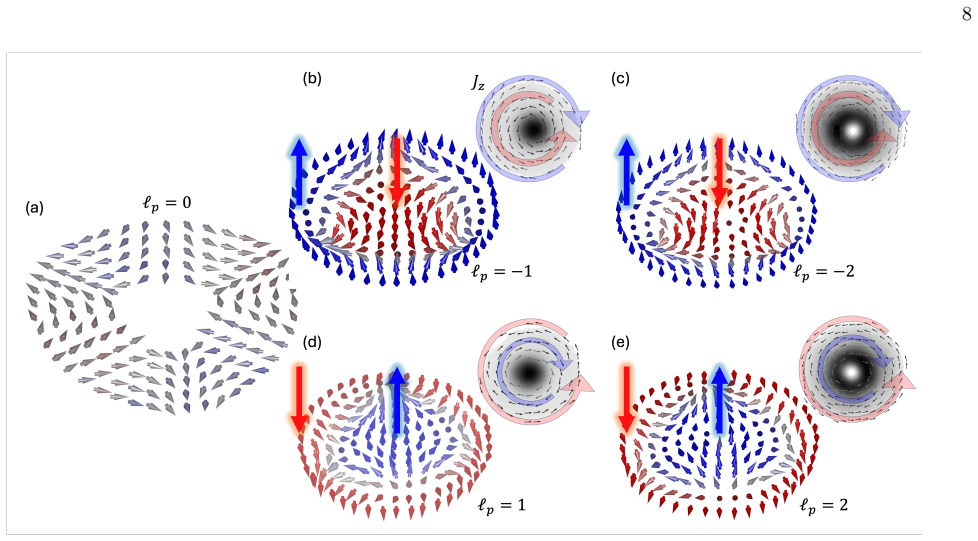
Higher-order Poincaré modes with tunable Pancharatnam topological charge control spin-orbit interaction purely from light topology in free space.
A machine-rendered reading of the paper's core claim, the machinery that carries it, and where it could break.
Core claim
Higher-order Poincaré modes, carrying a tunable Pancharatnam topological charge ℓ_p, enable precise control of SOI purely from the intrinsic topology of the light field, without requiring any material interface. In doing so, the work reveals a free-space paraxial optical Hall effect, where modulation of ℓ_p drives spatial separation of circular polarization states. The analysis identifies two propagation-induced topological mechanisms: differential Gouy phase shifts between orthogonal components, and radial divergence of the beam envelope.
What carries the argument
Higher-order Poincaré modes with a tunable Pancharatnam topological charge ℓ_p, which induce propagation-based separation of polarization states through phase and envelope effects.
If this is right
- Precise control of chirality and spin angular momentum becomes possible without material interfaces.
- A free-space paraxial optical Hall effect appears when the topological charge is modulated.
- New opportunities open for optical manipulation, chiral sensing, and high-dimensional photonic information processing.
- Spin-orbit effects in light can be realized in the paraxial regime.
Where Pith is reading between the lines
- This method could simplify experiments by eliminating the need for interfaces or tight focusing in controlling light chirality.
- It suggests that topological features in light can be harnessed more broadly in free-space optics for quantum or classical information.
- Further work might test similar effects with other structured light modes beyond Poincaré beams.
Load-bearing premise
The observed effects arise solely from propagation-induced mechanisms like differential Gouy phase shifts and radial divergence of the beam envelope, while remaining strictly within the paraxial regime without material or non-paraxial contributions.
What would settle it
Measuring no spatial separation between left- and right-circular polarization components when varying the Pancharatnam topological charge ℓ_p in a paraxial higher-order Poincaré beam would falsify the central claim.
Figures


read the original abstract
Structured light beams with engineered topological properties offer a powerful means to control spin angular momentum (SAM) and optical chirality, key quantities shaped by spin-orbit interaction (SOI) in light. Such effects are typically regarded as emerging only through light-matter interactions. Here, we show that higher-order Poincar\'e modes, carrying a tunable Pancharatnam topological charge $\ell_p$, enable precise control of SOI purely from the intrinsic topology of the light field, without requiring any material interface. In doing so, we reveal a free-space paraxial optical Hall effect, where modulation of $\ell_p$ drives spatial separation of circular polarization states - a direct signature of SOI in a regime previously thought immune to such behaviour. Our analysis identifies two propagation-induced topological mechanisms underlying this effect: differential Gouy phase shifts between orthogonal components, and radial divergence of the beam envelope. These results overturn the common view that spin-orbit effects in free space require non-paraxial conditions, and establish a broadly tunable route to generating and controlling chirality and SAM without tight focusing. This approach provides new opportunities for optical manipulation, chiral sensing, and high-dimensional photonic information processing.
Editorial analysis
A structured set of objections, weighed in public.
Referee Report
Summary. The paper claims that higher-order Poincaré modes carrying a tunable Pancharatnam topological charge ℓ_p enable precise control of spin-orbit interaction (SOI) and optical chirality purely from the intrinsic topology of the light field in free space. It identifies two propagation-induced mechanisms—differential Gouy phase shifts between orthogonal components and radial divergence of the beam envelope—that produce a free-space paraxial optical Hall effect, in which modulation of ℓ_p drives spatial separation of circular polarization states without material interfaces or non-paraxial conditions.
Significance. If the central claim holds, the work would be significant for structured light and spin-orbit optics. It challenges the standard view that free-space SOI requires non-paraxial focusing or material boundaries by attributing observable polarization separation to intrinsic topological properties and standard paraxial propagation. This could provide a broadly tunable route to controlling SAM and chirality, with potential implications for optical manipulation, chiral sensing, and high-dimensional photonic information processing. The introduction of a 'paraxial optical Hall effect' is a conceptually novel framing.
major comments (1)
- [analysis of the two propagation-induced topological mechanisms] The assertion that the radial-divergence mechanism remains strictly paraxial is load-bearing for the central claim of a 'free-space paraxial optical Hall effect'. For nonzero ℓ_p the transverse wave-vector content grows with propagation distance, so the error term in the paraxial Helmholtz equation (scaling as (k_⊥/k)^2) may become non-negligible at distances where the reported circular-polarization separation is observable. The manuscript should supply an explicit bound on this error or a direct comparison with the non-paraxial propagator to confirm the effect does not rely on hidden non-paraxial contributions.
minor comments (1)
- The abstract states that the effects occur 'without requiring any material interface' and 'in a regime previously thought immune'; a short paragraph in the introduction contrasting the present paraxial treatment with prior non-paraxial or interface-based SOI literature would improve context.
Simulated Author's Rebuttal
We thank the referee for their constructive review and for identifying the need to rigorously bound the paraxial error in the radial-divergence mechanism. We address this point directly below and will incorporate the requested analysis into the revised manuscript.
read point-by-point responses
-
Referee: The assertion that the radial-divergence mechanism remains strictly paraxial is load-bearing for the central claim of a 'free-space paraxial optical Hall effect'. For nonzero ℓ_p the transverse wave-vector content grows with propagation distance, so the error term in the paraxial Helmholtz equation (scaling as (k_⊥/k)^2) may become non-negligible at distances where the reported circular-polarization separation is observable. The manuscript should supply an explicit bound on this error or a direct comparison with the non-paraxial propagator to confirm the effect does not rely on hidden non-paraxial contributions.
Authors: We agree that an explicit bound is essential to substantiate the paraxial character of the radial-divergence contribution. In the revised manuscript we will add a dedicated subsection that quantifies the error term (k_⊥/k)^2 for the specific beam parameters, propagation distances, and range of ℓ_p used in our simulations and analysis. Using the standard paraxial beam divergence for higher-order Poincaré modes, we will show that k_⊥/k remains ≪ 1 (error < 3 %) over the distances at which the circular-polarization separation reaches its reported magnitude. This bound confirms that the observed effect arises within the paraxial regime and does not rely on non-paraxial corrections. If the referee prefers, we can also include a short numerical comparison against the angular-spectrum propagator to further validate consistency. revision: yes
Circularity Check
No circularity: derivation uses standard paraxial propagation independent of target result
full rationale
The paper derives the free-space paraxial optical Hall effect from two explicit propagation mechanisms—differential Gouy phase shifts between orthogonal polarization components and radial divergence of the beam envelope—both obtained directly from the paraxial Helmholtz equation applied to higher-order Poincaré modes. These quantities are defined via the standard Laguerre-Gaussian or similar mode expansions and the known Gouy phase formula φ_G = (2p + |ℓ| + 1) arctan(z/z_R); neither is introduced by fitting to the observed circular-polarization separation nor defined in terms of the SOI outcome. No self-citation chain is invoked to establish uniqueness or to forbid alternatives, and the analysis remains within the stated paraxial regime without smuggling ansatzes or renaming prior empirical patterns. The central claim therefore reduces to ordinary beam-propagation mathematics rather than to a tautological re-expression of its own inputs.
Axiom & Free-Parameter Ledger
axioms (1)
- domain assumption The paraxial approximation remains valid for the described beam propagation and mode evolution.
Lean theorems connected to this paper
-
IndisputableMonolith/Foundation/AlexanderDuality.leanalexander_duality_circle_linking unclear?
unclearRelation between the paper passage and the cited Recognition theorem.
higher-order Poincaré modes, carrying a tunable Pancharatnam topological charge ℓ_p, enable precise control of SOI purely from the intrinsic topology of the light field... differential Gouy phase shifts between orthogonal components, and radial divergence of the beam envelope
-
IndisputableMonolith/Foundation/Cost/FunctionalEquation.leanwashburn_uniqueness_aczel unclear?
unclearRelation between the paper passage and the cited Recognition theorem.
free-space paraxial optical Hall effect... without requiring any material interface
What do these tags mean?
- matches
- The paper's claim is directly supported by a theorem in the formal canon.
- supports
- The theorem supports part of the paper's argument, but the paper may add assumptions or extra steps.
- extends
- The paper goes beyond the formal theorem; the theorem is a base layer rather than the whole result.
- uses
- The paper appears to rely on the theorem as machinery.
- contradicts
- The paper's claim conflicts with a theorem or certificate in the canon.
- unclear
- Pith found a possible connection, but the passage is too broad, indirect, or ambiguous to say the theorem truly supports the claim.
Reference graph
Works this paper leans on
-
[1]
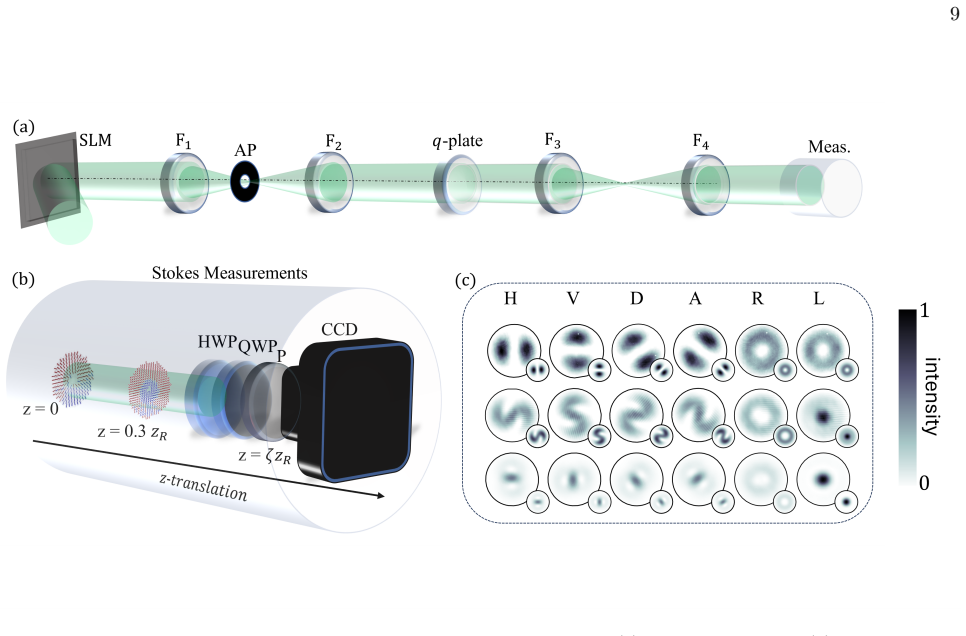
arctan(z/zR); and an azimuthal phase, exp(iℓ pϕ). Note how the topological charge determines the change in the Gouy phase term, as well as the divergence through the radial term. The resulting field will be modulated with a spin-orbit coupling (SOC) device, e.g., aq-plate, at thez= 0 plane, yielding the mapping LGℓp ˆx q-plate − − − − →Uin(r, z= 0), =f ℓp...
-
[2]
converted the incoming horizon- tally polarized scalar mode into a radially polarized vec- tor mode. Here the horizontally polarized light (|H⟩) can be written as a superposition of right- and left-handed CP, (|R⟩and|L⟩, respectively) with theq-plate convert- ing|L⟩into|R⟩and vice-versa, while introducing a phase of e i(ℓ−2q)ϕ and e i(ℓ+2q)ϕ to|R⟩and|L⟩, ...
-
[3]
Transverse and longitudinal angular momenta of light.Physics Reports, 592:1–38, 2015
Konstantin Y Bliokh and Franco Nori. Transverse and longitudinal angular momenta of light.Physics Reports, 592:1–38, 2015
work page 2015
-
[4]
Or- bital angular momentum lasers.Nature Reviews Physics, 6(6):352–364, 2024
Andrew Forbes, Light Mkhumbuza, and Liang Feng. Or- bital angular momentum lasers.Nature Reviews Physics, 6(6):352–364, 2024
work page 2024
-
[5]
30 years of orbital angular mo- mentum of light.Nature Reviews Physics, 4(6):361–361, 2022
Sonja Franke-Arnold. 30 years of orbital angular mo- mentum of light.Nature Reviews Physics, 4(6):361–361, 2022
work page 2022
-
[6]
Yijie Shen, Xuejiao Wang, Zhenwei Xie, Changjun Min, Xing Fu, Qiang Liu, Mali Gong, and Xiaocong Yuan. Optical vortices 30 years on: Oam manipulation from topological charge to multiple singularities.Light: Sci- ence & Applications, 8(1):90, 2019
work page 2019
-
[7]
Quantum structured light in high dimensions.APL Photonics, 8(5), 2023
Isaac Nape, Bereneice Sephton, Pedro Ornelas, Chane Moodley, and Andrew Forbes. Quantum structured light in high dimensions.APL Photonics, 8(5), 2023
work page 2023
-
[8]
Atoms in complex twisted light.Journal of Optics, 21(1):013001, 2019
Mohamed Babiker, David L Andrews, and Vassilis E Lembessis. Atoms in complex twisted light.Journal of Optics, 21(1):013001, 2019
work page 2019
-
[9]
Guillermo F Quinteiro Rosen, Pablo I Tamborenea, and Tilmann Kuhn. Interplay between optical vortices and condensed matter.Reviews of Modern Physics, 94(3):035003, 2022
work page 2022
-
[10]
A Porfirev, S Khonina, and A Kuchmizhak. Light–matter interaction empowered by orbital angular momentum: Control of matter at the micro-and nanoscale.Progress in Quantum Electronics, 88:100459, 2023
work page 2023
-
[11]
Tweezers with a twist.Nature photonics, 5(6):343–348, 2011
Miles Padgett and Richard Bowman. Tweezers with a twist.Nature photonics, 5(6):343–348, 2011
work page 2011
-
[12]
Optical trapping with structured light: a review.Advanced Photonics, 3(3):034001–034001, 2021
Yuanjie Yang, Yu-Xuan Ren, Mingzhou Chen, Yoshihiko Arita, and Carmelo Rosales-Guzm´ an. Optical trapping with structured light: a review.Advanced Photonics, 3(3):034001–034001, 2021
work page 2021
-
[13]
Structured light.Nature Photonics, 15(4):253–262, 2021
Andrew Forbes, Michael de Oliveira, and Mark R Dennis. Structured light.Nature Photonics, 15(4):253–262, 2021
work page 2021
-
[14]
Towards higher-dimensional structured light.Light: Science & Applications, 11(1):205, 2022
Chao He, Yijie Shen, and Andrew Forbes. Towards higher-dimensional structured light.Light: Science & Applications, 11(1):205, 2022
work page 2022
-
[15]
Spin–orbit interac- tions of light.Nature Photonics, 9(12):796–808, 2015
Konstantin Yu Bliokh, Francisco J Rodr´ ıguez-Fortu˜ no, Franco Nori, and Anatoly V Zayats. Spin–orbit interac- tions of light.Nature Photonics, 9(12):796–808, 2015
work page 2015
-
[16]
Eliahu Cohen, Hugo Larocque, Fr´ ed´ eric Bouchard, Farshad Nejadsattari, Yuval Gefen, and Ebrahim Karimi. Geometric phase from aharonov–bohm to pancharatnam–berry and beyond.Nature Reviews Physics, 1(7):437–449, 2019. 11
work page 2019
-
[17]
Yijie Shen, Qiang Zhang, Peng Shi, Luping Du, Xiao- cong Yuan, and Anatoly V Zayats. Optical skyrmions and other topological quasiparticles of light.Nature Pho- tonics, 18(1):15–25, 2024
work page 2024
-
[18]
Peng Chen, Bing-Yan Wei, Wei Hu, and Yan-Qing Lu. Liquid-crystal-mediated geometric phase: from transmis- sive to broadband reflective planar optics.Advanced Ma- terials, 32(27):1903665, 2020
work page 2020
-
[19]
Patrice Genevet, Federico Capasso, Francesco Aieta, Mo- hammadreza Khorasaninejad, and Robert Devlin. Recent advances in planar optics: from plasmonic to dielectric metasurfaces.Optica, 4(1):139–152, 2017
work page 2017
-
[20]
Tunable struc- tured light with flat optics.Science, 376(6591):eabi6860, 2022
Ahmed H Dorrah and Federico Capasso. Tunable struc- tured light with flat optics.Science, 376(6591):eabi6860, 2022
work page 2022
-
[21]
Roadmap for optical metasurfaces.ACS photonics, 11(3):816–865, 2024
Arseniy I Kuznetsov, Mark L Brongersma, Jin Yao, Mu Ku Chen, Uriel Levy, Din Ping Tsai, Nikolay I Zheludev, Andrei Faraon, Amir Arbabi, Nanfang Yu, et al. Roadmap for optical metasurfaces.ACS photonics, 11(3):816–865, 2024
work page 2024
-
[22]
Quantum spin hall effect of light.Science, 348(6242):1448–1451, 2015
Konstantin Y Bliokh, Daria Smirnova, and Franco Nori. Quantum spin hall effect of light.Science, 348(6242):1448–1451, 2015
work page 2015
-
[23]
Peter Lodahl, Sahand Mahmoodian, Søren Stobbe, Arno Rauschenbeutel, Philipp Schneeweiss, J¨ urgen Volz, Hannes Pichler, and Peter Zoller. Chiral quantum optics. Nature, 541(7638):473–480, 2017
work page 2017
-
[24]
Chiral quantum op- tics: Recent developments and future directions.PRX Quantum, 6(2):020101, 2025
DG Su´ arez-Forero, M Jalali Mehrabad, C Vega, A Gonz´ alez-Tudela, and M Hafezi. Chiral quantum op- tics: Recent developments and future directions.PRX Quantum, 6(2):020101, 2025
work page 2025
-
[25]
Konstantin Y Bliokh, Miguel A Alonso, Elena A Ostro- vskaya, and Andrea Aiello. Angular momenta and spin- orbit interaction of nonparaxial light in free space.Phys- ical Review A, 82(6):063825, 2010
work page 2010
-
[26]
Spin-orbit opti- cal hall effect.Physical Review Letters, 123(24):243904, 2019
Shenhe Fu, Chaoheng Guo, Guohua Liu, Yongyao Li, Hao Yin, Zhen Li, and Zhenqiang Chen. Spin-orbit opti- cal hall effect.Physical Review Letters, 123(24):243904, 2019
work page 2019
-
[27]
Hehe Li, Chenghao Ma, Jingge Wang, Miaomiao Tang, and Xinzhong Li. Spin-orbit hall effect in the tight focus- ing of a radially polarized vortex beam.Optics Express, 29(24):39419–39427, 2021
work page 2021
-
[28]
Yi-Jing Wu, Pan-Pan Yu, Yi-Fan Liu, Jing-Han Zhuang, Zi-Qiang Wang, Yin-Mei Li, Cheng-Wei Qiu, and Lei Gong. Controllable microparticle spinning via light with- out spin angular momentum.Physical Review Letters, 132(25):253803, 2024
work page 2024
-
[29]
Avi Niv, Gabriel Biener, Vladimir Kleiner, and Erez Has- man. Manipulation of the pancharatnam phase in vecto- rial vortices.Optics Express, 14(10):4208–4220, 2006
work page 2006
-
[30]
Goos–h¨ anchen and imbert–fedorov beam shifts: an overview.Journal of Optics, 15(1):014001, 2013
Konstantin Y Bliokh and Andrea Aiello. Goos–h¨ anchen and imbert–fedorov beam shifts: an overview.Journal of Optics, 15(1):014001, 2013
work page 2013
-
[31]
Minkyung Kim, Younghwan Yang, Dasol Lee, Yeseul Kim, Hongyoon Kim, and Junsuk Rho. Spin hall effect of light: from fundamentals to recent advancements.Laser & Photonics Reviews, 17(1):2200046, 2023
work page 2023
-
[32]
Panpan Yu, Qian Zhao, Xinyao Hu, Yinmei Li, and Lei Gong. Orbit-induced localized spin angular momentum in the tight focusing of linearly polarized vortex beams. Optics Letters, 43(22):5677–5680, 2018
work page 2018
-
[33]
VV Kotlyar, AG Nalimov, AA Kovalev, AP Porfirev, and SS Stafeev. Spin-orbit and orbit-spin conversion in the sharp focus of laser light: Theory and experiment.Phys- ical Review A, 102(3):033502, 2020
work page 2020
-
[34]
Measures of helicity and chirality of optical vortex beams.Journal of Optics, 23(11):115401, 2021
Kayn A Forbes and Garth A Jones. Measures of helicity and chirality of optical vortex beams.Journal of Optics, 23(11):115401, 2021
work page 2021
-
[35]
Lei Han, Sheng Liu, Peng Li, Yi Zhang, Huachao Cheng, and Jianlin Zhao. Catalystlike effect of orbital angu- lar momentum on the conversion of transverse to three- dimensional spin states within tightly focused radially polarized beams.Physical Review A, 97(5):053802, 2018
work page 2018
-
[36]
Manman Li, Yanan Cai, Shaohui Yan, Yansheng Liang, Peng Zhang, and Baoli Yao. Orbit-induced localized spin angular momentum in strong focusing of optical vectorial vortex beams.Physical Review A, 97(5):053842, 2018
work page 2018
-
[37]
Peng Shi, Luping Du, and Xiaocong Yuan. Structured spin angular momentum in highly focused cylindrical vec- tor vortex beams for optical manipulation.Optics Ex- press, 26(18):23449–23459, 2018
work page 2018
-
[38]
Kayn A Forbes. Spin angular momentum and optical chirality of poincar´ e vector vortex beams.Journal of Optics, 26(12):125401, 2024
work page 2024
-
[39]
Peiwen Meng, Zhongsheng Man, AP Konijnenberg, and HP Urbach. Angular momentum properties of hybrid cylindrical vector vortex beams in tightly focused optical systems.Optics Express, 27(24):35336–35348, 2019
work page 2019
-
[40]
Tao Geng, MIN Li, and Hanming Guo. Orbit-induced localized spin angular momentum of vector circular airy vortex beam in the paraxial regime.Optics Express, 29(9):14069–14077, 2021
work page 2021
-
[41]
Yiqi Fang, Meng Han, Peipei Ge, Zhenning Guo, Xi- aoyang Yu, Yongkai Deng, Chengyin Wu, Qihuang Gong, and Yunquan Liu. Photoelectronic mapping of the spin– orbit interaction of intense light fields.Nature Photonics, 15(2):115–120, 2021
work page 2021
-
[42]
Yanxiang Zhang, Zijing Zhang, Yuan Zhao, and Zhongquan Nie. Ultrafast spin-to-orbit and orbit-to- local-spin conversions of tightly focused hybridly po- larized light pulses.Advanced Photonics Research, 3(3):2100308, 2022
work page 2022
-
[43]
Zhongsheng Man, Yuquan Zhang, and Shenggui Fu. Po- larization singularities hidden in a deep subwavelength confined electromagnetic field with angular momentum. Optics Express, 30(17):31298–31309, 2022
work page 2022
-
[44]
Fengqi Liu, Jingqi Song, Naichen Zhang, Xiangyu Tong, Mingli Sun, Bingsong Cao, Kaikai Huang, Xian Zhang, and Xuanhui Lu. Manipulation of optical orbit-induced localized spin angular momentum using the periodic edge dislocation.Optics Express, 32(6):9867–9876, 2024
work page 2024
-
[45]
Gouy phase effects on propagation of pure and hybrid vector beams
Mar´ ıa M S´ anchez-L´ opez, Jeffrey A Davis, Ignacio Moreno, Aar´ on Cofr´ e, and Don M Cottrell. Gouy phase effects on propagation of pure and hybrid vector beams. Optics Express, 27(3):2374–2386, 2019
work page 2019
-
[46]
Vasilios Cocotos, Light Mkhumbuza, Kayn A Forbes, Robert de Mello Koch, Angela Dudley, and Isaac Nape. Laguerre–gaussian modes become elegant after an az- imuthal phase modulation.Optics Letters, 50(6):1913– 1916, 2025
work page 1913
-
[47]
Hypergeometric-gaussian modes.Optics letters, 32(21):3053–3055, 2007
Ebrahim Karimi, Gianluigi Zito, Bruno Piccir- illo, Lorenzo Marrucci, and Enrico Santamato. Hypergeometric-gaussian modes.Optics letters, 32(21):3053–3055, 2007
work page 2007
-
[48]
Keshaan Singh, Najmeh Tabebordbar, Andrew Forbes, and Angela Dudley. Digital stokes polarimetry and its application to structured light: tutorial.JOSA A, 12 37(11):C33–C44, 2020. [47] Dennis H Goldstein. Polarization measurements. InEn- cyclopedia of Optical and Photonic Engineering (Print)- Five Volume Set, pages 1–9. CRC Press, 2015
work page 2020
discussion (0)
Sign in with ORCID, Apple, or X to comment. Anyone can read and Pith papers without signing in.