REVIEW 2 major objections 4 minor 1 cited by
Vortex Light at the Nanoscale: Twists, Spins, and Surprises -- A Review
T0 review · 2 major / 4 minor · reviewed 2026-08-05 · deepseek-v4-flash
Pith's one-line read A single second-order expansion of Maxwell's equations explains the unexpected spin, intensity, and chirality of tightly focused vortex beams, unifying a decade of surprising experiments.
desk verdict A useful but author-centric synthesis of nonparaxial vortex optics; the Lax-series framework is never benchmarked, so its quantitative predictions in the tight-focusing regime are not as secure as the narrative suggests. read the letter →
The pith
A machine-rendered reading of the paper's core claim, the machinery that carries it, and where it could break.
The reading
What carries the argument
The central object is the second-order Lax-series vector field, Eq. (8): the electric field of a Laguerre-Gaussian mode written as $T_0 + L_1 + T_2$, where $T_0$ is the paraxial transverse field, $L_1 = \frac{i}{k}\nabla_\perp\cdot\mathbf{E}$ (from Gauss's law) is the first-order longitudinal field, and $T_2$ is the second-order transverse field generated by iterating Faraday's and Ampère's laws to first order. The magnetic field is built to the same order. This single expansion carries the entire argument: every derived quantity—intensity, canonical momentum, transverse and longitudinal spin, optical chirality—is a bilinear combination of these components, and the qualitative surprises (spi
What would settle it
Compare Eq. (8) against a full vector diffraction integral (e.g., Richards-Wolf) for a circularly polarized $\ell=1$ LG beam with $w_0\approx\lambda$, NA $\approx 1.3$: if the predicted on-axis intensity or the sign/magnitude of the transverse spin density in Eq. (17) differ measurably from the diffraction calculation at the focal plane, the Lax truncation has broken down. Alternatively, measure the optical chirality density of a tightly focused, unpolarized $\ell=\pm1$ vortex beam through the differential absorption of a small chiral dipolar scatterer: the paper predicts a nonzero, $\ell$-dep
Extended reading notes
Core claim
On the paper's own terms, the central claim is that the Lax-series expansion of a paraxial LG beam, kept to second order in $1/(kw)$, is the correct minimal description of tightly focused vortex light, and that the higher-order field components it generates—the first-order longitudinal field $L_1$ and the second-order transverse field $T_2$—are not small corrections but the carriers of new physics. Using this expansion, the review shows that an $\ell=1$ vortex with spin opposite to its orbital motion loses its central intensity null; that a linearly polarized beam develops transverse spin in the focal plane; that a spinless input beam acquires longitudinal spin density when it carries orbita
Load-bearing premise
The load-bearing assumption is that the iterative scheme's replacement of the z-integral by $i/k$ times the transverse divergence—valid when the field's z-variation is dominated by the $e^{ikz}$ carrier—remains quantitatively accurate when the paraxial parameter $1/(kw)$ approaches unity, i.e., when the beam waist is comparable to the wavelength, so that the truncated second-order series still represents the exact focused field.
Editorial extensions
If this is right
- Tightly focused $\ell=1$ vortex beams with anti-parallel spin and orbital angular momentum become bright on axis, so the vortex dark core is not a fixed topological feature but depends on focusing and helicity.
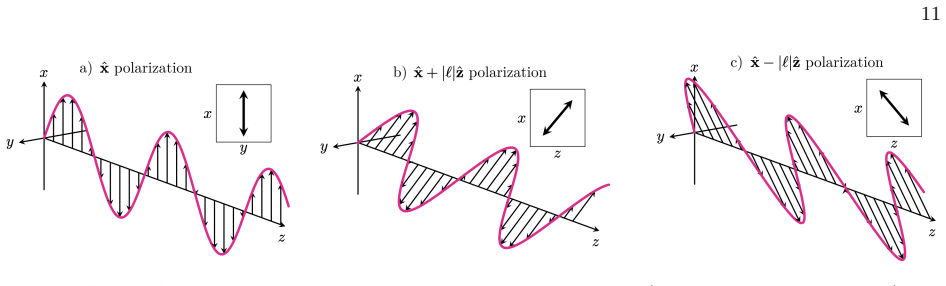
- Focusing a linearly polarized beam creates transverse spin in the focal plane, so linearly polarized (and even unpolarized) light can drive spin-directional coupling and photonic-wheel effects without any input ellipticity.
- Orbit-induced local spin means an input beam with zero spin can acquire longitudinal spin density in the focus, enabling torques on absorptive dipolar particles; because the dual-symmetric spin vanishes, these torques produce no chiral optical force.
- The optical chirality density of a focused vortex contains a polarization-independent, $\ell$-linear term, so vortex dichroism is accessible with $\sigma=0$ light and can be enhanced by tight focusing, directly relevant to chiral sensing.
- Mechanical observations of spin-to-orbit conversion in the Mie regime cannot be attributed to the orbital momentum alone, since the spin momentum dominates those forces; unambiguous proof requires Rayleigh particles in a circularly polarized Gaussian beam.
Reading between the lines
- Extension: because Eq. (22) predicts a chirality term that survives averaging over the two circular polarizations, the author leaves implicit that a randomly polarized (thermal) vortex beam should also exhibit vortex dichroism in a chiral dipolar scatterer—something no strictly paraxial theory allows.
- Extension: the framework's separation of intrinsic and extrinsic OILS suggests that experiments on tightly focused vector vortex beams should be re-examined: the dominant longitudinal spin seen in several 2018 studies may be the paraxial, Gouy-phase-driven eOILS rather than a focusing-induced effect, and only measurements that vary focusing strength independently can disentangle them.
- Testable extension: the review notes that transverse spin of scalar vortices has never been directly observed; since Eq. (17) gives a definite spatial pattern depending on the input linear-polarization angle $\theta$, a nanoparticle-scattering or near-field probe mapped over $\theta$ would provide a direct confirmation of the $L_1$ mechanism.
- Caution inferred, not stated: the fourth-order terms (e.g., $E^{*T_2}\cdot E_{T_2}$) that the review sets aside for intensity may become non-negligible for the highest-NA experiments ($w_0\approx 0.5\lambda$), so the framework's quantitative reach is best established by benchmarking against vector diffraction before using it to design chiral sensors.
Editorial analysis
A structured set of objections, weighed in public.
Referee Report
Summary. This review aims to unify the physics of tightly focused optical vortex beams at the nanoscale through a single analytical framework based on the Lax-series (Born-type iterative) expansion of a paraxial Laguerre–Gaussian beam. Starting from the paraxial T0 field, the review constructs the first-order longitudinal field L1 and the second-order transverse field T2 via Maxwell’s equations, arriving at Eq. (8). From this field expression it derives explicit formulas for the intensity (Eq. 11), canonical momentum (Eq. 14), transverse spin (Eqs. 17–19), longitudinal spin/OILS (Eq. 20), and optical chirality (Eq. 22). These formulas are used to discuss phenomena including on-axis intensity for |ℓ|=1 vortices, spin-to-orbit conversion, transverse spin of focused and unpolarized beams, orbit-induced local spin (iOILS/eOILS), wavefront-curvature-induced angular momentum, and polarization-independent vortex chirality. The review also surveys experimental work and critically reinterprets earlier claims of mechanical spin-to-orbit conversion, and it explicitly notes that iOILS has not yet been observed.
Significance. If the Lax-series truncation is quantitatively reliable in the tight-focusing regime, this review would provide a valuable unified theoretical foundation and a clear synthesis of a broad experimental literature. Its strengths include explicit closed-form expressions for measurable quantities, a critical reassessment of previous spin-to-orbit conversion experiments (Section V), candid disclosure of unobserved predictions such as iOILS (Section VI), and a broad citation of independent experimental confirmations (e.g., Wozniak et al. for vortex dichroism, Neugebauer et al. for transverse spin, Schmiegelow et al. for OAM transfer). The review also highlights useful conceptual distinctions, such as intrinsic vs. extrinsic OILS and the decoupling of spin, chirality, and polarization in nonparaxial fields. However, the significance is moderated by the lack of a quantitative validation of the central Lax truncation in the regime where all illustrative plots are computed (λ = w0), and by the reliance on self-citations for the key formulas.
major comments (2)
- [Section VII, Eq. (22)] The load-bearing premise is the validity of the Lax-series truncation at the focusing parameters used throughout the paper. Equation (7) replaces the z-integral by i/k times the transverse divergence, assuming that the envelope’s z-dependence is negligible relative to e^{ikz}. The text states that 'as w becomes comparable in size with λ, the paraxial parameter 1/kw → 1' (p. 5), which is numerically incorrect: 1/(kw) = λ/(2πw), so at w = λ it is ≈ 0.16, and it reaches 1 only for w ≈ 0.16λ. More importantly, all figures use λ = w0 (and the Schmiegelow experiment has λ/w0 ≈ 0.27), yet no comparison with Richards–Wolf vector diffraction or another full-vector method is provided. Since every derived quantity—intensity (Eq. 11), momentum (Eq. 14), spin (Eqs. 17–20), and chirality (Eq. 22)—follows from the truncated Eq. (8), the review should either supply a convergence test or explicitly state
- [Section VII, Eq. (22)] The polarization-independent optical chirality is a central claim of the review, but Eq. (22) is presented without derivation and without the explicit magnetic-field counterpart for Eq. (8). The text says only that the result was 'first derived in [113, 155]'. Because C depends on Im(E*·B), and the review itself stresses that electric and magnetic fields must be derived to the same order to avoid artifacts, the reader cannot verify that the ℓ-dependent, σ-independent term is not an artifact of the truncation. I recommend either including the magnetic field expression in an appendix or a supplementary derivation, or clearly labeling Eq. (22) as quoted from prior work rather than re-derived in this review.
minor comments (4)
- [Section III, p. 5] The phrase '1/kw → 1' should be corrected. At w = λ, 1/(kw) ≈ 0.16; the parameter only approaches 1 for deeply subwavelength waists. The text should say the parameter becomes non-negligible, not that it approaches unity.
- [Figure 5 caption] The caption refers to 'canonical (orbital) momentum from Eq. (18)', but Eq. (18) is the transverse spin density for linearly polarized input. The canonical momentum is given by Eq. (14). Please correct the cross-reference.
- [Eq. (17)] The expression contains stray braces in the TeX source (e.g., a misplaced '}' after the γ cosφ terms). Please re-typeset the equation to ensure it is readable and unambiguous.
- [Section IV, Eq. (11)] The intensity formula is derived explicitly for p = 0 and circular polarization. This restriction is used in most of the associated plots, but the text later discusses p-dependence and other polarization states without giving the corresponding formulas. Please state the p = 0 restriction more prominently and specify where generalizations can be found.
Circularity Check
No significant circularity: the Lax-series framework is externally grounded and the derived quantities follow algebraically from Eq. (8); self-citations are attribution, not load-bearing premises.
full rationale
The paper's central framework, Eq. (8), is obtained by an explicit iterative solution of Maxwell's equations starting from the standard paraxial Laguerre-Gaussian ansatz, with the z-integral approximation in Eq. (7) attributed to an external textbook (Ref. [25]) and the iterative method to Lax et al. (Ref. [23]). The intensity, momentum, spin, and chirality densities (Eqs. 11, 14, 17-20, 22) are presented as algebraic consequences of Eq. (8); none is fitted to data, and none is equivalent by construction to an input assumption. The transverse-spin phase relationship follows from the i factor introduced by the Lax approximation, but the paper does not present that as an independent prediction; it explicitly ties the phase structure to Richards-Wolf theory (Ref. [94]) and to prior experimental results from other groups (Bokor, Neugebauer, Wozniak, Eismann, Schmiegelow). Self-citations such as [102], [113], [127], and [131] are used as attribution for previously derived results or as pointers to explicit field expressions derived under the same stated Maxwell/Lax assumptions; they do not import the target conclusions as unverified premises. The paper also candidly states that the iOILS mechanism remains experimentally unobserved, further reducing any concern that its conclusions are forced by the framework's assumptions. The only significant caveat is the quantitative validity of the Lax truncation at wavelength-scale waists, but that is a correctness/accuracy concern with independent external benchmarks, not a circularity in the derivation chain.
Assumptions & free parameters
assumptions (4)
- domain assumption The Lax perturbative series in 1/(kw), truncated at second order, converges and accurately represents the focused field when 1/(kw) is of order unity.
- standard math The decomposition of the total momentum into canonical momentum p_o and spin momentum p_s = (1/2)∇×s is physically meaningful and the Belinfante spin momentum does not contribute to forces on small electric-dipole particles.
- domain assumption Optical chirality density C ∝ -Im(E*·B) is the relevant measure for chiral discrimination in the electric-dipole magnetic-dipole (E1M1) approximation, and the total integrated optical chirality is the observable for molecular solutions.
- domain assumption The input paraxial LG beam is an exact solution of the paraxial wave equation, and the Jones vector coefficients α, β are constant across the input plane.
Cite this review
Pith. "Pith review of Vortex Light at the Nanoscale: Twists, Spins, and Surprises -- A Review." pith.science (2026). https://pith.science/paper/4TUHX4IQ
@misc{pith2026250809564,
  author       = {Pith},
  title        = {Pith review of: Vortex Light at the Nanoscale: Twists, Spins, and Surprises -- A Review},
  year         = {2026},
  howpublished = {\url{https://pith.science/paper/4TUHX4IQ}},
  note         = {Machine review of arXiv:2508.09564}
}
read the original abstract
For over three decades, the study of optical vortex beams carrying orbital angular momentum (OAM) has been at the forefront of optics, driven by fundamental questions about optical momentum as well as diverse applications in quantum information, communications, and optical manipulation. Most work has focused on paraxial beams, whose transverse fields are accurately described by conventional wave optics and the Stokes formalism. By contrast, when light is confined to the nanoscale and tightly focused beyond the paraxial regime, vortex beams exhibit complex electromagnetic structures that transcend these conventional models. In this deeply non-paraxial regime, the resulting fields display rich and often counterintuitive behaviour, opening new perspectives on light-matter interactions. This review unifies the emerging physics of nanoscale optical vortices by developing a coherent theoretical framework and offering a critical synthesis of recent advances, guiding readers toward a deeper understanding and stimulating future work in this rapidly evolving field.
Figures


Figures from the paper (11 more)


Forward citations
Cited by 1 Pith paper
-
Electric-Magnetic Geometric Phase
A new optical geometric phase appears in nonparaxial light from electric-magnetic field cycles and is represented on an electric-magnetic sphere.
Reference graph
Works this paper leans on
-
[1]
radiality
was responsible for highlighting the chiral wavefront of such modes to a significantly broader audience. Soon researchers asked the question: can the helical wavefront of vortex modes engage in chiral light-matter interactions in an analogous fashion to the helical structure of circularly polarised light? That is to say, for example, just as circular dich...
2004
-
[2]
Franke-Arnold, 30 years of orbital angular momentum of light, Nature Reviews Physics 4, 361 (2022)
S. Franke-Arnold, 30 years of orbital angular momentum of light, Nature Reviews Physics 4, 361 (2022)
2022
-
[3]
Allen, M
L. Allen, M. W. Beijersbergen, R. Spreeuw, and J. Woerdman, Orbital angular momentum of light and the transformation of laguerre-gaussian laser modes, Physical Review A 45, 8185 (1992)
1992
-
[4]
Y. Shen, X. Wang, Z. Xie, C. Min, X. Fu, Q. Liu, M. Gong, and X. Yuan, Optical vortices 30 years on: Oam manipulation from topological charge to multiple singularities, Light: Science & Applications 8, 90 (2019)
2019
-
[5]
D. L. Andrews, Structured light and its applications: An introduction to phase-structured beams and nanoscale optical forces(Academic Press, 2011)
2011
-
[6]
O. V. Angelsky, A. Y. Bekshaev, S. G. Hanson, C. Y. Zenkova, I. I. Mokhun, and J. Zheng, Structured light: ideas and concepts, Frontiers in Physics 8, 114 (2020)
2020
-
[7]
Forbes, Structured light from lasers, Laser & Photonics Reviews 13, 1900140 (2019)
A. Forbes, Structured light from lasers, Laser & Photonics Reviews 13, 1900140 (2019)
2019
-
[8]
Forbes, M
A. Forbes, M. de Oliveira, and M. R. Dennis, Structured light, Nature Photonics 15, 253 (2021)
2021
Show all 203 references
-
[9]
Yang, Y.-X
Y. Yang, Y.-X. Ren, M. Chen, Y. Arita, and C. Rosales-Guzm´ an, Optical trapping with structured light: a review, Advanced Photonics 3, 034001 (2021)
2021
-
[10]
Novotny and B
L. Novotny and B. Hecht, Principles of Nano-Optics(Cambridge University Press, 2012)
2012
-
[11]
C. He, Y. Shen, and A. Forbes, Towards higher-dimensional structured light, Light: Science & Applications 11, 205 (2022)
2022
-
[12]
Z. Chen, L. Hua, and J. Pu, Tight focusing of light beams: effect of polarization, phase, and coherence, in Progress in Optics, Vol. 57 (Elsevier, 2012) pp. 219–260
2012
-
[13]
Benisty, J.-J
H. Benisty, J.-J. Greffet, and P. Lalanne, Introduction to nanophotonics(Oxford University Press, 2022)
2022
-
[14]
Peatross, M
J. Peatross, M. Berrondo, D. Smith, and M. Ware, Vector fields in a tight laser focus: comparison of models, Optics Express 25, 13990 (2017)
2017
-
[15]
Garoli, P
D. Garoli, P. Zilio, Y. Gorodetski, F. Tantussi, and F. De Angelis, Optical vortex beam generator at nanoscale level, Scientific Reports 6, 29547 (2016)
2016
-
[16]
Prinz, M
E. Prinz, M. Hartelt, G. Spektor, M. Orenstein, and M. Aeschlimann, Orbital angular momentum in nanoplas- monic vortices, ACS Photonics 10, 340 (2023)
2023
-
[17]
Kozawa and S
Y. Kozawa and S. Sato, Small focal spot formation by vector beams, Progress in Optics 66, 35 (2021)
2021
-
[18]
M. A. Alonso, Geometric descriptions for the polarization of nonparaxial light: a tutorial, Advances in Optics and Photonics 15, 176 (2023)
2023
-
[19]
Q. Chen, G. Qu, J. Yin, Y. Wang, Z. Ji, W. Yang, Y. Wang, Z. Yin, Q. Song, Y. Kivshar, et al., Highly efficient vortex generation at the nanoscale, Nature Nanotechnology 19, 1000 (2024)
2024
-
[20]
D. L. Andrews and M. Babiker, The Angular Momentum of Light(Cambridge University Press, 2012)
2012
-
[21]
K. Y. Bliokh, A. Y. Bekshaev, and F. Nori, Dual electromagnetism: helicity, spin, momentum and angular momentum, New Journal of Physics 15, 033026 (2013). 30
2013
-
[22]
Porfirev, S
A. Porfirev, S. Khonina, and A. Kuchmizhak, Light–matter interaction empowered by orbital angular momen- tum: Control of matter at the micro-and nanoscale, Progress in Quantum Electronics 88, 100459 (2023)
2023
-
[23]
K. A. Forbes and D. L. Andrews, Orbital angular momentum of twisted light: chirality and optical activity, Journal of Physics: Photonics 3, 022007 (2021)
2021
-
[24]
Lekner, Polarization of tightly focused laser beams, Journal of Optics A: Pure and Applied Optics 5, 6 (2002)
J. Lekner, Polarization of tightly focused laser beams, Journal of Optics A: Pure and Applied Optics 5, 6 (2002)
2002
-
[25]
M. Lax, W. H. Louisell, and W. B. McKnight, From maxwell to paraxial wave optics, Physical Review A 11, 1365 (1975)
1975
-
[26]
Rosales-Guzm´ an, B
C. Rosales-Guzm´ an, B. Ndagano, and A. Forbes, A review of complex vector light fields and their applications, Journal of Optics 20, 123001 (2018)
2018
-
[27]
C. S. Adams and I. G. Hughes, Optics f2f: from Fourier to Fresnel(Oxford University Press, Oxford, 2018)
2018
-
[28]
Milione, H
G. Milione, H. Sztul, D. Nolan, and R. Alfano, Higher-order poincar´ e sphere, stokes parameters, and the angular momentum of light, Physical Review Letters 107, 053601 (2011)
2011
-
[29]
Arora, S
G. Arora, S. Deepa, S. N. Khan, and P. Senthilkumaran, Detection of degenerate stokes index states, Scientific Reports 10, 20759 (2020)
2020
-
[30]
X. Ling, X. Yi, Z. Dai, Y. Wang, and L. Chen, Characterization and manipulation of full poincar´ e beams on the hybrid poincar´ e sphere, Journal of the Optical Society of America B 33, 2172 (2016)
2016
-
[31]
X. Yi, Y. Liu, X. Ling, X. Zhou, Y. Ke, H. Luo, S. Wen, and D. Fan, Hybrid-order poincar´ e sphere, Physical Review A 91, 023801 (2015)
2015
-
[32]
Naidoo, F
D. Naidoo, F. S. Roux, A. Dudley, I. Litvin, B. Piccirillo, L. Marrucci, and A. Forbes, Controlled generation of higher-order poincar´ e sphere beams from a laser, Nature Photonics10, 327 (2016)
2016
-
[33]
Arora, P
G. Arora, P. Senthilkumaran, et al., Hybrid order poincar´ e spheres for stokes singularities, Optics Letters 45, 5136 (2020)
2020
-
[34]
J. Wang, F. Castellucci, and S. Franke-Arnold, Vectorial light–matter interaction: Exploring spatially structured complex light fields, A VS Quantum Science 2 (2020)
2020
-
[35]
Forbes and I
A. Forbes and I. Nape, Quantum mechanics with patterns of light: progress in high dimensional and multidi- mensional entanglement with structured light, A VS Quantum Science 1 (2019)
2019
-
[36]
I. Nape, B. Sephton, P. Ornelas, C. Moodley, and A. Forbes, Quantum structured light in high dimensions, APL Photonics 8 (2023)
2023
-
[37]
I. Nape, K. Singh, A. Klug, W. Buono, C. Rosales-Guzman, A. McWilliam, S. Franke-Arnold, A. Kritzinger, P. Forbes, A. Dudley, et al., Revealing the invariance of vectorial structured light in complex media, Nature Photonics 16, 538 (2022)
2022
-
[38]
Wang, C.-H
Q. Wang, C.-H. Tu, Y.-N. Li, and H.-T. Wang, Polarization singularities: Progress, fundamental physics, and prospects, APL Photonics 6 (2021)
2021
-
[39]
K. Y. Bliokh, M. A. Alonso, and M. R. Dennis, Geometric phases in 2d and 3d polarized fields: geometrical, dynamical, and topological aspects, Reports on Progress in Physics 82, 122401 (2019)
2019
-
[40]
Ganic, X
D. Ganic, X. Gan, and M. Gu, Focusing of doughnut laser beams by a high numerical-aperture objective in free space, Optics Express 11, 2747 (2003)
2003
-
[41]
C. Zhou, Z. Mou, P. Lu, and S. Teng, Optical singularity built on tiny holes, Annalen der Physik 533, 2100147 (2021)
2021
-
[42]
Bokor, Y
N. Bokor, Y. Iketaki, T. Watanabe, and M. Fujii, Investigation of polarization effects for high-numerical-aperture first-order laguerre-gaussian beams by 2d scanning with a single fluorescent microbead, Optics Express13, 10440 (2005)
2005
-
[43]
T¨ or¨ ok and P
P. T¨ or¨ ok and P. Munro, The use of gauss-laguerre vector beams in sted microscopy, Optics Express12, 3605 (2004)
2004
-
[44]
K. Y. Bliokh, M. A. Alonso, E. A. Ostrovskaya, and A. Aiello, Angular momenta and spin-orbit interaction of nonparaxial light in free space, Physical Review A 82, 063825 (2010)
2010
-
[45]
Iketaki, T
Y. Iketaki, T. Watanabe, N. Bokor, and M. Fujii, Investigation of the center intensity of first-and second-order laguerre–gaussian beams with linear and circular polarization, Optics Letters 32, 2357 (2007)
2007
-
[46]
Y. Dong, Y. Wang, D. He, T. Wang, J. Zeng, and J. Wang, Nearfield observation of spin-orbit interactions at nanoscale using photoinduced force microscopy, Science Advances 10, eadp8460 (2024)
2024
-
[47]
K. Y. Bliokh, E. A. Ostrovskaya, M. A. Alonso, O. G. Rodr ´ ıguez-Herrera, D. Lara, and C. Dainty, Spin-to- orbital angular momentum conversion in focusing, scattering, and imaging systems, Optics Express 19, 26132 (2011)
2011
-
[48]
Brasselet, N
E. Brasselet, N. Murazawa, H. Misawa, and S. Juodkazis, Optical vortices from liquid crystal droplets, Physical Review Letters 103, 103903 (2009)
2009
-
[49]
O. G. Rodr ´ ıguez-Herrera, D. Lara, K. Y. Bliokh, E. A. Ostrovskaya, and C. Dainty, Optical nanoprobing via spin-orbit interaction of light, Physical Review Letters 104, 253601 (2010)
2010
-
[50]
K. A. Forbes and D. Green, Topological-charge-dependent dichroism and birefringence of optical vortices, Laser 31 & Photonics Reviews 18, 2400109 (2024)
2024
-
[51]
Zambrana-Puyalto, X
X. Zambrana-Puyalto, X. Vidal, and G. Molina-Terriza, Angular momentum-induced circular dichroism in non-chiral nanostructures, Nature Communications 5, 4922 (2014)
2014
-
[52]
Ouyang, Y
X. Ouyang, Y. Xu, M. Xian, Z. Feng, L. Zhu, Y. Cao, S. Lan, B.-O. Guan, C.-W. Qiu, M. Gu, et al., Synthetic helical dichroism for six-dimensional optical orbital angular momentum multiplexing, Nature Photonics 15, 901 (2021)
2021
-
[53]
V. Aita, D. J. Roth, A. Zaleska, A. V. Krasavin, L. H. Nicholls, M. Shevchenko, F. Rodr ´ ıguez-Fortu˜ no, and A. V. Zayats, Longitudinal field controls vector vortex beams in anisotropic epsilon-near-zero metamaterials, Nature Communications 16, 3807 (2025)
2025
-
[54]
Q. Yang, Z. Xie, M. Zhang, X. Ouyang, Y. Xu, Y. Cao, S. Wang, L. Zhu, and X. Li, Ultra-secure optical encryption based on tightly focused perfect optical vortex beams, Nanophotonics 11, 1063 (2022)
2022
-
[55]
Pinnell, V
J. Pinnell, V. Rodr ´ ıguez-Fajardo, and A. Forbes, How perfect are perfect vortex beams?, Optics Letters 44, 5614 (2019)
2019
-
[56]
X. Hao, C. Kuang, T. Wang, and X. Liu, Phase encoding for sharper focus of the azimuthally polarized beam, Optics Letters 35, 3928 (2010)
2010
-
[57]
Zhan, Cylindrical vector beams: from mathematical concepts to applications, Advances in Optics and Photonics 1, 1 (2009)
Q. Zhan, Cylindrical vector beams: from mathematical concepts to applications, Advances in Optics and Photonics 1, 1 (2009)
2009
-
[58]
X. Li, P. Venugopalan, H. Ren, M. Hong, and M. Gu, Super-resolved pure-transverse focal fields with an enhanced energy density through focus of an azimuthally polarized first-order vortex beam, Optics Letters 39, 5961 (2014)
2014
-
[59]
Sato and Y
S. Sato and Y. Kozawa, Hollow vortex beams, Journal of the Optical Society of America A 26, 142 (2008)
2008
-
[60]
M. V. Berry, Optical currents, Journal of Optics A: Pure and Applied Optics 11, 094001 (2009)
2009
-
[61]
A. Y. Bekshaev and M. Soskin, Transverse energy flows in vectorial fields of paraxial beams with singularities, Optics Communications 271, 332 (2007)
2007
-
[62]
K. Y. Bliokh, A. Y. Bekshaev, and F. Nori, Extraordinary momentum and spin in evanescent waves, Nature Communications 5, 3300 (2014)
2014
-
[63]
Bekshaev, K
A. Bekshaev, K. Y. Bliokh, and M. Soskin, Internal flows and energy circulation in light beams, Journal of Optics 13, 053001 (2011)
2011
-
[64]
Padgett and R
M. Padgett and R. Bowman, Tweezers with a twist, Nature Photonics 5, 343 (2011)
2011
-
[65]
K. Y. Bliokh, F. J. Rodr ´ ıguez-Fortu˜ no, F. Nori, and A. V. Zayats, Spin–orbit interactions of light, Nature Photonics 9, 796 (2015)
2015
-
[66]
Y. Zhao, J. S. Edgar, G. D. Jeffries, D. McGloin, and D. T. Chiu, Spin-to-orbital angular momentum conversion in a strongly focused optical beam, Physical Review Letters 99, 073901 (2007)
2007
-
[67]
T. A. Nieminen, A. B. Stilgoe, N. R. Heckenberg, and H. Rubinsztein-Dunlop, Angular momentum of a strongly focused gaussian beam, Journal of Optics A: Pure and Applied Optics 10, 115005 (2008)
2008
-
[68]
Adachi, S
H. Adachi, S. Akahoshi, and K. Miyakawa, Orbital motion of spherical microparticles trapped in diffraction patterns of circularly polarized light, Physical Review A 75, 063409 (2007)
2007
-
[69]
Y. Zhao, D. Shapiro, D. Mcgloin, D. T. Chiu, and S. Marchesini, Direct observation of the transfer of orbital angular momentum to metal particles from a focused circularly polarized gaussian beam, Optics Express 17, 23316 (2009)
2009
-
[70]
Zhang, Z
S. Zhang, Z. Zhou, Y. Fu, Q. Chen, W. Li, H. Fang, C. Min, Y. Zhang, and X. Yuan, Temporal effect of the spin-to-orbit conversion in tightly focused femtosecond optical fields, Optics Express 31, 5820 (2023)
2023
-
[71]
A. V. Arzola, L. Chv´ atal, P. J´ akl, and P. Zem´ anek, Spin to orbital light momentum conversion visualized by particle trajectory, Scientific Reports 9, 4127 (2019)
2019
-
[72]
X.-L. Wang, J. Chen, Y. Li, J. Ding, C.-S. Guo, and H.-T. Wang, Optical orbital angular momentum from the curl of polarization, Physical Review Letters 105, 253602 (2010)
2010
-
[73]
Huang, G.-L
S.-Y. Huang, G.-L. Zhang, Q. Wang, M. Wang, C. Tu, Y. Li, and H.-T. Wang, Spin-to-orbital angular momen- tum conversion via light intensity gradient, Optica 8, 1231 (2021)
2021
-
[74]
A. Y. Bekshaev, K. Y. Bliokh, and M. S. Soskin, Comment on” optical orbital angular momentum from the curl of polarization”, arXiv preprint arXiv:1102.1603 (2011)
2011 arXiv
-
[75]
optical orbital angular momentum from the curl of polarization
S. Yan, B. Yao, and M. Lei, Comment on “optical orbital angular momentum from the curl of polarization”, Physical Review Letters 106, 189301 (2011)
2011
-
[76]
Angelsky, A
O. Angelsky, A. Y. Bekshaev, P. Maksimyak, A. Maksimyak, S. G. Hanson, and C. Y. Zenkova, Orbital rotation without orbital angular momentum: mechanical action of the spin part of the internal energy flow in light beams, Optics Express 20, 3563 (2012)
2012
-
[77]
V. Svak, O. Brzobohat` y, M.ˇSiler, P. J´ akl, J. Kaˇ nka, P. Zem´ anek, and S. Simpson, Transverse spin forces and non-equilibrium particle dynamics in a circularly polarized vacuum optical trap, Nature Communications 9, 5453 (2018)
2018
-
[78]
A. Y. Bekshaev, Subwavelength particles in an inhomogeneous light field: optical forces associated with the spin and orbital energy flows, Journal of Optics 15, 044004 (2013)
2013
-
[79]
D. B. Ruffner and D. G. Grier, Optical forces and torques in nonuniform beams of light, Physical Review Letters 108, 173602 (2012)
2012
-
[80]
Antognozzi, C
M. Antognozzi, C. R. Bermingham, R. L. Harniman, S. Simpson, J. Senior, R. Hayward, H. Hoerber, M. R. Dennis, A. Y. Bekshaev, K. Y. Bliokh, et al., Direct measurements of the extraordinary optical momentum and transverse spin-dependent force using a nano-cantilever, Nature Phy...
2016
-
[81]
Hayat, J
A. Hayat, J. B. Mueller, and F. Capasso, Lateral chirality-sorting optical forces, Proceedings of the National 32 Academy of Sciences 112, 13190 (2015)
2015
-
[82]
J. H. Poynting, The wave motion of a revolving shaft, and a suggestion as to the angular momentum in a beam of circularly polarised light, Proceedings of the Royal Society of London. Series A, Containing Papers of a Mathematical and Physical Character 82, 560 (1909)
1909
-
[83]
K. T. McDonald, Orbital and spin angular momentum of electromagnetic fields, Princeton University: Prince- ton, NJ, USA , 1 (2009)
2009
-
[84]
H. He, M. Friese, N. Heckenberg, and H. Rubinsztein-Dunlop, Direct observation of transfer of angular mo- mentum to absorptive particles from a laser beam with a phase singularity, Physical Review Letters 75, 826 (1995)
1995
-
[85]
R. A. Beth, Mechanical detection and measurement of the angular momentum of light, Physical Review 50, 115 (1936)
1936
-
[86]
K. Y. Bliokh, J. Dressel, and F. Nori, Conservation of the spin and orbital angular momenta in electromagnetism, New Journal of Physics 16, 093037 (2014)
2014
-
[87]
S. M. Barnett and L. Allen, Orbital angular momentum and nonparaxial light beams, Optics Communications 110, 670 (1994)
1994
-
[88]
Kim, I.-M
K.-Y. Kim, I.-M. Lee, J. Kim, J. Jung, and B. Lee, Time reversal and the spin angular momentum of transverse- electric and transverse-magnetic surface modes, Physical Review A 86, 063805 (2012)
2012
-
[89]
K. Y. Bliokh and F. Nori, Transverse spin of a surface polariton, Physical Review A 85, 061801 (2012)
2012
-
[90]
K. Y. Bliokh, D. Smirnova, and F. Nori, Quantum spin hall effect of light, Science 348, 1448 (2015)
2015
-
[91]
K. Y. Bliokh and F. Nori, Transverse and longitudinal angular momenta of light, Physics Reports 592, 1 (2015)
2015
-
[92]
Aiello, P
A. Aiello, P. Banzer, M. Neugebauer, and G. Leuchs, From transverse angular momentum to photonic wheels, Nature Photonics 9, 789 (2015)
2015
-
[93]
Lodahl, S
P. Lodahl, S. Mahmoodian, S. Stobbe, A. Rauschenbeutel, P. Schneeweiss, J. Volz, H. Pichler, and P. Zoller, Chiral quantum optics, Nature 541, 473 (2017)
2017
-
[94]
Richards and E
B. Richards and E. Wolf, Electromagnetic diffraction in optical systems, II. Structure of the image field in an aplanatic system, Proceedings of the Royal Society of London. Series A. Mathematical and Physical Sciences 253, 358 (1959)
1959
-
[95]
Y. Shi, X. Xu, M. Nieto-Vesperinas, Q. Song, A. Q. Liu, G. Cipparrone, Z. Su, B. Yao, Z. Wang, C.-W. Qiu, et al., Advances in light transverse momenta and optical lateral forces, Advances in Optics and Photonics 15, 835 (2023)
2023
-
[96]
Aiello, N
A. Aiello, N. Lindlein, C. Marquardt, and G. Leuchs, Transverse angular momentum and geometric spin hall effect of light, Physical Review Letters 103, 100401 (2009)
2009
-
[97]
Banzer, P., Neugebauer, M., Aiello, A., Marquardt, C., Lindlein, N., Bauer, T., and Leuchs, G., The photonic wheel - demonstration of a state of light with purely transverse angular momentum, J. Eur. Opt. Soc.-Rapid Publ. 8, 13032 (2013)
2013
-
[98]
Neugebauer, T
M. Neugebauer, T. Bauer, A. Aiello, and P. Banzer, Measuring the transverse spin density of light, Physical Review Letters 114, 063901 (2015)
2015
-
[99]
(N.B. the extremely weak x-component of the electric T-SAM for the x-polarised Gaussian mode is the L1 × T2 contribution mentioned in the text); b) M¨ obius strips of light [104]; c) Electric and magnetic T-SAM of unpolarised tightly-focused Gaussian beams [100] (N.B. the elec...
2018
-
[100]
Neugebauer, P
M. Neugebauer, P. Banzer, T. Bauer, S. Orlov, N. Lindlein, A. Aiello, and G. Leuchs, Geometric spin hall effect of light in tightly focused polarization-tailored light beams, Physical Review A 89, 013840 (2014)
2014
-
[101]
Neugebauer, J
M. Neugebauer, J. S. Eismann, T. Bauer, and P. Banzer, Magnetic and electric transverse spin density of spatially confined light, Physical Review X 8, 021042 (2018)
2018
-
[102]
J. S. Eismann, L. H. Nicholls, D. J. Roth, M. A. Alonso, P. Banzer, F. J. Rodr ´ ıguez-Fortu˜ no, A. V. Zayats, F. Nori, and K. Y. Bliokh, Transverse spinning of unpolarized light, Nature Photonics 15, 156 (2021)
2021
-
[103]
Y. Chen, F. Wang, Z. Dong, Y. Cai, A. Norrman, J. J. Gil, A. T. Friberg, and T. Set¨ al¨ a, Structure of transverse spin in focused random light, Physical Review A 104, 013516 (2021)
2021
-
[104]
K. A. Forbes, Optical helicity of unpolarized light, Physical Review A 105, 023524 (2022)
2022
-
[105]
Bauer, P
T. Bauer, P. Banzer, E. Karimi, S. Orlov, A. Rubano, L. Marrucci, E. Santamato, R. W. Boyd, and G. Leuchs, Observation of optical polarization m¨ obius strips, Science347, 964 (2015)
2015
-
[106]
Bauer, M
T. Bauer, M. Neugebauer, G. Leuchs, and P. Banzer, Optical polarization m¨ obius strips and points of purely transverse spin density, Physical Review Letters 117, 013601 (2016)
2016
-
[107]
K. A. Forbes, Spin angular momentum and optical chirality of poincar´ e vector vortex beams, Journal of Optics 26, 125401 (2024)
2024
-
[108]
M. Li, S. Yan, Y. Liang, P. Zhang, and B. Yao, Transverse spinning of particles in highly focused vector vortex beams, Physical Review A 95, 053802 (2017)
2017
-
[109]
R. N. Kumar, J. K. Nayak, S. D. Gupta, N. Ghosh, and A. Banerjee, Probing dual asymmetric transverse spin angular momentum in tightly focused vector beams in optical tweezers, Laser & Photonics Reviews 18, 2300189 (2024)
2024
-
[110]
J. Chen, C. Wan, L. J. Kong, and Q. Zhan, Tightly focused optical field with controllable photonic spin 33 orientation, Optics Express 25, 19517 (2017)
2017
-
[111]
Bauer, S
T. Bauer, S. Orlov, U. Peschel, P. Banzer, and G. Leuchs, Nanointerferometric amplitude and phase reconstruc- tion of tightly focused vector beams, Nature Photonics 8, 23 (2014)
2014
-
[112]
J. S. Eismann and P. Banzer, Nanoscale vectorial electric and magnetic field measurement, ACS Photonics 12, 522 (2024)
2024
-
[113]
P. Yu, Q. Zhao, X. Hu, Y. Li, and L. Gong, Orbit-induced localized spin angular momentum in the tight focusing of linearly polarized vortex beams, Optics Letters 43, 5677 (2018)
2018
-
[114]
Kotlyar, A
V. Kotlyar, A. Nalimov, A. Kovalev, A. Porfirev, and S. Stafeev, Spin-orbit and orbit-spin conversion in the sharp focus of laser light: Theory and experiment, Physical Review A 102, 033502 (2020)
2020
-
[115]
K. A. Forbes and G. A. Jones, Measures of helicity and chirality of optical vortex beams, Journal of Optics 23, 115401 (2021)
2021
-
[116]
L. Han, S. Liu, P. Li, Y. Zhang, H. Cheng, and J. Zhao, Catalystlike effect of orbital angular momentum on the conversion of transverse to three-dimensional spin states within tightly focused radially polarized beams, Physical Review A 97, 053802 (2018)
2018
-
[117]
M. Li, Y. Cai, S. Yan, Y. Liang, P. Zhang, and B. Yao, Orbit-induced localized spin angular momentum in strong focusing of optical vectorial vortex beams, Physical Review A 97, 053842 (2018)
2018
-
[118]
P. Shi, L. Du, and X. Yuan, Structured spin angular momentum in highly focused cylindrical vector vortex beams for optical manipulation, Optics Express 26, 23449 (2018)
2018
-
[119]
P. Meng, Z. Man, A. Konijnenberg, and H. Urbach, Angular momentum properties of hybrid cylindrical vector vortex beams in tightly focused optical systems, Optics Express 27, 35336 (2019)
2019
-
[120]
H. Li, C. Ma, J. Wang, M. Tang, and X. Li, Spin-orbit hall effect in the tight focusing of a radially polarized vortex beam, Optics Express 29, 39419 (2021)
2021
-
[121]
T. Geng, M. Li, and H. Guo, Orbit-induced localized spin angular momentum of vector circular airy vortex beam in the paraxial regime, Optics Express 29, 14069 (2021)
2021
-
[122]
Y. Fang, M. Han, P. Ge, Z. Guo, X. Yu, Y. Deng, C. Wu, Q. Gong, and Y. Liu, Photoelectronic mapping of the spin–orbit interaction of intense light fields, Nature Photonics 15, 115 (2021)
2021
-
[123]
Zhang, Z
Y. Zhang, Z. Zhang, Y. Zhao, and Z. Nie, Ultrafast spin-to-orbit and orbit-to-local-spin conversions of tightly focused hybridly polarized light pulses, Advanced Photonics Research 3, 2100308 (2022)
2022
-
[124]
Z. Man, Y. Zhang, and S. Fu, Polarization singularities hidden in a deep subwavelength confined electromagnetic field with angular momentum, Optics Express 30, 31298 (2022)
2022
-
[125]
F. Liu, J. Song, N. Zhang, X. Tong, M. Sun, B. Cao, K. Huang, X. Zhang, and X. Lu, Manipulation of optical orbit-induced localized spin angular momentum using the periodic edge dislocation, Optics Express 32, 9867 (2024)
2024
-
[126]
Wu, P.-P
Y.-J. Wu, P.-P. Yu, Y.-F. Liu, J.-H. Zhuang, Z.-Q. Wang, Y.-M. Li, C.-W. Qiu, and L. Gong, Controllable microparticle spinning via light without spin angular momentum, Physical Review Letters 132, 253803 (2024)
2024
-
[127]
Mkhumbuza, A
L. Mkhumbuza, A. Dudley, K. A. Forbes, and I. Nape, Stokes reconstruction of chiral fields, in Novel Optical Systems, Methods, and Applications XXVII(SPIE, 2024) p. PC131300E
2024
-
[128]
Mkhumbuza, P
L. Mkhumbuza, P. Ornelas, A. Dudley, I. Nape, and K. A. Forbes, Topological control of chirality and spin with structured light, https://arxiv.org/abs/2508.08733 (2025)
2025 arXiv
-
[129]
K. A. Forbes, On the orbit-induced spin density of tightly focused optical vortex beams: ellipticity and helicity, Journal of Optics 26, 08LT01 (2024)
2024
-
[130]
K. Y. Bliokh, Y. S. Kivshar, and F. Nori, Magnetoelectric effects in local light-matter interactions, Physical Review Letters 113, 033601 (2014)
2014
-
[131]
Genet, Chiral light–chiral matter interactions: An optical force perspective, ACS photonics 9, 319 (2022)
C. Genet, Chiral light–chiral matter interactions: An optical force perspective, ACS photonics 9, 319 (2022)
2022
-
[132]
A. J. Vernon, S. Golat, C. Rigouzzo, E. A. Lim, and F. J. Rodr ´ ıguez-Fortu˜ no, A decomposition of light’s spin angular momentum density, Light: Science & Applications 13, 160 (2024)
2024
-
[133]
K. A. Forbes, V. Aita, and A. V. Zayats, Generating optical angular momentum through wavefront curvature, APL Photonics 10 (2025)
2025
-
[134]
J. S. Eismann, P. Banzer, and M. Neugebauer, Spin-orbit coupling affecting the evolution of transverse spin, Physical Review Research 1, 033143 (2019)
2019
-
[135]
Pang and W
X. Pang and W. Miao, Spinning spin density vectors along the propagation direction, Optics Letters 43, 4831 (2018)
2018
-
[136]
J. P. Riehl, Mirror-image asymmetry: An introduction to the origin and consequences of chirality(John Wiley & Sons, 2010)
2010
-
[137]
R. U. McVicker and N. M. O’Boyle, Chirality of new drug approvals (2013–2022): trends and perspectives, Journal of Medicinal Chemistry 67, 2305 (2024)
2013
-
[138]
Z. Wang, F. Cheng, T. Winsor, and Y. Liu, Optical chiral metamaterials: a review of the fundamentals, fabrication methods and applications, Nanotechnology 27, 412001 (2016)
2016
-
[139]
Y. Luo, C. Chi, M. Jiang, R. Li, S. Zu, Y. Li, and Z. Fang, Plasmonic chiral nanostructures: chiroptical effects and applications, Advanced Optical Materials 5, 1700040 (2017)
2017
-
[140]
Yoo and Q.-H
S. Yoo and Q.-H. Park, Metamaterials and chiral sensing: a review of fundamentals and applications, Nanopho- 34 tonics 8, 249 (2019)
2019
-
[141]
D. L. Andrews, Quantum formulation for nanoscale optical and material chirality: symmetry issues, space and time parity, and observables, Journal of Optics 20, 033003 (2018)
2018
-
[142]
L. D. Barron, Molecular light scattering and optical activity(Cambridge University Press, 2009)
2009
-
[143]
Berova, P
N. Berova, P. L. Polavarapu, K. Nakanishi, and R. W. Woody,Comprehensive Chiroptical Spectroscopy, Volume 1: Instrumentation, Methodologies, and Theoretical Simulations, Vol. 1 (John Wiley & Sons, 2011)
2011
-
[144]
Berova, P
N. Berova, P. L. Polavarapu, K. Nakanishi, and R. W. Woody,Comprehensive Chiroptical Spectroscopy, Volume 2: Applications in Stereochemical Analysis of Synthetic Compounds, Natural Products, and Biomolecules, Vol. 2 (John Wiley & Sons, 2012)
2012
-
[145]
P. L. Polavarapu, Chiroptical spectroscopy: fundamentals and applications(CRC Press, 2016)
2016
-
[146]
K. A. Forbes and D. L. Andrews, Enhanced optical activity using the orbital angular momentum of structured light, Physical Review Research 1, 033080 (2019)
2019
-
[147]
K. Y. Bliokh and F. Nori, Characterizing optical chirality, Physical Review A 83, 021803 (2011)
2011
-
[148]
R. P. Cameron, S. M. Barnett, and A. M. Yao, Optical helicity, optical spin and related quantities in electro- magnetic theory, New Journal of Physics 14, 053050 (2012)
2012
-
[149]
Mackinnon, On the differences between helicity and chirality, Journal of Optics 21, 125402 (2019)
N. Mackinnon, On the differences between helicity and chirality, Journal of Optics 21, 125402 (2019)
2019
-
[150]
Nechayev, J
S. Nechayev, J. S. Eismann, R. Alaee, E. Karimi, R. W. Boyd, and P. Banzer, Kelvin’s chirality of optical beams, Physical Review A 103, L031501 (2021)
2021
-
[151]
R. P. Cameron, J. B. G¨ otte, S. M. Barnett, and A. M. Yao, Chirality and the angular momentum of light, Philosophical Transactions of the Royal Society A: Mathematical, Physical and Engineering Sciences 375, 20150433 (2017)
2017
-
[152]
D. P. Craig and T. Thirunamachandran, Molecular quantum electrodynamics: an introduction to radiation- molecule interactions (Courier Corporation, 1998)
1998
-
[153]
A. E. Siegman, Laser beams and resonators: the 1960s, IEEE Journal of selected topics in quantum electronics 6, 1380 (2000)
2000
-
[154]
Allen, Orbital angular momentum: a personal memoir, Philosophical Transactions of the Royal Society A: Mathematical, Physical and Engineering Sciences 375, 20160280 (2017)
L. Allen, Orbital angular momentum: a personal memoir, Philosophical Transactions of the Royal Society A: Mathematical, Physical and Engineering Sciences 375, 20160280 (2017)
2017
-
[155]
Andrews, L
D. Andrews, L. D. Romero, and M. Babiker, On optical vortex interactions with chiral matter, Optics Commu- nications 237, 133 (2004)
2004
-
[156]
Araoka, T
F. Araoka, T. Verbiest, K. Clays, and A. Persoons, Interactions of twisted light with chiral molecules: An experimental investigation, Physical Review A 71, 055401 (2005)
2005
-
[157]
Green and K
D. Green and K. A. Forbes, Optical chirality of vortex beams at the nanoscale, Nanoscale 15, 540 (2023)
2023
-
[158]
Rosales-Guzm´ an, K
C. Rosales-Guzm´ an, K. Volke-Sepulveda, and J. P. Torres, Light with enhanced optical chirality, Optics Letters 37, 3486 (2012)
2012
-
[159]
T. Wu, R. Wang, and X. Zhang, Plasmon-induced strong interaction between chiral molecules and orbital angular momentum of light, Scientific Reports 5, 18003 (2015)
2015
-
[160]
Wo´ zniak, I
P. Wo´ zniak, I. De Leon, K. H¨ oflich, G. Leuchs, and P. Banzer, Interaction of light carrying orbital angular momentum with a chiral dipolar scatterer, Optica 6, 961 (2019)
2019
-
[161]
Nechayev, J
S. Nechayev, J. S. Eismann, G. Leuchs, and P. Banzer, Orbital-to-spin angular momentum conversion employing local helicity, Physical Review B 99, 075155 (2019)
2019
-
[162]
J. R. Rouxel, B. R¨ osner, D. Karpov, C. Bacellar, G. F. Mancini, F. Zinna, D. Kinschel, O. Cannelli, M. Op- permann, C. Svetina, et al., Hard x-ray helical dichroism of disordered molecular media, Nature Photonics 16, 570 (2022)
2022
-
[163]
K. A. Forbes and G. A. Jones, Optical vortex dichroism in chiral particles, Physical Review A 103, 053515 (2021)
2021
-
[164]
K. A. Forbes and D. Green, Customized optical chirality of vortex structured light through state and degree- of-polarization control, Physical Review A 107, 063504 (2023)
2023
-
[165]
K. A. Forbes and D. Green, Enantioselective optical gradient forces using 3d structured vortex light, Optics Communications 515, 128197 (2022)
2022
-
[166]
Mayer, D
N. Mayer, D. Ayuso, P. Decleva, M. Khokhlova, E. Pisanty, M. Ivanov, and O. Smirnova, Chiral topological light for detection of robust enantiosensitive observables, Nature Photonics 18, 1155 (2024)
2024
-
[167]
Ayuso, O
D. Ayuso, O. Neufeld, A. F. Ordonez, P. Decleva, G. Lerner, O. Cohen, M. Ivanov, and O. Smirnova, Synthetic chiral light for efficient control of chiral light–matter interaction, Nature Photonics 13, 866 (2019)
2019
-
[168]
Cheeseman and K
L. Cheeseman and K. A. Forbes, Nonlinear vortex dichroism in chiral molecules, Advanced Optical Materials 13, 2402151 (2025)
2025
-
[169]
Herrero-Parareda and F
A. Herrero-Parareda and F. Capolino, The combination of the azimuthally and radially polarized beams: helicity and momentum densities, generation, and optimal chiral light, Advanced Photonics Research5, 2300265 (2024)
2024
-
[170]
K. A. Forbes and D. L. Andrews, Generalized polarization matrix approach to near-field optical chirality, Physical Review A 111, 063510 (2025)
2025
-
[171]
Brullot, M
W. Brullot, M. K. Vanbel, T. Swusten, and T. Verbiest, Resolving enantiomers using the optical angular momentum of twisted light, Science Advances 2, e1501349 (2016). 35
2016
-
[172]
K. A. Forbes and D. L. Andrews, Optical orbital angular momentum: twisted light and chirality, Optics Letters 43, 435 (2018)
2018
-
[173]
M¨ ullner, F
S. M¨ ullner, F. B¨ uscher, A. M¨ oller, and P. Lemmens, Discrimination of chiral and helical contributions to raman scattering of liquid crystals using vortex beams, Physical Review Letters 129, 207801 (2022)
2022
-
[174]
Fanciulli, M
M. Fanciulli, M. Pancaldi, E. Pedersoli, M. Vimal, D. Bresteau, M. Luttmann, D. De Angelis, P. R. Ribiˇ c, B. R¨ osner, C. David,et al., Observation of magnetic helicoidal dichroism with extreme ultraviolet light vortices, Physical Review Letters 128, 077401 (2022)
2022
-
[175]
J. Ni, S. Liu, D. Wu, Z. Lao, Z. Wang, K. Huang, S. Ji, J. Li, Z. Huang, Q. Xiong, et al., Gigantic vortical differential scattering as a monochromatic probe for multiscale chiral structures, Proceedings of the National Academy of Sciences 118, e2020055118 (2021)
2021
-
[176]
I. V. Reddy, A. Baev, E. P. Furlani, P. N. Prasad, and J. W. Haus, Interaction of structured light with a chiral plasmonic metasurface: giant enhancement of chiro-optic response, ACS Photonics 5, 734 (2018)
2018
-
[177]
C.-Y. Ji, S. Xu, Q. Liang, X. Zhang, X. Hong, Y. Wang, X. Li, L. Jiang, Y. Wang, J. Ni, et al., Observation of magnetic quadrupole endowed helical dichroism in artificial propeller meta-molecules, Advanced Optical Materials 12, 2302795 (2024)
2024
-
[178]
Kerber, J
R. Kerber, J. Fitzgerald, S. Oh, D. Reiter, and O. Hess, Orbital angular momentum dichroism in nanoantennas, Communications Physics 1, 87 (2018)
2018
-
[179]
K. A. Forbes, Raman optical activity using twisted photons, Physical Review Letters 122, 103201 (2019)
2019
-
[180]
Y.-C. Lim, R. M. Kim, J. H. Han, I. Aharonovich, K. T. Nam, and S. Kim, Strong chiral response of chiral plasmonic nanoparticles to photonic orbital angular momentum, Advanced Optical Materials , 2402268 (2024)
2024
-
[181]
A. A. Sirenko, P. Marsik, C. Bernhard, T. Stanislavchuk, V. Kiryukhin, and S.-W. Cheong, Terahertz vortex beam as a spectroscopic probe of magnetic excitations, Physical Review Letters 122, 237401 (2019)
2019
-
[182]
Fanciulli, M
M. Fanciulli, M. Pancaldi, A.-E. Stanciu, M. Guer, E. Pedersoli, D. De Angelis, P. Rebernik Ribiˇ c, D. Bresteau, M. Luttmann, P. Carrara, et al., Magnetic vortex dynamics probed by time-resolved magnetic helicoidal dichro- ism, Physical Review Letters 134, 156701 (2025)
2025
-
[183]
J. Ni, S. Liu, G. Hu, Y. Hu, Z. Lao, J. Li, Q. Zhang, D. Wu, S. Dong, J. Chu, et al., Giant helical dichroism of single chiral nanostructures with photonic orbital angular momentum, ACS nano 15, 2893 (2021)
2021
-
[184]
Babiker, D
M. Babiker, D. L. Andrews, and V. E. Lembessis, Atoms in complex twisted light, Journal of Optics 21, 013001 (2019)
2019
-
[185]
Babiker, C
M. Babiker, C. Bennett, D. Andrews, and L. D´ avila Romero, Orbital angular momentum exchange in the interaction of twisted light with molecules, Physical Review Letters 89, 143601 (2002)
2002
-
[186]
C. T. Schmiegelow, J. Schulz, H. Kaufmann, T. Ruster, U. G. Poschinger, and F. Schmidt-Kaler, Transfer of optical orbital angular momentum to a bound electron, Nature Communications 7, 12998 (2016)
2016
-
[187]
G. F. Quinteiro, C. T. Schmiegelow, D. Reiter, and T. Kuhn, Reexamination of bessel beams: A generalized scheme to derive optical vortices, Physical Review A 99, 023845 (2019)
2019
-
[188]
Afanasev, C
A. Afanasev, C. E. Carlson, C. T. Schmiegelow, J. Schulz, F. Schmidt-Kaler, and M. Solyanik, Experimental verification of position-dependent angular-momentum selection rules for absorption of twisted light by a bound electron, New Journal of Physics 20, 023032 (2018)
2018
-
[189]
Ramakrishna, J
S. Ramakrishna, J. Hofbrucker, and S. Fritzsche, Photoexcitation of atoms by cylindrically polarized laguerre- gaussian beams, Physical Review A 105, 033103 (2022)
2022
-
[190]
Verde, C
M. Verde, C. T. Schmiegelow, U. Poschinger, and F. Schmidt-Kaler, Trapped atoms in spatially-structured vector light fields, Scientific Reports 13, 21283 (2023)
2023
-
[191]
A. F. Alharbi, A. Lyras, and V. E. Lembessis, Significance of the longitudinal component of paraxial light in position-dependent selection rules for quadrupole atomic transitions, Optics Express 31, 43690 (2023)
2023
-
[192]
Mashhadi and G
L. Mashhadi and G. Shayeganrad, Quadrupole excitation of atoms with tightly focused laguerre-gaussian beams, Optics Express 32, 12127 (2024)
2024
-
[193]
Lange, N
R. Lange, N. Huntemann, A. Peshkov, A. Surzhykov, and E. Peik, Excitation of an electric octupole transition by twisted light, Physical Review Letters 129, 253901 (2022)
2022
-
[194]
Svensson, C
S. Svensson, C. R. Higgins, D. Pizzey, I. G. Hughes, and S. Franke-Arnold, Visualizing strongly focused 3d light fields in an atomic vapor, arXiv preprint arXiv:2506.01680 (2025)
2025 arXiv
-
[195]
Y. Shen, Q. Zhang, P. Shi, L. Du, X. Yuan, and A. V. Zayats, Optical skyrmions and other topological quasiparticles of light, Nature Photonics 18, 15 (2024)
2024
-
[196]
Guti´ errez-Cuevas and E
R. Guti´ errez-Cuevas and E. Pisanty, Optical polarization skyrmionic fields in free space, Journal of Optics 23, 024004 (2021)
2021
-
[197]
Mata-Cervera, D
N. Mata-Cervera, D. K. Sharma, Y. Shen, R. Paniagua-Dominguez, and M. A. Porras, Skyrmionic polarization texture around the phase singularity of optical vortices, Physical Review Letters 135, 033805 (2025)
2025
-
[198]
G. F. Quinteiro Rosen, P. I. Tamborenea, and T. Kuhn, Interplay between optical vortices and condensed matter, Reviews of Modern Physics 94, 035003 (2022)
2022
-
[199]
Y. Zhou, X. Xu, Y. Zhang, M. Li, S. Yan, M. Nieto-Vesperinas, B. Li, C.-W. Qiu, and B. Yao, Observation of high-order imaginary poynting momentum optomechanics in structured light, Proceedings of the National Academy of Sciences 119, e2209721119 (2022). 36
2022
-
[200]
Rebernik Ribiˇ c, B
P. Rebernik Ribiˇ c, B. R¨ osner, D. Gauthier, E. Allaria, F. D¨ oring, L. Foglia, L. Giannessi, N. Mahne, M. Man- fredda, C. Masciovecchio, et al., Extreme-ultraviolet vortices from a free-electron laser, Physical Review X 7, 031036 (2017)
2017
-
[201]
M. R. McCarter, L. E. De Long, J. T. Hastings, and S. Roy, Generation and applications of x-ray and extreme ultraviolet beams carrying orbital angular momentum, Journal of Physics: Condensed Matter36, 423003 (2024)
2024
-
[202]
X. Wang, Z. Nie, Y. Liang, J. Wang, T. Li, and B. Jia, Recent advances on optical vortex generation, Nanopho- tonics 7, 1533 (2018)
2018
-
[203]
S. A. Schulz, R. F. Oulton, M. Kenney, A. Al` u, I. Staude, A. Bashiri, Z. Fedorova, R. Kolkowski, A. F. Koenderink, X. Xiao, et al., Roadmap on photonic metasurfaces, Applied Physics Letters 124, 1 (2024)
2024
Reviewed August 5, 2026 · model on record in the stance chip above.
Discussion (0). Sign in to comment.