Grazing duration and intensity modulate vegetation dynamics in semi-arid ecosystems with seasonal succession
Pith reviewed 2026-05-18 23:16 UTC · model grok-4.3
The pith
A piecewise periodic model identifies duration thresholds for dry seasons and grazing that determine vegetation persistence, extinction, or competitive outcomes in semi-arid ecosystems.
A machine-rendered reading of the paper's core claim, the machinery that carries it, and where it could break.
Core claim
In this piecewise periodic dynamical system, critical thresholds for the durations of the dry season and the grazing period separate persistence from extinction for a single vegetation species. For two competing species, the grazing parameters control the competitive outcomes of exclusion, coexistence, and bistability, with numerical simulations displaying the corresponding bifurcation diagrams and phase transitions.
What carries the argument
The novel piecewise periodic model that divides the annual cycle into three distinct phases with piecewise constant parameters in each phase.
If this is right
- Dry season duration above a critical value leads to extinction of a single vegetation species while shorter durations allow persistence.
- Grazing period length and intensity shift competitive outcomes among exclusion, coexistence, and bistability for two species.
- Bifurcation diagrams from the model display phase transitions as grazing regimes change.
- The thresholds supply concrete targets for adjusting grazing timing to support vegetation in arid and semi-arid regions.
Where Pith is reading between the lines
- If the thresholds hold in the field, managers could extend or shorten grazing periods in specific years to steer outcomes toward coexistence rather than loss of species.
- Adding rainfall variability or stochastic events to the phase structure could test whether the same thresholds remain reliable under climate fluctuations.
- The phase-division method might transfer to other seasonal systems such as crop rotations or wildlife population cycles with distinct activity periods.
Load-bearing premise
The ecosystem can be represented accurately by splitting the year into three phases with parameters that stay constant inside each phase and reflect real ecological processes.
What would settle it
Long-term field measurements in a semi-arid site showing that vegetation persists when the dry season length exceeds the model's critical threshold or goes extinct when it falls short of that threshold.
Figures


read the original abstract
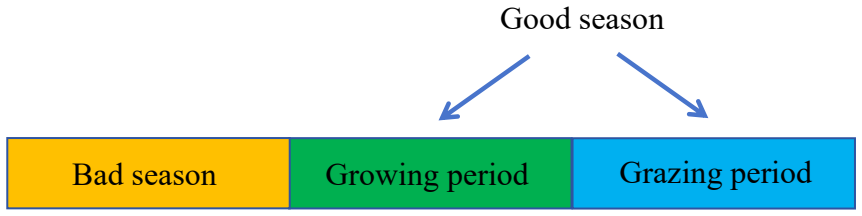
This study investigates the impacts of grazing duration and intensity on vegetation population dynamics in semi-arid ecosystems characterized by seasonal succession. A novel piecewise periodic model is proposed, dividing the annual cycle into three distinct phases: dry season, growth period and grazing period in wet season. We derive critical thresholds for the durations of the dry season and grazing period that determine the persistence or extinction of a single vegetation species. For two competing species, we analyze how grazing parameters influence competitive outcomes, including exclusion, coexistence, and bistability. Theoretical results are supported by numerical simulations, which illustrate bifurcation diagrams and phase transitions under varying grazing regimes. Our findings provide actionable insights for sustainable grazing management in arid and semi-arid regions.
Editorial analysis
A structured set of objections, weighed in public.
Referee Report
Summary. The paper proposes a piecewise periodic model dividing the annual cycle into three phases (dry season, growth period, grazing period) with constant parameters in each. It derives explicit critical thresholds for dry-season and grazing-period durations governing single-species persistence or extinction via the period map. For two competing species it analyzes grazing-parameter effects on exclusion, coexistence, and bistability, with results illustrated by numerical bifurcation diagrams and phase-transition plots.
Significance. If the thresholds are correctly obtained from the integrated growth factors of the period map, the work supplies a transparent mathematical link between grazing timing/intensity and vegetation outcomes that could inform management in semi-arid systems. The explicit derivation and bifurcation analysis constitute a clear strength; however, the overall significance hinges on whether the piecewise-constant idealization produces thresholds that remain informative under more gradual environmental transitions.
major comments (2)
- [§2] §2 (Model formulation): the central thresholds are obtained from the product of exponential growth factors across the three fixed-length intervals with instantaneous switches. Because real moisture, temperature, and grazing intensity vary continuously rather than abruptly, the effective integrals differ and the location of the critical-duration curves in parameter space can shift; this assumption is load-bearing for the persistence/extinction claims.
- [§4] §4 (Numerical results): the bifurcation diagrams and phase portraits are generated entirely inside the same piecewise-constant framework. They therefore cannot detect the discrepancy that would arise from smoothed transitions, leaving the robustness of the reported threshold curves untested.
minor comments (2)
- [§3] Notation for the period map and the integrated growth factors could be introduced earlier and used consistently to improve readability of the threshold derivations.
- [§4] The manuscript would benefit from a brief sensitivity check (e.g., replacing one abrupt switch with a short linear ramp) to quantify how much the critical durations move.
Simulated Author's Rebuttal
We thank the referee for their insightful comments, which highlight important considerations regarding the model's assumptions. We agree that the piecewise-constant idealization is a simplification of real-world gradual transitions, and we will revise the manuscript to address the robustness of our findings. We respond to each major comment below.
read point-by-point responses
-
Referee: §2 (Model formulation): the central thresholds are obtained from the product of exponential growth factors across the three fixed-length intervals with instantaneous switches. Because real moisture, temperature, and grazing intensity vary continuously rather than abruptly, the effective integrals differ and the location of the critical-duration curves in parameter space can shift; this assumption is load-bearing for the persistence/extinction claims.
Authors: We recognize that the abrupt switches in our piecewise periodic model represent an idealization, as real environmental variables change gradually. This simplification enables the explicit computation of the period map and the derivation of critical thresholds for dry-season and grazing-period durations. To strengthen the manuscript, we will add a new subsection discussing the potential impact of smoothed transitions on the threshold locations and include a brief numerical sensitivity analysis comparing the piecewise model to one with continuous transition functions. revision: partial
-
Referee: §4 (Numerical results): the bifurcation diagrams and phase portraits are generated entirely inside the same piecewise-constant framework. They therefore cannot detect the discrepancy that would arise from smoothed transitions, leaving the robustness of the reported threshold curves untested.
Authors: The numerical results, including bifurcation diagrams, are indeed computed within the piecewise-constant model to illustrate the theoretical findings. We agree that this does not test robustness to gradual changes. In the revision, we will incorporate additional simulations using smoothed transition functions for the seasonal phases and compare the resulting bifurcation structures and critical curves to those in the original model. revision: yes
Circularity Check
Derivation self-contained from piecewise model equations
full rationale
The paper constructs a piecewise periodic dynamical system dividing the year into three phases with constant rates, then derives persistence/extinction thresholds and competitive outcomes explicitly from the period map and Floquet multipliers of that system. These steps follow standard analytic techniques for periodic ODEs and do not reduce to fitted data, self-citations, or tautological redefinitions. Numerical bifurcation diagrams are produced inside the same model and serve only as illustration, not as independent validation that would create circularity. No load-bearing self-citation or ansatz smuggling is present in the provided derivation chain.
Axiom & Free-Parameter Ledger
free parameters (2)
- growth rates in different phases
- grazing intensity and duration parameters
axioms (2)
- domain assumption The ecosystem dynamics can be modeled using ordinary differential equations with piecewise periodic coefficients.
- ad hoc to paper Grazing occurs only during a defined period in the wet season with uniform intensity.
Reference graph
Works this paper leans on
- [1]
-
[2]
S.B. Hsu and X.Q. Zhao, A Lotka-Volterra competition model with seasonal suc- cession. J. Math. Biol. (2012) , 64(1-2):109-130
work page 2012
- [3]
-
[4]
L. Pu, Z. Lin, Y. Lou, A West Nile virus nonlocal model with free boundaries and seasonal succession, J. Math. Biol. (2023), 86: 1-52
work page 2023
-
[5]
L. Niu, Y. Wang, X. Xie, Carrying simplex in the Lotka-Volterra competition model with seasonal succession with applications, Discrete Contin. Dyn. Syst., Ser. B (2021), 26: 2161-2172
work page 2021
-
[6]
U. Sommer, Z.M. Gliwicz, W. Lampert, A. Duncan, The PEG-model of seasonal succession of planktonic events in fresh waters, Arch. Hydrobiol. (1986), 106: 433- 471
work page 1986
-
[7]
M. Wang, Q. Zhang, X.Q. Zhao, Dynamics for a diffusive competition model with seasonal succession and different free boundaries, J. Differ. Equ. (2021), 285: 536- 582
work page 2021
- [8]
- [9]
-
[10]
S. Liu, Y. Lou, Classifying the level set of principal eigenvalue for time-periodic parabolic operators and applications, J. Funct. Anal. 282 (2022) 109338
work page 2022
- [11]
- [12]
- [13]
-
[14]
J. Chen, J. Huang, S. Ruan, J. Wang, Bifurcations of invariant tori in predator- prey models with seasonal prey harvesting, SIAM J. Appl. Math. (2013), 73: 1876- 1905
work page 2013
-
[15]
I.A. Darabsah, Y. Yuan, A stage-structured mathematical model for fish stock with harvesting, SIAM J. Appl. Math. (2018), 78: 145-170
work page 2018
-
[16]
W. Gan, Z. Lin, M. Pedersen, Delay-driven spatial patterns in a predator-prey model with constant prey harvesting, Z. Angew. Math. Phys. (2022), 73: 1-18
work page 2022
-
[17]
D. Xiao, Dynamics and bifurcations on a class of population model with seasonal constant-yield harvesting, Discrete Contin. Dyn. Syst. Ser. B (2016), 21: 699-719
work page 2016
- [18]
- [19]
-
[20]
J.S. Yu, Existence and stability of a unique and exact two periodic orbits for an interactive wild and sterile mosquito model. J. Differ. Equ. (2020) , 269: 10395- 10415
work page 2020
- [21]
- [22]
-
[23]
L. Eigentler, J.A. Sherratt, Effects of precipitation intermittency on vegetation patterns in semi-arid landscape, Physica D. (2020), 405: 132396. 40
work page 2020
-
[24]
L. Eigentler, ¡ ¤ J.A. Sherratt, An integrodifference model for vegetation patterns in semi-arid environments with seasonality, J. Math. Biol. (2020), 81 (3):875-904
work page 2020
- [25]
-
[26]
Xiaoli Wang, Guohong Zhang, The influence of infiltration feedback on the char- acteristic of banded vegetation pattern on hillsides of semiarid area, Plos One( 2019),14(1): e0205715
work page 2019
-
[27]
J. A. Sherratt, Pattern solutions of the Klausmeier model for banded vegetation in semi-arid environments II: Patterns with the largest possible propagation speeds, Proc. R. Soc. A(2011), 467: 3272-3294
work page 2011
-
[28]
C. A. Klausmeier, Regular and irregular patterns in semiarid vegetation, Sci- ence(1999), 284:1826-1828
work page 1999
-
[29]
Rietkerk, S. C. Dekker, P. C. de Ruiter, and J. van de Koppel, Self-organized patchiness and catastrophic shifts in ecosystems, Science(2004), 305: 1926-1929
work page 2004
-
[30]
M. K. Pal and S. Pori, Effect of nonlocal grazing on dry-land vegetation dynamics, Phys. Review. E. (2022), 106: 054407
work page 2022
-
[31]
Y. Maimaiti, W.B. Yang, Spatial vegetation pattern formation and transition of an extended water ¨Cplant model with nonlocal or local grazing, Nonlinear Dyn. (2024), 112 5765-5791
work page 2024
-
[32]
Siero, Nonlocal grazing in patterned ecosystem, J
E. Siero, Nonlocal grazing in patterned ecosystem, J. Theor. Biol. (2018), 436: 64-71
work page 2018
- [33]
discussion (0)
Sign in with ORCID, Apple, or X to comment. Anyone can read and Pith papers without signing in.