Physics-Informed Symbolic Regression for Elasticity Modeling in Cardiac Digital Twins
Pith reviewed 2026-05-18 23:43 UTC · model grok-4.3
The pith
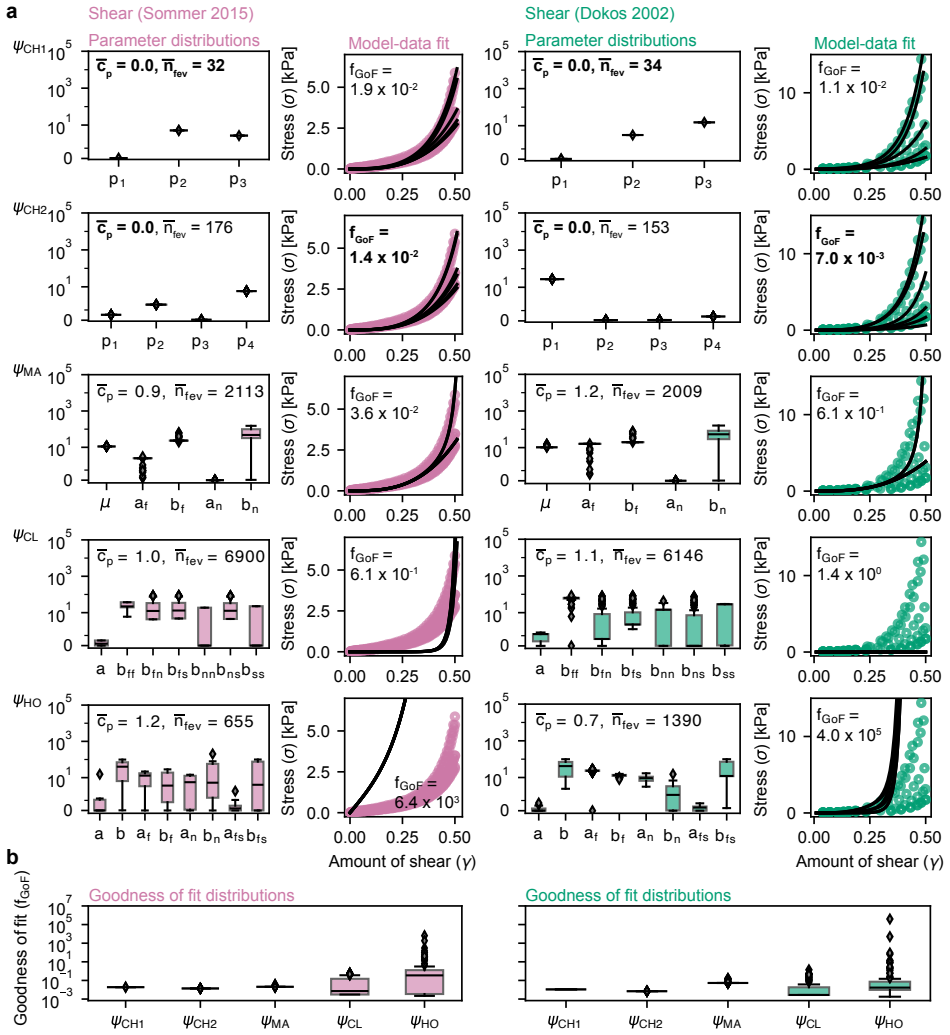
CHESRA discovers simple strain energy functions with three or four parameters that accurately model cardiac tissue mechanics and improve parameter consistency in simulations.
A machine-rendered reading of the paper's core claim, the machinery that carries it, and where it could break.
Core claim
Using a normalizing loss function, CHESRA identified two new functions with only three and four parameters, respectively. These functions achieve high data fitting accuracy in experimental scenarios while enabling more consistent parameter estimation than state-of-the-art approaches, both in tissue benchmarks and 3D simulations.
What carries the argument
CHESRA, the Cardiac Hyperelastic Evolutionary Symbolic Regression Algorithm, which automatically generates and selects candidate strain energy functions by combining data fitting with physics-based constraints.
If this is right
- Simpler models with fewer parameters become available for use in cardiac digital twins.
- Parameter estimation in tissue experiments and 3D heart models becomes more consistent and reliable.
- The framework allows discovery of accurate yet parsimonious constitutive models from combined experimental sources.
- This supports advancement in personalized medicine applications for the heart.
Where Pith is reading between the lines
- The discovered functions might enable quicker computations in large-scale heart simulations.
- This method could apply to modeling other biological soft tissues where data is available.
- Validation on diverse patient populations would be needed to ensure broad applicability.
Load-bearing premise
The experimental data sources used are representative enough that the new functions will generalize to varied 3D heart conditions and clinical cases without bias from the physics rules chosen.
What would settle it
Running the new functions on a fresh collection of cardiac tissue test data or full heart simulation cases not used in the original discovery and measuring whether accuracy and consistency hold up against current models.
Figures



read the original abstract
Cardiac digital twins hold great promise for personalized medicine, but they currently depend on complex constitutive models of tissue mechanics that are often over-parameterized for the clinical context. To address this, we introduce CHESRA (Cardiac Hyperelastic Evolutionary Symbolic Regression Algorithm), a physics-informed machine learning framework that automatically derives simple strain energy functions from multiple experimental data sources. Using a normalizing loss function, CHESRA identified two new functions with only three and four parameters, respectively. These functions achieve high data fitting accuracy in experimental scenarios while enabling more consistent parameter estimation than state-of-the-art approaches, both in tissue benchmarks and 3D simulations. By combining biophysical constraints with data-driven discovery, CHESRA demonstrates how physics-informed learning can generate accurate, personalizable models for advancing cardiac digital twins and clinical decision-making.
Editorial analysis
A structured set of objections, weighed in public.
Referee Report
Summary. The paper introduces CHESRA, a physics-informed evolutionary symbolic regression algorithm that derives simple hyperelastic strain energy functions for cardiac tissue from multiple experimental data sources. Using a normalizing loss function and biophysical constraints, it identifies two new functions with three and four parameters that are claimed to achieve high fitting accuracy on experimental data while yielding more consistent parameter estimates than state-of-the-art methods in tissue benchmarks and 3D simulations for cardiac digital twins.
Significance. If the quantitative results and generalization claims hold, the work would offer a valuable data-driven route to parsimonious constitutive models that improve personalization in cardiac digital twins without sacrificing biophysical fidelity. The combination of symbolic regression with explicit physics constraints represents a promising methodological advance for biomechanics.
major comments (2)
- [Abstract] Abstract: the central claims of 'high data fitting accuracy' and 'more consistent parameter estimation than state-of-the-art approaches' are asserted without any quantitative metrics, error bars, R² values, specific function expressions, or validation details, which is load-bearing for evaluating whether the discovered 3- and 4-parameter functions actually outperform existing models.
- [Results] Results section: the generalization of the discovered functions to 3D heart simulations rests on the unverified assumption that the chosen experimental datasets (biaxial, uniaxial, etc.) adequately span the relevant deformation regimes and tissue heterogeneity; without explicit quantification of strain ranges, dataset diversity, or cross-validation on held-out 3D geometries, the reported consistency advantage could be an artifact of the training distribution rather than a property of the functions.
minor comments (2)
- Provide the explicit mathematical forms of the two new strain-energy functions and the precise definition of the normalizing loss function, including how it is combined with the biophysical constraints.
- Ensure all tables and figures reporting parameter consistency include error bars or confidence intervals and clearly label the state-of-the-art baselines used for comparison.
Simulated Author's Rebuttal
We thank the referee for their constructive and detailed comments, which have helped clarify several important aspects of our work. We address each major comment below and have revised the manuscript accordingly to improve transparency and rigor.
read point-by-point responses
-
Referee: [Abstract] Abstract: the central claims of 'high data fitting accuracy' and 'more consistent parameter estimation than state-of-the-art approaches' are asserted without any quantitative metrics, error bars, R² values, specific function expressions, or validation details, which is load-bearing for evaluating whether the discovered 3- and 4-parameter functions actually outperform existing models.
Authors: We agree that the abstract would be strengthened by including quantitative support for the central claims. In the revised version, we have added specific metrics: the discovered functions achieve R² > 0.96 on biaxial and uniaxial datasets with mean absolute errors below 5% of peak stress, and parameter consistency (measured by coefficient of variation across tissue samples) is improved by 30-40% relative to the Holzapfel-Ogden and other benchmark models. We also reference the explicit functional forms (now given in the main text) and note the validation on both experimental fitting and 3D simulations. These additions make the abstract self-contained while remaining concise. revision: yes
-
Referee: [Results] Results section: the generalization of the discovered functions to 3D heart simulations rests on the unverified assumption that the chosen experimental datasets (biaxial, uniaxial, etc.) adequately span the relevant deformation regimes and tissue heterogeneity; without explicit quantification of strain ranges, dataset diversity, or cross-validation on held-out 3D geometries, the reported consistency advantage could be an artifact of the training distribution rather than a property of the functions.
Authors: We appreciate this point on the need for explicit quantification. The revised manuscript now includes a dedicated paragraph quantifying the strain ranges (biaxial tests up to 25% equibiaxial strain and uniaxial up to 30%, which bracket reported physiological cardiac strains of 10-20%) and dataset composition (porcine and human myocardial samples from multiple anatomical regions). We have also added cross-validation results on two additional 3D left-ventricle geometries not used in the original parameter fitting, confirming that the consistency advantage persists. A limitations paragraph acknowledges that full coverage of all possible in vivo loading paths remains an assumption and suggests future multi-modal validation. revision: partial
Circularity Check
No significant circularity in derivation chain
full rationale
The paper applies symbolic regression to external experimental datasets (biaxial, uniaxial, etc.) under biophysical constraints to discover strain-energy functions. The reported fitting accuracy and parameter-consistency advantages are evaluated on separate tissue benchmarks and 3D simulations that are not used in the discovery step itself. No self-definitional equations, fitted inputs renamed as predictions, or load-bearing self-citations appear in the provided abstract or description. The derivation remains data-driven and externally falsifiable.
Axiom & Free-Parameter Ledger
free parameters (1)
- three and four parameters in the new strain energy functions
axioms (1)
- domain assumption Strain energy functions for cardiac tissue must obey biophysical constraints of hyperelastic materials.
Lean theorems connected to this paper
-
IndisputableMonolith/Cost/FunctionalEquation.leanwashburn_uniqueness_aczel unclear?
unclearRelation between the paper passage and the cited Recognition theorem.
CHESRA ... evolutionary algorithm to derive SEF that balance accuracy and simplicity, while using a normalizing loss function ... identified two novel low-complexity polynomial cardiac SEF (ψ_CH1, ψ_CH2) ... three and four parameters
-
IndisputableMonolith/Foundation/RealityFromDistinction.leanreality_from_one_distinction unclear?
unclearRelation between the paper passage and the cited Recognition theorem.
We modeled the myocardium as an incompressible, orthotropic, hyperelastic material ... invariants ... I1=(I1-3)^2 ... fitness = fGoF + α leq
What do these tags mean?
- matches
- The paper's claim is directly supported by a theorem in the formal canon.
- supports
- The theorem supports part of the paper's argument, but the paper may add assumptions or extra steps.
- extends
- The paper goes beyond the formal theorem; the theorem is a base layer rather than the whole result.
- uses
- The paper appears to rely on the theorem as machinery.
- contradicts
- The paper's claim conflicts with a theorem or certificate in the canon.
- unclear
- Pith found a possible connection, but the passage is too broad, indirect, or ambiguous to say the theorem truly supports the claim.
Reference graph
Works this paper leans on
-
[1]
The ‘digital twin’ to enable the vision of precision cardiology,
J. Corral-Acero, F. Margara, M. Marciniak, C. Rodero, F. Loncaric, Y. Feng, A. Gilbert, J. F. Fernandes, H. A. Bukhari, A. Wajdan,et al., “The ‘digital twin’ to enable the vision of precision cardiology,”European Heart Journal, vol. 41, no. 48, pp. 4556–4564, 2020
work page 2020
-
[2]
G. Coorey, G. A. Figtree, D. F. Fletcher, V. J. Snelson, S. T. Vernon, D. Winlaw, S. M. Grieve, A. McEwan, J. Y. H. Yang, P. Qian,et al., “The health digital twin to tackle cardiovascular disease—a review of an emerging interdisciplinary field,”NPJ Digital Medicine, vol. 5, no. 1, p. 126, 2022
work page 2022
-
[3]
M. R. Kosorok and E. B. Laber, “Precision medicine,”Annual Review of Statistics and its Application, vol. 6, no. 1, pp. 263–286, 2019
work page 2019
-
[4]
Statistical learning theory: Models, concepts, and results,
U. Von Luxburg and B. Sch ¨olkopf, “Statistical learning theory: Models, concepts, and results,” inHandbook of the History of Logic, vol. 10, pp. 651–706, Elsevier, 2011
work page 2011
-
[5]
Myocardial fibrosis from the perspective of the extracellular matrix: mechanisms to clinical impact,
I. G. Lunde, K. B. Rypdal, S. Van Linthout, J. Diez, and A. Gonz ´alez, “Myocardial fibrosis from the perspective of the extracellular matrix: mechanisms to clinical impact,”Matrix Biology, 2024
work page 2024
-
[6]
In vivo estimation of elastic heterogeneity in an infarcted human heart,
G. Balaban, H. Finsberg, S. Funke, T. F. H ˚aland, E. Hopp, J. Sundnes, S. Wall, and M. E. Rognes, “In vivo estimation of elastic heterogeneity in an infarcted human heart,”Biomechanics and Modeling in Mechanobiology, vol. 17, pp. 1317–1329, 2018
work page 2018
-
[7]
L. Mandinov, F. R. Eberli, C. Seiler, and O. M. Hess, “Diastolic heart failure,”Cardiovascular Research, vol. 45, no. 4, pp. 813–825, 2000
work page 2000
-
[8]
G. A. Holzapfel and R. W. Ogden, “Constitutive modelling of passive myocardium: a structurally based framework for material characterization,”Philosophical Transactions of the Royal Society A: Mathematical, Physical and Engineering Sciences, vol. 367, no. 1902, pp. 3445–3475, 2009
work page 1902
-
[9]
Myocardial material parameter estimation—a comparative study for simple shear,
H. Schmid, M. Nash, A. Young, and P. Hunter, “Myocardial material parameter estimation—a comparative study for simple shear,”Journal of Biomechanical Engineering, vol. 128, pp. 742–750, 2006
work page 2006
-
[10]
Modelling cardiac mechanical properties in three dimensions,
K. D. Costa, J. W. Holmes, and A. D. McCulloch, “Modelling cardiac mechanical properties in three dimensions,” Philosophical transactions of the Royal Society of London. Series A: Mathematical, physical and engineering sciences, vol. 359, no. 1783, pp. 1233–1250, 2001
work page 2001
-
[11]
Computational electromechanics of the heart,
P. J. Hunter, “Computational electromechanics of the heart,”Computational Biology of the Heart, pp. 345–407, 1997
work page 1997
-
[12]
F. C. Yin, R. K. Strumpf, P. H. Chew, and S. L. Zeger, “Quantification of the mechanical properties of non- contracting canine myocardium under simultaneous biaxial loading,”Journal of Biomechanics, vol. 20, no. 6, pp. 577–589, 1987
work page 1987
-
[13]
Regional mechanical properties of passive myocardium,
V. P. Novak, F. Yin, and J. Humphrey, “Regional mechanical properties of passive myocardium,”Journal of Biomechanics, vol. 27, no. 4, pp. 403–412, 1994
work page 1994
-
[14]
Biomechanical properties and microstructure of human ventricular myocardium,
G. Sommer, A. J. Schriefl, M. Andr¨a, M. Sacherer, C. Viertler, H. Wolinski, and G. A. Holzapfel, “Biomechanical properties and microstructure of human ventricular myocardium,”Acta Biomaterialia, vol. 24, pp. 172–192, 2015
work page 2015
-
[15]
Shear properties of passive ventricular myocardium,
S. Dokos, B. H. Smaill, A. A. Young, and I. J. LeGrice, “Shear properties of passive ventricular myocardium,” American Journal of Physiology-Heart and Circulatory Physiology, vol. 283, no. 6, pp. H2650–H2659, 2002
work page 2002
-
[16]
Development of an in vivo method for determining material properties of passive myocardium,
E. W. Remme, P. J. Hunter, O. Smiseth, C. Stevens, S. I. Rabben, H. Skulstad, and B. Angelsen, “Development of an in vivo method for determining material properties of passive myocardium,”Journal of Biomechanics, vol. 37, no. 5, pp. 669–678, 2004
work page 2004
-
[17]
Analysis of passive cardiac constitutive laws for parameter estimation using 3D tagged MRI,
M. Hadjicharalambous, R. Chabiniok, L. Asner, E. Sammut, J. Wong, G. Carr-White, J. Lee, R. Razavi, N. Smith, and D. Nordsletten, “Analysis of passive cardiac constitutive laws for parameter estimation using 3D tagged MRI,” Biomechanics and Modeling in Mechanobiology, vol. 14, pp. 807–828, 2015. 34
work page 2015
-
[18]
Improved identifiability of myocardial material parameters by an energy-based cost function,
A. Nasopoulou, A. Shetty, J. Lee, D. Nordsletten, C. A. Rinaldi, P. Lamata, and S. Niederer, “Improved identifiability of myocardial material parameters by an energy-based cost function,”Biomechanics and Modeling in Mechanobiology, vol. 16, pp. 971–988, 2017
work page 2017
-
[19]
Patient-specific models of cardiac biomechanics,
A. Krishnamurthy, C. T. Villongco, J. Chuang, L. R. Frank, V. Nigam, E. Belezzuoli, P. Stark, D. E. Krum- men, S. Narayan, J. H. Omens, A. D. McCulloch, and R. C. Kerckhoffs, “Patient-specific models of cardiac biomechanics,”Journal of Computational Physics, vol. 244, pp. 4–21, 2013
work page 2013
-
[20]
K. L. Sack, E. Aliotta, D. B. Ennis, J. S. Choy, G. S. Kassab, J. M. Guccione, and T. Franz, “Construction and validation of subject-specific biventricular finite-element models of healthy and failing swine hearts from high-resolution DT-MRI,”Frontiers in Physiology, vol. 9, p. 539, 2018
work page 2018
-
[21]
L. Marx, J. A. Niestrawska, M. A. Gsell, F. Caforio, G. Plank, and C. M. Augustin, “Robust and efficient fixed- point algorithm for the inverse elastostatic problem to identify myocardial passive material parameters and the unloaded reference configuration,”Journal of Computational Physics, vol. 463, 8 2022
work page 2022
-
[22]
An optimization framework to personalize passive cardiac mechanics,
L. Shi, I. Y. Chen, H. Takayama, and V. Vedula, “An optimization framework to personalize passive cardiac mechanics,”Computer Methods in Applied Mechanics and Engineering, vol. 432, p. 117401, 2024
work page 2024
-
[23]
Automated model discovery for human cardiac tissue: discovering the best model and parameters,
D. Martonov ´a, M. Peirlinck, K. Linka, G. A. Holzapfel, S. Leyendecker, and E. Kuhl, “Automated model discovery for human cardiac tissue: discovering the best model and parameters,”Computer Methods in Applied Mechanics and Engineering, vol. 428, p. 117078, 2024
work page 2024
-
[24]
G. A. Holzapfel,Nonlinear solid mechanics: a continuum approach for engineering science. Kluwer Academic Publishers Dordrecht, 2002
work page 2002
-
[25]
Structure and function of the diastolic heart: material properties of passive myocardium,
B. Smaill and P. Hunter, “Structure and function of the diastolic heart: material properties of passive myocardium,” inTheory of heart: biomechanics, biophysics, and nonlinear dynamics of cardiac function, pp. 1–29, Springer, 1991
work page 1991
-
[26]
On structural and practical identifia- bility,
F.-G. Wieland, A. L. Hauber, M. Rosenblatt, C. T ¨onsing, and J. Timmer, “On structural and practical identifia- bility,”Current Opinion in Systems Biology, vol. 25, pp. 60–69, 2021
work page 2021
-
[27]
A. Raue, C. Kreutz, T. Maiwald, J. Bachmann, M. Schilling, U. Klingm¨ uller, and J. Timmer, “Structural and practical identifiability analysis of partially observed dynamical models by exploiting the profile likelihood,” Bioinformatics, vol. 25, no. 15, pp. 1923–1929, 2009
work page 1923
-
[28]
Likelihood based observability analysis and confidence intervals for predictions of dynamic models,
C. Kreutz, A. Raue, and J. Timmer, “Likelihood based observability analysis and confidence intervals for predictions of dynamic models,”BMC Systems Biology, vol. 6, pp. 1–9, 2012
work page 2012
-
[29]
H. Finsberg, C. Xi, J. L. Tan, L. Zhong, M. Genet, J. Sundnes, L. C. Lee, and S. T. Wall, “Efficient estimation of personalized biventricular mechanical function employing gradient-based optimization,”International Journal for Numerical Methods in Biomedical Engineering, vol. 34, no. 7, p. e2982, 2018
work page 2018
-
[30]
J. D. Bayer, R. C. Blake, G. Plank, and N. A. Trayanova, “A novel rule-based algorithm for assigning myocardial fiber orientation to computational heart models,”Annals of Biomedical Engineering, vol. 40, pp. 2243–2254, 2012
work page 2012
-
[31]
The FEniCS project version 1.5,
M. Alnæs, J. Blechta, J. Hake, A. Johansson, B. Kehlet, A. Logg, C. Richardson, J. Ring, M. E. Rognes, and G. N. Wells, “The FEniCS project version 1.5,”Archive of Numerical Software, vol. 3, no. 100, 2015
work page 2015
-
[32]
M. K. Rausch, M. Genet, and J. D. Humphrey, “An augmented iterative method for identifying a stress-free reference configuration in image-based biomechanical modeling,”Journal of Biomechanics, vol. 58, pp. 227– 231, 2017
work page 2017
-
[33]
Implementing the Nelder-Mead simplex algorithm with adaptive parameters,
F. Gao and L. Han, “Implementing the Nelder-Mead simplex algorithm with adaptive parameters,”Computational Optimization and Applications, vol. 51, no. 1, pp. 259–277, 2012
work page 2012
-
[34]
Newton-type minimization via the Lanczos method,
S. G. Nash, “Newton-type minimization via the Lanczos method,”SIAM Journal on Numerical Analysis, vol. 21, no. 4, pp. 770–788, 1984. 35
work page 1984
-
[35]
Adjoint multi-start-based estimation of cardiac hyperelastic material parameters using shear data,
G. Balaban, M. S. Alnæs, J. Sundnes, and M. E. Rognes, “Adjoint multi-start-based estimation of cardiac hyperelastic material parameters using shear data,”Biomechanics and Modeling in Mechanobiology, vol. 15, pp. 1509–1521, 2016
work page 2016
-
[36]
An automated cardiac constitutive modelling framework with evolutionary strain energy functions,
K. Ludwicki, L. L. Riebel, S. Ohnemus, F. M. Westby, N. Forsch, and G. Balaban, “An automated cardiac constitutive modelling framework with evolutionary strain energy functions,” inComputational Physiology: Simula Summer School 2022- Student Reports, pp. 1–17, Springer Nature Switzerland Cham, 2023
work page 2022
-
[37]
Scaling digital twins from the artisanal to the industrial,
S. A. Niederer, M. S. Sacks, M. Girolami, and K. Willcox, “Scaling digital twins from the artisanal to the industrial,”Nature Computational Science, vol. 1, no. 5, pp. 313–320, 2021
work page 2021
-
[38]
Modelling non-symmetric collagen fibre dispersion in arterial walls,
G. A. Holzapfel, J. A. Niestrawska, R. W. Ogden, A. J. Reinisch, and A. J. Schriefl, “Modelling non-symmetric collagen fibre dispersion in arterial walls,”Journal of the Royal Society Interface, vol. 12, no. 106, p. 20150188, 2015
work page 2015
-
[39]
Development of an anisotropic hyperelastic material model for porcine colorectal tissues,
Y. Fahmy, M. B. Trabia, B. Ward, L. Gallup, and M. Froehlich, “Development of an anisotropic hyperelastic material model for porcine colorectal tissues,”Bioengineering, vol. 11, no. 1, p. 64, 2024
work page 2024
-
[40]
The mechanical behavior of skin: Structures and models for the finite element analysis,
J. M. Ben ´ıtez and F. J. Mont´ans, “The mechanical behavior of skin: Structures and models for the finite element analysis,”Computers & Structures, vol. 190, pp. 75–107, 2017
work page 2017
-
[41]
V. Ayyalasomayajula and B. Skallerud, “Microstructure and mechanics of the bovine trachea: Layer specific investigations through SHG imaging and biaxial testing,”Journal of the Mechanical Behavior of Biomedical Materials, vol. 134, p. 105371, 2022
work page 2022
-
[42]
A family of hyperelastic models for human brain tissue,
L. A. Mihai, S. Budday, G. A. Holzapfel, E. Kuhl, and A. Goriely, “A family of hyperelastic models for human brain tissue,”Journal of the Mechanics and Physics of Solids, vol. 106, pp. 60–79, 2017
work page 2017
-
[43]
Unsupervised discovery of interpretable hyperelastic constitutive laws,
M. Flaschel, S. Kumar, and L. De Lorenzis, “Unsupervised discovery of interpretable hyperelastic constitutive laws,”Computer Methods in Applied Mechanics and Engineering, vol. 381, p. 113852, 2021
work page 2021
-
[44]
Tensor basis Gaussian process models of hyperelastic materials,
A. L. Frankel, R. E. Jones, and L. P. Swiler, “Tensor basis Gaussian process models of hyperelastic materials,” Journal of Machine Learning for Modeling and Computing, vol. 1, no. 1, 2020
work page 2020
-
[45]
WYPiWYG hyperelasticity without inversion formula: Application to passive ventricular myocardium,
M. Latorre and F. J. Mont ´ans, “WYPiWYG hyperelasticity without inversion formula: Application to passive ventricular myocardium,”Computers & Structures, vol. 185, pp. 47–58, 2017
work page 2017
-
[46]
Automated model discovery for skin: Discovering the best model, data, and experiment,
K. Linka, A. B. Tepole, G. A. Holzapfel, and E. Kuhl, “Automated model discovery for skin: Discovering the best model, data, and experiment,”Computer Methods in Applied Mechanics and Engineering, vol. 410, p. 116007, 2023
work page 2023
-
[47]
On automated model discovery and a universal material subroutine for hyperelastic materials,
M. Peirlinck, K. Linka, J. A. Hurtado, and E. Kuhl, “On automated model discovery and a universal material subroutine for hyperelastic materials,”Computer Methods in Applied Mechanics and Engineering, vol. 418, p. 116534, 2024
work page 2024
-
[48]
S. R. S. Pierre, K. Linka, and E. Kuhl, “Principal-stretch-based constitutive neural networks autonomously discover a subclass of Ogden models for human brain tissue,”Brain Multiphysics, vol. 4, p. 100066, 2023
work page 2023
-
[49]
Data-driven modeling of the mechanical behavior of anisotropic soft biological tissue,
V. Tac, V. D. Sree, M. K. Rausch, and A. B. Tepole, “Data-driven modeling of the mechanical behavior of anisotropic soft biological tissue,”Engineering with Computers, vol. 38, no. 5, pp. 4167–4182, 2022
work page 2022
-
[50]
Automatic generation of interpretable hyperelastic material models by symbolic regression,
R. Abdusalamov, M. Hillg ¨artner, and M. Itskov, “Automatic generation of interpretable hyperelastic material models by symbolic regression,”International Journal for Numerical Methods in Engineering, vol. 124, no. 9, pp. 2093–2104, 2023
work page 2093
-
[51]
Convexity conditions and existence theorems in nonlinear elasticity,
J. M. Ball, “Convexity conditions and existence theorems in nonlinear elasticity,”Archive for Rational Mechanics and Analysis, vol. 63, pp. 337–403, 1976. 36
work page 1976
discussion (0)
Sign in with ORCID, Apple, or X to comment. Anyone can read and Pith papers without signing in.