REVIEW 3 major objections 5 minor 15 references
The Alternative Hypothesis for Zeros of the Riemann Zeta-Function
T0 review · 3 major / 5 minor · reviewed 2026-08-05 · deepseek-v4-flash
Pith's one-line read Under the Riemann Hypothesis and a strengthened Alternative Hypothesis, almost all zeros of the zeta-function are simple.
desk verdict The paper's new Strong AH-Pairs => p0=1 result is not proven as written: the error terms lose log^2 and log^3 factors, so the stated decay hypotheses are too weak to force the conclusion. read the letter →
The pith
A machine-rendered reading of the paper's core claim, the machinery that carries it, and where it could break.
The reading
What carries the argument
The central machinery is a Fourier-pair argument that feeds the Alternative Hypothesis into Montgomery's pair-correlation function $F(\alpha)$. The kernels $g_n(\alpha)=\sin^2(n\pi\alpha/2)$ on $|\alpha|\le 1$ (with cosine for odd $n$) have transforms $\hat g_n(t)=\frac{\sin(2\pi t)}{2\pi t}\frac{n^2}{n^2-4t^2}$, which vanish at every half-integer $k/2$ except $0$ and $\pm n/2$. Applying $g_n$ through MT-Pairs isolates the pair densities $P_0$ and $P_{n/2}$ and gives $P_0+(-1)^{n+1}P_{n/2}\sim \tfrac12$ for even $n$ or $\tfrac32-\tfrac{2}{\pi^2 n^2}$ for odd $n$. For Theorem 2, the sine kernel from Montgomery's Corollary 1 is used under Strong AH-Pairs, which permits truncation to difference
What would settle it
Compute $P_0(T)$ for zeros up to large height and show $\limsup P_0$ exceeds $\tfrac32 - \tfrac{2}{\pi^2}\approx 1.2974$, contradicting Theorem 1; or exhibit a sequence satisfying RH and AH-Pairs with $R(T)\log T\to 0$ for which $P_0$ has no limit or a limit other than 1, contradicting Theorem 2.
Extended reading notes
Core claim
Assuming RH, define $P_{k/2}(T)$ as the normalized count of pairs of zeros with imaginary parts in $[T/\log^2 T, T]$ whose difference is within a small $\delta$ of $k/2$ times the average spacing $2\pi/\log T$. Under the Alternative Hypothesis for pairs (AH-Pairs), every admissible pair lies within $O((|k|+1)R(T))$ of such a half-integer, with $R(T)\to 0$. Theorem 1 shows that $1+o(1)\le P_0 \le \tfrac32 - \tfrac{2}{\pi^2} + o(1)$, and for $k\ne 0$, $P_{k/2}\sim P_0 - \tfrac12$ if $k$ is even, while $P_{k/2}\sim \tfrac32 - \tfrac{2}{\pi^2 k^2} - P_0$ if $k$ is odd. In particular, if any one limiting density $p_{k/2}$ exists, all do. Theorem 2 strengthens the error term to $R(T)\log T \to 0$
Load-bearing premise
The load-bearing premise is that every sufficiently close pair of zeta zeros has a normalized difference within $O((|k|+1)R(T))$ of a half-integer multiple of the average spacing, with $R(T)\to 0$; for the simplicity result the error must shrink fast enough that $R(T)\log T\to 0$.
Editorial extensions
If this is right
- If the limiting density $p_0$ exists, then every $p_{k/2}$ exists and satisfies the stated formulas; for $p_0=1$, even spacings have density $\tfrac12$ and odd spacings have density $\tfrac12 - \tfrac{2}{\pi^2 k^2}$.
- Under Strong AH-Pairs, the Essential Simplicity Hypothesis follows: almost all zeros are simple and distinct zeros are not closer than the average spacing.
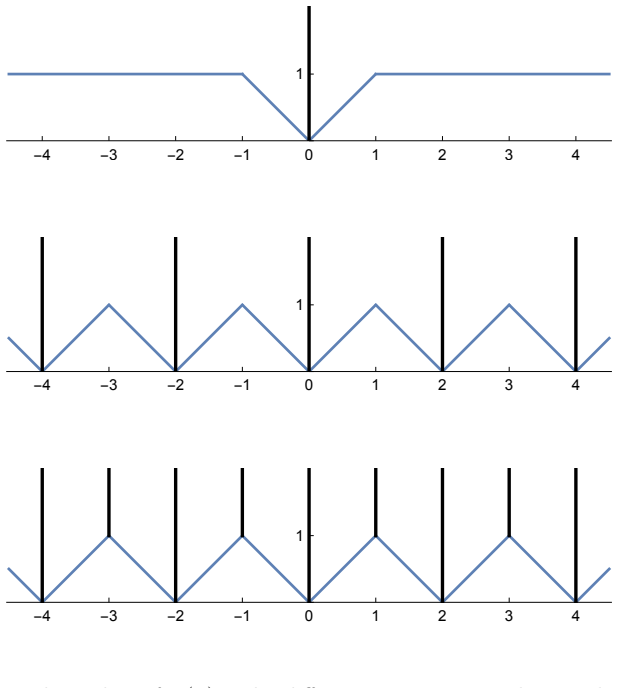
- Montgomery's $F(\alpha)$ is determined on $[0,2]$ as $\min(\alpha,2-\alpha)+\delta_0+2(P_0-1)\delta_1$, with period $2$, showing AH gives a periodic, non-GUE pair correlation.
- The constant $C$ in the second moment of $S(T)$ becomes $1+\left(\tfrac32(p_0-1)+\tfrac14\right)\tfrac{\pi^2}{6}+\tfrac{\log 2}{\pi}$ when $p_0$ exists.
- A version of Montgomery's pair-correlation theorem is recovered from AH-Density without assuming RH or explicit formulas.
Reading between the lines
- If the sharp error in Strong AH-Pairs could be derived from the original AH statement rather than assumed, Theorem 2 would upgrade to a proof that AH itself implies essential simplicity.
- The half-integer spacing rule predicts a stair-step $F(\alpha)$ that could be distinguished from the GUE model by computing higher-order correlations beyond the pair level.
- The consistency relations are numerically testable: existing zero data at available heights should show $P_0(T)$ near 1 if AH is correct, and near the upper bound $\tfrac32-\tfrac{2}{\pi^2}\approx 1.2974$ in the opposite extreme.
- The kernel method suggests that Fourier pairs vanishing at all half-integers except a prescribed set could be used to derive analogous constraints on triple or higher correlations under AH.
Editorial analysis
A structured set of objections, weighed in public.
Referee Report
Summary. The paper assumes the Riemann Hypothesis together with the Alternative Hypothesis in a quantitative 'AH-Pairs' form, in which normalized differences of zero ordinates are constrained to be close to half-integers k/2. Defining densities P_{k/2} for the number of zero pairs in bins around k/2, it claims in Theorem 1 that 1+o(1) ≤ P0 ≤ 3/2 − 2/π² + o(1) and gives asymptotic relations linking P_{k/2} to P0 for even and odd k. Theorem 2 introduces a stronger 'Strong AH-Pairs' condition and claims P0 → 1, hence the Essential Simplicity Hypothesis. A model for the pair-correlation function F(α) is derived in Theorem 3, a related constant is computed in Corollary 4, and Theorem 4 derives a version of Montgomery's pair-correlation sum from the 'AH-Density' relations. The proofs follow Montgomery's Fourier-kernel method, using MT and Lemmas 1–6.
Significance. If the results were correct as stated, they would give a nearly complete determination of the density of zero pairs under a plausible alternative to the pair-correlation conjecture, and would show that a stronger form of AH implies that almost all zeros are simple. This would be a notable contribution to the study of the Alternative Hypothesis and to the program of relating zero-spacing assumptions to consequences for zero multiplicities. The paper contains substantial original technique, especially the use of the special Fourier kernels in Lemma 4 and the smoothed averaging arguments of Lemmas 5–6. At the same time, the significance is conditional and modest: the conclusions are deduced from hypotheses that are themselves far from being established, and the paper's own Theorem 4 is a consistency statement rather than an independent derivation of Montgomery's theorem.
major comments (3)
- [§1, eqs. (1.1)-(1.8); §2, eqs. (2.5), (2.7)] The displayed normalization is internally inconsistent. With N(T) ~ T/(2π) log T from (1.1), the average spacing is 2π/log T, so the normalized difference should be (γ−γ′) log T/(2π), as in (1.3). However (1.2) and (1.4) define P(T,M) and B_{k/2} using |γ−γ′|/(2π log T) ≤ M, and (1.5) normalizes |B_{k/2}| by T/(2π log T), a factor (log T)^2 smaller than N(T). Taken literally, the diagonal pairs γ=γ′ alone give P0 ≥ N(T)/(T/(2π log T)) ~ 2π (log T)^2, contradicting Theorem 1's assertion that P0 = O(1). The same erroneous factor appears in (1.8), (2.5), (2.7), and (2.11). This is load-bearing: all of the density relations and the error-term bookkeeping depend on this normalization. The paper must be re-read with the corrected choices N(T) ~ T/(2π) log T and (γ−γ′) log T/(2π) as the normalized difference; as printed, the theorems are not well posed.
- [§3, Lemma 3 and proof of Theorem 1] Independently of the normalization issue, the proof of Theorem 1 as printed contains an error-term mismatch. Lemma 3 gives an error O(M^2 R(T) T log T) in (2.7). Dividing by the displayed main factor T/(2π log T) yields O(M^2 R(T) log^2 T), not the printed O(M^2 R(T)). Since AH-Pairs only assumes R(T) → 0, the term M^2 R(T) log^2 T need not vanish, and the conclusion P0 + (−1)^{n+1}P_{n/2} ∼ ... does not follow by taking T first and then M large. If the normalization is corrected to N(T) ~ T/(2π) log T, this particular mismatch disappears; but as the manuscript stands, the proof of (1.5)–(1.6) is incomplete.
- [§4, proof of Theorem 2, around (4.1)] The same type of error occurs in Theorem 2. The contribution of k ≠ 0 is bounded by O(R(T)|Q(T,M)|) = O(M R(T) T log^2 T). Dividing by T/(2π log T) gives O(M R(T) log^3 T), not O(M R(T) log T) as printed in the penultimate display of the proof. Consequently, the final assertion P0 = 1 + O(1/M^2) + O(1/√log T) + O(M R(T) log T) is not justified by Strong AH-Pairs, which only gives R(T) log T → 0. Balancing M = M(T) would require R(T) = o(1/log^3 T), a strictly stronger hypothesis than the one stated. With the corrected normalization N(T) ~ T/(2π) log T, the printed bound would be O(M R(T) log T) and the proof would go through; but as written, Theorem 2 is not established.
minor comments (5)
- [§1, definition of eγ] The normalized ordinate is defined as eγ := γ/(2π log γ), but with this definition the consecutive distance is 1/(log γ)^2, not asymptotic to 1. The intended definition is presumably eγ := (γ/(2π)) log γ (or γ/(2π) log(γ/2π)). This affects the intuition for all subsequent definitions.
- [§2, Theorem 4 and subsequent paragraph] The text itself states that Theorem 4 'could be viewed as using a false assumption to prove a true theorem.' Since AH-Density already contains exactly the relations that Theorem 1 would produce, Theorem 4 is a consistency check rather than independent evidence for AH. This is not a load-bearing flaw, but the framing should be adjusted so that the result is not over-advertised.
- [§3, Lemma 3] Lemma 3 is stated for r as in Lemma 2 (r ∈ L1, bounded, with algebraic decay), but the proof uses the Fourier transform of r to derive a Lipschitz bound on r. These hypotheses do not imply that the Fourier transform is in L1. All applications use r = g_n or a triangle kernel, for which the extra property holds; the lemma should state this additional hypothesis explicitly.
- [§2, eq. (2.11) and §4] The size of the error term in (2.11) is written as O(T√log T) at one point and O(T/√log T) at another; after dividing by the correct main term N(T), the relative error should be O(1/√log T). Please check and unify the displayed error terms.
- [§2, eq. (2.16)] Equation (2.16) uses the same symbol F for the actual pair-correlation function and for the model density in (2.12). This is likely a typesetting issue, but it makes the statement of Theorem 3 hard to parse; use a distinct notation such as F_model.
Circularity Check
One peripheral circularity: AH-Density is defined as the output of Theorem 1 and Theorem 4 then re-derives MT-Pairs from it; the central Theorems 1–2 are not circular but Theorem 2 has a separate error-term gap.
-
self definitional
[Section 1, AH-Density definition (p.5); Section 2, Theorem 4, Eq. (2.17); proof in Section 8]
"AH-Density. The limiting densities pk/2 exist and satisfy 1 ≤ p0 ≤ 3/2 − 2/π^2, and for k ∈ Z pk/2 = (p0 − 1)/2, if k ≠ 0 is even, 3/2 − 2/(π^2 k^2) − p0, if k is odd. ... Theorem 4. ... Then assuming AH-Density, we have (2.17) ∑_{k∈Z} br(k/2)pk/2 = r(0) + 2∫_0^1 αr(α) dα."
AH-Density is introduced explicitly as the limiting form of the relations that Theorem 1/Corollary 1 derive from MT-Pairs and AH-Pairs. In Section 8, the proof of Theorem 4 substitutes that same pk/2 formula into ∑ br(k/2)pk/2, expands r(α) in a Fourier series with coefficients br(k/2)/2, and applies Poisson summation to obtain r(0)+2∫_0^1 αr(α)dα, which is exactly the MT-Pairs evaluation (2.5). Thus (2.17) is a Fourier rearrangement of the assumed density relations, not an independent derivation from first principles; the paper even says AH-Density 'contains nearly the same information provided by MT and AH-Pairs.' The step is transparent and non-load-bearing for Theorems 1–2, but it is circular by construction.
full rationale
The main derivation in Theorem 1 is self-contained: it combines the independent Montgomery Theorem (RH) with the assumed AH-Pairs and evaluates the same pair sum two ways; the inequalities and asymptotics for P_{k/2} follow from honest error terms, not from an input that already contains the conclusion. Theorem 2 is a separate conditional argument: Strong AH-Pairs plus MT is used to try to force P0≈1. That proof appears to have a genuine error-term gap (the k≠0 contribution is bounded by O(MR(T)T log^2 T), which after division by T/(2π log T) is O(MR(T) log^3 T), not O(MR(T) log T); the stated R(T) log T→0 does not suffice). This is a correctness risk, not a circularity, and is not scored here. The one circular feature is the concluding AH-Density/Theorem 4 pair: AH-Density is defined as the limiting content of Theorem 1/Corollary 1, and Theorem 4's (2.17) is obtained by substituting that content back and applying Poisson summation, so it is a restatement rather than a prediction. The authors are candid about this ('One could view this as using a false assumption to prove a true theorem'), and the result is not load-bearing for the paper's central claims. Self-citations to [Bal16] and [BGSTB24,25] are either for the assumed hypothesis or for independent/transparent generalizations and do not make the core derivation circular. Overall partial circularity is confined to a peripheral application, so the score is 4 rather than 6–8.
Assumptions & free parameters
free parameters (2)
- P0 (limiting density of close pairs) =
unknown, constrained to [1, 3/2 - 2/pi^2]
- R(T) error function in AH-Pairs =
unspecified, only required R(T)->0 (Strong: R(T) log T ->0)
assumptions (6)
- domain assumption Riemann Hypothesis
- domain assumption Alternative Hypothesis for Differences of Zeros (AH-Pairs)
- domain assumption Strong AH-Pairs
- domain assumption AH-Density
- standard math Montgomery's Theorem (MT)
- standard math Standard zero-counting estimates (Goldston-Montgomery Lemma 9 and (3.1))
invented entities (1)
-
Strong AH-Pairs
Cite this review
Pith. "Pith review of The Alternative Hypothesis for Zeros of the Riemann Zeta-Function." pith.science (2026). https://pith.science/paper/HVSW5EKP
@misc{pith2026250810857,
  author       = {Pith},
  title        = {Pith review of: The Alternative Hypothesis for Zeros of the Riemann Zeta-Function},
  year         = {2026},
  howpublished = {\url{https://pith.science/paper/HVSW5EKP}},
  note         = {Machine review of arXiv:2508.10857}
}
abstract
In 2016, the first-named author introduced a formulation of the Alternative Hypothesis that assumes that consecutive zeros of the Riemann zeta-function are spaced at multiples of half of the average spacing, but does not assume that the zeros are simple. In this paper, we assume the Riemann Hypothesis and a similar formulation of the Alternative Hypothesis, and for each integer $k$ we obtain constraints on the density of pairs of zeros whose normalized differences are at $k/2$ times the average spacing. These constraints, in turn, restrict the density of (possible) multiple zeros. We also formulate a stronger version of the Alternative Hypothesis and show that it implies the Essential Simplicity Hypothesis.
Figures
Reference graph
Works this paper leans on
-
[1]
Siegfred Alan C. Baluyot. On the pair correlation conjecture and the alternative hypothesis. J. Number Theory , 169:183--226, 2016
work page 2016
-
[2]
Baluyot, Daniel Alan Goldston, Ade Irma Suriajaya, and Caroline L
Siegfred Alan C. Baluyot, Daniel Alan Goldston, Ade Irma Suriajaya, and Caroline L. Turnage-Butterbaugh. An unconditional M ontgomery theorem for pair correlation of zeros of the R iemann zeta-function. Acta Arith. , 214:357--376, 2024
work page 2024
-
[3]
Baluyot, Daniel Alan Goldston, Ade Irma Suriajaya, and Caroline L
Siegfred Alan C. Baluyot, Daniel Alan Goldston, Ade Irma Suriajaya, and Caroline L. Turnage-Butterbaugh. Pair correlation of zeros of the R iemann zeta function I : Proportions of simple zeros and critical zeros. arXiv:2501.14545 , 2025
-
[4]
Pair correlation estimates for the zeros of the zeta function via semidefinite programming
Andr\'es Chirre, Felipe Gon c alves, and David de Laat. Pair correlation estimates for the zeros of the zeta function via semidefinite programming. Adv. Math. , 361:106926, 22, 2020
work page 2020
-
[5]
Multiplicative number theory , volume 74 of Graduate Texts in Mathematics
Harold Davenport. Multiplicative number theory , volume 74 of Graduate Texts in Mathematics . Springer-Verlag, New York, third edition, 2000. Revised and with a preface by Hugh L. Montgomery
2000
-
[6]
Daniel A. Goldston and Hugh L. Montgomery. Pair correlation of zeros and primes in short intervals. In Analytic number theory and D iophantine problems ( S tillwater, OK , 1984) , volume 70 of Progr. Math. , pages 183--203. Birkh\"auser Boston, Boston, MA, 1987
work page 1984
-
[7]
L ARGE DIFFERENCES BETWEEN CONSECUTIVE PRIME NUMBERS
Daniel Alan Goldston. L ARGE DIFFERENCES BETWEEN CONSECUTIVE PRIME NUMBERS . ProQuest LLC, Ann Arbor, MI, 1981. Thesis (Ph.D.)--University of California, Berkeley
work page 1981
-
[8]
D. A. Goldston. On the function S(T) in the theory of the R iemann zeta-function. J. Number Theory , 27(2):149--177, 1987
work page 1987
Show all 15 references
-
[9]
D. R. Heath-Brown. Small class numbers and the pair correlation of zeros. https://vimeo.com/showcase/4967015/video/287694279, 1996. A talk given at the AIM Conference ``Riemann Hypothesis", Seattle, 1996
1996
-
[10]
An introduction to harmonic analysis
Yitzhak Katznelson. An introduction to harmonic analysis . Dover Publications, Inc., New York, corrected edition, 1976
1976
-
[11]
Languasco, A
A. Languasco, A. Perelli, and A. Zaccagnini. An extended pair-correlation conjecture and primes in short intervals. Trans. Amer. Math. Soc. , 369(6):4235--4250, 2017
2017
-
[12]
Lagarias and Brad Rodgers
Jeffrey C. Lagarias and Brad Rodgers. Higher correlations and the alternative hypothesis. Q. J. Math. , 71(1):257--280, 2020
2020
-
[13]
H. L. Montgomery. The pair correlation of zeros of the zeta function. In Analytic number theory ( P roc. S ympos. P ure M ath., V ol. XXIV , S t. L ouis U niv., S t. L ouis, M o., 1972) , volume Vol. XXIV of Proc. Sympos. Pure Math. , pages 181--193. Amer. Math. Soc., Providen...
1972
-
[14]
Arithmetic equivalent of essential simplicity of zeta zeros
Julia Mueller. Arithmetic equivalent of essential simplicity of zeta zeros. Trans. Amer. Math. Soc. , 275(1):175--183, 1983
1983
-
[15]
Montgomery and Robert C
Hugh L. Montgomery and Robert C. Vaughan. Multiplicative number theory. I . C lassical theory , volume 97 of Cambridge Studies in Advanced Mathematics . Cambridge University Press, Cambridge, 2007
2007
Reviewed August 5, 2026 · model on record in the stance chip above.
Discussion (0). Continue with ORCID to comment.