Wavelength dependence of laser pulse filamentation in the close spectral vicinity of atomic resonances
Pith reviewed 2026-05-18 23:29 UTC · model grok-4.3
The pith
Laser pulses in rubidium vapor self-focus sharply below the D2 resonance but weaken above it.
A machine-rendered reading of the paper's core claim, the machinery that carries it, and where it could break.
Core claim
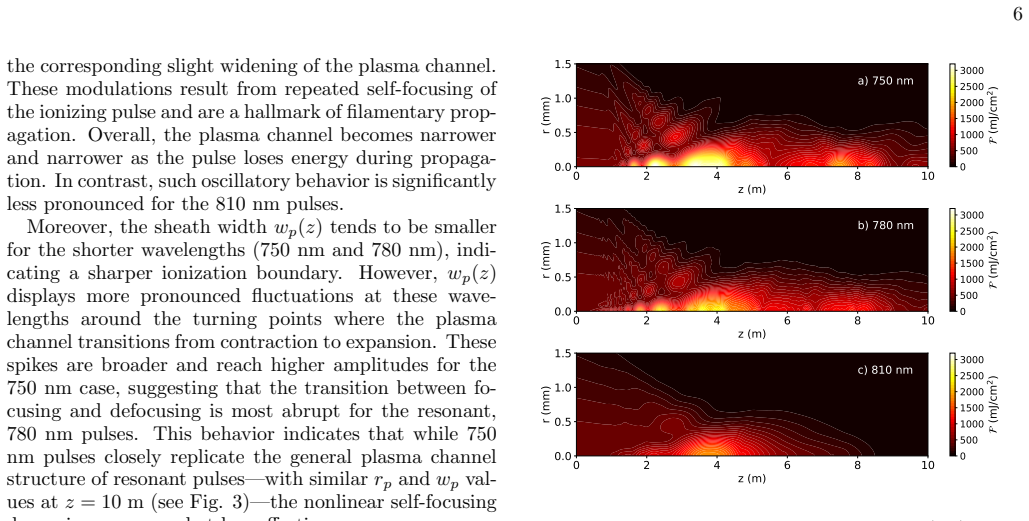
Numerical solutions of the propagation equations reveal that pulse wavelengths below the rubidium D2 resonance exhibit strong self-focusing and sharp plasma boundaries similar to the resonant 780 nm case, while wavelengths above 780 nm yield gradually weaker self-focusing and increasingly diffuse plasma boundaries. This behavior stems from the combined influence of anomalous dispersion around atomic resonances, resonant transitions between excited states of Rb in the 740-780 nm range, and wavelength-dependent multiphoton ionization rates.
What carries the argument
The numerical solutions of the propagation equations incorporating anomalous dispersion, resonant excited-state transitions, and multiphoton ionization rates.
If this is right
- Plasma channels are more homogeneous with sharper boundaries for sub-resonant wavelengths.
- Weaker self-focusing occurs for super-resonant wavelengths leading to diffuse boundaries.
- The model accounts for the distinct behaviors seen at 780 nm versus 810 nm in experiments.
- The interplay of dispersion, resonances, and ionization determines the filamentation outcome near atomic lines.
Where Pith is reading between the lines
- This could allow wavelength tuning to optimize plasma channel homogeneity for applications like laser guiding.
- Similar wavelength dependencies might occur in other atomic vapors with nearby resonances, affecting filamentation there.
- Direct measurements of ionization rates at these wavelengths could confirm the model's key factors.
Load-bearing premise
The numerical solutions of the propagation equations capture all relevant nonlinear and resonant effects without missing important contributions from the atomic medium or requiring unstated adjustments to model parameters.
What would settle it
Observing no significant change in plasma boundary sharpness or self-focusing strength when tuning across the resonance in rubidium, or finding that multiphoton ionization rates are independent of wavelength in this range, would falsify the proposed interplay.
Figures




read the original abstract
We investigate the propagation and nonlinear self-focusing of TW power laser pulses that create 10-m-scale, highly homogeneous plasma channels in rubidium vapor. Using computational solutions of the relevant propagation equations, we study the effects of the ionizing pulse central wavelength in relation to the resonance frequencies of atomic rubidium. Recent experiments show that pulse propagation and plasma channel creation is distinctly different for 780 nm laser pulses (resonant with the rubidium $D_2$ line) and 810 nm laser pulses. We study pulse propagation in a $\pm$30 nm range around the $D_2$ resonance and find that the results are distinctly different when tuning to sub-resonant wavelengths from those obtained for super-resonant wavelengths. For pulse wavelengths below the resonance the behavior is similar to the resonant case, characterized by strong self-focusing and a sharp plasma boundary. Pulse wavelengths above 780 nm on the other hand yield gradually weaker self-focusing and an increasingly diffuse plasma boundary. Our results suggest that the observed behavior can be attributed to an interplay between multiple factors: anomalous dispersion around atomic resonances, resonant transitions between excited states of Rb lying in the 740-780 nm range and wavelength-dependent multiphoton ionization rates.
Editorial analysis
A structured set of objections, weighed in public.
Referee Report
Summary. The paper investigates the wavelength dependence of TW-power laser pulse propagation and filamentation in rubidium vapor near the D2 resonance at 780 nm. Using numerical solutions of the propagation equations over a ±30 nm range, it reports that sub-resonant wavelengths produce strong self-focusing and sharp plasma boundaries similar to the resonant case at 780 nm, while super-resonant wavelengths yield weaker self-focusing and increasingly diffuse plasma boundaries. The authors attribute the sub- versus super-resonant asymmetry to the combined effects of anomalous dispersion, resonant transitions between excited Rb states in the 740–780 nm range, and wavelength-dependent multiphoton ionization rates.
Significance. If the numerical results are robust, the work offers a plausible mechanistic account for experimentally observed differences in plasma-channel formation near atomic resonances. This could inform control of long, homogeneous plasma channels in high-intensity laser–atom interactions, with relevance to filamentation studies and applications requiring precise plasma boundaries.
major comments (2)
- [Computational model / propagation equations] The central attribution to resonant excited-state transitions (740–780 nm) and wavelength-dependent MPI rates is load-bearing, yet the manuscript provides no explicit description of how these are incorporated into the propagation equations or susceptibility model. If an effective two-level or generic Keldysh treatment is used without multi-level tracking of 5P–5D transitions, the reported asymmetry could arise from incomplete physics rather than the claimed interplay.
- [Numerical methods] No information is given on the numerical scheme, spatial/temporal grid resolution, convergence tests, or direct validation against the referenced experiments. Without these, it is impossible to assess whether the solutions reliably capture the claimed wavelength dependence of self-focusing and plasma-boundary sharpness.
minor comments (2)
- [Abstract] The abstract states that results are 'distinctly different' for sub- versus super-resonant tuning but does not quantify the wavelength range or the magnitude of the differences in self-focusing or boundary sharpness.
- [References] Ensure that all cited experimental works on Rb filamentation are referenced with complete bibliographic details.
Simulated Author's Rebuttal
We thank the referee for the careful reading of our manuscript and the constructive comments, which will help strengthen the presentation of our results. We address each major comment below and will revise the manuscript to provide the requested details.
read point-by-point responses
-
Referee: [Computational model / propagation equations] The central attribution to resonant excited-state transitions (740–780 nm) and wavelength-dependent MPI rates is load-bearing, yet the manuscript provides no explicit description of how these are incorporated into the propagation equations or susceptibility model. If an effective two-level or generic Keldysh treatment is used without multi-level tracking of 5P–5D transitions, the reported asymmetry could arise from incomplete physics rather than the claimed interplay.
Authors: We agree that an explicit description of the model is essential for supporting the central claims. In the revised manuscript we will add a dedicated subsection that details the multi-level susceptibility model. This will specify how the resonant transitions between excited Rb states (including 5P–5D lines in the 740–780 nm window) enter the nonlinear polarization term, how the anomalous dispersion is computed from the full set of nearby resonances, and how the wavelength-dependent multiphoton ionization rate is obtained from a resonance-adjusted Keldysh-type expression. These additions will make clear that the reported sub- versus super-resonant asymmetry arises from the combined action of dispersion, excited-state resonances, and ionization rather than from an oversimplified two-level treatment. revision: yes
-
Referee: [Numerical methods] No information is given on the numerical scheme, spatial/temporal grid resolution, convergence tests, or direct validation against the referenced experiments. Without these, it is impossible to assess whether the solutions reliably capture the claimed wavelength dependence of self-focusing and plasma-boundary sharpness.
Authors: We acknowledge that the current version omits these technical details. The revised manuscript will include a new subsection describing the numerical scheme (split-step Fourier propagation with adaptive step-size control), the spatial and temporal grid resolutions employed, and the results of systematic convergence tests performed by successively refining the grids until the self-focusing distance and plasma-boundary sharpness stabilize to within a few percent. We will also add a brief comparison of simulated plasma-channel lengths and boundary profiles with the qualitative features reported in the referenced experiments, noting the level of agreement that can be expected given the available experimental data. revision: yes
Circularity Check
No significant circularity; derivation relies on standard numerical propagation modeling
full rationale
The paper computes solutions to propagation equations for TW laser pulses in Rb vapor and attributes sub- vs super-resonant differences in self-focusing and plasma boundary sharpness to the interplay of anomalous dispersion, excited-state resonances (740-780 nm), and wavelength-dependent MPI rates. These attributions rest on known atomic physics and nonlinear optics rather than any self-definitional loop, fitted parameter renamed as prediction, or load-bearing self-citation. No equations or results in the manuscript reduce by construction to the paper's own inputs; the numerical model is externally falsifiable against independent measurements of dispersion, transition strengths, and ionization rates. The central claim therefore remains independent of the present work's fitted values or definitions.
Axiom & Free-Parameter Ledger
Reference graph
Works this paper leans on
- [1]
-
[2]
L. Berg´ e, S. Skupin, R. Nuter, J. Kasparian, and J.-P. Wolf, Reports on Progress in Physics70, 1633– (2007)
work page 2007
-
[3]
V. P. Kandidov, S A Shlenov, and O. G. Kosareva, Quan- tum Electronics39, 205– (2009)
work page 2009
-
[4]
P. B. Corkum and F. Krausz, Nature Physics3, 381 (2007)
work page 2007
- [5]
-
[6]
P. Chen, J. Dawson, R. Huff, and T. Katsouleas, Phys- ical Review Letters54, 693 (1985)
work page 1985
-
[7]
I. Blumenfeld, C. Clayton, F. Decker, M. Hogan, C. Huang, C. Joshi, T. Katsouleas, W. Lu, W. Mori, P. Muggli,et al., Nature445, 741 (2007)
work page 2007
- [8]
- [9]
- [10]
- [11]
-
[12]
A. Caldwell, K. Lotov, A. Pukhov, and F. Simon, Nature Physics5, 363– (2009)
work page 2009
-
[13]
E. Gschwendtneret al., Nuclear Instruments and Meth- ods in Physics Research Section A: Accelerators, Spectrometers, Detectors and Associated Equipment 829, 76– (2016), 2nd European Advanced Accelerator Concepts Workshop - EAAC 2015
work page 2016
-
[14]
Adliet al.(AWAKE Collaboration), Nature561, 363 (2018)
E. Adliet al.(AWAKE Collaboration), Nature561, 363 (2018)
work page 2018
-
[15]
K. V. Lotov, A. Pukhov, and A. Caldwell, Physics of Plasmas20, 013102 (2013)
work page 2013
- [16]
-
[17]
A. Collaboration,AWAKE Design Report: A Proton- Driven Plasma Wakefield Acceleration Experiment at CERN, Tech. Rep. CERN-SPSC-2013-013, SPSC-TDR- 003 (CERN, 2013)
work page 2013
-
[18]
G. L. Lamb, Rev. Mod. Phys.43, 99–124 (1971)
work page 1971
- [19]
- [20]
-
[21]
G. Plyushchev, R. Kersevan, A. Petrenko, and P. Muggli, Journal of Physics D: Applied Physics51, 025203 (2017)
work page 2017
- [22]
-
[23]
G. Demeter, J. T. Moody, M. A. Kedves, B. R´ aczkevi, M. Aladi, A.-M. Bachmann, F. Batsch, F. Braunm¨ uller, G. P. Djotyan, V. Fedosseev, F. Friebel, S. Gess- ner, E. Granados, E. Guran, M. H¨ uther, V. Lee, M. Martyanov, P. Muggli, E. ¨Oz, H. Panuganti, L. Verra, and G. Z. Della Porta, Phys. Rev. A104, 033506 (2021)
work page 2021
-
[24]
G. Demeter, J. Moody, M. Kedves, F. Batsch, M. Berga- maschi, V. Fedosseev, E. Granados, P. Muggli, H. Panu- ganti, and G. Zevi Della Porta, Optics & Laser Technol- ogy168, 109921 (2024)
work page 2024
-
[25]
E. Gschwendtner, K. Lotov, P. Muggli, M. Wing, et al.(AWAKE Collaboration), Symmetry14(2022), 10.3390/sym14081680
-
[26]
A. Houard, P. Walsch, T. Produit,et al., Nature Photon- ics (2023), https://doi.org/10.1038/s41566-022-01139-z
- [27]
-
[28]
A. Couairon, E. Brambilla, T. Corti, D. Majus, O. de J. Ram´ ırez-G´ ongora, and M. Kolesik, The Eu- ropean Physical Journal Special Topics199, 5– (2011)
work page 2011
-
[29]
Boyd,Nonlinear Optics(Elsevier Science, 2003)
R. Boyd,Nonlinear Optics(Elsevier Science, 2003)
work page 2003
-
[30]
A. M. Perelomov, V. S. Popov, and M. V. Terent’ev, Soviet Physics JETP23, 924 (1966)
work page 1966
-
[31]
A. M. Perelomov, V. S. Popov, and M. V. Terent’ev, Soviet Physics JETP24, 207 (1967)
work page 1967
-
[32]
A. M. Perelomov and V. S. Popov, Soviet Physics JETP 25, 336 (1967)
work page 1967
-
[33]
B´ ejot,Theoretical and experimental investigations of ultrashort laser filamentation in gases, Ph.D
P. B´ ejot,Theoretical and experimental investigations of ultrashort laser filamentation in gases, Ph.D. the- sis (2008), , Universit´ e de Gen´ eve 2008 https://archive- ouverte.unige.ch/unige:4568
work page 2008
-
[34]
B. C. Duncan, V. Sanchez-Villicana, P. L. Gould, and H. R. Sadeghpour, Phys. Rev. A63, 043411 (2001)
work page 2001
-
[35]
D. A. Steck,Rubidium 85 D Line Data(available online at http://steck.us/alkalidata, (revision 2.1.2, 12 August 2009))
work page 2009
-
[36]
M. S. Safronova, C. J. Williams, and C. W. Clark, Phys. Rev. A69, 022509 (2004)
work page 2004
-
[37]
A. Kramida, Y. Ralchenko, J. Reader, and N. A. Team, NIST Atomic Spectra Database(National Institute of Standards and Technology, Gaithersburg, MD., 2018)
work page 2018
-
[38]
B. E. A. Saleh and M. C. Teich,Fundamentals of Pho- tonics(John Wiley and Sons, Inc., 2019)
work page 2019
-
[39]
M. H´ eder, E. Rig´ o, D. Medgyesi, R. Lovas, S. Tenczer, F. T¨ or¨ ok, A. Farkas, M. Em˝ odi, J. Kadlecsik, G. Mez˝ o, ´A. Pint´ er, and P. Kacsuk, Inform´ aci´ os T´ arsadalom22, 128 (2022)
work page 2022
discussion (0)
Sign in with ORCID, Apple, or X to comment. Anyone can read and Pith papers without signing in.