Encoding and Reasoning about Arrays in Constraint Logic Programming with Sets
Pith reviewed 2026-05-18 23:25 UTC · model grok-4.3
The pith
Arrays encoded as sets of ordered pairs reduce array reasoning to set reasoning via a new decision procedure.
A machine-rendered reading of the paper's core claim, the machinery that carries it, and where it could break.
Core claim
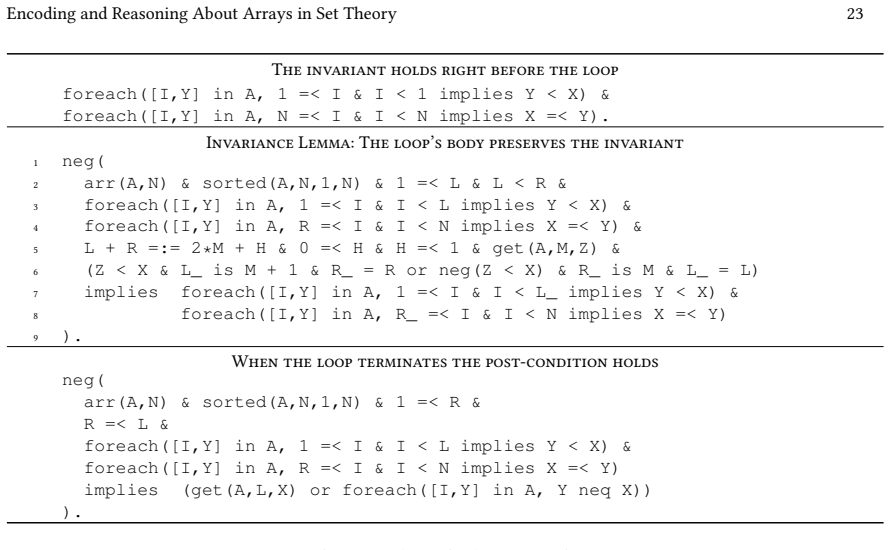
Arrays are represented as functions encoded as sets of ordered pairs where the cardinality of the set equals the length of the array. A fragment of set theory is defined to capture specifications of a non-trivial class of array programs, turning array reasoning into set reasoning. A decision procedure for this fragment is provided and implemented in the {log} constraint logic programming language and satisfiability solver, extending prior procedures for set theory fragments.
What carries the argument
Encoding arrays as sets of ordered pairs whose cardinality equals array length, allowing reduction to a decidable fragment of set theory.
If this is right
- Programs mixing arrays with sets and functions can be specified and solved for satisfiability in a single tool without separate encodings.
- The decision procedure extends earlier set-theory procedures to cover array operations directly.
- Constraint logic programming gains native support for array data structures through the existing set and relation solver.
- Users can reason about array-manipulating code by writing constraints in the set fragment and invoking the built-in solver.
Where Pith is reading between the lines
- Similar cardinality-based encodings could be tested on other indexed structures such as matrices or hash tables.
- The approach opens a route to verify array algorithms by reducing them to existing set-solver calls rather than building new array-specific engines.
- If the fragment proves too restrictive in practice, targeted extensions to the decision procedure could be checked for decidability.
Load-bearing premise
The chosen fragment of set theory is expressive enough to capture a non-trivial class of array programs and the decision procedure correctly decides satisfiability for all formulas in that fragment.
What would settle it
An array program specification expressible in the fragment for which the implemented solver returns the wrong satisfiability answer, such as a satisfiable formula declared unsatisfiable.
Figures


read the original abstract
We encode arrays as functions which, in turn, are encoded as sets of ordered pairs. The set cardinality of each of these functions coincides with the length of the array it is representing. Then we define a fragment of set theory that is used to give the specifications of a non-trivial class of programs with arrays. In this way, array reasoning becomes set reasoning. Furthermore, a decision procedure for this fragment is also provided and implemented as part of the {log} (read 'setlog') tool. {log} is a constraint logic programming language and satisfiability solver where sets and binary relations are first-class citizens. The tool already implements a few decision procedures for different fragments of set theory. In this way, arrays are seamlessly integrated into {log} thus allowing users to reason about sets, functions and arrays all in the same language and with the same solver. The decision procedure presented in this paper is an extension of decision procedures defined in earlier works not supporting arrays.
Editorial analysis
A structured set of objections, weighed in public.
Referee Report
Summary. The paper encodes arrays as finite functions represented by sets of ordered pairs whose cardinality equals the array length. It defines a fragment of set theory sufficient to specify a non-trivial class of array programs, reduces array access and update operations to set constraints, and supplies a decision procedure for the resulting fragment that is implemented as an extension of existing procedures inside the {log} constraint logic programming solver.
Significance. If the reduction and decision procedure are correct for the stated fragment, the work provides a uniform way to reason about sets, functions and arrays inside a single CLP language and solver. This integration is practically useful for constraint-based program analysis and verification tasks that mix array and set data structures. The explicit implementation in an existing tool and the conservative extension of prior decision procedures are concrete strengths.
minor comments (2)
- [Abstract] Abstract, paragraph 3: the phrase 'a non-trivial class of programs with arrays' is used without a brief characterization of the class (e.g., bounded-length arrays with index expressions drawn from a fixed set of operations). Adding one sentence would clarify the scope of the claimed decision procedure.
- [Introduction] The manuscript states that the decision procedure is an extension of earlier works; the introduction should list the specific prior papers (with section references) that supply the base rewrite rules so readers can trace the conservative addition of array rules.
Simulated Author's Rebuttal
We thank the referee for the positive assessment of our work on encoding arrays as sets of ordered pairs within the {log} solver and for recommending minor revision. The recognition that this provides a uniform approach to reasoning about sets, functions, and arrays is appreciated.
Circularity Check
No significant circularity detected
full rationale
The paper explicitly defines the encoding of arrays as functions (sets of ordered pairs whose cardinality equals array length) and reduces array constraints to set constraints within a newly specified fragment of set theory. This mapping and the associated rewrite rules for access, update, and cardinality are presented directly as the core contribution. The decision procedure is described as an extension of earlier procedures, but the paper states that it provides and implements the extension for the array fragment inside {log}, with the fragment restricted to finite sets with explicit cardinality and functional constraints. No equation or claim in the abstract reduces the new array encoding or the satisfiability result to a prior self-citation by construction; the extension is characterized as a conservative addition of array-specific rules. The overall derivation therefore remains self-contained and independently verifiable through the stated fragment definition and implementation.
Axiom & Free-Parameter Ledger
axioms (1)
- domain assumption Arrays can be faithfully represented as functions encoded as sets of ordered pairs whose cardinality equals the array length.
Lean theorems connected to this paper
-
IndisputableMonolith/Cost/FunctionalEquation.leanwashburn_uniqueness_aczel unclear?
unclearRelation between the paper passage and the cited Recognition theorem.
arr(A,m) ⇔ pfun(A) ∧ size(A,m) ∧ (∀(i,y)∈A : 1≤i≤m); dres([k,m],A,S); sorted via RUQ
What do these tags mean?
- matches
- The paper's claim is directly supported by a theorem in the formal canon.
- supports
- The theorem supports part of the paper's argument, but the paper may add assumptions or extra steps.
- extends
- The paper goes beyond the formal theorem; the theorem is a base layer rather than the whole result.
- uses
- The paper appears to rely on the theorem as machinery.
- contradicts
- The paper's claim conflicts with a theorem or certificate in the canon.
- unclear
- Pith found a possible connection, but the passage is too broad, indirect, or ambiguous to say the theorem truly supports the claim.
Reference graph
Works this paper leans on
-
[1]
Jean-Raymond Abrial. 1996. The B-book: Assigning Programs to Meanings . Cambridge University Press, New York, NY, USA
work page 1996
-
[2]
Jean-Raymond Abrial. 2010. Modeling in Event-B: System and Software Engineering (1st ed.). Cambridge University Press, New York, NY, USA
work page 2010
-
[3]
Francesco Alberti, Silvio Ghilardi, and Elena Pagani. 2017. Cardinality constraints for arrays (decidability results and applications). Formal Methods Syst. Des. 51, 3 (2017), 545–574. https://doi.org/10.1007/S10703-017-0279-6
-
[4]
Francesco Alberti, Silvio Ghilardi, and Natasha Sharygina. 2015. Decision Procedures for Flat Array Properties. J. Autom. Reason. 54, 4 (2015), 327–352. https://doi.org/10.1007/S10817-015-9323-7
-
[5]
Marius Bozga, Peter Habermehl, Radu Iosif, Filip Konecný, and Tomás Vojnar. [n. d.]. Automatic Verification of Integer Array Programs. InComputer Aided Verification, 21st International Conference, CA V 2009, Grenoble, France, June 26 - July 2, 2009. Proceedings (2009) (Lecture Notes in Computer Science, Vol. 5643), Ahmed Bouajjani and Oded Maler (Eds.). S...
-
[6]
Bradley, Zohar Manna, and Henny B
Aaron R. Bradley, Zohar Manna, and Henny B. Sipma. 2006. What’s Decidable About Arrays?. In Verification, Model Checking, and Abstract Interpretation, 7th International Conference, VMCAI 2006, Charleston, SC, USA, January 8-10, 2006, Proceedings (Lecture Notes in Computer Science, Vol. 3855), E. Allen Emerson and Kedar S. Namjoshi (Eds.). Springer, 427–44...
-
[7]
Domenico Cantone and Cristiano Longo. 2014. A decidable two-sorted quantified fragment of set theory with ordered pairs and some undecidable extensions. Theor. Comput. Sci. 560 (2014), 307–325. https://doi.org/10.1016/j.tcs.2014.03.021
-
[8]
Domenico Cantone, Eugenio G. Omodeo, and Alberto Policriti. 2001. Set Theory for Computing - From Decision Procedures to Declarative Programming with Sets. Springer. https://doi.org/10.1007/978-1-4757-3452-2
-
[9]
Alfredo Capozucca, Maximiliano Cristiá, Ross Horne, and Ricardo Katz. 2024. Brewer-Nash Scrutinised: Mechanised Checking of Policies Featuring Write Revocation. In 37th IEEE Computer Security Foundations Symposium, CSF 2024, Enschede, Netherlands, July 8-12, 2024 . IEEE, 112–126. https://doi.org/10.1109/CSF61375.2024.00042
-
[10]
Maximiliano Cristiá, Alfredo Capozucca, and Gianfranco Rossi. 2025. From a Constraint Logic Programming Language to a Formal Verification Tool. CoRR abs/2505.17350 (2025). https://doi.org/10.48550/ARXIV.2505.17350 arXiv:2505.17350
-
[11]
Maximiliano Cristiá, Guido De Luca, and Carlos Luna. 2023. An Automatically Verified Prototype of the Android Permissions System. J. Autom. Reason. 67, 2 (2023), 17. https://doi.org/10.1007/s10817-023-09666-2
-
[12]
Maximiliano Cristiá and Gianfranco Rossi. 2018. A Set Solver for Finite Set Relation Algebra. InRelational and Algebraic Methods in Computer Science - 17th International Conference, RAMiCS 2018, Groningen, The Netherlands, October 29 - November 1, 2018, Proceedings (Lecture Notes in Computer Science, Vol. 11194), Jules Desharnais, Walter Guttmann, and Ste...
-
[13]
Maximiliano Cristiá and Gianfranco Rossi. 2019. Rewrite Rules for a Solver for Sets, Binary Relations and Partial Functions . Technical Report. https://www.clpset.unipr.it/SETLOG/calculus.pdf
work page 2019
-
[14]
Maximiliano Cristiá and Gianfranco Rossi. 2020. Solving Quantifier-Free First-Order Constraints Over Finite Sets and Binary Relations. J. Autom. Reason. 64, 2 (2020), 295–330. https://doi.org/10.1007/s10817-019-09520-4
-
[15]
Maximiliano Cristiá and Gianfranco Rossi. 2021. Automated Proof of Bell-LaPadula Security Properties. J. Autom. Reason. 65, 4 (2021), 463–478. https://doi.org/10.1007/s10817-020-09577-6
-
[16]
Maximiliano Cristiá and Gianfranco Rossi. 2021. Automated Reasoning with Restricted Intensional Sets. J. Autom. Reason. 65, 6 (2021), 809–890. https://doi.org/10.1007/s10817-021-09589-w
-
[17]
Maximiliano Cristiá and Gianfranco Rossi. 2021. An Automatically Verified Prototype of the Tokeneer ID Station Specification. J. Autom. Reason. 65, 8 (2021), 1125–1151. https://doi.org/10.1007/s10817-021-09602-2
-
[18]
Maximiliano Cristiá and Gianfranco Rossi. 2023. Integrating Cardinality Constraints into Constraint Logic Programming with Sets. Theory Pract. Log. Program. 23, 2 (2023), 468–502. https://doi.org/10.1017/S1471068421000521
-
[19]
Maximiliano Cristiá and Gianfranco Rossi. 2024. A Decision Procedure for a Theory of Finite Sets with Finite Integer Intervals. ACM Trans. Comput. Log. 25, 1 (2024), 3:1–3:34. https://doi.org/10.1145/3625230
-
[20]
Maximiliano Cristiá and Gianfranco Rossi. 2024. A Practical Decision Procedure for Quantifier-Free, Decidable Languages Extended with Restricted Quantifiers. J. Autom. Reason. 68, 4 (2024), 23. https://doi.org/10.1007/S10817-024-09713-6
-
[21]
Maximiliano Cristiá, Gianfranco Rossi, and Claudia S. Frydman. 2013. {𝑙𝑜𝑔 } as a Test Case Generator for the Test Template Framework. In SEFM (Lecture Notes in Computer Science, Vol. 8137) , Robert M. Hierons, Mercedes G. Merayo, and Mario Bravetti (Eds.). Springer, 229–243. Manuscript submitted to ACM Encoding and Reasoning About Arrays in Set Theory 27
work page 2013
-
[22]
Henzinger, and Andrey Kupriyanov
Przemyslaw Daca, Thomas A. Henzinger, and Andrey Kupriyanov. [n. d.]. Array Folds Logic. InComputer Aided Verification - 28th International Conference, CA V 2016, Toronto, ON, Canada, July 17-23, 2016, Proceedings, Part II (2016) (Lecture Notes in Computer Science, Vol. 9780) , Swarat Chaudhuri and Azadeh Farzan (Eds.). Springer, 230–248. https://doi.org/...
-
[23]
Emanuele De Angelis, Fabio Fioravanti, Alberto Pettorossi, and Maurizio Proietti. 2017. Program Verification using Constraint Handling Rules and Array Constraint Generalizations. Fundam. Inform. 150, 1 (2017), 73–117. https://doi.org/10.3233/FI-2017-1461
-
[24]
Leonardo Mendonça de Moura and Nikolaj Bjørner. 2009. Generalized, efficient array decision procedures. In Proceedings of 9th International Conference on Formal Methods in Computer-Aided Design, FMCAD 2009, 15-18 November 2009, Austin, Texas, USA . IEEE, 45–52. https://doi.org/10. 1109/FMCAD.2009.5351142
-
[25]
Omodeo, Enrico Pontelli, and Gianfranco Rossi
Agostino Dovier, Eugenio G. Omodeo, Enrico Pontelli, and Gianfranco Rossi. 1996. A Language for Programming in Logic with Finite Sets. J. Log. Program. 28, 1 (1996), 1–44. https://doi.org/10.1016/0743-1066(95)00147-6
-
[26]
Agostino Dovier, Carla Piazza, Enrico Pontelli, and Gianfranco Rossi. 2000. Sets and constraint logic programming. ACM Trans. Program. Lang. Syst. 22, 5 (2000), 861–931
work page 2000
-
[27]
Agostino Dovier, Enrico Pontelli, and Gianfranco Rossi. 2006. Set unification. Theory Pract. Log. Program. 6, 6 (2006), 645–701. https://doi.org/10. 1017/S1471068406002730
work page 2006
-
[28]
Stephan Falke, Florian Merz, and Carsten Sinz. [n. d.]. Extending the Theory of Arrays: memset, memcpy, and Beyond. In Verified Software: Theories, Tools, Experiments - 5th International Conference, VSTTE 2013, Menlo Park, CA, USA, May 17-19, 2013, Revised Selected Papers (2013) (Lecture Notes in Computer Science, Vol. 8164), Ernie Cohen and Andrey Rybalc...
-
[29]
Peter Habermehl, Radu Iosif, and Tomás Vojnar. 2008. What Else Is Decidable about Integer Arrays?. In Foundations of Software Science and Computational Structures, 11th International Conference, FOSSACS 2008, Held as Part of the Joint European Conferences on Theory and Practice of Software, ETAPS 2008, Budapest, Hungary, March 29 - April 6, 2008. Proceedi...
-
[30]
Christian Holzbaur. 1995. OFAI CLP(Q,R) manual. Technical Report. edition 1.3.3. Technical Report TR-95-09, Austrian Research Institute for Artificial Intelligence. http://www.ofai.at/cgi-bin/tr-online?number+95-09
work page 1995
-
[31]
Quentin Plazar, Mathieu Acher, Sébastien Bardin, and Arnaud Gotlieb. [n. d.]. Efficient and Complete FD-solving for extended array constraints. In Proceedings of the Twenty-Sixth International Joint Conference on Artificial Intelligence, IJCAI 2017, Melbourne, Australia, August 19-25, 2017 (2017), Carles Sierra (Ed.). ijcai.org, 1231–1238. https://doi.org...
-
[32]
Rodrigo Raya and Viktor Kuncak. 2024. On algebraic array theories. J. Log. Algebraic Methods Program. 136 (2024), 100906. https://doi.org/10.1016/J. JLAMP.2023.100906
work page doi:10.1016/j 2024
-
[33]
Gianfranco Rossi and Maximiliano Cristiá. 2000. {𝑙𝑜𝑔 } home page. http://www.clpset.unipr.it/setlog.Home.html Last access 2025
work page 2000
-
[34]
Gianfranco Rossi and Maximiliano Cristiá. 2025. {𝑙𝑜𝑔 } User’s Manual. Technical Report. Dipartimento di Matematica, Universitá di Parma. https://www.clpset.unipr.it/SETLOG/setlog-man.pdf
work page 2025
-
[35]
Jacob T. Schwartz, Robert B. K. Dewar, Ed Dubinsky, and Edith Schonberg. 1986. Programming with Sets - An Introduction to SETL . Springer. https://doi.org/10.1007/978-1-4613-9575-1
-
[36]
J. M. Spivey. 1992. The Z notation: a reference manual . Prentice Hall International (UK) Ltd., Hertfordshire, UK, UK
work page 1992
-
[37]
P. Stocks and D. Carrington. 1996. A Framework for Specification-Based Testing. IEEE Transactions on Software Engineering 22, 11 (Nov. 1996), 777–793
work page 1996
-
[38]
Qinshi Wang and Andrew W. Appel. 2023. A Solver for Arrays with Concatenation. J. Autom. Reason. 67, 1 (2023), 4. https://doi.org/10.1007/S10817- 022-09654-Y Received 20 February 2007; revised 12 March 2009; accepted 5 June 2009 Manuscript submitted to ACM
discussion (0)
Sign in with ORCID, Apple, or X to comment. Anyone can read and Pith papers without signing in.