REVIEW 3 major objections 4 minor 21 references
Density and Particle Sourcing Optimization in a Helicon Plasma Source Prototype For Wakefield Accelerator Applications
T0 review · 3 major / 4 minor · reviewed 2026-08-15 · deepseek-v4-flash
Pith's one-line read In a two-antenna helicon plasma, removing background neutral gas flow halves the axial density variation — from 11% to 5% standard deviation — while raising density, though the profiles still miss the accelerator's 0.25% uniformity target…
desk verdict Solid experimental study showing no-flow neutral configurations double axial homogeneity in a two-antenna helicon, but the causal mechanism rests on an estimated neutral velocity and the headline metrics lack error bars. read the letter →
The pith
A machine-rendered reading of the paper's core claim, the machinery that carries it, and where it could break.
The reading
What carries the argument
The load-bearing object is the relative ion–neutral axial velocity and the sign of the friction term $-\nu_{\mathrm{in}}\, n m_i (v_{i,z} - v_{n,z})$ in a 2D axisymmetric axial momentum balance (Stangeby's equation, simplified by dropping anisotropy and anomalous terms). The zero-crossing of this term — the axial position where ions and neutrals move at equal speed — separates regions where neutrals drag ions forward from regions where they drain ion momentum; its location is measured through LIF ion velocities and an estimated neutral velocity. A second mechanism, linear superposition of single-antenna density and ionization profiles, carries the extension to multi-antenna arrays and lets the paper predict homogeneity as a function of antenna spacing $s$. The ionization source rate, measured by $S = \partial(nV_z)/\partial z + (1/r)\,\partial(r n V_r)/\partial r$, is dominated by the radial term (about 90%), so axial flow acts mainly on the roughly 10% axial refueling that the momentum balance amplifies.
What would settle it
Directly measure the neutral argon velocity profile in the no-flow configuration — for example by Doppler-resolved laser absorption or LIF on a neutral argon transition — at the same axial stations as the ion measurements. Observe whether a residual neutral flow exists while the density profile stays flat (if so, the zero-flow explanation is wrong), or inject a small controlled flow and check that homogeneity degrades continuously from 5% toward 11% (confirming the causal link). Resolving the zero-crossing in the z = 5–10 cm blind spot for the flow configurations would additionally test the momentum-balance picture.
Extended reading notes
Core claim
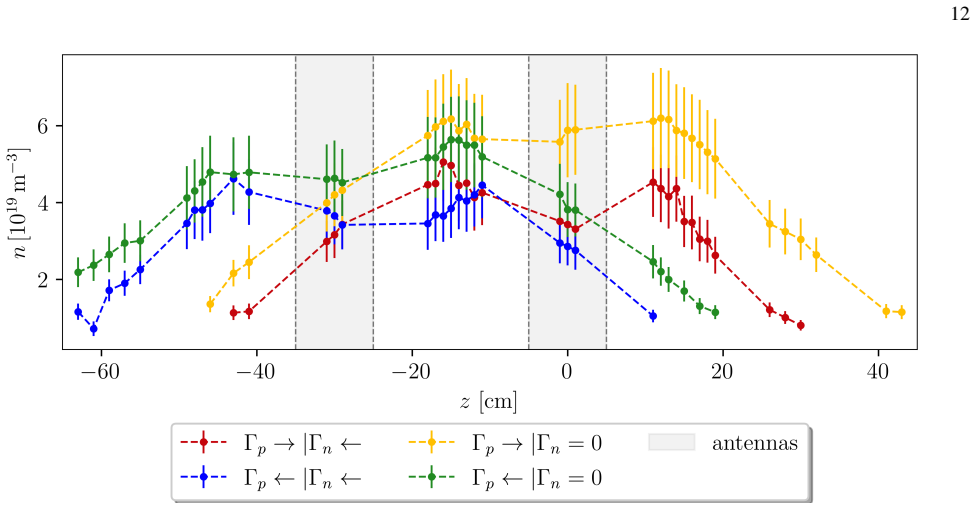
The central claim is that, in a two-antenna helicon plasma, configurations with no background neutral flow produce a much more flattened and denser axial density profile than configurations with flow in either direction, and that this is a consequence of the axial momentum balance. The evidence is Table I: standard deviation 5% (no flow) versus 11% (flow), maximum deviation 8–12% versus 17–21%, with the no-flow plasma also roughly 50% denser. The paper shows that single-antenna density profiles superpose nearly linearly when a second antenna is added, so the homogeneity gain is not an artifact of a single-antenna profile shape but of how flow changes the coupled two-antenna system. Momentum budget analysis identifies ion–neutral friction, $- u_{\mathrm{in}}\, n m_i (v_{i,z} - v_{n,z})$, as the dominant axial momentum sink; the relative ion–neutral velocity crosses zero at a measurable position, and in the no-flow case that crossing lies further downstream, so ions retain forward momentum past the density peak, flattening the profile. The paper recommends the no-flow fueling scheme for accelerator use, with higher neutral pressure before changing injection geometry and active distributed fueling along the axis for accelerator-length plasmas.
Load-bearing premise
The load-bearing premise is that the 'no-flow' configuration truly has zero background neutral velocity, but that velocity is calculated from device parameters rather than measured, and the paper itself notes neutral depletion will alter the true profile; a residual flow would compromise the attribution of the homogeneity gain and the momentum-balance mechanism built on the friction zero-crossing, which for the flow configurations sits in a diagnostic blind spot between z = 5 and 10 cm.
Editorial extensions
If this is right
- Removing background neutral flow in a multi-antenna helicon improves axial homogeneity by about a factor of two by both metrics (5% vs 11% standard, 8–12% vs 17–21% maximum) and raises density by roughly 50%.
- Single-antenna density profiles add nearly linearly in two-antenna operation, so antenna spacing can be chosen from single-antenna measurements to minimize inter-antenna ripple; the measured deviations track the predicted curves.
- Ion–neutral friction, not radial transport or the ionization source itself, is what the neutral flow configuration modifies; the friction zero-crossing position is the control point for profile shaping.
- For accelerator-length plasmas, end-to-end neutral flow is impractical — friction would stop neutrals after a few antennas — so distributed gas injection along the tube is the recommended fueling architecture, with neutral pressure as the second control.
- The best achieved 5% deviation means the 0.25% uniformity requirement is still 20 times away; the paper frames distributed fueling, RF power, antenna spacing, and magnetic field strength as the tuning knobs that could close the gap.
Reading between the lines
- If linear superposition of single-antenna profiles holds at higher power and density, then the homogeneity of an arbitrary antenna array could be optimized computationally from a single prototype antenna's measured profiles, before any multi-antenna hardware is built.
- The momentum-balance picture suggests a testable control law: actively adjusting local gas injection should move the friction zero-crossing and thereby shape the axial density profile in real time, offering feedback control of uniformity rather than only static optimization.
- Since radial recycling supplies about 90% of the fueling, chamber wall and pumping details (recycling coefficient, wall temperature, tube cleanliness) may matter as much as gas injection geometry for the next factor-of-two steps toward 0.25% homogeneity.
- The direction of residual flow, not the existence of flow, is what the no-flow result points to; a direct neutral-velocity measurement could determine whether the relevant control variable is truly zero flow or merely low relative ion–neutral speed.
Signed reviews
Editorial analysis
A structured set of objections, weighed in public.
Referee Report
Summary. The manuscript reports an experimental optimization study on the MAP helicon device aimed at improving axial density homogeneity for potential wakefield accelerator applications such as AWAKE. The authors compare one-antenna and two-antenna helicon plasmas under three background neutral flow configurations: antiparallel, parallel, and no flow. They find that with a single antenna the background neutral flow has little effect on the density and ionization source rate, whereas with two antennas the no-flow configuration yields a factor-of-two improvement in axial homogeneity (5% standard deviation vs. 11%) and a higher absolute density. The paper attributes this improvement to a momentum-balance mechanism in which ion-neutral friction, governed by the relative ion-neutral velocity, is the dominant momentum loss channel. The authors also demonstrate that two-antenna density profiles are approximately a linear superposition of single-antenna profiles, and use this to predict homogeneity as a function of antenna spacing. They conclude by recommending no-flow gas injection and distributed axial fueling for future wakefield-oriented helicon sources.
Significance. If the main claims hold, the paper provides a concrete, experimentally grounded design recommendation for helicon plasma sources intended for wakefield accelerators: avoid a directed background neutral flow and instead use distributed, low-flow fueling. The strengths of the work include direct LIF measurements of ion density, velocity, and ionization source rate profiles; an explicit test of the linear-superposition assumption against independent single-antenna data; and an internally consistent comparison of homogeneity metrics in Table I. The paper is honest about the remaining gap to the AWAKE 0.25% requirement, noting that the achieved 5% deviation is still a factor of 20 away. The main limitation is that the causal mechanism rests on an estimated, not measured, neutral velocity, and the key homogeneity metrics are quoted without uncertainty. These issues affect the strength of the physical interpretation but not the raw empirical comparison.
major comments (3)
- [Section IV, Fig. 8 and Eq. (9)] The central causal claim that the homogeneity improvement in the no-flow configuration is due to the absence of background neutral flow relies on the assumption that the neutral velocity is exactly zero in that configuration. However, the manuscript states that the neutral velocity is 'calculated from known device parameters' and concedes that 'the true neutral velocity profile will be influenced by neutral depletion and interactions with the plasma.' In the no-flow case the neutral velocity is not measured at all. Because Eq. (9) and the subsequent discussion hinge on the zero-crossing of (vi,z - vn,z), a residual or plasma-induced neutral flow would shift the zero-crossing and alter the frictional momentum source term. The authors should either provide a direct measurement of the neutral velocity profile, or an independent estimate of the residual neutral flow magnitude, or explicitly re-frame the conclusion as an empirical observation without the momentum-balance mechanism as the causal explanation.
- [Table I and Figures 14/17] The factor-of-two homogeneity improvement is presented as the central quantitative result, but the standard and maximum deviations in Table I are quoted without propagated uncertainties. The text reports that the LIF density uncertainty is 'typically about 20%' (Section IV), and Figure 14 shows typical uncertainties only for one trace. If the 20% uncertainty is point-to-point random noise, the 5% versus 11% standard-deviation difference may not be statistically robust; if the uncertainty is a correlated calibration error, it may cancel in relative deviations, but this needs to be stated explicitly. The authors should report the uncertainty on the deviation metrics, for example by propagating the density uncertainties through the standard-deviation calculation or by showing reproducibility across repeated profiles for each configuration.
- [Section IV, Eq. (9)] The momentum-balance calculation uses specific numerical values for the ion-neutral collision frequency (nu_in = 500 kHz) and the cross-field diffusion coefficient (D_perp = 3.5 m^2/s) without providing a derivation, citation, or sensitivity analysis. These values enter directly into the frictional term that is identified as the dominant momentum loss channel. The authors should justify these choices and, ideally, show how the qualitative conclusions change within a plausible range of these parameters. Without this, the statement that ion-neutral friction is the dominant loss mechanism is not fully supported by the presented analysis.
minor comments (4)
- [Section V, Fig. 15 caption and text] In the text describing Figure 15, the density peak is given as 'n = 4.6 m^-3'; the exponent is missing and should read approximately 4.6 x 10^19 m^-3.
- [Section V, Fig. 15 caption] The caption ends with 'as in Figures 15 and 13', which appears to be a self-referential typo; it should refer to Figures 12 and 13, or to the relevant density superposition figure.
- [Section V, Fig. 12] The agreement between the measured two-antenna profile and the linear superposition prediction is described qualitatively as 'suggesting' superposition. A quantitative measure, such as the maximum relative difference or a chi-squared value over the region between the antennas, would strengthen this point.
- [Abstract and throughout] The abbreviation 'AW AKE' is written with a space in the abstract and several places in the text; it should be 'AWAKE' for consistency.
Circularity Check
No significant circularity: the central claims are measured comparisons and independent superposition tests, with self-citations only for diagnostic calibration and method.
full rationale
The central results—density profiles, ionization source rates, and the Table I homogeneity deviations—are direct LIF/interferometer measurements, not outputs of a fitted model. The linear-superposition prediction in Section V is constructed from single-antenna measured profiles and then compared with an independent two-antenna measurement, so it is a genuine test rather than an input renamed as prediction. The momentum-balance analysis in Section IV uses Eq. (9) with measured ion velocities and an estimated neutral velocity; while the neutral velocity is acknowledged to be uncertain ('The neutral velocity is calculated from known device parameters. The true neutral velocity profile will be influenced by neutral depletion and interactions with the plasma'), this is a stated assumption/limitation, not a circular reduction: the density flattening in the no-flow configuration is measured, and the momentum-balance discussion is presented as a candidate mechanism, not as the source of the measured values. Self-citations (Refs. 7–15) provide diagnostic calibration, ionization-source-rate methodology, and launch-direction physics; Eq. (1) is calibrated against interferometer and Langmuir-probe data, and the directionality result in Ref. 8 is externally testable, so these citations are independent support rather than load-bearing circularity. No fitted parameter is renamed as a prediction, no uniqueness theorem is imported from the authors, and no ansatz is smuggled in via citation. The paper's caveat about neutral velocity is a correctness risk for the physical attribution, not circularity.
Assumptions & free parameters
free parameters (4)
- LIF density scaling coefficients =
1.85e18 m^-3 per (micro V s^-1)^0.3, exponent 0.3
- Ion-neutral collision frequency nu_in =
approximately 500 kHz
- Cross-field diffusion coefficient D_perp =
approximately 3.5 m^2/s
- Background neutral velocity =
estimated; shown as horizontal dotted lines in Fig. 8
assumptions (4)
- domain assumption Plasma is axisymmetric
- domain assumption Ambipolar plasma: electric field, electron temperature gradient, and ion-electron collision terms cancel in the total axial momentum balance
- domain assumption LIF density scaling law is valid at 1 kW, 3 Pa, and electron temperatures below 6 eV
- domain assumption Linear superposition of single-antenna density profiles predicts two-antenna profiles
Cite this review
Pith. "Pith review of Density and Particle Sourcing Optimization in a Helicon Plasma Source Prototype For Wakefield Accelerator Applications." pith.science (2026). https://pith.science/paper/UG3DA4NL
@misc{pith2026250812929,
  author       = {Pith},
  title        = {Pith review of: Density and Particle Sourcing Optimization in a Helicon Plasma Source Prototype For Wakefield Accelerator Applications},
  year         = {2026},
  howpublished = {\url{https://pith.science/paper/UG3DA4NL}},
  note         = {Machine review of arXiv:2508.12929}
}
read the original abstract
Helicon plasmas are being considered as plasma sources for wakefield accelerators, subject to strict density requirements. We present various mechanisms to increase axial density homogeneity in a helicon plasma for implementation in such an accelerator. We consider various background neutral flow configurations for helicons generated with first one antenna and then two identical antennas in a 2 meter long, 52 mm diameter plasma chamber with homogeneous magnetic field. In the case of a single antenna, the ionization source rate and density profiles are not significantly influenced by the background neutral flow. The use of a second antenna expands the plasma axially along the device, and results in an increased dependence of the axial density profile on the background neutral flow. We find an increase in axial homogeneity by a factor of two when there is no background neutral flow compared to when there is flow in either direction relative to the plasma. The minimum axial density deviation accomplished by optimization of RF antenna and neutral flow was 5%. This is still a factor of 20 above the nominal homogeneity requirement, but means to further improve this have been established in this study.
Figures


Figures from the paper (12 more)


Reference graph
Works this paper leans on
-
[1]
author author V. Saini \ and\ author R. Ganesh ,\ title title Numerical simulation of an expanding magnetic field plasma thruster: a comparative study for argon, xenon and iodine fuel gases , \ https://doi.org/10.1017/S0022377824000801 journal journal Journal of Plasma Physics \ volume 90 ,\ pages 905900411 ( year 2024 ) NoStop
-
[2]
author author J. F. \ Tooker , author A. Nagy , author J. deGrassie , author C. Moeller , author M. Hansink , author B. Fishler , author C. Murphy , author J. Anderson ,\ and\ author H. Torreblanca ,\ title title Development of a high power helicon system for diii-d , \ https://doi.org/10.1016/j.fusengdes.2017.03.055 journal journal Fusion Engineering and...
-
[3]
Pinsker , author B
author author R. Pinsker , author B. Van Compernolle , author S. Tang , author J. Lestz , author C. Moeller , author C. Petty , author A. Dupuy , author J. Squire , author A. Garofalo , author M. Porkolab , author J. Rost , author S. Baek , author A. Nagy , author S. Chowdhury , author N. Crocker , author G. Degrandchamp , author A. McLean , author K. Gag...
-
[4]
author author C. Stollberg , author P. Guittienne , author R. Karimov , author A. Sublet , author I. Furno , author B. Vincent , author Y. Andrebe ,\ and\ author B. Buttenschön ,\ title title First thomson scattering results from awake’s helicon plasma source , \ https://doi.org/10.1088/1361-6587/ad7d36 journal journal Plasma Physics and Controlled Fusion...
-
[5]
author author P. Muggli ,\ title title Physics to plan awake run 2 , \ https://doi.org/10.1088/1742-6596/1596/1/012008 journal journal Journal of Physics: Conference Series \ volume 1596 ,\ pages 012008 ( year 2020 ) NoStop
-
[6]
author author P. Muggli , author E. Adli , author R. Apsimon , author F. Asmus , author R. Baartman , author A.-M. \ Bachmann , author M. Barros Marin , author F. Batsch , author J. Bauche , author V. K. \ Berglyd Olsen , author M. Bernardini , author B. Biskup , author E. B. \ Vinuela , author A. Boccardi , author T. Bogey , author T. Bohl , author C. Br...
-
[7]
author author M. Granetzny , author B. Elward , author M. Zepp , author M. Loughan ,\ and\ author O. Schmitz ,\ title title Exploration of helicon plasmas for wakefield accelerators at the madison awake prototype , \ https://doi.org/10.48550/arXiv.2502.15085 journal journal Under review, arxiv preprint 2502.15085 \ ( year 2025 ),\ 10.48550/arXiv.2502.15085 NoStop
-
[8]
author author M. Granetzny , author O. Schmitz ,\ and\ author M. Zepp ,\ title title Preference of right-handed whistler modes and helicon discharge directionality due to plasma density gradients , \ https://doi.org/10.1063/5.0173918 journal journal Physics of Plasmas \ volume 30 ,\ pages 120701 ( year 2023 ) NoStop
Show all 21 references
-
[9]
Zepp , author M
author author M. Zepp , author M. Granetzny ,\ and\ author O. Schmitz ,\ title title Direct measurement of the 2d axisymmetric ionization source rate in a helicon plasma for wakefield particle accelerator applications , \ https://doi.org/10.1063/5.0211109 journal journal Physi...
-
[10]
Granetzny , author B
author author M. Granetzny , author B. Elward ,\ and\ author O. Schmitz ,\ title title An Innovative Heterodyne Microwave Interferometer for Plasma Density Measurements on the Madison AWAKE Prototype , \ https://doi.org/10.48550/arXiv.2503.11009 journal journal Submitted for p...
-
[11]
Green , author O
author author J. Green , author O. Schmitz , author G. Severn ,\ and\ author V. Winters ,\ title title Exploiting zeeman effect symmetries to measure particle velocities in magnetized plasmas , \ https://doi.org/10.1088/1361-6501/ab0e90 journal journal Measurement Science and ...
-
[12]
Green , author O
author author J. Green , author O. Schmitz ,\ and\ author M. Zepp ,\ title title Direct measurement of the ionization source rate and closure of the particle balance in a helicon plasma using laser induced fluorescence , \ https://doi.org/10.1063/1.5129232 journal journal Phys...
-
[13]
Green \ and\ author O
author author J. Green \ and\ author O. Schmitz ,\ title title Construction of a linear plasma device for studying helicon plasmas relevant to plasma-wakefield accelerators , \ https://doi.org/10.1088/1361-6595/ab7852 journal journal Plasma Sources Science and Technology \ vol...
-
[14]
author author G. D. \ Severn , author D. A. \ Edrich ,\ and\ author R. McWilliams ,\ title title Argon ion laser-induced fluorescence with diode lasers , \ https://doi.org/10.1063/1.1148472 journal journal Review of Scientific Instruments \ volume 69 ,\ pages 10–15 ( year 1998...
-
[15]
Zepp ,\ title Ionization and Density Studies in a Helicon Plasma for Wakefield Accelerator Applications ,\ https://digital.library.wisc.edu/1711.dl/PTEF5YPJXZVTP9C type Ph.d
author author M. Zepp ,\ title Ionization and Density Studies in a Helicon Plasma for Wakefield Accelerator Applications ,\ https://digital.library.wisc.edu/1711.dl/PTEF5YPJXZVTP9C type Ph.d. ,\ school The University of Wisconsin--Madison ( year 2024 ) NoStop
2024
-
[16]
Sun , author C
author author X. Sun , author C. Biloiu , author R. Hardin ,\ and\ author E. E. \ Scime ,\ title title Parallel velocity and temperature of argon ions in an expanding, helicon source driven plasma , \ https://doi.org/10.1088/0963-0252/13/3/001 journal journal Plasma Sources Sc...
-
[17]
author author P. C. \ Stangeby ,\ @noop title The plasma boundary of magnetic fusion devices ,\ Plasma physics series\ ( publisher Institute of Physics Pub ,\ address Bristol; Philadelphia ,\ year 2000 ) NoStop
2000
-
[18]
Gilland , author R
author author J. Gilland , author R. Breun ,\ and\ author N. Hershkowitz ,\ title title Neutral pumping in a helicon discharge , \ https://doi.org/10.1088/0963-0252/7/3/020 journal journal Plasma Sources Science and Technology \ volume 7 ,\ pages 416–422 ( year 1998 ) NoStop
-
[19]
Fruchtman , author G
author author A. Fruchtman , author G. Makrinich , author P. Chabert ,\ and\ author J. Rax ,\ title title Enhanced plasma transport due to neutral depletion , \ https://doi.org/10.1103/PhysRevLett.95.115002 journal journal Physical review letters \ volume 95 ,\ pages 115002 ( ...
-
[20]
author author R. M. \ Magee , author M. E. \ Galante , author J. Carr , author G. Lusk , author D. W. \ McCarren ,\ and\ author E. E. \ Scime ,\ title title Neutral depletion and the helicon density limit , \ https://doi.org/10.1063/1.4849376 journal journal Physics of Plasmas...
-
[21]
author author D. D. \ Blackwell , author T. G. \ Madziwa , author D. Arnush ,\ and\ author F. F. \ Chen ,\ title title Evidence for trivelpiece-gould modes in a helicon discharge , \ https://doi.org/10.1103/PhysRevLett.88.145002 journal journal Physical Review Letters \ volume...
Reviewed August 15, 2026 · model on record in the stance chip above.
Discussion (0). Continue with ORCID to comment.