REVIEW 2 major objections 3 minor 24 references
Dehn surgery functions are never injective
T0 review · 2 major / 3 minor · reviewed 2026-08-15 · deepseek-v4-flash
Pith's one-line read For every rational slope, two distinct knots share the same Dehn surgery.
desk verdict Gordon's conjecture is almost certainly proved; the construction is sound enough for a serious referee despite a sketchy Proposition 2.8. read the letter →
The pith
A machine-rendered reading of the paper's core claim, the machinery that carries it, and where it could break.
The reading
What carries the argument
The load-bearing machinery is the dual-knot calculus inside Dehn surgery. In a $p/q$-surgery on a knot $K$, the core of the attached solid torus becomes a knot $K^*$ in the surgered manifold, and undoing the surgery by surgering along $K^*$ recovers $S^3$; after isotoping out of the solid torus, $K^*$ is the cable $C_{r,s}(K)$ for integers $r,s$ with $ps-qr=1$. Iterating once gives a double dual $K^{**}$, an iterated cable, and the paper arranges the gluing data so that the surgeries along $(K,K^*)$ and along $(K^*,K^{**})$ each cancel. This produces the initial RBG link, in which the third component becomes a knot with framing $p/q$. A band sum with a Whitehead-double satellite pattern breaks the symmetry between the two resulting knots while preserving the algebraic linking that fixes the slope; the explicit descriptions $K_B=[P'_B]$ and $K_G=[P'_G]$ then make the HOMFLYPT computation tractable.
What would settle it
Take the construction for a specific slope with $p>1$, such as $p/q=2/1$, compute the zeroth HOMFLYPT coefficient polynomials of the two explicit knots from their band-sum diagrams, and check whether the difference of the two polynomials is identically zero; if it is, the distinction argument would fail. A more direct check is to trace the band-sum modification and verify that the framed red-blue and red-green sub-surgeries of the modified link each still cancel to $S^3$; if either cancellation fails for some choice of parameters, the RBG premise is false.
Extended reading notes
Core claim
For a fixed rational slope $p/q$, the authors build a modified RBG link—a three-component framed link whose red-blue and red-green pairs each cancel to $S^3$ under surgery—and read off from it two knots, $K_B$ and $K_G$. The RBG structure gives explicit homeomorphisms showing $S^3_{K_B}(p/q)$ is orientation-preservingly homeomorphic to $S^3_{K_G}(p/q)$. The two knots come from band-summing the blue and green components with two asymmetric iterated Whitehead-double satellite patterns, $P_B$ and $P_G$, related by a component-exchanging isotopy. For $|p|>1$, the knots are shown to be non-isotopic because their zeroth HOMFLYPT coefficient polynomials differ: the difference reduces to a product of factors involving the coefficient polynomial of an iterated torus cable, and that polynomial is not a unit when the cable is a positive braid knot—a knot that closes a braid with all crossings in the same direction. Together with the known cases $|p|\le 1$, this proves the theorem for every rational slope.
Load-bearing premise
The whole argument depends on the claim that adding a small satellite band to one component of the link does not change the way the other two components cancel each other out to recover the 3-sphere, even though their relative geometry is altered.
Editorial extensions
If this is right
- For every rational slope $p/q$, the surgery function from knots to closed oriented 3-manifolds has no injective fibres: at least two distinct knots produce the same $p/q$-surgery manifold.
- The 1978 conjecture that this map on knots is neither surjective nor injective is now fully settled, because non-surjectivity was already known.
- The construction yields explicit pairs of knots for every slope, described as band sums of unknots with twisted Whitehead-double satellite patterns around iterated cables, so the pairs can be diagrammed and used in further examples.
- For each knot in such a pair, the slope $p/q$ is a non-characterising slope, meaning knowledge of that surgery manifold does not determine the knot.
- The construction can produce non-integer non-characterising slopes, in contrast with earlier families that mainly produced integer examples.
Reading between the lines
- A natural test is to run the same skein-tree calculation on higher HOMFLYPT coefficient polynomials; if those also separate $K_B$ and $K_G$, the proof could be adapted to cover $|p|\le 1$ without relying on earlier constructions.
- Because the satellite patterns have winding number zero, the template may be adaptable to produce pairs of knots sharing a surgery that also have controlled genus or concordance properties, which would further clarify how non-unique surgery descriptions can be.
- The distinction argument depends on the positivity of HOMFLYPT polynomials for positive braid knots, so the proof as written applies when the iterated cable can be arranged to be a positive braid; extending the template to other slopes would require a separate invariant.
- One could test whether the two knots in a constructed pair are also distinguished by invariants such as the Alexander polynomial or knot Floer homology, which the paper does not compute.
Signed reviews
Editorial analysis
A structured set of objections, weighed in public.
Referee Report
Summary. The paper proves that for every rational number p/q, there exist distinct knots K and K' in S^3 whose p/q-surgeries are orientation-preservingly homeomorphic, confirming a 1978 conjecture of Gordon. The construction uses a modified RBG link framework: starting from an RBG link of unknot, cable, and double-cable, the authors perform a band sum with a satellite pattern to break symmetry, obtaining two knots K_B and K_G that share a p/q-surgery. Distinctness is established by comparing the zeroth coefficient polynomials of the HOMFLYPT polynomial, using skein and linking trees to express the difference as a product of non-zero factors.
Significance. This is a landmark result in 3-manifold topology: it completes Gordon's program on the injectivity of Dehn surgery functions and shows that no rational slope is characterising for all knots. The construction is genuinely new in its use of dual and double dual knots to control the rational slope, and the paper provides explicit, parametric families of knots. The HOMFLYPT calculations are carefully structured, and Lemma 3.10's factorisation is a particularly clean way to avoid computing the full polynomials. The paper also makes good use of existing results (Ito's positivity theorem, Van Buskirk's lemma) without fitting any constants to data. If the framing issue discussed below is resolved, this will be an elegant and definitive contribution.
major comments (2)
- [§2.3.2 (Proposition 2.8)] The proof that the modified link L remains an RBG link with common slope p/q is not sufficiently justified. The assertion that "we have not disturbed the red and blue (nor red and green) sublinking types or framings" is ambiguous and does not by itself demonstrate that the band-summed component B retains its p/q framing in the second description of Figure 4, nor that the induced framings on the knots K_B and K_G are p/q. Algebraic linking numbers are unchanged by the band sum, but a framing can change by full twists without changing linking numbers; the proof must track the longitude/framing curves of B and G through the band sum and the isotopy, or otherwise show that the common slope remains p/q. Proposition 2.10 tracks the images of the meridians µ_B and µ_G and the twistings of the satellite patterns, but it never tracks the longitudes/framings of B and G, so it does not fill this gap. This point is load-bearing: if the induced framing on bB is p/q + k for some nonzero integer k, then the pair (R,B) may not cancel to S^3, or the knots K_B and K_G may share slope p/q + k rather than p/q, and Theorem 1 would not follow.
- [§3.4 (Lemma 3.11 and its use)] Lemma 3.11 shows that C(R) can be chosen to be a positive braid knot, but Proposition 3.12 requires a non-trivial positive braid knot to conclude that Γ_C(R) is not a unit. The proof of Theorem 1 states that "C(R) can be chosen to be a positive braid knot and thus its zeroth coefficient polynomial Γ_C(R) is not a unit," which does not follow without excluding the case where C(R) is the unknot. The authors should either prove that for every p/q with |p|>1 there exists a choice of (r,s) for which C(R) is a non-trivial positive braid knot, or handle separately the slopes for which all admissible choices give a trivial C(R). As written, the distinguishing argument may fail for slopes where C(R) is necessarily trivial.
minor comments (3)
- [§2.3 (RBG links)] The definition of an RBG link is informal: the phrase "and perhaps satisfying additional technical conditions" leaves the precise requirements unclear. Since the paper relies on this framework, a precise definition with the exact conditions used in §2.3.2 would improve readability and verifiability.
- [§3.2 (Notation)] In the paragraph before the skein-tree lemmas, the text reads "we will write C(R) = C_{t,q}(T_{r,s}) and C(R) = C_{t,q}(T_{r,s})"; the second expression appears to be a typo, presumably meant to denote the reverse of C(R). Please correct this to avoid confusion.
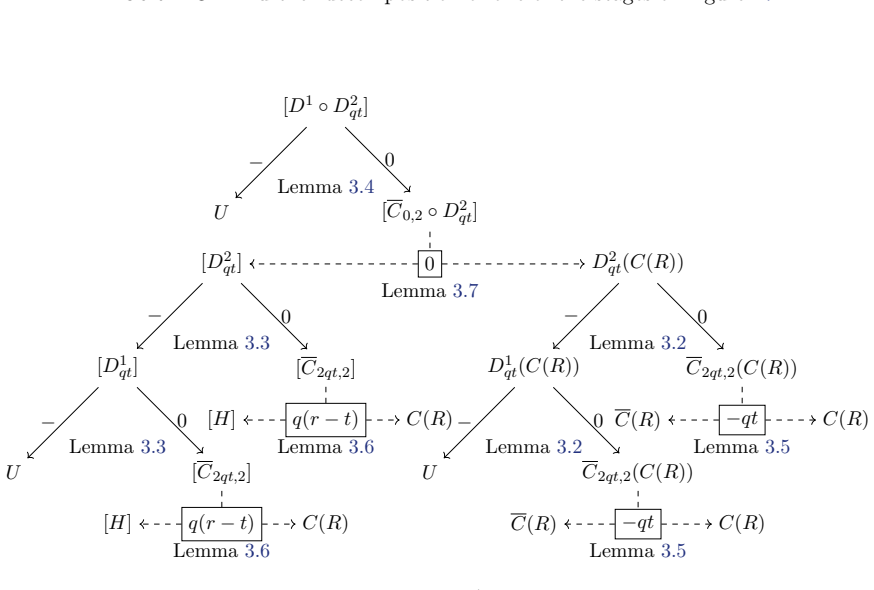
- [§3.3 (Proposition 3.9)] The proof of Proposition 3.9 is left almost entirely to the reader. Given the complexity of the skein/linking tree in Figure 20, a brief outline of the key algebraic steps or a statement that the computation mirrors Proposition 3.8 step-by-step would be helpful.
Circularity Check
No significant circularity: the construction is self-contained and the shared-slope claim is proved from explicit dual-cable lemmas rather than imported from the cited RBG framework.
full rationale
The paper's central claim is established by an explicit construction: the knots KB and KG are defined from a modified RBG link, and the shared p/q-surgery is verified by tracking the relevant gluing maps and framings through Lemmas 2.3, 2.4, 2.5, and Proposition 2.7. Proposition 2.8 then asserts that the band-sum modification preserves the RBG conditions because the red-blue and red-green sublinking types and framings are unchanged; this is a geometric preservation claim, not a restatement of the theorem. The later HOMFLYPT computation uses standard skein relations, Proposition 3.1 for the zeroth coefficient polynomial, and the external positivity result of Ito [Ito22] together with Van Buskirk's lemma [VB85]. These are independent mathematical inputs that do not assume the target theorem. The citation to [Pic19] for the RBG construction is contextual and not load-bearing: the needed cancellation homeomorphisms and framing computations are proved in the paper itself. There are no fitted parameters, no data subset from which a prediction is extracted, and no uniqueness theorem imported from the same authors to force the choice. The terseness of Proposition 2.8's preservation argument is a potential correctness concern, but it is not a circularity: even if the argument were incomplete, the claimed reduction would not be equivalent by definition to its inputs.
Assumptions & free parameters
assumptions (4)
- domain assumption For a positive braid link, the normalized HOMFLYPT polynomial has non-negative coefficients.
- domain assumption Every non-trivial positive braid knot admits a skein triple consisting of positive braid links.
- standard math Standard properties of the HOMFLYPT zeroth coefficient polynomial, including the skein relation and the product formula for link components.
- domain assumption Injectivity of the p/q-surgery function is equivalent to injectivity of the -p/q-surgery function.
Cite this review
Pith. "Pith review of Dehn surgery functions are never injective." pith.science (2026). https://pith.science/paper/RZMH6YJO
@misc{pith2026250813369,
  author       = {Pith},
  title        = {Pith review of: Dehn surgery functions are never injective},
  year         = {2026},
  howpublished = {\url{https://pith.science/paper/RZMH6YJO}},
  note         = {Machine review of arXiv:2508.13369}
}
abstract
We prove that, for each fixed rational number $p/q \in \mathbb{Q}$, there exists a pair of distinct knots whose $p/q$-surgeries are orientation-preservingly homeomorphic. This confirms a 1978 conjecture of Gordon.
Figures


Figures from the paper (17 more)



Reference graph
Works this paper leans on
-
[1]
Selman Akbulut, On 2-dimensional homology classes of 4-manifolds, Math. Proc. Camb. Philos. Soc. 82 (1977), 99--106 (English)
work page 1977
-
[2]
, An exotic 4 -manifold , J. Differential Geom. 33 (1991), no. 2, 357--361. 1094460
work page 1991
-
[3]
Knot Theory Ramifications 2 (1993), no
, Knots and exotic smooth structures on 4-manifolds, J. Knot Theory Ramifications 2 (1993), no. 1, 1--10 (English)
work page 1993
-
[4]
Kenneth Baker and Kimihiko Motegi, Non-characterizing slopes for hyperbolic knots, Algebr. Geom. Topol. 18 (2018), no. 3, 1461–1480
work page 2018
-
[5]
W. R. Brakes, Manifolds with multiple knot-surgery descriptions, Math. Proc. Cambridge Philos. Soc. 87 (1980), no. 3, 443--448. 556924
work page 1980
-
[6]
C. McA. Gordon and J. Luecke, Knots are determined by their complements, J. Am. Math. Soc. 2 (1989), no. 2, 371--415 (English)
work page 1989
-
[7]
Gompf and Katura Miyazaki, Some well-disguised ribbon knots, Topology Appl
Robert E. Gompf and Katura Miyazaki, Some well-disguised ribbon knots, Topology Appl. 64 (1995), no. 2, 117--131. 1340864
work page 1995
-
[8]
C. McA. Gordon, Some aspects of classical knot theory, Knot theory ( P roc. S em., P lans-sur- B ex, 1977), Lecture Notes in Math., vol. 685, Springer, Berlin-New York, 1978, pp. 1--60. 521730
work page 1977
Show all 24 references
-
[9]
Tetsuya Ito, A note on HOMFLY polynomial of positive braid links , Internat. J. Math. 33 (2022), no. 4, Paper No. 2250031, 18. 4402791
2022
-
[10]
Dedicata 61 (1996), no
Akio Kawauchi, Mutative hyperbolic homology 3 -spheres with the same F loer homology , Geom. Dedicata 61 (1996), no. 2, 205--217. 1397803
1996
-
[11]
Kronheimer, T
P. Kronheimer, T. Mrowka, P. Ozsv\' a th, and Z. Szab\' o , Monopoles and lens space surgeries, Ann. of Math. (2) 165 (2007), no. 2, 457--546. 2299739
2007
-
[12]
Marc Lackenby, Every knot has characterising slopes, Math. Ann. 374 (2019), no. 1-2, 429--446. 3961316
2019
-
[13]
W. B. R. Lickorish, A representation of orientable combinatorial 3-manifolds, Ann. Math. (2) 76 (1962), 531--540 (English)
1962
-
[14]
, Surgery on knots, Proc. Am. Math. Soc. 60 (1977), 296--298 (English)
1977
-
[15]
3, 937--950
Duncan McCoy, Characterizing slopes for the (-2,3,7) -pretzel knot, Canadian Mathematical Bulletin 66 (2023), no. 3, 937--950
2023
-
[16]
Symplectic Geom
Peter Ozsv\' a th and Zolt\' a n Szab\' o , The D ehn surgery characterization of the trefoil and the figure eight knot , J. Symplectic Geom. 17 (2019), no. 1, 251--265. 3956375
2019
-
[17]
Osoinach, Jr., Manifolds obtained by surgery on an infinite number of knots in S ^3 , Topology 45 (2006), no
John K. Osoinach, Jr., Manifolds obtained by surgery on an infinite number of knots in S ^3 , Topology 45 (2006), no. 4, 725--733. 2236375
2006
-
[18]
5, 2665--2684
Lisa Piccirillo, Shake genus and slice genus, Geometry & Topology 23 (2019), no. 5, 2665--2684
2019
-
[19]
Thurston, The geometry and topology of three-manifolds, 1978, Princeton University Lecture Notes
William P. Thurston, The geometry and topology of three-manifolds, 1978, Princeton University Lecture Notes
1978
-
[20]
3, 357--381
, Three-dimensional manifolds, K leinian groups and hyperbolic geometry , Bulletin of the American Mathematical Society (N.S.) 6 (1982), no. 3, 357--381
1982
-
[21]
Van Buskirk, Positive knots have positive C onway polynomials , Knot Theory and Manifolds (Berlin, Heidelberg) (Dale Rolfsen, ed.), Springer Berlin Heidelberg, 1985, pp
James M. Van Buskirk, Positive knots have positive C onway polynomials , Knot Theory and Manifolds (Berlin, Heidelberg) (Dale Rolfsen, ed.), Springer Berlin Heidelberg, 1985, pp. 146--159
1985
-
[22]
Laura Wakelin, Characterising slopes for hyperbolic knots and W hitehead doubles , Algebr. Geom. Topol. (to appear); arXiv:2304.04349 (2023)
2023
-
[23]
A. H. Wallace, Modifications and cobounding manifolds. I , II , Can. J. Math. 12 (1961), 503--528 (English)
1961
-
[24]
Kouchi Yasui, Corks, exotic 4-manifolds and knot concordance, J. Diff. Geom. (to appear); arXiv:1505.02551 (2015)
2015 arXiv
Reviewed August 15, 2026 · model on record in the stance chip above.
Discussion (0). Continue with ORCID to comment.