REVIEW 3 major objections 3 minor 9 references
Volumes of end-periodic mapping tori
T0 review · 3 major / 3 minor · reviewed 2026-08-05 · deepseek-v4-flash
Pith's one-line read The volume of an end-periodic mapping torus is controlled, up to constants, by how fast the map translates on the pants graph.
desk verdict A clear, well-illustrated survey of the authors' own volume bounds for end-periodic mapping tori; no new theorems, but a useful entry point that deserves a serious referee. read the letter →
The pith
A machine-rendered reading of the paper's core claim, the machinery that carries it, and where it could break.
The reading
What carries the argument
The compactified mapping torus Mbar_f is built by adding the f-invariant escaping neighborhoods U+ and U- as boundary surfaces to the infinite cyclic cover of the mapping torus and then quotienting. Its role is to turn an infinite-type surface mapping torus into a compact 3-manifold with boundary; strong irreducibility makes it acylindrical, so it carries a unique convex hyperbolic metric with totally geodesic boundary, and volume is measured in that metric. The volume-to-dynamics comparison is carried by two auxiliary devices: the capacity, defined as the pair (core characteristic, end complexity) that replaces finite-type Euler characteristic, and well-pleated surfaces, which produce bound
What would settle it
Take one of the explicit strongly irreducible end-periodic homeomorphisms built in the paper's Section 3.3, compute the exact hyperbolic volume of its compactified mapping torus by triangulating the drilled model, and compare it with Voct·τ(f) and c2·τ(f). A single such map with volume outside those bounds would falsify Theorem 4.1; matching the bounds across a family would corroborate it.
Extended reading notes
Core claim
The central object is the compactified mapping torus Mbar_f of an end-periodic homeomorphism f of an infinite-type surface. The theorem presented states that when f is strongly irreducible, the hyperbolic volume of Mbar_f is at most Voct·τ(f), where Voct is the volume of a regular ideal octahedron and τ(f) is the asymptotic translation length of f on the pants graph, and at least c2·τ(f), where c2 is a constant depending only on the capacity of f. This is put forward as the infinite-type analogue of the classical finite-type theorem for pseudo-Anosov mapping tori. The paper sketches the two mechanisms: for the lower bound, well-pleated surfaces adapted to a minimal core supply bounded-length
Load-bearing premise
The load-bearing premise is strong irreducibility: the absence of any simple closed curve or bi-infinite line whose iterates repeat in a controlled way, because this is what makes the compactified mapping torus acylindrical and gives the unique convex hyperbolic metric whose volume the theorem measures.
Editorial extensions
If this is right
- For strongly irreducible end-periodic homeomorphisms, hyperbolic volume is coarsely determined by a purely combinatorial quantity: the pants-graph translation length.
- The lower constant depends on capacity, so the theorem does not claim a universal lower bound across all infinite-type surfaces, unlike the universal octahedral upper bound.
- Passing to positive powers f^N preserves the bounds because both volume and translation length scale linearly in N.
- The upper-bound proof produces an explicit model manifold built from pants blocks, giving a concrete combinatorial handle on the geometry of Mbar_f.
- The result resolves, in a restricted but nontrivial setting, the guiding question of how the dynamics of a surface homeomorphism predict the geometry of its mapping torus.
Reading between the lines
- I infer that the true asymptotic ratio of volume to pants-graph translation length, if it exists, should be expressible in terms of the end-periodic analogue of measured foliation data, and the octahedral upper constant hints at a universal maximal volume density per pants-graph step.
- I infer that the theorem may extend to atoroidal end-periodic homeomorphisms that are not strongly irreducible, provided the cylinders coming from periodic lines are handled separately, since the proof's obstruction is specifically acylindricity.
- I infer that the capacity-dependent lower constant is likely not sharp, and the explicit handle-shift-plus-pseudo-Anosov examples in the paper's Section 3.3 are natural test cases for computing optimal constants.
- I infer that combining this block model with pseudo-Anosov flow representatives of end-periodic maps, as mentioned in the paper's final section, could convert these volume bounds into growth-rate bounds for the flows, though that connection is not established here.
Editorial analysis
A structured set of objections, weighed in public.
Referee Report
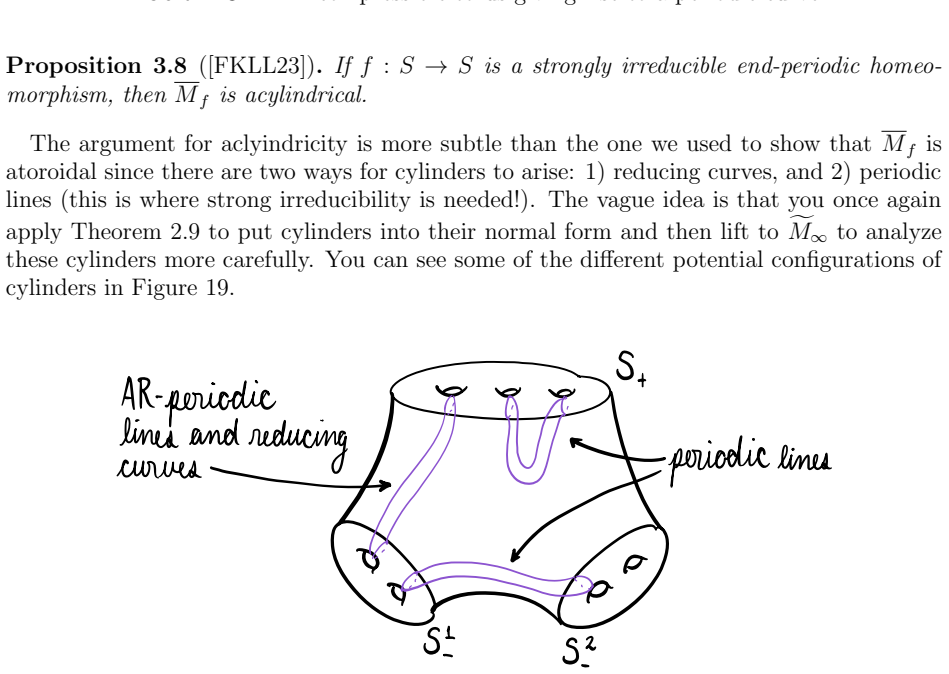
Summary. This expository paper, based on lecture notes from a 2023 minicourse, gives an intuition- and illustration-driven overview of two recent results on volumes of end-periodic mapping tori: the upper bound of Field--Kim--Leininger--Loving [FKLL23] and the lower bound of Field--Kent--Leininger--Loving [FKLL]. The central theorem, Theorem 4.1, states that for a strongly irreducible end-periodic homeomorphism f of an infinite-type surface, the volume of the compactified mapping torus M_f satisfies c2·τ(f) ≤ Vol(M_f) ≤ c1·τ(f), where c1 is the volume of a regular ideal octahedron, c2 depends only on the capacity of f, and τ(f) is the asymptotic translation length on the pants graph. The paper develops the necessary background on infinite-type surfaces, end-periodic homeomorphisms, and depth-one foliations; explains the structure of the compactified mapping torus; sketches the lower bound via well-pleated surfaces and an interpolation; and sketches the upper bound via pants-block decompositions and Dehn filling. Full proofs are deferred to the cited papers, as the Preface explicitly states.
Significance. If the cited theorems are correct, this is a valuable didactic resource: it captures the main ideas and constructions behind a nontrivial infinite-type analogue of Brock's theorem, with helpful figures and a clear explanation of why strong irreducibility (via acylindricity) and capacity play the roles they do. The exposition is honest about its limitations: the Preface states that detailed proofs are omitted and points to the original sources. I found no hidden circularity or fitted parameters; the statement of Theorem 4.1 is consistent with the cited theorems and with the internal sketch. The main weaknesses are local mathematical slips in the proof sketches, detailed below. They do not cast doubt on Theorem 4.1 itself, because that theorem is cited from [FKLL23] and [FKLL], but they should be corrected for the paper to serve its intended expository purpose.
major comments (3)
- [§4.3, Lemma 4.3] The proof sketch of Lemma 4.3 is internally inconsistent with the definition of 'minimal core' given in §4.2. Removing the annular neighborhood N_ε(∂Y) from Y yields a surface homeomorphic to Y, so |χ(Y−N_ε(∂Y))| = |χ(Y)|, not < |χ(Y)|. As written, the claimed contradiction to minimality does not follow. The intended argument may use a different notion of minimal core (e.g., inclusion-minimal) or a different measure of size; please clarify, and align the definition of χ(f) and 'minimally well-pleated' with the proof in [FKLL, Lemma 4.1].
- [§5.2, Proposition 5.2] The block volumes in Proposition 5.2 are inconsistent with the surrounding text and with Corollary 5.3. The text states that each B_S block contributes twice as much volume as a B_T block, and Corollary 5.3 computes Vol = V_oct(n_T + 2n_S). Proposition 5.2 as printed gives B_S volume V_oct and B_T volume 2V_oct, and the metric subscripts σ_BT/σ_BS are interchanged. Please correct the statement so the numerical assignments match the path-metric edge lengths.
- [§5.5, Step 2] The displayed inequality τ(f,Ω) ≤ τ(f) − ε is false under the hypothesis |τ(f)−τ(f,Ω)| < ε; the correct bound is τ(f,Ω) < τ(f)+ε. The epsilon argument for the upper bound works with the corrected sign. Please fix this before publication.
minor comments (3)
- [§4.4, Step 4] The symbol K is used both for the uniform power K ≥ 5|χ(f)| and for the Brock-type constant appearing in the final inequality of the lower-bound sketch. Rename one of these (e.g., use C for the constant) so that the statement 'where K relies only on the capacity of f' is unambiguous.
- [§5.5, Steps 1–2] The quantity τ(f,Ω) is used but never defined. Please add the definition: the asymptotic translation length of f restricted to the f-invariant component Ω of the pants graph P(S).
- [Various] Minor typos: 'psuedo-Anosov' in Theorem 2.5; 'aclyindricity' in the paragraph after Proposition 3.8; 'Handell-Miller' in Section 6. Also, the Preface's explicit statement that full proofs are omitted is appropriate and should remain.
Circularity Check
No circularity: the paper is an expository survey whose central theorem is imported from independent prior work, with no fitted parameters or definitional reductions.
full rationale
The manuscript explicitly identifies itself as an expository overview (Preface, §1) of the main theorems of [FKLL23] and [FKLL]. Theorem 4.1 is presented as the combination of those two papers' results, not derived from data or from a parameter fitted in this text. The load-bearing notions—strong irreducibility (Definition 3.4), capacity (χ(f), ξ(f)), and τ(f)—are defined independently of the volume bounds, and no equation of the paper defines one side of Theorem 4.1 in terms of the other. The sketched proofs rely on standard external theorems (Richards classification, Thurston hyperbolization, Mostow rigidity, Roussarie–Thurston normal form, Agol’s block-volume computation, Thurston’s Dehn surgery theorem) and on the cited papers for the substantive estimates (Propositions 3.7–3.8, Lemma 4.3, Claim 5.7). Self-citation is central to the survey format, but the cited works are independent mathematical results with explicit hypotheses; Brock’s theorem is invoked as an external finite-type analogue, not as an input to the bound. The Preface’s caveat that proofs are not fully reproduced here is a limitation of the survey genre, not evidence of circularity. No prediction reduces by construction to its input, so the appropriate score is 0.
Assumptions & free parameters
assumptions (6)
- standard math Roussarie-Thurston Normal Form (Theorem 2.9)
- standard math Thurston Hyperbolization Theorem (Theorem 2.4) and fibered case (Theorem 2.5)
- standard math Basmajian's tubular neighborhood theorem [Bas94]
- standard math Agol's volume computation for pants blocks [Ago03] (Proposition 5.2)
- domain assumption Strong irreducibility of end-periodic homeomorphisms (Definition 3.4)
- domain assumption Capacity (chi(f), xi(f)) is finite and well-defined
Cite this review
Pith. "Pith review of Volumes of end-periodic mapping tori." pith.science (2026). https://pith.science/paper/GICDQ6IB
@misc{pith2026250814244,
  author       = {Pith},
  title        = {Pith review of: Volumes of end-periodic mapping tori},
  year         = {2026},
  howpublished = {\url{https://pith.science/paper/GICDQ6IB}},
  note         = {Machine review of arXiv:2508.14244}
}
read the original abstract
In this expository paper, we provide an intuition and illustration-driven overview of two recent results that tie the dynamics of certain homeomorphisms of infinite-type surfaces, called end-periodic homeomorphisms, to the geometry of their associated (compactified) mapping tori. These results are analogues of a theorem of Brock in the finite-type setting for mapping tori of pseudo-Anosov homeomorphisms.
Figures


Figures from the paper (31 more)







Reference graph
Works this paper leans on
-
[3]
Examples of endperiodic automorphisms
29 [CC16] John Cantwell and Larwence Conlon. Examples of endperiodic automorphisms. Preprint, arXiv:1008.2549,
-
[1923]
[LMT] Michael Landry, Yair Minsky, and Samuel J. Taylor. Endperiodic maps via pseudo-Anosov flows. arXiv:2304.10620. [LMT23] Michael Landry, Yair Minsky, and Samuel J. Taylor. Flows, growth rates, and the veering poly- nomial. Ergodic Theory and Dynamical Systems , 43(9):3026–3107,
- [1974]
-
[1986]
Short curves of end-periodic mapping tori
[Whi] Brandis Whitfield. Short curves of end-periodic mapping tori. arXiv:2408.07044. 31
-
[1997]
A lower bound on volumes of end-periodic mapping tori
[FKLL] Elizabeth Field, Autumn Kent, Christopher Leininger, and Marissa Loving. A lower bound on volumes of end-periodic mapping tori. arXiv:math.GT/2306.03279. [FKLL23] Elizabeth Field, Heejoung Kim, Christopher Leininger, and Marissa Loving. End-periodic home- omorphisms and volumes of mapping tori. J. Topol., 16(1):57–105,
-
[2001]
Translated from the 1996 French original by Leslie D. Kay. [Par] Hugo Parlier. A shorter note on shorter pants. arXiv:2304.06973. [Ric63] Ian Richards. On the classification of noncompact surfaces. Trans. Amer. Math. Soc., 106:259–269,
work page Pith review arXiv 1996
-
[2003]
Infinite-type loxodromic isometries of the relative arc graph
[AMP21] Carolyn R. Abbott, Nicholas Miller, and Priyam Patel. Infinite-type loxodromic isometries of the relative arc graph. arXiv:math.GT/2109.06106,
- [2007]
Show all 9 references
-
[2010]
[Can96] Richard D
Reprint of the 1992 edition. [Can96] Richard D. Canary. A covering theorem for hyperbolic 3–manifolds and its applications. Topology, 35(3):751–778,
1992
Reviewed August 5, 2026 · model on record in the stance chip above.
Discussion (0). Continue with ORCID to comment.