REVIEW 4 major objections 5 minor 31 references
D$^2$-LIO: Enhanced Optimization for LiDAR-IMU Odometry Considering Directional Degeneracy
T0 review · 4 major / 5 minor · reviewed 2026-08-05 · deepseek-v4-flash
Pith's one-line read D²-LIO attacks LiDAR degeneracy from two sides: a per-point outlier threshold and a regularizer that weights weakly constrained directions by fusing IMU covariance with the scan-matching Hessian.
desk verdict The adaptive per-point threshold is a real, small win; the degeneracy-aware weighting matrix in Eq. (13) is mathematically ill-posed, and the abstract overstates what Table II actually shows. read the letter →
The pith
A machine-rendered reading of the paper's core claim, the machinery that carries it, and where it could break.
The reading
What carries the argument
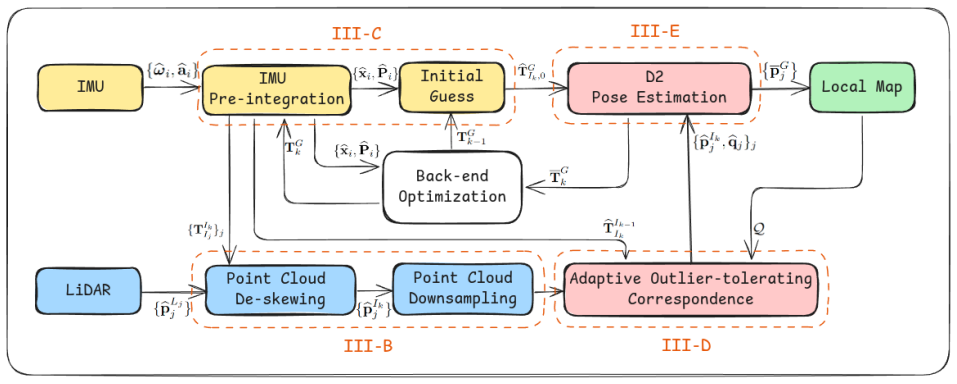
The load-bearing object is the directional regularizer (1/λ_i)||(x − x̂_k)·v_i||², summed over degenerate eigen-directions of the Hessian A^T A and written compactly as ||x − x̂_k||²_{(A^T A)^{-1}}. Replacing the bare inverse Hessian with W = (A^T A P_{T,k})^{-1} lets IMU preintegration covariance scale the pull toward the predicted pose in each weakly observable direction. The second mechanism is the per-point threshold ϵ_j = translational displacement + 2·range·sin(rotational displacement/2), which keeps the rejection rate roughly uniform across ranges and motion amplitudes.
What would settle it
Run the same pipeline on a straight corridor twice: once with W = (A^T A P_{T,k})^{-1} and once with W = (A^T A)^{-1}, while adding a slowly growing gyro bias. If the regularized version follows the biased IMU prediction and yields larger absolute trajectory error than the unregularized one, the fusion premise fails. A complementary check on the ECMD highway sequence is to zero out the IMU covariance in W; if accuracy does not worsen, the degeneracy-aware regularizer rather than the IMU covariance is doing the work.
Extended reading notes
Core claim
The paper's central claim is that directional degeneracy can be detected through eigen-decomposition of the scan-matching Hessian and countered by a regularizer that pulls the solution toward the IMU-predicted pose only along weakly constrained directions, with pull strength inversely proportional to each eigenvalue. This is implemented via the weighting matrix W = (A^T A P_{T,k})^{-1}, which fuses the geometric information in A^T A with the IMU preintegration covariance P_{T,k}, and via separate rotational and translational eigenspace analyses to handle the scale disparity between rotation and translation. The companion contribution is an adaptive per-point correspondence threshold that ext
Load-bearing premise
Everything rests on treating the product of the scan-matching Hessian and the IMU preintegration covariance as a trustworthy weight for dragging the solution toward the IMU-predicted pose in weakly constrained directions; if the IMU prediction drifts or the local Hessian misrepresents the geometry, the regularizer injects that error into the final pose.
Editorial extensions
If this is right
- In repetitive geometry such as tunnels, corridors, and highway or bridge spans, absolute trajectory error drops relative to the four compared LiDAR-inertial pipelines on the tested sequences.
- The per-point threshold transfers across front-end designs: the ablation inserts the same strategy into both a filtering-based pipeline and an optimization-based pipeline and reports gains in nearly every tested sequence.
- The benefit scales with degradation severity: mild degradation shows marginal gains, moderate degradation such as highways and bridges shows the largest improvements, and severe degradation such as flat ground remains unsolved.
- The reported eigenvalue traces imply that the regularizer raises the minimum eigenvalue of the translation Hessian during degenerate phases, giving the system a built-in real-time indicator of when the optimization has become ill-conditioned.
Reading between the lines
- Our inference: the same per-point threshold rule could be plugged into point-to-plane or GICP-style cost functions; the paper only tests point-to-point ICP, so transfer to other error metrics is untested.
- Our inference: the weight matrix W = (A^T A P_{T,k})^{-1} can be read as a Bayesian prior update if A^T A is treated as observed information and P_{T,k} as prior covariance; that reading is not in the paper, but it would turn the regularizer's strength into a principled tuning parameter and make its failure mode—trusting a drifting IMU prior—explicit.
- Our inference: a lightweight online degeneracy alarm could be built by tracking the regularized minimum eigenvalue; the paper uses the eigenvalue for post-hoc analysis, not as an online trigger.
Editorial analysis
A structured set of objections, weighed in public.
Referee Report
Summary. The manuscript proposes D²-LIO, a LiDAR-inertial odometry front-end intended for geometrically degenerate environments. Two main mechanisms are presented: (i) a per-point adaptive correspondence threshold based on the point's range and the platform's translational/rotational motion between scans (Eq. 7), and (ii) a degeneracy-aware regularizer that augments the ICP cost with a weighted quadratic penalty pulling the pose toward the IMU-preintegrated prediction, where the weight is formed by combining the scan-matching Hessian with the IMU preintegration covariance (Eqs. 13–15). The method is embedded in a modified LIO-SAM framework and evaluated on the GEODE, SubT-MRS, and ECMD datasets against FAST-LIO2, LIO-SAM, PV-LIO, and VoxelMap. The paper claims consistent improvements in accuracy and robustness in degenerate environments.
Significance. If the proposed weighting scheme were correct and the empirical claims were supported, the adaptive thresholding idea and the use of IMU covariance to regularize degenerate directions could be useful additions to LIO front-ends. The paper benchmarks on three challenging public datasets and explicitly acknowledges some residual failure modes, which is a positive feature. However, the central fusion formula is asserted rather than derived and, as written, is not a valid quadratic-form weight; the experimental record does not support the abstract's 'consistently outperforms' claim; and the lack of error bars, code, and disclosure of the key scalar weight prevents independent verification. The contribution as presented is therefore not yet established.
major comments (4)
- [§III-E.2, Eq. (13) and Eq. (14)] The central weighting matrix W=(A^T A \hat P_{T,k})^{-1} is not, in general, symmetric positive definite. For arbitrary SPD matrices A^T A and \hat P_{T,k}, the product is not symmetric unless the two matrices commute, and no commutativity assumption is stated or justified. Consequently, the expression \|e\|_W^2 in Eq. (14) does not define a valid Mahalanobis-type quadratic form. A proper probabilistic fusion would add information matrices: the posterior precision is A^T A + \hat P_{T,k}^{-1}, and the regularizer should be (x-\hat x_k)^T \hat P_{T,k}^{-1}(x-\hat x_k). As written, the paper's core 'directional degeneracy' mechanism is mathematically ill-posed, so the reported improvements cannot be attributed to the objective described.
- [Abstract and §IV-C, Table II] The abstract's claim that the method 'consistently outperforms' state-of-the-art approaches is contradicted by the paper's own Table II. D²-LIO is worse than the best baseline by large margins on GEODE Offroad-3 (0.75 m vs 0.22–0.34 m), SubT-MRS LongCorridor1 (1.65 m vs 1.08 m), and ECMD Dense street day easy a (0.71 m vs 0.34 m). No error bars, repeated runs, or statistical significance tests are provided, so even the favorable entries cannot be assessed. The text in Section IV.C also concedes that in 'severely degenerated scenarios' LiDAR-IMU fusion alone is inadequate, which further qualifies the unqualified abstract claim. Because the comparison table is the main evidence for the paper's central claim, this is a load-bearing issue.
- [§III-E.2, Eq. (14) and Algorithm 1] The scalar weight w in Eq. (14) is a free parameter, but its value and tuning procedure are not reported. Since Eq. (14) is the final objective and w balances the geometric and IMU-inertial terms, the experimental results are not reproducible without this information. The paper states that baseline parameters were kept at default values, but w is introduced by this paper and should be disclosed. A simple ablation over w would also clarify how sensitive the reported improvements are to this choice.
- [§III-E.2, Eqs. (11)–(15)] There are several derivational gaps around the regularizer. Eq. (12) is presented as a rewrite of Eq. (11), but Eq. (13) then introduces P_{T,k} multiplicatively with no derivation or probabilistic justification. The algorithm further separates the Hessian into rotational and translational blocks, using \hat P_{r,k} and \hat P_{t,k}, but the paper never explains how the full IMU pose covariance \hat P_{T,k} is decomposed into these blocks. Additionally, Eq. (15) appears to contain a typo: the translational residual term in Eq. (14) is written with W_r rather than W_t. These gaps make it impossible to reproduce the regularizer as specified.
minor comments (5)
- [§III-D, Eq. (7)] The adaptive threshold is plausible, but the notation is hard to parse: the term \hat R^{I_k}_{I_{k-1}} should be defined more explicitly as the relative rotation between the current and previous IMU frames. It would also help to state that 2\|p\| sin(θ/2) is an upper bound on the rotational displacement, and to discuss whether sensor noise or map uncertainty should enter the threshold.
- [§IV-D, Fig. 2] The figure is referenced as supporting the eigenvalue analysis, but the caption and text do not report the numerical values shown in the bottom panel. Please add axis labels, legends, and a quantitative description of the improvement.
- [§IV-A] The paper does not provide the sensor specifications, point-cloud preprocessing parameters, or the hardware used for the experiments beyond saying the platform was consistent. Given the well-known sensitivity of LIO to LiDAR range and IMU quality, adding these details would improve reproducibility.
- [General] No code, configuration files, or supplementary material are provided. Given that the method is described only through equations and a high-level algorithm, releasing an implementation or a detailed parameter list would be necessary for any future comparison.
- [Eq. (15)] As noted in the major comments, the second occurrence of W_r in Eq. (15) should almost certainly be W_t. Please fix this and check the surrounding notation for consistency.
Circularity Check
No significant circularity; core equations are geometric identities or explicit design choices, and experimental evidence is from external benchmarks.
full rationale
The paper's derivation chain is self-contained and does not reduce to its own outputs. Equation (7) defines a per-point threshold directly from a geometric motion bound (translational displacement plus range-scaled rotational displacement), not from the reported localization errors. Equations (9)-(12) use a standard eigendecomposition identity: (A^T A)^{-1} = sum_i lambda_i^{-1} v_i v_i^T, so the norm rewrite in (12) is algebraically exact. Equations (13)-(15) are an explicit, hand-specified fusion rule combining the scan Hessian and the IMU preintegration covariance; although the resulting matrix product is not symmetric and lacks a probabilistic derivation, this is a mathematical correctness/design concern rather than circularity, because the proposed weighting is not fitted to the claimed results and does not define the output in terms of itself. The paper cites no prior work by the same authors, and all experimental comparisons use external datasets (GEODE, SubT-MRS, ECMD) with standard metrics. Even the eigenvalue-elevation observation in Section IV-D is a direct consequence of adding a positive regularizer of the form 1/lambda_i along degenerate directions, so it functions as a mechanism check rather than an independent empirical prediction; it does not make the central claim circular. The acknowledged limitations and failure cases in Section IV-C further indicate that the method's improvements are not forced by construction. Overall, no load-bearing step is equivalent to its input by definition or by fitted equivalence.
Assumptions & free parameters
free parameters (3)
- Regularization scalar weight w =
unspecified (not given in paper)
- Convergence threshold epsilon =
unspecified
- Voxel grid size for downsampling =
unspecified
assumptions (5)
- domain assumption IMU frame coincides with body frame
- domain assumption Eigen-decomposition of A^T A from the linearized least squares problem indicates directional degeneracy
- ad hoc to paper Correct fusion weight is W = (A^T A P_{T,k})^{-1}
- ad hoc to paper Rotational and translational parts must be regularized separately with separate Hessians
- domain assumption Per-point threshold from Eq. (7) captures all significant mismatch sources
Cite this review
Pith. "Pith review of D$^2$-LIO: Enhanced Optimization for LiDAR-IMU Odometry Considering Directional Degeneracy." pith.science (2026). https://pith.science/paper/YZPCH5WQ
@misc{pith2026250814355,
  author       = {Pith},
  title        = {Pith review of: D$^2$-LIO: Enhanced Optimization for LiDAR-IMU Odometry Considering Directional Degeneracy},
  year         = {2026},
  howpublished = {\url{https://pith.science/paper/YZPCH5WQ}},
  note         = {Machine review of arXiv:2508.14355}
}
read the original abstract
LiDAR-inertial odometry (LIO) plays a vital role in achieving accurate localization and mapping, especially in complex environments. However, the presence of LiDAR feature degeneracy poses a major challenge to reliable state estimation. To overcome this issue, we propose an enhanced LIO framework that integrates adaptive outlier-tolerant correspondence with a scan-to-submap registration strategy. The core contribution lies in an adaptive outlier removal threshold, which dynamically adjusts based on point-to-sensor distance and the motion amplitude of platform. This mechanism improves the robustness of feature matching in varying conditions. Moreover, we introduce a flexible scan-to-submap registration method that leverages IMU data to refine pose estimation, particularly in degenerate geometric configurations. To further enhance localization accuracy, we design a novel weighting matrix that fuses IMU preintegration covariance with a degeneration metric derived from the scan-to-submap process. Extensive experiments conducted in both indoor and outdoor environments-characterized by sparse or degenerate features-demonstrate that our method consistently outperforms state-of-the-art approaches in terms of both robustness and accuracy.
Figures

Reference graph
Works this paper leans on
-
[1]
Autonomous navigation and mapping in underground mines using aerial robots,
Christos Papachristos, Shehryar Khattak, Frank Mascarich, and Kostas Alexis, “Autonomous navigation and mapping in underground mines using aerial robots,” in Proceedings of the 2019 IEEE Aerospace Conference, pp. 1–8, 2019. IEEE
work page 2019
-
[2]
LOAM: Lidar odometry and mapping in real-time,
Ji Zhang, Sanjiv Singh, and others, “LOAM: Lidar odometry and mapping in real-time,” in Proceedings of Robotics: Science and Systems, vol. 2, no. 9, pp. 1–9, 2014. Berkeley, CA
work page 2014
-
[3]
Lio-sam: Tightly-coupled lidar inertial odometry via smoothing and mapping,
Tixiao Shan, Brendan Englot, Drew Meyers, Wei Wang, Carlo Ratti, and Daniela Rus, “Lio-sam: Tightly-coupled lidar inertial odometry via smoothing and mapping,” in Proceedings of the 2020 IEEE/RSJ International Conference on Intelligent Robots and Systems (IROS) , pp. 5135–5142, 2020. IEEE
work page 2020
-
[4]
Fast-lio2: Fast direct lidar-inertial odometry,
Wei Xu, Yixi Cai, Dongjiao He, Jiarong Lin, and Fu Zhang, “Fast-lio2: Fast direct lidar-inertial odometry,” IEEE Transactions on Robotics , vol. 38, no. 4, pp. 2053–2073, 2022. IEEE
-
[5]
Efficient and probabilistic adaptive voxel mapping for accurate online LiDAR odometry,
Chongjian Yuan, Wei Xu, Xiyuan Liu, Xiaoping Hong, and Fu Zhang, “Efficient and probabilistic adaptive voxel mapping for accurate online LiDAR odometry,” IEEE Robotics and Automation Letters , vol. 7, no. 3, pp. 8518–8525, 2022. IEEE
work page 2022
-
[6]
A LiDAR-inertial odometry with principled uncertainty modeling,
Binqian Jiang and Shaojie Shen, “A LiDAR-inertial odometry with principled uncertainty modeling,” in Proceedings of the 2022 IEEE/RSJ International Conference on Intelligent Robots and Systems (IROS), pp. 13292–13299, 2022. IEEE
work page 2022
-
[7]
Present and future of SLAM in extreme environments: The DARPA SubT challenge,
Kamak Ebadi, Lukas Bernreiter, Harel Biggie, Gavin Catt, Yun Chang, Arghya Chatterjee, Christopher E. Denniston, Simon-Pierre Deschˆenes, Kyle Harlow, Shehryar Khattak, and others, “Present and future of SLAM in extreme environments: The DARPA SubT challenge,” IEEE Transactions on Robotics , vol. 40, pp. 936–959,
-
[8]
DARE-SLAM: Degeneracy-aware and re- silient loop closing in perceptually-degraded environments,
Kamak Ebadi, Matteo Palieri, Sally Wood, Curtis Padgett, and Ali- Akbar Agha-Mohammadi, “DARE-SLAM: Degeneracy-aware and re- silient loop closing in perceptually-degraded environments,” Journal of Intelligent & Robotic Systems , vol. 102, pp. 1–25, 2021. Springer
work page 2021
Show all 31 references
-
[9]
Probabilistic degeneracy de- tection for point-to-plane error minimization,
Johan Hatleskog and Kostas Alexis, “Probabilistic degeneracy de- tection for point-to-plane error minimization,” IEEE Robotics and Automation Letters, 2024. IEEE
2024
-
[10]
A Real-Time Degeneracy Sensing and Compensation Method for Enhanced LiDAR SLAM,
Zongbo Liao, Xuanxuan Zhang, Tianxiang Zhang, Zhi Li, Zhenqi Zheng, Zhichao Wen, and You Li, “A Real-Time Degeneracy Sensing and Compensation Method for Enhanced LiDAR SLAM,” IEEE Transactions on Intelligent Transportation Systems , 2025. IEEE
2025
-
[11]
Informed, constrained, aligned: A field analysis on degeneracy-aware point cloud registration in the wild,
Turcan Tuna, Julian Nubert, Patrick Pfreundschuh, Cesar Cadena, Shehryar Khattak, and Marco Hutter, “Informed, constrained, aligned: A field analysis on degeneracy-aware point cloud registration in the wild,” arXiv preprint arXiv:2408.11809 , 2024
2024 arXiv
-
[12]
X-ICP: Localizability-aware LiDAR registration for robust localization in extreme environments,
Turcan Tuna, Julian Nubert, Yoshua Nava, Shehryar Khattak, and Marco Hutter, “X-ICP: Localizability-aware LiDAR registration for robust localization in extreme environments,” IEEE Transactions on Robotics, vol. 40, pp. 452–471, 2023. IEEE
2023
-
[13]
GenZ-ICP: General- izable and Degeneracy-Robust LiDAR Odometry Using an Adaptive Weighting,
Daehan Lee, Hyungtae Lim, and Soohee Han, “GenZ-ICP: General- izable and Degeneracy-Robust LiDAR Odometry Using an Adaptive Weighting,” IEEE Robotics and Automation Letters , 2024. IEEE
2024
-
[14]
Method for registration of 3-D shapes,
Paul J. Besl and Neil D. McKay, “Method for registration of 3-D shapes,” in Sensor Fusion IV: Control Paradigms and Data Structures , vol. 1611, pp. 586–606, 1992. SPIE
1992
-
[15]
An ICP variant using a point-to-line metric,
Andrea Censi, “An ICP variant using a point-to-line metric,” in 2008 IEEE International Conference on Robotics and Automation , pp. 19– 25, 2008. IEEE
2008
-
[16]
Kiss-ICP: In defense of point-to-point ICP–simple, accurate, and robust registration if done the right way,
Ignacio Vizzo, Tiziano Guadagnino, Benedikt Mersch, Louis Wies- mann, Jens Behley, and Cyrill Stachniss, “Kiss-ICP: In defense of point-to-point ICP–simple, accurate, and robust registration if done the right way,” IEEE Robotics and Automation Letters , vol. 8, no. 2, pp. 1029...
2023
-
[17]
Teaser: Fast and certi- fiable point cloud registration,
Heng Yang, Jingnan Shi, and Luca Carlone, “Teaser: Fast and certi- fiable point cloud registration,” IEEE Transactions on Robotics , vol. 37, no. 2, pp. 314–333, 2020. IEEE
2020
-
[18]
RMS: Redundancy- Minimizing Point Cloud Sampling for Real-Time Pose Estimation,
Pavel Petracek, Kostas Alexis, and Martin Saska, “RMS: Redundancy- Minimizing Point Cloud Sampling for Real-Time Pose Estimation,” IEEE Robotics and Automation Letters , 2024
2024
-
[19]
Efficient surfel-based SLAM using 3D laser range data in urban environments,
Jens Behley and Cyrill Stachniss, “Efficient surfel-based SLAM using 3D laser range data in urban environments,” in Robotics: Science and Systems, 2018, p. 59
2018
-
[20]
Point set registration: Coherent point drift,
Andriy Myronenko and Xubo Song, “Point set registration: Coherent point drift,” IEEE Transactions on Pattern Analysis and Machine Intelligence, vol. 32, no. 12, pp. 2262–2275, 2010. IEEE
2010
-
[21]
PointDSC: Robust point cloud registration using deep spatial consistency,
Xuyang Bai, Zixin Luo, Lei Zhou, Hongkai Chen, Lei Li, Zeyu Hu, Hongbo Fu, and Chiew-Lan Tai, “PointDSC: Robust point cloud registration using deep spatial consistency,” in Proceedings of the IEEE/CVF Conference on Computer Vision and Pattern Recognition , pp. 15859–15869, 2021
2021
-
[22]
Suma++: Efficient lidar- based semantic slam,
Xieyuanli Chen, Andres Milioto, Emanuele Palazzolo, Philippe Giguere, Jens Behley, and Cyrill Stachniss, “Suma++: Efficient lidar- based semantic slam,” in 2019 IEEE/RSJ International Conference on Intelligent Robots and Systems (IROS) , pp. 4530–4537, 2019
2019
-
[23]
Geometrically stable sampling for the ICP algorithm,
Natasha Gelfand, Leslie Ikemoto, Szymon Rusinkiewicz, and Marc Levoy, “Geometrically stable sampling for the ICP algorithm,” in F ourth International Conference on 3-D Digital Imaging and Mod- eling, 2003. 3DIM 2003. Proceedings. , pp. 260–267, 2003
2003
-
[24]
Predicting align- ment risk to prevent localization failure,
Simona Nobili, Georgi Tinchev, and Maurice Fallon, “Predicting align- ment risk to prevent localization failure,” in 2018 IEEE International Conference on Robotics and Automation (ICRA) , pp. 1003–1010, IEEE, 2018
2018
-
[25]
A prediction method of localizability based on deep learning,
Yang Gao, Shu Qi Wang, Jing Hang Li, Meng Qi Hu, Hong Yao Xia, Hui Hu, and Lai Jun Wang, “A prediction method of localizability based on deep learning,” IEEE Access , vol. 8, pp. 110103–110115, 2020
2020
-
[26]
Complementary multi–modal sensor fusion for re- silient robot pose estimation in subterranean environments,
Shehryar Khattak, Huan Nguyen, Frank Mascarich, Tung Dang, and Kostas Alexis, “Complementary multi–modal sensor fusion for re- silient robot pose estimation in subterranean environments,” in 2020 International Conference on Unmanned Aircraft Systems (ICUAS) , 2020, pp. 1024–1029
2020
-
[27]
On degeneracy of optimization-based state estimation problems,
Ji Zhang, Michael Kaess, and Sanjiv Singh, “On degeneracy of optimization-based state estimation problems,” in 2016 IEEE Inter- national Conference on Robotics and Automation (ICRA) , 2016, pp. 809–816
2016
-
[28]
Hetero- geneous lidar dataset for benchmarking robust localization in diverse degenerate scenarios,
Zhiqiang Chen, Yuhua Qi, Dapeng Feng, Xuebin Zhuang, Hongbo Chen, Xiangcheng Hu, Jin Wu, Kelin Peng, and Peng Lu, “Hetero- geneous lidar dataset for benchmarking robust localization in diverse degenerate scenarios,” arXiv preprint arXiv:2409.04961 , 2024
2024 arXiv
-
[29]
SubT-MRS dataset: Pushing SLAM towards all-weather environments,
Shibo Zhao, Yuanjun Gao, Tianhao Wu, Damanpreet Singh, Rushan Jiang, Haoxiang Sun, Mansi Sarawata, Yuheng Qiu, Warren Whit- taker, Ian Higgins, and others, “SubT-MRS dataset: Pushing SLAM towards all-weather environments,” in Proceedings of the IEEE/CVF Conference on Computer ...
2024
-
[30]
ECMD: An event-centric multisensory driving dataset for SLAM,
Peiyu Chen, Weipeng Guan, Feng Huang, Yihan Zhong, Weisong Wen, Li-Ta Hsu, and Peng Lu, “ECMD: An event-centric multisensory driving dataset for SLAM,” IEEE Transactions on Intelligent V ehicles, vol. 9, no. 1, pp. 407–416, 2023. IEEE
2023
-
[31]
evo: Python package for the evaluation of odome- try and SLAM,
Michael Grupp, “evo: Python package for the evaluation of odome- try and SLAM,” https://github.com/MichaelGrupp/evo, 2017
2017
Reviewed August 5, 2026 · model on record in the stance chip above.
Discussion (0). Sign in to comment.