Injective (edge) colorings of generalized Sierpi\'{n}ski graphs
Pith reviewed 2026-05-18 22:45 UTC · model grok-4.3
The pith
Generalized Sierpiński graphs over cycles have injective chromatic number exactly 3 for all levels n at least 2.
A machine-rendered reading of the paper's core claim, the machinery that carries it, and where it could break.
Core claim
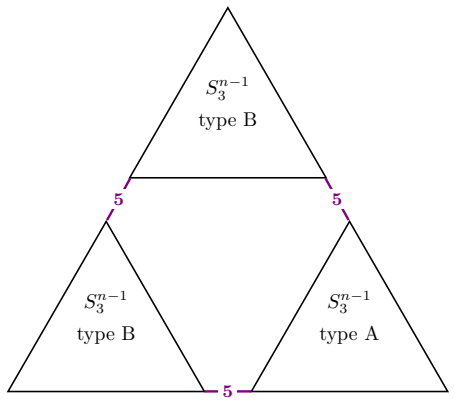
The authors prove that χ_i(S_{C_k}^n) equals 3 for every n ≥ 2 and k ≥ 3. They further prove that χ_i(S_G^n) belongs to the two-element set {χ_i(G), χ_i(G)+1} for arbitrary G and n ≥ 2. For the edge version they show χ_i'(S_{K_3}^n) equals 5 when n ≥ 3 (with smaller values at n=1 and n=2), and that for triangle-free G the edge number after level 3 lies between χ_i'(S_G^3) and that quantity plus one under suitable lifting conditions on the third level.
What carries the argument
The recursive definition of S_G^n from |V(G)| copies of S_G^{n-1} joined according to the edges of G, which permits controlled lifting of colorings from smaller to larger levels.
If this is right
- The injective chromatic number of any generalized Sierpiński graph stays within one of the base graph's value no matter how many recursive levels are added.
- Cycle-based versions stabilize immediately at three colors from the second level.
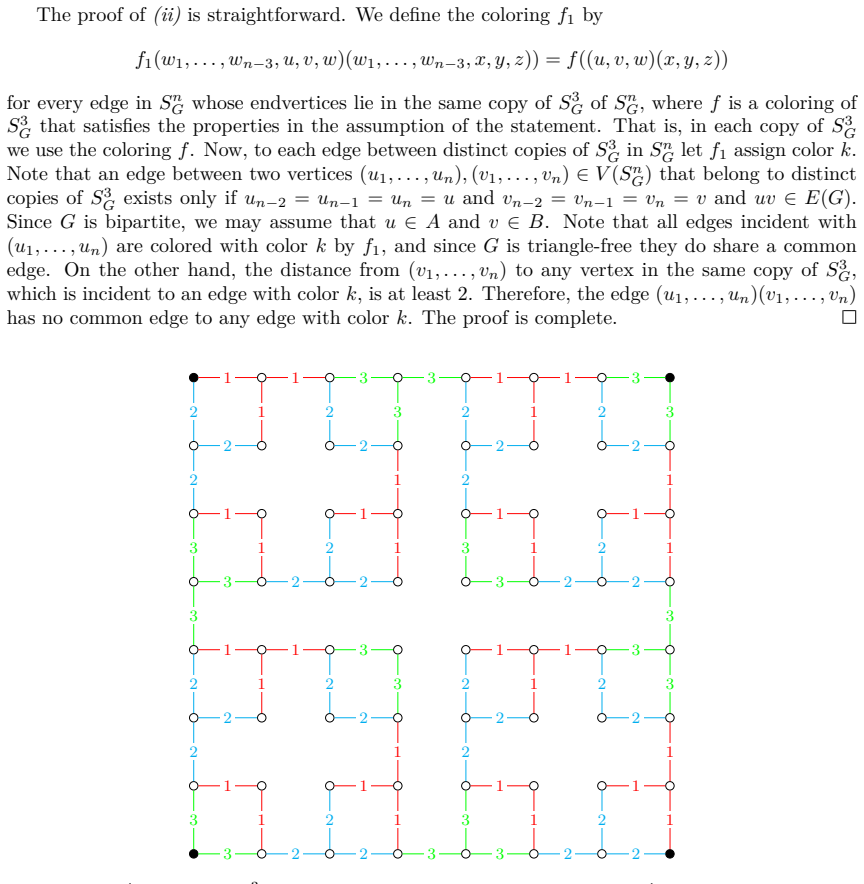
- Edge injective numbers for triangle-free bases stabilize after the third level within a one-color window.
- The K_3 base produces edge numbers that reach five by level three and remain there.
Where Pith is reading between the lines
- The same recursive lifting technique might bound other distance-based coloring parameters on these graphs.
- One could check whether the one-color window persists when the base graph contains many triangles beyond the single K_3 case.
- The stability result suggests that injective colorings behave more predictably than ordinary chromatic numbers under fractal graph constructions.
Load-bearing premise
Any valid injective coloring of a smaller generalized Sierpiński graph can be extended to the next level by adding at most one new color.
What would settle it
An explicit injective coloring or lower-bound argument showing that some S_{C_k}^n for n ≥ 2 requires four colors.
Figures




read the original abstract
Generalized Sierpi\'{n}ski graphs constitute a distinctive class of fractal-like networks with recursive definition: given a graph $G$, $S_G^1=G$ while $S_G^n$ is obtained from $|V(G)|$ copies of $S_G^{n-1}$ by adding some edges in a prescribed way that reflects the structure of $G$. Many graph invariants have been studied in generalized Sierpi\'{n}ski graphs. In this paper, we focus on their injective colorings, both the vertex and the edge version. Given a graph $G$, a mapping $f$ that assigns an integer from $\{1,\ldots,k\}$ to each vertex (resp.\ edge) of $G$ is an injective (edge) coloring of $G$ if $f(x)=f(y)$ implies that $x$ and $y$ are not in a common triangle nor at distance $2$ for any two vertices (resp.\ edges) $x$ and $y$ in $G$. The minimum number of colors $k$ for which there exists an injective (edge) coloring of $G$ is called the injective chromatic number (resp.\ injective chromatic index) of $G$ and is denoted by $\chi_i(G)$ (resp.\ $\chi_i'(G)$). The vertex version of injective colorings in generalized Sierpi\'{n}ski graphs was studied in an earlier paper, where the authors determined the injective chromatic numbers of standard Sierpi\'{n}ski graphs, and asked about the values when $G$ is a cycle. We resolve this question by proving that $\chi_i(S_{C_k}^n)=3$ for every $n\ge 2$ and every $k\ge 3$. Moreover, we prove an almost conclusive result that $\chi_i(S_G^n)\in \{\chi_i(G),\chi_i(G)+1\}$ for any graph $G$ and any $n\ge 2$. For injective edge colorings we prove that $\chi_i'(S_{K_3}^n)=5$ for all $n\ge 3$, while $\chi_i'(S_{K_3}^2)=4$ and $\chi_i'(S_{K_3}^1)=3$. Furthermore, if $G$ is a triangle-free graph, we prove that $\chi_i'(S_G^n)\in \{\chi_i'(S_G^3),\chi_i'(S_G^3)+1\}$ for all $n\ge 4$, and provide some sufficient conditions on an injective edge coloring of the 3-dimensional Sierpi\'{n}ski graph over $G$, which ensure that $\chi_i'(S_G^n)=\chi_i'(S_G^3)$.
Editorial analysis
A structured set of objections, weighed in public.
Referee Report
Summary. The manuscript studies injective vertex colorings and injective edge colorings of generalized Sierpiński graphs S_G^n defined recursively from a base graph G. It proves that χ_i(S_{C_k}^n) = 3 for every n ≥ 2 and k ≥ 3, resolving an open question from prior work. It further claims that χ_i(S_G^n) ∈ {χ_i(G), χ_i(G)+1} for arbitrary G and n ≥ 2. For the edge version, it determines χ_i'(S_{K_3}^n) exactly (3 for n=1, 4 for n=2, 5 for n ≥ 3) and shows that for triangle-free G the value χ_i'(S_G^n) lies in {χ_i'(S_G^3), χ_i'(S_G^3)+1} for n ≥ 4 under stated sufficient conditions on a 3-dimensional coloring.
Significance. If the proofs hold, the work resolves a concrete open question on cycles and supplies a general structural bound on how the injective chromatic number evolves under the Sierpiński recursion. The explicit computations for K_3 and the conditional results for triangle-free graphs are concrete contributions to the study of injective edge colorings on recursively constructed graphs.
minor comments (3)
- The statement of the general vertex-coloring bound in the abstract and introduction should explicitly reference the section containing the inductive argument so readers can locate the lifting construction immediately.
- Notation for the copies of S_G^{n-1} inside S_G^n is introduced without a diagram or small example; adding a figure for n=2 or n=3 would improve readability of the recursive definition.
- The sufficient conditions for the edge-coloring bound on triangle-free graphs are stated in the final section; a short table summarizing which graphs satisfy the conditions would help readers apply the result.
Simulated Author's Rebuttal
We thank the referee for their careful reading and positive evaluation of the manuscript. We are grateful for the recommendation of minor revision and for highlighting the resolution of the open question on cycles as well as the general bounds obtained for injective chromatic numbers and indices under the generalized Sierpiński recursion.
Circularity Check
No significant circularity; proofs rely on explicit constructions and induction rather than self-referential reductions
full rationale
The paper defines injective coloring via the standard distance-2 and triangle condition, then proves specific values for cycles and a general bound χ_i(S_G^n) ∈ {χ_i(G), χ_i(G)+1} by direct inductive lifting on the recursive copy construction of S_G^n. No equation equates a claimed result to a fitted parameter or prior self-citation by construction; the earlier paper is cited only for the open question on cycles, which this work resolves independently. The edge-coloring results for K_3 and triangle-free G similarly proceed from explicit colorings and sufficient conditions stated in the present manuscript. All load-bearing steps are self-contained against the given recursive definition and do not reduce to renaming or ansatz smuggling.
Axiom & Free-Parameter Ledger
axioms (1)
- standard math Standard definitions of graphs, distance, triangles, and proper colorings from graph theory.
Lean theorems connected to this paper
-
IndisputableMonolith/Foundation/RealityFromDistinction.leanreality_from_one_distinction unclear?
unclearRelation between the paper passage and the cited Recognition theorem.
We resolve this question by proving that χ_i(S_{C_k}^n)=3 for every n≥2 and every k≥3. Moreover, we prove an almost conclusive result that χ_i(S_G^n)∈{χ_i(G),χ_i(G)+1} for any graph G and any n≥2.
-
IndisputableMonolith/Cost/FunctionalEquation.leanwashburn_uniqueness_aczel unclear?
unclearRelation between the paper passage and the cited Recognition theorem.
Theorem 2.4. For any graph G and positive integer n, χ_i(G)≤χ_i(S^n_G)≤χ_i(G)+1, and the bounds are sharp.
What do these tags mean?
- matches
- The paper's claim is directly supported by a theorem in the formal canon.
- supports
- The theorem supports part of the paper's argument, but the paper may add assumptions or extra steps.
- extends
- The paper goes beyond the formal theorem; the theorem is a base layer rather than the whole result.
- uses
- The paper appears to rely on the theorem as machinery.
- contradicts
- The paper's claim conflicts with a theorem or certificate in the canon.
- unclear
- Pith found a possible connection, but the passage is too broad, indirect, or ambiguous to say the theorem truly supports the claim.
Reference graph
Works this paper leans on
- [1]
-
[2]
K. Balakrishnan, M. Changat, A.M. Hinz, and D.S. Lekha, The median of Sierpi´ nski graphs, Discrete Appl. Math. 319 (2022) 159–170
work page 2022
-
[3]
C.K. Bhanupriya, C. Dominic, and M.S. Sunitha, Injective edge coloring of product graphs and some complexity results, Filomat 37 (2023) 3963–3983
work page 2023
-
[4]
C.K. Bhanupriya, and M.S. Sunitha, Injective coloring of generalized Mycielskian of graphs, Commun. Comb. Optim. 10 (2025) 463–482
work page 2025
-
[5]
B. Breˇ sar, and J. Ferme, Packing coloring of Sierpi´ nski-type graphs, Aequationes Math. 92 (2018) 1091–1118
work page 2018
-
[6]
B. Breˇ sar, S. Klavˇ zar, B. Samadi, and I.G. Yero, Injective colorings of Sierpi´ nski-like graphs and Kneser graphs, Graphs. Combin. 41 (2025) 83
work page 2025
-
[7]
B. Breˇ sar, B. Samadi, and I. G. Yero, Injective coloring of graphs revisited, Discrete Math. 346 (2023) 113348
work page 2023
-
[8]
Y. Bu, D. Chen, A. Raspaud, and W. Wang, Injective coloring of planar graphs, Discrete Appl. Math. 157 (2009) 663–672
work page 2009
-
[9]
Cs. Bujt´ as, E. Sampathkumar, Zs. Tuza, C. Dominic and L. Pushpalatha, 3-consecutive edge coloring of a graph, Discrete Math. 312 (2012) 561–573
work page 2012
-
[10]
D.M. Cardoso, J.O. Cerdeira, C. Dominic and J.P. Cruz, Injective edge coloring of graphs, Filomat 33 (2019) 6411—6423
work page 2019
-
[11]
D. Cranston, S.J. Kim, and G. Yu, Injective colorings of sparse graphs, Discrete Math. 310 (2010) 2965–2973
work page 2010
-
[12]
F. Deng, Z. Shao, and A. Vesel, On the packing coloring of base-3 Sierpi´ nski graphs and H-graphs, Aequationes Math. 95 (2021) 329–341
work page 2021
-
[13]
W. Dong, and W. Lin, Injective coloring of plane graphs with girth 5, Discrete Math. 315 (2014) 120–127
work page 2014
-
[14]
E. Estaji, and J.A. Rodr´ ıguez-Vel´ azquez, The strong metric dimension of generalized Sierpi´ nski graphs with pendant vertices, Ars Math. Contemp. 12 (2017) 127–134
work page 2017
-
[15]
A. Estrada-Moreno, and J.A. Rodr´ ıguez-Vel´ azquez, On the General Randi´ c index of polymeric networks modelled by generalized Sierpi´ nski graphs, Discrete Appl. Math. 263 (2019) 140–151
work page 2019
-
[16]
B. Ferdjallah, S. Kerdjoudj, and A. Raspaud, Injective edge-coloring of subcubic graphs, Discrete Math. Algorithms Appl. 14 (2022) 2250040
work page 2022
-
[17]
F. Foucaud, H. Hocquard, and D. Lajou, Complexity and algorithms for injective edge-coloring in graphs, Inform. Process. Lett. 170 (2021) 106121. 15
work page 2021
-
[18]
J. Geetha, and K. Somasundaram, Total coloring of generalized Sierpi´ nski graphs, Australas. J. Combin. 63 (2015) 58–69
work page 2015
-
[19]
S. Gravier, M. Kovˇ se, and A. Parreau, Generalized Sierpi´ nski graphs; in: Posters at Eu- roComb’11, Budapest, August 29-September 2, 2011, http://www.renyi.hu/conferences/ ec11/posters/parreau.pdf (2024–08–21)
work page 2011
-
[20]
G. Hahn, J. Kratochv´ ıl, J.ˇSir´ aˇ n, and D. Sotteau, On the injective chromatic number of graphs, Discrete Math. 256 (2002) 179–192
work page 2002
-
[21]
A.M. Hinz, S. Klavˇ zar, C. Petr, The Tower of Hanoi—Myths and Maths , Second Edition, Birkh¨ auser/Springer, Cham, 2018
work page 2018
-
[22]
A.M. Hinz, S. Klavˇ zar, and S.S. Zemljiˇ c, A survey and classification of Sierpi´ nski-type graphs, Discrete Appl. Math. 217 (2017) 565–600
work page 2017
-
[23]
J. Jin, B. Xu, and X. Zhang, On the complexity of injective colorings and its generalizations, Theoret. Comput. Sci. 491 (2013) 119-126
work page 2013
-
[24]
S. Klavˇ zar, and U. Milutinovi´ c, GraphsS(n,k ) and a variant of the Tower of Hanoi problem, Czechoslovak Math. J. 47 (1997) 95-104
work page 1997
-
[25]
S. Klavˇ zar, and S.S. Zemljiˇ c, Connectivity and some other properties of generalized Sierpi´ nski graphs, Appl. Anal. Discrete Math. 12 (2018) 401–412
work page 2018
-
[26]
D. Korˇ ze, and A. Vesel, Packing coloring of generalized Sierpi´ nski graphs, Discrete Math. Theor. Comput. Sci. 21 (2019) 7
work page 2019
-
[27]
B. Luˇ zar, and R. ˇSkrekovski, Counterexamples to a conjecture on injective colorings, Ars Math. Contemp. 8 (2015) 291–295
work page 2015
-
[28]
M.K. Menon, M.R. Chithra, and K.S. Savitha, Security in Sierpi´ nski graphs, Discrete Appl. Math. 328 (2023) 10–15
work page 2023
-
[29]
M. Mozafari-Nia, and B. Omoomi, Injective chromatic number of outerplanar graphs, Tai- wanese J. Math. 22 (2018) 1309–1320
work page 2018
-
[30]
B.S. Panda and Priyamvada, Injective coloring of some subclasses of bipartite graphs and chordal graphs, Discrete Appl. Math. 291 (2021) 68–87
work page 2021
- [31]
-
[32]
J.A. Rodr´ ıguez-Vel´ azquez, E.D. Rodr´ ıguez-Bazan, and A. Estrada-Moreno, On generalized Sierpi´ nski graphs, Discuss. Math. Graph Theory 37 (2017) 547–560
work page 2017
- [33]
-
[34]
J. Song, and J. Yue, Injective coloring of some graph operations, Appl. Math. Comput. 264 (2015) 279–283
work page 2015
-
[35]
West, Introduction to Graph Theory (Second Edition), Prentice Hall, USA, 2001
D.B. West, Introduction to Graph Theory (Second Edition), Prentice Hall, USA, 2001. 16
work page 2001
discussion (0)
Sign in with ORCID, Apple, or X to comment. Anyone can read and Pith papers without signing in.