REVIEW 4 major objections 6 minor 16 references
ASCMamba: Multimodal Time-Frequency Mamba for Acoustic Scene Classification
T0 review · 4 major / 6 minor · reviewed 2026-08-05 · deepseek-v4-flash
Pith's one-line read The paper's central claim is that a Mamba-based dual-path network, ASCMamba, wins the APSIPA ASC 2025 acoustic scene classification challenge at 64.4% macro accuracy, and that its audio-only variant is the right submission because location
desk verdict First-place challenge system, credible score, but the audio-only variant was chosen using evaluation-set statistics, so the robustness claim is weaker than it looks. read the letter →
The pith
A machine-rendered reading of the paper's core claim, the machinery that carries it, and where it could break.
The reading
What carries the argument
The Dual-path Mamba block carries the argument: the spectrogram feature is reshaped into two sequences — each frequency bin as a sequence over record time, and each frame as a sequence over frequency — and each is run through a Mamba selective state-space block, giving long-range modeling along both axes. Multimodal fusion is carried by Conditional Layer Normalization, CLN(x,c) = γ(c)·LN(x) + β(c), where the affine parameters are generated from the projected text embedding, so location and recording time modulate the feature space. A two-step pseudo-labeling scheme extends the semi-supervised pipeline: the top 90% of unlabeled clips by confidence receive labels from the fine-tuned ASCMamba;
What would settle it
Retrain and select the model with strict city-separated cross-validation — holding out the six cities that appear only in the evaluation set, and never extracting any features from the evaluation set itself — then compare the audio-only and multimodal variants on those held-out cities. If the audio-only variant no longer beats the multimodal variant, the reported robustness advantage of dropping location and time is an artifact of tuning on the official test set's statistics rather than a property of the model.
Extended reading notes
Core claim
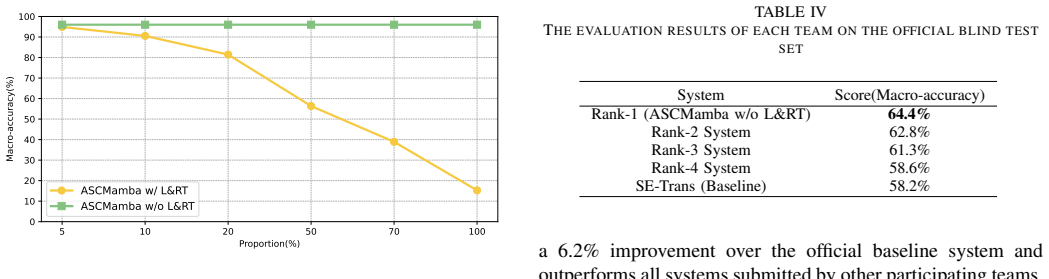
On its own terms, the paper establishes two things. First, the ASCMamba architecture — a DenseEncoder front-end feeding dual Mamba paths, one scanning along time and one along frequency — achieves 64.4% macro accuracy on the challenge's official blind test set, beating the SE-Trans baseline by 6.2% and every other team. Second, its ablations show that the multimodal variant (fusing location and recording-time text embeddings via Conditional Layer Normalization) is stronger when distributions match (97.71% vs 93.75% on the easy validation split) but weaker when the test environment shifts (94.14% vs 96.41% on the hard split, degrading further as metadata is shuffled or locations become unseen
Load-bearing premise
The model-selection evidence assumes the authors may extract feature statistics from the official evaluation set to build their validation splits, so the conclusion that the audio-only model is more robust holds only if that peek at the test set's statistics did not steer the choice.
Editorial extensions
If this is right
- If correct, the architecture shows that Mamba-based state-space modeling over both time and frequency axes is a strong backbone for environmental audio, competitive with attention-based backbones on this task.
- The ablation result implies a practical rule for any multimodal audio system: fuse location or time metadata only when the deployment distribution matches the training distribution; under domain shift, audio-only models are the safer choice.
- The two-step pseudo-labeling intersection scheme expands usable training data from 1,740 official labeled clips to a much larger set, evidence that semi-supervised training recovers accuracy from unlabeled audio when official labels are scarce.
- The paper's comparison with the runner-up systems attributes their lower scores to insufficient handling of positional-information reliance, which positions robustness to metadata shift as the decisive factor separating the top teams.
Reading between the lines
- The validation protocol extracts feature statistics from the official evaluation set to build the Valid-Hard splits; a strictly city-separated cross-validation that never touches the evaluation set would test whether the audio-only advantage and the 6.2% margin are genuine or partly an artifact of tuning on the test set's statistics.
- The pattern — large gains from conditioning on in-distribution metadata, clear losses under shift — suggests the multimodal branch learns a location/time shortcut rather than a generative context; a testable extension would train with deliberately corrupted or dropped metadata to force the network not to rely on it.
- The same Conditional Layer Normalization mechanism could carry other auxiliary text such as device, weather, or annotator notes, and the paper's trade-off implies such conditioning should include a confidence gate on the metadata itself.
- The paper does not separate the winning margin into contributions from the Mamba backbone, the pseudo-labeling, and the decision to drop location and time; swapping one component at a time in the four-stage pipeline would isolate which piece drives the 6.2% improvement.
Editorial analysis
A structured set of objections, weighed in public.
Referee Report
Summary. The paper describes ASCMamba, the proposed system for the APSIPA ASC 2025 Grand Challenge acoustic scene classification task. The architecture combines a DenseEncoder with dual-path Mamba blocks that model time and frequency dependencies, and optionally conditions the feature representation on location/record-time text embeddings through conditional layer normalization. A two-step pseudo-labeling scheme is used to exploit unlabeled development data. The authors report that the submitted system, labeled 'ASCMamba w/o L&RT' (i.e., without location and record-time metadata), achieved rank 1 on the official blind test set with 64.4% macro accuracy, a 6.2% absolute improvement over the SE-Trans baseline.
Significance. The headline result is supported by an external, organizer-scored blind evaluation, which is a strong form of validation. The paper also releases code, model, and pre-trained checkpoints. If the architectural claims were fully substantiated, the work would provide a useful data point for Mamba-based state-space models in acoustic scene classification. However, the scientific contribution is weakened by three issues: (1) the validation protocol uses the official evaluation set's feature statistics to construct validation splits and select the final model variant; (2) the central robustness comparison is reported without error bars or significance tests; and (3) the submitted model is audio-only, while the paper's framing emphasizes a multimodal contribution. These issues do not invalidate the official rank, but they limit the strength of the generalizations drawn from the experiments.
major comments (4)
- [IV-A, V] The validation-set creation protocol uses the official evaluation set to engineer Valid-Easy/Valid-Hard splits: LMFB features are extracted from the evaluation set, cosine similarity with validation features is computed, and a threshold of 0.9 assigns samples to Valid-Hard. The subsequent choice of ASCMamba w/o L&RT as the submitted system is therefore informed by the unlabeled test distribution. The official 64.4% score is still a legitimate blind-label evaluation, but it is not an unbiased estimate of performance on a new sample from the same task, and the conclusion that audio-only modeling is more robust under distribution shift is not established as a general property. Please report a leave-one-location-out or city-separated validation, or explicitly frame the result as transductive model selection.
- [Table III, Figs. 3-4] All reported comparisons between ASCMamba w/ L&RT and w/o L&RT are single-run accuracy values with no error bars, confidence intervals, or significance tests. The key difference on Valid-Hard (96.41% vs 94.14%) is small and could be within run-to-run variation. Without multiple seeds or a paired test across the same validation folds, the robustness claim is not statistically supported. This is load-bearing because the decision to submit the audio-only variant rests on these figures.
- [Abstract, III-A, IV-A, V] The paper is framed as a 'multimodal' system, and the abstract states that ASCMamba 'integrates audio and textual information.' However, the submitted system is explicitly 'ASCMamba w/o L&RT', meaning the conditional location/time pathway is disabled. The official rank-1 result is thus for the audio-only model, while the multimodal variant is only an ablation experiment. This mismatch should be clarified in the abstract, the architecture description, and the conclusion; as written, a reader could reasonably infer that the winning system uses the proposed multimodal fusion.
- [III-C, V] The two-step pseudo-labeling mechanism is presented as a key contribution, but no ablation isolates its effect. Table III compares only the baseline, w/ L&RT, and w/o L&RT; no experiment compares training with and without pseudo-labeling, or with a simpler one-step confidence threshold. Without such an ablation, the claimed benefit of the two-step intersection strategy is not demonstrated.
minor comments (6)
- [II-B] The statement that the evaluation set has 12 locations with 6 overlapping in the development set is useful, but the source of this information should be cited (challenge description or official dataset documentation).
- [III-B, Eq. (2)] Equation (2) is hard to parse: the notation 'c,i⊃c' and the phrase 'since i ⊃ c' are confusing. Typically one would write c ∈ {1,...,10}, i ∈ {1,2}, with the constraint that class c belongs to the indoor/outdoor group i. Please rewrite the equation and the accompanying explanation.
- [IV-C] The pretraining stage on TAU UAS 2020 and CochlScene is described, but the scene mapping/merging procedure in Table I is not detailed. Since this is a nonstandard pretraining corpus, the mapping rules should be specified or the merged dataset released.
- [V] The text says 'Experimental results in demonstrate' — a missing noun. Also, the conclusion repeats 'demonstrate' twice. Please proofread.
- [References] Reference [13] is formatted as 'K. D. B. J. Adam et al.'; the correct citation is Kingma and Ba, 'Adam: A Method for Stochastic Optimization.'
- [Fig. 3 and Fig. 4] The two figures have identical axes and similar curves; the difference between shuffling spatiotemporal metadata (Fig. 3) and replacing locations with unseen ones (Fig. 4) should be stated clearly in each caption.
Circularity Check
No circular derivation; the headline result is anchored by an external blind-test evaluation.
full rationale
The paper's central claim—64.4% macro accuracy, first place, 6.2% over the baseline—is based on the official blind test set scored by the challenge organizers. This is external evidence, not a quantity derived from the model's own outputs or fitted parameters. The pseudo-labeling pipeline uses the model's own predictions to construct additional training data, but this affects training only; the final evaluation is independent. The only notable methodological issue is in Section IV-A, where LMFB features from the official evaluation set are used to construct Valid-Easy/Valid-Hard and to select the audio-only variant. That is test-set-aware model selection and a legitimate generalization concern, but it is not circularity in the derivation sense: no equation or fitted parameter is renamed as a prediction, and the official score was still measured on the hidden test. Self-citations to SE-Trans, the ICME challenge, and other teams' reports are contextual and not load-bearing; no uniqueness theorem is imported from the authors' prior work, and no ansatz is smuggled in via citation. The paper presents an empirical system, not a derivation chain that reduces to its inputs.
Assumptions & free parameters
free parameters (4)
- Cosine similarity threshold (0.9) for Valid-Easy/Valid-Hard split =
0.9
- Pseudo-label confidence cutoff (top 90%) =
90%
- Learning rate =
0.0001
- Dropout rate =
0.1
assumptions (4)
- domain assumption Log-mel spectrogram features (64 filter banks, 500 frames) are a sufficient input representation.
- domain assumption Location and record time metadata are directly related to scene labels.
- ad hoc to paper The official evaluation set's feature statistics are a valid proxy for the hidden test distribution, allowing construction of Valid-Hard.
- domain assumption Pseudo-labels agreed upon by two models are reliable enough to fine-tune the final model.
Cite this review
Pith. "Pith review of ASCMamba: Multimodal Time-Frequency Mamba for Acoustic Scene Classification." pith.science (2026). https://pith.science/paper/OKSEDDHB
@misc{pith2026250815632,
  author       = {Pith},
  title        = {Pith review of: ASCMamba: Multimodal Time-Frequency Mamba for Acoustic Scene Classification},
  year         = {2026},
  howpublished = {\url{https://pith.science/paper/OKSEDDHB}},
  note         = {Machine review of arXiv:2508.15632}
}
read the original abstract
Acoustic Scene Classification (ASC) is a fundamental problem in computational audition, which seeks to classify environments based on the distinctive acoustic features. In the ASC task of the APSIPA ASC 2025 Grand Challenge, the organizers introduce a multimodal ASC task. Unlike traditional ASC systems that rely solely on audio inputs, this challenge provides additional textual information as inputs, including the location where the audio is recorded and the time of recording. In this paper, we present our proposed system for the ASC task in the APSIPA ASC 2025 Grand Challenge. Specifically, we propose a multimodal network, ASCMamba, which integrates audio and textual information for fine-grained acoustic scene understanding and effective multimodal ASC. The proposed ASCMamba employs a DenseEncoder to extract hierarchical spectral features from spectrograms, followed by a dual-path Mamba blocks that capture long-range temporal and frequency dependencies using Mamba-based state space models. In addition, we present a two-step pseudo-labeling mechanism to generate more reliable pseudo-labels. Results show that the proposed system outperforms all the participating teams and achieves a 6.2% improvement over the baseline. Code, model and pre-trained checkpoints are available at https://github.com/S-Orion/ASCMamba.git.
Figures


Figures from the paper (1 more)

Reference graph
Works this paper leans on
-
[1]
Acoustic scene classification: Classifying environments from the sounds they produce,
D. Barchiesi, D. Giannoulis, D. Stowell, and M. D. Plumbley, “Acoustic scene classification: Classifying environments from the sounds they produce,” IEEE Signal Processing Magazine , vol. 32, no. 3, pp. 16–34, 2015
work page 2015
-
[2]
Exploring text-queried sound event detection with audio source separation,
H. Yin, J. Bai, Y . Xiao, et al. , “Exploring text-queried sound event detection with audio source separation,” in IEEE International Conference on Acoustics, Speech and Signal Processing (ICASSP) , IEEE, 2025, pp. 1–5
work page 2025
-
[3]
Multi-granularity acous- tic information fusion for sound event detection,
H. Yin, J. Chen, J. Bai, et al., “Multi-granularity acous- tic information fusion for sound event detection,” Signal Processing, vol. 227, p. 109 691, 2025
work page 2025
-
[4]
J. Bai, M. Wang, H. Liu, et al. , “Description on ieee icme 2024 grand challenge: Semi-supervised acoustic scene classification under domain shift,” arXiv preprint arXiv:2402.02694, 2024
arXiv 2024
-
[5]
Mamba: Linear-time sequence modeling with selective state spaces,
A. Gu and T. Dao, “Mamba: Linear-time sequence modeling with selective state spaces,” arXiv preprint arXiv:2312.00752, 2023
arXiv 2023
-
[6]
A. Vaswani, N. Shazeer, N. Parmar, et al., “Attention is all you need,” Advances in neural information process- ing systems, vol. 30, 2017
work page 2017
-
[7]
Tau urban acoustic scenes 2020 mobile development dataset [data set],
H. Toni, M. Annamaria, and V . Tuomas, “Tau urban acoustic scenes 2020 mobile development dataset [data set],” Zenodo, 2020
work page 2020
-
[8]
Cochlscene: Acquisition of acoustic scene data using crowdsourcing,
I.-Y . Jeong and J. Park, “Cochlscene: Acquisition of acoustic scene data using crowdsourcing,” in Asia- Pacific Signal and Information Processing Association Annual Summit and Conference, IEEE, 2022, pp. 17–21
work page 2022
Show all 16 references
-
[9]
A squeeze-and-excitation and transformer-based cross- task model for environmental sound recognition,
J. Bai, J. Chen, M. Wang, M. S. Ayub, and Q. Yan, “A squeeze-and-excitation and transformer-based cross- task model for environmental sound recognition,” IEEE Transactions on Cognitive and Developmental Systems , vol. 15, no. 3, pp. 1501–1513, 2023
2023
-
[10]
Densenets reloaded: Paradigm shift beyond resnets and vits,
D. Kim, B. Heo, and D. Han, “Densenets reloaded: Paradigm shift beyond resnets and vits,” in Euro- pean Conference on Computer Vision , Springer, 2024, pp. 395–415
2024
-
[11]
A two-stage approach to device-robust acoustic scene classification,
H. Hu, C.-H. H. Yang, X. Xia, et al. , “A two-stage approach to device-robust acoustic scene classification,” in IEEE International Conference on Acoustics, Speech and Signal Processing (ICASSP), IEEE, 2021, pp. 845– 849
2021
-
[12]
Librosa: Audio and music signal analysis in python.,
B. McFee, C. Raffel, D. Liang, et al., “Librosa: Audio and music signal analysis in python.,” SciPy, vol. 2015, pp. 18–24, 2015
2015
-
[13]
A method for stochastic op- timization,
K. D. B. J. Adam et al., “A method for stochastic op- timization,” arXiv preprint arXiv:1412.6980 , vol. 1412, no. 6, 2014
2014 arXiv
-
[14]
Pytorch: An im- perative style, high-performance deep learning library,
A. Paszke, S. Gross, F. Massa, et al., “Pytorch: An im- perative style, high-performance deep learning library,” Advances in neural information processing systems , vol. 32, 2019
2019
-
[15]
Evaluation of low-frequency feature restriction and average pooling for acoustic scene classification under unseen-city con- ditions,
T. Kawamura, M. Sera, and N. Ono, “Evaluation of low-frequency feature restriction and average pooling for acoustic scene classification under unseen-city con- ditions,” Technical Report, 2025
2025
-
[16]
A semi-supervised acoustic scene clas- sification network based on multi-modal information fusion,
J. Yang, H. Liu, L. Shi, L. Gan, H. Nishizaki, and C. S. Leow, “A semi-supervised acoustic scene clas- sification network based on multi-modal information fusion,” Technical Report, 2025
2025
Reviewed August 5, 2026 · model on record in the stance chip above.
Discussion (0). Sign in to comment.