CausalMesh: A Formally Verified Causally Consistent Distributed Cache with Support for Client Migration
Pith reviewed 2026-05-21 22:07 UTC · model grok-4.3
The pith
CausalMesh maintains causal consistency in distributed caches even when clients migrate between servers without coordination or aborts for basic operations.
A machine-rendered reading of the paper's core claim, the machinery that carries it, and where it could break.
Core claim
CausalMesh is the first cache system to support coordination-free, abort-free read/write operations and read transactions when clients migrate across multiple servers, while also supporting read-write transactional causal consistency at the cost of abort-freedom, and it has been formally verified in Dafny.
What carries the argument
A migration-aware causal dependency tracking protocol that uses observable client migrations and network message ordering to maintain consistency without additional coordination.
If this is right
- Applications like stateful serverless workflows can run correctly across migrating functions without seeing inconsistent states.
- The system achieves lower latency and higher throughput than prior proposals for consistent caching.
- Read-write transactions are possible under migration, though they may require aborts in some cases.
- Formal verification provides high assurance of the protocol's adherence to causal consistency.
Where Pith is reading between the lines
- Similar techniques might apply to other distributed systems where processes move between nodes, such as in edge computing.
- Performance gains could make causal consistency more practical for high-throughput cloud services.
- Extending the approach to stronger consistency models might be feasible if migration observability is maintained.
Load-bearing premise
The protocol assumes that the system can observe client migrations and that the network delivers messages in an order that permits tracking causal dependencies without extra coordination.
What would settle it
Demonstrating a scenario where a migrating client observes a violation of causal consistency, such as reading a value that should depend on a prior write not yet visible, would falsify the correctness claim.
Figures






read the original abstract
Cloud applications often insert a caching lay\-er in front of a database in order to reduce I/O latency and improve throughput. One complication occurs when a client fetches some data from one cache node, then migrates to another (e.g., due to failures, load balancing, or client mobility), where it fetches the remaining data. If the data in the cache nodes is inconsistent, the client could observe states that undermine the application's correctness. One example of a situation where this is common is stateful serverless workflows, which consist of multiple serverless functions that access state in a remote database. In serverless, functions in the same workflow may be scheduled to different nodes with different caches, resulting in the migration pattern described above -- the same client (the workflow) reads some data from one cache and other data from another. To address this issue, this paper presents CausalMesh, a novel approach to causally consistent distributed caching in environments where computations may migrate between machines. CausalMesh is the first cache system to support coordination-free, abort-free read/write operations and read transactions when clients migrate across multiple servers. CausalMesh also supports read-write transactional causal consistency in the presence of client migration, but at the cost of abort-freedom. Our experimental evaluation shows that CausalMesh has lower latency and higher throughput than existing proposals. Finally, we have formally verified the correctness of \sys's protocol in Dafny.
Editorial analysis
A structured set of objections, weighed in public.
Referee Report
Summary. The paper presents CausalMesh, a causally consistent distributed cache designed for environments with client migrations (e.g., serverless workflows). It claims to be the first system supporting coordination-free, abort-free read/write operations and read transactions across migrations, while also offering read-write transactional causal consistency (with aborts). The protocol is formally verified for correctness in Dafny, and experiments report lower latency and higher throughput than existing proposals.
Significance. If the central claims hold, the work is significant for practical distributed systems and serverless computing, where client or function migrations are routine. The machine-checked Dafny proofs provide strong evidence for the consistency invariants, and the performance results address real latency concerns in caching layers. This combination of formal guarantees and empirical gains could inform future cache designs.
major comments (2)
- [Approach and Verification sections] The migration handling logic (described in the approach and verified in Dafny): the central claim of coordination-free causal consistency across migrations depends on observable client handoffs and network delivery order. The Dafny model appears to idealize these as reliable FIFO channels with instantaneous detection; the paper must explicitly state whether the verified invariants transfer to asynchronous networks with possible reordering or delayed observability, as this is load-bearing for deployment claims.
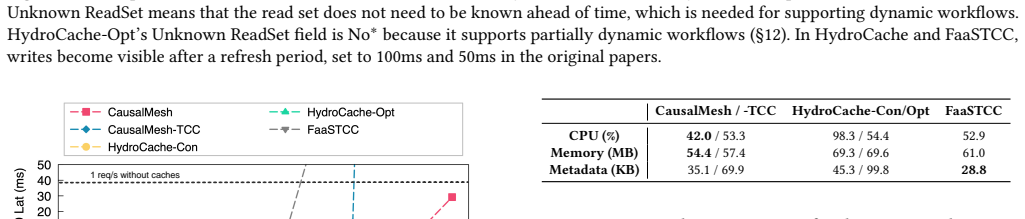
- [Evaluation section] § on experimental evaluation: the performance comparison to baselines should include details on how migration frequency and network conditions were modeled, to substantiate the throughput/latency gains under the same assumptions used in the proof.
minor comments (2)
- [Abstract] Abstract contains a formatting artifact ('lay- er'); this and similar typographical issues should be cleaned up.
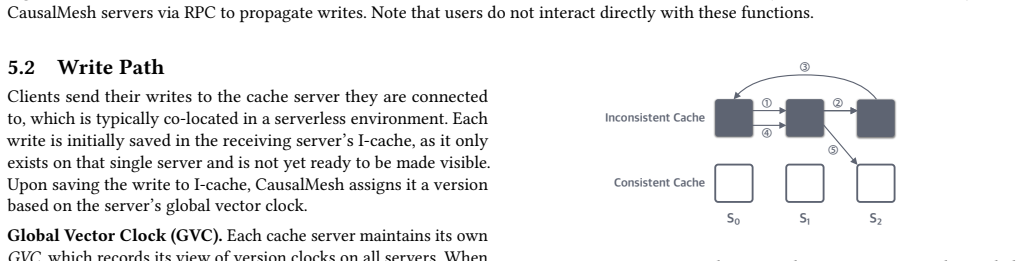
- [Protocol description] Notation for causal metadata propagation during migration could be clarified with a small example or diagram to aid readability.
Simulated Author's Rebuttal
We thank the referee for the constructive and insightful comments. We address each major comment below and indicate planned revisions to strengthen the manuscript.
read point-by-point responses
-
Referee: [Approach and Verification sections] The migration handling logic (described in the approach and verified in Dafny): the central claim of coordination-free causal consistency across migrations depends on observable client handoffs and network delivery order. The Dafny model appears to idealize these as reliable FIFO channels with instantaneous detection; the paper must explicitly state whether the verified invariants transfer to asynchronous networks with possible reordering or delayed observability, as this is load-bearing for deployment claims.
Authors: We agree that the network assumptions require explicit clarification. The Dafny model formalizes client handoffs and message delivery using reliable FIFO channels with instantaneous observability, which is a standard abstraction used to prove causal consistency invariants in the literature. The verified properties hold under these assumptions. Our implementation assumes an ordered transport (e.g., TCP) for migration handoff messages. We will revise the verification section to state these modeling choices explicitly and discuss their scope, noting that arbitrary reordering would require additional mechanisms such as sequence numbers to preserve the guarantees. This change will better align the formal claims with deployment considerations. revision: yes
-
Referee: [Evaluation section] § on experimental evaluation: the performance comparison to baselines should include details on how migration frequency and network conditions were modeled, to substantiate the throughput/latency gains under the same assumptions used in the proof.
Authors: We appreciate the request for additional experimental details. In the evaluation, client migrations were triggered at rates ranging from 1% to 10% of operations, and network conditions were simulated using latency distributions (10–100 ms) and low packet-loss rates representative of serverless environments. These parameters were chosen to exercise the migration path while remaining consistent with the FIFO delivery assumptions in the formal model. We will expand the evaluation section to document these parameters, the simulator configuration, and their relationship to the verified protocol. revision: yes
Circularity Check
No circularity: protocol and invariants verified externally in Dafny
full rationale
The paper introduces a new caching protocol whose correctness is established by a machine-checked Dafny proof rather than by any self-referential definition, fitted parameter renamed as prediction, or load-bearing self-citation. The derivation chain consists of protocol rules plus invariants that are checked against an external formal model; this verification supplies independent evidence and does not reduce the claimed properties to the inputs by construction. Assumptions about observable migrations and network ordering are explicit model parameters, not hidden equivalences that collapse the result.
Axiom & Free-Parameter Ledger
axioms (1)
- domain assumption Client migrations are observable and the network model permits tracking of causal dependencies without extra coordination messages.
Lean theorems connected to this paper
-
IndisputableMonolith/Foundation/ArrowOfTime.leanarrow_from_z unclear?
unclearRelation between the paper passage and the cited Recognition theorem.
CausalMesh ensures that any data accessed by a serverless function observes the effects of prior serverless functions... via dependency integration and propagation chains (two full rounds) to guarantee monotonic cuts across client migrations.
-
IndisputableMonolith/Foundation/AbsoluteFloorClosure.leanabsolute_floor_iff_bare_distinguishability unclear?
unclearRelation between the paper passage and the cited Recognition theorem.
Definition 4.1 (Strict Causal Cut). A set of writes S is a strict causal cut ⇐⇒ ∀x∈S, ∀y∈x.deps, ∃y′∈S | y.key=y′.key ∧ (y′=y ∨ y→y′)
What do these tags mean?
- matches
- The paper's claim is directly supported by a theorem in the formal canon.
- supports
- The theorem supports part of the paper's argument, but the paper may add assumptions or extra steps.
- extends
- The paper goes beyond the formal theorem; the theorem is a base layer rather than the whole result.
- uses
- The paper appears to rely on the theorem as machinery.
- contradicts
- The paper's claim conflicts with a theorem or certificate in the canon.
- unclear
- Pith found a possible connection, but the passage is too broad, indirect, or ambiguous to say the theorem truly supports the claim.
Reference graph
Works this paper leans on
-
[1]
Palette load balancing: Locality hints for serverless functions
Mania Abdi, Samuel Ginzburg, Xiayue Charles Lin, Jose Faleiro, Gohar Irfan Chaudhry, Inigo Goiri, Ricardo Bianchini, Daniel S Berger, and Rodrigo Fonseca. Palette load balancing: Locality hints for serverless functions. In Proceedings of the ACM European Conference on Computer Systems (EuroSys) , 2023
work page 2023
-
[2]
Firecracker: Lightweight virtualization for serverless applications
Alexandru Agache, Marc Brooker, Alexandra Iordache, Anthony Liguori, Rolf Neugebauer, Phil Piwonka, and Diana-Maria Popa. Firecracker: Lightweight virtualization for serverless applications. InProceedings of the USENIX Symposium on Networked Systems Design and Implementation (NSDI) , 2020
work page 2020
-
[3]
Cure: Strong semantics meets high availability and low latency
Deepthi Devaki Akkoorath, Alejandro Z Tomsic, Manuel Bravo, Zhongmiao Li, Tyler Crain, Annette Bieniusa, Nuno Preguiça, and Marc Shapiro. Cure: Strong semantics meets high availability and low latency. In International Conference on Distributed Computing Systems (ICDCS) , 2016
work page 2016
-
[4]
Chainreaction: a causal+ consis- tent datastore based on chain replication
Sérgio Almeida, João Leitão, and Luís Rodrigues. Chainreaction: a causal+ consis- tent datastore based on chain replication. In Proceedings of the ACM European Conference on Computer Systems (EuroSys) , 2013
work page 2013
-
[5]
Peter Bailis, Ali Ghodsi, Joseph M Hellerstein, and Ion Stoica. Bolt-on causal consistency. In Proceedings of the ACM SIGMOD Conference (SIGMOD) , 2013
work page 2013
-
[6]
Nalini Moti Belaramani, Michael Dahlin, Lei Gao, Amol Nayate, Arun Venkatara- mani, Praveen Yalagandula, and Jiandan Zheng. Practi replication. In Proceedings of the USENIX Symposium on Networked Systems Design and Implementation (NSDI), 2006
work page 2006
-
[7]
Eventual consistency: How soon is eventual? an evaluation of amazon s3’s consistency behavior
David Bermbach and Stefan Tai. Eventual consistency: How soon is eventual? an evaluation of amazon s3’s consistency behavior. InWorkshop on Middleware for Service Oriented Computing (MW4SOC) , 2011
work page 2011
- [8]
-
[9]
Cypress: input size-sensitive container provisioning and request scheduling for serverless platforms
Vivek M Bhasi, Jashwant Raj Gunasekaran, Aakash Sharma, Mahmut Taylan Kandemir, and Chita Das. Cypress: input size-sensitive container provisioning and request scheduling for serverless platforms. InProceedings of the ACM Symposium on Cloud Computing (SOCC) , 2022
work page 2022
-
[10]
Durable functions: semantics for state- ful serverless
Sebastian Burckhardt, Chris Gillum, David Justo, Konstantinos Kallas, Connor McMahon, and Christopher S Meiklejohn. Durable functions: semantics for state- ful serverless. Proceedings of the ACM SIGPLAN Conference on Object-Oriented Programming Systems, Languages and Applications (OOPSLA) , 2021
work page 2021
- [11]
-
[12]
Brian F Cooper, Raghu Ramakrishnan, Utkarsh Srivastava, Adam Silberstein, Philip Bohannon, Hans-Arno Jacobsen, Nick Puz, Daniel Weaver, and Ramana Yerneni. Pnuts: Yahoo!’s hosted data serving platform.Proceedings of the Interna- tional Conference on Very Large Data Bases (VLDB) , 2008
work page 2008
-
[13]
https://azure.microsoft.com/en-us/products/cosmos-db/
cosmosdb. https://azure.microsoft.com/en-us/products/cosmos-db/
- [14]
-
[15]
https://docs.aws.amazon.com/amazon dynamodb/latest/developerguide/DAX.consistency.html
Dax and dynamodb consistency models. https://docs.aws.amazon.com/amazon dynamodb/latest/developerguide/DAX.consistency.html
-
[16]
Leonardo Mendonça de Moura and Nikolaj S. Bjørner. Z3: an efficient SMT solver. In Tools and Algorithms for the Construction and Analysis of Systems (TACAS) , volume 4963 of Lecture Notes in Computer Science , pages 337–340, 2008
work page 2008
-
[17]
https://github.com/delimitrou/DeathStarBench/
DeathStarBench. https://github.com/delimitrou/DeathStarBench/
-
[18]
Dynamo: Amazon’s highly available key-value store
Giuseppe DeCandia, Deniz Hastorun, Madan Jampani, Gunavardhan Kakula- pati, Avinash Lakshman, Alex Pilchin, Swaminathan Sivasubramanian, Peter Vosshall, and Werner Vogels. Dynamo: Amazon’s highly available key-value store. Proceedings of the ACM Symposium on Operating Systems Principles (SOSP) , 2007
work page 2007
-
[19]
Orbe: Scalable causal consistency using dependency matrices and physical clocks
Jiaqing Du, Sameh Elnikety, Amitabha Roy, and Willy Zwaenepoel. Orbe: Scalable causal consistency using dependency matrices and physical clocks. InProceedings of the ACM Symposium on Cloud Computing (SOCC) , 2013
work page 2013
-
[20]
Gentlerain: Cheap and scalable causal consistency with physical clocks
Jiaqing Du, Călin Iorgulescu, Amitabha Roy, and Willy Zwaenepoel. Gentlerain: Cheap and scalable causal consistency with physical clocks. In Proceedings of the ACM Symposium on Cloud Computing (SOCC) , 2014
work page 2014
-
[21]
https: //github.com/jonhoo/evmap
evmap: A lock-free, eventually consistent, concurrent multi-value map. https: //github.com/jonhoo/evmap
-
[22]
Yu Gan, Yanqi Zhang, Dailun Cheng, Ankitha Shetty, Priyal Rathi, Nayan Katarki, Ariana Bruno, Justin Hu, Brian Ritchken, Brendon Jackson, Kelvin Hu, Meghna Pancholi, Yuan He, Brett Clancy, Chris Colen, Fukang Wen, Catherine Leung, Siyuan Wang, Leon Zaruvinsky, Mateo Espinosa, Rick Lin, Zhongling Liu, Jake Padilla, and Christina Delimitrou. An open-source ...
work page 2019
- [23]
-
[24]
Fifer: Tackling resource underuti- lization in the serverless era
Jashwant Raj Gunasekaran, Prashanth Thinakaran, Nachiappan C Nachiappan, Mahmut Taylan Kandemir, and Chita R Das. Fifer: Tackling resource underuti- lization in the serverless era. In Proceedings of the ACM/IFIP/USENIX International Middleware Conference (Middleware), 2020
work page 2020
-
[25]
Lorch, Bryan Parno, Michael Lowell Roberts, Srinath T
Chris Hawblitzel, Jon Howell, Manos Kapritsos, Jacob R. Lorch, Bryan Parno, Michael Lowell Roberts, Srinath T. V. Setty, and Brian Zill. Ironfleet: Proving practical distributed systems correct. In ACM Symposium on Operating Systems Principles (SOSP), 2015
work page 2015
-
[26]
Hellerstein, Jose Faleiro, Joseph E
Joseph M. Hellerstein, Jose Faleiro, Joseph E. Gonzalez, Johann Schleier-Smith, Vikram Sreekanti, Alexey Tumanov, and Chenggang Wu. Serverless computing: One step forward, two steps back. In Conference on Innovative Data Systems Research (CIDR), 2019
work page 2019
-
[27]
Zookeeper: Wait-free coordination for internet-scale systems
Patrick Hunt, Mahadev Konar, Flavio P Junqueira, and Benjamin Reed. Zookeeper: Wait-free coordination for internet-scale systems. In Proceedings of the USENIX Annual Technical Conference (ATC), 2010
work page 2010
-
[28]
Lifting the veil on meta’s microservice architecture: Analyses of topology and request workflows
Darby Huye, Yuri Shkuro, and Raja R Sambasivan. Lifting the veil on meta’s microservice architecture: Analyses of topology and request workflows. In Pro- ceedings of the USENIX Annual Technical Conference (ATC) , 2023
work page 2023
-
[29]
Boki: Stateful serverless computing with shared logs
Zhipeng Jia and Emmett Witchel. Boki: Stateful serverless computing with shared logs. In Proceedings of the ACM Symposium on Operating Systems Principles (SOSP), 2021. Haoran Zhang, Zihao Zhang, Shuai Mu, Sebastian Angel, and Vincent Liu
work page 2021
-
[30]
Zhipeng Jia and Emmett Witchel. Nightcore: efficient and scalable serverless computing for latency-sensitive, interactive microservices. In Proceedings of the International Conference on Architectural Support for Programming Languages and Operating Systems (ASPLOS), 2021
work page 2021
-
[31]
Occupy the cloud: Distributed computing for the 99%
Eric Jonas, Qifan Pu, Shivaram Venkataraman, Ion Stoica, and Benjamin Recht. Occupy the cloud: Distributed computing for the 99%. In Proceedings of the ACM Symposium on Cloud Computing (SOCC) , 2017
work page 2017
-
[32]
Centralized core- granular scheduling for serverless functions
Kostis Kaffes, Neeraja J Yadwadkar, and Christos Kozyrakis. Centralized core- granular scheduling for serverless functions. In Proceedings of the ACM Sympo- sium on Cloud Computing (SOCC) , 2019
work page 2019
-
[33]
Hermod: principled and practical scheduling for serverless functions
Kostis Kaffes, Neeraja J Yadwadkar, and Christos Kozyrakis. Hermod: principled and practical scheduling for serverless functions. In Proceedings of the ACM Symposium on Cloud Computing (SOCC) , 2022
work page 2022
-
[34]
Pocket: Elastic ephemeral storage for serverless analyt- ics
Ana Klimovic, Yawen Wang, Patrick Stuedi, Animesh Trivedi, Jonas Pfefferle, and Christos Kozyrakis. Pocket: Elastic ephemeral storage for serverless analyt- ics. In Proceedings of the USENIX Symposium on Operating Systems Design and Implementation (OSDI), 2018
work page 2018
-
[35]
How long does AWS Lambda keep your idle functions around before a cold start? https://acloudguru.com/blog/engineering/how-long-does-aws-lambda-keep- your-idle-functions-around-before-a-cold-start
-
[36]
Leslie Lamport. The temporal logic of actions. ACM Trans. Program. Lang. Syst. , 16(3):872–923, 1994
work page 1994
-
[37]
Specifying Systems, The TLA+ Language and Tools for Hardware and Software Engineers
Leslie Lamport. Specifying Systems, The TLA+ Language and Tools for Hardware and Software Engineers. 2002
work page 2002
-
[38]
Time, clocks, and the ordering of events in a distributed system
Leslie Lamport. Time, clocks, and the ordering of events in a distributed system. In Communications of the ACM, 2019
work page 2019
-
[39]
Dafny: An automatic program verifier for functional correct- ness
K Rustan M Leino. Dafny: An automatic program verifier for functional correct- ness. In International conference on logic for programming artificial intelligence and reasoning, pages 348–370, 2010
work page 2010
- [40]
-
[41]
The serverless computing survey: A technical primer for design architecture
Zijun Li, Linsong Guo, Jiagan Cheng, Quan Chen, BingSheng He, and Minyi Guo. The serverless computing survey: A technical primer for design architecture. ACM Computing Surveys, 2022
work page 2022
-
[42]
Liu, Shadi Noghabi, Sebastian Burckhardt, and Amit Levy
David H. Liu, Shadi Noghabi, Sebastian Burckhardt, and Amit Levy. Doing more with less: Orchestrating serverless applications without an orchestrator. In Pro- ceedings of the USENIX Symposium on Networked Systems Design and Implemen- tation (NSDI), 2023
work page 2023
-
[43]
Don’t settle for eventual: Scalable causal consistency for wide-area storage with cops
Wyatt Lloyd, Michael J Freedman, Michael Kaminsky, and David G Andersen. Don’t settle for eventual: Scalable causal consistency for wide-area storage with cops. In Proceedings of the ACM Symposium on Operating Systems Principles (SOSP), 2011
work page 2011
-
[44]
Stronger semantics for low-latency geo-replicated storage
Wyatt Lloyd, Michael J Freedman, Michael Kaminsky, and David G Andersen. Stronger semantics for low-latency geo-replicated storage. In Proceedings of the USENIX Symposium on Networked Systems Design and Implementation (NSDI) , 2013
work page 2013
-
[45]
Characterizing microservice dependency and performance: Alibaba trace analysis
Shutian Luo, Huanle Xu, Chengzhi Lu, Kejiang Ye, Guoyao Xu, Liping Zhang, Yu Ding, Jian He, and Chengzhong Xu. Characterizing microservice dependency and performance: Alibaba trace analysis. In Proceedings of the ACM Symposium on Cloud Computing (SOCC) , 2021
work page 2021
-
[46]
Faastcc: efficient transac- tional causal consistency for serverless computing
Taras Lykhenko, Rafael Soares, and Luis Rodrigues. Faastcc: efficient transac- tional causal consistency for serverless computing. In Proceedings of the ACM/I- FIP/USENIX International Middleware Conference (Middleware) , 2021
work page 2021
-
[47]
Prince Mahajan, Lorenzo Alvisi, and Mike Dahlin. Consistency, availability. Tech- nical report, and convergence. Technical Report TR-11-22, Univ. Texas at Austin, 2011
work page 2011
-
[48]
I can’t believe it’s not causal! scalable causal consistency with no slowdown cascades
Syed Akbar Mehdi, Cody Littley, Natacha Crooks, Lorenzo Alvisi, Nathan Bronson, and Wyatt Lloyd. I can’t believe it’s not causal! scalable causal consistency with no slowdown cascades. In Proceedings of the USENIX Symposium on Networked Systems Design and Implementation (NSDI) , 2017
work page 2017
- [49]
-
[50]
Zanzibar: Google’s consistent, global authorization system
Ruoming Pang, Ramon Caceres, Mike Burrows, Zhifeng Chen, Pratik Dave, Nathan Germer, Alexander Golynski, Kevin Graney, Nina Kang, Lea Kissner, et al. Zanzibar: Google’s consistent, global authorization system. InProceedings of the USENIX Annual Technical Conference (ATC), 2019
work page 2019
-
[51]
Flexible update propagation for weakly consistent replication
Karin Petersen, Mike J Spreitzer, Douglas B Terry, Marvin M Theimer, and Alan J Demers. Flexible update propagation for weakly consistent replication. In Pro- ceedings of the ACM Symposium on Operating Systems Principles (SOSP) , 1997
work page 1997
-
[52]
Shuffling, fast and slow: Scalable analytics on serverless infrastructure
Qifan Pu, Shivaram Venkataraman, and Ion Stoica. Shuffling, fast and slow: Scalable analytics on serverless infrastructure. In Proceedings of the USENIX Symposium on Networked Systems Design and Implementation (NSDI) , 2019
work page 2019
- [53]
-
[54]
Faa$t: A transparent auto-scaling cache for serverless applications
Francisco Romero, Gohar Irfan Chaudhry, Íñigo Goiri, Pragna Gopa, Paul Batum, Neeraja J Yadwadkar, Rodrigo Fonseca, Christos Kozyrakis, and Ricardo Bianchini. Faa$t: A transparent auto-scaling cache for serverless applications. InProceedings of the ACM Symposium on Cloud Computing (SOCC) , 2021
work page 2021
-
[55]
What serverless computing is and should become: The next phase of cloud computing
Johann Schleier-Smith, Vikram Sreekanti, Anurag Khandelwal, Joao Carreira, Neeraja J Yadwadkar, Raluca Ada Popa, Joseph E Gonzalez, Ion Stoica, and David A Patterson. What serverless computing is and should become: The next phase of cloud computing. Communications of the ACM, 2021
work page 2021
-
[56]
Serverless computing: a survey of opportunities, challenges, and applications
Hossein Shafiei, Ahmad Khonsari, and Payam Mousavi. Serverless computing: a survey of opportunities, challenges, and applications. ACM Computing Surveys, 2022
work page 2022
-
[57]
An efficient implementation of vector clocks
Mukesh Singhal and Ajay Kshemkalyani. An efficient implementation of vector clocks. Information Processing Letters, 1992
work page 1992
-
[58]
Cloudburst: stateful functions-as-a-service
Vikram Sreekanti, Chenggang Wu, Xiayue Charles Lin, Johann Schleier-Smith, Joseph E Gonzalez, Joseph M Hellerstein, and Alexey Tumanov. Cloudburst: stateful functions-as-a-service. Proceedings of the International Conference on Very Large Data Bases (VLDB) , 2020
work page 2020
-
[59]
Twine: A unified cluster management system for shared infrastructure
Chunqiang Tang, Kenny Yu, Kaushik Veeraraghavan, Jonathan Kaldor, Scott Michelson, Thawan Kooburat, Aravind Anbudurai, Matthew Clark, Kabir Gogia, Long Cheng, et al. Twine: A unified cluster management system for shared infrastructure. In Proceedings of the USENIX Symposium on Operating Systems Design and Implementation (OSDI) , 2020
work page 2020
-
[60]
Implementation of cluster-wide logical clock and causal consistency in mongodb
Misha Tyulenev, Andy Schwerin, Asya Kamsky, Randolph Tan, Alyson Cabral, and Jack Mulrow. Implementation of cluster-wide logical clock and causal consistency in mongodb. In Proceedings of the ACM SIGMOD Conference (SIGMOD) , 2019
work page 2019
-
[61]
Chain replication for supporting high throughput and availability
Robbert Van Renesse and Fred B Schneider. Chain replication for supporting high throughput and availability. In Proceedings of the USENIX Symposium on Operating Systems Design and Implementation (OSDI) , 2004
work page 2004
-
[62]
Infinicache: Exploiting ephemeral serverless functions to build a cost-effective memory cache
Ao Wang, Jingyuan Zhang, Xiaolong Ma, Ali Anwar, Lukas Rupprecht, Dim- itrios Skourtis, Vasily Tarasov, Feng Yan, and Yue Cheng. Infinicache: Exploiting ephemeral serverless functions to build a cost-effective memory cache. In Pro- ceedings of the USENIX Conference on File and Storage Technologies (FAST) , 2020
work page 2020
-
[63]
https: //github.com/giltene/wrk2
wrk2: A constant throughput, correct latency recording variant of wrk. https: //github.com/giltene/wrk2
-
[64]
Chenggang Wu, Jose M Faleiro, Yihan Lin, and Joseph M Hellerstein. Anna: A kvs for any scale. IEEE Transactions on Knowledge and Data Engineering (TKDE) , 2019
work page 2019
-
[65]
Autoscaling tiered cloud storage in anna
Chenggang Wu, Vikram Sreekanti, and Joseph M Hellerstein. Autoscaling tiered cloud storage in anna. Proceedings of the International Conference on Very Large Data Bases (VLDB), 2019
work page 2019
-
[66]
Transactional causal consistency for serverless computing
Chenggang Wu, Vikram Sreekanti, and Joseph M Hellerstein. Transactional causal consistency for serverless computing. In Proceedings of the ACM SIGMOD Conference (SIGMOD), 2020
work page 2020
-
[67]
Design and evaluation of a continuous consistency model for repli- cated services
Haifeng Yu. Design and evaluation of a continuous consistency model for repli- cated services. In Proceedings of the USENIX Symposium on Operating Systems Design and Implementation (OSDI) , 2000
work page 2000
-
[68]
Restructuring serverless computing with data-centric function orchestration
Minchen Yu, Tingjia Cao, Wei Wang, and Ruichuan Chen. Restructuring serverless computing with data-centric function orchestration. arXiv:2109.13492, 2021. https: //arxiv.org/abs/2109.13492
-
[69]
Write fast, read in the past: Causal consistency for client-side applications
Marek Zawirski, Nuno Preguiça, Sérgio Duarte, Annette Bieniusa, Valter Balegas, and Marc Shapiro. Write fast, read in the past: Causal consistency for client-side applications. In Proceedings of the ACM/IFIP/USENIX International Middleware Conference (Middleware), 2015
work page 2015
-
[70]
Fault-tolerant and transactional stateful serverless workflows
Haoran Zhang, Adney Cardoza, Peter Baile Chen, Sebastian Angel, and Vincent Liu. Fault-tolerant and transactional stateful serverless workflows. In Proceedings of the USENIX Symposium on Operating Systems Design and Implementation (OSDI), 2020
work page 2020
-
[71]
Causalmesh: A causal cache for stateful serverless computing
Haoran Zhang, Shuai Mu, Sebastian Angel, and Vincent Liu. Causalmesh: A causal cache for stateful serverless computing. The Proceedings of the VLDB Endowment (PVLDB), 17(13), 2024
work page 2024
-
[72]
Caerus: Nimble task scheduling for serverless analytics
Hong Zhang, Yupeng Tang, Anurag Khandelwal, Jingrong Chen, and Ion Stoica. Caerus: Nimble task scheduling for serverless analytics. In Proceedings of the USENIX Symposium on Networked Systems Design and Implementation (NSDI) , 2021
work page 2021
discussion (0)
Sign in with ORCID, Apple, or X to comment. Anyone can read and Pith papers without signing in.