REVIEW 3 major objections 3 minor 1 cited by
Optical Spectroscopy Reveals Hidden Neutron-capture Elemental Abundance Differences among APOGEE-identified Chemical Doppelg\"angers
T0 review · 3 major / 3 minor · reviewed 2026-08-05 · deepseek-v4-flash
Pith's one-line read APOGEE-identified chemical twin stars carry hidden neutron-capture abundance differences, up to 0.38 dex, visible only in high-resolution optical spectra.
desk verdict A genuinely new result—APOGEE doppelgangers hide n-capture differences—but the paper needs a quantitative resolution of its own Teff-equilibrium caveat before I'd sign off. read the letter →
The pith
A machine-rendered reading of the paper's core claim, the machinery that carries it, and where it could break.
The reading
What carries the argument
The line-by-line differential abundance analysis: for every absorption line shared by the two members of a pair, an abundance difference is measured from the optical spectra, then combined with inverse-variance weighting across lines. This cancels line-list and continuum systematics that would otherwise inflate uncertainties. The analysis is anchored by two references: open-cluster pairs in M67 define the born-together abundance scatter, while random field pairs define the unrelated-star scatter. BACCHUS handles the line fitting, adopting APOGEE's Teff and logg while fitting microturbulence and spectral broadening from the optical data.
What would settle it
For the seven pairs that fail iron excitation balance, especially Pair 35 (which would need a ~130 K temperature shift), re-derive Teff and logg directly from the optical spectra and re-measure differential [La/Fe], [Ce/Fe], and [Ba/Fe]. If those differences collapse to the M67 scatter, the reported neutron-capture differences are artifacts of adopted parameters; if they persist, the result is a true composition difference.
Extended reading notes
Core claim
The central empirical claim is that chemical doppelgängers found with APOGEE are generally not doppelgängers in the neutron-capture elements. Using high-resolution optical spectra of 25 such pairs and 11 M67 giants as a conatal reference, the authors measure line-by-line differential abundances for 21 elements. All 25 pairs differ beyond open-cluster scatter in at least one neutron-capture element; the heavy s-process elements Ba, La, and Ce vary most (average 0.03–0.048 dex, up to 0.38 dex in La for Pair 47), light s-process Y and Zr and mixed-element Nd also distinguish many pairs, while r-process Eu distinguishes only one in five pairs. Even including APOGEE's own Ce measurement in the pa
Load-bearing premise
The load-bearing premise is that APOGEE's adopted effective temperatures and surface gravities are accurate enough that any parameter mismatch does not create the measured neutron-capture differences, yet 7 of 25 pairs fail iron excitation balance with the APOGEE temperatures.
Editorial extensions
If this is right
- APOGEE abundances, even from 17 elements and SNR>300 spectra, are not always sufficient for identifying truly chemically similar stars; neutron-capture elements carry independent information.
- Optically measured neutron-capture abundances can separate doppelgängers that APOGEE and BAWLAS Ce measurements cannot, because their ~0.08–0.09 dex precision exceeds the typical 0.02–0.05 dex differences.
- The heavy s-process elements Ba, La, and Ce are the most discriminating among otherwise chemically similar disk stars, while r-process Eu distinguishes only a minority of pairs.
- The results imply neutron-capture elements evolve semi-independently from lighter elements, and if s-process ratios trace age, they may provide a more reliable chemical clock than [C/N] in some giants.
- Combining APOGEE with optical surveys that measure s-process elements could improve chemical tagging and studies of disk birth radii and mixing.
Reading between the lines
- An implication the authors leave open: if s-process differences mostly track age, then [s/alpha] or [s/Al] clocks could expose age differences among stars that [C/N] misses; this could be tested directly with asteroseismic ages for the same pairs.
- The occasional large Eu differences (up to ~0.1 dex) in pairs with otherwise similar s-process elements suggest rare, spatially patchy r-process enrichment; a larger sample of doppelgänger pairs could map how often such patches appear in the local disk.
- The 0.02–0.05 dex precision threshold this paper identifies is a practical benchmark: any survey or tagging pipeline that cannot reach it will unknowingly mix stars with different neutron-capture enrichment histories.
- If birth radius is traced by age and metallicity, the s-process differences at fixed [Fe/H] and [C/N] imply neutron-capture radial gradients steeper than those of lighter elements; measuring s-process differences as a function of birth radius in a larger pair sample would test this.
Editorial analysis
A structured set of objections, weighed in public.
Referee Report
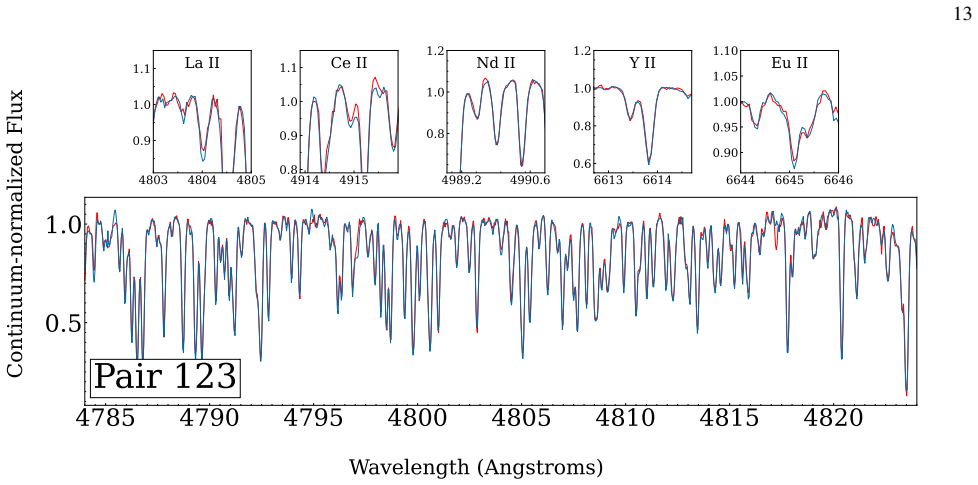
Summary. The paper identifies 25 pairs of APOGEE DR17 'chemical doppelgängers' (field pairs with a chi^2 chemical-similarity metric below the median intra-cluster value), obtains high-resolution optical Tull spectra, and performs a line-by-line differential abundance analysis for 21 elements, focusing on neutron-capture elements (Y, Zr, Ba, La, Ce, Nd, Eu) that APOGEE cannot measure precisely. The authors confirm that the pairs are generally indistinguishable in the light, alpha, odd-Z, and iron-peak elements used for selection, but find that most pairs differ by 0.02-0.05 dex in one or more s-process elements, with a few differences up to 0.38 dex, exceeding the scatter among M67 cluster pairs. They conclude that APOGEE abundances, even from SNR>300 spectra, are insufficient to establish full chemical similarity and that optical neutron-capture abundances add independent information.
Significance. If correct, this result is significant for chemical tagging, Galactic chemical evolution, and ISM mixing studies. The paper has notable strengths: the line-by-line differential method is standard and well suited to the question; the M67 open cluster provides an external homogeneity benchmark; the sample is drawn from high-SNR APOGEE spectra; and the comparison of optical Ce with APOGEE/BAWLAS Ce directly quantifies why APOGEE Ce is insufficient. The central conclusion is plausible and interesting. However, the analysis rests on adopting APOGEE Teff/logg without re-derivation, and the appendix itself flags a subset of pairs for which those parameters fail Fe excitation balance, with no quantitative test that this does not drive the claimed neutron-capture differences. That gap is load-bearing and needs to be closed before the headline result is fully supported.
major comments (3)
- [Appendix / §3.1] The appendix reports that 7/25 pairs require Teff shifts >25 K to satisfy Fe excitation balance, including ~130 K for Pair 35, yet the claim that 'we see no correlation between a lack of spectroscopic equilibrium satisfaction and the presence of significant s-process abundance differences' is unsupported by any test. Using Table 3's Ce II 4773.9 Å sensitivity (0.03 dex per 100 K in Teff), a 130 K shift changes Ce by ~0.04 dex, comparable to the average doppelgänger-vs-M67 excess (0.02–0.05 dex) and to typical element uncertainties. A quantitative test (e.g., correlation statistic, or re-derivation of Teff for affected pairs) is required to show the n-capture differences are not artifacts of adopted parameter mismatch.
- [§4.2 / Table 4] The paper does not tabulate the individual pair-by-pair abundance differences and their uncertainties. The central claims that 'none of the 25 pairs can be considered doppelgänger in all neutron-capture elements' and that 15, 19, 11, 12, 10 pairs differ in Y/Zr, Ba, La, Ce, and Nd, respectively, rely on per-pair values shown only in Figure 4. This is not reproducible or auditable. A machine-readable table with each pair's Δ[X/Fe], uncertainty, and number of lines should be provided.
- [§4.2.2 / §4.3 / Figure 6] The 'random chemically unrelated field pairs' comparison sample is constructed by recycling the doppelgänger sample and excluding doppelgänger combinations, and it does not impose the strict ΔTeff < 50 K and Δlogg < 0.1 dex cuts used for the doppelgängers. This makes the baseline dependent on the very sample it is meant to contrast and can bias the quoted 'distinguishing power' of each element. An independent field-pair sample with matched parameter cuts should be used.
minor comments (3)
- [Abstract / §1] The phrase 'APOGEE lacks access to strong lines of neutron-capture elements' is slightly misleading; APOGEE does have weak Ce, Nd, Rb, and Yb lines, but they are weak and imprecisely measured. Consider rewording to 'APOGEE has access to few, weak lines.'
- [Figure 4 / Table 4] Notation is inconsistent: Figure 4 uses 'M67 Doppelgangers' while Table 4 and the text use 'M67 pairs.' Unify the terminology. Also, the truncated rows in Table 2 (indicated by '..') must be fully expanded in the published version.
- [§5.3.1] The statement that '[C/N] and [α/Fe] ... are not as effective as [s/α or Al] at identifying coeval stars' is presented as a possibility, but the paper does not directly compare age estimates from [C/N] with those from s-process elements for these pairs. Soften the language or add a direct comparison.
Circularity Check
No significant circularity: optical neutron-capture abundances are new independent measurements benchmarked against M67; the APOGEE Teff caveat is a systematic-risk caveat, not a circular reduction.
full rationale
The paper's central measurement—optical line-by-line differential abundances of Y, Zr, Ba, La, Ce, Nd, and Eu—is independent of the APOGEE values used to select the doppelgängers. The Tull spectra are new data reduced with TSDRP, and abundances are fit with BACCHUS; the M67 cluster pairs provide an external homogeneity benchmark obtained with the same instrument and pipeline. The only APOGEE quantities entering the differential analysis are adopted Teff and logg (Section 3), which are not re-derived. The Appendix explicitly flags that 7/25 pairs require >25 K Teff shifts to satisfy Fe excitation balance and states without a quantitative test that this does not correlate with s-process differences; that is an unresolved systematic/correctness caveat, not a case of a prediction being equal to its input by construction. Including APOGEE Ce in the selection does not make the finding circular: the result is that optically measured Ce differences appear despite small APOGEE Ce differences, and the comparison of APOGEE/BAWLAS Ce precision (0.08–0.09 dex) to the measured optical differences (0.02–0.05 dex) is an independent empirical statement. The N18 doppelgänger definition is a self-cited convention, but it is only a sample-selection tool and is benchmarked against cluster pairs; the central claim does not rest on an unverified uniqueness theorem from the same authors. No equation equates the output to an input, and no fitted parameter is renamed as a prediction.
Assumptions & free parameters
assumptions (5)
- domain assumption 1D LTE MARCS model atmospheres and TURBOSPECTRUM synthesis are adequate for differential abundance analysis of red giants
- domain assumption APOGEE DR17 ASPCAP Teff and logg values and uncertainties are accurate enough as inputs to the differential analysis
- domain assumption Gaia-ESO linelist v5 atomic line data are sufficiently accurate for line-by-line differential analysis
- domain assumption M67 and NGC 6819 open clusters are representative of the chemical homogeneity of conatal stars
- ad hoc to paper The sensitivity of line abundances to stellar parameter perturbations estimated from five representative pairs (Pairs 1, 13, 29, 49, 52) applies to all pairs
Cite this review
Pith. "Pith review of Optical Spectroscopy Reveals Hidden Neutron-capture Elemental Abundance Differences among APOGEE-identified Chemical Doppelg\"angers." pith.science (2026). https://pith.science/paper/B2OEOJHH
@misc{pith2026250816717,
  author       = {Pith},
  title        = {Pith review of: Optical Spectroscopy Reveals Hidden Neutron-capture Elemental Abundance Differences among APOGEE-identified Chemical Doppelg\"angers},
  year         = {2026},
  howpublished = {\url{https://pith.science/paper/B2OEOJHH}},
  note         = {Machine review of arXiv:2508.16717}
}
abstract
Grouping stars by chemical similarity has the potential to reveal the Milky Way's evolutionary history. The APOGEE stellar spectroscopic survey has the resolution and sensitivity for this task. However, APOGEE lacks access to strong lines of neutron-capture elements ($Z > 28$) which have nucleosynthetic origins that are distinct from those of the lighter elements. We assess whether APOGEE abundances are sufficient for selecting chemically similar disk stars by identifying 25 pairs of chemical ``doppelgangers'' in APOGEE DR17 and following them up with the Tull spectrograph, an optical, $R \sim 60{,}000$ echelle on the McDonald Observatory 2.7-m telescope. Line-by-line differential analyses of pairs' optical spectra reveals neutron-capture (Y, Zr, Ba, La, Ce, Nd, and Eu) elemental abundance differences of $\Delta$[X/Fe] $\rm \sim 0.020 \pm 0.015$ to $0.380 \pm 0.15$ dex (4--140%), and up to 0.05 dex (12%) on average, a factor of 1--2 times higher than intra-cluster pairs. This is despite the pairs sharing nearly identical APOGEE-reported abundances and [C/N] ratios, a tracer of giant-star age. This work illustrates that even when APOGEE abundances derived from SNR $> 300$ spectra are available, optically-measured neutron-capture element abundances contain critical information about composition similarity. These results hold implications for the chemical dimensionality of the disk, mixing within the interstellar medium, and chemical tagging with the neutron-capture elements.
Figures


Figures from the paper (6 more)



Forward citations
Cited by 1 Pith paper
-
Milky Way Mapper decoded abundances -- I. Shared disc enrichment patterns
A data-driven decomposition of stellar abundance vectors into four latent patterns identifies distinct contributions from core-collapse supernovae, Type Ia supernovae, and AGB stars across the Milky Way disc.
Reference graph
Works this paper leans on
-
[1]
, " * write output.state after.block = add.period write newline
ENTRY address archivePrefix author booktitle chapter doi edition editor eprint howpublished institution journal key month number organization pages publisher school series title misctitle type volume year version url label extra.label sort.label short.list INTEGERS output.state before.all mid.sentence after.sentence after.block FUNCTION init.state.consts ...
-
[2]
write newline
" write newline "" before.all 'output.state := FUNCTION format.url url empty "" new.block "" url * "" * if FUNCTION format.eprint eprint empty "" archivePrefix empty "" archivePrefix "arXiv" = new.block " " eprint * " " * new.block " " eprint * " " * if if if FUNCTION format.doi doi empty "" " " doi * " " * if FUNCTION format.pid doi empty eprint empty ur...
-
[3]
thebibliography [1] 20pt to REFERENCES 6pt =0pt \@twocolumntrue 12pt -12pt 10pt plus 3pt =0pt =0pt =1pt plus 1pt =0pt =0pt -12pt =13pt plus 1pt =20pt =13pt plus 1pt \@M =10000 =-1.0em =0pt =0pt 0pt =0pt =1.0em @enumiv\@empty 10000 10000 `\.\@m \@noitemerr \@latex@warning Empty `thebibliography' environment \@ifnextchar \@reference \@latexerr Missing key o...
arXiv 2017
-
[4]
Abdurro'uf et al., 2022, @doi [ ] 10.3847/1538-4365/ac4414 , https://ui.adsabs.harvard.edu/abs/2022ApJS..259...35A 259, 35
-
[5]
Anders F., et al., 2014, @doi [ ] 10.1051/0004-6361/201323038 , https://ui.adsabs.harvard.edu/abs/2014A&A...564A.115A 564, A115
-
[6]
Armillotta L., Krumholz M. R., Fujimoto Y., 2018, @doi [ ] 10.1093/mnras/sty2625 , https://ui.adsabs.harvard.edu/abs/2018MNRAS.481.5000A 481, 5000
-
[7]
Astropy Collaboration et al., 2013, @doi [ ] 10.1051/0004-6361/201322068 , http://adsabs.harvard.edu/abs/2013A
-
[8]
Astropy Collaboration et al., 2018, @doi [ ] 10.3847/1538-3881/aabc4f , https://ui.adsabs.harvard.edu/abs/2018AJ....156..123A 156, 123
Show all 150 references
-
[9]
Astropy Collaboration et al., 2022, @doi [ ] 10.3847/1538-4357/ac7c74 , https://ui.adsabs.harvard.edu/abs/2022ApJ...935..167A 935, 167
2022 doi
-
[10]
Baratella M., et al., 2021, @doi [ ] 10.1051/0004-6361/202141069 , https://ui.adsabs.harvard.edu/abs/2021A&A...653A..67B 653, A67
2021 doi
-
[11]
Bedell M., et al., 2018, @doi [The Astrophysical Journal] 10.3847/1538-4357/aad908
2018 doi
-
[12]
W., Koposov S
Belokurov V., Erkal D., Evans N. W., Koposov S. E., Deason A. J., 2018, @doi [ ] 10.1093/mnras/sty982 , http://adsabs.harvard.edu/abs/2018MNRAS.478..611B 478, 611
2018 doi
-
[13]
Belokurov V., et al., 2020, @doi [ ] 10.1093/mnras/staa1522 , https://ui.adsabs.harvard.edu/abs/2020MNRAS.496.1922B 496, 1922
2020 doi
-
[14]
S., Yong D., Mel \'e ndez J., 2011, @doi [ ] 10.1088/2041-8205/735/2/L46 , https://ui.adsabs.harvard.edu/abs/2011ApJ...735L..46B 735, L46
Bensby T., Alves-Brito A., Oey M. S., Yong D., Mel \'e ndez J., 2011, @doi [ ] 10.1088/2041-8205/735/2/L46 , https://ui.adsabs.harvard.edu/abs/2011ApJ...735L..46B 735, L46
2011 doi
-
[15]
Bisterzo S., Pompeia L., Gallino R., Pignatari M., Cunha K., Heger A., Smith V., 2005, @doi [ ] 10.1016/j.nuclphysa.2005.05.049 , https://ui.adsabs.harvard.edu/abs/2005NuPhA.758..284B 758, 284
2005 doi
-
[16]
Bisterzo S., Travaglio C., Gallino R., Wiescher M., K \"a ppeler F., 2014, @doi [ ] 10.1088/0004-637X/787/1/10 , https://ui.adsabs.harvard.edu/abs/2014ApJ...787...10B 787, 10
2014 doi
-
[17]
R., Freeman K., 2010, @doi [ ] 10.1088/0004-637X/713/1/166 , https://ui.adsabs.harvard.edu/abs/2010ApJ...713..166B 713, 166
Bland-Hawthorn J., Krumholz M. R., Freeman K., 2010, @doi [ ] 10.1088/0004-637X/713/1/166 , https://ui.adsabs.harvard.edu/abs/2010ApJ...713..166B 713, 166
2010 doi
-
[18]
Bovy J., 2016, @doi [ ] 10.3847/0004-637X/817/1/49 , https://ui.adsabs.harvard.edu/abs/2016ApJ...817...49B 817, 49
2016 doi
-
[19]
W., Beers T
Bovy J., Rix H.-W., Liu C., Hogg D. W., Beers T. C., Lee Y. S., 2012, @doi [ ] 10.1088/0004-637X/753/2/148 , https://ui.adsabs.harvard.edu/abs/2012ApJ...753..148B 753, 148
2012 doi
-
[20]
K., Kallivayalil N., 2016, @doi [ ] 10.3847/1538-4357/833/1/31 , https://ui.adsabs.harvard.edu/abs/2016ApJ...833...31B 833, 31
Bovy J., Bahmanyar A., Fritz T. K., Kallivayalil N., 2016, @doi [ ] 10.3847/1538-4357/833/1/31 , https://ui.adsabs.harvard.edu/abs/2016ApJ...833...31B 833, 31
2016 doi
-
[21]
Buck T., 2020, @doi [ ] 10.1093/mnras/stz3289 , https://ui.adsabs.harvard.edu/abs/2020MNRAS.491.5435B 491, 5435
2020 doi
-
[22]
Buder S., et al., 2018, @doi [ ] 10.1093/mnras/sty1281 , https://ui.adsabs.harvard.edu/abs/2018MNRAS.478.4513B 478, 4513
2018 doi
-
[23]
Buder S., et al., 2021, @doi [ ] 10.1093/mnras/stab1242 , https://ui.adsabs.harvard.edu/abs/2021MNRAS.506..150B 506, 150
2021 doi
- [24]
-
[25]
Caffau E., et al., 2023, @doi [ ] 10.1093/mnras/stac3372 , https://ui.adsabs.harvard.edu/abs/2023MNRAS.518.3796C 518, 3796
2023 doi
-
[26]
Cantat-Gaudin T., et al., 2018, @doi [ ] 10.1051/0004-6361/201833476 , https://ui.adsabs.harvard.edu/abs/2018A&A...618A..93C 618, A93
2018 doi
- [27]
-
[28]
Carrillo A., Hawkins K., Jofr \'e P., de Brito Silva D., Das P., Lucey M., 2022, @doi [ ] 10.1093/mnras/stac518 , https://ui.adsabs.harvard.edu/abs/2022MNRAS.513.1557C 513, 1557
2022 doi
-
[29]
J., Fattahi A., Callingham T
Carrillo A., Deason A. J., Fattahi A., Callingham T. M., Grand R. J. J., 2024, @doi [ ] 10.1093/mnras/stad3274 , https://ui.adsabs.harvard.edu/abs/2024MNRAS.527.2165C 527, 2165
2024 doi
-
[30]
Casali G., et al., 2019, @doi [ ] 10.1051/0004-6361/201935282 , https://ui.adsabs.harvard.edu/abs/2019A&A...629A..62C 629, A62
2019 doi
-
[31]
Casali G., et al., 2020, @doi [ ] 10.1051/0004-6361/202038055 , https://ui.adsabs.harvard.edu/abs/2020A&A...639A.127C 639, A127
2020 doi
- [32]
-
[33]
arXiv:2103.14692
Casamiquela L., et al., 2021, arXiv e-prints, https://ui.adsabs.harvard.edu/abs/2021arXiv210314692C p. arXiv:2103.14692
2021 arXiv
-
[34]
M., Price-Jones N., Bovy J., 2021, @doi [ ] 10.1093/mnras/stab2106 , https://ui.adsabs.harvard.edu/abs/2021MNRAS.506.5573C 506, 5573
Cheng C. M., Price-Jones N., Bovy J., 2021, @doi [ ] 10.1093/mnras/stab2106 , https://ui.adsabs.harvard.edu/abs/2021MNRAS.506.5573C 506, 5573
2021 doi
-
[35]
Ciuc a I., et al., 2024, @doi [ ] 10.1093/mnrasl/slad033 , https://ui.adsabs.harvard.edu/abs/2024MNRAS.528L.122C 528, L122
2024 doi
-
[36]
L., Ritter C., Paul A., Wehmeyer B., O'Shea B
C \^o t \'e B., Belczynski K., Fryer C. L., Ritter C., Paul A., Wehmeyer B., O'Shea B. W., 2017, @doi [ ] 10.3847/1538-4357/aa5c8d , https://ui.adsabs.harvard.edu/abs/2017ApJ...836..230C 836, 230
2017 doi
-
[37]
C \^o t \'e B., et al., 2018, @doi [ ] 10.3847/1538-4357/aaad67 , https://ui.adsabs.harvard.edu/abs/2018ApJ...855...99C 855, 99
2018 doi
-
[38]
Cristallo S., et al., 2011, @doi [ ] 10.1088/0067-0049/197/2/17 , https://ui.adsabs.harvard.edu/abs/2011ApJS..197...17C 197, 17
2011 doi
-
[39]
Cristallo S., et al., 2018, @doi [ ] 10.3847/1538-4357/aac177 , https://ui.adsabs.harvard.edu/abs/2018ApJ...859..105C 859, 105
2018 doi
-
[40]
Cunha K., et al., 2017, @doi [ ] 10.3847/1538-4357/aa7beb , https://ui.adsabs.harvard.edu/abs/2017ApJ...844..145C 844, 145
2017 doi
-
[41]
Z., Sousa S
Delgado Mena E., Tsantaki M., Adibekyan V. Z., Sousa S. G., Santos N. C., Gonz \'a lez Hern \'a ndez J. I., Israelian G., 2017, @doi [ ] 10.1051/0004-6361/201730535 , https://ui.adsabs.harvard.edu/abs/2017A&A...606A..94D 606, A94
2017 doi
-
[42]
M., 2021, @doi [ ] 10.1093/mnras/stab323 , https://ui.adsabs.harvard.edu/abs/2021MNRAS.506.2269E 506, 2269
El-Badry K., Rix H.-W., Heintz T. M., 2021, @doi [ ] 10.1093/mnras/stab323 , https://ui.adsabs.harvard.edu/abs/2021MNRAS.506.2269E 506, 2269
2021 doi
-
[43]
L., Mac Low M.-M., 2020, @doi [ ] 10.3847/1538-4357/ab6efc , https://ui.adsabs.harvard.edu/abs/2020ApJ...890..155E 890, 155
Emerick A., Bryan G. L., Mac Low M.-M., 2020, @doi [ ] 10.3847/1538-4357/ab6efc , https://ui.adsabs.harvard.edu/abs/2020ApJ...890..155E 890, 155
2020 doi
-
[44]
R., 2014, @doi [ ] 10.1038/nature13662 , https://ui.adsabs.harvard.edu/abs/2014Natur.513..523F 513, 523
Feng Y., Krumholz M. R., 2014, @doi [ ] 10.1038/nature13662 , https://ui.adsabs.harvard.edu/abs/2014Natur.513..523F 513, 523
2014 doi
-
[45]
K., Feltzing S., Sahlholdt C., Bensby T., 2022, @doi [ ] 10.3847/1538-4357/ac76ba , https://ui.adsabs.harvard.edu/abs/2022ApJ...934...21F 934, 21
Feuillet D. K., Feltzing S., Sahlholdt C., Bensby T., 2022, @doi [ ] 10.3847/1538-4357/ac76ba , https://ui.adsabs.harvard.edu/abs/2022ApJ...934...21F 934, 21
2022 doi
- [46]
-
[47]
Freeman K., Bland-Hawthorn J., 2002, @doi [ ] 10.1146/annurev.astro.40.060401.093840 , http://adsabs.harvard.edu/abs/2002ARA
2002
-
[48]
Frischknecht U., et al., 2016, @doi [ ] 10.1093/mnras/stv2723 , https://ui.adsabs.harvard.edu/abs/2016MNRAS.456.1803F 456, 1803
2016 doi
-
[49]
Fuhrmann K., 1998, , https://ui.adsabs.harvard.edu/abs/1998A&A...338..161F 338, 161
1998
-
[50]
Gilmore G., et al., 2022, @doi [ ] 10.1051/0004-6361/202243134 , https://ui.adsabs.harvard.edu/abs/2022A&A...666A.120G 666, A120
2022 doi
-
[51]
L., Sarajedini A., eds, Astronomical Society of the Pacific Conference Series Vol
Gratton R., Carretta E., Matteucci F., Sneden C., 1996, in Morrison H. L., Sarajedini A., eds, Astronomical Society of the Pacific Conference Series Vol. 92, Formation of the Galactic Halo...Inside and Out. p. 307
1996
-
[52]
F., 2008, The Observation and Analysis of Stellar Photospheres
Gray D. F., 2008, The Observation and Analysis of Stellar Photospheres
2008
-
[53]
J., Weinberg D
Griffith E. J., Weinberg D. H., Buder S., Johnson J. A., Johnson J. W., Vincenzo F., 2022, @doi [ ] 10.3847/1538-4357/ac5826 , https://ui.adsabs.harvard.edu/abs/2022ApJ...931...23G 931, 23
2022 doi
- [54]
-
[55]
G., Nordlund A ., Plez B., 2008, @doi [ ] 10.1051/0004-6361:200809724 , https://ui.adsabs.harvard.edu/abs/2008A&A...486..951G 486, 951
Gustafsson B., Edvardsson B., Eriksson K., J rgensen U. G., Nordlund A ., Plez B., 2008, @doi [ ] 10.1051/0004-6361:200809724 , https://ui.adsabs.harvard.edu/abs/2008A&A...486..951G 486, 951
2008 doi
-
[56]
R., et al., 2020, @doi [Nature] 10.1038/s41586-020-2649-2 , 585, 357–362
Harris C. R., et al., 2020, @doi [Nature] 10.1038/s41586-020-2649-2 , 585, 357–362
2020 doi
-
[57]
Hasselquist S., et al., 2016, @doi [ ] 10.3847/1538-4357/833/1/81 , https://ui.adsabs.harvard.edu/abs/2016ApJ...833...81H 833, 81
2016 doi
-
[58]
Hawkins K., Masseron T., Jofr \'e P., Gilmore G., Elsworth Y., Hekker S., 2016, @doi [ ] 10.1051/0004-6361/201628812 , https://ui.adsabs.harvard.edu/abs/2016A&A...594A..43H 594, A43
2016 doi
-
[59]
Hawkins K., et al., 2020, @doi [ ] 10.1093/mnras/stz3132 , https://ui.adsabs.harvard.edu/abs/2020MNRAS.492.1164H 492, 1164
2020 doi
-
[60]
R., et al., 2015, @doi [ ] 10.1088/0004-637X/808/2/132 , http://adsabs.harvard.edu/abs/2015ApJ...808..132H 808, 132
Hayden M. R., et al., 2015, @doi [ ] 10.1088/0004-637X/808/2/132 , http://adsabs.harvard.edu/abs/2015ApJ...808..132H 808, 132
2015 doi
-
[61]
R., et al., 2018, @doi [ ] 10.3847/1538-4357/aa9cec , https://ui.adsabs.harvard.edu/abs/2018ApJ...852...49H 852, 49
Hayes C. R., et al., 2018, @doi [ ] 10.3847/1538-4357/aa9cec , https://ui.adsabs.harvard.edu/abs/2018ApJ...852...49H 852, 49
2018 doi
-
[62]
R., et al., 2022, @doi [ ] 10.3847/1538-4365/ac839f , https://ui.adsabs.harvard.edu/abs/2022ApJS..262...34H 262, 34
Hayes C. R., et al., 2022, @doi [ ] 10.3847/1538-4365/ac839f , https://ui.adsabs.harvard.edu/abs/2022ApJS..262...34H 262, 34
2022 doi
-
[63]
D., Snaith O., Khoperskov S., G \'o mez A., 2018, @doi [ ] 10.3847/1538-4357/aad235 , https://ui.adsabs.harvard.edu/abs/2018ApJ...863..113H 863, 113
Haywood M., Di Matteo P., Lehnert M. D., Snaith O., Khoperskov S., G \'o mez A., 2018, @doi [ ] 10.3847/1538-4357/aad235 , https://ui.adsabs.harvard.edu/abs/2018ApJ...863..113H 863, 113
2018 doi
-
[64]
S., Feuillet D., Garc \' a-Hern \'a ndez D
Heged u s V., M \'e sz \'a ros S., Jofr \'e P., Stringfellow G. S., Feuillet D., Garc \' a-Hern \'a ndez D. A., Nitschelm C., Zamora O., 2023, @doi [ ] 10.1051/0004-6361/202244813 , https://ui.adsabs.harvard.edu/abs/2023A&A...670A.107H 670, A107
2023 doi
-
[65]
Heil M., K \"a ppeler F., Uberseder E., Gallino R., Pignatari M., 2008, @doi [ ] 10.1103/PhysRevC.77.015808 , https://ui.adsabs.harvard.edu/abs/2008PhRvC..77a5808H 77, 015808
2008 doi
-
[66]
Heiter U., et al., 2021, @doi [ ] 10.1051/0004-6361/201936291 , https://ui.adsabs.harvard.edu/abs/2021A&A...645A.106H 645, A106
2021 doi
-
[67]
H., Massari D., Veljanoski J., Brown A
Helmi A., Babusiaux C., Koppelman H. H., Massari D., Veljanoski J., Brown A. G. A., 2018, @doi [ ] 10.1038/s41586-018-0625-x , http://adsabs.harvard.edu/abs/2018Natur.563...85H 563, 85
2018 doi
-
[68]
R., Ishimaru Y., Wanajo S., 2018, @doi [ ] 10.3847/1538-4357/aaaabc , https://ui.adsabs.harvard.edu/abs/2018ApJ...855...63H 855, 63
Hirai Y., Saitoh T. R., Ishimaru Y., Wanajo S., 2018, @doi [ ] 10.3847/1538-4357/aaaabc , https://ui.adsabs.harvard.edu/abs/2018ApJ...855...63H 855, 63
2018 doi
- [69]
-
[70]
M., Hogg D
Horta D., Price-Whelan A. M., Hogg D. W., Johnston K. V., Widrow L., Dalcanton J. J., Ness M. K., Hunt J. A. S., 2024, @doi [ ] 10.3847/1538-4357/ad16e8 , https://ui.adsabs.harvard.edu/abs/2024ApJ...962..165H 962, 165
2024 doi
-
[71]
D., 2007, @doi [Computing in Science and Engineering] 10.1109/MCSE.2007.55 , https://ui.adsabs.harvard.edu/abs/2007CSE.....9...90H 9, 90
Hunter J. D., 2007, @doi [Computing in Science and Engineering] 10.1109/MCSE.2007.55 , https://ui.adsabs.harvard.edu/abs/2007CSE.....9...90H 9, 90
2007 doi
-
[72]
Imig J., et al., 2023, @doi [ ] 10.3847/1538-4357/ace9b8 , https://ui.adsabs.harvard.edu/abs/2023ApJ...954..124I 954, 124
2023 doi
-
[73]
P., et al., 2020, @doi [ ] 10.3847/1538-4357/ab6213 , https://ui.adsabs.harvard.edu/abs/2020ApJ...889...27J 889, 27
Ji A. P., et al., 2020, @doi [ ] 10.3847/1538-4357/ab6213 , https://ui.adsabs.harvard.edu/abs/2020ApJ...889...27J 889, 27
2020 doi
-
[74]
Jofr \'e P., Heiter U., Soubiran C., 2019, @doi [ ] 10.1146/annurev-astro-091918-104509 , https://ui.adsabs.harvard.edu/abs/2019ARA&A..57..571J 57, 571
2019 doi
-
[75]
C., Gupta S
Jordan G. C., Gupta S. S., Meyer B. S., 2003, @doi [ ] 10.1103/PhysRevC.68.065801 , https://ui.adsabs.harvard.edu/abs/2003PhRvC..68f5801J 68, 065801
2003 doi
-
[76]
I., Lattanzio J
Karakas A. I., Lattanzio J. C., 2014, @doi [ ] 10.1017/pasa.2014.21 , https://ui.adsabs.harvard.edu/abs/2014PASA...31...30K 31, e030
2014 doi
-
[77]
I., Lugaro M., 2016, @doi [ ] 10.3847/0004-637X/825/1/26 , https://ui.adsabs.harvard.edu/abs/2016ApJ...825...26K 825, 26
Karakas A. I., Lugaro M., 2016, @doi [ ] 10.3847/0004-637X/825/1/26 , https://ui.adsabs.harvard.edu/abs/2016ApJ...825...26K 825, 26
2016 doi
-
[78]
Kobayashi C., Umeda H., Nomoto K., Tominaga N., Ohkubo T., 2006, @doi [ ] 10.1086/508914 , https://ui.adsabs.harvard.edu/abs/2006ApJ...653.1145K 653, 1145
2006 doi
-
[79]
I., Lugaro M., 2020, @doi [ ] 10.3847/1538-4357/abae65 , https://ui.adsabs.harvard.edu/abs/2020ApJ...900..179K 900, 179
Kobayashi C., Karakas A. I., Lugaro M., 2020, @doi [ ] 10.3847/1538-4357/abae65 , https://ui.adsabs.harvard.edu/abs/2020ApJ...900..179K 900, 179
2020 doi
-
[80]
Kos J., et al., 2021, @doi [ ] 10.1093/mnras/stab1767 , https://ui.adsabs.harvard.edu/abs/2021MNRAS.506.4232K 506, 4232
2021 doi
-
[81]
arXiv:2501.06140
Kos J., et al., 2025, @doi [arXiv e-prints] 10.48550/arXiv.2501.06140 , https://ui.adsabs.harvard.edu/abs/2025arXiv250106140K p. arXiv:2501.06140
2025 doi
-
[82]
R., Ting Y.-S., 2018, @doi [ ] 10.1093/mnras/stx3286 , https://ui.adsabs.harvard.edu/abs/2018MNRAS.475.2236K 475, 2236
Krumholz M. R., Ting Y.-S., 2018, @doi [ ] 10.1093/mnras/stx3286 , https://ui.adsabs.harvard.edu/abs/2018MNRAS.475.2236K 475, 2236
2018 doi
-
[83]
L., 1992
Kurucz R. L., 1992. pp 225--225
1992
-
[84]
Lian J., et al., 2022, @doi [ ] 10.1093/mnras/stac1151 , https://ui.adsabs.harvard.edu/abs/2022MNRAS.513.4130L 513, 4130
2022 doi
-
[85]
Limongi M., Chieffi A., 2018, @doi [ ] 10.3847/1538-4365/aacb24 , https://ui.adsabs.harvard.edu/abs/2018ApJS..237...13L 237, 13
2018 doi
-
[86]
I., Carlos M., Marino A
Liu F., Asplund M., Yong D., Mel \'e ndez J., Ram \' rez I., Karakas A. I., Carlos M., Marino A. F., 2016, @doi [ ] 10.1093/mnras/stw2045 , https://ui.adsabs.harvard.edu/abs/2016MNRAS.463..696L 463, 696
2016 doi
- [87]
-
[88]
T., Yong D., Ting Y.-S., Feltzing S., 2021, @doi [Monthly Notices of the Royal Astronomical Society] 10.1093/mnras/stab2471 , 508, 1227
Liu F., Bitsch B., Asplund M., Liu B.-B., Murphy M. T., Yong D., Ting Y.-S., Feltzing S., 2021, @doi [Monthly Notices of the Royal Astronomical Society] 10.1093/mnras/stab2471 , 508, 1227
2021 doi
-
[89]
Liu F., et al., 2024, @doi [ ] 10.1038/s41586-024-07091-y , https://ui.adsabs.harvard.edu/abs/2024Natur.627..501L 627, 501
2024 doi
-
[90]
I., 2012, @doi [ ] 10.1103/PhysRevC.85.065809 , https://ui.adsabs.harvard.edu/abs/2012PhRvC..85f5809L 85, 065809
Longland R., Iliadis C., Karakas A. I., 2012, @doi [ ] 10.1103/PhysRevC.85.065809 , https://ui.adsabs.harvard.edu/abs/2012PhRvC..85f5809L 85, 065809
2012 doi
-
[91]
K., 2022, @doi [ ] 10.1093/mnrasl/slac065 , https://ui.adsabs.harvard.edu/abs/2022MNRAS.515L..34L 515, L34
Lu Y., Buck T., Minchev I., Ness M. K., 2022, @doi [ ] 10.1093/mnrasl/slac065 , https://ui.adsabs.harvard.edu/abs/2022MNRAS.515L..34L 515, L34
2022 doi
-
[92]
R., et al., 2017, @doi [ ] 10.3847/1538-3881/aa784d , https://ui.adsabs.harvard.edu/abs/2017AJ....154...94M 154, 94
Majewski S. R., et al., 2017, @doi [ ] 10.3847/1538-3881/aa784d , https://ui.adsabs.harvard.edu/abs/2017AJ....154...94M 154, 94
2017 doi
- [93]
-
[94]
Masseron T., et al., 2014, @doi [ ] 10.1051/0004-6361/201423956 , https://ui.adsabs.harvard.edu/abs/2014A&A...571A..47M 571, A47
2014 doi
-
[95]
Masseron T., Merle T., Hawkins K., 2016, BACCHUS: Brussels Automatic Code for Characterizing High accUracy Spectra , Astrophysics Source Code Library, record ascl:1605.004
2016
-
[96]
M., Busson M., Gallino R., Gratton R., 1993, , https://ui.adsabs.harvard.edu/abs/1993A&A...272..421M 272, 421
Matteucci F., Raiteri C. M., Busson M., Gallino R., Gratton R., 1993, , https://ui.adsabs.harvard.edu/abs/1993A&A...272..421M 272, 421
1993
-
[97]
Matteucci F., Romano D., Arcones A., Korobkin O., Rosswog S., 2014, @doi [ ] 10.1093/mnras/stt2350 , https://ui.adsabs.harvard.edu/abs/2014MNRAS.438.2177M 438, 2177
2014 doi
- [98]
-
[99]
Mel \'e ndez J., et al., 2012, @doi [ ] 10.1051/0004-6361/201117222 , https://ui.adsabs.harvard.edu/abs/2012A&A...543A..29M 543, A29
2012 doi
-
[100]
R., Yong D., Ram \' rez I., Asplund M., 2014, @doi [ ] 10.1051/0004-6361/201424172 , https://ui.adsabs.harvard.edu/abs/2014A&A...567L...3M 567, L3
Mel \'e ndez J., Schirbel L., Monroe T. R., Yong D., Ram \' rez I., Asplund M., 2014, @doi [ ] 10.1051/0004-6361/201424172 , https://ui.adsabs.harvard.edu/abs/2014A&A...567L...3M 567, L3
2014 doi
-
[101]
Molero M., Magrini L., Matteucci F., Romano D., Palla M., Cescutti G., Viscasillas V \'a zquez C., Spitoni E., 2023, @doi [ ] 10.1093/mnras/stad1577 , https://ui.adsabs.harvard.edu/abs/2023MNRAS.523.2974M 523, 2974
2023 doi
-
[102]
Monty S., et al., 2024, @doi [ ] 10.1093/mnras/stae1895 , https://ui.adsabs.harvard.edu/abs/2024MNRAS.533.2420M 533, 2420
2024 doi
-
[103]
Nandakumar G., et al., 2022, @doi [ ] 10.1093/mnras/stac873 , https://ui.adsabs.harvard.edu/abs/2022MNRAS.513..232N 513, 232
2022 doi
-
[104]
Nelson T., Ting Y.-S., Hawkins K., Ji A., Kamdar H., El-Badry K., 2021, @doi [The Astrophysical Journal] 10.3847/1538-4357/ac14be , 921, 118
2021 doi
-
[105]
W., Rix H
Ness M., Hogg D. W., Rix H. W., Ho A. Y. Q., Zasowski G., 2015, @doi [ ] 10.1088/0004-637X/808/1/16 , https://ui.adsabs.harvard.edu/abs/2015ApJ...808...16N 808, 16
2015 doi
-
[106]
Ness M., et al., 2018, @doi [ ] 10.3847/1538-4357/aa9d8e , https://ui.adsabs.harvard.edu/abs/2018ApJ...853..198N 853, 198
2018 doi
-
[107]
K., Johnston K
Ness M. K., Johnston K. V., Blancato K., Rix H. W., Beane A., Bird J. C., Hawkins K., 2019, @doi [ ] 10.3847/1538-4357/ab3e3c , https://ui.adsabs.harvard.edu/abs/2019ApJ...883..177N 883, 177
2019 doi
-
[108]
E., 2015, @doi [ ] 10.1051/0004-6361/201526269 , https://ui.adsabs.harvard.edu/abs/2015A&A...579A..52N 579, A52
Nissen P. E., 2015, @doi [ ] 10.1051/0004-6361/201526269 , https://ui.adsabs.harvard.edu/abs/2015A&A...579A..52N 579, A52
2015 doi
-
[109]
E., Gustafsson B., 2018, @doi [Astronomy and Astrophysics Review] 10.1007/s00159-018-0111-3 , 26, 6
Nissen P. E., Gustafsson B., 2018, @doi [Astronomy and Astrophysics Review] 10.1007/s00159-018-0111-3 , 26, 6
2018 doi
-
[110]
Ortigoza-Urdaneta M., et al., 2023, @doi [ ] 10.1051/0004-6361/202346325 , https://ui.adsabs.harvard.edu/abs/2023A&A...676A.140O 676, A140
2023 doi
-
[111]
Pignatari M., Gallino R., Heil M., Wiescher M., K \"a ppeler F., Herwig F., Bisterzo S., 2010, @doi [ ] 10.1088/0004-637X/710/2/1557 , https://ui.adsabs.harvard.edu/abs/2010ApJ...710.1557P 710, 1557
2010 doi
-
[112]
Plez B., 2012, Turbospectrum: Code for spectral synthesis , Astrophysics Source Code Library, record ascl:1205.004
2012
-
[113]
J., et al., 2020, Technical report, Open Cluster Chemical Homogeneity Throughout the Milky Way
Poovelil V. J., et al., 2020, Technical report, Open Cluster Chemical Homogeneity Throughout the Milky Way . ( @eprint arXiv 2009.06777v1 )
2020 arXiv
-
[114]
Price-Jones N., et al., 2020, @doi [ ] 10.1093/mnras/staa1905 , https://ui.adsabs.harvard.edu/abs/2020MNRAS.496.5101P 496, 5101
2020 doi
-
[115]
M., et al., 2021, @doi [ ] 10.3847/1538-4357/abe1b7 , https://ui.adsabs.harvard.edu/abs/2021ApJ...910...17P 910, 17
Price-Whelan A. M., et al., 2021, @doi [ ] 10.3847/1538-4357/abe1b7 , https://ui.adsabs.harvard.edu/abs/2021ApJ...910...17P 910, 17
2021 doi
-
[117]
Randich S., et al., 2022b, @doi [ ] 10.1051/0004-6361/202243141 , https://ui.adsabs.harvard.edu/abs/2022A&A...666A.121R 666, A121
-
[118]
Ratcliffe B., Minchev I., Cescutti G., Spitoni E., J \"o nsson H., Anders F., Queiroz A., Steinmetz M., 2024, @doi [ ] 10.1093/mnras/stae226 , https://ui.adsabs.harvard.edu/abs/2024MNRAS.528.3464R 528, 3464
2024 doi
-
[119]
G., Cignoni M., 2021, @doi [ ] 10.3847/2041-8213/abd53d , https://ui.adsabs.harvard.edu/abs/2021ApJ...907L..16R 907, L16
Re Fiorentin P., Spagna A., Lattanzi M. G., Cignoni M., 2021, @doi [ ] 10.3847/2041-8213/abd53d , https://ui.adsabs.harvard.edu/abs/2021ApJ...907L..16R 907, L16
2021 doi
-
[120]
Reback J., et al., 2020, pandas-dev/pandas: Pandas 1.0.3 , @doi 10.5281/zenodo.3509134
2020 doi
-
[121]
Recio-Blanco A., Fern \'a ndez-Alvar E., de Laverny P., Antoja T., Helmi A., Crida A., 2021, @doi [ ] 10.1051/0004-6361/202038943 , https://ui.adsabs.harvard.edu/abs/2021A&A...648A.108R 648, A108
2021 doi
-
[122]
E., Tomkin J., Lambert D
Reddy B. E., Tomkin J., Lambert D. L., Allende Prieto C., 2003, @doi [ ] 10.1046/j.1365-8711.2003.06305.x , https://ui.adsabs.harvard.edu/abs/2003MNRAS.340..304R 340, 304
2003
-
[123]
G., 1952, @doi [ ] 10.1086/145598 , https://ui.adsabs.harvard.edu/abs/1952ApJ...116..122R 116, 122
Roman N. G., 1952, @doi [ ] 10.1086/145598 , https://ui.adsabs.harvard.edu/abs/1952ApJ...116..122R 116, 122
1952 doi
-
[124]
Serminato A., Gallino R., Travaglio C., Bisterzo S., Straniero O., 2009, @doi [ ] 10.1071/AS08053 , https://ui.adsabs.harvard.edu/abs/2009PASA...26..153S 26, 153
2009 doi
-
[125]
Shetrone M., et al., 2019, @doi [ ] 10.3847/1538-4357/aaff66 , https://ui.adsabs.harvard.edu/abs/2019ApJ...872..137S 872, 137
2019 doi
-
[126]
J., Collier J., Woolf V
Simmerer J., Sneden C., Cowan J. J., Collier J., Woolf V. M., Lawler J. E., 2004, @doi [ ] 10.1086/424504 , https://ui.adsabs.harvard.edu/abs/2004ApJ...617.1091S 617, 1091
2004 doi
-
[127]
Sinha A., Zasowski G., Frinchaboy P., Cunha K., Souto D., Tayar J., Stassun K., 2024, @doi [ ] 10.3847/1538-4357/ad78e1 , https://ui.adsabs.harvard.edu/abs/2024ApJ...975...89S 975, 89
2024 doi
-
[128]
G., Crocker D
Sneden C., Gratton R. G., Crocker D. A., 1991, , https://ui.adsabs.harvard.edu/abs/1991A&A...246..354S 246, 354
1991
-
[129]
Souto D., et al., 2018, @doi [ ] 10.3847/1538-4357/aab612 , https://ui.adsabs.harvard.edu/abs/2018ApJ...857...14S 857, 14
2018 doi
-
[130]
Souto D., et al., 2019, @doi [ ] 10.3847/1538-4357/ab0b43 , https://ui.adsabs.harvard.edu/abs/2019ApJ...874...97S 874, 97
2019 doi
-
[131]
I., Ram \' rez I., Monroe T
Spina L., Mel \'e ndez J., Karakas A. I., Ram \' rez I., Monroe T. R., Asplund M., Yong D., 2016, @doi [ ] 10.1051/0004-6361/201628557 , https://ui.adsabs.harvard.edu/abs/2016A&A...593A.125S 593, A125
2016 doi
-
[132]
Spina L., et al., 2018, @doi [ ] 10.1093/mnras/stx2938 , https://ui.adsabs.harvard.edu/abs/2018MNRAS.474.2580S 474, 2580
2018 doi
-
[133]
Spina L., et al., 2022, @doi [ ] 10.1051/0004-6361/202243316 , https://ui.adsabs.harvard.edu/abs/2022A&A...668A..16S 668, A16
2022 doi
-
[134]
Spoo T., Tayar J., Frinchaboy P., Cunha K., Myers N., Donor J., Majewski S., 2022, in American Astronomical Society Meeting \#240. p. 201.05
2022
-
[135]
X., et al., 2020, @doi [ ] 10.3847/1538-4357/abb1b7 , https://ui.adsabs.harvard.edu/abs/2020ApJ...903...12S 903, 12
Sun W. X., et al., 2020, @doi [ ] 10.3847/1538-4357/abb1b7 , https://ui.adsabs.harvard.edu/abs/2020ApJ...903...12S 903, 12
2020 doi
-
[136]
M., 1968, @doi [ ] 10.1086/149455 , https://ui.adsabs.harvard.edu/abs/1968ApJ...151..547T 151, 547
Tinsley B. M., 1968, @doi [ ] 10.1086/149455 , https://ui.adsabs.harvard.edu/abs/1968ApJ...151..547T 151, 547
1968 doi
-
[137]
M., 1979, @doi [ ] 10.1086/157039 , https://ui.adsabs.harvard.edu/abs/1979ApJ...229.1046T 229, 1046
Tinsley B. M., 1979, @doi [ ] 10.1086/157039 , https://ui.adsabs.harvard.edu/abs/1979ApJ...229.1046T 229, 1046
1979 doi
-
[138]
Travaglio C., Galli D., Gallino R., Busso M., Ferrini F., Straniero O., 1999, @doi [ ] 10.1086/307571 , https://ui.adsabs.harvard.edu/abs/1999ApJ...521..691T 521, 691
1999 doi
-
[139]
Travaglio C., Gallino R., Arnone E., Cowan J., Jordan F., Sneden C., 2004, @doi [ ] 10.1086/380507 , https://ui.adsabs.harvard.edu/abs/2004ApJ...601..864T 601, 864
2004 doi
-
[140]
G., MacQueen P
Tull R. G., MacQueen P. J., Sneden C., Lambert D. L., 1995, @doi [ ] 10.1086/133548 , https://ui.adsabs.harvard.edu/abs/1995PASP..107..251T 107, 251
1995 doi
-
[141]
Vincenzo F., Spitoni E., Calura F., Matteucci F., Silva Aguirre V., Miglio A., Cescutti G., 2019, @doi [ ] 10.1093/mnrasl/slz070 , https://ui.adsabs.harvard.edu/abs/2019MNRAS.487L..47V 487, L47
2019 doi
-
[142]
Virtanen P., et al., 2020, @doi [Nature Methods] 10.1038/s41592-019-0686-2 , https://rdcu.be/b08Wh 17, 261
2020 doi
-
[143]
L., Aguirre B rsen-Koch V., 2024, @doi [arXiv e-prints] 10.48550/arXiv.2401.02328 , https://ui.adsabs.harvard.edu/abs/2024arXiv240102328V p
Vitali S., Slumstrup D., Jofr \'e P., Casamiquela L., Korhonen H., Blanco-Cuaresma S., Winther M. L., Aguirre B rsen-Koch V., 2024, @doi [arXiv e-prints] 10.48550/arXiv.2401.02328 , https://ui.adsabs.harvard.edu/abs/2024arXiv240102328V p. arXiv:2401.02328
-
[144]
Wallerstein G., 1962, @doi [ ] 10.1086/190067 , https://ui.adsabs.harvard.edu/abs/1962ApJS....6..407W 6, 407
1962 doi
-
[145]
Winckler N., Dababneh S., Heil M., K \"a ppeler F., Gallino R., Pignatari M., 2006, @doi [ ] 10.1086/505026 , https://ui.adsabs.harvard.edu/abs/2006ApJ...647..685W 647, 685
2006 doi
-
[146]
E., Weaver T
Woosley S. E., Weaver T. A., 1995, @doi [ ] 10.1086/192237 , https://ui.adsabs.harvard.edu/abs/1995ApJS..101..181W 101, 181
1995 doi
-
[147]
Yong D., et al., 2013, @doi [Monthly Notices of the Royal Astronomical Society] 10.1093/mnras/stt1276 , 434, 3542
2013 doi
-
[148]
Yong D., et al., 2023, @doi [ ] 10.1093/mnras/stad2679 , https://ui.adsabs.harvard.edu/abs/2023MNRAS.526.2181Y 526, 2181
2023 doi
-
[149]
R., 2025, @doi [ ] 10.1093/mnras/staf194 , https://ui.adsabs.harvard.edu/abs/2025MNRAS.tmp..198Z
Zhang C., Li Z., Hu Z., Krumholz M. R., 2025, @doi [ ] 10.1093/mnras/staf194 , https://ui.adsabs.harvard.edu/abs/2025MNRAS.tmp..198Z
2025 doi
-
[150]
arXiv:2103.06377
de Mijolla D., Ness M., Viti S., Wheeler A., 2021, arXiv e-prints, https://ui.adsabs.harvard.edu/abs/2021arXiv210306377D p. arXiv:2103.06377
2021 arXiv
-
[151]
C., Varoquaux G., 2011, @doi [Computing in Science and Engineering] 10.1109/MCSE.2011.37 , https://ui.adsabs.harvard.edu/abs/2011CSE....13b..22V 13, 22
van der Walt S., Colbert S. C., Varoquaux G., 2011, @doi [Computing in Science and Engineering] 10.1109/MCSE.2011.37 , https://ui.adsabs.harvard.edu/abs/2011CSE....13b..22V 13, 22
2011 doi
Reviewed August 5, 2026 · model on record in the stance chip above.
Discussion (0). Sign in to comment.