REVIEW 2 major objections 5 minor 1 cited by
Gamma-ray Pulsar Emission is Mostly Stable on Timescales from Minutes to Years
T0 review · 2 major / 5 minor · reviewed 2026-08-05 · deepseek-v4-flash
Pith's one-line read Gamma-ray pulsars hold their brightness steady for years, a 115-pulsar study finds.
desk verdict A careful matched-filter search that rules out strong quasiperiodic switching in 115 gamma-ray pulsars; the 'mostly stable' headline is real but narrower than the abstract says. read the letter →
The pith
A machine-rendered reading of the paper's core claim, the machinery that carries it, and where it could break.
The reading
What carries the argument
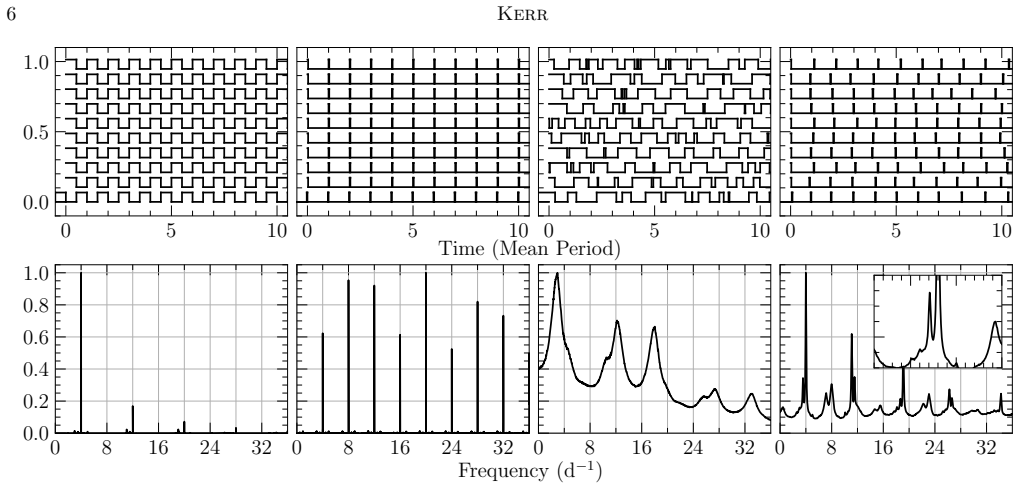
The central object is the matched-filter statistic C^2_D, built from the response function R(f): the expected power spectrum that a candidate flux-modulation process would produce after convolution with Fermi's exposure window. R(f) is computed by simulating the proposed two-state process many times and averaging the resulting spectra; C^2_D then weights the observed power spectrum by R(f), collecting spectral leakage that a plain peak search would miss. The variability model is an asymmetric, quasi-periodic square wave parameterized by modulation M, asymmetry A, and randomness Q, whose power-spectrum templates are approximated for four values of |A| and a grid of spectral widths. This machi
What would settle it
Re-analyze the marginal candidate PSR J0613-0200 with pulse-phase weighting and full background modeling: if its roughly 33/day quasi-periodic excess survives above 7 sigma, the claim that fast state changes are absent in the sample is wrong for at least one pulsar. Separately, compute R(f) for a state-switching process with unbounded residence times; if it yields a flat spectrum, the paper's limits do not cover the most aperiodic switching models.
Extended reading notes
Core claim
The central claim is that gamma-ray pulsar flux state changes are neither widespread nor strong. Using a two-state quasiperiodic square-wave model, parameterized by modulation strength M, asymmetry A, and randomness Q, the author builds matched filters that gather the power a true periodic signal would leak across Fermi's complicated exposure window. The search spans timescales from about 10 minutes to a few days, after slow variations are modeled and filtered with Bayesian blocks. No new state changes are found: slow flux variability is limited to the 10 percent level across the sample, fast variability to roughly 10-20 percent for nearly periodic switching, and full nulling is excluded in
Load-bearing premise
The search assumes real state-switching would leave a non-flat power spectrum, so a process whose states last for unbounded, aperiodic times could hide completely and the reported stability limits would not apply.
Editorial extensions
If this is right
- If gamma-ray flux traces spindown power, gamma-ray pulsars spend essentially all of their time in a force-free magnetosphere state, with excursions limited to 1-10 percent.
- PSR J2021+4026 remains the only known gamma-ray flux state changer, so any general theory of pulsar state changing must explain why this pulsar is unique among the brightest 115.
- The 0.1-10 percent spindown variations seen in radio pulsar timing are not accompanied by comparable gamma-ray flux changes on short timescales, suggesting those variations either operate on longer timescales or occur in regions that do not affect the gamma-ray-emitting magnetosphere.
- Substantial nulling of gamma-ray emission is excluded for nearly all of the sample, so gamma-ray pulsars do not null the way some radio pulsars do.
- Pulse-phase weighting should improve sensitivity by more than a factor of 3, allowing the best limits to be pushed below 1 percent and enabling searches for pulse-profile shape variations.
Reading between the lines
- The reported limits apply only to switching that is at least quasi-periodic; a magnetosphere that switched on unbounded, aperiodic residence times would leave a flat power spectrum and escape the matched filter, so the 'mostly stable' conclusion may not cover the most irregular state-changing process.
- If flux variations track spindown power, gamma-ray-bright pulsars' spin-down is now constrained to be stable on minute-to-day timescales, a new restriction on models that locate state-changing mechanisms near the polar cap rather than in the outer magnetosphere.
- The marginal fast-variability candidates, such as PSR J0613-0200 at about 33/day and PSR J1658-5324, are natural targets for the proposed pulse-phase-resolved analysis; if one survives full background modeling, the sample would not be perfectly stable.
- The same two-stage matched-filter framework could be extended to other Fermi LAT source classes, such as blazars or binary systems, where exposure leakage similarly limits searches for quasi-periodic flux modulation.
Editorial analysis
A structured set of objections, weighed in public.
Referee Report
Summary. The paper develops a two-stage search for flux variability in 115 bright gamma-ray pulsars using Fermi-LAT photon weights. Slow variability (timescales >= 2 weeks) is modeled and filtered with Bayesian blocks; fast variability (down to ~10 min) is searched with matched-filter statistics built from simulated response functions for a two-state quasiperiodic square-wave process with bounded random state durations. The author reports no confirmed new state changes, gives upper limits on modulation amplitude for the model family (typically <10%, and <=1% for the best cases), and interprets the null results as evidence that gamma-ray pulsar magnetospheres maintain a nearly constant single configuration. The paper is careful about exposure systematics (Appendix B), trial accounting, and sensitivity calibration, and it explicitly acknowledges in Section 7 that a state-switching process with unbounded residence times would evade the search.
Significance. If the central claim holds, this is a valuable ensemble result: it places the first sub-hour flux-variability constraints on a large sample of gamma-ray pulsars and substantially extends the parameter space probed by earlier slow-variability and single-pulse searches. The method itself is a useful contribution: the matched-filter aggregation of leaked power (Eq. 5) and the explicit response-function construction are sound, and the validation with injected signals (Figure 3) and the percent-level exposure agreement (Appendix B) are strengths. The upper limits on two-state quasiperiodic switching, especially the exclusion of strong nulling over most of the sample, are a concrete falsifiable result. The paper's astrophysical interpretation, however, is broader than the model family actually searched, and the abstract's 'no new instances' claim sits uneasily with the >7-sigma candidate excesses reported in Section 6.1.
major comments (2)
- [§7 and abstract] The caveat stated at the end of Section 7 — 'a state switching process with an unbounded maximum state residence time would evade detection' — is load-bearing for the headline conclusion. The model in Section 2 (Eqs. 1–4) has bounded uniform state durations (0≤W_f≤T_f, 0≤W_b≤T_b), and the search templates (Section 6 and Appendix A) cover only four asymmetry values |A|≤0.94 and harmonically structured spectra. Real state-changing phenomena cited in Section 1, such as mode changing, nulling, and intermittent pulsars, are often aperiodic and can have heavy-tailed or exponential residence times, whose power is mostly broadband and partially removed by the slow-variability filtering. Thus the abstract's 'wide range of possible state changing models' and 'variations of any sort to ≤1%' are not established for that model family. Please restrict the abstract and conclusions to the bounded quasip
- [§6.1, §6, and abstract] Several candidates exceed the adopted 7σ threshold: J1658−5324 at 8.5σ, J0218+4232 at 7.6σ, and J0613−0200 and J1816+4510 at 7.3σ. For J0613−0200 the text states there is 'no obvious background contamination,' and for J1658−5324 the excess is very broad. Calling the result 'no new instances of state changes' in the abstract is therefore overstated unless 'instances' means 'confirmed state changes after a more stringent criterion.' The paper should state the expected number of false positives under the quoted trial estimate, and either report these as candidate state changes or justify their assignment to background more explicitly, especially for J0613−0200 and J1658−5324.
minor comments (5)
- [§4, §5.3, §7, Figure 5] Typos: 'methodlogy' (Section 4), 'suparass' (Section 5.3), 'impossible to difficult' and 'pulars' (Section 7), and 'Cygnux X-3' (Figure 5 caption).
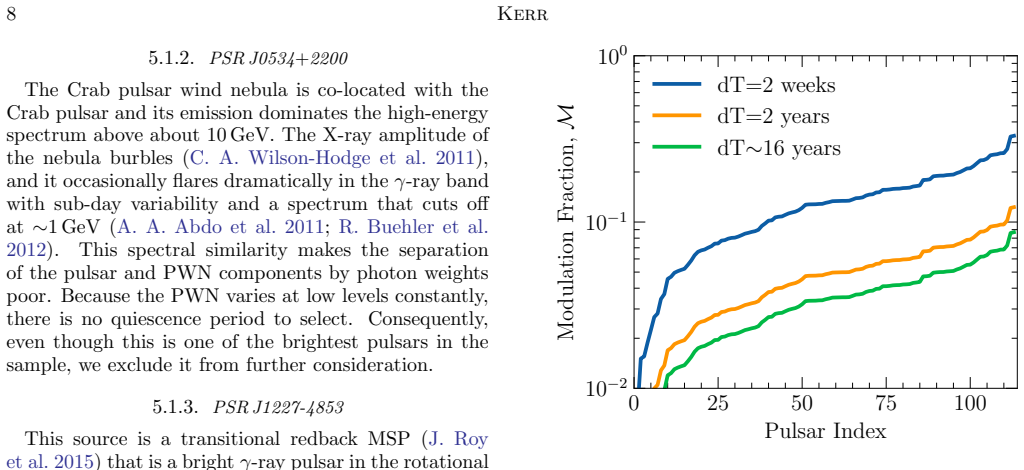
- [§5.3 and Figure 6] The slow-variability sensitivity estimate uses a generic σ_v for the modulation and then labels the limit 'M,' the same symbol as the two-state modulation factor in Eq. 1. Rename or explicitly distinguish this quantity to avoid conflating the slow and fast model families.
- [§4] The sentence 'We select the known γ-ray pulsars those that have a 4FGL-DR4...' is a grammatical fragment; please rephrase.
- [§2, after Eq. 3] The phrase 'low (infinite) variance in the A→1 (A→−1) limits' is confusingly worded; clarify that the variance diverges as A→−1 and vanishes as A→1.
- [Figure 9] The figure includes Q<1 cases labeled 'not meaningful.' Consider removing them or adding an explicit note that they are outside the physical range, so readers do not interpret them as valid templates.
Circularity Check
No circularity: limits are derived from forward simulations and null-hypothesis calibration, not from fitting; K19 citation is an independent tool.
full rationale
The central result is a null/upper-limit analysis. For fast variability, the statistic C_D (Eq. 5) is a matched filter that weights the observed Leahy-normalized power spectrum P(f) by response functions R(f) obtained by forward-simulating the assumed two-state quasiperiodic process and averaging the resulting power spectra (Section 3.2, Figure 4). Sensitivity limits (Figure 8) are computed by injecting the maximal modulation M=1, using the expectation CD(M=1), and solving Eq. 7 for the modulation M required to reach a 5-sigma threshold. The observed power spectra are compared to the chi-square null; no parameter is fitted to the data to produce the central limits. Slow variability uses Bayesian blocks against the constant hypothesis. The paper explicitly states in Section 7 that a state-switching process with unbounded maximum residence time would evade detection; this is a scope limitation, not a circular definition. K19 is self-cited for the weighted-power-spectrum estimator and exposure/godot tools, but that estimator is independently established prior work and is not used to define the target result. No reduction of the claim to its inputs occurs.
Assumptions & free parameters
free parameters (5)
- Bayesian blocks change-point prior exponent =
-10
- Fast variability trial-corrected detection threshold =
7 sigma
- Sensitivity reporting threshold =
2 sigma (slow), 5 sigma (fast)
- Model asymmetry grid =
|A| = 0, 0.5, 0.82, 0.94
- Spectral width grid =
W = 1 to 32768 bins in powers of 2
assumptions (7)
- domain assumption Two-state quasiperiodic square-wave model (Eqs. 1-4) with bounded state durations captures the relevant fast flux variability in gamma-ray pulsars.
- domain assumption Gamma-ray flux variations are a proxy for variations in spindown power Edot or particle acceleration.
- standard math The power spectrum estimator P(f) from K19 is chi-square distributed under the null hypothesis of a constant Poisson rate, with negligible off-diagonal covariance between Fourier modes.
- domain assumption The Fermi LAT exposure model (godot) is accurate at the percent level after the improvements described in Section 4.
- domain assumption Slow variability can be removed by Bayesian blocks and re-weighting so that residual leakage into the fast band is negligible.
- ad hoc to paper The spectral feature width scales as sigma_f proportional to f/Q^2, and Gaussian-plus-pedestal templates approximate exact response functions.
- domain assumption The sample of 115 pulsars with 4FGL TS > 1000 is representative enough for the conclusion about gamma-ray pulsar state changing.
Cite this review
Pith. "Pith review of Gamma-ray Pulsar Emission is Mostly Stable on Timescales from Minutes to Years." pith.science (2026). https://pith.science/paper/DCB7JBM4
@misc{pith2026250818195,
  author       = {Pith},
  title        = {Pith review of: Gamma-ray Pulsar Emission is Mostly Stable on Timescales from Minutes to Years},
  year         = {2026},
  howpublished = {\url{https://pith.science/paper/DCB7JBM4}},
  note         = {Machine review of arXiv:2508.18195}
}
abstract
We present a method for the detection and characterization of random changes in the flux from $\gamma$-ray pulsars on sub-hour timescales, much shorter than variations that can be accessed using direct flux measurements. Flux variations are a proxy for the variations in spindown power ($\dot{E}$) or particle acceleration, which can be produced by random switches between quasi-stable configurations of the pulsar magnetosphere. This technique therefore probes the stability of pulsar magnetospheres and discrete spindown states on timescales much shorter than can be achieved with pulsar timing. We apply the method to a sample of 115 bright $\gamma$-ray pulsars, finding no new instances of state changes. We derive the sensitivity of the method and find that, for a wide range of possible state changing models, over a wide range of timescales, we can limit the amplitude of flux ($\dot{E}$) variations to $<$10%. Substantial nulling is excluded in nearly all cases. The best cases limit variations of any sort to $\leq$1%. These results indicate that $\gamma$-ray pulsar magnetospheres maintain a single configuration or narrow range of configurations with nearly constant power output.
Figures


Figures from the paper (8 more)



Forward citations
Cited by 1 Pith paper
-
The SKAO Pulsar Timing Array
An SKAO PTA with ~174 millisecond pulsars can dominate nanohertz GW sensitivity within four years and enable continuous-wave detections plus anisotropy maps of the gravitational-wave background.
Reference graph
Works this paper leans on
-
[1]
A., Ackermann, M., Ajello, M., et al
Abdo, A. A., Ackermann, M., Ajello, M., et al. 2009, Science, 326, 1512, doi: 10.1126/science.1182174
-
[2]
A., Ackermann, M., Ajello, M., et al
Abdo, A. A., Ackermann, M., Ajello, M., et al. 2011, Science, 331, 739, doi: 10.1126/science.1199705
-
[3]
2020, ApJS, 247, 33, doi: 10.3847/1538-4365/ab6bcb
Abdollahi, S., Acero, F., Ackermann, M., et al. 2020, ApJS, 247, 33, doi: 10.3847/1538-4365/ab6bcb
-
[4]
2012, Science, 335, 189, doi: 10.1126/science.1213974
Ackermann, M., Ajello, M., Ballet, J., et al. 2012, Science, 335, 189, doi: 10.1126/science.1213974
-
[5]
Ajello, M., Atwood, W. B., Baldini, L., et al. 2022, Science, 376, 521, doi: 10.1126/science.abm3231
-
[6]
2013, ApJL, 777, L2, doi: 10.1088/2041-8205/777/1/L2
Allafort, A., Baldini, L., Ballet, J., et al. 2013, ApJL, 777, L2, doi: 10.1088/2041-8205/777/1/L2
-
[7]
2013, arXiv e-prints, arXiv:1303.3514
Atwood, W., Albert, A., Baldini, L., et al. 2013, arXiv e-prints, arXiv:1303.3514. https://arxiv.org/abs/1303.3514
arXiv 2013
-
[8]
Atwood, W. B., Abdo, A. A., Ackermann, M., et al. 2009, ApJ, 697, 1071, doi: 10.1088/0004-637X/697/2/1071
Show all 61 references
- [9]
-
[10]
Beloborodov, A. M. 2008, The Astrophysical Journal, 683, L41, doi: 10.1086/590079
2008 doi
-
[11]
2008, ApJ, 685, 384, doi: 10.1086/590399
Bickel, P., Kleijn, B., & Rice, J. 2008, ApJ, 685, 384, doi: 10.1086/590399
2008 doi
-
[12]
K., & Kazanas, D
Harding, A. K., & Kazanas, D. 2018, ApJ, 858, 81, doi: 10.3847/1538-4357/aab3e1
2018 doi
-
[13]
R., Karastergiou, A., Johnston, S., et al
Brook, P. R., Karastergiou, A., Johnston, S., et al. 2016, Monthly Notices of the Royal Astronomical Society, 456, 1374, doi: 10.1093/mnras/stv2715
2016 doi
-
[14]
H., Digel, S
Bruel, P., Burnett, T. H., Digel, S. W., et al. 2018, arXiv e-prints, arXiv:1810.11394. https://arxiv.org/abs/1810.11394
2018 arXiv
-
[15]
D., Blandford, R
Buehler, R., Scargle, J. D., Blandford, R. D., et al. 2012, ApJ, 749, 26, doi: 10.1088/0004-637X/749/1/26
2012 doi
-
[16]
2012, The Astrophysical Journal, 746, 63, doi: 10.1088/0004-637X/746/1/63
Demorest, P. 2012, The Astrophysical Journal, 746, 63, doi: 10.1088/0004-637X/746/1/63
2012 doi
-
[17]
2015, MNRAS, 448, 606, doi: 10.1093/mnras/stv042
Cerutti, B., Philippov, A., Parfrey, K., & Spitkovsky, A. 2015, MNRAS, 448, 606, doi: 10.1093/mnras/stv042
2015 doi
-
[18]
Y., & Beloborodov, A
Chen, A. Y., & Beloborodov, A. M. 2014, ApJL, 795, L22, doi: 10.1088/2041-8205/795/1/L22
2014 doi
-
[19]
Y., Cruz, F., & Spitkovsky, A
Chen, A. Y., Cruz, F., & Spitkovsky, A. 2020, ApJ, 889, 69, doi: 10.3847/1538-4357/ab5c20
2020 doi
-
[20]
J., Kerr, M., Barr, E
Clark, C. J., Kerr, M., Barr, E. D., et al. 2023, Nature Astronomy, 7, 451, doi: 10.1038/s41550-022-01874-x
2023 doi
-
[21]
1999, ApJ, 511, 351, doi: 10.1086/306652
Contopoulos, I., Kazanas, D., & Fendt, C. 1999, ApJ, 511, 351, doi: 10.1086/306652
1999 doi
-
[22]
Cordes, J. M. 2013, The Astrophysical Journal, 775, 47, doi: 10.1088/0004-637X/775/1/47
2013 doi
-
[23]
K., et al
Fiori, A., Razzano, M., Harding, A. K., et al. 2024, Astronomy and Astrophysics, 685, A70, doi: 10.1051/0004-6361/202348924 γ-ray pulsar variability 13
2024 doi
-
[24]
Goldreich, P., & Julian, W. H. 1969, The Astrophysical Journal, 157, 869, doi: 10.1086/150119
1969 doi
-
[25]
E., Lupsasca, A., & Philippov, A
Gralla, S. E., Lupsasca, A., & Philippov, A. 2017, The Astrophysical Journal, 851, 137, doi: 10.3847/1538-4357/aa978d
2017 doi
-
[26]
2023, The Astrophysical Journal, 943, 105, doi: 10.3847/1538-4357/acab05
Hakobyan, H., Philippov, A., & Spitkovsky, A. 2023, The Astrophysical Journal, 943, 105, doi: 10.3847/1538-4357/acab05
2023 doi
-
[27]
Hermsen, W., Hessels, J. W. T., Kuiper, L., et al. 2013, Science, 339, 436, doi: 10.1126/science.1230960
2013 doi
-
[28]
Hermsen, W., Kuiper, L., Hessels, J. W. T., et al. 2017, Monthly Notices of the Royal Astronomical Society, 466, 1688, doi: 10.1093/mnras/stw3135
2017 doi
-
[29]
J., Ray, P
Johnson, T. J., Ray, P. S., Roy, J., et al. 2015, ApJ, 806, 91, doi: 10.1088/0004-637X/806/1/91
2015 doi
-
[30]
2011, ApJ, 732, 38, doi: 10.1088/0004-637X/732/1/38
Kerr, M. 2011, ApJ, 732, 38, doi: 10.1088/0004-637X/732/1/38
2011 doi
-
[31]
2019, ApJ, 885, 92, doi: 10.3847/1538-4357/ab459f
Kerr, M. 2019, ApJ, 885, 92, doi: 10.3847/1538-4357/ab459f
2019 doi
-
[32]
2022, ApJ, 934, 30, doi: 10.3847/1538-4357/ac7877
Kerr, M. 2022, ApJ, 934, 30, doi: 10.3847/1538-4357/ac7877
2022 doi
-
[33]
Kerr, M., Hobbs, G., Johnston, S., & Shannon, R. M. 2016, MNRAS, 455, 1845, doi: 10.1093/mnras/stv2457
2016 doi
-
[34]
M., et al
Kerr, M., Hobbs, G., Shannon, R. M., et al. 2014, MNRAS, 445, 320, doi: 10.1093/mnras/stu1716
2014 doi
-
[35]
J., et al
Kerr, M., Camilo, F., Johnson, T. J., et al. 2012, ApJL, 748, L2, doi: 10.1088/2041-8205/748/1/L2
2012 doi
-
[36]
Lorimer, D. R. 2006, Science, 312, 549, doi: 10.1126/science.1124060
2006 doi
-
[37]
Krause-Polstorff, J., & Michel, F. C. 1985, MNRAS, 213, 43, doi: 10.1093/mnras/213.1.43P
1985 doi
-
[38]
E., Johnston, S., Karastergiou, A., et al
Lower, M. E., Johnston, S., Karastergiou, A., et al. 2023, Monthly Notices of the Royal Astronomical Society, 524, 5904, doi: 10.1093/mnras/stad2243
2023 doi
- [39]
-
[40]
2010, Science, 329, 408, doi: 10.1126/science.1186683
Lyne, A., Hobbs, G., Kramer, M., Stairs, I., & Stappers, B. 2010, Science, 329, 408, doi: 10.1126/science.1186683
2010 doi
-
[41]
G., Stappers, B
Lyne, A. G., Stappers, B. W., Freire, P. C. C., et al. 2017, The Astrophysical Journal, 834, 72, doi: 10.3847/1538-4357/834/1/72
2017 doi
-
[42]
2014, Monthly Notices of the Royal Astronomical Society, 437, 21, doi: 10.1093/mnras/stt1828
Melatos, A., & Link, B. 2014, Monthly Notices of the Royal Astronomical Society, 437, 21, doi: 10.1093/mnras/stt1828
2014 doi
-
[43]
2022, Annual Review of Astronomy and Astrophysics, 60, 495, doi: 10.1146/annurev-astro-052920-112338
Philippov, A., & Kramer, M. 2022, Annual Review of Astronomy and Astrophysics, 60, 495, doi: 10.1146/annurev-astro-052920-112338
2022 doi
-
[44]
2020, Physical Review Letters, 124, 245101, doi: 10.1103/PhysRevLett.124.245101
Philippov, A., Timokhin, A., & Spitkovsky, A. 2020, Physical Review Letters, 124, 245101, doi: 10.1103/PhysRevLett.124.245101
2020 doi
-
[45]
A., & Spitkovsky, A
Philippov, A. A., & Spitkovsky, A. 2014, The Astrophysical Journal, 785, L33, doi: 10.1088/2041-8205/785/2/L33
2014 doi
-
[46]
A., & Spitkovsky, A
Philippov, A. A., & Spitkovsky, A. 2018, ApJ, 855, 94, doi: 10.3847/1538-4357/aaabbc
2018 doi
-
[47]
A., Spitkovsky, A., & Cerutti, B
Philippov, A. A., Spitkovsky, A., & Cerutti, B. 2015, ApJL, 801, L19, doi: 10.1088/2041-8205/801/1/L19
2015 doi
-
[48]
M., et al
Razzano, M., Fiori, A., Saz Parkinson, P. M., et al. 2023, Astronomy and Astrophysics, 676, A91, doi: 10.1051/0004-6361/202345873
2023 doi
-
[49]
S., Bhattacharyya, B., et al
Roy, J., Ray, P. S., Bhattacharyya, B., et al. 2015, ApJL, 800, L12, doi: 10.1088/2041-8205/800/1/L12
2015 doi
-
[50]
Scargle, J. D. 1998, ApJ, 504, 405, doi: 10.1086/306064
1998 doi
-
[51]
D., Norris, J
Scargle, J. D., Norris, J. P., Jackson, B., & Chiang, J. 2013, ApJ, 764, 167, doi: 10.1088/0004-637X/764/2/167
2013 doi
-
[52]
W., Weltevrede, P., et al
Shaw, B., Stappers, B. W., Weltevrede, P., et al. 2022, Monthly Notices of the Royal Astronomical Society, 513, 5861, doi: 10.1093/mnras/stac1156
2022 doi
-
[53]
A., Abdollahi, S., Ajello, M., et al
Smith, D. A., Abdollahi, S., Ajello, M., et al. 2023, ApJS
2023
-
[54]
2024, Scaling up global kinetic models of pulsar magnetospheres using a hybrid force-free-PIC numerical approach, doi: 10.48550/arXiv.2406.14512
Soudais, A., Cerutti, B., & Contopoulos, I. 2024, Scaling up global kinetic models of pulsar magnetospheres using a hybrid force-free-PIC numerical approach, doi: 10.48550/arXiv.2406.14512
-
[55]
2006, ApJL, 648, L51, doi: 10.1086/507518
Spitkovsky, A. 2006, ApJL, 648, L51, doi: 10.1086/507518
2006 doi
-
[56]
2002, in Astronomical Society of the Pacific Conference Series, Vol
Spitkovsky, A., & Arons, J. 2002, in Astronomical Society of the Pacific Conference Series, Vol. 271, Neutron Stars in Supernova Remnants, ed. P. O. Slane & B. M. Gaensler, 81, doi: 10.48550/arXiv.astro-ph/0201360 The Fermi LAT Collaboration, Ajello, M., Axelsson, M., et al. 2...
-
[57]
Timokhin, A. N. 2006, MNRAS, 368, 1055, doi: 10.1111/j.1365-2966.2006.10192.x
2006
-
[58]
Timokhin, A. N. 2010, MNRAS, 408, L41, doi: 10.1111/j.1745-3933.2010.00924.x
2010
-
[59]
N., & Arons, J
Timokhin, A. N., & Arons, J. 2013, MNRAS, 429, 20, doi: 10.1093/mnras/sts298
2013 doi
-
[60]
N., & Johnston, S
Wang, N., Manchester, R. N., & Johnston, S. 2007, MNRAS, 377, 1383, doi: 10.1111/j.1365-2966.2007.11703.x
2007
-
[61]
A., Cherry, M
Wilson-Hodge, C. A., Cherry, M. L., Case, G. L., et al. 2011, ApJL, 727, L40, doi: 10.1088/2041-8205/727/2/L40 14 Kerr APPENDIX A. APPROXIMATING MATCHED FILTERS Recall that the degree of randomness in the pulsar variability model is governed by Q ≡ (Tf + Tb)/(Wf + Wb). This ra...
2011 doi
Reviewed August 5, 2026 · model on record in the stance chip above.
Discussion (0). Sign in to comment.