Bifurcation and stability of stationary shear flows of Ericksen-Leslie model for nematic liquid crystals
Pith reviewed 2026-05-18 20:53 UTC · model grok-4.3
The pith
Under a generic condition the zero eigenvalue at critical stationary shear flows splits to negative on one branch and positive on the other as shear speed increases.
A machine-rendered reading of the paper's core claim, the machinery that carries it, and where it could break.
Core claim
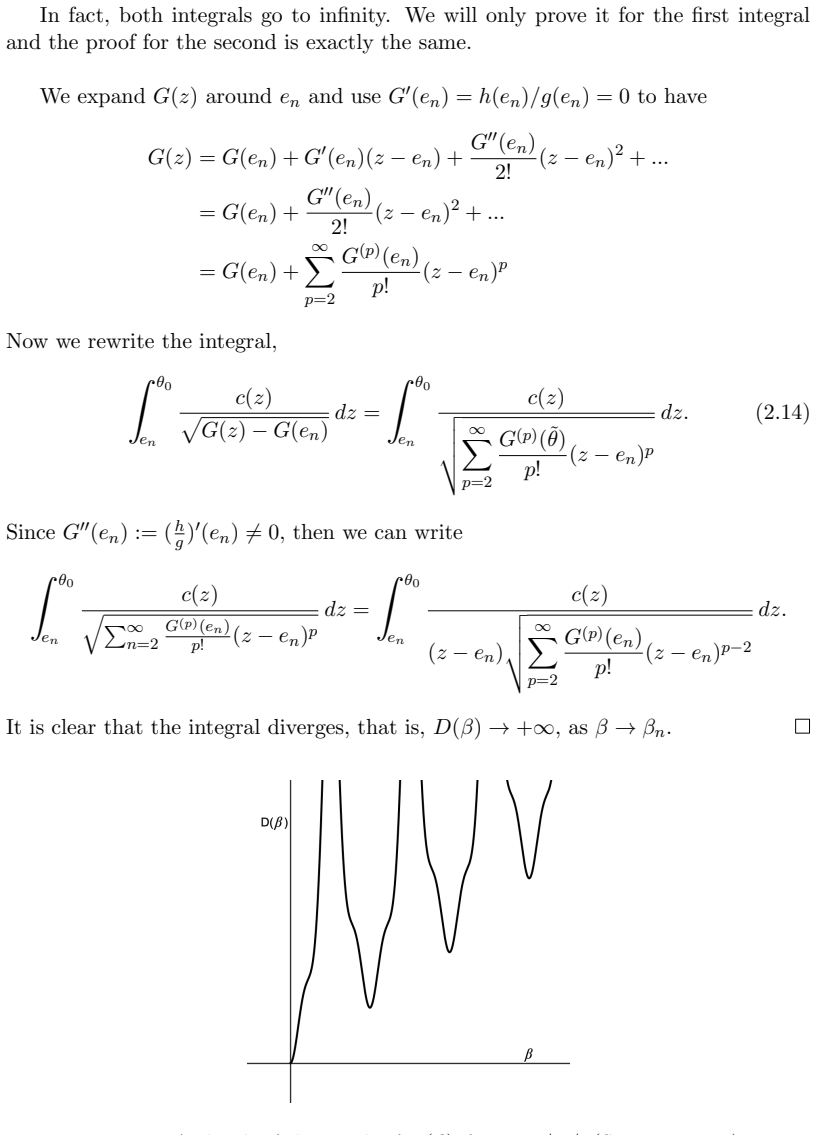
Stationary solutions of the Ericksen-Leslie system stand in one-to-one correspondence with solutions of an algebraic equation in the cusp case. Multiple solutions arise through countably many saddle-node bifurcations at critical shear speeds. At each critical value there is a unique stationary solution whose linearization possesses a simple zero eigenvalue under a generic condition. For shear speeds larger than critical this zero eigenvalue bifurcates to a negative eigenvalue along one branch and a positive eigenvalue along the other branch.
What carries the argument
The one-to-one correspondence between stationary solutions of the Ericksen-Leslie system and roots of the associated algebraic equation, used to locate saddle-node bifurcations and to track the splitting of a simple zero eigenvalue in the linearized operator.
If this is right
- Pairs of stationary solutions are born at each critical shear speed through saddle-node bifurcations.
- For shear speeds below a critical value the corresponding stationary solution ceases to exist.
- One of the two solutions that exist above the critical speed is linearly stable while the other is linearly unstable.
- The stability exchange is controlled by the sign change of the bifurcated eigenvalue.
Where Pith is reading between the lines
- The same algebraic reduction may allow explicit tracking of the time-dependent orbits that connect the stable and unstable branches after the bifurcation.
- The generic condition is likely satisfied for an open set of physical parameters in the Ericksen-Leslie model, making the stability switch observable in many regimes.
- Analogous eigenvalue-splitting mechanisms could appear in other director-field models of non-Newtonian fluids once a similar algebraic reduction is performed.
Load-bearing premise
The generic condition that guarantees the zero eigenvalue at each critical stationary solution is simple and splits in the stated manner.
What would settle it
Numerical computation of the spectrum of the linearized operator at a point slightly beyond a critical shear speed, checking whether one eigenvalue crosses to negative values on one branch while the other crosses to positive values on the remaining branch.
Figures


read the original abstract
In this work, focusing on a critical case for shear flows of nematic liquid crystals, we investigate multiplicity and stability of stationary solutions via the parabolic Ericksen-Leslie system. We establish a one-to-one correspondence between the set of the stationary solutions with the set of the solutions of an algebraic equation for a cusp case. This one-to-one correspondence is established essentially based on the treatment in the work of Jiao, et. al. [{\em J. Diff. Dyn. Syst. {\bf 34} (2022), 239-269}] for a different case, and the relation gives directly parameter ranges for existence of multiple stationary solutions; in particular, multiple stationary solutions are created through countably many saddle-node bifurcations for the algebraic equation at critical shear speeds. The main result of the paper is on the stability of stationary solutions associated to the bifurcations; more precisely, (i) for each critical shear speed, there is a unique stationary solution and, for smaller shear speed, the stationary solution disappears but, for larger shear speed, two stationary solutions nearby bifurcate; (ii) more importantly, under a generic condition, there is a simple zero eigenvalue for the linearization of the shear flow at the critical stationary solution and, for larger shear speed, the zero eigenvalue bifurcates to a negative eigenvalue for one of the two stationary solutions and to a positive eigenvalue for the other stationary solution.
Editorial analysis
A structured set of objections, weighed in public.
Referee Report
Summary. The manuscript examines multiplicity and stability of stationary shear flows for the parabolic Ericksen-Leslie system in a critical regime. It establishes a one-to-one correspondence between stationary solutions of the PDE and roots of an algebraic equation (adapting the treatment of Jiao et al. 2022), implying countably many saddle-node bifurcations at critical shear speeds. The central claim is that, under a generic condition, the linearization at each critical stationary solution has a simple zero eigenvalue; for larger shear speeds this eigenvalue splits into a negative eigenvalue on one bifurcating branch and a positive eigenvalue on the other.
Significance. If the reduction to the algebraic equation and the spectral analysis hold, the work supplies explicit parameter ranges for multiple stationary solutions and determines their stability via eigenvalue splitting. This extends prior results on non-critical cases to the critical shear-flow regime and yields concrete predictions about which branch is stable after each saddle-node bifurcation.
major comments (2)
- [Abstract and stability analysis] Abstract (final paragraph) and the stability analysis section: the generic condition guaranteeing that the zero eigenvalue at the critical stationary solution is simple and that the splitting occurs with the stated signs is invoked but not verified explicitly for the Ericksen-Leslie linearization. The reduction via the algebraic equation from Jiao et al. does not automatically rule out continuous-spectrum contributions or non-local terms that could affect simplicity or the sign of the splitting in the critical regime.
- [Section establishing the one-to-one correspondence] The correspondence between stationary solutions and algebraic roots is asserted to be one-to-one, but the manuscript does not supply an explicit algebraic equation or the full details of the adaptation from Jiao et al.; without these, it is impossible to confirm that the transversality condition transfers directly to the spectrum of the full parabolic operator.
minor comments (2)
- [Model formulation] Notation for the director field and velocity components should be introduced once at the beginning of the model section and used consistently thereafter.
- [Introduction] The citation to Jiao et al. (2022) is given, but the precise theorem or equation number from that reference that is being adapted should be stated explicitly.
Simulated Author's Rebuttal
We thank the referee for the careful reading of our manuscript and the constructive comments. We address each major comment below and indicate the changes planned for the revised version.
read point-by-point responses
-
Referee: [Abstract and stability analysis] Abstract (final paragraph) and the stability analysis section: the generic condition guaranteeing that the zero eigenvalue at the critical stationary solution is simple and that the splitting occurs with the stated signs is invoked but not verified explicitly for the Ericksen-Leslie linearization. The reduction via the algebraic equation from Jiao et al. does not automatically rule out continuous-spectrum contributions or non-local terms that could affect simplicity or the sign of the splitting in the critical regime.
Authors: We agree that an explicit verification of the generic condition is desirable to make the spectral analysis fully self-contained. In the revised manuscript we will add a dedicated subsection that computes the linearized operator at the critical stationary solution, confirms that the zero eigenvalue is algebraically simple under the generic condition, and shows that the essential spectrum lies strictly in the left half-plane. This will be done by adapting the resolvent estimates from the non-critical case in Jiao et al. to the critical regime and verifying that no continuous-spectrum or non-local contributions cross the imaginary axis at the bifurcation point. The sign of the eigenvalue splitting on each branch will then follow from the standard transversality argument once simplicity is established. revision: yes
-
Referee: [Section establishing the one-to-one correspondence] The correspondence between stationary solutions and algebraic roots is asserted to be one-to-one, but the manuscript does not supply an explicit algebraic equation or the full details of the adaptation from Jiao et al.; without these, it is impossible to confirm that the transversality condition transfers directly to the spectrum of the full parabolic operator.
Authors: We accept that the explicit algebraic equation and the detailed adaptation steps were omitted in the interest of brevity. In the revision we will insert the precise algebraic equation obtained after integrating the stationary Ericksen-Leslie system in the critical regime, together with a concise outline of the changes needed from the treatment in Jiao et al. This will include verification that the one-to-one correspondence maps simple roots of the algebraic equation to isolated eigenvalues of the parabolic linearization and that the transversality condition (non-vanishing derivative of the algebraic function) directly implies the required spectral gap, with the remainder of the spectrum controlled by the dissipative structure of the system. revision: yes
Circularity Check
No significant circularity; derivation relies on external citation and stated generic assumption
full rationale
The paper establishes the one-to-one correspondence between stationary solutions of the Ericksen-Leslie system and roots of an algebraic equation by explicitly citing the treatment in Jiao et al. (2022) for a different case, which supplies independent external grounding rather than a self-referential reduction. The central stability result (simple zero eigenvalue at the critical solution that splits under larger shear speed) is conditioned on a generic assumption whose verification is left as an external check on the linearization; no parameters are fitted to the target spectrum and then relabeled as predictions, no uniqueness theorem is imported from the authors' own prior work, and no ansatz is smuggled via self-citation. The derivation therefore remains self-contained against external benchmarks and does not reduce to its inputs by construction.
Axiom & Free-Parameter Ledger
axioms (1)
- standard math Standard results from bifurcation theory and linearization for parabolic systems apply to the stationary Ericksen-Leslie equations.
Lean theorems connected to this paper
-
IndisputableMonolith/Cost/FunctionalEquation.leanwashburn_uniqueness_aczel unclear?
unclearRelation between the paper passage and the cited Recognition theorem.
under a generic condition, there is a simple zero eigenvalue for the linearization of the shear flow at the critical stationary solution and, for larger shear speed, the zero eigenvalue bifurcates to a negative eigenvalue for one of the two stationary solutions and to a positive eigenvalue for the other
-
IndisputableMonolith/Foundation/ArithmeticFromLogic.leanLogicNat_equiv_Nat unclear?
unclearRelation between the paper passage and the cited Recognition theorem.
one-to-one correspondence between the set of the stationary solutions with the set of the solutions of an algebraic equation for a cusp case
What do these tags mean?
- matches
- The paper's claim is directly supported by a theorem in the formal canon.
- supports
- The theorem supports part of the paper's argument, but the paper may add assumptions or extra steps.
- extends
- The paper goes beyond the formal theorem; the theorem is a base layer rather than the whole result.
- uses
- The paper appears to rely on the theorem as machinery.
- contradicts
- The paper's claim conflicts with a theorem or certificate in the canon.
- unclear
- Pith found a possible connection, but the passage is too broad, indirect, or ambiguous to say the theorem truly supports the claim.
Reference graph
Works this paper leans on
-
[1]
M. Calderer and C. Liu. Liquid crystal flow: Dynamic and static configurations. SIAM J. Appl. Math , 60:1925–1949, 2000
work page 1925
-
[2]
G. Chen, Y. Hu, and Q. Zhang. Initial-boundary value problems for poiseuille flow of nematic liquid crystal via full Ericksen–Leslie model. SIAM Journal on Mathematical Analysis, 56(2):1809–1850, 2024
work page 2024
-
[3]
G. Chen, T. Huang, and W. Liu. Poiseuille flow of nematic liquid crystals via the full Ericksen-Leslie model. Arch. Ration. Mech. Anal , 236(no. 2):839–891, 2020
work page 2020
-
[4]
G. Chen, T. Huang, and X. Xu. Singularity formation for full ericksen–leslie system of nematic liquid crystal flows in dimension two. SIAM Journal on Math- ematical Analysis, 56(3):3968–4005, 2024
work page 2024
-
[5]
G. Chen, W. Liu, and M. Sofiani. The poiseuille flow of the full ericksen-leslie model for nematic liquid crystals: The general case. Journal of Differential Equations, 376:538–573, 2023
work page 2023
-
[6]
G. Chen and M. Sofiani. Singularity formation for the general poiseuille flow of nematic liquid crystals. Communications on Applied Mathematics and Compu- tation, pages 1–18, 2022
work page 2022
-
[7]
T. Dorn and W. Liu. Steady-states for shear flows of a liquid-crystal model: Mul- tiplicity, stability, and hysteresis. J. Differential Equations , 253(no. 12):3184– 3210, 2012
work page 2012
- [8]
-
[9]
J. L. Ericksen. Hydrostatic theory of liquid crystals. Arch. Ration. Mech. Anal, 9:371–378, 1962
work page 1962
-
[10]
J. L. Ericksen. Equilibrium theory of liquid crystals. In Advances in Liquid Crystals, pages 233–298. G. H. Brown, ed.), Vol. 2,. Academic Press, New York, 1976
work page 1976
-
[11]
F. C. Frank and I. Liquid Crystals. On the theory of liquid crystals. Discussions of the Faraday Society, 25:19–28, 1958
work page 1958
-
[12]
P. G. De Gennes and J. Prost. The Physics of Liquid Crystals . International Series of Monographs on Physics, 83, Oxford Science Publications, 2nd edition, 1995
work page 1995
-
[13]
J. Jiao, K. Huang, and W. Liu. Stationary shear flows of nematic liquid crystals: A comprehensive study via Ericksen-Leslie model. J. Dynam. Diff. Equations , 253(no. 34):239–269, 2022
work page 2022
-
[14]
F. M. Leslie. Some thermal effects in cholesteric liquid crystals. Proc. Roy. Soc. A, 307:359–372, 1968. 28
work page 1968
-
[15]
F. M. Leslie. Theory of flow phenomena in liquid crystals. In Advances in Liquid Crystals, Vol. 4, pages 1–81. Academic Press, New York, 1979
work page 1979
-
[16]
Some constitutive equations for liquid crystals
Frank M Leslie. Some constitutive equations for liquid crystals. Archive for Rational Mechanics and Analysis , 28:265–283, 1968
work page 1968
-
[17]
F. H. Lin. Nonlinear theory of defects in nematic liquid crystals; phase transition and phenomena. Comm. Pure Appl. Math , 42:789–814, 1989
work page 1989
-
[18]
C. W. Oseen. The theory of liquid crystals. Trans. Faraday Soc, 29(no. 140):883– 899, 1933
work page 1933
-
[19]
H. Zocher. Uber die einwirkung magnetischer, elektrischer und mechanischer kr¨ afte auf mesophasen.Physik. Zietschr, 28:790–796, 1927. 29
work page 1927
discussion (0)
Sign in with ORCID, Apple, or X to comment. Anyone can read and Pith papers without signing in.