REVIEW 2 major objections 5 minor 146 references
The Seven Dwarfs illuminated. The impact of radiation on dwarf galaxies and their circumgalactic medium
T0 review · 2 major / 5 minor · reviewed 2026-08-05 · deepseek-v4-flash
Pith's one-line read Adding on-the-fly radiative transfer to the identical simulation setup produces eight additional ultra-faint dwarf galaxies and shrinks dark-matter cores by a factor of 2–3.
desk verdict A clean RT-vs-no-RT differential comparison of the same dwarf ICs; the eight new UFDs rest on a delayed box-edge UVB, but the smaller DM cores and CGM ion predictions deserve serious follow-up. read the letter →
The pith
A machine-rendered reading of the paper's core claim, the machinery that carries it, and where it could break.
The reading
What carries the argument
The load-bearing tool is the on-the-fly radiative transfer solver embedded in the hydrodynamic simulation: a tree-based reverse ray tracing algorithm that groups gas into tree cells and casts rays along angular cones, with stellar and background spectra reconstructed by a piece-wise power-law method. Each stellar particle contributes age-dependent ionising and photodissociating radiation, while the cosmic ultraviolet background enters through 128 background sources placed on a sphere at the box edge with a redshift-dependent intensity. The key work this machinery does is to make reionisation a propagating front rather than an instantaneous switch: the ionising background reaches the galaxy-f
What would settle it
Run the same simulation with the ultraviolet background switched on uniformly across the whole volume at the standard reionisation epoch (complete by z≈6) and check whether the eight quenched dwarfs, Dopey, Grumpy, and qDG1–qDG8, still form and retain old stellar populations; the paper's mechanism predicts they would not. Observationally, a falsifying signal would be ultra-faint dwarfs whose ancient star formation cannot be reconciled with a late (z≈3–4) reionisation in their local environment.
Extended reading notes
Core claim
On the paper's own terms, the central discovery is a controlled before/after comparison: with the identical initial conditions and identical supernova-feedback physics, turning on on-the-fly radiative transfer creates a population of eight quenched dwarf galaxies (qDG1–qDG8) that do not exist in the no-RT runs, and simultaneously changes the two most massive dwarfs. The new dwarfs have halo masses from roughly 10^6 to a few 10^8 solar masses at z=0 (with larger pre-infall peaks), stellar masses from about 10^4 to several 10^5 solar masses, and purely old stellar populations formed between reionisation-era redshifts and z ≈ 3–4. The reason they form is the finite travel time of the reionisati
Load-bearing premise
The load-bearing premise is that the ultraviolet background is represented by sources at the edge of the simulation box, so that reionisation reaches the galaxy-forming region only by z≈3–4; the eight new ultra-faint dwarfs are attributed to exactly this delay, so if the delay is an artifact of the box-edge geometry, the headline population would likely not form.
Editorial extensions
If this is right
- Simulations without on-the-fly radiative transfer can miss an entire population of ultra-faint dwarf galaxies: the eight new quenched dwarfs appear solely because the UVB arrives late and lets small halos form stars before reionisation completes.
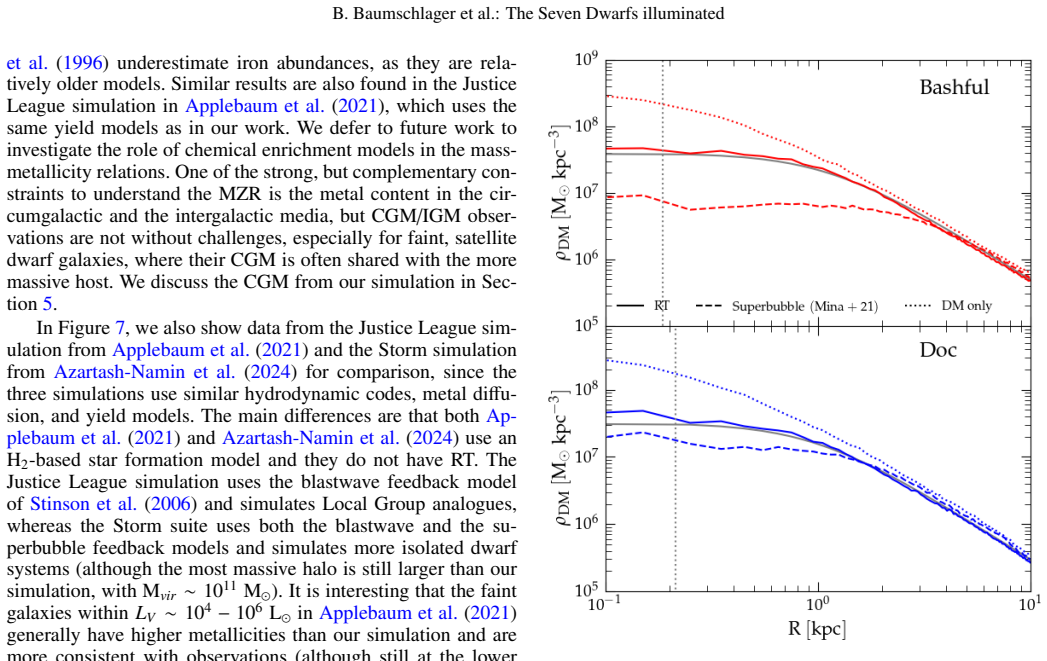
- Dark-matter core sizes are sensitive to radiative feedback, not just to supernova feedback; ignoring radiation can overproduce cored profiles by a factor of 2–3, so comparisons with cusp-core observations need RT-based models.
- The timing of reionisation in a local region becomes a measurable input: the star-formation histories of the faintest dwarfs—old populations quenched by z≈3–4—directly encode when the ionising background arrived.
- Synthetic CGM observations should use the simulation's actual radiation field: assuming a uniform UVB overpredicts the CIV column density by roughly 0.5 dex because escaping hard photons ionise CIV to higher states.
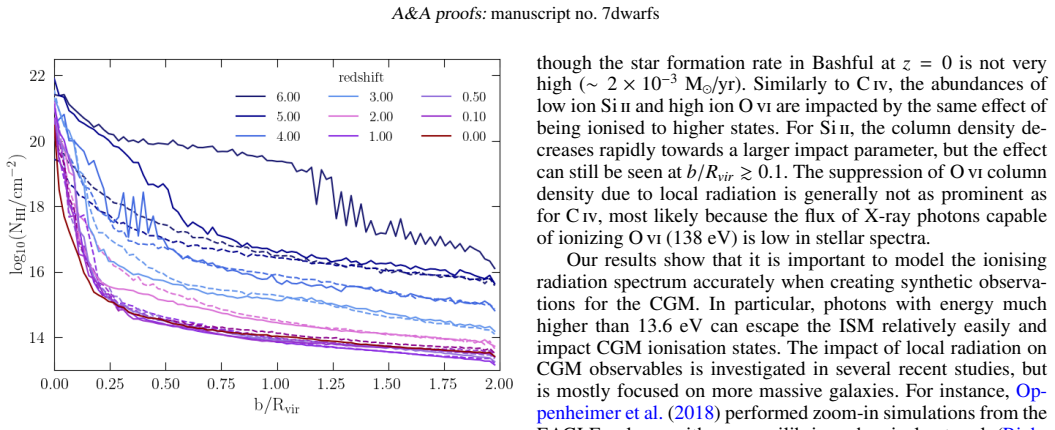
- Dwarf CGM HI is predicted to be nearly ubiquitous and feedback-insensitive at z=0, but far more abundant at z>5 in RT runs, giving a clear redshift-dependent signature for upcoming high-redshift CGM surveys.
Reading between the lines
- Editorial inference: the delayed-reionisation result depends on placing the UVB sources at the edge of a 25 cMpc box; a smaller box or a denser source configuration would reionise the zoom region earlier and likely erase the eight new dwarfs. A control run with an instantaneously uniform UVB is the natural falsification test.
- Editorial inference: if real ultra-faint dwarfs are reionisation relics, their scatter in star-formation histories and quenching redshifts could be used to map the inhomogeneity of reionisation on small scales, something the paper's mechanism makes plausible.
- Editorial inference: the finding that radiative feedback weakens cusp-core transformation suggests that the observed diversity of dwarf dark-matter cores may partly reflect differences in reionisation history and ISM preconditioning, not only feedback strength or dark-matter model.
- Editorial inference: the paper's CGM result can be extended to predict that low-ion absorbers (SiII, CII) around faint dwarfs should be confined to the ISM, while intermediate ions like CIV should be suppressed by local radiation—a pattern directly testable with stacked QSO absorption-line surveys.
Editorial analysis
A structured set of objections, weighed in public.
Referee Report
Summary. This paper presents a high-resolution cosmological zoom-in simulation of a group of field dwarf galaxies (the 'Seven Dwarfs', plus new satellites) run with on-the-fly radiative transfer (TREVR2 in Gasoline2) to z=0. The simulation uses the same initial conditions, resolution, and subgrid physics as the no-RT 'Superbubble' run of Mina et al. (2021), isolating the effect of radiation. The authors report: (i) formation of eight new quenched ultra-faint dwarf galaxies (qDGs) with M* ~ 1e4-1e5 Msun, mostly quenched by z~3-4; (ii) reduced star-formation burstiness and smaller DM core radii for the two most massive dwarfs (Bashful: 1.12 kpc, Doc: 0.97 kpc); (iii) ubiquitous HI in the CGM with covering fraction unity within Rvir; and (iv) systematically lower column densities of CIV, OVI, and SiII compared to the no-RT run, partly due to hard photons escaping the ISM. The paper compares its results to observed scaling relations (SMHM, mass-size, luminosity-velocity dispersion, luminosity-metallicity) and to CGM absorption surveys.
Significance. If the results are robust, this study would be a valuable demonstration that radiative transfer, including a finite-speed ionisation front, can dramatically alter the faint end of the galaxy population and the DM core properties of dwarfs, while also affecting CGM ionic abundances. The controlled comparison with identical ICs and physics is a clear strength, and the simulation evolves to z=0 with on-the-fly RT, which is rare. The paper is generally transparent about its assumptions. However, the headline new population of eight qDGs is explicitly attributed to the delayed propagation of the UVB from 128 background sources placed at the simulation box edge. Because this delay causes reionisation to complete only at z~3-4 in the zoom region, well after the standard epoch, the qDG population may be an artifact of the boundary treatment rather than a robust consequence of RT. This makes the central claim conditional on a modelling choice, and a sensitivity test with a different UVB source geometry is needed before the result can be accepted as general.
major comments (2)
- [§3.2, §3.3, Fig. 3, Footnote 1; Conclusions, first bullet] The formation of the eight qDGs (and of Dopey and Grumpy) is explicitly attributed to the time delay of the UVB ionisation front propagating from 128 background sources on the 12.5 cMpc box edge. Reionisation in the zoom region completes only at z~3-4, much later than the standard cosmic epoch (z~6). The paper is transparent about this (Footnote 1), but the qDG population is a headline result and it is entirely dependent on this box-edge artifact. In a realistic UVB (e.g., uniform HM12 background, or sources distributed throughout the volume), the smallest halos would be photoheated before they can collapse, and these galaxies likely would not form, as in the Superbubble run. To support the claim that 'the inclusion of RT results in the formation of eight additional faint dwarf galaxies', the authors need to run at least one control with a different UVB source distribution or otherwise d
- [§3.6, Fig. 8] The metallicity distribution function of the faint galaxies (Dopey, Grumpy, qDGs) peaks at [Fe/H] ~ -3.5, about 1 dex below the observed UFD composite MDF from Fu et al. (2023), which peaks near -2.5. The paper attributes this to outdated Fe yield tables, but this is a post hoc assumption. The claim in the abstract that these galaxies are 'similar to the observed Ultra-Faint Dwarf galaxies' is weakened by this offset, especially because the paper itself notes the average [Fe/H] values for the faintest galaxies fall below the observed luminosity-metallicity relation. The alternative comparison using Z/Z⊙ (star symbols in Fig. 7) is not directly comparable to the observed [Fe/H] data and could be misleading. The authors should either provide a quantitative test with updated yields or soften the 'similar to observed UFDs' language.
minor comments (5)
- [Affiliations] 'University of Menphis' should be 'University of Memphis'.
- [Table 2] The column headers use 'viral' instead of 'virial' for mass and radius.
- [§3.2] The notation Mv is used both for virial mass and V-band absolute magnitude; please disambiguate (e.g., M_vir and M_V) to avoid confusion.
- [§5.1] In the text, fHI is defined as the HI fraction, but it is not explicitly defined before first use in the paragraph beginning 'The CGM is generally highly ionised...' Please define it there.
- [§5.2] The sentence 'The distribution of moderately ionised CIV is also extended but is generally below the detection limit' repeats information already given in the preceding paragraph; consider condensing.
Circularity Check
No significant circularity; self-citations are method reuse and the benchmark comparisons are genuine predictions.
full rationale
This is a controlled comparison between three simulations with identical initial conditions and resolution, differing only in radiative transfer (and SN feedback in the earlier Blastwave run). The headline results—eight additional quenched ultra-faint dwarfs and smaller DM cores—are outputs of the simulation, not quantities fitted to the observations they are compared against. The observed scaling relations (SMHM, mass–size, luminosity–velocity dispersion, MZR, CGM covering fractions) are external benchmarks that could have disagreed; they are genuine predictions. The main caveat, that the UVB is injected at the box edge and reionization completes only at z~3–4, is explicitly acknowledged by the authors and is the stated reason the eight quenched dwarfs form (Sec. 3.1, footnote 1; Sec. 3.2; Sec. 6, first bullet). This is a modeling/robustness limitation, not a circular step: the delayed UVB is a physical consequence of the chosen source geometry, not a parameter tuned to produce UFDs, and the paper is transparent about it. Citations to Wadsley et al. (2024) for TREVR2 and Baumschlager et al. (2024) for the spectral reconstruction are method reuse by overlapping authors, but they are not invoked as a uniqueness theorem or as evidence for the astrophysical claims; the claims rest on the simulation outputs and external comparisons. No equation reduces to an input, and no fitted quantity is renamed as a prediction. The score of 1 reflects only the presence of minor self-citations, which are not load-bearing circularity.
Assumptions & free parameters
free parameters (3)
- Star formation efficiency epsilon_SF =
0.1
- Star formation density threshold n_H =
100 cm^-3
- UVB ramp window =
z = 16 to 15.2
assumptions (7)
- domain assumption Lambda-CDM cosmology with Omega_m=0.24, Omega_Lambda=0.76, h=0.73, sigma8=0.77
- domain assumption Kroupa IMF and Starburst99 SEDs with Padova tracks at solar metallicity
- domain assumption Superbubble SN feedback model (Keller et al. 2014)
- domain assumption Non-equilibrium primordial chemistry network (H, He only; no H2)
- domain assumption Metal cooling from CLOUDY tables assuming photoionisation equilibrium under a uniform UVB
- domain assumption UVB is emitted by background sources on a sphere at the box edge and propagates inward as a front
- domain assumption Infinite speed of light in TREVR2 (instantaneous RT)
Cite this review
Pith. "Pith review of The Seven Dwarfs illuminated. The impact of radiation on dwarf galaxies and their circumgalactic medium." pith.science (2026). https://pith.science/paper/JGKEPHJX
@misc{pith2026250819396,
  author       = {Pith},
  title        = {Pith review of: The Seven Dwarfs illuminated. The impact of radiation on dwarf galaxies and their circumgalactic medium},
  year         = {2026},
  howpublished = {\url{https://pith.science/paper/JGKEPHJX}},
  note         = {Machine review of arXiv:2508.19396}
}
abstract
We present a high-resolution cosmological zoom-in simulation of a group of field dwarf galaxies which includes on-the-fly radiative transfer (RT) and is evolved to $z=0$. Emission from stars is included according to age-dependent spectra, and a redshift-dependent UV background. The inclusion of RT results in the formation of eight additional faint dwarf galaxies with stellar masses of $10^{4}$ M$_{\odot}$ to several $10^{5}$ M$_{\odot}$ and only old stellar populations, similar to the observed Ultra-Faint Dwarf galaxies. They formed before and during cosmic reionisation and were mostly quenched by $z \sim 3-4$. The simulated galaxies follow many observed scaling relations such as the stellar mass-halo mass relation, the mass-size relation, and the luminosity-velocity dispersion relation. For the more massive dwarf galaxies, radiative feedback suppresses star formation, making it less bursty and reducing explosive outflows. This consequently reduces the dark matter core sizes by a factor of 2-3, rendering the core sizes ($\sim$ 1 kpc) more consistent with observations. The distribution of HI in the circumgalactic medium (CGM) is ubiquitous with a covering fraction of unity within $R_{vir}$, in good agreement with observations. It is rather insensitive to radiative or SN feedback at $z=0$, but at $z>5$ it is much higher in the RT simulation. In contrast, the distribution of low ions like SiII is very compact and declines sharply beyond the ISM scale. CIV and OVI have a more extended distribution, but their column densities are generally below the detection limit. Radiative feedback leads to smaller column densities of the metal ions, partly due to the reduction of total metal production, and partly because hard photons from the stellar radiation escape the ISM and further ionise the CGM. The abundance of CIV is particularly sensitive to the latter effect.
Figures


Figures from the paper (13 more)





Reference graph
Works this paper leans on
-
[1]
& Kravtsov, A
Agertz, O. & Kravtsov, A. V . 2015, ApJ, 804, 18
2015
-
[2]
I., et al
Agertz, O., Pontzen, A., Read, J. I., et al. 2020, MNRAS, 491, 1656
2020
-
[3]
2019, arXiv e-prints, arXiv:1902.05569
Akeson, R., Armus, L., Bachelet, E., et al. 2019, arXiv e-prints, arXiv:1902.05569
arXiv 2019
-
[4]
M., Christensen, C
Applebaum, E., Brooks, A. M., Christensen, C. R., et al. 2021, ApJ, 906, 96 Arjona-Gálvez, E., Di Cintio, A., & Grand, R. J. J. 2024, A&A, 690, A286
2021
-
[5]
J., & Scott, P
Asplund, M., Grevesse, N., Sauval, A. J., & Scott, P. 2009, Annual Review of Astronomy and Astrophysics, 47, 481
2009
-
[6]
2024, ApJ, 970, 40
Azartash-Namin, B., Engelhardt, A., Munshi, F., et al. 2024, ApJ, 970, 40
2024
-
[7]
Baumschlager, B., Shen, S., & Wadsley, J. W. 2024, A&A, 691, A219
2024
-
[8]
S., Wechsler, R
Behroozi, P. S., Wechsler, R. H., & Conroy, C. 2013, ApJ, 770, 57
2013
Show all 146 references
-
[9]
K., et al
Bordoloi, R., Tumlinson, J., Werk, J. K., et al. 2014, ApJ, 796, 136
2014
-
[10]
2023, MNRAS, 525, 5932
Borrow, J., Kannan, R., Garaldi, E., et al. 2023, MNRAS, 525, 5932
2023
-
[11]
S., Jenkins, A., et al
Bose, S., Frenk, C. S., Jenkins, A., et al. 2019, MNRAS, 486, 4790
2019
-
[12]
S., & Kaplinghat, M
Boylan-Kolchin, M., Bullock, J. S., & Kaplinghat, M. 2011, MNRAS, 415, L40
2011
-
[13]
S., & Kaplinghat, M
Boylan-Kolchin, M., Bullock, J. S., & Kaplinghat, M. 2012, MNRAS, 422, 1203
2012
-
[14]
B., Di Cintio, A., Knebe, A., et al
Brook, C. B., Di Cintio, A., Knebe, A., et al. 2014, ApJ, 784, L14
2014
-
[15]
B., Governato, F., Roškar, R., et al
Brook, C. B., Governato, F., Roškar, R., et al. 2011, MNRAS, 415, 1051
2011
-
[16]
Brooks, A. M. & Zolotov, A. 2014, ApJ, 786, 87
2014
-
[17]
M., Tumlinson, J., Geha, M., et al
Brown, T. M., Tumlinson, J., Geha, M., et al. 2014, ApJ, 796, 91
2014
-
[18]
S., Kravtsov, A
Bullock, J. S., Kravtsov, A. V ., & Weinberg, D. H. 2000, ApJ, 539, 517
2000
-
[19]
N., Tripp, T
Burchett, J. N., Tripp, T. M., Bordoloi, R., et al. 2016, ApJ, 832, 124
2016
-
[20]
2015, ApJ, 808, 158
Burkert, A. 2015, ApJ, 808, 158
2015
-
[21]
2012, MNRAS, 425, 3058 Corral van Damme, C., Prod’Homme, T., Isaak, K., Rühl, T., & Sirianni, M
Christensen, C., Quinn, T., Governato, F., et al. 2012, MNRAS, 425, 3058 Corral van Damme, C., Prod’Homme, T., Isaak, K., Rühl, T., & Sirianni, M. 2024, in Society of Photo-Optical Instrumentation Engineers (SPIE) Confer- ence Series, V ol. 13092, Space Telescopes and Instrume...
2012
-
[22]
2024, A&A, 685, A8
Decataldo, D., Shen, S., Mayer, L., Baumschlager, B., & Madau, P. 2024, A&A, 685, A8
2024
-
[23]
2024, arXiv e-prints, arXiv:2405.08869
Deng, Y ., Li, H., Liu, B., et al. 2024, arXiv e-prints, arXiv:2405.08869
2024 arXiv
-
[24]
J., & Weinberg, D
Dijkstra, M., Haiman, Z., Rees, M. J., & Weinberg, D. H. 2004, ApJ, 601, 666
2004
-
[25]
2009, MNRAS, 397, 1169
Donato, F., Gentile, G., Salucci, P., et al. 2009, MNRAS, 397, 1169
2009
-
[26]
1992, MNRAS, 256, 43P
Efstathiou, G. 1992, MNRAS, 256, 43P
1992
-
[27]
C., Kim, C.-G., Quataert, E., & Weisz, D
El-Badry, K., Ostriker, E. C., Kim, C.-G., Quataert, E., & Weisz, D. R. 2019, MNRAS, 490, 1961
2019
-
[28]
L., & Mac Low, M.-M
Emerick, A., Bryan, G. L., & Mac Low, M.-M. 2018, ApJ, 865, L22 Euclid Collaboration, Mellier, Y ., Abdurro’uf, et al. 2024, arXiv e-prints, arXiv:2405.13491
2018
-
[29]
Fabian, A. C. 2012, ARA&A, 50, 455
2012
-
[30]
J., Chatzikos, M., Guzmán, F., et al
Ferland, G. J., Chatzikos, M., Guzmán, F., et al. 2017, Rev. Mexicana Astron. Astrofis., 53, 385
2017
-
[31]
2019, MNRAS, 490, 962
Fitts, A., Boylan-Kolchin, M., Bozek, B., et al. 2019, MNRAS, 490, 962
2019
-
[32]
D., et al
Fitts, A., Boylan-Kolchin, M., Elbert, O. D., et al. 2017, MNRAS, 471, 3547
2017
-
[33]
Flores, R. A. & Primack, J. R. 1994, ApJ, 427, L1
1994
-
[34]
W., Weisz, D
Fu, S. W., Weisz, D. R., Starkenburg, E., et al. 2023, ApJ, 958, 167
2023
-
[35]
S., & Lee, K
Garrison-Kimmel, S., Boylan-Kolchin, M., Bullock, J. S., & Lee, K. 2014, MN- RAS, 438, 2578
2014
-
[36]
Gnedin, N. Y . 2014, ApJ, 793, 29
2014
-
[37]
Gnedin, N. Y . & Hollon, N. 2012, ApJS, 202, 13 Górski, K. M., Hivon, E., Banday, A. J., et al. 2005, ApJ, 622, 759
2012
-
[38]
2010, Nature, 463, 203
Governato, F., Brook, C., Mayer, L., et al. 2010, Nature, 463, 203
2010
-
[39]
2015, MNRAS, 448, 792
Governato, F., Weisz, D., Pontzen, A., et al. 2015, MNRAS, 448, 792
2015
-
[40]
2012, MNRAS, 422, 1231
Governato, F., Zolotov, A., Pontzen, A., et al. 2012, MNRAS, 422, 1231
2012
-
[41]
J., Woods, R
Grond, J. J., Woods, R. M., Wadsley, J. W., & Couchman, H. M. P. 2019, MN- RAS, 485, 3681
2019
-
[42]
A., Pakmor, R., Naab, T., & Springel, V
Gutcke, T. A., Pakmor, R., Naab, T., & Springel, V . 2021, MNRAS, 501, 5597
2021
-
[43]
& Madau, P
Haardt, F. & Madau, P. 2012, ApJ, 746, 125
2012
-
[44]
C., Ma, X., Anglés-Alcázar, D., & Cochrane, R
Holguin, F., Hayward, C. C., Ma, X., Anglés-Alcázar, D., & Cochrane, R. K. 2024, arXiv e-prints, arXiv:2405.13110
2024 arXiv
-
[45]
F., Grudi´c, M
Hopkins, P. F., Grudi´c, M. Y ., Wetzel, A., et al. 2020, MNRAS, 491, 3702
2020
-
[46]
F., Wetzel, A., Wheeler, C., et al
Hopkins, P. F., Wetzel, A., Wheeler, C., et al. 2023, MNRAS, 519, 3154
2023
-
[47]
Hu, C.-Y ., Naab, T., Walch, S., Glover, S. C. O., & Clark, P. C. 2016, MNRAS, 458, 3528
2016
-
[48]
C., Teyssier, R., et al
Hu, C.-Y ., Smith, M. C., Teyssier, R., et al. 2023, ApJ, 950, 132 Ivezi´c, Ž., Kahn, S. M., Tyson, J. A., et al. 2019, ApJ, 873, 111
2023
-
[49]
2017, ApJ, 848, 85
Jeon, M., Besla, G., & Bromm, V . 2017, ApJ, 848, 85
2017
-
[50]
2018, MNRAS, 473, 2060
Jethwa, P., Erkal, D., & Belokurov, V . 2018, MNRAS, 473, 2060
2018
-
[51]
D., Chen, H.-W., Mulchaey, J
Johnson, S. D., Chen, H.-W., Mulchaey, J. S., Schaye, J., & Straka, L. A. 2017, ApJ, 850, L10
2017
-
[52]
2022, MNRAS, 511, 4005
Kannan, R., Garaldi, E., Smith, A., et al. 2022, MNRAS, 511, 4005
2022
-
[53]
Karukes, E. V . & Salucci, P. 2017, MNRAS, 465, 4703
2017
-
[54]
2022, MNRAS, 512, 348
Katz, H. 2022, MNRAS, 512, 348
2022
-
[55]
2020, MNRAS, 494, 2200
Katz, H., Ramsoy, M., Rosdahl, J., et al. 2020, MNRAS, 494, 2200
2020
-
[56]
W., Wadsley, J., Benincasa, S
Keller, B. W., Wadsley, J., Benincasa, S. M., & Couchman, H. M. P. 2014, MN- RAS, 442, 3013
2014
-
[57]
& Ostriker, E
Kim, C.-G. & Ostriker, E. C. 2017, ApJ, 846, 133
2017
-
[58]
& Cen, R
Kimm, T. & Cen, R. 2014, ApJ, 788, 121
2014
-
[59]
N., Cohen, J
Kirby, E. N., Cohen, J. G., Guhathakurta, P., et al. 2013, ApJ, 779, 102
2013
-
[60]
N., Lanfranchi, G
Kirby, E. N., Lanfranchi, G. A., Simon, J. D., Cohen, J. G., & Guhathakurta, P. 2011, ApJ, 727, 78
2011
-
[61]
V ., Valenzuela, O., & Prada, F
Klypin, A., Kravtsov, A. V ., Valenzuela, O., & Prada, F. 1999, ApJ, 522, 82
1999
-
[62]
A., & Sijacki, D
Koudmani, S., Henden, N. A., & Sijacki, D. 2021, MNRAS, 503, 3568
2021
-
[63]
2001, MNRAS, 322, 231
Kroupa, P. 2001, MNRAS, 322, 231
2001
-
[64]
2014, ApJS, 212, 14
Leitherer, C., Ekström, S., Meynet, G., et al. 2014, ApJS, 212, 14
2014
-
[65]
& Nomoto, K
Leung, S.-C. & Nomoto, K. 2018, ApJ, 861, 143
2018
-
[66]
2021, MNRAS, 500, 1038
Li, F., Rahman, M., Murray, N., et al. 2021, MNRAS, 500, 1038
2021
-
[67]
Liang, C. J. & Chen, H.-W. 2014, MNRAS, 445, 2061 Macciò, A. V ., Frings, J., Buck, T., et al. 2017, MNRAS, 472, 2356
2014
-
[68]
2008, ApJ, 689, L41
Madau, P., Kuhlen, M., Diemand, J., et al. 2008, ApJ, 689, L41
2008
-
[69]
2014, ApJ, 789, L17 Article number, page 20 of 21 B
Madau, P., Shen, S., & Governato, F. 2014, ApJ, 789, L17 Article number, page 20 of 21 B. Baumschlager et al.: The Seven Dwarfs illuminated
2014
-
[70]
R., Cuillandre, J
Marleau, F. R., Cuillandre, J. C., Cantiello, M., et al. 2024, arXiv e-prints, arXiv:2405.13502
2024
-
[71]
G., et al
Martin-Alvarez, S., Sijacki, D., Haehnelt, M. G., et al. 2023, MNRAS, 525, 3806
2023
-
[72]
Mashchenko, S., Wadsley, J., & Couchman, H. M. P. 2008, Science, 319, 174
2008
-
[73]
McConnachie, A. W. 2012, AJ, 144, 4
2012
-
[74]
McQuinn, K. B. W., B. Newman, M. J., Savino, A., et al. 2024, ApJ, 961, 16
2024
-
[75]
F., & Winther, H
Mina, M., Mota, D. F., & Winther, H. A. 2020, arXiv e-prints, arXiv:2007.04119
2020 arXiv
-
[76]
W., et al
Mina, M., Shen, S., Keller, B. W., et al. 2021, A&A, 655, A22
2021
-
[77]
D., Rudie, G
Mishra, N., Johnson, S. D., Rudie, G. C., et al. 2024, ApJ, 976, 149
2024
-
[78]
1999, ApJ, 524, L19
Moore, B., Ghigna, S., Governato, F., et al. 1999, ApJ, 524, L19
1999
-
[79]
P., Naab, T., & White, S
Moster, B. P., Naab, T., & White, S. D. M. 2013, MNRAS, 428, 3121
2013
-
[80]
C., et al
Mostow, O., Torrey, P., Rose, J. C., et al. 2024, arXiv e-prints, arXiv:2412.09566
2024
-
[81]
I., et al
Muni, C., Pontzen, A., Read, J. I., et al. 2025, MNRAS, 536, 314
2025
-
[82]
M., Applebaum, E., et al
Munshi, F., Brooks, A. M., Applebaum, E., et al. 2021, ApJ, 923, 35
2021
-
[83]
M., Christensen, C., et al
Munshi, F., Brooks, A. M., Christensen, C., et al. 2019, ApJ, 874, 40
2019
-
[84]
O., Wechsler, R
Nadler, E. O., Wechsler, R. H., Bechtol, K., et al. 2020, ApJ, 893, 48
2020
-
[85]
F., Eke, V
Navarro, J. F., Eke, V . R., & Frenk, C. S. 1996, MNRAS, 283, L72
1996
-
[86]
2020, MNRAS, 498, 2391
Nelson, D., Sharma, P., Pillepich, A., et al. 2020, MNRAS, 498, 2391
2020
-
[87]
Nori, M., Bhatia, S., & Macciò, A. V . 2024, arXiv e-prints, arXiv:2411.09733 Oñorbe, J., Boylan-Kolchin, M., Bullock, J. S., et al. 2015, MNRAS, 454, 2092
2024 arXiv
-
[88]
V ., & Buck, T
Obreja, A., Arrigoni Battaia, F., Macciò, A. V ., & Buck, T. 2024, MNRAS, 527, 8078
2024
-
[89]
D., Segers, M., Schaye, J., Richings, A
Oppenheimer, B. D., Segers, M., Schaye, J., Richings, A. J., & Crain, R. A. 2018, MNRAS, 474, 4740
2018
-
[90]
Orkney, M. D. A., Read, J. I., Rey, M. P., et al. 2021, MNRAS, 504, 3509
2021
-
[91]
G., Izotov, Y
Papaderos, P., Guseva, N. G., Izotov, Y . I., & Fricke, K. J. 2008, A&A, 491, 113 Peñarrubia, J., Pontzen, A., Walker, M. G., & Koposov, S. E. 2012, ApJ, 759, L42
2008
-
[92]
2017, MNRAS, 466, 3293
Peters, T., Naab, T., Walch, S., et al. 2017, MNRAS, 466, 3293
2017
-
[93]
R., Brooks, A
Piacitelli, D. R., Brooks, A. M., Christensen, C., et al. 2025, arXiv e-prints, arXiv:2505.08861
2025
-
[94]
2016, ApJS, 225, 24
Pignatari, M., Herwig, F., Hirschi, R., et al. 2016, ApJS, 225, 24
2016
-
[95]
& Governato, F
Pontzen, A. & Governato, F. 2012, MNRAS, 421, 3464
2012
-
[96]
F., Jenkins, A., et al
Power, C., Navarro, J. F., Jenkins, A., et al. 2003, MNRAS, 338, 14
2003
-
[97]
X., Weiner, B., Chen, H
Prochaska, J. X., Weiner, B., Chen, H. W., Mulchaey, J., & Cooksey, K. 2011, ApJ, 740, 91
2011
-
[98]
X., Werk, J
Prochaska, J. X., Werk, J. K., Worseck, G., et al. 2017, ApJ, 837, 169
2017
-
[99]
E., Zheng, Y ., Price-Whelan, A
Putman, M. E., Zheng, Y ., Price-Whelan, A. M., et al. 2021, ApJ, 913, 53
2021
-
[100]
M., Villata, M., & Navarro, J
Raiteri, C. M., Villata, M., & Navarro, J. F. 1996, A&A, 315, 105
1996
-
[101]
Read, J. I. & Erkal, D. 2019, MNRAS, 487, 5799
2019
-
[102]
Read, J. I. & Gilmore, G. 2005, MNRAS, 356, 107
2005
-
[103]
I., Iorio, G., Agertz, O., & Fraternali, F
Read, J. I., Iorio, G., Agertz, O., & Fraternali, F. 2017, MNRAS, 467, 2019
2017
-
[104]
I., Walker, M
Read, J. I., Walker, M. G., & Steger, P. 2019, MNRAS, 484, 1401
2019
-
[105]
& Jablonka, P
Revaz, Y . & Jablonka, P. 2018, A&A, 616, A96
2018
-
[106]
P., Taylor, E., Gray, E
Rey, M. P., Taylor, E., Gray, E. I., et al. 2025, MNRAS, 541, 1195
2025
-
[107]
J., Schaye, J., & Oppenheimer, B
Richings, A. J., Schaye, J., & Oppenheimer, B. D. 2014, MNRAS, 440, 3349
2014
-
[108]
D., et al
Richstein, H., Kallivayalil, N., Simon, J. D., et al. 2024, ApJ, 967, 72
2024
-
[109]
2018, MNRAS, 479, 994
Rosdahl, J., Katz, H., Blaizot, J., et al. 2018, MNRAS, 479, 994
2018
-
[110]
2015, MNRAS, 451, 34
Rosdahl, J., Schaye, J., Teyssier, R., & Agertz, O. 2015, MNRAS, 451, 34
2015
-
[111]
2019, A&A Rev., 27, 2
Salucci, P. 2019, A&A Rev., 27, 2
2019
-
[112]
I., Walker, M
Salucci, P., Wilkinson, M. I., Walker, M. G., et al. 2012, MNRAS, 420, 2034
2012
-
[113]
M., Di Cintio, A., Brook, C
Santos-Santos, I. M., Di Cintio, A., Brook, C. B., et al. 2018, MNRAS, 473, 4392
2018
-
[114]
S., Fattahi, A., et al
Sawala, T., Frenk, C. S., Fattahi, A., et al. 2016, MNRAS, 457, 1931
2016
-
[115]
H., et al
Scannapieco, C., Wadepuhl, M., Parry, O. H., et al. 2012, MNRAS, 423, 1726
2012
-
[116]
A., Bower, R
Schaye, J., Crain, R. A., Bower, R. G., et al. 2015, MNRAS, 446, 521
2015
-
[117]
1959, ApJ, 129, 243
Schmidt, M. 1959, ApJ, 129, 243
1959
-
[118]
Sellwood, J. A. & McGaugh, S. S. 2005, ApJ, 634, 70
2005
-
[119]
S., Brooks, A
Sharma, R. S., Brooks, A. M., Tremmel, M., Bellovary, J., & Quinn, T. R. 2023, ApJ, 957, 16
2023
-
[120]
2012, ApJ, 760, 50
Shen, S., Madau, P., Aguirre, A., et al. 2012, ApJ, 760, 50
2012
-
[121]
2014, ApJ, 792, 99
Shen, S., Madau, P., Conroy, C., Governato, F., & Mayer, L. 2014, ApJ, 792, 99
2014
-
[122]
2013, ApJ, 765, 89
Shen, S., Madau, P., Guedes, J., et al. 2013, ApJ, 765, 89
2013
-
[123]
2010, MNRAS, 407, 1581
Shen, S., Wadsley, J., & Stinson, G. 2010, MNRAS, 407, 1581
2010
-
[124]
F., Necib, L., et al
Shen, X., Hopkins, P. F., Necib, L., et al. 2024, ApJ, 966, 131
2024
-
[125]
Simon, J. D. 2019, ARA&A, 57, 375
2019
-
[126]
C., Sijacki, D., & Shen, S
Smith, M. C., Sijacki, D., & Shen, S. 2018, MNRAS, 478, 302
2018
-
[127]
C., Sijacki, D., & Shen, S
Smith, M. C., Sijacki, D., & Shen, S. 2019, MNRAS, 485, 3317
2019
-
[128]
2006, MNRAS, 373, 1074
Stinson, G., Seth, A., Katz, N., et al. 2006, MNRAS, 373, 1074
2006
-
[129]
R., et al
Strawn, C., Roca-Fàbrega, S., Primack, J. R., et al. 2024, ApJ, 962, 29
2024
-
[130]
2009, ARA&A, 47, 371
Tolstoy, E., Hill, V ., & Tosi, M. 2009, ARA&A, 47, 371
2009
-
[131]
A., Ferland, G
Verner, D. A., Ferland, G. J., Korista, K. T., & Yakovlev, D. G. 1996, ApJ, 465, 487 V ogelsberger, M., Zavala, J., Simpson, C., & Jenkins, A. 2014, MNRAS, 444, 3684
1996
-
[132]
W., Baumschlager, B., & Shen, S
Wadsley, J. W., Baumschlager, B., & Shen, S. 2024, MNRAS, 528, 3767
2024
-
[133]
W., Keller, B
Wadsley, J. W., Keller, B. W., & Quinn, T. R. 2017, MNRAS, 471, 2357
2017
-
[134]
& Naab, T
Walch, S. & Naab, T. 2015, MNRAS, 451, 2757
2015
-
[135]
R., Dolphin, A
Weisz, D. R., Dolphin, A. E., Skillman, E. D., et al. 2014, ApJ, 789, 147
2014
-
[136]
K., Prochaska, J
Werk, J. K., Prochaska, J. X., Thom, C., et al. 2013, ApJS, 204, 17
2013
-
[137]
R., Hopkins, P
Wetzel, A. R., Hopkins, P. F., Kim, J.-h., et al. 2016, ApJ, 827, L23
2016
-
[138]
F., Pace, A
Wheeler, C., Hopkins, P. F., Pace, A. B., et al. 2019, MNRAS, 490, 4447
2019
-
[139]
S., et al
Wheeler, C., Oñorbe, J., Bullock, J. S., et al. 2015, MNRAS, 453, 1305
2015
-
[140]
M., Gawiser, E., & Prochaska, J
Wolfe, A. M., Gawiser, E., & Prochaska, J. X. 2005, ARA&A, 43, 861
2005
-
[141]
C., Brooks, A
Wright, A. C., Brooks, A. M., Weisz, D. R., & Christensen, C. R. 2019, MNRAS, 482, 1176
2019
-
[142]
V ., Marinacci, F., et al
Zhang, E., Sales, L. V ., Marinacci, F., et al. 2024, arXiv e-prints, arXiv:2406.10338
2024 arXiv
-
[143]
E., et al
Zheng, Y ., Emerick, A., Putman, M. E., et al. 2020, ApJ, 905, 133
2020
-
[144]
D., et al
Zheng, Y ., Faerman, Y ., Oppenheimer, B. D., et al. 2024, ApJ, 960, 55
2024
-
[145]
& Springel, V
Zhu, B. & Springel, V . 2024, MNRAS, 533, 4360
2024
-
[146]
M., Willman, B., et al
Zolotov, A., Brooks, A. M., Willman, B., et al. 2012, ApJ, 761, 71 Article number, page 21 of 21
2012
Reviewed August 5, 2026 · model on record in the stance chip above.
Discussion (0). Sign in to comment.